

- Industry Size (2026)
- USD 784.8 Mn
- Forecast (2036)
- USD 1109.4 Mn
- CAGR (2026 to 2036)
- 3.5%
Demand for Dried Spent Grain in Japan Forecast and Outlook 2026 to 2036
The demand for dried spent grain in Japan is valued at USD 784.8 million in 2026 and is projected to reach USD 1,109.4 million by 2036, reflecting a CAGR of 3.5%. Growth from 2020 to 2026 shows an increase from USD 637.5 million to USD 784.8 million, shaped by stable use across food, beverage, and bakery applications. Organic variants hold the larger share, supported by interest in fiber rich ingredients and reformulated products. Wheat remains the leading source, followed by rice and barley in diversified processing streams across Japan.
From 2027 onward, values progress from USD 812.5 million to USD 933.2 million by 2031, then advance to USD 1,109.4 million by 2036 through consistent annual gains. Bakery and confectionery producers maintain regular intake as spent grain supports texture and nutritional fortification. Dairy and health drink applications show measured growth linked to product innovation. Sorghum and millet based sources add niche but stable contributions. Long term expansion reflects wider integration of upcycled ingredients and steady production from brewing and grain processing facilities. Demand remains closely tied to formulation cycles and routine output across Japan’s food manufacturing sectors.
Quick Stats of the Demand for Dried Spent Grain in Japan
- Demand for Dried Spent Grain in Japan Value (2026): USD 784.8 million
- Demand for Dried Spent Grain in Japan Forecast Value (2036): USD 1,109.4 million
- Demand for Dried Spent Grain in Japan Forecast CAGR (2026-2036): 3.5%
- Demand for Dried Spent Grain in Japan Leading Nature: Organic (60%)
- Demand for Dried Spent Grain in Japan Key Growth Regions: Kyushu & Okinawa, Kanto, Kansai
- Demand for Dried Spent Grain in Japan Top Players: EverGrain Ingredients, Malteurop Group, Grain Processing Corporation

What is the Growth Forecast for Dried Spent Grain in Japan through 2036?
Between 2026 and 2031, demand for dried spent grain in Japan rises from USD 784.8 million to USD 901.4 million, reflecting a gain of USD 116.6 million across five years. Growth in this period is shaped by feed industry procurement, expanding use in mixed rations, and stable livestock population trends. Earlier demand was influenced by brewery byproduct availability and steady adoption in cost-sensitive feed formulations. Near term progression reflects growing interest in fiber enriched feed blends, controlled inclusion rates in dairy and beef operations, and greater consistency in supply from domestic breweries with structured byproduct collection systems.
From 2031 to 2036, demand increases from USD 901.4 million to USD 1,109.4 million, adding USD 208.0 million over the latter half of the outlook. Growth accelerates as dried spent grain gains wider application in functional feed components, standardized pelletized formulations, and diversified livestock sectors. Earlier expansion relied on conventional use in bulk rations, while later growth reflects rising reliance on high-volume feed manufacturing, greater emphasis on digestibility metrics, and more uniform drying and processing operations. Expansion in regional feed mills, improved logistics coordination, and growing alignment between breweries and integrated feed producers support long term stability across Japan’s feed supply chain.
Dried Spent Grain Industry in Japan Key Takeaways
| Metric | Value |
|---|---|
| Industry Value (2026) | USD 784.8 million |
| Forecast Value (2036) | USD 1,109.4 million |
| Forecast CAGR (2026-2036) | 3.5% |
What Is Driving the Demand for Dried Spent Grain in Japan from 2026 to 2036?
Demand for dried spent grain in Japan has grown as breweries and distilleries seek cost-effective, nutrient-rich uses for this by-product of beer production. After brewing, the remaining grain is rich in protein and fiber but perishable unless dried for transport and storage. Drying enables its use in livestock feed, particularly for cattle, poultry and swine, where producers look for economical feed components with high nutritional content. The brewing industry supplies a reliable source of raw material, and partnerships with feed processors support supply chain continuity. Adoption in animal feed reflects established livestock and poultry sectors seeking sustainable, lower-cost alternatives to conventional feed ingredients.
From 2026 to 2036 demand in Japan is anticipated to expand across animal nutrition and emerging sustainability-linked sectors. Growth of craft and premium breweries increases availability of spent grain for commercial drying operations, making larger-scale feed supply feasible. Beyond traditional livestock feed, food manufacturers explore dried spent grain as a functional ingredient in high-fiber foods, plant-based products and nutritional formulations where clean-label, sustainable inputs appeal to evolving consumer preferences. Interest in organic fertiliser and compost further broadens applications. Expansion depends on investments in efficient drying, storage and packaging technologies to extend shelf life and facilitate distribution nationwide.
What Is the Demand for Dried Spent Grain in Japan by Nature and Source for 2026 to 2036?
The demand for dried spent grain in Japan from 2026 to 2036 is shaped by growth in craft brewing, expansion of dairy and livestock feed processing, and increased interest in fiber-rich ingredients across food manufacturing. Organic products lead by nature due to expanding procurement from breweries supplying certified feedstock and rising preference for traceable agricultural inputs. Wheat represents the largest share by source as domestic breweries rely heavily on wheat-based mash profiles. Procurement is driven by feed mills, ingredient blenders, and food producers incorporating cereal by-products. Import reliance remains limited since sourcing aligns closely with domestic brewing output. Substitution pressure exists from conventional cereal bran and oilseed cakes.
Why does organic dried spent grain account for 60% of the demand in Japan by nature from 2026 to 2036?

Organic dried spent grain accounts for 60% of the demand in Japan by nature due to steady adoption among livestock feed buyers seeking traceable material with consistent nutrient values. Consumption intensity is driven by poultry and dairy operations where organic feed components support certification programs. Usage remains stable because breweries with organic labeling generate predictable supply streams from controlled grain batches. Procurement is led by feed processors and food ingredient formulators who value low residues and uniform composition. Price sensitivity remains moderate because organic classification commands higher willingness to pay. Organic spent grain maintains stable repeat demand through 2026 to 2036 as brewing volumes expand and processors strengthen supply agreements with breweries. Repeat utilization remains predictable due to its role as a fiber and protein supplement. Buyers favor lots with verified organic documentation and reliable drying profiles. Margin structure stays steady under long-term supply contracts. Regulatory exposure centers on organic certification and residue compliance. Import reliance remains minimal because domestic breweries form the primary supply base.
Why does wheat represent 35.0% of the demand for dried spent grain in Japan by source?

Wheat represents 35.0% of the demand for dried spent grain in Japan by source because domestic breweries and food processors rely heavily on wheat-based mash formulations. Consumption intensity is driven by feed manufacturers using wheat-derived spent grain for balanced energy and fiber contributions in rations. Usage remains stable because wheat mash yields uniform residues with predictable drying behavior. Procurement is led by feed mixers and ingredient buyers who value the palatability and digestibility profile of wheat-derived material. Price sensitivity remains moderate because wheat spent grain competes favorably with barley and rice bran. Wheat-based spent grain maintains consistent demand across 2026 to 2036 due to continuous brewing cycles and stable wheat sourcing among beverage producers. Repeat utilization remains predictable as feed blends retain wheat residues for energy consistency. Buyers favor wheat-derived inputs for their compatibility with automated mixing lines and storage systems. Margin structure remains stable due to controlled production costs at brewery sites. Regulatory exposure remains tied to feed quality standards and handling norms. Import reliance stays low as local breweries provide most supply. Substitution pressure from barley or rice spent grain remains limited where wheat-based material aligns better with formulation needs.
What Is Driving the Demand for Dried Spent Grain in Japan Across Feed, Food Processing, and Circular Use Streams?
Demand for dried spent grain in Japan grows through the need to extract more value from brewery byproducts, reduce feed import exposure, and strengthen circular processing practices in urban manufacturing corridors. Breweries in Hokkaido, Kansai, and Kanto supply stable volumes that livestock operators convert into energy-dense feed for cattle and swine. Food processors blend dried grain into baked goods, snacks, and fiber-enriched products targeting health-conscious segments. Industrial users apply it in biomass pellets for heat generation. Demand rises through local byproduct utilization, feed substitution needs, and stable brewery output rather than short-lived sustainability themes or global waste narratives.
How Are Livestock Producers and Regional Feed Mills Shaping Dried Spent Grain Usage in Japan?
Livestock producers in Japan incorporate dried spent grain to offset high-priced corn and soybean imports, especially during currency fluctuations. Dairy farms in Hokkaido value its protein and fiber balance for rumen stability, while swine operations in Kyushu blend it into mixed rations for cost control. Regional feed mills standardize moisture and particle size to ensure predictable storage and mixing. Transport distance from breweries determines adoption feasibility, making local supply chains central to procurement decisions. Demand follows feed blending economics, stable protein availability, and predictable brewery output rather than experimental feed additives or broad livestock system overhauls.
Why Are Food and Beverage Manufacturers Increasing Trials with Dried Spent Grain in Japan?
Food manufacturers in Japan run trials incorporating dried spent grain into crackers, granola, noodles, and bakery lines as fiber-enhancing components. Its mild flavor and granular texture fit small inclusion rates that avoid reformulating core recipes extensively. Urban consumers show interest in traceable ingredients connected to domestic production. Processors near major breweries benefit from short transport distances that keep input consistency high. Shelf stability after drying allows controlled usage throughout the year. Demand develops from formulation practicality, reliable supply, and product diversification goals rather than promotional sustainability claims or attempts to build mass-market novelty.
What is the Demand for Dried Spent Grain in Japan by Region?

| Region | CAGR (%) |
|---|---|
| Kyushu & Okinawa | 4.4% |
| Kanto | 4.1% |
| Kansai | 3.6% |
| Chubu | 3.1% |
| Tohoku | 2.7% |
| Rest of Japan | 2.6% |
The demand for dried spent grain in Japan is rising steadily across feed, food ingredient, and bioresource applications, led by Kyushu and Okinawa at a 4.4% CAGR. Growth in this region is supported by active livestock farming, craft breweries, and expanding use of byproduct ingredients in regional feed mills. Kanto follows at 4.1%, driven by dense food manufacturing clusters, functional ingredient adoption, and growing brewery byproduct recovery systems. Kansai records 3.6% growth, reflecting stable use in mixed feed formulations and emerging interest from sustainable food producers. Chubu at 3.1% shows moderate uptake linked to dairy and livestock operations. Tohoku and the Rest of Japan, at 2.7% and 2.6%, reflect slower growth shaped by smaller farming bases, limited brewery concentration, and lower industrial ingredient utilization.
How Are Feed and Food Processing Uses Driving Dried Spent Grain Demand in Kyushu and Okinawa?
Demand for dried spent grain in Kyushu and Okinawa is rising at a CAGR of 4.4% from 2026 to 2036, supported by livestock feed operations, food ingredient production, and brewery byproduct utilization programs. Livestock producers use dried spent grain for cost stable nutrition and consistent protein levels. Food processors adopt it for fiber enrichment in selected applications. Breweries maintain steady output that supplies local feed and ingredient networks. Regional demand aligns with agricultural output, livestock population patterns, and processing plant activity, creating stable consumption levels across feed mills, mixed farms, and food producers using spent grain for functional formulation needs.
- Feed mills incorporate spent grain into rations
- Food processors use grain for fiber enhancement
- Breweries supply steady byproduct volumes
- Mixed farms maintain continuous demand
Why Are Dense Processing Networks Supporting Dried Spent Grain Use in Kanto?
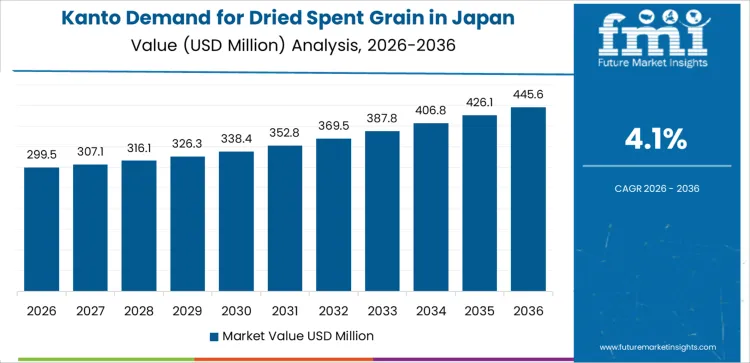
Demand for dried spent grain in Kanto is growing at a CAGR of 4.1% from 2026 to 2036, supported by extensive food processing clusters, beverage producers, and livestock feed distribution channels. Facilities adopt spent grain for formulation consistency and cost efficiency across feed blends and selected food applications. Breweries generate significant byproduct volumes that flow into established sourcing networks. Demand reflects structured procurement routines, predictable supply relationships, and continuous use in commercial feed operations. Kanto’s diverse food production landscape supports steady integration of dried spent grain where stable nutritional profiles and reliable availability align with regional manufacturing and agricultural requirements.
- Feed distributors rely on steady grain inputs
- Food plants use grain for targeted formulations
- Breweries maintain reliable byproduct streams
- Procurement schedules shape demand patterns
How Are Established Agricultural Practices Sustaining Demand in Kansai?
Demand for dried spent grain in Kansai is advancing at a CAGR of 3.6% from 2026 to 2036, supported by livestock farms, feed mixing centers, and food ingredient processors. Feed operators value dried spent grain for balanced energy and fiber content across cattle, dairy, and selected poultry rations. Food producers incorporate it into functional recipes requiring stable bulk and nutritional properties. Breweries maintain consistent byproduct output that aligns with feed formulation cycles. Regional demand reflects agricultural routines, moderate processing activity, and structured supply flows that support ongoing use of dried spent grain within diversified production systems.
- Livestock farms use grain in daily feeding
- Feed centers mix grain into blended rations
- Food processors adopt grain for functional uses
- Brewery volumes support steady supply
What Is Guiding Dried Spent Grain Consumption Across Chubu?
Demand for dried spent grain in Chubu is moving at a CAGR of 3.1% from 2026 to 2036, supported by livestock feed operations, dairy farms, and regional processing facilities. Dried spent grain is incorporated into feed mixes to improve fiber content and support cost management in ration formulation. Local breweries supply byproduct streams that align with procurement schedules. Demand levels reflect stable processing output and predictable livestock feeding patterns. Producers value dried spent grain as a functional ingredient that fits into existing feed strategies designed to balance nutrition, manage costs, and support operational consistency across agricultural and processing environments.
- Dairy farms use grain for ration balance
- Feed operators integrate grain into blends
- Breweries supply consistent volumes
- Stable feeding patterns sustain demand
How Are Agricultural Cycles Shaping Dried Spent Grain Use in Tohoku?
Demand for dried spent grain in Tohoku is increasing at a CAGR of 2.7% from 2026 to 2036, supported by mixed farming operations, regional feed mills, and selective food ingredient applications. Producers rely on dried spent grain for fiber rich feed blends aligned with livestock nutrition needs. Seasonal output patterns influence procurement timing, while local breweries maintain moderate byproduct availability. Food processors use dried spent grain in limited functional roles. Regional demand remains steady due to practical integration of spent grain into feeding strategies that support cost efficiency and consistent nutrient delivery across various livestock categories.
- Mixed farms incorporate grain into feed programs
- Feed mills blend grain for cost stability
- Breweries produce modest supply volumes
- Food processors adopt grain selectively
Which Factors Maintain Dried Spent Grain Demand Across Rest of Japan?
Demand for dried spent grain in Rest of Japan is advancing at a CAGR of 2.6% from 2026 to 2036, supported by small livestock farms, localized feed operations, and community level processors. Producers use dried spent grain to manage feed costs and supplement fiber content. Supply originates primarily from regional breweries with consistent production rhythms. Demand reflects structured feeding routines and stable livestock populations across dispersed farming areas. Smaller food processors adopt dried spent grain for basic formulation needs. Regional usage stays steady due to practical feeding requirements, predictable supply relationships, and continued integration of spent grain into daily agricultural operations.
- Small farms rely on grain for feed balance
- Local feed mixers use grain in daily blends
- Breweries provide steady byproduct supply
- Community processors incorporate grain as needed
What Is Driving the Demand for Dried Spent Grain in Japan and Which Companies Shape Food and Feed Supply?
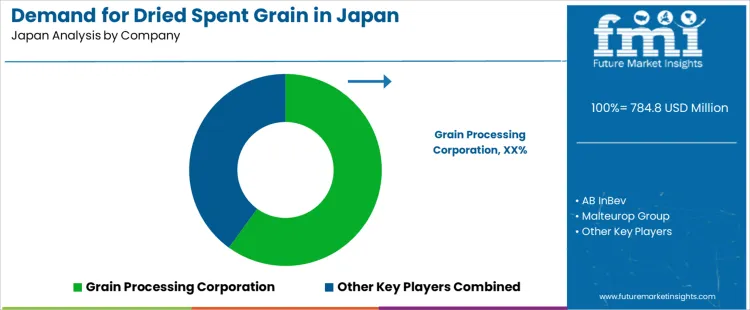
The demand for dried spent grain in Japan is shaped by interest in high protein fiber rich ingredients for food products and steady use in livestock feed. Domestic breweries supply much of the base material through integrated collection and drying programs linked to regional processors. EverGrain Ingredients participates through upcycled barley ingredients used in bakery snacks and plant based foods for health focused consumers. Malteurop Group influences availability through malt supply networks that feed into breweries and regional processors. Grain Processing Corporation supports demand through functional grain ingredients used by food manufacturers exploring new texture and nutrition formats.
Selection in Japan is governed by protein content, moisture stability, particle size, and odor control to ensure compatibility with food applications. Feed producers focus on amino acid balance and digestibility for dairy and beef operations. Food manufacturers favor consistent flavor, low microbial load, and reliable traceability from brewery to processor. Demand visibility tracks interest in sustainable ingredient sourcing, growth in high fiber snacks, expansion of craft brewing, and steady feed demand in livestock regions. Buyers include bakeries, snack processors, pet food makers, and regional feed mills.
Key Players in the Dried Spent Grain Indstry in Japan
- EverGrain Ingredients
- Malteurop Group
- Grain Processing Corporation
Scope of the Report
| Items | Values |
|---|---|
| Quantitative Units (2026) | USD million |
| Nature | Organic; Conventional |
| Source | Wheat; Rice; Barley; Sorghum; Millet |
| End Use | Food and Beverages; Bakery; Confectionery; Dairy Products; Health Drinks |
| Regions Covered | Kyushu & Okinawa; Kanto; Kansai; Chubu; Tohoku; Rest of Japan |
| Countries Covered | Japan |
| Key Companies Profiled | EverGrain Ingredients; Malteurop Group; Grain Processing Corporation |
| Additional Attributes | Dollar sales by nature and source; integration with feed mills and food ingredient networks; traceability requirements in organic supply chains; reliance on brewery byproduct streams; drying and storage specifications; compatibility with pelletized feed systems; formulation suitability for bakery and beverage applications; moisture stability and microbial control; domestic sourcing alignment with brewery concentration; distribution influenced by livestock density and regional food clusters. |
Dried Spent Grain Industry in Japan Segmentation
Nature:
- Organic
- Conventional
Source:
- Wheat
- Rice
- Barley
- Sorghum
- Millet
End-use:
- Food & Beverages
- Bakery
- Confectionery
- Dairy Products
- Health Drinks
Region:
- Kyushu & Okinawa
- Kanto
- Kansai
- Chubu
- Tohoku
- Rest of Japan
Frequently Asked Questions
How big is the demand for dried spent grain in Japan in 2026?
The demand for dried spent grain in Japan is estimated to be valued at USD 784.8 million in 2026.
What will be the size of dried spent grain in Japan in 2036?
The market size for the dried spent grain in Japan is projected to reach USD 1,109.4 million by 2036.
How much will be the demand for dried spent grain in Japan growth between 2026 and 2036?
The demand for dried spent grain in Japan is expected to grow at a 3.5% CAGR between 2026 and 2036.
What are the key product types in the dried spent grain in Japan?
The key product types in dried spent grain in Japan are organic and conventional.
Which source segment is expected to contribute significant share in the dried spent grain in Japan in 2026?
In terms of source, wheat segment is expected to command 35.0% share in the dried spent grain in Japan in 2026.
Preview the report firsthand - request a free sample
Get SampleGet the brochure for pricing and purchase details.
Get PDFTable of Content
- Executive Summary
- Japan Market Outlook
- Demand-side Trends
- Supply-side Trends
- Technology Roadmap Analysis
- Analysis and Recommendations
- Market Overview
- Market Coverage / Taxonomy
- Market Definition / Scope / Limitations
- Market Background
- Market Dynamics
- Drivers
- Restraints
- Opportunity
- Trends
- Scenario Forecast
- Demand in Optimistic Scenario
- Demand in Likely Scenario
- Demand in Conservative Scenario
- Opportunity Map Analysis
- Product Life Cycle Analysis
- Supply Chain Analysis
- Investment Feasibility Matrix
- Value Chain Analysis
- PESTLE and Porter’s Analysis
- Regulatory Landscape
- Regional Parent Market Outlook
- Production and Consumption Statistics
- Import and Export Statistics
- Market Dynamics
- Japan Market Analysis 2020 to 2024 and Forecast, 2025 to 2035
- Historical Market Size Value (USD Million) Analysis, 2020 to 2024
- Current and Future Market Size Value (USD Million) Projections, 2025 to 2035
- Y-o-Y Growth Trend Analysis
- Absolute $ Opportunity Analysis
- Japan Market Pricing Analysis 2020 to 2024 and Forecast 2025 to 2035
- Japan Market Analysis 2020 to 2024 and Forecast 2025 to 2035, By Nature
- Introduction / Key Findings
- Historical Market Size Value (USD Million) Analysis By Nature , 2020 to 2024
- Current and Future Market Size Value (USD Million) Analysis and Forecast By Nature , 2025 to 2035
- Organic
- Conventional
- Y-o-Y Growth Trend Analysis By Nature , 2020 to 2024
- Absolute $ Opportunity Analysis By Nature , 2025 to 2035
- Japan Market Analysis 2020 to 2024 and Forecast 2025 to 2035, By Source
- Introduction / Key Findings
- Historical Market Size Value (USD Million) Analysis By Source, 2020 to 2024
- Current and Future Market Size Value (USD Million) Analysis and Forecast By Source, 2025 to 2035
- Wheat
- Rice
- Barley
- Sorghum
- Millet
- Y-o-Y Growth Trend Analysis By Source, 2020 to 2024
- Absolute $ Opportunity Analysis By Source, 2025 to 2035
- Japan Market Analysis 2020 to 2024 and Forecast 2025 to 2035, By End-use
- Introduction / Key Findings
- Historical Market Size Value (USD Million) Analysis By End-use, 2020 to 2024
- Current and Future Market Size Value (USD Million) Analysis and Forecast By End-use, 2025 to 2035
- Food & Beverages
- Bakery
- Confectionery
- Dairy Products
- Health Drinks
- Y-o-Y Growth Trend Analysis By End-use, 2020 to 2024
- Absolute $ Opportunity Analysis By End-use, 2025 to 2035
- Market Structure Analysis
- Competition Dashboard
- Competition Benchmarking
- Market Share Analysis of Top Players
- By Regional
- By Nature
- By Source
- By End-use
- Competition Analysis
- Competition Deep Dive
- Grain Processing Corporation
- Overview
- Product Portfolio
- Profitability by Market Segments (Product/Age /Sales Channel/Region)
- Sales Footprint
- Strategy Overview
- Marketing Strategy
- Product Strategy
- Channel Strategy
- AB InBev
- Malteurop Group
- Brewers Grain Ltd.
- EverGrain Ingredients
- Grain Processing Corporation
- Competition Deep Dive
- Assumptions & Acronyms Used
- Research Methodology


