

- Industry Size (2026)
- USD 122.4 Mn
- Forecast (2036)
- USD 430.7 Mn
- CAGR (2026 to 2036)
- 13.4%
Spent Coffee Grounds Fiber Market Size, Market Forecast and Outlook By FMI
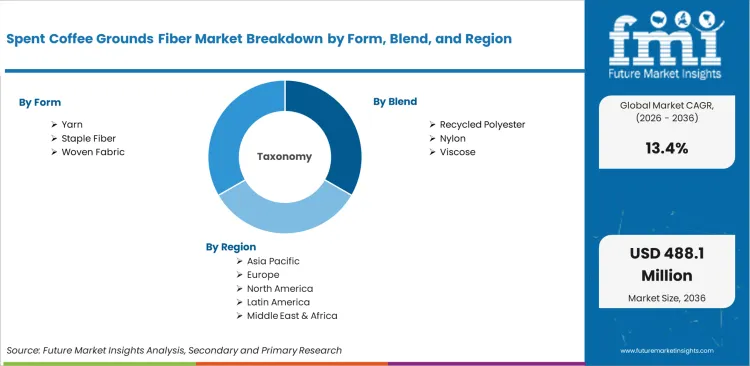
The spent coffee grounds fiber market stood at USD 107.9 million in 2025. Sector is poised to cross USD 122.4 million in 2026, and reach USD 430.7 million by 2036. Demand is poised to rise at a 13.4% CAGR over the forecast period, propelled by spinning mills optimizing composite particle suspension inside synthetic extrusion lines.
Summary of Spent Coffee Grounds Fiber Market
- The market is estimated at USD 122.4 million in 2026.
- The market is projected to reach USD 430.7 million by 2036.
- The market is expected to grow at a CAGR of 13.4% from 2026 to 2036.
- The forecast period represents an incremental opportunity of USD 308.3 million.
- Yarn leads the form segment with a 46.0% share.
- Recycled polyester dominates the blend segment with a 54.0% share.
- Apparel leads the application segment with a 58.0% share.
- Sportswear dominates the end use segment with a 41.0% share.
- B2B supply leads the channel segment with a 72.0% share.
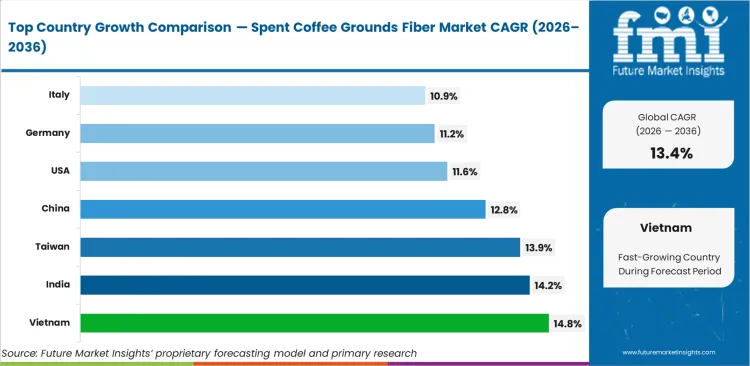
- Vietnam (14.8%), India (14.2%), and Taiwan (13.9%) are among the fastest-growing markets.
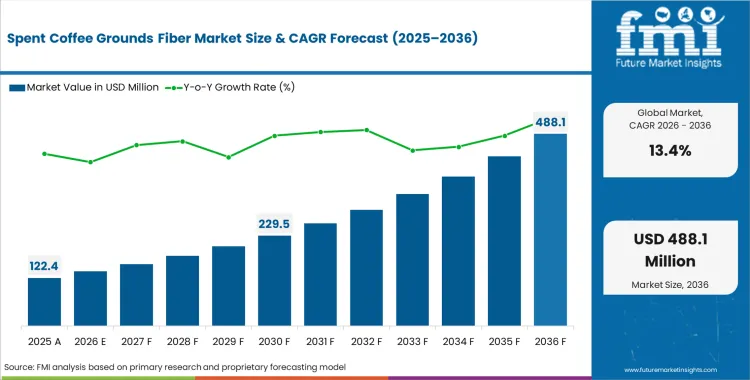
Spent Coffee Grounds Fiber Market Key Takeaways
| Metric | Details |
|---|---|
| Industry Size (2026) | USD 122.4 million |
| Industry Value (2036) | USD 430.7 million |
| CAGR (2026-2036) | 13.4% |
Source: Future Market Insights (FMI) analysis, based on proprietary forecasting model and primary research
Apparel brands facing virgin synthetic phase-outs require commercial-scale recycled alternatives that deliver inherent functional properties rather than superficial marketing narratives. Securing these specialized material streams prevents mid-tier labels from losing retail shelf space to vertically integrated competitors holding proprietary supply chains. Procurement departments specifically target coffee grounds integration within existing extrusion infrastructure to achieve odor-control baselines without relying on topical chemical finishes. Failing to lock in hybrid performance polymers early forces garment manufacturers into spot-contract purchasing at steep premiums. Evaluating the spent coffee grounds fiber market forecast confirms early adopters monopolize limited compounding capacity.
Output volume scales rapidly once polymerization facilities stabilize bio-particle dispersion at high speeds. Manufacturing economics shift when extrusion nozzle blockage rates drop below acceptable threshold limits. Process stability allows regional upcycled olive pomace prebiotic fiber suppliers to convert localized waste streams into standardized masterbatch pellets for global distribution.
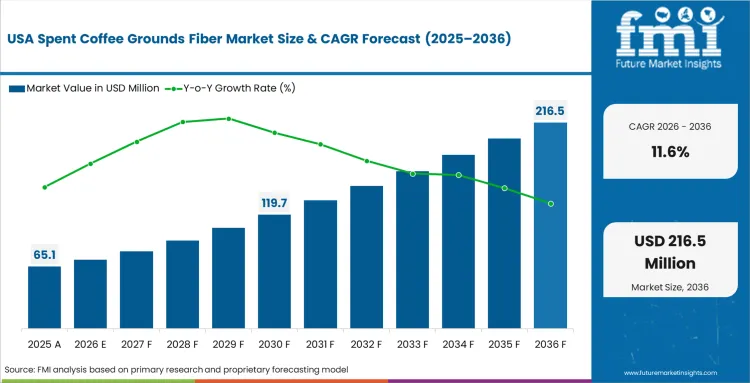
Vietnam is expected to register a 14.8% CAGR during the forecast period due to aggressive vertical integration across garment assembly nodes. India is estimated to expand at a 14.2% CAGR as spun-yarn producers upgrade legacy spinning assets. Growth in Taiwan is poised to expand at a 13.9% CAGR due to localized patent concentration among specialized functional-fabric mills, China at 12.8% CAGR as domestic dietary fibres compounders redirect capital toward apparel applications, United States at 11.6% CAGR, Germany and Italy at a 11.2% and 10.9% CAGR respectively. Early-stage platforms show European regulatory pressure separating premium compliance geographies from volume-driven production centers.
Segmental Analysis
Spent Coffee Grounds Fiber Market Analysis by Form
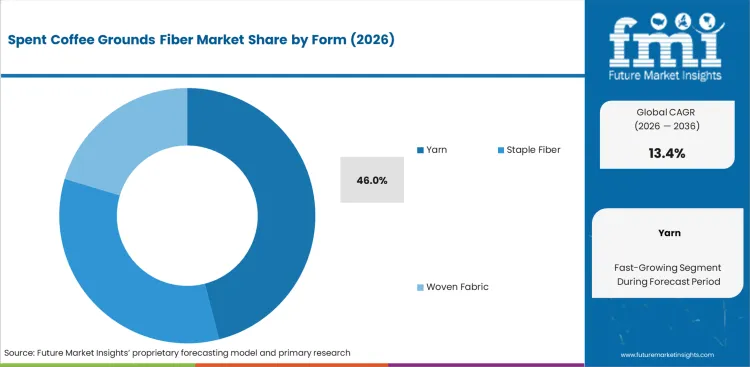
Fabric mill operators replacing topical treatments notice significant water-consumption reductions alongside improved batch consistency. Patent-protected micro-pulverization techniques prevent uncertified spinners from replicating performance metrics reliably, consolidating volume among established yarn producers. The yarn segment is expected to hold 46.0% revenue share in 2026. This is because material engineers prioritize pre-spinning masterbatch integration over post-production chemical dips to survive aggressive industrial laundering conditions. Operations managers face compounding margin erosion as regulatory bodies penalize excessive water consumption during traditional fabric finishing stages, forcing the shift toward integrated yarn platforms.
- Initial Validation: Textile engineers test carbonized bio-particle dispersion rates across pilot-scale extrusion lines. Research and development departments authorize capital expenditure only when nozzle blockage rates fall below specified operational tolerances during continuous multi-day runs, ensuring that the yarn segment remains the most technically viable starting point for mass commercialization.
- Qualification Protocols: Quality assurance managers subject recycled coffee grounds yarn to repeated industrial laundering cycles evaluating permanent odor-absorption retention. Procurement officers leverage successful retention data justifying premium masterbatch pricing structures to executive finance committees, proving that embedded yarn solutions outperform superficial fabric coatings over the product lifecycle.
- Renewal Triggers: Garment assembly managers renew contracts based on consistent dye-uptake performance across large production volumes. Sourcing departments penalize suppliers showing batch variance, forcing spinners into strict adherence protocols preserving valuable vendor relationships and driving recurring revenue within the spun yarn category.
Spent Coffee Grounds Fiber Market Analysis by Blend
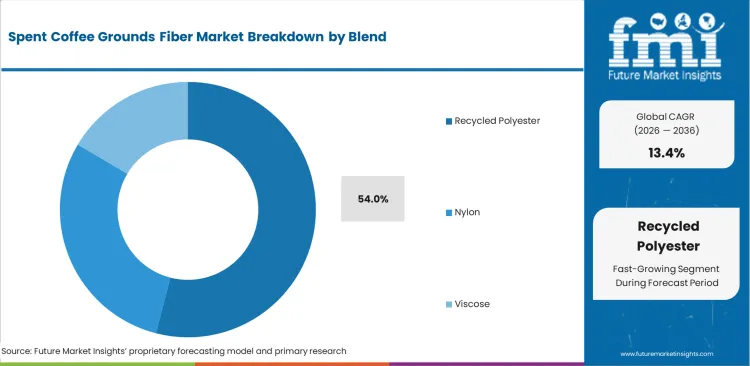
Thermal compatibility between carbonized biomass and base polymers determines manufacturing viability across high-speed synthetic lines. The recycled polyester segment is estimated to secure 54.0% revenue share in 2026. Supply chain departments favor this specific matrix because it satisfies dual retailer mandates demanding both post-consumer content and active functional properties. Factory supervisors swapping virgin materials for pineapple fiber compounds face immediate machinery calibration challenges, pushing preference toward stable polyester. Successful polyester blending unlocks access to premium athleisure brand programs that require strict tensile strength and uniform dispersion metrics.
- Procurement Savings: Raw material buyers capture margin advantages by substituting expensive specialized chemical finishes with inherent carbonized masterbatch pellets. Financial controllers document these direct chemical-cost reductions, shifting budget allocations toward premium blended yarn procurement, securing long-term cost efficiencies.
- Operational Burdens: Floor supervisors endure unexpected downtime when uncertified polyester blends cause severe extrusion nozzle blockages. Maintenance engineers require extensive recalibration sessions, inflating hidden labor costs often ignored during initial unit-price negotiations, which highlights the value of certified recycled polyester masterbatches.
- Lifecycle Economics: Sustainability departments calculate total impact metrics including reduced water consumption during fabric finishing stages. Marketing executives leverage these comprehensive lifecycle improvements, positioning finished garments in higher retail pricing tiers successfully while adhering strictly to regional environmental compliance protocols.
Spent Coffee Grounds Fiber Market Analysis by Application
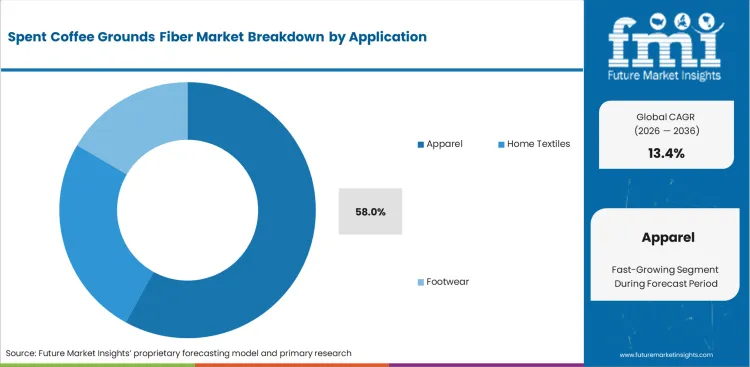
Quality control inspectors evaluating treated fabrics often reject lots losing functionality after ten washes, heavily favoring integrated polymer apparel solutions. Brand managers ignoring embedded functional polymers lose positioning against competitors offering permanent moisture-management guarantees in activewear. The apparel segment is predicted to account for 58.0% revenue share in 2026. Consumer demand for permanent odor control clashes directly with brand commitments reducing synthetic chemical usage, making bio-enhanced apparel the primary testing ground. High-level aggregate data fails to reveal how heavy citrus fiber masterbatch costs restrict applications entirely to premium retail segments where apparel margins absorb the premium effectively.
- Prevention Mechanics: Integrated bio-particles trap odor molecules permanently within synthetic matrices. Product developers specify these enhanced fabrics preventing garment failure during rigorous physical activity, satisfying demanding consumer performance expectations consistently and maintaining brand loyalty across competitive apparel markets.
- Residual Vulnerabilities: Intense abrasive wear during extreme athletic events degrades exposed fiber surfaces over time. Quality assurance teams track failure points, noting how compromised outer layers diminish overall moisture-wicking efficiency marginally, prompting continuous material engineering improvements within the apparel segment.
- Capture Strategies: Garment technologists must calibrate knitting tension precisely preserving optimal spent coffee grounds textile fiber surface-area exposure. Production managers failing this technical calibration produce garments exhibiting standard performance, missing premium functional benefits entirely and risking extensive apparel inventory write-downs.
Spent Coffee Grounds Fiber Market Analysis by End Use
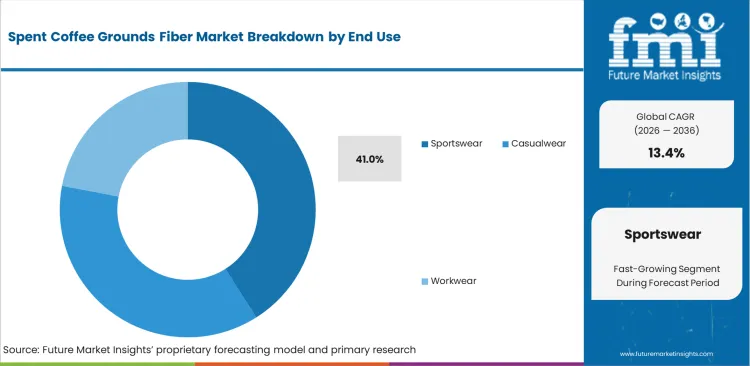
Technical designers mandate specific bio-particle concentrations ensuring garments meet established cooling and odor-control metrics required by active consumers. The sportswear segment is likely to hold 41.0% revenue share in 2026. Athleisure category managers weigh premium masterbatch costs against verifiable performance claims during seasonal collection planning, highly favoring sportswear integration. Major sportswear brands force exclusive supplier contracts, deliberately starving mid-tier competitors of certified material access and consolidating segment value. Buyers opting for cheaper superficial treatments face immediate consumer backlash when garments retain odors post-workout, cementing the need for embedded sportswear solutions.
- Initial Triggers: Activewear designers specify bio-enhanced yarns reacting to consumer complaints regarding persistent synthetic garment odor. Category managers approve elevated material costs recognizing permanent functional claims drive higher retail point-of-sale conversion rates, justifying the initial investment in premium sportswear material procurement.
- Qualification Hurdles: Independent testing laboratories subject prototypes to rigorous bacterial reduction protocols before authorizing official performance tags. Compliance officers reject fabrics failing strict moisture-transfer thresholds, protecting brand reputation from unsubstantiated marketing claims and enforcing high technical barriers to entry within the sportswear segment.
- Expansion Mechanics: Successful product launches prompt merchandising departments to expand functional fabric usage across broader seasonal collections. Supply chain managers consolidate fabric sourcing, rewarding reliable spinning mills with larger multi-year contract volumes, securing highly loaded prebiotic fiber yarns essential for athletic performance limits.
Spent Coffee Grounds Fiber Market Analysis by Channel
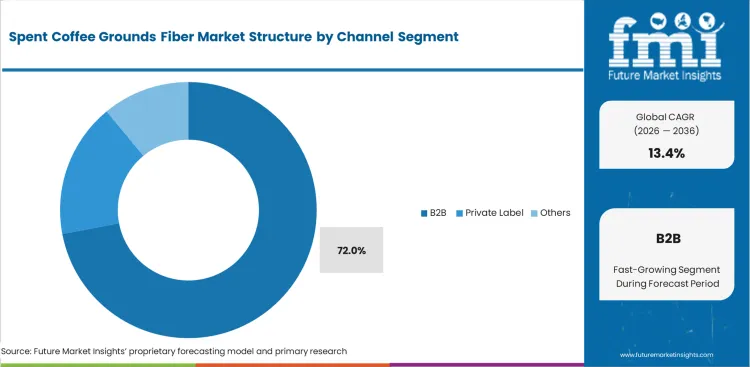
Yarn manufacturers rely on dedicated compounders providing stabilized pellets ready for high-speed extrusion to avoid catastrophic production failures. The B2B supply segment is estimated to account for 72.0% revenue share in 2026. Commercializing complex masterbatch technology requires deep technical integration among specialized polymer converters before consumer products ever materialize. Proprietary fibers and specialty carbohydrates licensing agreements strictly dictate which mills legally produce certified textiles, forcing compliance through B2B channels. Unlicensed weavers attempting reverse-engineering face immediate legal injunctions alongside ruined production runs, cementing the dominance of verified B2B partnerships.
- Sustaining Producers: Specialized chemical compounders manufacture precise masterbatch pellets owning critical dispersion patents. Plant managers operating these facilities control global supply availability, dictating terms to downstream spinning mills seeking certified material inputs, effectively centralizing pricing power within the B2B supply segment.
- Supply Constraints: Carbonization facility throughput limits total global masterbatch production volumes. Procurement departments at large apparel brands struggle securing sufficient tonnage, forcing them into aggressive multi-year volume commitments that bypass spot-market availability and reinforce direct B2B supply chain dependencies.
- Trajectory Shifts: Increased bio-refinery investments are expected to gradually decentralize current masterbatch production monopolies. Regional supply chain departments anticipate localized pellet availability reducing current fourteen-week lead times significantly, allowing domestic coffee fabric suppliers to capture larger shares of the expanding B2B supply ecosystem.
Spent Coffee Grounds Fiber Market Drivers, Restraints, and Opportunities
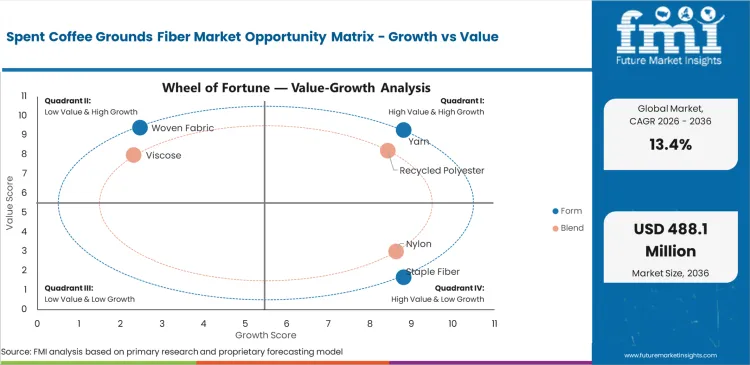
Impending legislative prohibitions concerning particular topical chemical finishes necessitate material innovation executives immediately secure inherently functional polymers. Postponing action awaiting absolute price parity introduces considerable risk of supply chain disruption particularly as current chemical providers abruptly discontinue entire product categories. Organizations substituting conventional treatments with low fermentability dietary fibers observe that first movers already secured a dominant position over the limited masterbatch manufacturing capacity.
Sourcing departments understand that delaying qualification protocols means initiating transactions at elevated spot pricing specifically during periods of intensified regulatory enforcement. Forward-thinking apparel organizations are establishing and formalizing multi-year supply agreements effectively preventing competitors from obtaining access to verified circular materials. Procurement agents tasked with sourcing contracts for coffee yarn OEM manufacturers establish secure and resilient supply networks that remain insulated from significant raw material price fluctuations.
The constrained throughput capabilities of carbonization facilities introduce operational obstacles, significantly impeding the widespread adoption of innovative materials across the industry. Bio-mass processing necessitates the precise elimination of moisture and subsequent micro-pulverization before the actual polymer compounding process becomes technologically viable. Facilities possessing the necessary engineering capability for achieving sub-micron particle distributions remain globally scarce, consequentially restricting the overall worldwide masterbatch output.
Upgrading existing agricultural waste processors requires substantial capital expenditure, a financial undertaking independent recyclers typically decline without guaranteed long-term contracts from significant brands. Technical purchasing personnel comparing coffee yarn with recycled polyester yarn encounter substantial availability disparities heavily favoring the more established synthetic options currently available. This production bottleneck continues to persist until major polymer manufacturers commit considerable investment directly into establishing dedicated carbonization infrastructure supporting these novel materials.
Opportunities in the Spent Coffee Grounds Fiber Market
- Masterbatch localization: Supply chain departments partnering with regional bio-refineries reduce excessive trans-pacific shipping delays. Localized masterbatch production allows domestic spinning mills to respond faster to shifting seasonal brand demands.
- Nonwoven composite integration: Automotive interior engineers testing bio-enhanced high tenacity cellulosic staple fiber blends discover exceptional acoustic dampening properties. Qualifying these materials creates broad new volume channels completely isolated from apparel-sector volatility.
- Footwear membrane development: Shoe technologists embedding carbonized particles into waterproof-breathable laminates achieve superior micro-climate regulation. Material science heads successfully commercializing these membranes command premium margins within high-performance athletic footwear categories.
Regional Analysis
Based on regional analysis, the spent coffee grounds fiber market is segmented into North America, Latin America, Europe, Asia Pacific, and Middle East and Africa across 40 plus countries.
.webp "Top Country Growth Comparison Spent Coffee Grounds Fiber Market Cagr (2026 2036)")
| Country | CAGR (2026 to 2036) |
|---|---|
| Vietnam | 14.8% |
| India | 14.2% |
| Taiwan | 13.9% |
| China | 12.8% |
| United States | 11.6% |
| Germany | 11.2% |
| Italy | 10.9% |
Source: Future Market Insights (FMI) analysis, based on proprietary forecasting model and primary research
Asia Pacific Spent Coffee Grounds Fiber Market Analysis
Proactive vertical integration across regional garment assembly nodes shapes local consumption patterns. Mill operators historically reliant on imported specialty yarns now invest heavily in domestic masterbatch compounding infrastructure. This pivot allows regional fabric producers to bypass extended supply chain delays plaguing global competitors. Factory managers deploying localized biodegradable polyester cellulosic blend formulations report significant unit-cost reductions. Sourcing departments leveraging close proximity between spinning facilities and cut-and-sew operations execute faster seasonal turnarounds. According to FMI's estimates, Asia Pacific manufacturers increasingly dictate global technical standards, driven by a robust spent coffee grounds fiber market CAGR profile.
- Vietnam: Factory operators capturing premium sportswear contracts secure long-term masterbatch supplies ensuring consistent production quality and avoiding spot-market volatility. Vietnam is expected to grow at a rate of 14.8% during the forecast period. Rapid domestic expansion across vertically integrated apparel manufacturing drives aggressive industrial consumption. Early-moving textile groups locking down exclusive regional processing rights establish strong cost advantages over fragmented global competitors. Proximity to major cut-and-sew operations allows sourcing departments to execute faster seasonal turnarounds, making the local manufacturing hub highly competitive.
- India: India is projected to expand at a CAGR of 14.2% during the forecast period. Legacy spun-yarn producers upgrading outdated spinning assets accelerate technical material integration to capture lucrative sustainable-export contracts from Europe based retail brands. Plant managers modifying existing extrusion lines successfully qualify hybrid polymers, integrating deeper into global activewear supply chains. Government-backed textile parks provide the necessary capital expenditure support for mills to transition from conventional cotton to advanced recycled synthetic blends. Strong domestic availability of raw biomass combined with expanding polymerization capacity reduces reliance on imported masterbatch pellets.
- Taiwan: Research and development departments operating pilot facilities perfect complex bio-dispersion techniques, maintaining the region's position as the primary innovation hub for textile engineering. Taiwan is predicted to register a CAGR of 13.9% during the forecast period. This is due to significant technological advantage: the localized concentration of patents among specialized functional-fabric mills, which results in a formidable expertise that prevents global competitors from matching their tensile strength. Taiwan-based compounders license proprietary masterbatch formulas globally, controlling critical intellectual property and dictating international pricing structures. Deep integration between local chemical suppliers and high-end spinning mills ensures continuous optimization of extrusion nozzle geometries.
- China: Procurement heads navigating saturated local markets consolidate supplier bases demanding stricter quality verification protocols to filter out uncertified vendors. Massive production scale allows top-tier China-based spinners to undercut international pricing structures aggressively, capturing volume-driven brand contracts. State-level circular economy mandates compel legacy polyester manufacturers to incorporate minimum thresholds of verified waste-stream inputs into their production lines. China is estimated to expand at a CAGR of 12.8% during the forecast period. Domestic compounders redirecting capital toward high-margin apparel applications face intense internal competition, consequently driving rapid capacity expansion across major textile hubs. Increasing consumer preference for comfortable and durable performance apparel is significantly driving the demand for specialized polymer materials, contributing to market growth.
FMI's report includes Japan, South Korea, and Indonesia. Mature patent frameworks protect early innovators while emerging economies focus on volume-driven material conversion.
Europe Spent Coffee Grounds Fiber Market Analysis
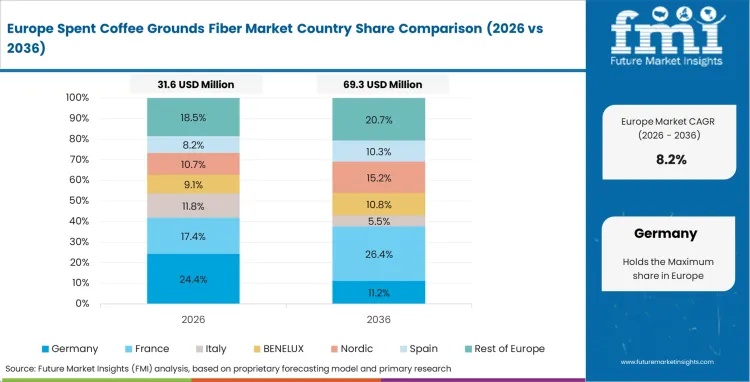
Strict circular-material procurement mandates force fashion brands to restructure legacy supply chains fundamentally. Compliance officers facing stringent extended producer responsibility penalties specify verified waste-stream inputs across entire seasonal collections. This legislative pressure drives intense collaboration between pumpkin seed protein and fiber innovators and traditional spinning mills. Factory supervisors auditing local facilities demand absolute traceability regarding biomass origins. Sourcing heads abandoning unregulated suppliers consolidate purchase volumes among certified regional compounders. FMI observes that buyers prioritize supply chain transparency over minor unit-cost savings.
- Germany: Germany is expected to expand at a rate of 11.2% during the forecast period. Key factor is stringent circular-material procurement mandates that compel domestic manufacturers to adopt verified recycled polymers rapidly to avoid extended producer responsibility penalties. Sustainability departments overhauling corporate sourcing strategies prioritize inherent functional materials that minimize chemical wastewater discharge during domestic finishing stages. German automotive brands qualifying these textiles for interior seating create distinct secondary volume channels isolated from traditional apparel-sector volatility. Heavy investments in advanced textile recycling infrastructure accelerate bio-enhanced material adoption across high-end fashion segments headquartered locally.
- Italy: Premium fashion houses demanding sustainable luxury materials drive localized specialty yarn development to satisfy discerning consumer expectations. Italy is predicted to register a CAGR of 10.9% during the forecast period. Technological advancements in fiber manufacturing processes, including the development of sustainable and bio-based polymers, are creating new opportunities for market expansion and product innovation in the coming years. Textile engineers blending carbonized bio-particles with high-end cellulosic bases achieve unique tactile properties that mass-market producers cannot replicate. Italian mills perfecting these sophisticated blends successfully defend premium margins against low-cost Asian volume producers. Strict regional compliance officers mandate absolute traceability regarding biomass origins, favoring domestic compounders who offer complete supply chain transparency.
FMI's report includes France, the United Kingdom, and Spain. Sophisticated textile recycling infrastructure accelerates bio-enhanced material adoption across high-end fashion segments.
North America Spent Coffee Grounds Fiber Market Analysis
Direct-to-consumer athletic brands dominate regional material specifications demanding rigorous performance validation. Product developers testing prototype garments mandate strict moisture-transfer metrics before authorizing mass production. Sourcing departments bypassing traditional wholesale channels partner directly with Asian masterbatch compounders securing exclusive material rights. Factory auditors evaluating fruit pomace integration protocols penalize suppliers failing independent bacterial-reduction testing. Quality control managers defending brand reputations reject fabric lots exhibiting inconsistent odor-absorption capabilities. In FMI's view, North America performance standards dictate global manufacturing tolerances.
- United States: Proliferation of fast fashion trends and the resulting need for quicker product cycles necessitate the use of advanced polymer formulations capable of meeting stringent quality and performance requirements within the textile sector. The United States is likely to expand at a CAGR of 11.6% during the forecast period. Key factor is favorable governmental policies and investments promoting the establishment of large-scale textile manufacturing parks in various regions are effectively boosting overall production capacity for polymer consumption in textiles. Direct-to-consumer athletic brands dominating regional demand mandate rigorous performance validation, forcing suppliers into continuous technical innovation cycles. Product developers require strict moisture-transfer metrics and verifiable circular-material narratives to justify premium retail pricing positioning.
FMI's report includes Canada and Mexico. Cross-border assembly operations leverage specialized fabric imports supporting rapid regional activewear production cycles.
Competitive Aligners for Market Players
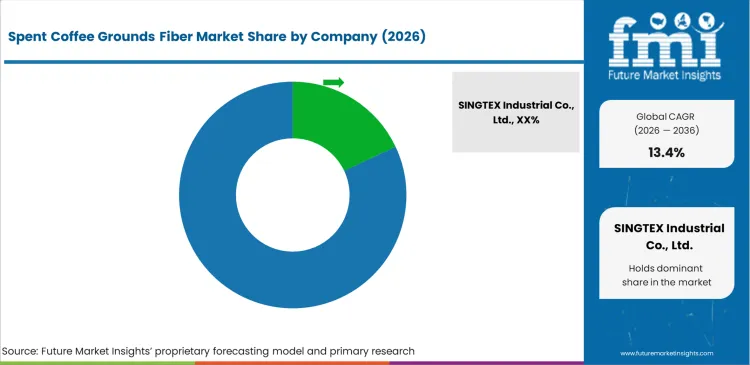
Specialized patent portfolios defining optimal micro-pulverization techniques shape intense competitive rivalries. Unlike fragmented commodity textile sectors, early innovators dominating critical masterbatch intellectual property wield disproportionate pricing power. SINGTEX Industrial Co., Ltd. controls significant global production by licensing proprietary S.Café technology directly to vetted spinning mills. Smartex Yarn Corp. and FASLINK JSC challenge this dominance by engineering alternative dispersion methods bypassing existing patent protections. Material science departments evaluating functional flours assess coupling-agent effectiveness rather than basic biomass content. Procurement heads choose spent coffee grounds fiber market suppliers based entirely on proven high-speed extrusion stability, ignoring vendors pushing uncertified experimental pellets.
Incumbent compounders possess extensive long-term biomass collection agreements alongside perfectly calibrated thermal extrusion profiles. Challengers attempting rapid entry discover sourcing raw grounds remains trivial while achieving uniform sub-micron particle distribution requires years of capital-intensive process refinement. Thai Son S.P Sewing Factory and Bao Lan Textile Co., Ltd. leverage established pulse ingredients relationships ensuring consistent fabric quality downstream. Facilities lacking optimized cooling algorithms experience line-stopping nozzle blockages ruining entire production runs. Consequently, spent coffee grounds fiber market key players maintain absolute leverage over apparel brands desperate for verified circular-material narratives.
Large sportswear buyers resist single-vendor lock-in by aggressively funding alternative bio-refinery startups. Sourcing executives deploying capital reserves intentionally dilute incumbent patent monopolies by open-sourcing competing extraction methodologies. Purchasing departments evaluating bean flour variants demand open-architecture masterbatch formulas preventing proprietary chemical dependencies. Garment assembly managers refuse fabric lots tied to restrictive downstream licensing agreements. Mid-tier plant based fiber innovators navigating this tension align with large retail conglomerates guaranteeing immediate volume scale. Evolving certification protocols mandate absolute chemical transparency, systematically dismantling secretive formulation advantages held by early pioneers.
Key Players in Spent Coffee Grounds Fiber Market
- SINGTEX Industrial Co., Ltd.
- Smartex Yarn Corp.
- Bao Lan Textile Co., Ltd. (WELL FABRIC)
- FASLINK JSC
- Thai Son S.P Sewing Factory
- Jay Ho Corp., Ltd.
- Jia-Zhan Textile Co., Ltd.
Scope of the Report
| Metric | Value |
|---|---|
| Quantitative Units | USD 122.4 million to USD 430.7 million, at a CAGR of 13.4% |
| Market Definition | Engineered textile materials embedding processed coffee residue into synthetic matrices achieving permanent odor absorption without topical chemical treatments. |
| Segmentation | Form, Blend, Application, End Use, Channel, Region |
| Regions Covered | North America, Latin America, Europe, Asia Pacific, Middle East and Africa |
| Countries Covered | United States, Germany, Italy, China, India, Vietnam, Taiwan |
| Key Companies Profiled | SINGTEX Industrial Co., Ltd., Smartex Yarn Corp., Bao Lan Textile Co., Ltd. (WELL FABRIC), FASLINK JSC, Thai Son S.P Sewing Factory, Jay Ho Corp., Ltd., Jia-Zhan Textile Co., Ltd. |
| Forecast Period | 2026 to 2036 |
| Approach | Global spun-yarn output metrics cross-referenced against masterbatch formulation ratios |
Source: Future Market Insights (FMI) analysis, based on proprietary forecasting model and primary research
Spent Coffee Grounds Fiber Market Analysis by Segments
Form
- Yarn
- Staple Fiber
- Woven Fabric
- Nonwoven
Blend
- Recycled Polyester
- Nylon
- Viscose
- PLA
Application
- Apparel
- Home Textiles
- Footwear
- Composites
End Use
- Sportswear
- Casualwear
- Workwear
- Accessories
Channel
- B2B Supply
- Private Label
- Direct Brand
- R&D Programs
Region
- North America
- United States
- Canada
- Europe
- Germany
- United Kingdom
- France
- Italy
- Spain
- Asia Pacific
- China
- Japan
- South Korea
- Taiwan
- Singapore
- Latin America
- Brazil
- Mexico
- Argentina
- Middle East & Africa
- GCC Countries
- South Africa
- Israel
- Rest of Middle East & Africa
Bibliography
- USA Department of Agriculture, Foreign Agricultural Service. (2025, June). Coffee: World markets and trade. USDA.
- Papageorgiou, C., Dermesonlouoglou, E., Tsimogiannis, D., & Taoukis, P. (2024, August). Enrichment of bakery products with antioxidant and dietary fiber ingredients obtained from spent coffee ground. Applied Sciences, 14(16), 6863.
- Montemurro, M., Casertano, M., Vilas-Franquesa, A., Rizzello, C. G., & Fogliano, V. (2024, April). Exploitation of spent coffee ground (SCG) as a source of functional compounds and growth substrate for probiotic lactic acid bacteria. LWT, 198, 115974.
- Kanai, N., Yamada, K., Sumida, C., Tanzawa, M., Ito, Y., Saito, T., Kimura, R., Saito-Yamazaki, M., Oyama, T., Isogai, A., & Kawamura, I. (2024, December). Mannan-rich holocellulose nanofibers mechanically isolated from spent coffee grounds: Structure and properties. Carbohydrate Polymer Technologies and Applications, 8, 100539.
- Dilek, N. M. (2025, October). Utilization of spent coffee grounds as an antioxidant dietary fiber in beef patties: Oxidative stability, texture properties, and molecular docking. Food Science & Nutrition, 13(10), e70919.
- Choe, U. (2025, February). Valorization of spent coffee grounds and their applications in food science. Current Research in Food Science, 10, 101010.
This bibliography is provided for reader reference. The full FMI report contains the complete reference list with primary source documentation.
This Report Addresses
- Procurement departments seeking alternative odor-control strategies preventing virgin synthetic chemical usage.
- Material innovation heads evaluating thermal extrusion compatibility crossing carbonized bio-particles with recycled polyester.
- Yarn spinners anticipating margin compression caused by delayed masterbatch integration capabilities.
- R&D departments authorizing capital expenditure optimizing nozzle blockage rates during high-speed production.
- Sustainability departments overhauling corporate sourcing strategies prioritizing inherent functional materials globally.
- Factory supervisors managing machinery recalibration sessions preventing critical polymer viscosity failures.
- Brand managers targeting verifiable circular-material inputs supporting premium sportswear merchandising claims.
- Supply chain managers consolidating verified upstream compounders avoiding untested spot-contract purchasing risks.
Frequently Asked Questions
How is coffee fiber made?
Carbonization facility throughput restricts global masterbatch production severely. Precise moisture elimination alongside sub-micron pulverization requires heavy capital investment before extrusion. Regional bio-refineries lacking guaranteed multi-year brand contracts avoid funding specialized equipment upgrades preventing volume scaling.
What is coffee yarn made of?
Thermal compatibility between carbonized biomass and base polymers determines high-speed manufacturing viability. Extrusion temperature overlaps allow factory supervisors deploying recycled polyester to bind these elements, avoiding severe machinery blockages plaguing incompatible cellulosic platforms.
Can coffee grounds be turned into fabric?
Yes, localized patent concentration among specialized functional-fabric mills establishes formidable technological pathways. R&D departments operating pilot facilities perfect complex bio-dispersion techniques integrating carbonized residue into synthetic matrices preventing international competitors from achieving comparable tensile strength metrics.
Who are the leading spent coffee grounds fiber market companies?
SINGTEX Industrial Co., Ltd. controls significant global production by licensing proprietary technology directly to vetted spinning mills. Smartex Yarn Corp., Bao Lan Textile Co., Ltd., and FASLINK JSC challenge this dominance by engineering alternative dispersion methods bypassing existing patent protections globally.
Explain the spent coffee grounds fiber market valuation trajectory?
Procurement teams secure inherent masterbatch blends capturing significant long-term margin advantages globally. Sustainability departments record noticeable water-consumption reductions during fabric finishing stages allowing marketing executives targeting premium pricing tiers successfully, pushing overall valuation higher.
Give me the forecast for coffee ground fiber through 2036?
Vertically integrated competitors holding proprietary supply chains lock down limited masterbatch production capacity driving consistent compound expansion at 13.4%. Apparel brands relying on spot-contract purchasing face severe raw material shortages missing seasonal delivery windows entirely.
How do Europe-based buyers handle compliance verification?
Compliance officers facing strict extended producer responsibility penalties mandate absolute traceability regarding biomass origins. Sourcing heads abandoning unregulated suppliers consolidate purchase volumes among certified regional compounders prioritizing supply chain transparency.
What role does Yarn play?
Yarn captures 46.0% share anchoring widespread commercialization across knitting supply chains. Material engineers prioritize pre-spinning masterbatch integration over post-production dips ensuring permanent functional properties survive aggressive industrial laundering conditions.
Why is spent coffee grounds fiber segmentation critical for quality control?
Specialized chemical compounders must produce stabilized pellets ready for high-speed extrusion before consumer products materialize. Unlicensed weavers attempting reverse-engineering without certified B2B partnerships face immediate legal injunctions alongside ruined production runs.
What distinguishes Vietnam and India?
Vietnam leverages aggressive vertical integration across garment assembly nodes ensuring rapid seasonal turnarounds. India tracks closely as legacy spun-yarn producers upgrade outdated spinning assets capturing lucrative sustainable-export contracts from Europe-headquatered brands.
How do sportswear brands validate performance claims?
Independent testing laboratories subject prototypes to rigorous bacterial reduction protocols before authorizing official performance tags. Compliance officers reject fabrics failing strict moisture-transfer thresholds protecting brand reputation against unsubstantiated marketing narratives.
Why do nonwoven composites represent future opportunities?
Automotive interior engineers testing bio-enhanced blends discover exceptional acoustic dampening properties. Qualifying these specific materials creates broad new volume channels completely isolated from traditional apparel-sector volatility.
What gate triggers exponential scaling?
Output volume scales rapidly once polymerization facilities stabilize bio-particle dispersion avoiding extrusion nozzle blockages. Process stability allows regional suppliers converting localized waste streams into standardized masterbatch pellets reliably.
How do large buyers resist single-vendor lock-in?
Sourcing executives deploy capital reserves intentionally funding alternative bio-refinery startups. Purchasing departments demand open-architecture masterbatch formulas preventing restrictive downstream licensing agreements tying brands into proprietary chemical dependencies.
Why do casualwear designers specify these materials?
Designers seek activewear crossover appeal satisfying consumer demands regarding permanent moisture management. Garments retaining functionality after rigorous physical activity command higher retail conversion rates than superficially treated alternatives.
What causes visible banding defects during production?
Factory foremen optimizing circular knitting machines struggle maintaining consistent loop structures using highly loaded yarns. Tension inconsistencies caused by inadequate technical calibration produce fabrics exhibiting severe failures.
How do patent portfolios shape competitive rivalries?
Early innovators controlling optimal micro-pulverization techniques wield disproportionate pricing power licensing proprietary technology directly to vetted spinning mills. Challengers engineering alternative dispersion methods struggle bypassing established intellectual property frameworks.
What happens when compounders ignore exact chemistries?
Production planners selecting incompatible cellulosic platforms suffer severe tensile strength degradation. Uncertified polyester blends cause line-stopping extrusion nozzle blockages inflating hidden labor costs drastically during prolonged maintenance recalibrations.
Why is footwear membrane development significant?
Shoe technologists embedding carbonized particles into waterproof-breathable laminates achieve superior micro-climate regulation. Material science heads successfully commercializing these specific membranes command premium margins within high-performance athletic categories.
How do direct-to-consumer brands impact material specifications?
Athletic brands dominating regional markets mandate strict moisture-transfer metrics forcing suppliers into continuous technical innovation cycles. Companies securing exclusive material technologies capture premium retail positioning effectively.
What obscures exact masterbatch formulation metrics?
Tonnage reporting masks how heavily producers guard specific coupling-agent chemistries enabling uniform dispersion. Companies sharing exact formulation data risk unauthorized replication undermining proprietary vendor relationships severely.
Why do sourcing heads abandon unregulated suppliers?
Evolving certification protocols increasingly mandate absolute chemical transparency dismantling secretive formulation advantages. Buyers prioritizing supply chain transparency avoid uncertified vendors risking severe regulatory penalties globally.
What defines the boundary between inclusions and exclusions?
Modified architectures containing verified coffee waste fractions integrated into polymer extrusion pipelines fall within boundaries. Unmodified loose agricultural amendments lacking textile applications remain excluded completely.
Preview the report firsthand - request a free sample
Get SampleGet the brochure for pricing and purchase details.
Get PDFTable of Content
- Executive Summary
- Global Market Outlook
- Demand-side Trends
- Supply-side Trends
- Technology Roadmap Analysis
- Analysis and Recommendations
- Market Overview
- Market Coverage / Taxonomy
- Market Definition / Scope / Limitations
- Research Methodology
- Chapter Orientation
- Analytical Lens and Working Hypotheses
- Market Structure, Signals, and Trend Drivers
- Benchmarking and Cross-market Comparability
- Market Sizing, Forecasting, and Opportunity Mapping
- Research Design and Evidence Framework
- Desk Research Programme (Secondary Evidence)
- Company Annual and Sustainability Reports
- Peer-reviewed Journals and Academic Literature
- Corporate Websites, Product Literature, and Technical Notes
- Earnings Decks and Investor Briefings
- Statutory Filings and Regulatory Disclosures
- Technical White Papers and Standards Notes
- Trade Journals, Industry Magazines, and Analyst Briefs
- Conference Proceedings, Webinars, and Seminar Materials
- Government Statistics Portals and Public Data Releases
- Press Releases and Reputable Media Coverage
- Specialist Newsletters and Curated Briefings
- Sector Databases and Reference Repositories
- FMI Internal Proprietary Databases and Historical Market Datasets
- Subscription Datasets and Paid Sources
- Social Channels, Communities, and Digital Listening Inputs
- Additional Desk Sources
- Expert Input and Fieldwork (Primary Evidence)
- Primary Modes
- Qualitative Interviews and Expert Elicitation
- Quantitative Surveys and Structured Data Capture
- Blended Approach
- Why Primary Evidence is Used
- Field Techniques
- Interviews
- Surveys
- Focus Groups
- Observational and In-context Research
- Social and Community Interactions
- Stakeholder Universe Engaged
- C-suite Leaders
- Board Members
- Presidents and Vice Presidents
- R&D and Innovation Heads
- Technical Specialists
- Domain Subject-matter Experts
- Scientists
- Physicians and Other Healthcare Professionals
- Governance, Ethics, and Data Stewardship
- Research Ethics
- Data Integrity and Handling
- Primary Modes
- Tooling, Models, and Reference Databases
- Desk Research Programme (Secondary Evidence)
- Data Engineering and Model Build
- Data Acquisition and Ingestion
- Cleaning, Normalisation, and Verification
- Synthesis, Triangulation, and Analysis
- Quality Assurance and Audit Trail
- Market Background
- Market Dynamics
- Drivers
- Restraints
- Opportunity
- Trends
- Scenario Forecast
- Demand in Optimistic Scenario
- Demand in Likely Scenario
- Demand in Conservative Scenario
- Opportunity Map Analysis
- Product Life Cycle Analysis
- Supply Chain Analysis
- Investment Feasibility Matrix
- Value Chain Analysis
- PESTLE and Porter’s Analysis
- Regulatory Landscape
- Regional Parent Market Outlook
- Production and Consumption Statistics
- Import and Export Statistics
- Market Dynamics
- Global Market Analysis 2021 to 2025 and Forecast, 2026 to 2036
- Historical Market Size Value (USD Million) Analysis, 2021 to 2025
- Current and Future Market Size Value (USD Million) Projections, 2026 to 2036
- Y-o-Y Growth Trend Analysis
- Absolute $ Opportunity Analysis
- Global Market Pricing Analysis 2021 to 2025 and Forecast 2026 to 2036
- Global Market Analysis 2021 to 2025 and Forecast 2026 to 2036, By Form
- Introduction / Key Findings
- Historical Market Size Value (USD Million) Analysis By Form , 2021 to 2025
- Current and Future Market Size Value (USD Million) Analysis and Forecast By Form , 2026 to 2036
- Yarn
- Staple Fiber
- Woven Fabric
- Yarn
- Y-o-Y Growth Trend Analysis By Form , 2021 to 2025
- Absolute $ Opportunity Analysis By Form , 2026 to 2036
- Global Market Analysis 2021 to 2025 and Forecast 2026 to 2036, By Blend
- Introduction / Key Findings
- Historical Market Size Value (USD Million) Analysis By Blend, 2021 to 2025
- Current and Future Market Size Value (USD Million) Analysis and Forecast By Blend, 2026 to 2036
- Recycled Polyester
- Nylon
- Viscose
- Recycled Polyester
- Y-o-Y Growth Trend Analysis By Blend, 2021 to 2025
- Absolute $ Opportunity Analysis By Blend, 2026 to 2036
- Global Market Analysis 2021 to 2025 and Forecast 2026 to 2036, By Application
- Introduction / Key Findings
- Historical Market Size Value (USD Million) Analysis By Application, 2021 to 2025
- Current and Future Market Size Value (USD Million) Analysis and Forecast By Application, 2026 to 2036
- Apparel
- Home Textiles
- Footwear
- Apparel
- Y-o-Y Growth Trend Analysis By Application, 2021 to 2025
- Absolute $ Opportunity Analysis By Application, 2026 to 2036
- Global Market Analysis 2021 to 2025 and Forecast 2026 to 2036, By End Use
- Introduction / Key Findings
- Historical Market Size Value (USD Million) Analysis By End Use, 2021 to 2025
- Current and Future Market Size Value (USD Million) Analysis and Forecast By End Use, 2026 to 2036
- Sportswear
- Casualwear
- Workwear
- Sportswear
- Y-o-Y Growth Trend Analysis By End Use, 2021 to 2025
- Absolute $ Opportunity Analysis By End Use, 2026 to 2036
- Global Market Analysis 2021 to 2025 and Forecast 2026 to 2036, By Channel
- Introduction / Key Findings
- Historical Market Size Value (USD Million) Analysis By Channel, 2021 to 2025
- Current and Future Market Size Value (USD Million) Analysis and Forecast By Channel, 2026 to 2036
- B2B
- Private Label
- Others
- B2B
- Y-o-Y Growth Trend Analysis By Channel, 2021 to 2025
- Absolute $ Opportunity Analysis By Channel, 2026 to 2036
- Global Market Analysis 2021 to 2025 and Forecast 2026 to 2036, By Region
- Introduction
- Historical Market Size Value (USD Million) Analysis By Region, 2021 to 2025
- Current Market Size Value (USD Million) Analysis and Forecast By Region, 2026 to 2036
- North America
- Latin America
- Western Europe
- Eastern Europe
- East Asia
- South Asia and Pacific
- Middle East & Africa
- Market Attractiveness Analysis By Region
- North America Market Analysis 2021 to 2025 and Forecast 2026 to 2036, By Country
- Historical Market Size Value (USD Million) Trend Analysis By Market Taxonomy, 2021 to 2025
- Market Size Value (USD Million) Forecast By Market Taxonomy, 2026 to 2036
- By Country
- USA
- Canada
- Mexico
- By Form
- By Blend
- By Application
- By End Use
- By Channel
- By Country
- Market Attractiveness Analysis
- By Country
- By Form
- By Blend
- By Application
- By End Use
- By Channel
- Key Takeaways
- Latin America Market Analysis 2021 to 2025 and Forecast 2026 to 2036, By Country
- Historical Market Size Value (USD Million) Trend Analysis By Market Taxonomy, 2021 to 2025
- Market Size Value (USD Million) Forecast By Market Taxonomy, 2026 to 2036
- By Country
- Brazil
- Chile
- Rest of Latin America
- By Form
- By Blend
- By Application
- By End Use
- By Channel
- By Country
- Market Attractiveness Analysis
- By Country
- By Form
- By Blend
- By Application
- By End Use
- By Channel
- Key Takeaways
- Western Europe Market Analysis 2021 to 2025 and Forecast 2026 to 2036, By Country
- Historical Market Size Value (USD Million) Trend Analysis By Market Taxonomy, 2021 to 2025
- Market Size Value (USD Million) Forecast By Market Taxonomy, 2026 to 2036
- By Country
- Germany
- UK
- Italy
- Spain
- France
- Nordic
- BENELUX
- Rest of Western Europe
- By Form
- By Blend
- By Application
- By End Use
- By Channel
- By Country
- Market Attractiveness Analysis
- By Country
- By Form
- By Blend
- By Application
- By End Use
- By Channel
- Key Takeaways
- Eastern Europe Market Analysis 2021 to 2025 and Forecast 2026 to 2036, By Country
- Historical Market Size Value (USD Million) Trend Analysis By Market Taxonomy, 2021 to 2025
- Market Size Value (USD Million) Forecast By Market Taxonomy, 2026 to 2036
- By Country
- Russia
- Poland
- Hungary
- Balkan & Baltic
- Rest of Eastern Europe
- By Form
- By Blend
- By Application
- By End Use
- By Channel
- By Country
- Market Attractiveness Analysis
- By Country
- By Form
- By Blend
- By Application
- By End Use
- By Channel
- Key Takeaways
- East Asia Market Analysis 2021 to 2025 and Forecast 2026 to 2036, By Country
- Historical Market Size Value (USD Million) Trend Analysis By Market Taxonomy, 2021 to 2025
- Market Size Value (USD Million) Forecast By Market Taxonomy, 2026 to 2036
- By Country
- China
- Japan
- South Korea
- By Form
- By Blend
- By Application
- By End Use
- By Channel
- By Country
- Market Attractiveness Analysis
- By Country
- By Form
- By Blend
- By Application
- By End Use
- By Channel
- Key Takeaways
- South Asia and Pacific Market Analysis 2021 to 2025 and Forecast 2026 to 2036, By Country
- Historical Market Size Value (USD Million) Trend Analysis By Market Taxonomy, 2021 to 2025
- Market Size Value (USD Million) Forecast By Market Taxonomy, 2026 to 2036
- By Country
- India
- ASEAN
- Australia & New Zealand
- Rest of South Asia and Pacific
- By Form
- By Blend
- By Application
- By End Use
- By Channel
- By Country
- Market Attractiveness Analysis
- By Country
- By Form
- By Blend
- By Application
- By End Use
- By Channel
- Key Takeaways
- Middle East & Africa Market Analysis 2021 to 2025 and Forecast 2026 to 2036, By Country
- Historical Market Size Value (USD Million) Trend Analysis By Market Taxonomy, 2021 to 2025
- Market Size Value (USD Million) Forecast By Market Taxonomy, 2026 to 2036
- By Country
- Kingdom of Saudi Arabia
- Other GCC Countries
- Turkiye
- South Africa
- Other African Union
- Rest of Middle East & Africa
- By Form
- By Blend
- By Application
- By End Use
- By Channel
- By Country
- Market Attractiveness Analysis
- By Country
- By Form
- By Blend
- By Application
- By End Use
- By Channel
- Key Takeaways
- Key Countries Market Analysis
- USA
- Pricing Analysis
- Market Share Analysis, 2025
- By Form
- By Blend
- By Application
- By End Use
- By Channel
- Canada
- Pricing Analysis
- Market Share Analysis, 2025
- By Form
- By Blend
- By Application
- By End Use
- By Channel
- Mexico
- Pricing Analysis
- Market Share Analysis, 2025
- By Form
- By Blend
- By Application
- By End Use
- By Channel
- Brazil
- Pricing Analysis
- Market Share Analysis, 2025
- By Form
- By Blend
- By Application
- By End Use
- By Channel
- Chile
- Pricing Analysis
- Market Share Analysis, 2025
- By Form
- By Blend
- By Application
- By End Use
- By Channel
- Germany
- Pricing Analysis
- Market Share Analysis, 2025
- By Form
- By Blend
- By Application
- By End Use
- By Channel
- UK
- Pricing Analysis
- Market Share Analysis, 2025
- By Form
- By Blend
- By Application
- By End Use
- By Channel
- Italy
- Pricing Analysis
- Market Share Analysis, 2025
- By Form
- By Blend
- By Application
- By End Use
- By Channel
- Spain
- Pricing Analysis
- Market Share Analysis, 2025
- By Form
- By Blend
- By Application
- By End Use
- By Channel
- France
- Pricing Analysis
- Market Share Analysis, 2025
- By Form
- By Blend
- By Application
- By End Use
- By Channel
- India
- Pricing Analysis
- Market Share Analysis, 2025
- By Form
- By Blend
- By Application
- By End Use
- By Channel
- ASEAN
- Pricing Analysis
- Market Share Analysis, 2025
- By Form
- By Blend
- By Application
- By End Use
- By Channel
- Australia & New Zealand
- Pricing Analysis
- Market Share Analysis, 2025
- By Form
- By Blend
- By Application
- By End Use
- By Channel
- China
- Pricing Analysis
- Market Share Analysis, 2025
- By Form
- By Blend
- By Application
- By End Use
- By Channel
- Japan
- Pricing Analysis
- Market Share Analysis, 2025
- By Form
- By Blend
- By Application
- By End Use
- By Channel
- South Korea
- Pricing Analysis
- Market Share Analysis, 2025
- By Form
- By Blend
- By Application
- By End Use
- By Channel
- Russia
- Pricing Analysis
- Market Share Analysis, 2025
- By Form
- By Blend
- By Application
- By End Use
- By Channel
- Poland
- Pricing Analysis
- Market Share Analysis, 2025
- By Form
- By Blend
- By Application
- By End Use
- By Channel
- Hungary
- Pricing Analysis
- Market Share Analysis, 2025
- By Form
- By Blend
- By Application
- By End Use
- By Channel
- Kingdom of Saudi Arabia
- Pricing Analysis
- Market Share Analysis, 2025
- By Form
- By Blend
- By Application
- By End Use
- By Channel
- Turkiye
- Pricing Analysis
- Market Share Analysis, 2025
- By Form
- By Blend
- By Application
- By End Use
- By Channel
- South Africa
- Pricing Analysis
- Market Share Analysis, 2025
- By Form
- By Blend
- By Application
- By End Use
- By Channel
- USA
- Market Structure Analysis
- Competition Dashboard
- Competition Benchmarking
- Market Share Analysis of Top Players
- By Regional
- By Form
- By Blend
- By Application
- By End Use
- By Channel
- Competition Analysis
- Competition Deep Dive
- SINGTEX Industrial Co., Ltd.
- Overview
- Product Portfolio
- Profitability by Market Segments (Product/Age /Sales Channel/Region)
- Sales Footprint
- Strategy Overview
- Marketing Strategy
- Product Strategy
- Channel Strategy
- Smartex Yarn Corp.
- Bao Lan Textile Co., Ltd. (WELL FABRIC)
- FASLINK JSC
- Thai Son S.P Sewing Factory
- SINGTEX Industrial Co., Ltd.
- Competition Deep Dive
- Assumptions & Acronyms Used


