

- Industry Size (2025)
- USD 187.3 Mn
- Forecast (2035)
- USD 372.9 Mn
- CAGR (2025 to 2035)
- 7.1%
Demand for Optical Encoder in Japan Forecast and Outlook 2025 to 2035
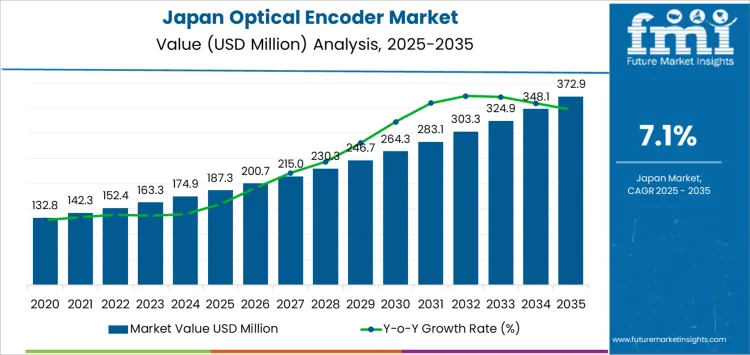
The demand for optical encoder in Japan is valued at USD 187.3 million in 2025 and is projected to reach USD 372.9 million by 2035, reflecting a CAGR of 7.1%. The historical rise from USD 132.8 million in 2020 to USD 187.3 million in 2025 indicates strengthening demand from factory automation and precision motion systems. Shafted and hollow shaft configurations together account for most unit shipments due to compatibility with existing motor and drive assemblies. Consumer electronics and semiconductor manufacturing equipment represent a major application base, supported by stable capital spending on production tools. Robotics equipment also contributes rising volumes as motion feedback accuracy remains central to repeatable industrial tasks. Early phase adoption reflects structured upgrades of motion platforms rather than broad equipment replacement across all sectors.
From 2026 onward, demand increases from USD 200.7 million to USD 283.1 million by 2030, then advances to USD 372.9 million by 2035 through widening annual increments. Robotics becomes the largest single application as encoder density per system increases within articulated and collaborative platforms. Healthcare equipment maintains steady demand for diagnostic and surgical positioning systems where motion accuracy remains critical. Test and measurement equipment contributes periodic procurement linked to calibration cycles. Absolute and multi turn formats gain share in applications requiring continuous position tracking after power loss. After 2030, value growth reflects both unit volume expansion and gradual shifts toward higher specification encoders. Annual value additions widen steadily, indicating rising spend intensity across precision engineering, automation, and motion control systems in Japan.
Quick Stats of the Demand for Optical Encoder in Japan
- Demand for Optical Encoder in Japan Value (2025): USD 187.3 million
- Demand for Optical Encoder in Japan Forecast Value (2035): USD 372.9 million
- Demand for Optical Encoder in Japan Forecast CAGR (2025-2035): 7.1%
- Demand for Optical Encoder in Japan Leading Configuration: Shafted (35%)
- Demand for Optical Encoder in Japan Key Growth Regions: Kyushu & Okinawa, Kanto, Kansai
- Demand for Optical Encoder in Japan Top Players: Renishaw plc, Heidenhain GmbH, Rockwell Automation, Dynapar Corporation, Sensata Technologies
What is the Growth Forecast for Optical Encoder in Japan through 2035?
During the early phase from 2020 to 2025, demand for optical encoders in Japan increased from USD 132.8 million to USD 187.3 million, reflecting a moderate annual expansion driven by steady investments in factory automation, CNC machinery, and electronics assembly equipment. Growth in this period remained controlled due to cautious capital spending following global industrial slowdowns and supply chain adjustments. Encoder demand was primarily supported by replacement of legacy motion sensors and incremental upgrades in robotics used across automotive and electronics manufacturing. Adoption during this phase focused on improving positional accuracy rather than large scale capacity expansion across production facilities.
From 2025 to 2030, demand rises from USD 187.3 million to USD 264.3 million, indicating a visibly faster pace of expansion. This shift is linked to rising automation intensity across battery manufacturing, semiconductor equipment, and precision tooling industries. Motion feedback density per machine increases as multi axis systems become more common across compact production environments. From 2030 to 2035, demand accelerates further from USD 264.3 million to USD 372.9 million, supported by advanced robotics, inspection systems, and high speed motion platforms used in export oriented industrial equipment manufacturing.
Optical Encoder Industry in Japan Key Takeaways
| Metric | Value |
|---|---|
| Industry Value (2025) | USD 187.3 million |
| Forecast Value (2035) | USD 372.9 million |
| Forecast CAGR (2025-2035) | 7.1% |
What Is Driving the Demand for Optical Encoders in Japan Across Historical and Future Growth Phases?
Demand for optical encoders in Japan built momentum as domestic manufacturing and automation sectors expanded. Industries such as automotive, robotics, precision machinery and electronics relied on encoders for accurate motion control, positioning and feedback. Standard manufacturing lines, CNC machines, factory robotics, and conveyor systems incorporated encoders to maintain tight tolerances and stable output. Demand depended on reliability, precision, and durability under typical industrial conditions. Domestic suppliers and specialized vendors served much of the demand because of Japan’s established base in precision engineering. Market growth closely tracked production levels in heavy industry, automotive output, electronics manufacturing and industrial capital-goods investment cycles.
Demand for optical encoders in Japan is likely to increase further as automation intensifies, smart factories spread, and high-precision machinery use rises. Growth in robotics deployment, electric vehicle manufacturing, semiconductor fabrication, and industrial IoT systems generates demand for high-resolution, compact, and digitally interfaced encoders. Applications in medical devices, robotics, automated inspection systems, and advanced drive systems favor optical encoders because of high accuracy and repeatability. Demand will often target absolute encoders with digital output and resilient designs. Buyers will value low-maintenance, high-precision encoders compatible with networked control systems. Suppliers focusing on miniaturization, environmental resilience, and integration with automation platforms are likely to see continued demand.
What Is the Demand for Optical Encoder in Japan by Configuration and Output Signal Format?
The demand for optical encoder in Japan is shaped by factory automation expansion, robotics deployment, and high precision motion control requirements across manufacturing and transport equipment. Shafted configuration leads by configuration due to its broad compatibility with legacy drives and rotary systems. Shafted output signal format also leads by output signal format as many industrial systems continue to rely on direct rotational feedback architectures. Procurement is driven by robotics manufacturers, CNC machine builders, and motion control system integrators. Import reliance remains present for high resolution code disks and photo sensor arrays. Substitution pressure exists from magnetic encoders in harsh environments. Demand stability is supported by steady capital equipment production and automation investment.
Why does shafted configuration account for 35% of the demand for optical encoder in Japan by configuration?
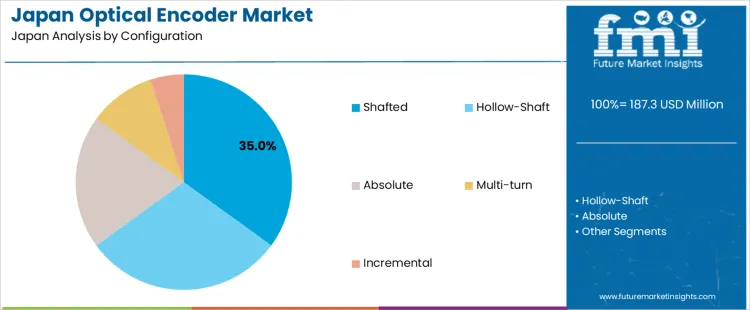
Shafted configuration accounts for 35% of the demand for optical encoder in Japan by configuration, reflecting its widespread use in motors, actuators, and rotary tables used across automated equipment. Consumption intensity is driven by servo motor feedback, conveyor positioning, and spindle speed monitoring. Usage remains stable because shafted encoders offer direct mechanical coupling and consistent rotational accuracy. Procurement is led by machine tool producers, industrial robot makers, and motion control OEMs. Price sensitivity remains moderate because feedback accuracy directly affects product quality and cycle time control. Specification control emphasizes shaft concentricity tolerance, bearing life, vibration resistance, and resolution stability under continuous high speed operation.
Shafted encoders also generate steady repeat demand through equipment replacement cycles and spindle refurbishment programs. Repeat utilization remains predictable as worn encoders are replaced during scheduled machine overhauls. Buyers favor standardized shaft diameters and mounting patterns to simplify interchangeability across equipment platforms. Margin structure remains controlled under competition among domestic and international encoder suppliers. Regulatory exposure centers on industrial safety compliance and electromagnetic compatibility certification. Import reliance persists for precision bearings and optical sensing elements. Substitution pressure from hollow shaft models remains present in compact drive systems where space constraints dominate.
Why does shafted output signal format represent 35.0% of the demand for optical encoder in Japan by output signal format?
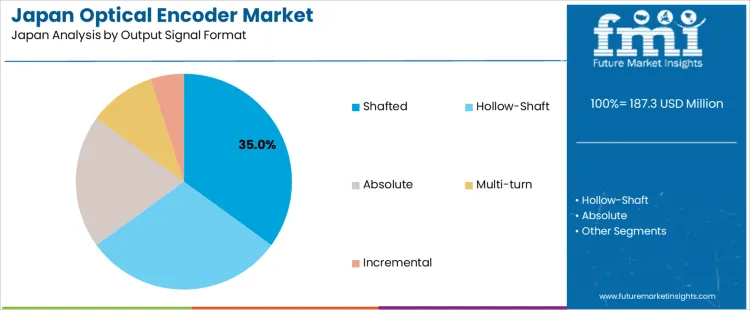
Shafted output signal format represents 35.0% of the demand for optical encoder in Japan by output signal format, reflecting continued reliance on direct rotary output feedback in automation systems. Consumption intensity is driven by motor speed control, axis positioning, and rotational synchronization across packaging, semiconductor, and automotive assembly equipment. Usage remains stable because shaft based output ensures low signal loss and consistent phase alignment. Procurement is dominated by automation OEMs and drive control suppliers integrating encoders at the motor assembly stage. Price sensitivity remains moderate because signal stability affects closed loop control accuracy. Specification control emphasizes output waveform integrity, phase offset stability, noise immunity, and connector reliability under industrial duty.
Shafted output formats also generate consistent repeat demand through motor replacement programs and controller upgrades. Repeat utilization remains predictable as feedback devices are bundled with new servo and stepper motor installations. Buyers favor proven output signal standards to maintain compatibility with existing PLC and drive architectures. Margin structure remains controlled under long term supply agreements with machine builders. Regulatory exposure centers on electrical safety and industrial communication standards. Import reliance persists for signal conditioning ICs and optical transmitter components. Substitution pressure from absolute and multi turn digital formats increases in high precision robotics, though shafted output remains dominant in general industrial motion control.
What Is Driving the Demand for Optical Encoder in Japan Precision Motion Control and Automation Reliability?
Demand for optical encoder in Japan reflects high reliance on precision motion across robotics, machine tools, semiconductor equipment, and transport systems. Factories require accurate position feedback for cutting, alignment, and inspection tasks where micron level error causes yield loss. Rail systems use encoders for speed control, braking logic, and door timing. Packaging lines track rotation for filling accuracy. Buyers prioritize resolution stability, vibration tolerance, and long life under continuous duty. Demand follows capital equipment renewal programs and automation retrofits rather than consumer electronics volume cycles across industrial production zones nationwide today especially in precision export manufacturing corridors with schedule discipline.
How Is Hybrid Manufacturing and Robotics Expanding Encoder Requirements in Japan?
Japan factories integrate robots with vision systems and servo motors that require continuous position feedback across multiple axes. Optical encoders supply rotation data for pick placement, welding, and surface finishing tasks where repeatability defines output quality. Automotive body lines use encoders to synchronize motion between presses and transfer units. Warehousing robots track lift height and wheel speed under variable load. These uses raise resolution and noise immunity requirements. Demand links directly to robotics penetration across assembly, intralogistics, and inspection rather than to manual line substitution alone in engineering driven production clusters nationwide today supporting sustained encoder upgrades within core automation.
Why Are Semiconductor and Electronics Plants Sustaining High Precision Encoder Demand in Japan?
Semiconductor fabs in Japan rely on optical encoders for wafer handling, lithography staging, and inspection positioning under nanometer tolerances. Encoders guide reticle movement, vacuum transfer arms, and probe stations where vibration control protects yield. Flat panel display lines use encoders to align glass substrates during deposition and cutting stages. Cleanroom motors require low outgassing and thermal drift characteristics. Equipment uptime links directly to encoder bearing quality and signal filtering. Demand follows fab upgrade schedules and equipment tool refresh waves rather than short consumer electronics cycles within export oriented electronics manufacturing programs nationwide today driven by foundry investment pacing and process.
How Do Cost, Qualification, and Environmental Stress Limit Wider Encoder Adoption in Japan?
Optical encoder demand in Japan faces limits tied to qualification depth, cost discipline, and harsh operating conditions. Equipment builders require long validation cycles under heat, vibration, dust, and oil mist exposure. Entry suppliers face approval hurdles tied to controller compatibility and safety certification audits. Price pressure from export competition limits margin room for frequent design changes. Miniaturization raises sensitivity to contamination within compact housings. Sealed encoder units carry higher cost that slows uptake in low margin machines. These factors concentrate adoption in performance critical equipment rather than across every general purpose motor application nationwide today under standard factory retrofit programs.
What is the Demand for Optical Encoder in Japan by Region?
| Region | CAGR (%) |
|---|---|
| Kyushu & Okinawa | 8.9% |
| Kanto | 8.2% |
| Kansai | 7.2% |
| Chubu | 6.3% |
| Tohoku | 5.6% |
| Rest of Japan | 5.3% |
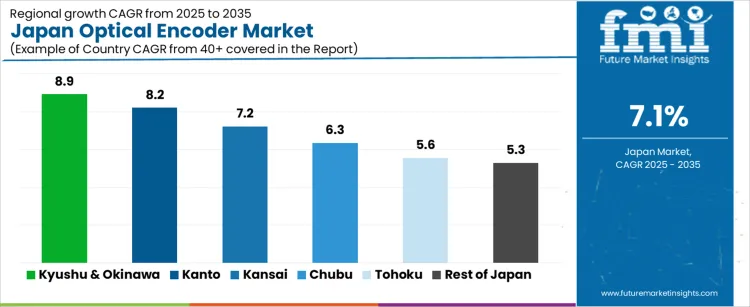
The demand for optical encoders in Japan is expanding steadily across automation and precision manufacturing regions, led by Kyushu and Okinawa at an 8.9% CAGR. Growth in this region is supported by semiconductor equipment production, factory automation upgrades, and rising deployment in robotics and motion control systems. Kanto follows at 8.2%, driven by dense clusters of electronics manufacturers, industrial automation firms, and high integration in CNC machinery and smart factories. Kansai records 7.2% growth, reflecting stable adoption in packaging machinery, robotics, and industrial inspection equipment. Chubu at 6.3% shows moderate uptake linked to automotive production lines and motor control systems. Tohoku and the Rest of Japan, at 5.6% and 5.3%, reflect slower growth shaped by smaller automation clusters, conservative capital spending, and longer equipment replacement cycles.
How Is Factory Automation Expansion Driving Optical Encoder Demand in Kyushu and Okinawa?
Demand for optical encoder in Kyushu and Okinawa is advancing at a CAGR of 8.9% through 2035, supported by rising adoption of automation in manufacturing plants, logistics hubs, and port handling equipment. Regional industries apply optical encoders in conveyor systems, robotic arms, and packaging lines to improve positional accuracy and motion control. Renewable energy installations also use encoders for turbine pitch control. Growth reflects rising investment in smart factory upgrades, port modernization programs, and steady integration of precision motion components across automated production environments.
- Port automation supports continuous encoder installation
- Robotic material handling drives motion sensing demand
- Packaging line automation expands encoder usage
- Renewable energy equipment adds secondary application volume
Why Is Advanced Manufacturing Density Sustaining Optical Encoder Growth in Kanto?
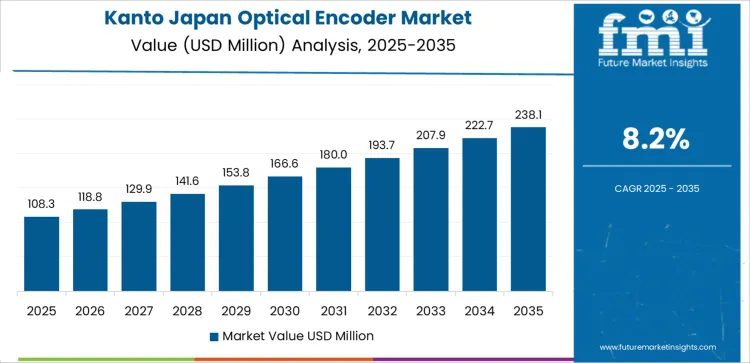
Demand for optical encoder in Kanto is rising at a CAGR of 8.2% through 2035, driven by dense electronics manufacturing, semiconductor fabrication, and extensive robotics deployment across industrial clusters. Precision assembly lines rely on encoders for feedback control, speed regulation, and axis synchronization. Automation integrators record steady order volumes from automotive electronics and industrial machinery producers. Growth reflects strong capital investment in smart manufacturing, rising use of collaborative robots, and continuous upgrades of motion control systems across high throughput production facilities.
- Semiconductor equipment drives high precision encoder demand
- Collaborative robots rely on real time positional feedback
- Factory upgrades sustain steady replacement cycles
- Electronics assembly lines support volume driven installations
What Is Supporting Balanced Optical Encoder Adoption Across Kansai Industrial Facilities?
Demand for optical encoder in Kansai is progressing at a CAGR of 7.2% through 2035, supported by steady output from machinery manufacturing, food processing automation, and pharmaceutical production lines. Kansai industries apply encoders in bottling systems, material transfer equipment, and inspection stations to maintain speed consistency and quality control. Adoption remains balanced between rotary and linear encoder formats. Growth reflects controlled automation spending, compliance with production accuracy standards, and stable industrial equipment upgrade programs.
- Bottling and packaging lines drive encoder integration
- Material transfer systems rely on speed feedback control
- Rotary and linear encoders show balanced market use
- Industrial retrofits support steady procurement activity
How Is Automotive and Equipment Manufacturing Shaping Optical Encoder Demand in Chubu?
Demand for optical encoder in Chubu is advancing at a CAGR of 6.3% through 2035, supported by automotive production lines, machining centers, and precision equipment manufacturing. Encoders are applied in CNC machines, robotic welding stations, and automated inspection systems to control tool positioning and component alignment. Industrial robotics suppliers report steady regional demand. Growth reflects stable vehicle production volumes, continuous modernization of machining equipment, and rising adoption of closed loop motor control systems across precision manufacturing operations.
- CNC machining centers sustain continuous encoder demand
- Robotic welding requires accurate position feedback
- Automotive assembly lines apply multi axis motion sensing
- Tool alignment systems expand high resolution encoder use
Why Is Industrial Scale and Infrastructure Limiting Optical Encoder Growth in Tohoku?
Demand for optical encoder in Tohoku is advancing at a CAGR of 5.6% through 2035, supported by selective automation in food processing plants, utility infrastructure, and regional manufacturing units. Encoders are used in pumping stations, conveyor belts, and material sorting systems. Large scale robotics adoption remains limited. Growth reflects moderate industrial investment levels, steady public infrastructure upgrades, and gradual replacement of mechanical sensors with digital motion feedback components across essential processing facilities.
- Utility pumping systems apply position monitoring devices
- Conveyor automation supports basic encoder installation
- Public infrastructure upgrades guide steady equipment demand
- Mechanical sensor replacement supports gradual adoption
How Is Small Industry Automation Influencing Optical Encoder Demand in Rest of Japan?
Demand for optical encoder in Rest of Japan is advancing at a CAGR of 5.3% through 2035, supported by small scale factory automation, woodworking machinery upgrades, and gradual expansion of precision control in regional manufacturing workshops. These areas apply encoders in basic motor drives, cutting equipment, and automated inspection tools. High end robotics adoption remains limited. Growth remains steady and guided by local factory modernization efforts, technician training programs, and gradual transition from manual to semi-automated production processes.
- Small workshops adopt encoders for basic motion control
- Woodworking and cutting machines drive entry level demand
- Technician training supports correct installation practices
- Semi automation projects guide steady growth patterns
What Is Driving the Demand for Optical Encoder in Japan and Which Companies Shape Industrial Deployment?
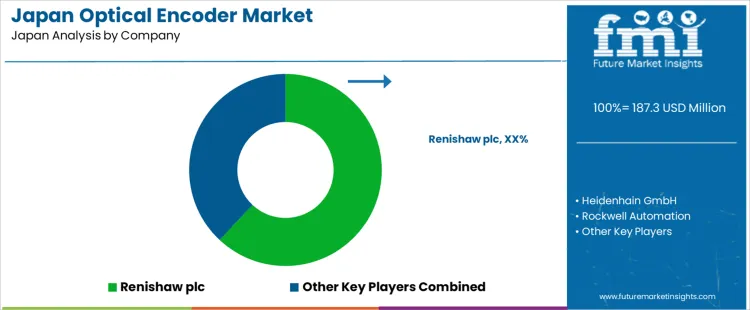
The demand for optical encoders in Japan is shaped by steady expansion of factory automation, robotics deployment, precision machine tools, and semiconductor manufacturing equipment. Mitutoyo holds a central domestic position through high resolution linear and rotary encoders used in coordinate measuring machines and CNC platforms. Tamagawa Seiki supports demand through resolvers and optical encoders supplied to industrial robots, servo motors, and aerospace systems. Nikon contributes through precision metrology encoders used in lithography stages and inspection equipment. Heidenhain GmbH maintains strong adoption through ultra-high accuracy encoders used in multi axis machining centers and advanced motion control systems. Renishaw participates through encoder feedback systems used in precision positioning and additive manufacturing platforms adopted by research and industrial users across manufacturing clusters.
Rockwell Automation supports demand through encoder integration within programmable automation and motion control systems used in automotive assembly and packaging lines. Dynapar Corporation participates through heavy duty encoders used in conveyors, cranes, and steel processing equipment operated by industrial groups. Sensata Technologies supports niche applications through position sensing platforms used in transportation and industrial safety systems. System selection in Japan is governed by resolution accuracy, temperature stability, vibration tolerance, and long cycle reliability under continuous operation. Buyer preference favors suppliers with domestic calibration support, rapid failure analysis, and compatibility with third party servo and controller platforms. Demand visibility tracks capital investment in robotics, semiconductor fabrication equipment expansion, renewable energy drive systems, and continued modernization of machining facilities across major industrial prefectures.
Key Players in the Optical Encoder Industry in Japan
- Renishaw plc
- Heidenhain GmbH
- Rockwell Automation
- Dynapar Corporation
- Sensata Technologies
Scope of the Report
| Items | Values |
|---|---|
| Quantitative Units (2025) | USD million |
| Type | Shafted, Hollow Shaft, Absolute, Multi turn, Incremental |
| Application | Healthcare Equipment, Consumer Electronics and Semiconductor Manufacturing Equipment, Robotics Equipment, Test and Measurement Equipment |
| End User | Robotics OEMs, CNC and Machine Tool Builders, Semiconductor and Electronics Equipment Manufacturers, Healthcare and Diagnostic Equipment Producers, Motion Control System Integrators |
| Regions Covered | Kyushu and Okinawa, Kanto, Kansai, Chubu, Tohoku, Rest of Japan |
| Countries Covered | Japan |
| Key Companies Profiled | Mitutoyo, Tamagawa Seiki, Nikon, Renishaw plc, Heidenhain GmbH, Rockwell Automation, Dynapar Corporation, Sensata Technologies |
| Additional Attributes | Dollar sales by configuration and output signal format, demand from factory automation, robotics, semiconductor and precision machining applications, replacement driven demand under capital equipment refresh cycles, technical requirements for high resolution, vibration tolerance, and temperature stability, increasing encoder density per robot and motion axis, regional growth linked to semiconductor equipment, smart factory upgrades, and automotive production lines |
Optical Encoder Industry in Japan Segmentation
Configuration:
- Shafted
- Hollow-Shaft
- Absolute
- Multi-turn
- Incremental
Output Signal Format:
- Shafted
- Hollow-Shaft
- Absolute
- Multi-turn
- Incremental
Application:
- Healthcare Equipment
- Consumer Electronics and Semiconductor Manufacturing Equipment
- Robotics Equipment
- Test & Measurement Equipment
Region:
- Kyushu & Okinawa
- Kanto
- Kansai
- Chubu
- Tohoku
- Rest of Japan
Frequently Asked Questions
How big is the demand for optical encoder in Japan in 2025?
The demand for optical encoder in Japan is estimated to be valued at USD 187.3 million in 2025.
What will be the size of optical encoder in Japan in 2035?
The market size for the optical encoder in Japan is projected to reach USD 372.9 million by 2035.
How much will be the demand for optical encoder in Japan growth between 2025 and 2035?
The demand for optical encoder in Japan is expected to grow at a 7.1% CAGR between 2025 and 2035.
What are the key product types in the optical encoder in Japan?
The key product types in optical encoder in Japan are shafted, hollow-shaft, absolute, multi-turn and incremental.
Which output signal format segment is expected to contribute significant share in the optical encoder in Japan in 2025?
In terms of output signal format, shafted segment is expected to command 35.0% share in the optical encoder in Japan in 2025.
Preview the report firsthand - request a free sample
Get SampleGet the brochure for pricing and purchase details.
Get PDFTable of Content
- Executive Summary
- Japan Market Outlook
- Demand-side Trends
- Supply-side Trends
- Technology Roadmap Analysis
- Analysis and Recommendations
- Market Overview
- Market Coverage / Taxonomy
- Market Definition / Scope / Limitations
- Market Background
- Market Dynamics
- Drivers
- Restraints
- Opportunity
- Trends
- Scenario Forecast
- Demand in Optimistic Scenario
- Demand in Likely Scenario
- Demand in Conservative Scenario
- Opportunity Map Analysis
- Product Life Cycle Analysis
- Supply Chain Analysis
- Investment Feasibility Matrix
- Value Chain Analysis
- PESTLE and Porter’s Analysis
- Regulatory Landscape
- Regional Parent Market Outlook
- Production and Consumption Statistics
- Import and Export Statistics
- Market Dynamics
- Japan Market Analysis 2020 to 2024 and Forecast, 2025 to 2035
- Historical Market Size Value (USD Million) Analysis, 2020 to 2024
- Current and Future Market Size Value (USD Million) Projections, 2025 to 2035
- Y-o-Y Growth Trend Analysis
- Absolute $ Opportunity Analysis
- Japan Market Pricing Analysis 2020 to 2024 and Forecast 2025 to 2035
- Japan Market Analysis 2020 to 2024 and Forecast 2025 to 2035, By Configuration
- Introduction / Key Findings
- Historical Market Size Value (USD Million) Analysis By Configuration , 2020 to 2024
- Current and Future Market Size Value (USD Million) Analysis and Forecast By Configuration , 2025 to 2035
- Shafted
- Hollow-Shaft
- Absolute
- Multi-turn
- Incremental
- Y-o-Y Growth Trend Analysis By Configuration , 2020 to 2024
- Absolute $ Opportunity Analysis By Configuration , 2025 to 2035
- Japan Market Analysis 2020 to 2024 and Forecast 2025 to 2035, By Output Signal Format
- Introduction / Key Findings
- Historical Market Size Value (USD Million) Analysis By Output Signal Format, 2020 to 2024
- Current and Future Market Size Value (USD Million) Analysis and Forecast By Output Signal Format, 2025 to 2035
- Shafted
- Hollow-Shaft
- Absolute
- Multi-turn
- Incremental
- Y-o-Y Growth Trend Analysis By Output Signal Format, 2020 to 2024
- Absolute $ Opportunity Analysis By Output Signal Format, 2025 to 2035
- Japan Market Analysis 2020 to 2024 and Forecast 2025 to 2035, By Application
- Introduction / Key Findings
- Historical Market Size Value (USD Million) Analysis By Application, 2020 to 2024
- Current and Future Market Size Value (USD Million) Analysis and Forecast By Application, 2025 to 2035
- Healthcare Equipment
- Consumer Electronics and Semiconductor Manufacturing Equipment
- Robotics Equipment
- Test & Measurement Equipment
- Y-o-Y Growth Trend Analysis By Application, 2020 to 2024
- Absolute $ Opportunity Analysis By Application, 2025 to 2035
- Market Structure Analysis
- Competition Dashboard
- Competition Benchmarking
- Market Share Analysis of Top Players
- By Regional
- By Configuration
- By Output Signal Format
- By Application
- Competition Analysis
- Competition Deep Dive
- Renishaw plc
- Overview
- Product Portfolio
- Profitability by Market Segments (Product/Age /Sales Channel/Region)
- Sales Footprint
- Strategy Overview
- Marketing Strategy
- Product Strategy
- Channel Strategy
- Heidenhain GmbH
- Rockwell Automation
- Dynapar Corporation
- Sensata Technologies
- Renishaw plc
- Competition Deep Dive
- Assumptions & Acronyms Used
- Research Methodology


