

- Industry Size (2025)
- USD 1.3 Bn
- Forecast (2035)
- USD 3.1 Bn
- CAGR (2025 to 2035)
- 9.0%
Demand for Optical Encoder in USA 2025 to 2035
Demand for optical encoder in USA is valued at USD 1.3 billion in 2025 and is projected to reach USD 3.1 billion by 2035, recording a CAGR of 9.0%. Expansion is supported by sustained investment in industrial automation, factory modernization, and advanced manufacturing across automotive, electronics, and semiconductor supply chains. Broader deployment of automation in energy systems, healthcare equipment manufacturing, and autonomous platform development continues to strengthen long-term market consumption.
Regional demand remains concentrated in the West, South, and Northeast, where high-density manufacturing corridors, technology clusters, and capital spending on automated production systems are well established. These regions account for a large share of installed automation infrastructure and ongoing retrofit activity. Competitive landscape is shaped by global and domestic suppliers such as Renishaw plc, Heidenhain GmbH, Rockwell Automation, Dynapar Corporation, and Sensata Technologies. Market competition centers on scale of supply, integration with automation ecosystems, long-term supply contracts, and alignment with OEM and system integrator requirements across industrial and high-precision manufacturing sectors.
Quick Stats for USA Optical Encoder Demand
- USA Optical Encoder Sales Value (2025): USD 1.3 billion
- USA Optical Encoder Forecast Value (2035): USD 3.1 billion
- USA Optical Encoder Forecast CAGR (2025–2035): 9.0%
- Leading Configuration in USA Optical Encoder Demand: Shafted
- Key Growth Regions in USA Optical Encoder Demand: West USA, South USA, Northeast USA
- Top Players in USA Optical Encoder Demand: Renishaw plc, Heidenhain GmbH, Rockwell Automation, Dynapar Corporation, Sensata Technologies
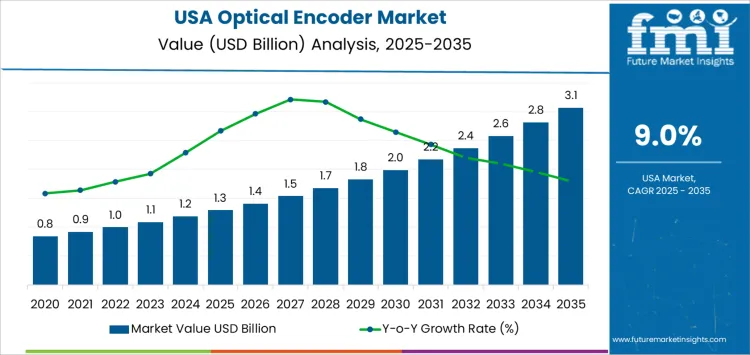
What is the Growth Forecast for Optical Encoder Industry in USA through 2035?
Demand for optical encoders in the United States follows a cycle shaped by automation spending and capital equipment refresh rates. Peak growth potential aligns with investment in robotics, semiconductor machinery, and precision motion control in industrial environments. Uptime improvement, higher positioning accuracy, and feedback reliability support strong early cycle momentum as factories expand automation footprints. Growth reaches a high point when multi-sector manufacturing utilization remains strong and supply chains invest in domestic advanced production.
Trough tendencies emerge when spending slows in machine tools and electronic assembly lines due to delayed capital upgrades. Budget adjustments in automotive and aerospace production reduce near-term procurement cycles. Price sensitivity in mid-scale factories also shifts preference to incremental retrofits rather than replacement of entire encoder systems. The trough does not signal structural weakness because operational reliability needs persist.
Recovery from trough periods is steady since maintenance requirements and accuracy standards create unavoidable demand. Peak phases return when federal incentives for reshoring and digital transformation resume impact across industrial ecosystems. The overall pattern indicates periodic dips, yet the depth remains moderated by continued adoption of closed-loop control systems and rising deployment of automation in logistics and medical device manufacturing in the United States.
USA Optical Encoder Key Takeaways
| Metric | Value |
|---|---|
| USA Optical Encoder Sales Value (2025) | USD 1.3 billion |
| USA Optical Encoder Forecast Value (2035) | USD 3.1 billion |
| USA Optical Encoder Forecast CAGR (2025-2035) | 9.0% |
Why is the Demand for Optical Encoders in the USA Growing?
Demand for optical encoders in the USA is rising because manufacturing, robotics, automation and medical-device industries require precise position and speed feedback for motion control systems. Modern automated lines in automotive, semiconductor and packaging plants increasingly rely on high-resolution encoders to guide robots, conveyors and CNC machines. Consistent accuracy and repeatable performance help reduce errors and improve throughput.
The growth in robotics, including warehouse automation, pick-and-place systems and collaborative robots strengthens need for compact and reliable encoders. Design engineers specify optical encoders to support high speed motion with minimal backlash. Medical imaging equipment and surgical robots also boost demand due to strict requirements for smooth, accurate movement in sensitive environments.
Maintenance and retrofitting of existing equipment contribute to steady replacement demand as older sensors wear or fail. Users value optical encoders for long service life, resistance to electrical noise and compatibility with digital control systems. Availability of low-cost, high-speed models supports adoption even among small to mid-size manufacturers. Challenges include cost sensitivity in low-margin applications and need for integration skills when upgrading legacy systems. Some operations might delay encoder upgrades until mechanical or control-system overhauls are justified.
Which Configurations, Output Signal Formats, and Applications Lead Demand for Optical Encoders in the United States?
Demand for optical encoders in the United States is supported by precision-motion requirements in advanced automation. Adoption aligns with robotics expansion, semiconductor fabrication equipment, medical devices, and industrial positioning systems. Manufacturers emphasize high resolution, reduced maintenance, and compatibility with high-speed feedback environments. Growth reflects investments in automated assembly lines, robotic arms, and smart diagnostic equipment used in healthcare and consumer electronics production.
By Configuration, Shafted Encoders Hold the Largest Share
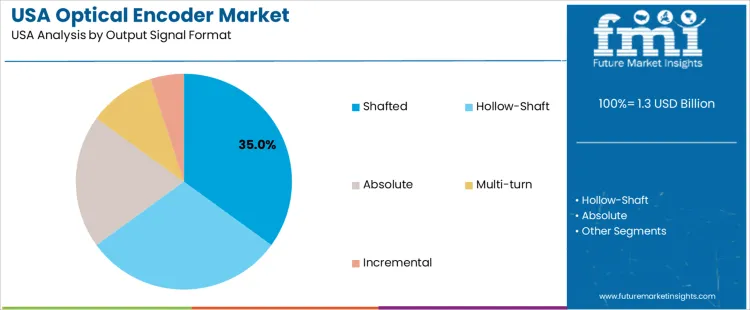
Shafted encoders account for 35.0%. Their widespread use reflects strong reliability and easier integration into industrial automation shafts that demand precise rotational measurements. Hollow-shaft encoders hold 30.0%. These designs reduce mechanical couplings and support compact equipment requiring simplified installation. Absolute encoders represent 20.0%, addressing high-accuracy needs in advanced electronics, robotic navigation, and patient-care instruments. Multi-turn encoders hold 10.0%, useful where rotational data retention during power loss is critical. Incremental units hold 5.0%, supporting legacy systems and lower-cost installations.
Key Points:
- Shafted types support multiple industrial motion-control systems
- Hollow-shaft types allow faster mounting with reduced alignment errors
- Absolute and multi-turn types enable position retention in advanced controls
By Output Signal Format, Shafted Signals Lead Demand
Output formats follow the same distribution as configuration due to aligned industrial adoption. Shafted output signaling maintains 35.0%. Hollow-shaft format holds 30.0% for integrated automation lines. Absolute signals represent 20.0%, prioritized for accuracy in sensitive positioning assemblies. Multi-turn signals account for 10.0%, applied in equipment requiring full rotation tracking memory. Incremental signaling holds 5.0%, focused on lower-precision environments.
Key Points:
- Output needs closely match encoder hardware structure
- Precise feedback supports automation and semiconductor tools
- Multi-turn signals ensure motion continuity in safety-critical systems
By Application, Robotics Equipment Leads Demand
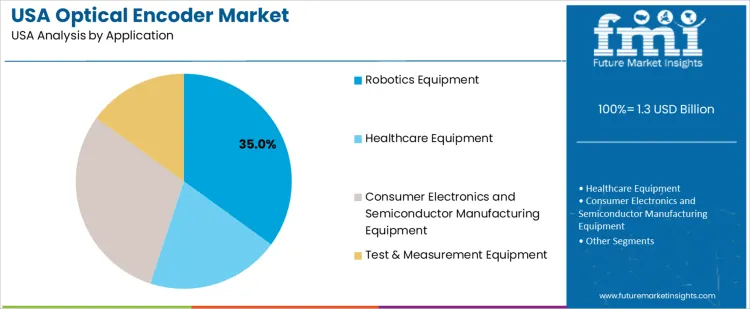
Robotics equipment represents 35.0%. Automated machinery requires consistent position feedback for actuators, end-effectors, and navigation systems. Consumer electronics and semiconductor manufacturing equipment follow at 30.0%, where placement accuracy and micro-motion control guide adoption. Healthcare equipment accounts for 20.0%, reflecting usage in imaging systems and surgical devices. Test and measurement equipment holds 15.0%, requiring precision tracking of rotational and linear adjustments.
Key Points:
- Robotics expansion drives rising encoder installations
- Semiconductor equipment ensures sub-micron precision in device fabrication
- Healthcare applications secure stable motion in patient-focused technologies
What are the Key Dynamics in the Optical Encoder Industry?
Growth of automation in manufacturing, wider adoption in robotics and increased demand in motion-controlled equipment drive demand.
In the United States, optical encoders support precision feedback in automated machinery used in automotive components, aerospace structures and electronic assembly lines. Robotics adoption rises in warehouse fulfillment, food processing and metal fabrication, creating steady procurement for rotary and linear encoders that guide repeatable movement. Semiconductor fabrication plants rely on high-accuracy motion systems that track wafer positioning during lithography steps. Electric vehicles require encoders in traction motors and steering modules to maintain controlled motion. Medical device manufacturers integrate encoders into imaging tables and robotic surgery systems to improve procedural accuracy. These industry applications maintain consistent sourcing from domestic automation suppliers and global encoder manufacturers.
High performance requirements, cost sensitivity in basic machinery and vulnerability to harsh operating conditions restrain faster expansion.
Precision encoders with advanced sensing and signal output raise equipment cost at a time when some buyers prioritize budget options. Small and mid-sized workshops extend service life of older machinery without feedback upgrades, reducing new installations in legacy facilities. Dust, oil and vibration exposure in heavy industries create maintenance needs that discourage selection of open-style optical units. Adoption in low-tech sectors proceeds slowly when manual processes remain adequate for profitability. These constraints influence purchasing decisions in segments that do not require advanced motion control.
Shift toward compact industrial designs, increased use in collaborative robots and rising integration with digital monitoring platforms define key trends.
Manufacturers deliver smaller encoders that fit into tight assemblies found in mobile robots and compact automation cells. Collaborative robot systems used in packaging, inspection and light assembly increase encoder usage due to safety-oriented motion precision. Industrial users adopt feedback solutions that support predictive maintenance and remote diagnostics through digital communication protocols. Growth in additive manufacturing, printed-circuit assembly and battery production expands demand for encoders capable of sub-micron resolution. Domestic investment in advanced manufacturing training supports higher encoder adoption as factories modernize equipment for consistent throughput. These developments indicate strong and technology-driven demand for optical encoders across the United States supported by automation upgrades, industrial productivity goals and precision motion requirements.
Analysis of the Demand for Optical Encoders in the USA by Region
Demand for optical encoders in the United States reflects ongoing automation expansion in motion control, industrial robotics, and semiconductor fabrication environments. Accuracy requirements in positioning systems drive procurement of advanced rotary and linear encoders. Medical equipment manufacturers integrate optical sensing into surgical robots and diagnostic platforms. Packaging machinery upgrades sustain baseline usage across food and consumer-goods facilities. West USA leads growth at 10.4% CAGR, followed by South USA at 9.3%, Northeast USA at 8.3%, and Midwest USA at 7.2%. Supply decisions evaluate environmental durability, resolution capability, and interface compatibility with automated equipment.
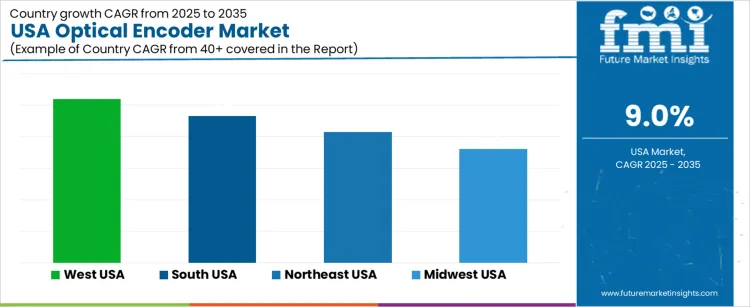
| Region | CAGR (2025-2035) |
|---|---|
| West USA | 10.4% |
| South USA | 9.3% |
| Northeast USA | 8.3% |
| Midwest USA | 7.2% |
How is the West USA driving demand for optical encoders?
West USA records 10.4% CAGR, driven by intensive automation programs throughout California and leading semiconductor hubs. Robotics manufacturers require high-resolution encoder systems for pick-and-place accuracy and production yield stability. Aerospace and tech-equipment companies enhance precision control in automated assembly lines, including optical scanning and advanced mechatronics. Medical-robot developers adopt compact encoder modules that support precise motion tracking in minimally invasive systems. Buyers prioritize encoder durability under fluctuating temperatures inside cleanrooms and controlled production spaces. Procurement standards include MTBF stability, signal noise resistance, and flexible digital-communication output for integration across multivendor control networks.
- Semiconductor automation boosting encoder usage
- Robotics and mechatronics supporting advanced positioning needs
- Medical-robot integration expanding unit volumes
- Environmental performance benchmarking guiding vendor selection
How is the South USA shaping demand?
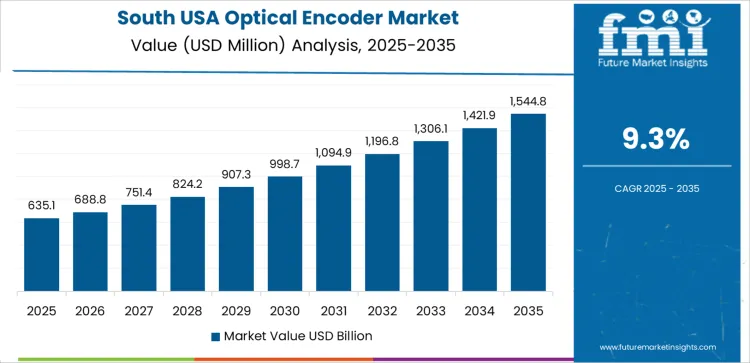
South USA posts 9.3% CAGR, supported by rapid automation in automotive production and expanding oil and gas equipment manufacturing. Encoder-based control systems enable smoother operations in drilling machinery and material-handling applications. Electric-vehicle component suppliers incorporate rotary encoders into powertrain assembly lines to maintain torque accuracy. Distribution centers deploy automated conveyors that depend on encoder feedback for synchronized movement. Buyers evaluate encoder housings that resist vibration and contaminants encountered in industrial environments.
- Automotive manufacturing reinforcing consistent encoder consumption
- Energy-equipment operations requiring vibration-resistant designs
- Conveyor automation driving positioning reliability
- Procurement focused on ruggedized enclosures and stable feedback
How is the Northeast USA influencing encoder adoption?
Northeast USA delivers 8.3% CAGR, influenced by precision manufacturing, medical-technology expansion, and laboratory instrumentation upgrades. Life-science instrument builders embed encoders into micro-motion stages for analytical accuracy. Regional packaging firms automate labeling and sealing processes where displacement tracking improves throughput. Research institutions assess encoder repeatability to maintain test integrity across high-precision mechanical systems. Buyers request calibration support and compatibility with industrial Ethernet protocols for seamless equipment integration.
- Precision tooling and life-science devices using micro-stage encoders
- Packaging automation supporting synchronized movement accuracy
- Calibration requirements shaping validation procedures
- Ethernet-ready communication aiding system integration
How is the Midwest USA contributing to ongoing demand?
Midwest USA grows at 7.2% CAGR, reflecting modernization in agricultural machinery, material processing, and general industrial manufacturing. Rotary encoders enable stable motion feedback in CNC systems used widely across machine shops. Food-processing facilities upgrade motion-control systems to maintain efficiency and safety requirements. Procurement teams emphasize cost consistency, long operational life, and replacement accessibility through regional distributors. Encoder form factors must remain compatible with established drive and control architectures.
- CNC modernization driving incremental adoption
- Processing facilities ensuring reliable automated throughput
- Cost stability and lifecycle assurance influencing purchase priorities
- Distributor presence supporting maintenance availability
What is the competitive landscape of demand for optical encoders in the United States?
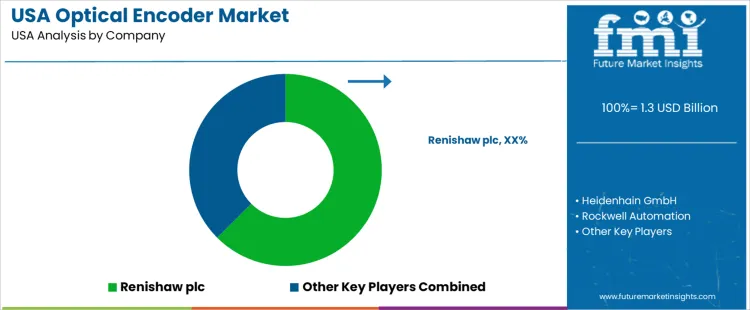
Demand for optical encoders in the United States is closely tied to automation intensity across semiconductor fabrication, robotics, CNC machining, aerospace assembly, and medical equipment motion control. Purchasing behavior is shaped by expectations around consistent feedback accuracy, resistance to contamination, and calibration stability during continuous operation. Procurement decisions place emphasis on documented performance records, customization capability, and access to localized technical support from manufacturers that work closely with USA-based system integrators.
Renishaw plc maintains a leading position in the United States through deep penetration in precision machining, coordinate metrology, and automated inspection platforms used by industrial and defense manufacturers. Its strong alignment with advanced motion systems and calibration workflows has created long -term dependency among high-precision users. Heidenhain GmbH remains well positioned among machine tool builders and semiconductor manufacturers, where predictable thermal behavior and repeatable axis accuracy are required in controlled production environments. Rockwell Automation participates through integrated motion feedback embedded within industrial drives and programmable automation architectures used across USA production lines. Dynapar Corporation addresses demand from industrial facilities operating in harsh environments, where reliability, rugged housings, and retrofit compatibility influence buying decisions. Sensata Technologies serves niche demand linked to aerospace and medical applications that prioritize compact form factors, quality traceability, and regulatory compliance.
Competitive differentiation across the USA market is defined by long-term resolution stability, protection against dust and fluids, configuration flexibility for multi-axis systems, and availability of application engineering resources within key manufacturing regions. Suppliers demonstrating strong lifecycle support and dependable delivery performance retain stronger positioning across ongoing demand for optical encoders in the United States.
Key Players in USA Optical Encoder Demand
- Renishaw plc
- Heidenhain GmbH
- Rockwell Automation
- Dynapar Corporation
- Sensata Technologies
Scope of the Report
| Items | Values |
|---|---|
| Quantitative Units | USD billion |
| Configuration | Shafted, Hollow-Shaft, Absolute, Multi-turn, Incremental |
| Output Signal Format | Shafted, Hollow-Shaft, Absolute, Multi-turn, Incremental |
| Application | Robotics Equipment, Healthcare Equipment, Consumer Electronics and Semiconductor Manufacturing Equipment, Test & Measurement Equipment |
| Regions Covered | West USA, South USA, Northeast USA, Midwest USA |
| Key Companies Profiled | Renishaw plc, Heidenhain GmbH, Rockwell Automation, Dynapar Corporation, Sensata Technologies |
| Additional Attributes | Dollar sales by encoder configuration, output signal format, and application; demand trends in industrial automation and robotics across USA manufacturing; regional adoption in semiconductor and healthcare equipment sectors; technological advances in high-resolution sensing, multi-turn measurement, and rugged encoder design; integration with Industry 4.0, motion control, and closed-loop feedback systems. |
USA Optical Encoder Demand by Segments
Configuration:
- Shafted
- Hollow-Shaft
- Absolute
- Multi-turn
- Incremental
Output Signal Format:
- Shafted
- Hollow-Shaft
- Absolute
- Multi-turn
- Incremental
Application:
- Robotics Equipment
- Healthcare Equipment
- Consumer Electronics and Semiconductor Manufacturing Equipment
- Test & Measurement Equipment
Region:
- West USA
- South USA
- Northeast USA
- Midwest USA
Frequently Asked Questions
How big is the demand for optical encoder in USA in 2025?
The demand for optical encoder in USA is estimated to be valued at USD 1.3 billion in 2025.
What will be the size of optical encoder in USA in 2035?
The market size for the optical encoder in USA is projected to reach USD 3.1 billion by 2035.
How much will be the demand for optical encoder in USA growth between 2025 and 2035?
The demand for optical encoder in USA is expected to grow at a 9.0% CAGR between 2025 and 2035.
What are the key product types in the optical encoder in USA?
The key product types in optical encoder in USA are shafted, hollow-shaft, absolute, multi-turn and incremental.
Which output signal format segment is expected to contribute significant share in the optical encoder in USA in 2025?
In terms of output signal format, shafted segment is expected to command 35.0% share in the optical encoder in USA in 2025.
Preview the report firsthand - request a free sample
Get SampleGet the brochure for pricing and purchase details.
Get PDFTable of Content
- Executive Summary
- USA Market Outlook
- Demand-side Trends
- Supply-side Trends
- Technology Roadmap Analysis
- Analysis and Recommendations
- Market Overview
- Market Coverage / Taxonomy
- Market Definition / Scope / Limitations
- Market Background
- Market Dynamics
- Drivers
- Restraints
- Opportunity
- Trends
- Scenario Forecast
- Demand in Optimistic Scenario
- Demand in Likely Scenario
- Demand in Conservative Scenario
- Opportunity Map Analysis
- Product Life Cycle Analysis
- Supply Chain Analysis
- Investment Feasibility Matrix
- Value Chain Analysis
- PESTLE and Porter’s Analysis
- Regulatory Landscape
- Regional Parent Market Outlook
- Production and Consumption Statistics
- Import and Export Statistics
- Market Dynamics
- USA Market Analysis 2020 to 2024 and Forecast, 2025 to 2035
- Historical Market Size Value (USD Million) Analysis, 2020 to 2024
- Current and Future Market Size Value (USD Million) Projections, 2025 to 2035
- Y-o-Y Growth Trend Analysis
- Absolute $ Opportunity Analysis
- USA Market Pricing Analysis 2020 to 2024 and Forecast 2025 to 2035
- USA Market Analysis 2020 to 2024 and Forecast 2025 to 2035, By Configuration
- Introduction / Key Findings
- Historical Market Size Value (USD Million) Analysis By Configuration , 2020 to 2024
- Current and Future Market Size Value (USD Million) Analysis and Forecast By Configuration , 2025 to 2035
- Shafted
- Hollow-Shaft
- Absolute
- Multi-turn
- Incremental
- Y-o-Y Growth Trend Analysis By Configuration , 2020 to 2024
- Absolute $ Opportunity Analysis By Configuration , 2025 to 2035
- USA Market Analysis 2020 to 2024 and Forecast 2025 to 2035, By Output Signal Format
- Introduction / Key Findings
- Historical Market Size Value (USD Million) Analysis By Output Signal Format, 2020 to 2024
- Current and Future Market Size Value (USD Million) Analysis and Forecast By Output Signal Format, 2025 to 2035
- Shafted
- Hollow-Shaft
- Absolute
- Multi-turn
- Incremental
- Y-o-Y Growth Trend Analysis By Output Signal Format, 2020 to 2024
- Absolute $ Opportunity Analysis By Output Signal Format, 2025 to 2035
- USA Market Analysis 2020 to 2024 and Forecast 2025 to 2035, By Application
- Introduction / Key Findings
- Historical Market Size Value (USD Million) Analysis By Application, 2020 to 2024
- Current and Future Market Size Value (USD Million) Analysis and Forecast By Application, 2025 to 2035
- Robotics Equipment
- Healthcare Equipment
- Consumer Electronics and Semiconductor Manufacturing Equipment
- Test & Measurement Equipment
- Y-o-Y Growth Trend Analysis By Application, 2020 to 2024
- Absolute $ Opportunity Analysis By Application, 2025 to 2035
- Market Structure Analysis
- Competition Dashboard
- Competition Benchmarking
- Market Share Analysis of Top Players
- By Regional
- By Configuration
- By Output Signal Format
- By Application
- Competition Analysis
- Competition Deep Dive
- Renishaw plc
- Overview
- Product Portfolio
- Profitability by Market Segments (Product/Age /Sales Channel/Region)
- Sales Footprint
- Strategy Overview
- Marketing Strategy
- Product Strategy
- Channel Strategy
- Heidenhain GmbH
- Rockwell Automation
- Dynapar Corporation
- Sensata Technologies
- Renishaw plc
- Competition Deep Dive
- Assumptions & Acronyms Used
- Research Methodology


