

- Industry Size (2025)
- USD 234.6 Mn
- Forecast (2035)
- USD 322.2 Mn
- CAGR (2025 to 2035)
- 3.2%
Demand for Paperboard Tray in Japan Forecast and Outlook 2025 to 2035
Demand for paperboard tray in Japan stands at USD 234.6 million in 2025 and is projected to reach USD 322.2 million by 2035, progressing at a CAGR of 3.2%. Kraft paper dominates material usage, followed by paperboard and molded fiber, reflecting the balance between rigidity and lightweight performance in food packaging lines. Products with cavity structures account for the larger share due to their suitability for ready meals and portioned foods. Microwavable trays represent most installed demand, aligned with convenience meal consumption. Capacity demand is centered in the 8 oz to 20 oz range. Consumption is concentrated across Kanto, Kansai, and Chubu, driven by dense retail food networks and centralized meal production facilities.
From 2030 onward, growth is shaped by expansion of chilled and frozen bento meals, institutional catering, and private label convenience foods supplied through national retail chains. Smaller capacity trays support on-the-go meal formats, while above 20 oz formats sustain demand from foodservice and shared meal applications. Distribution is controlled mainly through long-term supply relationships between converters and major food processors. Key companies active in this segment include Toyo Seikan, Dai Nippon Printing, Rengo, Oji Holdings, and Huhtamaki Japan. Competitive positioning rests on heat resistance, sealing consistency, and production efficiency suited to Japan high-speed filling and retort packaging operations.
Quick Stats of the Paperboard Tray in Japan
- Paperboard Tray in Japan Value (2025): USD 234.6 million
- Paperboard Tray in Japan Forecast Value (2035): USD 322.2 million
- Paperboard Tray in Japan Forecast CAGR (2025-2035): 3.2%
- Paperboard Tray in Japan Leading Material: Kraft Paper (60%)
- Paperboard Tray in Japan Key Growth Regions: Kyushu & Okinawa, Kanto, Kansai, Chubu
- Paperboard Tray in Japan Top Players: Toyo Seikan, Rengo, Oji Holdings, Huhtamaki Japan, Amcor
What is the Demand Forecast for Paperboard Tray in Japan through 2035?
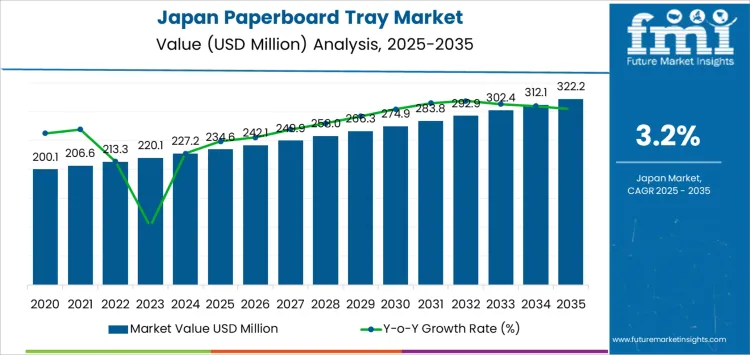
Paperboard tray demand in Japan stands at USD 234.6 million in 2025 and rises to USD 266.3 million by 2030, adding USD 31.7 million in new value over five years. This expansion follows a clear consumption-driven path rather than a packaging format shift. Growth is closely tied to the continuous rise in convenience meals, chilled bento formats, bakery assortments, and seafood trays sold through national convenience store chains and urban food retailers. The shift from USD 200.1 million in 2020 to current levels reflects higher unit throughput from central kitchens and contract food processors rather than an increase in tray pricing. Tray demand is reinforced by fast inventory turnover, strict portion sizing, and the preference for rigid, stack-efficient food containers across logistics and in-store display operations.
From 2030 to 2035, demand expands from USD 266.3 million to USD 322.2 million, generating a larger USD 55.9 million value addition in the second phase. The yearly value build accelerates as urban food retail density increases and premium ready-meal formats scale beyond major metro areas. Protein trays for poultry, seafood, and ready-to-cook selections account for a rising share of incremental volumes during this stage. Growth is also supported by wider tray standardization across supermarket groups, which raises repeat procurement volumes for manufacturers. By 2035, paperboard tray demand in Japan reflects structurally higher prepared food consumption and retail meal replacement behavior rather than short-term packaging substitution trends.
Paperboard Tray Industry in Japan Key Takeaways
| Metric | Value |
|---|---|
| Industry Value (2025) | USD 234.6 million |
| Forecast Value (2035) | USD 322.2 million |
| Forecast CAGR (2025-2035) | 3.2% |
What Is Driving the Demand for Paperboard Tray in Japan?
Demand for paperboard tray in Japan is shaped by retail presentation discipline, compact living formats, and strict separation of packaging waste at the household level. Historically, plastic trays dominated fresh food, confectionery, and ready meal presentation due to moisture resistance and machinability. Over time, municipal waste sorting rules and retailer led packaging guidelines began pushing converters toward paper based structures for secondary and semi primary food applications. Paperboard trays gained acceptance in bento meals, bakery items, fresh produce, confectionery assortments, and seasonal gift packs where visual order, stack stability, and clean presentation matter. Department stores and premium supermarkets reinforced this demand by favoring rigid, well-structured paper based trays that align with Japans gift culture and shelf presentation standards.
Future demand for paperboard tray in Japan will be shaped by growth of takeaway meals, aging driven shift toward portion controlled food, and expansion of temperature controlled home delivery. Paperboard trays will gain further use in chilled meals, protein portions, dessert assortments, and export oriented gift foods where plastic reduction is now a procurement requirement. Convenience stores will also continue adopting paperboard trays for private label meals as they refine recyclability targets. Barriers include performance limits under high moisture and oily food conditions, higher converting cost for coated paperboard grades, and supply tightness in specialty boards. Long-term demand will depend on how effectively Japanese converters improve moisture resistance, runability on high-speed lines, and compatibility with automated food packing systems.
What is the Demand for Paperboard Tray in Japan by Material and Product?
Demand for paperboard tray in Japan is shaped by ready to eat meals, convenience store food formats, bento packaging, and institutional food service supply. Kraft paper leads by material due to its strength, print clarity, and compatibility with hot fill and chilled food applications. Trays with cavity dominate by product because compartmentalization supports portion separation and visual presentation standards common in Japanese prepared foods. Procurement is driven by food processors, convenience store suppliers, and catering contractors focused on portion control and logistics efficiency. Import reliance remains limited due to strong domestic converting capacity. Substitution pressure persists from molded fiber and plastic under application specific handling needs.
Why does kraft paper dominate the demand for paperboard tray in Japan by material?
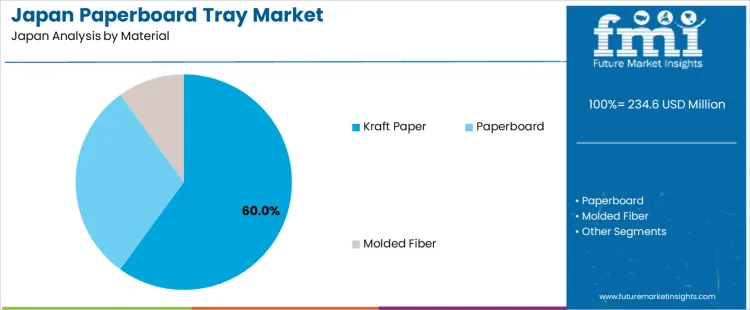
Kraft paper accounts for 60% of the demand for paperboard tray in Japan by material, reflecting its balance of rigidity, lightweight handling, and food contact reliability. Consumption intensity is driven by chilled meals, bakery trays, seafood packaging, and takeaway food used across convenience stores and supermarkets. Usage remains stable because kraft performs consistently under refrigeration, moisture exposure, and thermal sealing. Procurement is led by large food manufacturers and co packers supplying national retail chains. Price sensitivity remains moderate because packaging cost is tightly controlled across high turnover food categories. Specification control emphasizes basis weight consistency, grease resistance, odor neutrality, and surface smoothness for printed branding.
Kraft paper trays also generate steady repeat demand through daily bento production cycles, airline catering supply, and vending channel food distribution. Repeat ordering remains predictable because prepared food output runs continuously with limited seasonal interruption. Buyers favor standardized kraft grades to avoid sealing failure and line speed variation. Margin structure remains tight due to converter competition and pulp cost volatility. Regulatory exposure centers on food contact material compliance and migration testing. Import reliance remains low due to strong domestic paper production. Substitution pressure from molded fiber exists in premium presentation formats, though kraft retains dominance in high volume cost controlled applications.
What drives trays with cavity to lead the demand for paperboard tray in Japan by product?
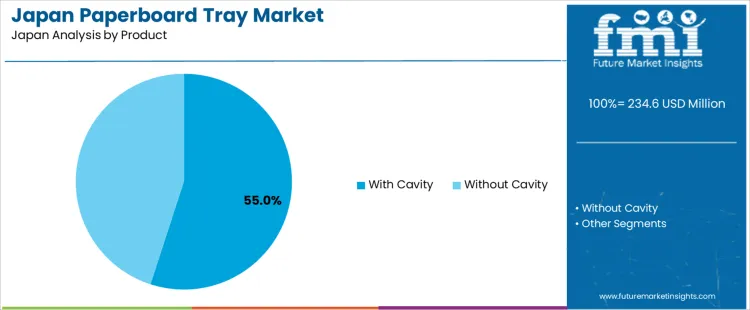
Trays with cavity represent 55.0% of the demand for paperboard tray in Japan by product, reflecting the country’s strong preference for compartmentalized meal presentation. Consumption intensity is driven by bento boxes, convenience store meals, hospital food service, and school lunches where portion separation supports dietary balance and visual appeal. Usage remains stable because cavity trays improve portion control and prevent flavor mixing during transport. Procurement is dominated by chilled food producers and institutional catering suppliers. Price sensitivity remains moderate because filling efficiency and reduced product waste outweigh added tooling cost. Specification control emphasizes cavity depth accuracy, seal flange uniformity, and stacking stability.
Cavity trays also generate strong repeat demand through continuous convenience store menu refresh cycles and institutional food service contracts. Repeat utilization remains high because portion sizes and tray footprints remain standardized across distribution networks. Buyers favor multi cavity formats to support varied food combinations without altering outer dimensions. Margin structure remains controlled under converter competition and tool amortization. Regulatory exposure remains elevated under food hygiene and migration standards. Import reliance is limited to select coating materials. Substitution pressure from without cavity trays remains limited to bakery and single item meal formats where separation is not required.
What Is Reshaping the Demand for Paperboard Tray in Japan Urban Retail and Prepared Food Distribution?
Demand for paperboard trays in Japan is closely tied to the dominance of convenience stores, department store basements, and high-frequency takeaway meals. Fresh bento boxes, sushi assortments, desserts, and regional specialty foods rely on precise tray sizing, rigidity, and visual cleanliness. Small living spaces and daily shopping habits favor lightweight, single-meal packaging. Plastic reduction ordinances in multiple prefectures push retailers toward fiber formats for both chilled and hot foods. Demand is therefore shaped by urban consumption density, compact logistics, and strict visual presentation requirements rather than bulk foodservice distribution alone.
How Are Convenience Stores and Department Food Halls Driving Daily Volume?
Japan convenience stores and basement food halls generate continuous turnover of ready-to-eat meals that rely on paperboard trays for portion segmentation and structural stability. Trays must support stacking in compact display cabinets while preventing oil seepage and deformation. Seasonal menu rotations and regional product launches require frequent tray format adjustments. Unlike bulk foodservice, this environment demands high design accuracy and aesthetic uniformity at scale. This daily retail rhythm creates constant demand that is tied to consumer foot traffic rather than institutional catering volume.
Why Is Plastic Reduction at the City Level Forcing Material Switching?
Several Japanese cities and retail chains have imposed strict plastic reduction targets that directly affect prepared food packaging. Retailers are under pressure to replace black plastic trays and rigid polymers with fiber-based alternatives that maintain food appearance. Paperboard trays coated with minimal barrier layers are increasingly specified for chilled and warm foods. Compliance is enforced at store-operation level through supplier audits. This regulatory pressure converts paperboard trays into a required operating format rather than a discretionary sustainability upgrade.
How Do Moisture Sensitivity, Coating Constraints, and Waste Sorting Rules Limit Expansion?
Paperboard tray demand in Japan faces restraint from high-moisture food applications such as soups, simmered dishes, and oily fried foods. Barrier coatings required for these uses increase cost and complicate municipal waste separation rules. Some municipalities restrict mixed-material disposal, forcing retailers to maintain multiple tray types. Heat resistance during microwave reheating also limits full substitution. These operational and disposal constraints slow complete migration despite strong retail and policy-driven momentum.
What is the Demand for Paperboard Tray in Japan by Region?
| Region | CAGR (%) |
|---|---|
| Kyushu & Okinawa | 4.0% |
| Kanto | 3.7% |
| Kansai | 3.3% |
| Chubu | 2.9% |
| Tohoku | 2.5% |
| Rest of Japan | 2.4% |
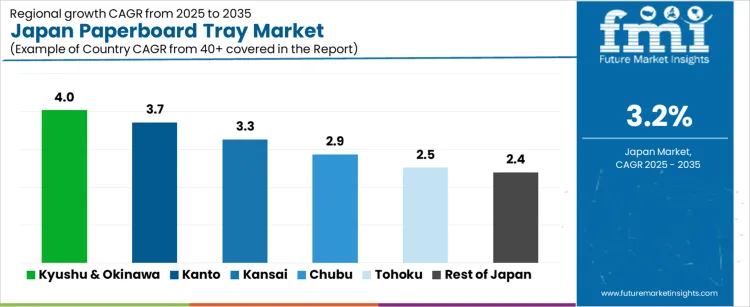
The demand for paperboard trays in Japan is rising at a steady pace across food and retail packaging clusters, led by Kyushu and Okinawa at a 4.0% CAGR. Growth in this region is supported by expanding ready meal production, bakery packaging demand, and strong tourism driven foodservice volumes. Kanto follows at 3.7%, driven by dense urban convenience food consumption, private label expansion, and high use in chilled and takeaway formats. Kansai records 3.3% growth, reflecting stable demand from confectionery, quick service restaurants, and supermarket meal kits. Chubu at 2.9% shows moderate uptake linked to regional food processing and logistics hubs. Tohoku and the Rest of Japan, at 2.5% and 2.4%, reflect slower expansion shaped by lower packaged food penetration, aging consumer bases, and conservative packaging format transitions.
How Is Fresh Food Distribution Supporting Paperboard Tray Demand in Kyushu and Okinawa?
Demand for paperboard tray in Kyushu and Okinawa is advancing at a CAGR of 4.0% through 2035, supported by strong seafood processing, fresh produce packaging, and expanding retail ready meal formats. This region records high usage of trays for fish, cut fruits, and bento meal components supplied to supermarkets and local food chains. Kyushu and Okinawa differ from Kanto through stronger focus on fresh and frozen food logistics rather than premium branded packaging. Demand remains closely tied to refrigerated transport growth and regional food export activity.
- Seafood and fresh produce packaging anchors daily tray usage
- Bento meal supply chains drive repeat demand cycles
- Refrigerated logistics expansion supports volume growth
- Regional food exports sustain steady tray consumption
Why Is Urban Retail Packaging Driving Paperboard Tray Growth in Kanto?
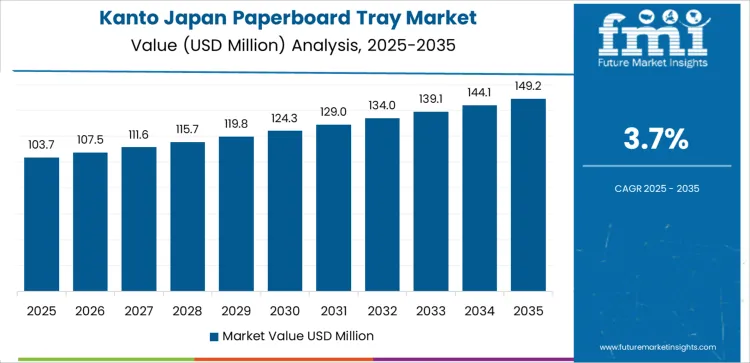
Demand for paperboard tray in Kanto is advancing at a CAGR of 3.7% through 2035, supported by dense supermarket networks, convenience store meal programs, and high turnover of ready to eat foods in Tokyo and surrounding cities. Kanto shows strong demand for compact trays used in bakery, confectionery, and takeaway meal applications. This region contrasts with Kyushu and Okinawa through higher emphasis on visual presentation and space efficient packaging. Growth is reinforced by private label food expansion and frequent product refresh cycles across urban retail.
- Convenience store ready meals anchor bulk tray demand
- Bakery and confectionery packaging supports daily turnover
- Compact tray formats suit dense urban retail layouts
- Private label food programs sustain consistent volume
What Is Sustaining Balanced Paperboard Tray Usage Across Food Manufacturing in Kansai?
Demand for paperboard tray in Kansai is advancing at a CAGR of 3.3% through 2035, supported by processed food manufacturing, traditional confectionery production, and steady supermarket distribution across Osaka and Kyoto. Kansai displays mixed usage across fresh food, frozen meals, and gift food packaging. This region differs from Kanto through higher share of regional brand production rather than national convenience store dominance. Demand growth reflects steady output from small and mid-sized food processors serving western Japan retail markets.
- Processed food plants maintain stable tray consumption
- Traditional confectionery supports specialty tray formats
- Regional supermarket distribution anchors repeat orders
- Mid-sized food producers guide steady demand expansion
How Is Automotive and Industrial Catering Shaping Paperboard Tray Demand in Chubu?
Demand for paperboard tray in Chubu is advancing at a CAGR of 2.9% through 2035, supported by institutional catering, factory meal supply, and regional food packaging linked to automotive and industrial workforces. Aichi leads usage through employee meal services and bulk prepared food operations. Chubu contrasts with Kanto through stronger reliance on large batch catering rather than retail driven small pack meals. Growth remains moderate and linked to workforce driven meal supply and factory canteen food packaging programs.
- Institutional catering drives bulk tray consumption
- Factory meal services sustain repeat daily usage
- Large batch food supply shapes tray size preferences
- Workforce driven demand supports stable volumes
Why Is Demographic Decline Moderating Paperboard Tray Growth in Tohoku?
Demand for paperboard tray in Tohoku is advancing at a CAGR of 2.5% through 2035, supported by limited population growth, stable frozen food consumption, and modest supermarket expansion. Miyagi anchors most regional demand through frozen seafood and packaged meal distribution. Tohoku differs from Kanto through lower retail density and slower product turnover. Usage remains focused on frozen meals, school catering, and regional food processing rather than premium retail display packaging.
- Frozen food packaging dominates regional tray usage
- School and institutional catering supports baseline demand
- Lower retail density limits rapid packaging growth
- Regional processors guide stable but slow expansion
How Is Small City Retail Penetration Influencing Paperboard Tray Demand in Rest of Japan?
Demand for paperboard tray in Rest of Japan is advancing at a CAGR of 2.4% through 2035, supported by small city supermarkets, regional food processing, and steady household consumption of prepared meals. These areas contrast with Kanto through limited convenience store concentration and lower daily meal turnover. Paperboard trays are mainly used for frozen foods, bakery items, and basic takeaway meals. Growth remains gradual and closely tied to local retail expansion and regional food supply chain stability.
- Small city supermarkets anchor most tray consumption
- Frozen and bakery foods dominate application segments
- Lower store density restricts high turnover growth
- Local food processors sustain steady packaging demand
What Is Driving the Demand for Paperboard Tray in Japan and Which Companies Shape Food Packaging Supply
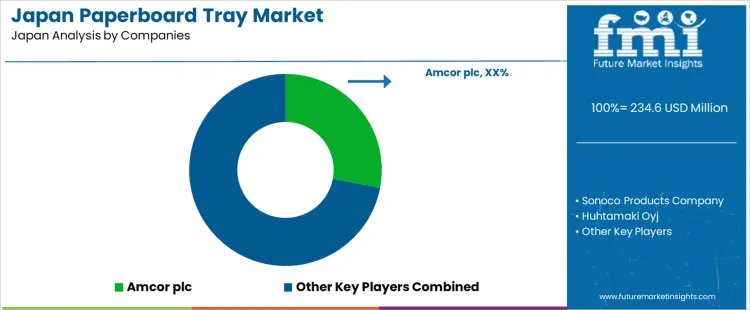
The demand for paperboard trays in Japan is driven by growth in ready meal consumption, expansion of convenience food retail, and increasing use of fiber based formats in chilled and microwaveable food packaging. Toyo Seikan holds a central domestic position through large scale paperboard converting and thermoforming operations serving bento meals, chilled noodles, bakery items, and prepared seafood. Rengo supports demand through containerboard based tray and food packaging supply aligned with supermarket private labels and food processors. Oji Holdings maintains a strong role through food grade paperboard production and downstream packaging systems used by national food brands. These domestic suppliers anchor volume demand through long term contracts with retailers, food manufacturers, and logistics operators.
Amcor participates through barrier coated paperboard trays supplied to Japan through multinational food brand programs and export oriented packaging supply chains. Sonoco Products Company supports demand through imported paperboard tray systems used in confectionery, frozen foods, and institutional catering. Huhtamaki supplies molded fiber and paperboard trays used in foodservice and takeout packaging serving restaurant chains. DS Smith and International Paper participate indirectly through specialty board grades converted by Japanese partners. Procurement in Japan is governed by oil and moisture resistance, stacking strength, heat tolerance for microwave use, and compliance with food contact safety standards. Buyer preference favors suppliers with short lead times, consistent board quality, and domestic production support for seasonal food demand cycles.
Key Players in the Paperboard Tray Industry in Japan
- Amcor plc
- Sonoco Products Company
- Huhtamaki Oyj
- DS Smith Plc
- International Paper Company
Scope of the Report
| Items | Values |
|---|---|
| Quantitative Units (2025) | USD million |
| Material | Kraft Paper, Paperboard, Molded Fiber |
| Product | With Cavity, Without Cavity |
| Ovenable Format | Microwavable Trays, Conventional Trays |
| Capacity | Up to 8 Oz, 8 Oz to 20 Oz, 20 Oz to 30 Oz, Above 30 Oz |
| End Use | Food and Beverages Packaging, Cosmetics & Personal Care Product Packaging, Pharmaceuticals Packaging, Homecare Packaging, Electrical and Electronics Product Packaging, Others |
| Region | Kyushu & Okinawa, Kanto, Kansai, Chubu, Tohoku, Rest of Japan |
| Countries Covered | Japan |
| Key Companies Profiled | Toyo Seikan, Dai Nippon Printing, Rengo, Oji Holdings, Huhtamaki Japan, Amcor, Sonoco Products Company, DS Smith, International Paper |
| Additional Attributes | Dollar by sales by material, product type, ovenable format, and capacity; Regional CAGR and growth drivers; Moisture and oil resistance; Heat tolerance for microwavable use; Stackability and cavity standardization; Domestic vs. import reliance; Repeat procurement patterns from convenience store chains and institutional catering; Regulatory compliance with Japanese food contact standards; Integration with automated food packing systems; Packaging line efficiency and tooling flexibility; Private label and national brand adoption trends |
Paperboard Tray Industry in Japan Segmentation
Material:
- Kraft Paper
- Paperboard
- Molded Fiber
Product:
- With Cavity
- Without Cavity
Ovenable Format:
- Microwavable Trays
- Conventional Trays
Capacity:
- Up to 8 Oz
- 8 Oz to 20 Oz
- 20 Oz to 30 Oz
- Above 30 Oz
End Use:
- Food and Beverages Packaging
- Cosmetics & Personal Care Product Packaging
- Pharmaceuticals Packaging
- Homecare Packaging
- Electrical and Electronics Product Packaging
- Others
Region:
- Kyushu & Okinawa
- Kanto
- Kansai
- Chubu
- Tohoku
- Rest of Japan
Frequently Asked Questions
How big is the demand for paperboard tray in Japan in 2025?
The demand for paperboard tray in Japan is estimated to be valued at USD 234.6 million in 2025.
What will be the size of paperboard tray in Japan in 2035?
The market size for the paperboard tray in Japan is projected to reach USD 322.2 million by 2035.
How much will be the demand for paperboard tray in Japan growth between 2025 and 2035?
The demand for paperboard tray in Japan is expected to grow at a 3.2% CAGR between 2025 and 2035.
What are the key product types in the paperboard tray in Japan?
The key product types in paperboard tray in Japan are kraft paper, paperboard and molded fiber.
Which product segment is expected to contribute significant share in the paperboard tray in Japan in 2025?
In terms of product, with cavity segment is expected to command 55.0% share in the paperboard tray in Japan in 2025.
Preview the report firsthand - request a free sample
Get SampleGet the brochure for pricing and purchase details.
Get PDFTable of Content
- Executive Summary
- Japan Market Outlook
- Demand-side Trends
- Supply-side Trends
- Technology Roadmap Analysis
- Analysis and Recommendations
- Market Overview
- Market Coverage / Taxonomy
- Market Definition / Scope / Limitations
- Market Background
- Market Dynamics
- Drivers
- Restraints
- Opportunity
- Trends
- Scenario Forecast
- Demand in Optimistic Scenario
- Demand in Likely Scenario
- Demand in Conservative Scenario
- Opportunity Map Analysis
- Product Life Cycle Analysis
- Supply Chain Analysis
- Investment Feasibility Matrix
- Value Chain Analysis
- PESTLE and Porter’s Analysis
- Regulatory Landscape
- Regional Parent Market Outlook
- Production and Consumption Statistics
- Import and Export Statistics
- Market Dynamics
- Japan Market Analysis 2020 to 2024 and Forecast, 2025 to 2035
- Historical Market Size Value (USD Million) Analysis, 2020 to 2024
- Current and Future Market Size Value (USD Million) Projections, 2025 to 2035
- Y-o-Y Growth Trend Analysis
- Absolute $ Opportunity Analysis
- Japan Market Pricing Analysis 2020 to 2024 and Forecast 2025 to 2035
- Japan Market Analysis 2020 to 2024 and Forecast 2025 to 2035, By Material
- Introduction / Key Findings
- Historical Market Size Value (USD Million) Analysis By Material , 2020 to 2024
- Current and Future Market Size Value (USD Million) Analysis and Forecast By Material , 2025 to 2035
- Kraft Paper
- Paperboard
- Molded Fiber
- Y-o-Y Growth Trend Analysis By Material , 2020 to 2024
- Absolute $ Opportunity Analysis By Material , 2025 to 2035
- Japan Market Analysis 2020 to 2024 and Forecast 2025 to 2035, By Product
- Introduction / Key Findings
- Historical Market Size Value (USD Million) Analysis By Product, 2020 to 2024
- Current and Future Market Size Value (USD Million) Analysis and Forecast By Product, 2025 to 2035
- With Cavity
- Without Cavity
- Y-o-Y Growth Trend Analysis By Product, 2020 to 2024
- Absolute $ Opportunity Analysis By Product, 2025 to 2035
- Japan Market Analysis 2020 to 2024 and Forecast 2025 to 2035, By Ovenable Format
- Introduction / Key Findings
- Historical Market Size Value (USD Million) Analysis By Ovenable Format, 2020 to 2024
- Current and Future Market Size Value (USD Million) Analysis and Forecast By Ovenable Format, 2025 to 2035
- Microwavable Trays
- Conventional Trays
- Y-o-Y Growth Trend Analysis By Ovenable Format, 2020 to 2024
- Absolute $ Opportunity Analysis By Ovenable Format, 2025 to 2035
- Japan Market Analysis 2020 to 2024 and Forecast 2025 to 2035, By Capacity
- Introduction / Key Findings
- Historical Market Size Value (USD Million) Analysis By Capacity, 2020 to 2024
- Current and Future Market Size Value (USD Million) Analysis and Forecast By Capacity, 2025 to 2035
- Up to 8 Oz
- 8 Oz to 20 Oz
- 20 Oz to 30 Oz
- Above 30 Oz
- Y-o-Y Growth Trend Analysis By Capacity, 2020 to 2024
- Absolute $ Opportunity Analysis By Capacity, 2025 to 2035
- Japan Market Analysis 2020 to 2024 and Forecast 2025 to 2035, By End Use
- Introduction / Key Findings
- Historical Market Size Value (USD Million) Analysis By End Use, 2020 to 2024
- Current and Future Market Size Value (USD Million) Analysis and Forecast By End Use, 2025 to 2035
- Food and Beverages Packaging
- Cosmetics & Personal Care Product Packaging
- Pharmaceuticals Packaging
- Homecare Packaging
- Electrical and Electronics Product Packaging
- Y-o-Y Growth Trend Analysis By End Use, 2020 to 2024
- Absolute $ Opportunity Analysis By End Use, 2025 to 2035
- Market Structure Analysis
- Competition Dashboard
- Competition Benchmarking
- Market Share Analysis of Top Players
- By Regional
- By Material
- By Product
- By Ovenable Format
- By Capacity
- By End Use
- Competition Analysis
- Competition Deep Dive
- Amcor plc
- Overview
- Product Portfolio
- Profitability by Market Segments (Product/Age /Sales Channel/Region)
- Sales Footprint
- Strategy Overview
- Marketing Strategy
- Product Strategy
- Channel Strategy
- Sonoco Products Company
- Huhtamaki Oyj
- DS Smith Plc
- International Paper Company
- Amcor plc
- Competition Deep Dive
- Assumptions & Acronyms Used
- Research Methodology


