

- Industry Size (2025)
- USD 756.0 Mn
- Forecast (2035)
- USD 1252.1 Mn
- CAGR (2025 to 2035)
- 5.2%
Demand for Smart Agriculture Solution in Japan Forecast and Outlook 2025 to 2035
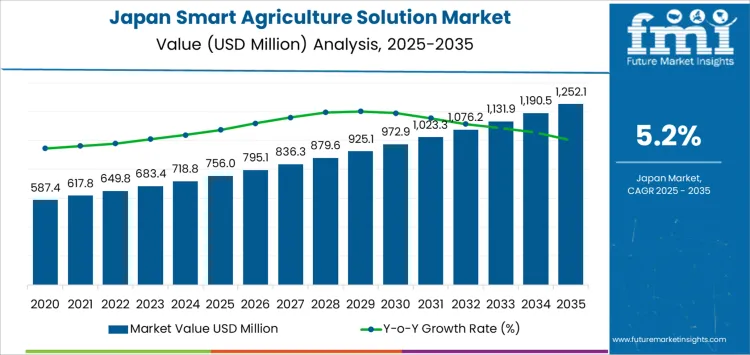
The demand for smart agriculture solution in Japan is valued at USD 756.0 million in 2025 and is projected to reach USD 1,252.1 million by 2035, reflecting a CAGR of 5.2%. The historical series from 2020 to 2025 shows expansion from USD 587.4 million to USD 756.0 million, supported by steady uptake of automated field monitoring and machinery control systems. Hardware accounts for the largest component share due to sensor installations, guidance modules, and onboard control units. Automated machinery guidance and control leads application demand as farms address labor shortages and field precision requirements. Safety monitoring and obstacle detection also contribute stable volumes. Early adoption reflects structured pilot programs and targeted upgrades rather than full farm digitization. Procurement during this phase follows seasonal machinery replacement cycles and regulated safety compliance needs.
From 2026 onward, demand rises from USD 795.1 million to USD 1,023.3 million by 2031, then advances to USD 1,252.1 million by 2035 through steady annual additions. Software gains share as data platforms support variable rate applications and equipment performance tracking. Services expand alongside system maintenance, calibration, and operator training requirements. Variable rate technology adoption widens as input cost control becomes a priority across crop segments. Building and premises surveillance grows at a slower pace, centered on storage and equipment yards. After 2030, replacement demand and system upgrades become the main drivers as early installations reach renewal stages. Annual value increments remain narrow and consistent, indicating limited volatility and controlled capital planning across the agriculture equipment base in Japan.
Quick Stats of the Demand for Smart Agriculture Solution in Japan:
- Demand for Smart Agriculture Solution in Japan Value (2025): USD 756.0 million
- Demand for Smart Agriculture Solution in Japan Forecast Value (2035): USD 1,252.1 million
- Demand for Smart Agriculture Solution in Japan Forecast CAGR (2025-2035): 5.2%
- Demand for Smart Agriculture Solution in Japan Leading Component Type: Hardware (45%)
- Demand for Smart Agriculture Solution in Japan Key Growth Regions: Kyushu & Okinawa, Kanto, Kansai
- Demand for Smart Agriculture Solution in Japan Top Players: Kubota, Yanmar, Topcon Positioning Systems, John Deere, Trimble, AGCO
What is the Growth Forecast for Smart Agriculture Solution in Japan through 2035?
Between 2025 and 2030, demand for smart agriculture solution in Japan is projected to rise from USD 756.0 million to USD 972.9 million, creating an absolute increase of USD 216.9 million and representing about 43.7% of total decade growth. This phase reflects gradual digital integration across crop monitoring, precision irrigation, and greenhouse automation. Equipment replacement in controlled environment farming supports baseline demand. Historical growth depended on pilot adoption and subsidy driven deployments, while near term performance is shaped by labor shortages, rising input cost management, and steady uptake of sensor based field monitoring across high value produce cultivation zones.
From 2030 to 2035, demand is forecast to expand from USD 972.9 million to USD 1,252.1 million, adding USD 279.2 million and accounting for nearly 56.3% of total ten-year expansion. This stage reflects wider system level deployment across livestock management, soil analytics, and autonomous farm operations. Data integration across weather, yield forecasting, and supply planning becomes more standardized. Earlier growth relied on productivity improvement projects, while future expansion is guided by farm consolidation, higher capital availability among large producers, and stronger alignment between digital farm platforms and food supply traceability requirements across domestic distribution systems.
Smart Agriculture Solution Industry in Japan Key Takeaways
| Metric | Value |
|---|---|
| Industry Value (2025) | USD 756.0 million |
| Forecast Value (2035) | USD 1,252.1 million |
| Forecast CAGR (2025-2035) | 5.2% |
What Is Driving the Demand for Smart Agriculture Solutions in Japan Across Historical and Future Growth Cycles?
Demand for smart agriculture solutions in Japan developed as farms faced aging labor, limited land availability, and rising pressure to maintain output with fewer workers. Adoption focused on basic field sensors, greenhouse monitoring systems, and automated irrigation controls. Cooperative farming groups and local governments supported early deployment through pilot programs and equipment sharing schemes. Historical growth relied on gradual replacement of manual practices with semi-automated tools rather than full digital integration. Equipment purchasing emphasized durability, ease of maintenance, and compatibility with small plot operations. Data usage remained limited to yield tracking and weather observation. Growth reflected structural labor shortages, steady rural consolidation, and long standing policy support for agricultural efficiency within domestic food production systems.
Future demand for smart agriculture solutions in Japan is expected to depend on full scale data integration, robotics adoption, and precision crop management. Expansion of automated harvesting, drone based field monitoring, and AI driven yield forecasting supports higher productivity under tighter labor conditions. Greenhouse production and vertical farming will increase demand for climate control platforms and nutrient management systems. Historical growth relied on labor substitution through basic tools. Future growth centers on predictive analytics, remote farm operations, and system interoperability across production stages. Export quality standards and food traceability requirements influence purchasing priorities. Investment decisions will reflect energy use control, digital skill availability, and long term land use efficiency across domestic farming regions.
What Is the Demand for Smart Agriculture Solution in Japan by Component Type and Application?
The demand for smart agriculture solution in Japan is shaped by farm labor shortages, aging grower population, and pressure to raise productivity on limited arable land. Hardware leads by component type due to heavy reliance on sensors, guidance systems, and connected machinery. Automated machinery guidance control leads by application because precision steering and navigation directly affect fuel use, input efficiency, and field productivity. Procurement is driven by agricultural cooperatives, machinery manufacturers, and regional farming groups. Import reliance remains present for positioning modules, imaging sensors, and control chips. Substitution pressure exists from conventional mechanical farming methods in smaller holdings. Demand stability is supported by policy backed digital farming programs and rural automation funding.
Why does hardware account for 45% of the demand for smart agriculture solution in Japan by component type?
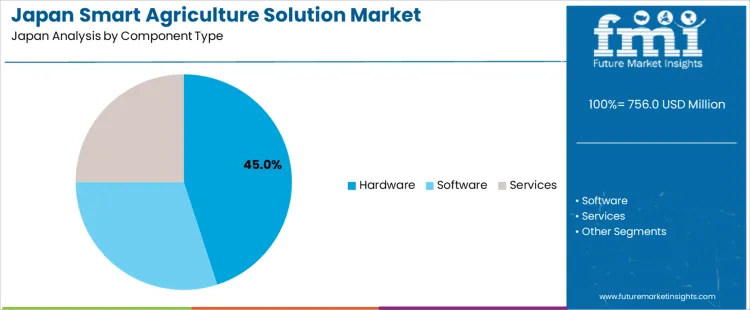
Hardware accounts for 45% of the demand for smart agriculture solution in Japan by component type, reflecting the central role of physical devices in farm automation. Consumption intensity is driven by GPS guidance units, soil sensors, crop monitoring cameras, and automated control modules installed on tractors and harvesters. Usage remains stable because core farming operations depend on continuous physical data capture and machine actuation. Procurement is led by agricultural equipment suppliers and cooperative purchasing bodies. Price sensitivity remains moderate because hardware durability affects multi season usage value. Specification control emphasizes positioning accuracy, vibration tolerance, water resistance, and long duty cycle performance.
Hardware deployment also generates steady repeat demand through replacement of weather exposed units and technology upgrades. Repeat utilization remains predictable as farms expand monitored acreage and add new machinery. Buyers favor standardized device platforms to simplify calibration and maintenance. Margin structure remains controlled under competition between domestic manufacturers and imported equipment vendors. Regulatory exposure centers on radio frequency compliance and machinery safety certification. Import reliance persists for satellite navigation receivers and advanced imaging sensors. Substitution pressure from software only solutions remains limited because physical data acquisition remains essential for field level automation.
Why does automated machinery guidance control represent 28.0% of the demand for smart agriculture solution in Japan by application?
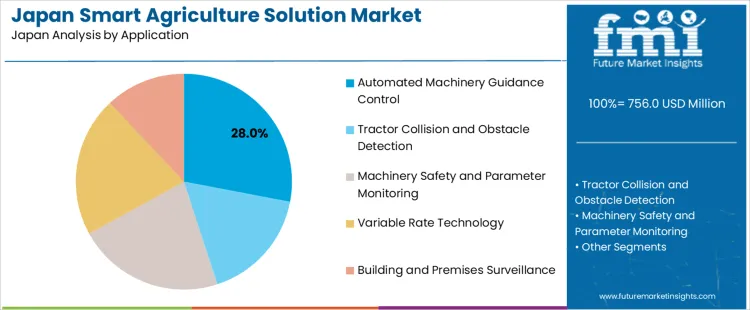
Automated machinery guidance control represents 28.0% of the demand for smart agriculture solution in Japan by application, reflecting its direct impact on operational accuracy and fuel efficiency. Consumption intensity is driven by rice cultivation, vegetable row planting, and precision spraying where steering deviation affects yield and input waste. Usage remains stable because guidance systems support straight line driving, overlap reduction, and night operation. Procurement is dominated by tractor manufacturers, farm equipment dealers, and cooperative led technology programs. Price sensitivity remains moderate because guidance investment reduces long term labor and fuel cost. Specification control emphasizes satellite signal stability, correction accuracy, and latency control under real field conditions.
Guidance control systems also generate consistent repeat demand through retrofitting of older tractors and expansion across multi vehicle farms. Repeat utilization remains predictable as guidance adoption spreads from large to mid-size operations. Buyers favor systems that integrate with existing machinery displays and steering actuators. Margin structure remains controlled under bundled equipment sales and service contracts. Regulatory exposure centers on machinery operation safety standards and radio transmission approval. Import reliance persists for RTK correction modules and precision steering controllers. Substitution pressure from manual steering remains present in small scale plots where automation value remains limited.
What Is Driving the Demand for Smart Agriculture Solution in Japan Farm Labor Shortage and Yield Stability Needs?
Demand for smart agriculture solution in Japan is shaped by severe farm labor aging, declining rural population, and pressure to stabilize domestic food output. Many growers operate with limited human support and rely on automation to sustain planting, irrigation, and harvesting cycles. Greenhouses, rice paddies, and orchard systems integrate sensors for soil moisture, temperature, and nutrient control. Government backed digital farming programs support adoption through equipment subsidies and technical guidance. Farmers seek higher yield per hectare under variable weather conditions. Demand follows survival based productivity management rather than lifestyle driven technology adoption across fragmented agricultural holdings nationwide.
How Is Aging Farm Ownership Restructuring Daily Field Operations in Japan?
Japan farming population shows one of the highest average ages among major agricultural economies. Physical workload reduction stands as a major adoption driver for automated irrigation, autonomous tractors, and remote crop monitoring. Smart agriculture tools allow elderly operators to oversee multiple plots without continuous on site presence. Alert based systems reduce walking distance and manual inspection frequency. Family labor replacement through sensors and robotics changes task planning from physical endurance to data interpretation. This structural shift alters equipment purchasing priorities toward reliability and simplicity. Demand expands through necessity driven workflow redesign rather than productivity optimization ambition alone across small and medium farming units nationwide.
Why Are Climate Variability and Crop Loss Risk Raising Monitoring Intensity?
Japan agriculture faces frequent typhoons, irregular rainfall, heat stress, and frost risk that threaten short seasonal harvest windows. Smart agriculture solutions provide continuous microclimate tracking and early warning of crop stress. Rice farmers use water level sensors to manage flood risk. Greenhouse growers rely on automated ventilation and shading control to prevent thermal damage. Orchard producers monitor humidity to suppress fungal spread. These functions protect limited output windows where recovery time remains narrow. Demand links directly to crop survival assurance and insurance claim validation rather than to yield maximization alone across temperature sensitive food production zones nationwide.
How Do Cost Barriers, Data Skills, and Farm Fragmentation Limit Wider Use?
Smart agriculture solution demand in Japan faces restraint from equipment cost, digital skill gaps, and fragmented land ownership. Many farms operate on small plots with narrow profit margins that delay capital investment. Data interpretation requires training that older farmers often hesitate to pursue. Interoperability between sensor brands and control platforms remains uneven. Cellular coverage gaps affect remote field connectivity in mountainous regions. Cooperative purchasing reduces some burden yet adoption still varies widely. These constraints slow uniform penetration despite policy support. Demand progresses through gradual generational transition rather than immediate nationwide technology conversion across diverse crop categories and rural infrastructure conditions.
What is the Demand for Smart Agriculture Solution in Japan by Region?
| Region | CAGR (%) |
|---|---|
| Kyushu & Okinawa | 6.5% |
| Kanto | 6.0% |
| Kansai | 5.2% |
| Chubu | 4.6% |
| Tohoku | 4.0% |
| Rest of Japan | 3.8% |
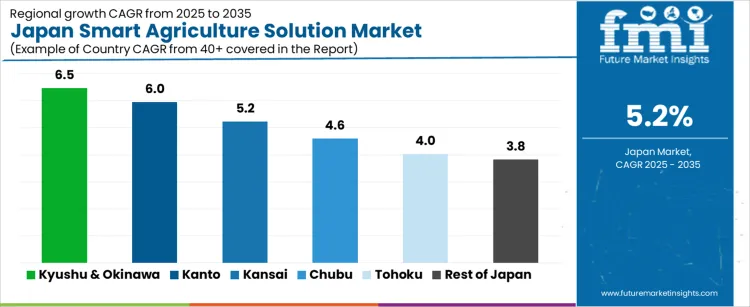
The demand for smart agriculture solution in Japan is increasing steadily across farming regions, led by Kyushu and Okinawa at a 6.5% CAGR. Growth in this region is supported by large scale horticulture operations, greenhouse automation, and rising deployment of sensor based irrigation and climate control systems. Kanto follows at 6.0%, driven by urban farming initiatives, precision farming pilots, and strong participation from agri technology vendors and cooperatives. Kansai records 5.2% growth, reflecting steady adoption in vegetable cultivation and controlled environment agriculture. Chubu at 4.6% shows moderate uptake linked to mechanized crop management and dairy automation. Tohoku and the Rest of Japan, at 4.0% and 3.8%, reflect slower growth shaped by smaller farm units, aging farmer demographics, and gradual transitions from conventional to data driven farming practices.
How Is Climate Intensive Crop Production Advancing Smart Agriculture Use in Kyushu and Okinawa?
Demand for smart agriculture solution in Kyushu and Okinawa is advancing at a CAGR of 6.5% through 2035, supported by intensive vegetable farming, tropical crop cycles, and rising dependence on sensor based irrigation systems. Farmers apply automated watering, real time soil diagnostics, and climate linked yield planning tools. Greenhouse cultivation for fruits and leafy vegetables shows steady growth in digital climate control usage. Adoption reflects rising labor shortages, increasing cost control needs, and strong penetration of mobile based farm monitoring platforms.
- Sensor driven irrigation guides water efficiency
- Greenhouse climate automation supports crop consistency
- Mobile dashboards support daily field supervision
- Labor shortage drives reliance on automated systems
Why Is Urban Food Supply Pressure Sustaining Smart Agriculture Growth in Kanto?
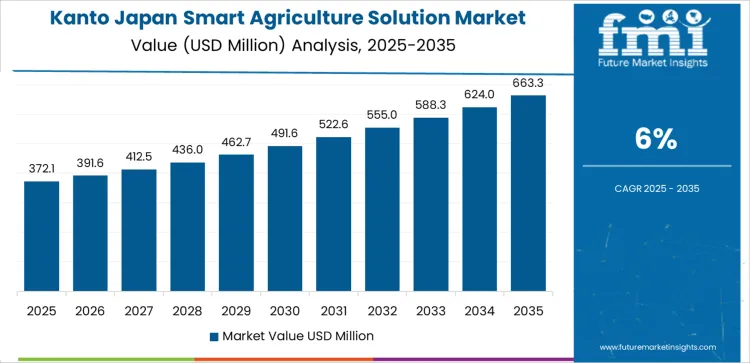
Demand for smart agriculture solution in Kanto is rising at a CAGR of 6.0% through 2035, driven by urban food supply needs, vertical farming systems, and hydroponic cultivation near major cities. Peri urban farms deploy automated lighting control, nutrient dosing platforms, and growth analytics for rapid crop turnover. Data driven sowing schedules support daily fresh supply chains. Growth reflects rising demand for pesticide controlled produce, land scarcity near city centers, and steady investment in multilayer indoor farming systems.
- Vertical farms drive high intensity technology use
- Automated nutrient systems control plant nutrition
- Fast crop cycles support daily supply to urban retailers
- Indoor farming limits climate dependency risks
What Is Supporting Cooperative Smart Farm Development Across Kansai?
Demand for smart agriculture solution in Kansai is progressing at a CAGR of 5.2% through 2035, supported by cooperative farm networks, orchard monitoring systems, and automated irrigation controlled through central dashboards. Kansai growers apply field sensors for disease detection, crop stress tracking, and seasonal yield balance. Livestock farms also integrate feed management and health tracking platforms. Growth reflects steady modernization through group level investments, training driven adoption, and expansion of crop level data management across mixed farming systems.
- Orchard monitoring tools support fruit yield stability
- Field sensors improve crop stress visibility
- Livestock tracking improves feeding control
- Cooperative investment models expand digital access
How Is Precision Machinery Availability Shaping Smart Agriculture Demand in Chubu?
Demand for smart agriculture solution in Chubu is advancing at a CAGR of 4.6% through 2035, supported by precision farming machinery access, GPS guided equipment, and automated planting control systems. Farms deploy connected tractors, remote controlled seeders, and harvest yield mapping tools. Equipment performance monitoring supports maintenance scheduling and avoids breakdown related losses. Growth reflects manufacturing sector proximity, strong dealer service networks, and gradual integration of data analytics into mechanized agriculture.
- GPS guided tractors improve planting accuracy
- Yield mapping tools support productivity benchmarking
- Equipment diagnostics improve uptime management
- Mechanization drives steady system deployment
Why Is Large Acreage Crop Structure Influencing Smart Agriculture Use in Tohoku?
Demand for smart agriculture solution in Tohoku is advancing at a CAGR of 4.0% through 2035, supported by large scale grain cultivation, cold season crop management needs, and wide use of weather forecasting tools. Farms apply frost sensors, soil mapping systems, and seasonal climate analytics to manage planting risk. Digital deployment remains focused on seasonal decision support rather than continuous automation. Growth reflects farm consolidation patterns, fuel efficiency concerns, and gradual expansion of smart field equipment across broad acreage farms.
- Frost detection tools reduce cold damage exposure
- Soil mapping guides fertilizer efficiency
- Seasonal weather analysis determines planting windows
- Large field layouts support sensor network scaling
How Is Entry Level Digital Farming Advancing in Rest of Japan?
Demand for smart agriculture solution in Rest of Japan is advancing at a CAGR of 3.8% through 2035, supported by smallholder adoption of mobile farm tools, cooperative equipment sharing, and rise of entry level sensor kits. Farmers apply smartphone based alerts for irrigation timing and pest risk monitoring. High capital automation remains limited. Growth reflects rural broadband expansion, training programs by local agriculture groups, and gradual replacement of manual farm control practices with digital support systems.
- Smartphone alerts guide daily farm operations
- Low cost sensor kits enable early digitization
- Equipment sharing expands technology access
- Local training programs support adoption confidence
What Is Driving the Demand for Smart Agriculture Solution in Japan and Which Companies Shape Farm Level Adoption?
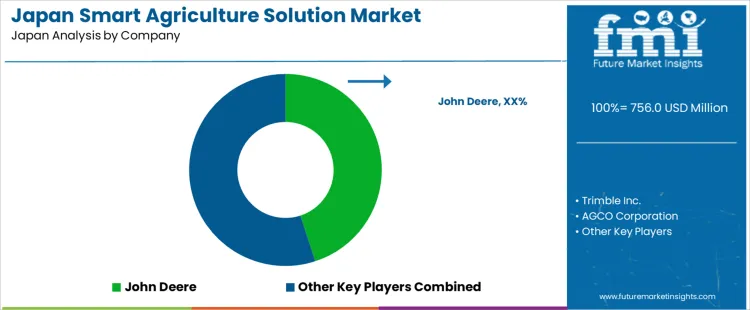
The demand for smart agriculture solutions in Japan is shaped by rural labor shortages, aging farmer demographics, and pressure to stabilize yields under variable climate conditions. Kubota holds a central domestic position through connected tractors, automated rice transplanters, and cloud based farm management platforms used across paddy fields and open vegetable farms. Yanmar supports adoption through engine telemetry, automated harvesting systems, and greenhouse control equipment used in mixed crop operations. Topcon Positioning Systems anchors precision guidance through GNSS based steering, land leveling, and variable rate application systems adopted in large scale mechanized regions such as Hokkaido. These domestic suppliers influence qualification cycles through close ties with agricultural cooperatives, prefectural test farms, and subsidy backed deployment programs.
John Deere participates through imported precision farming platforms adopted by large scale operators and corporate farms focused on export crops and feed grains. Trimble and AGCO support adoption through guidance systems, yield monitoring platforms, and machine connectivity used in dairy, wheat, and sugar beet production zones. System selection in Japan is governed by reliability under narrow field layouts, data accuracy in terraced farming, and service access in remote prefectures. Buyer preference favors suppliers with domestic service engineers, simple user interfaces for older operators, and compatibility with compact machinery formats. Demand visibility tracks smart paddy demonstration projects, government backed digital agriculture subsidies, rising fertilizer input costs, and steady expansion of automated harvesting and spraying across high labor cost rural regions.
Key Players in the Smart Agriculture Solution Industry in Japan
- Kubota
- Yanmar
- Topcon
- John Deere
- Trimble
- AGCO
Scope of the Report
| Items | Values |
|---|---|
| Quantitative Units (2025) | USD million |
| Type | Hardware, Software, Services |
| Application | Automated Machinery Guidance Control, Tractor Collision and Obstacle Detection, Machinery Safety and Parameter Monitoring, Variable Rate Technology, Building and Premises Surveillance |
| End User | Crop Farmers, Greenhouse Operators, Livestock Farms, Agricultural Cooperatives, Corporate Farms and Agri Enterprises |
| Regions Covered | Kyushu and Okinawa, Kanto, Kansai, Chubu, Tohoku, Rest of Japan |
| Countries Covered | Japan |
| Key Companies Profiled | Kubota, Yanmar, Topcon Positioning Systems, John Deere, Trimble, AGCO |
| Additional Attributes | Dollar sales by component type and application category, regional deployment linked to greenhouse automation and precision field operations, replacement driven demand for weather exposed sensors and guidance units, policy backed digital farming adoption programs, integration of variable rate technology with crop input management, equipment safety compliance and radio frequency certification requirements for automated farm machinery |
Smart Agriculture Solution Industry in Japan Segmentation
Component Type:
- Hardware
- Software
- Services
Application:
- Automated Machinery Guidance Control
- Tractor Collision and Obstacle Detection
- Machinery Safety and Parameter Monitoring
- Variable Rate Technology
- Building and Premises Surveillance
Region:
- Kyushu & Okinawa
- Kanto
- Kansai
- Chubu
- Tohoku
- Rest of Japan
Frequently Asked Questions
How big is the demand for smart agriculture solution in Japan in 2025?
The demand for smart agriculture solution in Japan is estimated to be valued at USD 756.0 million in 2025.
What will be the size of smart agriculture solution in Japan in 2035?
The market size for the smart agriculture solution in Japan is projected to reach USD 1,252.1 million by 2035.
How much will be the demand for smart agriculture solution in Japan growth between 2025 and 2035?
The demand for smart agriculture solution in Japan is expected to grow at a 5.2% CAGR between 2025 and 2035.
What are the key product types in the smart agriculture solution in Japan?
The key product types in smart agriculture solution in Japan are hardware, software and services.
Which application segment is expected to contribute significant share in the smart agriculture solution in Japan in 2025?
In terms of application, automated machinery guidance control segment is expected to command 28.0% share in the smart agriculture solution in Japan in 2025.
Preview the report firsthand - request a free sample
Get SampleGet the brochure for pricing and purchase details.
Get PDFTable of Content
- Executive Summary
- Japan Market Outlook
- Demand-side Trends
- Supply-side Trends
- Technology Roadmap Analysis
- Analysis and Recommendations
- Market Overview
- Market Coverage / Taxonomy
- Market Definition / Scope / Limitations
- Market Background
- Market Dynamics
- Drivers
- Restraints
- Opportunity
- Trends
- Scenario Forecast
- Demand in Optimistic Scenario
- Demand in Likely Scenario
- Demand in Conservative Scenario
- Opportunity Map Analysis
- Product Life Cycle Analysis
- Supply Chain Analysis
- Investment Feasibility Matrix
- Value Chain Analysis
- PESTLE and Porter’s Analysis
- Regulatory Landscape
- Regional Parent Market Outlook
- Production and Consumption Statistics
- Import and Export Statistics
- Market Dynamics
- Japan Market Analysis 2020 to 2024 and Forecast, 2025 to 2035
- Historical Market Size Value (USD Million) Analysis, 2020 to 2024
- Current and Future Market Size Value (USD Million) Projections, 2025 to 2035
- Y-o-Y Growth Trend Analysis
- Absolute $ Opportunity Analysis
- Japan Market Pricing Analysis 2020 to 2024 and Forecast 2025 to 2035
- Japan Market Analysis 2020 to 2024 and Forecast 2025 to 2035, By Component Type
- Introduction / Key Findings
- Historical Market Size Value (USD Million) Analysis By Component Type , 2020 to 2024
- Current and Future Market Size Value (USD Million) Analysis and Forecast By Component Type , 2025 to 2035
- Hardware
- Software
- Services
- Y-o-Y Growth Trend Analysis By Component Type , 2020 to 2024
- Absolute $ Opportunity Analysis By Component Type , 2025 to 2035
- Japan Market Analysis 2020 to 2024 and Forecast 2025 to 2035, By Application
- Introduction / Key Findings
- Historical Market Size Value (USD Million) Analysis By Application, 2020 to 2024
- Current and Future Market Size Value (USD Million) Analysis and Forecast By Application, 2025 to 2035
- Automated Machinery Guidance Control
- Tractor Collision and Obstacle Detection
- Machinery Safety and Parameter Monitoring
- Variable Rate Technology
- Building and Premises Surveillance
- Y-o-Y Growth Trend Analysis By Application, 2020 to 2024
- Absolute $ Opportunity Analysis By Application, 2025 to 2035
- Market Structure Analysis
- Competition Dashboard
- Competition Benchmarking
- Market Share Analysis of Top Players
- By Regional
- By Component Type
- By Application
- Competition Analysis
- Competition Deep Dive
- John Deere
- Overview
- Product Portfolio
- Profitability by Market Segments (Product/Age /Sales Channel/Region)
- Sales Footprint
- Strategy Overview
- Marketing Strategy
- Product Strategy
- Channel Strategy
- Trimble Inc.
- AGCO Corporation
- Raven Industries
- Topcon Positioning Systems
- John Deere
- Competition Deep Dive
- Assumptions & Acronyms Used
- Research Methodology


