

- Industry Size (2025)
- USD 5.8 Bn
- Forecast (2035)
- USD 11.0 Bn
- CAGR (2025 to 2035)
- 6.6%
Demand for Smart Agriculture Solution in USA 2025 to 2035
Demand for smart agriculture solution in the USA is valued at USD 5.8 billion in 2025 and is projected to reach USD 11.0 billion by 2035, reflecting a CAGR of 6.6%. Growth is supported by rising adoption of precision farming to improve crop yields, reduce resource consumption, and manage labor shortages. Farms continue to digitize operations through connected equipment, satellite guidance, and data-driven field monitoring, enhancing decision accuracy.
Hardware remains the leading component type because of the strong deployment of sensors, GPS-guided machinery, automated irrigation systems, and UAVs used for crop health assessment. Robust equipment improves input efficiency, reduces operational time, and supports scalable farm automation. Producers prioritize rugged devices with seamless data integration to optimize planting and harvesting processes.
The West, South, and Northeast regions exhibit elevated adoption driven by advanced agribusiness operations, diverse crop cultivation, and government support for sustainable farming technologies. Key suppliers include John Deere, Trimble Inc., AGCO Corporation, Raven Industries, and Topcon Positioning Systems. Their strategies focus on integrated precision platforms, enhanced connectivity between field assets, and technical support services that strengthen productivity improvements across large and mid-sized farms.
Quick Stats for USA Smart Agriculture Solution Demand
- USA Smart Agriculture Solution Sales Value (2025): USD 5.8 billion
- USA Smart Agriculture Solution Forecast Value (2035): USD 11.0 billion
- USA Smart Agriculture Solution Forecast CAGR (2025–2035): 6.6%
- Leading Component Type in USA Smart Agriculture Solution Demand: Hardware
- Key Growth Regions in USA Smart Agriculture Solution Demand: West USA, South USA, Northeast USA
- Top Players in USA Smart Agriculture Solution Demand: John Deere, Trimble Inc., AGCO Corporation, Raven Industries, Topcon Positioning Systems
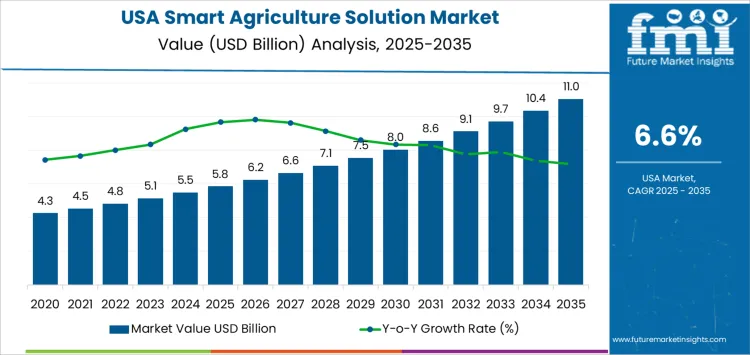
What is the Growth Forecast for Smart Agriculture Solution Industry in USA through 2035?
Demand for smart agriculture solutions in the United States continues to expand as growers adopt precision tools to improve productivity and resource efficiency. Uptake remains strong among large commercial farms with established budgets and infrastructure for automation, data platforms, and sensor systems. These users approach a moderate saturation stage in several mature crop categories because digital adoption has already reached essential operational layers such as irrigation monitoring, yield mapping, and livestock tracking.
Small and mid-sized farms contribute the next wave of demand as affordability improves and government support programs promote digital cultivation practices. This delays any uniform slowdown in national growth. New technologies such as autonomous equipment, predictive analytics, and robotics widen the application scope and reduce the likelihood of early saturation.
Regional variations persist. Western and Midwestern agribusiness remains more advanced in adoption, while southern and northeastern producers expand at a steadier pace. Market saturation increases only when penetration extends across fragmented operators and diverse crop environments. Continued environmental pressures, sustainability requirements, and labor shortages sustain interest in additional system upgrades rather than replacement cycles alone. Steady innovation and ongoing digital transition indicate that the United States maintains distance from any near-term saturation threshold.
USA Smart Agriculture Solution Key Takeaways
| Metric | Value |
|---|---|
| USA Smart Agriculture Solution Sales Value (2025) | USD 5.8 billion |
| USA Smart Agriculture Solution Forecast Value (2035) | USD 11.0 billion |
| USA Smart Agriculture Solution Forecast CAGR (2025-2035) | 6.6% |
Why is the Demand for Smart Agriculture Solutions in the USA Growing?
Demand for smart agriculture solutions in the USA is increasing because farms depend on technology that supports higher productivity and better resource management. Precision tools help farmers monitor soil conditions, crop health and weather patterns through sensors and data platforms. These systems guide fertilizer inputs and irrigation scheduling to reduce waste and support stable yields. Larger crop operations benefit when fields receive only the necessary inputs for strong performance each season.
Livestock farming also contributes to demand. Health monitoring devices, automated feeding equipment and barn climate controls improve animal welfare while reducing manual labor needs. Many producers manage wide areas of land and look for tools that support remote supervision of operations. Environmental regulations and sustainability goals influence purchasing decisions. Smart agriculture tools measure water usage and nutrient application to help maintain compliance with conservation requirements. Growth in greenhouse and controlled environment farming encourages investment in automated lighting and climate systems that maintain ideal growing conditions year round. Constraints involve cost of equipment and the need for training. Some small farms consider adoption only after assessing return on investment.
Which Component Types and Applications Lead Demand for Smart Agriculture Solutions in the United States?
Demand for smart agriculture solutions in the United States reflects the use of connected technologies to improve agricultural productivity, equipment utilization, and land resource planning. Adoption continues across large farms and corporate crop operations where data acquisition, automated machinery, and real-time analytics support operational efficiency. Farmers implement sensing hardware and digital tools to manage fields, livestock monitoring, soil variability, and energy consumption within controlled agricultural facilities.
By Component Type, Hardware Holds the Largest Share
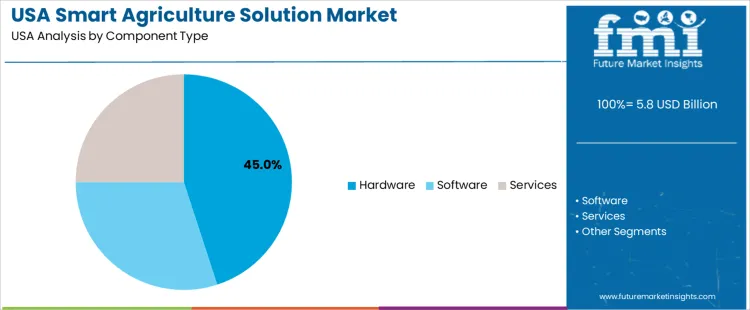
Hardware accounts for 45.0%. Devices such as sensors, automated guidance modules, GPS units, and monitoring systems support operational decision-making in real time. High availability and ruggedness suit agricultural conditions involving outdoor environments, dust exposure, and movement across difficult terrain. Software holds 30.0% and includes farm management programs, equipment analytics, and dashboard monitoring that support planning accuracy. Services represent 25.0%. Deployment support, maintenance, and technical training guide successful use of integrated agricultural equipment fleets in the United States. Component preferences reflect physical equipment reliance and digital workflow expansion within commercial farming systems where producers improve output predictability.
Key Points:
- Hardware drives reliability in field monitoring and equipment guidance
- Software supports coordinated resource and crop planning
- Services maintain integration across equipment and platforms
By Application, Automated Machinery Guidance Control Accounts for the Largest Share
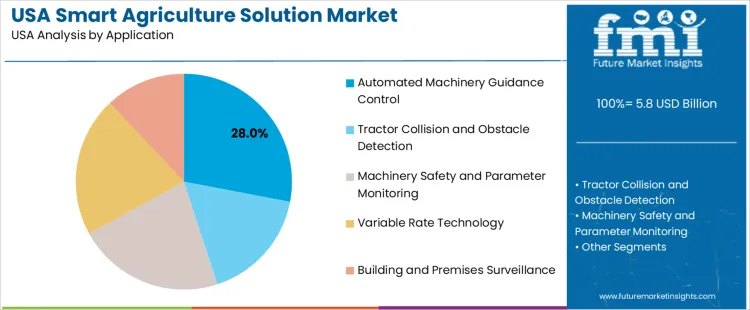
Automated machinery guidance control holds 28.0%. These systems assist tractors and harvesters in path accuracy across large farmlands, reducing soil compaction and fuel waste. Machinery safety and parameter monitoring holds 22.0% with continuous assessment of engine conditions, equipment wear, and operational safety requirements. Variable rate technology represents 21.0%. Precision nutrient application and irrigation help balance crop requirements with sustainability goals. Tractor collision and obstacle detection holds 17.0%. Cameras and proximity sensors support avoidance of human and equipment contact incidents. Building and premises surveillance holds 12.0% and ensures livestock protection and site security across agricultural facilities.
Key Points:
- Guidance control improves land use efficiency and operational safety
- Monitoring systems lower equipment downtime and repair frequency
- Variable input control aligns resources with crop needs
What are the Key Dynamics in the Smart Agriculture Solution Industry?
In the United States, organizations manage growing data volumes generated by mobile apps, online transactions, connected machinery and smart devices. Banks apply streaming analytics for fraud detection and instant risk scoring linked to payment authorization. Retailers analyze purchase behavior and inventory data during active customer sessions to improve promotions and reduce stockouts. Telecommunications providers use real-time analytics to monitor network performance and support continuous service uptime. Emergency response centers and logistics companies rely on dynamic alerts drawn from sensors, geolocation data and dispatch systems. These operational requirements sustain investment in platforms that process data streams with low latency.
High implementation cost, shortage of advanced analytics talent and data integration complexity restrain demand.
Deployment involves specialized cloud or edge infrastructure along with configuration for high-availability performance, which increases spending for mid-size firms. Many companies lack data engineers or architects trained to work with streaming frameworks. Integrating siloed enterprise systems into unified real-time pipelines presents substantial design and maintenance work. Decision-makers evaluate cost justification carefully when slower batch analytics still support certain reporting needs. These factors slow adoption in sectors with limited technical readiness.
Shift toward cloud-native architectures, increased use in cybersecurity monitoring and rising interest in edge analytics define key trends.
Cloud providers expand fully managed streaming services that reduce hardware burden and accelerate deployment. Security teams apply behavioral analytics to detect breaches, insider threats and bot activity while events remain active. Manufacturers and utilities evaluate edge-processed analytics near equipment to reduce bandwidth use and improve response times. Subscription pricing models improve accessibility for scaling up during high-traffic events such as seasonal shopping peaks. Data visualization tools enhance situational awareness for business users working with live dashboards. These patterns indicate continued demand for streaming analytics across the United States aligned with automation, digital commerce and always-active operational models.
Analysis of the Demand for Smart Agriculture Solutions in the USA by Region
Demand for smart agriculture solutions in the United States increases as crop producers, livestock operators, and resource-management teams rely on digital tools to improve yield efficiency and reduce input waste. Farming operations adopt connected sensors, automated irrigation, precision spraying, and remote-monitoring analytics to manage soil variability, fertilization schedules, and livestock health. Data infrastructure improves farm decision cycles, while robotics and autonomous equipment support labor-efficiency goals. Regional growth differences reflect climate diversity, farm sizes, investment capacity, and industry participation. West USA grows at 7.5%, South USA at 6.8%, Northeast USA at 6.0%, and Midwest USA at 5.2% through 2035.
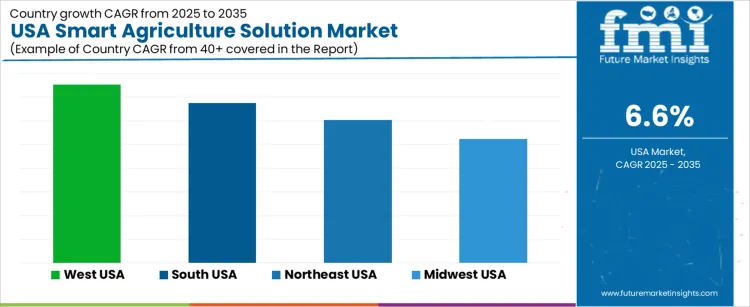
| Region | CAGR (2025-2035) |
|---|---|
| West USA | 7.5% |
| South USA | 6.8% |
| Northeast USA | 6.0% |
| Midwest USA | 5.2% |
How is the West USA driving demand for smart agriculture solutions?
West USA posts 7.5% CAGR, supported by large fruit, vegetable, and vineyard operations across California, Oregon, and Washington. Producers integrate precision-irrigation controls to manage drought challenges and water-allocation limits. Field-sensor networks monitor climate variation across coastal and inland production zones. Robotics assist repetitive harvesting conditions in high-value crops. Data-driven disease-detection systems help protect specialty produce. Procurement focuses on sensor accuracy, irrigation-system compatibility, and support services covering distant farm locations.
- Water-efficiency priorities influencing adoption
- Specialty crop protection using predictive data
- Robotics applied to harvesting and labor shortages
- Distribution of support networks shaping technology rollout
How is the South USA shaping demand?
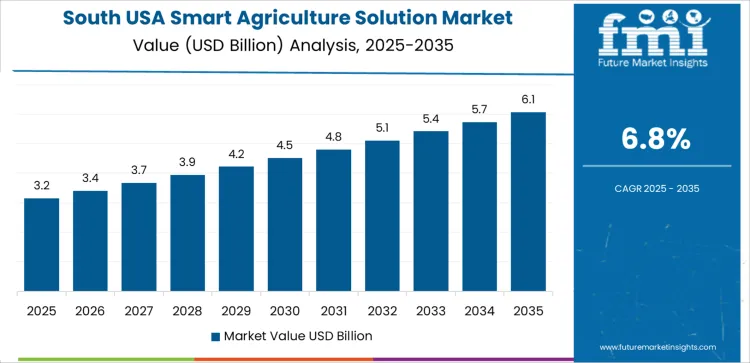
South USA achieves 6.8% CAGR, linked to large-scale row-crop production in Texas, Georgia, and Arkansas. Growers incorporate GPS-guided tractors and autonomous equipment for optimized field coverage. Sensor-based irrigation and fertilizer automation address soil-quality variation and heat-stress risks. Poultry and cattle operations deploy environmental-monitoring systems to maintain stable animal-health conditions. Procurement emphasizes cost management across extensive acreage and regulatory compliance for nutrient-runoff reduction.
- Autonomous farm equipment improving operational timing
- Livestock-monitoring solutions supporting herd wellness
- Fertilization tracking aiding regulatory alignment
- Heat-risk mitigation sustaining crop consistency
How is the Northeast USA contributing to solution adoption?
Northeast USA supports 6.0% CAGR, driven by dairy operations and smaller diversified farms in New York, Pennsylvania, and surrounding states. Indoor-farming systems integrate automated climate control for leafy greens and herbs. Dairy producers rely on sensor-based milking equipment and analytics that monitor herd productivity. Smart-greenhouse installations support year-round planting in colder environments. Buyers evaluate integration with traceability systems that support regional food-supply standards.
- Dairy production improving herd-efficiency management
- Smart-greenhouse solutions addressing seasonal limits
- Traceability features supporting retail expectations
- Smaller-farm suitability guiding product selection
How is the Midwest USA influencing smart-agriculture deployment?
Midwest USA posts 5.2% CAGR, reflecting continuous modernization of corn, soybean, and wheat production across Illinois, Iowa, and Ohio. Precision-planting systems reduce seed waste and maintain consistent spacing in high-acreage environments. Satellite-guided harvesters optimize route planning and fuel usage. Crop-health imaging tools support disease intervention before yield loss accelerates. Procurement preferences reflect equipment durability, field-data compatibility, and support availability necessary for long seasonal operation windows.
- Precision planting sustaining yield reliability
- Imaging tools enabling early disease response
- Fuel-efficiency technology guiding fleet decisions
- Long-season operational requirements shaping design selection
What is the competitive landscape of demand for smart agriculture solutions in the United States?
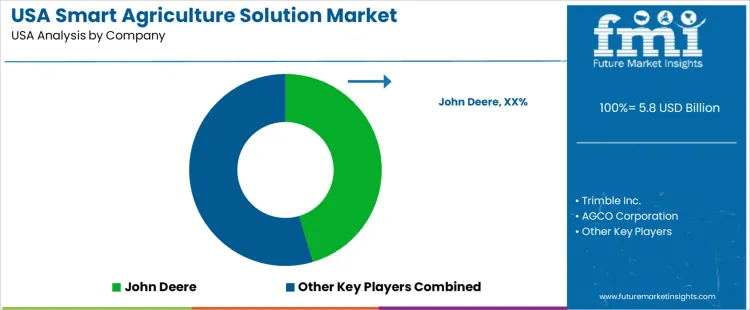
Demand for smart agriculture solutions in the United States reflects the adoption of precision equipment, automated guidance, connected telemetry, field-level sensors, and yield-optimization software. Buyers include row-crop growers, livestock operators, and large integrated farms seeking accurate resource application, reduced labor overhead, and higher output consistency. Decision criteria emphasize data ownership protections, dealership support reach, equipment interoperability, and proven return on technology investments across multi-season use.
John Deere holds a significant share due to integrated hardware platforms, proprietary machine connectivity, and strong dealer networks across major farming regions. Its advanced guidance systems, variable-rate technology, and remote diagnostics create high switching costs for users managing mixed fleets and large acreage. Trimble Inc. supports specialty crops and retrofit demand with positioning solutions and software tools that maintain compatibility across equipment brands in USA farms that refresh components incrementally rather than replacing entire machinery fleets.
AGCO Corporation provides factory-installed precision options aligned to tractors and harvesting equipment used by regional operators with brand loyalty. Raven Industries supplies application control systems and autonomous technology that attract farms expanding automation for spraying and planting tasks. Topcon Positioning Systems competes through positioning capabilities tailored to grading, land preparation, and orchard management requiring precise navigation. Competitive positioning relies on agronomic analytics tools, hardware reliability during long operational windows, and service infrastructure that supports rapid field repairs. Providers delivering robust data integration, local training, and scalable automation features maintain stronger placement across USA adoption of smart agriculture solutions.
Key Players in USA Smart Agriculture Solution Demand
- John Deere
- Trimble Inc.
- AGCO Corporation
- Raven Industries
- Topcon Positioning Systems
Scope of the Report
| Items | Values |
|---|---|
| Quantitative Units | USD billion |
| Component Type | Hardware, Software, Services |
| Application | Automated Machinery Guidance Control, Tractor Collision and Obstacle Detection, Machinery Safety and Parameter Monitoring, Variable Rate Technology, Building and Premises Surveillance |
| Regions Covered | West USA, South USA, Northeast USA, Midwest USA |
| Key Companies Profiled | John Deere, Trimble Inc., AGCO Corporation, Raven Industries, Topcon Positioning Systems |
| Additional Attributes | Dollar sales by component type and application; adoption trends among large commercial farms and mid-size producers; integration with GNSS guidance, telematics, and AI-driven decision support; growth driven by farm automation, yield optimization, and labor shortage; competitive landscape including precision agriculture ecosystem providers and connected farm platforms. |
USA Smart Agriculture Solution Demand by Segments
Component Type:
- Hardware
- Software
- Services
Application:
- Automated Machinery Guidance Control
- Tractor Collision and Obstacle Detection
- Machinery Safety and Parameter Monitoring
- Variable Rate Technology
- Building and Premises Surveillance
Region:
- West USA
- South USA
- Northeast USA
- Midwest USA
Frequently Asked Questions
How big is the demand for smart agriculture solution in USA in 2025?
The demand for smart agriculture solution in USA is estimated to be valued at USD 5.8 billion in 2025.
What will be the size of smart agriculture solution in USA in 2035?
The market size for the smart agriculture solution in USA is projected to reach USD 11.0 billion by 2035.
How much will be the demand for smart agriculture solution in USA growth between 2025 and 2035?
The demand for smart agriculture solution in USA is expected to grow at a 6.6% CAGR between 2025 and 2035.
What are the key product types in the smart agriculture solution in USA?
The key product types in smart agriculture solution in USA are hardware, software and services.
Which application segment is expected to contribute significant share in the smart agriculture solution in USA in 2025?
In terms of application, automated machinery guidance control segment is expected to command 28.0% share in the smart agriculture solution in USA in 2025.
Preview the report firsthand - request a free sample
Get SampleGet the brochure for pricing and purchase details.
Get PDFTable of Content
- Executive Summary
- USA Market Outlook
- Demand-side Trends
- Supply-side Trends
- Technology Roadmap Analysis
- Analysis and Recommendations
- Market Overview
- Market Coverage / Taxonomy
- Market Definition / Scope / Limitations
- Market Background
- Market Dynamics
- Drivers
- Restraints
- Opportunity
- Trends
- Scenario Forecast
- Demand in Optimistic Scenario
- Demand in Likely Scenario
- Demand in Conservative Scenario
- Opportunity Map Analysis
- Product Life Cycle Analysis
- Supply Chain Analysis
- Investment Feasibility Matrix
- Value Chain Analysis
- PESTLE and Porter’s Analysis
- Regulatory Landscape
- Regional Parent Market Outlook
- Production and Consumption Statistics
- Import and Export Statistics
- Market Dynamics
- USA Market Analysis 2020 to 2024 and Forecast, 2025 to 2035
- Historical Market Size Value (USD Million) Analysis, 2020 to 2024
- Current and Future Market Size Value (USD Million) Projections, 2025 to 2035
- Y-o-Y Growth Trend Analysis
- Absolute $ Opportunity Analysis
- USA Market Pricing Analysis 2020 to 2024 and Forecast 2025 to 2035
- USA Market Analysis 2020 to 2024 and Forecast 2025 to 2035, By Component Type
- Introduction / Key Findings
- Historical Market Size Value (USD Million) Analysis By Component Type , 2020 to 2024
- Current and Future Market Size Value (USD Million) Analysis and Forecast By Component Type , 2025 to 2035
- Hardware
- Software
- Services
- Y-o-Y Growth Trend Analysis By Component Type , 2020 to 2024
- Absolute $ Opportunity Analysis By Component Type , 2025 to 2035
- USA Market Analysis 2020 to 2024 and Forecast 2025 to 2035, By Application
- Introduction / Key Findings
- Historical Market Size Value (USD Million) Analysis By Application, 2020 to 2024
- Current and Future Market Size Value (USD Million) Analysis and Forecast By Application, 2025 to 2035
- Automated Machinery Guidance Control
- Tractor Collision and Obstacle Detection
- Machinery Safety and Parameter Monitoring
- Variable Rate Technology
- Building and Premises Surveillance
- Y-o-Y Growth Trend Analysis By Application, 2020 to 2024
- Absolute $ Opportunity Analysis By Application, 2025 to 2035
- Market Structure Analysis
- Competition Dashboard
- Competition Benchmarking
- Market Share Analysis of Top Players
- By Regional
- By Component Type
- By Application
- Competition Analysis
- Competition Deep Dive
- John Deere
- Overview
- Product Portfolio
- Profitability by Market Segments (Product/Age /Sales Channel/Region)
- Sales Footprint
- Strategy Overview
- Marketing Strategy
- Product Strategy
- Channel Strategy
- Trimble Inc.
- AGCO Corporation
- Raven Industries
- Topcon Positioning Systems
- John Deere
- Competition Deep Dive
- Assumptions & Acronyms Used
- Research Methodology


