

- Industry Size (2026)
- USD 106.7 Mn
- Forecast (2036)
- USD 156.4 Mn
- CAGR (2026 to 2036)
- 3.9%
Low Loss Phase Stable Cable Market Forecast and Outlook 2026 to 2036
In 2026, low loss phase stable cable supports USD 106.7 million in annual demand, with programs extending that base to USD 156.4 million by 2036 at a CAGR of 3.9%. Design work fixes phase drift limits, insertion loss ceilings, and bend tolerance before routing ever begins. Once drawings and connector interfaces reach release status, any substitution forces requalification across assemblies and test plans. Buyers work from controlled vendor lists supported by sweep data and phase versus temperature curves. Awards follow evidence of process stability, dielectric uniformity, and braid geometry control. Commercial negotiation comes after technical approval and audit clearance.
In 2026, low loss phase stable cable production operates inside narrow tolerance bands that govern yield, scrap, and test time, while the same base grows toward USD 156.4 million by 2036 at 3.90% CAGR. Factory planning revolves around conductor preparation, extrusion consistency, and braid coverage discipline. Line schedules group runs by die sets and jacket compounds to protect repeatability. Every shipment clears phase stability checks, sweep tests, and continuity gates. Reel handling methods affect damage during transport and site pulls. Contracts freeze specifications inside controlled drawings. Tooling recovery and scrap control shape margins more than shipment volume. Capacity follows awarded programs with fixed delivery windows.
Quick Stats for Low Loss Phase Stable Cable Market
- Low Loss Phase Stable Cable Market Value (2026): USD 106.7 million
- Low Loss Phase Stable Cable Market Forecast Value (2036): USD 156.4 million
- Low Loss Phase Stable Cable Market Forecast CAGR 2026 to 2036: 3.9%
- Leading Cable Type in Low Loss Phase Stable Cable Market: Coaxial low loss phase stable cables
- Leading Frequency Range in Low Loss Phase Stable Cable Market: RF and microwave phase stable applications
- Key Growth Regions in Low Loss Phase Stable Cable Market: Asia Pacific, North America, Europe
- Top Players in Low Loss Phase Stable Cable Market: Times Microwave Systems, Pasternack Enterprises, HUBER+SUHNER, Carlisle Interconnect Technologies, RADIAL Engineering, Belden Inc.
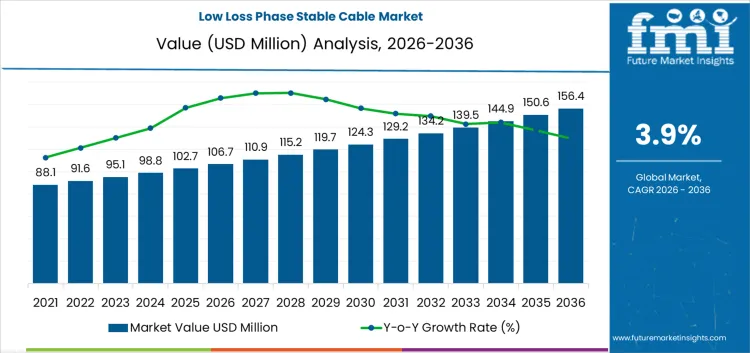
What Is the Growth Forecast for the Low Loss Phase Stable Cable Market through 2036?
Demand for low-loss, phase-stable cables is driven more by test system design and calibration cost control than by overall electronics production volumes. In the near term, adoption is strongest in RF test benches, aerospace platforms, and high-frequency instrumentation where even small phase drift can lead to measurement errors, rework, and costly downtime. These cables are typically specified during the system design stage and remain installed for long operating cycles, which means replacement demand follows planned maintenance schedules rather than short-term equipment shipment trends. Growth is supported by increasingly dense test setups, longer internal signal runs, and the shift to higher operating frequencies in advanced systems.
In the later stage, progress in this segment becomes more about manufacturing discipline than basic adoption. As deployment expands across laboratories, defense programs, and telecom test environments, buyers place higher importance on tight dielectric control, shielding uniformity, and long-term thermal stability. Procurement decisions increasingly favor suppliers that can provide documented performance data, strong lot traceability, and consistent behavior across production batches. As tolerances tighten, validation and verification requirements rise, increasing effort per cable. Suppliers that maintain measurement credibility and dependable delivery schedules are better positioned to secure repeat orders and long-duration program placements.
Low Loss Phase Stable Cable Market Key Takeaways
| Metric | Value |
|---|---|
| Market Value (2026) | USD 106.7 million |
| Forecast Value (2036) | USD 156.4 million |
| Forecast CAGR 2026 to 2036 | 3.9% |
How Is the Low Loss Phase Stable Cable Market Defining Signal Integrity in Precision Systems?
Low loss phase stable cable is specified where both attenuation and phase drift must remain tightly controlled. Earlier microwave and RF installations often accepted phase change with temperature and flexing, then compensated in software or calibration routines. That approach limited measurement repeatability and increased maintenance effort in test ranges, radar, and satellite ground equipment. Phase stable constructions address this by combining low expansion dielectrics, controlled shielding, and tightly managed geometry. Performance is judged across frequency, temperature, and bend cycles rather than by static datasheet values alone. Users include test equipment manufacturers, defense integrators, space programs, and telecom infrastructure builders. Adoption usually follows system redesigns, since cable behavior becomes part of the error budget and certification plan from the start.
Procurement in this category is driven by engineering validation rather than by purchasing departments alone. Earlier buying patterns favored small quantities for calibration labs and prototypes, with long lead times and limited vendor choice. Current programs demand consistent supply for production systems and field replacements, which changes supplier qualification criteria. Manufacturers compare insertion loss, phase change per degree, and durability under repeated handling, then lock part numbers for long service periods. Price is weighed against downtime risk and recalibration cost, not against generic RF cable alternatives. Suppliers compete on process control, test data traceability, and termination quality as much as on materials. Over time, demand tracks growth in high frequency testing, space systems, and advanced radar, where stable signal paths determine usable measurement margins and operating confidence.
What Factors Are Shaping the Demand for Low Loss Phase Stable Cable Market in 2026 by Cable Type and Frequency Range?
Design authority for Low Loss Phase Stable Cable Market usually sits with system architects, not with procurement teams. Once a phase budget is allocated across a signal chain, cabling becomes part of the measurement architecture, not a replaceable accessory. Phase drift limits, thermal behavior, and connector interfaces are fixed early and survive several hardware generations. Spending therefore tracks how many platforms move from prototype to deployed systems. Volume follows qualification milestones, not unit shipments. The segment structure reflects where phase error can be tolerated and where it cannot. Suppliers compete on measured stability over temperature, documented aging behavior, and repeatable assembly quality rather than on visible construction differences.
How Does Cable Type Choice Shape Production Methods and Qualification Burden in the Low Loss Phase Stable Cable Market?
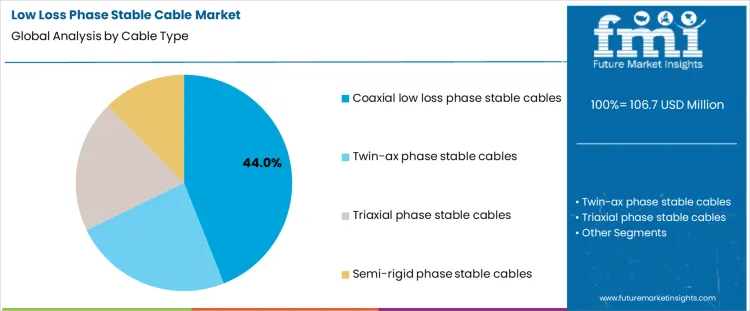
Coaxial low loss phase stable cables represent about 44% of demand in the Low Loss Phase Stable Cable Market because they balance predictable impedance control with manageable manufacturing tolerances. Their geometry supports stable phase behavior across temperature swings when dielectric consistency and braid tension are tightly controlled. Twin-ax variants appear in systems that favor differential signaling paths, though matching between conductor’s increases inspection workload. Triaxial constructions serve environments with aggressive shielding needs, which adds layers, mass, and termination complexity. Semi-rigid designs address applications where routing is fixed and mechanical stability is valued over flexibility. Each type carries different scrap risk profiles, tooling needs, and termination skill requirements, which separates production lines even inside the same factory.
The cost structure by cable type is driven by yield stability and requalification exposure rather than by raw material content. Coaxial designs benefit from long production history and stable process windows, which supports consistent batch performance. Twin-ax and triaxial constructions increase assembly steps and inspection points, raising labor content and throughput sensitivity. Semi-rigid cables impose tighter forming and handling rules, which shifts cost toward skilled labor and slower cycle times. Once a platform is certified with a given construction, substitutions remain rare because phase stability data must be regenerated across temperature and frequency ranges. Demand by type therefore follows long platform cycles instead of short procurement optimization exercises.
Why Does Frequency Range Define Performance Targets and Volume Concentration in the Low Loss Phase Stable Cable Market?
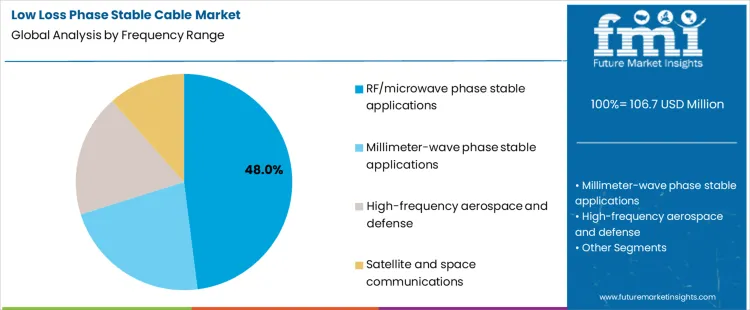
RF and microwave phase stable applications account for about 48% of demand in the Low Loss Phase Stable Cable Market because they combine wide deployment scale with strict, measurable phase budgets. These systems include test equipment, radar subsystems, and communication infrastructure where cable behavior directly affects calibration and timing alignment. Millimeter-wave uses operate at shorter wavelengths, which compresses tolerance margins and increases sensitivity to geometry variation, limiting volumes to programs that can absorb higher qualification cost. High frequency aerospace and defense applications impose environmental and documentation requirements that narrow supplier pools. Satellite and space communications prioritize mass, outgassing control, and thermal cycling behavior, which further concentrates demand into specialized production runs.
Frequency driven segmentation also shapes ordering patterns and service expectations. RF and microwave programs place larger, more regular orders because their platforms deploy in fleets and require spares with identical phase characteristics. Millimeter-wave, aerospace, and space programs order smaller quantities yet require deeper test records, traceability, and configuration control. These customers often reserve capacity early because recertification delays affect launch schedules and test campaigns. The resulting mix explains why volume leadership sits in lower frequency ranges while technical intensity increases at higher frequencies. Segment shares move with platform deployment schedules and test infrastructure expansion, not with short term electronics production cycles.
How Is the Low Loss Phase Stable Cable Market Being Shaped By System Reliability And Calibration Economics?
The low loss phase stable cable market is driven by applications where signal consistency matters more than simple transmission. In aerospace, defense, satellite communication, and test and measurement systems, phase drift and insertion loss directly affect calibration cycles, system uptime, and measurement credibility. Buyers treat these cables as part of the signal chain, not as interchangeable wiring. Procurement decisions therefore involve metrology, systems engineering, and quality teams rather than only sourcing departments. Cable selection is tied to long-term performance stability, documented behavior over temperature and flexing, and predictable aging characteristics. This makes the product a reliability component and a cost control tool rather than a commodity interconnect.
How Is Application Behavior Changing What Engineers Expect from The Low Loss Phase Stable Cable Market?
Equipment designers increasingly assume that signal paths must remain stable across temperature swings, mechanical movement, and long service intervals. This pushes demand toward cables that are characterized, not just specified. In test systems, phased array antennas, and high frequency communication links, repeatability over time reduces recalibration effort and downtime. As a result, low loss phase stable cable market demand is shifting toward tightly controlled constructions, better material consistency, and documented performance envelopes. There is also a growing preference for pre-tested assemblies to reduce installation variability. The buying decision is moving closer to performance assurance and away from simple frequency rating comparisons.
Where Does Sustainable Growth Come from in The Low Loss Phase Stable Cable Market Beyond Laboratory Environments?
Growth increasingly comes from deployment in operational systems rather than only in lab instrumentation. Radar platforms, satellite ground stations, production test lines, and field measurement systems all depend on stable signal paths to maintain accuracy without constant recalibration. These environments value predictable lifetime behavior and service stability, not just peak performance. There is also room to grow through system level offerings such as matched cable sets, characterized assemblies, and documentation packages that reduce integration risk for customers. Suppliers that work with system architects early in design cycles can become embedded in platforms that run for many years, creating durable and repeatable demand.
Why Does Qualification Discipline and Cost Sensitivity Limit Broader Adoption In The Low Loss Phase Stable Cable Market?
Once a signal path is qualified in a regulated or performance critical system, changing the cable often triggers revalidation, recertification, and system level testing. This makes users cautious about switching suppliers or designs, even when alternatives exist. At the same time, low loss phase stable cables carry a visible cost premium over standard coaxial solutions. In systems where performance margins are not tightly constrained, buyers often accept higher drift or loss to reduce upfront cost. This combination of qualification inertia and budget trade-offs slows expansion into less critical applications and keeps adoption concentrated in performance driven segments.
What is the Demand for Low Loss Phase Stable Cable by Country?
| Country | CAGR |
|---|---|
| USA | 3.5% |
| UK | 3.2% |
| China | 4.2% |
| India | 4.5% |
| Brazil | 3.8% |
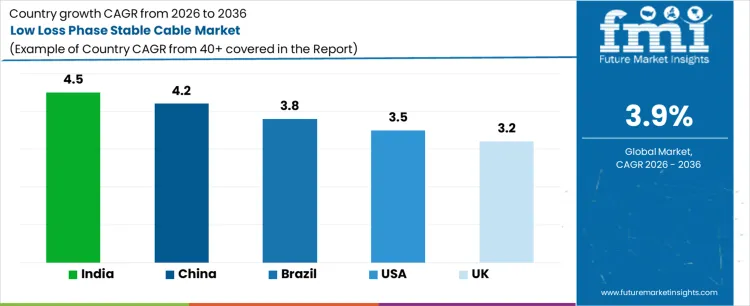
Demand for low loss phase stable cable is rising as test and measurement systems, radar installations, satellite communication, and high frequency networks require signal integrity under varying thermal and mechanical conditions. India leads with a 4.5% CAGR, supported by defense modernization, expansion of telecom testing infrastructure, and growing electronics manufacturing. China follows at 4.2%, driven by aerospace programs, 5G and satellite ground equipment, and domestic instrumentation production. Brazil records 3.8%, reflecting gradual upgrades in broadcast and telecom measurement networks. The USA grows at 3.5%, shaped by replacement demand in established defense, aerospace, and laboratory systems. The UK, at 3.2%, reflects a mature market with steady but replacement led procurement patterns.
How Do Qualification Cycles and Design Wins Shape Demand in The United States?
Long qualification cycles tied to multi-year equipment programs place the low loss phase stable cable market in the United States on a 3.5% CAGR path. Wireless densification, data center interconnect refresh, and defense communications programs define most volume. Approved part numbers stay fixed across extended deployment schedules. Cable purchases sit inside system supply contracts covering radios, test equipment, and backhaul assemblies. Aging installations generate steady replacement activity in high duty cycle locations. Inventory planning follows rollout calendars. Contractor preferences influence specification lists during site construction. Commercial position depends on retaining approved status within recurring programs and framework agreements rather than competing for isolated purchase orders.
Why Do Access Windows and Audit Controls Define Procurement in The United Kingdom?
Access planning and performance audits keep the low loss phase stable cable market in the United Kingdom aligned with a 3.2% CAGR. Telecom, broadcast, and defense estates operate under strict entry and work window controls. Infrastructure owners and prime integrators manage limited approval lists for cable types. Phase stability under temperature variation and shielding performance receive priority during acceptance testing. Orders appear in route based or site cluster packages. Refurbishment work contributes a large share of volumes where legacy links fail inspection. Stock positioning follows agreed work schedules. Commercial visibility comes from framework participation and audit history rather than short cycle price bidding.
What Planning Structure Controls Volume Formation in China?
Central rollout coordination places the low loss phase stable cable market in China on a 4.2% growth track. 5g networks, data center interconnects, aerospace platforms, and research facilities absorb most shipments. Major operators and prime contractors set uniform specifications. Supplier lists remain narrow. Order releases follow multi-year deployment plans. Domestic production capacity supports consistent delivery and quality checks. Capacity expansion and asset replacement proceed across several networks at the same time. Schedule performance defines supplier standing. Commercial success depends on inclusion in national programs and prime contractor supply chains rather than pursuit of regional supply contracts.
How Do Program Scale and System Contracts Shape Demand in India?
Network expansion programs fix the low loss phase stable cable market in India at a 4.5% CAGR. Telecom rollout, instrumentation upgrades, and space and defense projects account for most demand. Cable volumes move through integrated system supply packages. Funding and approval milestones control release timing. Qualification lists limit eligible suppliers. New site construction contributes more volume than replacement activity, though environmental stress increases inspection driven changeouts. Integrators influence part selection through standardized designs. Repeated tender participation determines supplier continuity. Commercial position depends on maintaining approval status across successive program phases rather than competing for one off supply orders.
How Do Operator Plans and Certification Timelines Guide Spending in Brazil?
Investment programs and regulatory clearances keep the low loss phase stable cable market in Brazil near a 3.8% CAGR. Telecom expansion, broadcast network upkeep, and selected research and defense systems define spending patterns. Technical lists controlled by operators and integrators determine acceptable cable types. Import certification and logistics planning shape order batching and stock policies. Purchases travel inside larger equipment and network upgrade contracts. Field conditions drive steady replacement of links that no longer meet phase stability limits. Distribution coverage and integrator relationships shape supplier access. Commercial results depend on position inside program supply chains rather than competition for small standalone tenders.
How Do Suppliers Compete for Program Positions in the Low Loss Phase Stable Cable Market?
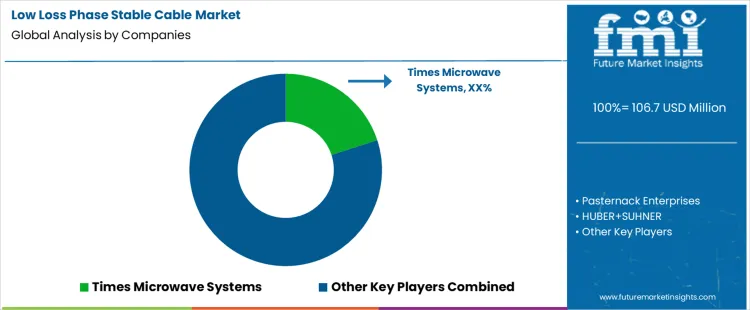
Low loss phase stable cable demand comes from radar, test systems, satellite payloads, electronic warfare, precision timing links. Program teams select cable families during early architecture definition. Electrical drift limits, temperature behavior, bend stability, connector interfaces fix the shortlist. Times Microwave Systems, Pasternack Enterprises, HUBER+SUHNER, Carlisle Interconnect Technologies, RADIAL Engineering, Belden compete at specification stage rather than at spot purchase stage. Once qualified, cable references enter drawings and test procedures. Times Microwave Systems holds strong positions in defense and aerospace programs. HUBER+SUHNER focuses on high reliability RF assemblies and system integration. Carlisle Interconnect Technologies links cable offerings with interconnect platforms. Pasternack Enterprises serves rapid delivery and prototype cycles. RADIAL Engineering supplies niche high stability assemblies. Belden supports industrial and instrumentation programs with controlled production lines and documented processes.
Competition follows approval lists, audit histories, and long production lifecycles. Buyers examine phase stability curves, attenuation limits, shielding performance, mechanical repeatability, and test documentation. Manufacturing scale matters for long programs with stable call off schedules. Engineering support matters for early design validation and change control. Times Microwave Systems benefits from installed base and defense qualification history. HUBER+SUHNER leverages European aerospace and rail electronics programs. Carlisle Interconnect Technologies uses system level relationships across connectors, harnesses, and cable assemblies. Pasternack Enterprises captures time sensitive builds and lab expansion projects. RADIAL Engineering holds positions in specialized RF platforms. Belden competes where industrial qualification, process control, and long term supply assurance govern awards. Pricing pressure remains bounded by requalification cost, schedule risk, and customer documentation rules. Market positions vary by sector, program maturity, and certification regime.
Key Players in the Low Loss Phase Stable Cable Market
- Times Microwave Systems
- Pasternack Enterprises
- HUBER+SUHNER
- Carlisle Interconnect Technologies
- RADIAL Engineering
- Belden Inc.
Scope of the Report
| Items | Values |
|---|---|
| Quantitative Units (2026) | USD million |
| Cable Type | Coaxial low loss phase stable cables, Twin-ax phase stable cables, Triaxial phase stable cables, Semi-rigid phase stable cables |
| Frequency Range | RF and microwave phase stable applications, Millimeter-wave phase stable applications, High-frequency aerospace and defense, Satellite and space communications |
| Region | Asia Pacific, Europe, North America, Latin America, Middle East & Africa |
| Countries Covered | China, Japan, South Korea, India, Australia & New Zealand, ASEAN, Germany, United Kingdom, France, Italy, Spain, Nordic, BENELUX, United States, Canada, Mexico, Brazil, Chile, Saudi Arabia, Turkey, South Africa, and other regional markets |
| Key Companies Profiled | Times Microwave Systems, Pasternack Enterprises, HUBER+SUHNER, Carlisle Interconnect Technologies, RADIAL Engineering, Belden Inc. |
| Additional Attributes | Dollar by sales by cable type and frequency range; demand driven by calibration economics, phase drift limits, and system reliability needs; growth led by test systems, radar, satellite, and telecom infrastructure; purchasing shaped by qualification cycles, traceability, documented stability, and long-term program lock-in rather than unit price. |
Low Loss Phase Stable Cable Market Segmentation
Cable Type:
- Coaxial low loss phase stable cables
- Twin-ax phase stable cables
- Triaxial phase stable cables
- Semi-rigid phase stable cables
Frequency Range:
- RF/microwave phase stable applications
- Millimeter-wave phase stable applications
- High-frequency aerospace and defense
- Satellite and space communications
Region:
- Asia Pacific
- China
- Japan
- South Korea
- India
- Australia & New Zealand
- ASEAN
- Rest of Asia Pacific
- Europe
- Germany
- United Kingdom
- France
- Italy
- Spain
- Nordic
- BENELUX
- Rest of Europe
- North America
- United States
- Canada
- Mexico
- Latin America
- Brazil
- Chile
- Rest of Latin America
- Middle East & Africa
- Kingdom of Saudi Arabia
- Other GCC Countries
- Turkey
- South Africa
- Other African Union
- Rest of Middle East & Africa
Bibliography
- International Electrotechnical Commission. (2023). IEC 61196 series: Radio-frequency cables. International Electrotechnical Commission.
- Institute of Electrical and Electronics Engineers. (2024). IEEE Standard 287: Precision coaxial connectors (7 mm, 14 mm, 7/16, and related RF interfaces). IEEE Standards Association.
- National Institute of Standards and Technology. (2024). Microwave and millimeter-wave metrology for high-frequency measurement systems. U.S. Department of Commerce.
Frequently Asked Questions
How big is the low loss phase stable cable market in 2026?
The global low loss phase stable cable market is estimated to be valued at USD 106.7 million in 2026.
What will be the size of low loss phase stable cable market in 2036?
The market size for the low loss phase stable cable market is projected to reach USD 156.4 million by 2036.
How much will be the low loss phase stable cable market growth between 2026 and 2036?
The low loss phase stable cable market is expected to grow at a 3.9% CAGR between 2026 and 2036.
What are the key product types in the low loss phase stable cable market?
The key product types in low loss phase stable cable market are coaxial low loss phase stable cables , twin‑ax phase stable cables, triaxial phase stable cables and semi‑rigid phase stable cables.
Which frequency range segment to contribute significant share in the low loss phase stable cable market in 2026?
In terms of frequency range, rf/microwave phase stable applications segment to command 48.0% share in the low loss phase stable cable market in 2026.
Preview the report firsthand - request a free sample
Get SampleGet the brochure for pricing and purchase details.
Get PDFTable of Content
- Executive Summary
- Global Market Outlook
- Demand-side Trends
- Supply-side Trends
- Technology Roadmap Analysis
- Analysis and Recommendations
- Market Overview
- Market Coverage / Taxonomy
- Market Definition / Scope / Limitations
- Market Background
- Market Dynamics
- Drivers
- Restraints
- Opportunity
- Trends
- Scenario Forecast
- Demand in Optimistic Scenario
- Demand in Likely Scenario
- Demand in Conservative Scenario
- Opportunity Map Analysis
- Product Life Cycle Analysis
- Supply Chain Analysis
- Investment Feasibility Matrix
- Value Chain Analysis
- PESTLE and Porter’s Analysis
- Regulatory Landscape
- Regional Parent Market Outlook
- Production and Consumption Statistics
- Import and Export Statistics
- Market Dynamics
- Global Market Analysis 2021 to 2025 and Forecast, 2026 to 2036
- Historical Market Size Value (USD Million) Analysis, 2021 to 2025
- Current and Future Market Size Value (USD Million) Projections, 2026 to 2036
- Y-o-Y Growth Trend Analysis
- Absolute $ Opportunity Analysis
- Global Market Pricing Analysis 2021 to 2025 and Forecast 2026 to 2036
- Global Market Analysis 2021 to 2025 and Forecast 2026 to 2036, By Cable Type
- Introduction / Key Findings
- Historical Market Size Value (USD Million) Analysis By Cable Type , 2021 to 2025
- Current and Future Market Size Value (USD Million) Analysis and Forecast By Cable Type , 2026 to 2036
- Coaxial low loss phase stable cables
- Twin‑ax phase stable cables
- Triaxial phase stable cables
- Semi‑rigid phase stable cables
- Coaxial low loss phase stable cables
- Y-o-Y Growth Trend Analysis By Cable Type , 2021 to 2025
- Absolute $ Opportunity Analysis By Cable Type , 2026 to 2036
- Global Market Analysis 2021 to 2025 and Forecast 2026 to 2036, By Frequency Range
- Introduction / Key Findings
- Historical Market Size Value (USD Million) Analysis By Frequency Range, 2021 to 2025
- Current and Future Market Size Value (USD Million) Analysis and Forecast By Frequency Range, 2026 to 2036
- RF/microwave phase stable applications
- Millimeter‑wave phase stable applications
- High‑frequency aerospace and defense
- Satellite and space communications
- RF/microwave phase stable applications
- Y-o-Y Growth Trend Analysis By Frequency Range, 2021 to 2025
- Absolute $ Opportunity Analysis By Frequency Range, 2026 to 2036
- Global Market Analysis 2021 to 2025 and Forecast 2026 to 2036, By Region
- Introduction
- Historical Market Size Value (USD Million) Analysis By Region, 2021 to 2025
- Current Market Size Value (USD Million) Analysis and Forecast By Region, 2026 to 2036
- North America
- Latin America
- Western Europe
- Eastern Europe
- East Asia
- South Asia and Pacific
- Middle East & Africa
- Market Attractiveness Analysis By Region
- North America Market Analysis 2021 to 2025 and Forecast 2026 to 2036, By Country
- Historical Market Size Value (USD Million) Trend Analysis By Market Taxonomy, 2021 to 2025
- Market Size Value (USD Million) Forecast By Market Taxonomy, 2026 to 2036
- By Country
- USA
- Canada
- Mexico
- By Cable Type
- By Frequency Range
- By Country
- Market Attractiveness Analysis
- By Country
- By Cable Type
- By Frequency Range
- Key Takeaways
- Latin America Market Analysis 2021 to 2025 and Forecast 2026 to 2036, By Country
- Historical Market Size Value (USD Million) Trend Analysis By Market Taxonomy, 2021 to 2025
- Market Size Value (USD Million) Forecast By Market Taxonomy, 2026 to 2036
- By Country
- Brazil
- Chile
- Rest of Latin America
- By Cable Type
- By Frequency Range
- By Country
- Market Attractiveness Analysis
- By Country
- By Cable Type
- By Frequency Range
- Key Takeaways
- Western Europe Market Analysis 2021 to 2025 and Forecast 2026 to 2036, By Country
- Historical Market Size Value (USD Million) Trend Analysis By Market Taxonomy, 2021 to 2025
- Market Size Value (USD Million) Forecast By Market Taxonomy, 2026 to 2036
- By Country
- Germany
- UK
- Italy
- Spain
- France
- Nordic
- BENELUX
- Rest of Western Europe
- By Cable Type
- By Frequency Range
- By Country
- Market Attractiveness Analysis
- By Country
- By Cable Type
- By Frequency Range
- Key Takeaways
- Eastern Europe Market Analysis 2021 to 2025 and Forecast 2026 to 2036, By Country
- Historical Market Size Value (USD Million) Trend Analysis By Market Taxonomy, 2021 to 2025
- Market Size Value (USD Million) Forecast By Market Taxonomy, 2026 to 2036
- By Country
- Russia
- Poland
- Hungary
- Balkan & Baltic
- Rest of Eastern Europe
- By Cable Type
- By Frequency Range
- By Country
- Market Attractiveness Analysis
- By Country
- By Cable Type
- By Frequency Range
- Key Takeaways
- East Asia Market Analysis 2021 to 2025 and Forecast 2026 to 2036, By Country
- Historical Market Size Value (USD Million) Trend Analysis By Market Taxonomy, 2021 to 2025
- Market Size Value (USD Million) Forecast By Market Taxonomy, 2026 to 2036
- By Country
- China
- Japan
- South Korea
- By Cable Type
- By Frequency Range
- By Country
- Market Attractiveness Analysis
- By Country
- By Cable Type
- By Frequency Range
- Key Takeaways
- South Asia and Pacific Market Analysis 2021 to 2025 and Forecast 2026 to 2036, By Country
- Historical Market Size Value (USD Million) Trend Analysis By Market Taxonomy, 2021 to 2025
- Market Size Value (USD Million) Forecast By Market Taxonomy, 2026 to 2036
- By Country
- India
- ASEAN
- Australia & New Zealand
- Rest of South Asia and Pacific
- By Cable Type
- By Frequency Range
- By Country
- Market Attractiveness Analysis
- By Country
- By Cable Type
- By Frequency Range
- Key Takeaways
- Middle East & Africa Market Analysis 2021 to 2025 and Forecast 2026 to 2036, By Country
- Historical Market Size Value (USD Million) Trend Analysis By Market Taxonomy, 2021 to 2025
- Market Size Value (USD Million) Forecast By Market Taxonomy, 2026 to 2036
- By Country
- Kingdom of Saudi Arabia
- Other GCC Countries
- Turkiye
- South Africa
- Other African Union
- Rest of Middle East & Africa
- By Cable Type
- By Frequency Range
- By Country
- Market Attractiveness Analysis
- By Country
- By Cable Type
- By Frequency Range
- Key Takeaways
- Key Countries Market Analysis
- USA
- Pricing Analysis
- Market Share Analysis, 2025
- By Cable Type
- By Frequency Range
- Canada
- Pricing Analysis
- Market Share Analysis, 2025
- By Cable Type
- By Frequency Range
- Mexico
- Pricing Analysis
- Market Share Analysis, 2025
- By Cable Type
- By Frequency Range
- Brazil
- Pricing Analysis
- Market Share Analysis, 2025
- By Cable Type
- By Frequency Range
- Chile
- Pricing Analysis
- Market Share Analysis, 2025
- By Cable Type
- By Frequency Range
- Germany
- Pricing Analysis
- Market Share Analysis, 2025
- By Cable Type
- By Frequency Range
- UK
- Pricing Analysis
- Market Share Analysis, 2025
- By Cable Type
- By Frequency Range
- Italy
- Pricing Analysis
- Market Share Analysis, 2025
- By Cable Type
- By Frequency Range
- Spain
- Pricing Analysis
- Market Share Analysis, 2025
- By Cable Type
- By Frequency Range
- France
- Pricing Analysis
- Market Share Analysis, 2025
- By Cable Type
- By Frequency Range
- India
- Pricing Analysis
- Market Share Analysis, 2025
- By Cable Type
- By Frequency Range
- ASEAN
- Pricing Analysis
- Market Share Analysis, 2025
- By Cable Type
- By Frequency Range
- Australia & New Zealand
- Pricing Analysis
- Market Share Analysis, 2025
- By Cable Type
- By Frequency Range
- China
- Pricing Analysis
- Market Share Analysis, 2025
- By Cable Type
- By Frequency Range
- Japan
- Pricing Analysis
- Market Share Analysis, 2025
- By Cable Type
- By Frequency Range
- South Korea
- Pricing Analysis
- Market Share Analysis, 2025
- By Cable Type
- By Frequency Range
- Russia
- Pricing Analysis
- Market Share Analysis, 2025
- By Cable Type
- By Frequency Range
- Poland
- Pricing Analysis
- Market Share Analysis, 2025
- By Cable Type
- By Frequency Range
- Hungary
- Pricing Analysis
- Market Share Analysis, 2025
- By Cable Type
- By Frequency Range
- Kingdom of Saudi Arabia
- Pricing Analysis
- Market Share Analysis, 2025
- By Cable Type
- By Frequency Range
- Turkiye
- Pricing Analysis
- Market Share Analysis, 2025
- By Cable Type
- By Frequency Range
- South Africa
- Pricing Analysis
- Market Share Analysis, 2025
- By Cable Type
- By Frequency Range
- USA
- Market Structure Analysis
- Competition Dashboard
- Competition Benchmarking
- Market Share Analysis of Top Players
- By Regional
- By Cable Type
- By Frequency Range
- Competition Analysis
- Competition Deep Dive
- Times Microwave Systems
- Overview
- Product Portfolio
- Profitability by Market Segments (Product/Age /Sales Channel/Region)
- Sales Footprint
- Strategy Overview
- Marketing Strategy
- Product Strategy
- Channel Strategy
- Pasternack Enterprises
- HUBER+SUHNER
- Carlisle Interconnect Technologies
- RADIAL Engineering
- Belden Inc.
- Times Microwave Systems
- Competition Deep Dive
- Assumptions & Acronyms Used
- Research Methodology


