

- Industry Size (2026)
- USD 536.39 Mn
- Forecast (2036)
- USD 1115.84 Mn
- CAGR (2026 to 2036)
- 7.6%
Macroporous Strong Acid Cation Exchange Resin Market Size, Market Forecast and Outlook By FMI
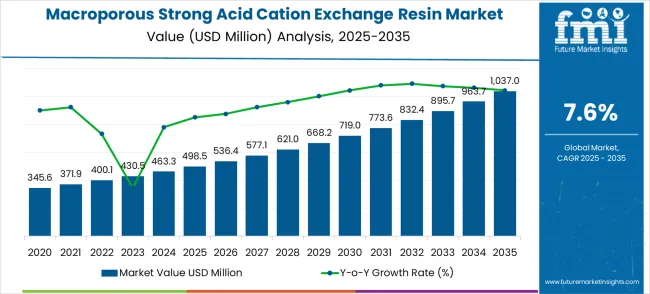
The macroporous strong acid cation exchange resin market was valued at USD 498.50 million in 2025, projected to reach USD 536.39 million in 2026, and is forecast to expand to USD 1,115.84 million by 2036 at a 7.6% CAGR. Intensifying global water scarcity, stricter industrial effluent discharge standards, and expanding pharmaceutical purification requirements are the core demand drivers directing capital toward high-capacity macroporous resin platforms. FMI is of the opinion that the transition from gel-type to macroporous resin architectures reflects a structural shift in procurement specifications, as industrial water treatment operators require higher mechanical stability and superior fouling resistance under variable feed conditions.
Summary of Macroporous Strong Acid Cation Exchange Resin Market
- Market Snapshot
- The macroporous strong acid cation exchange resin market is valued at USD 498.50 million in 2025 and is projected to reach USD 1,115.84 million by 2036.
- The industry is expected to grow at a 7.6% CAGR from 2026 to 2036, creating an incremental opportunity of USD 579.45 million.
- The market is a specification-driven industrial water treatment and purification category where bead mechanical stability, exchange capacity, and regeneration durability define procurement decisions.
- Demand and Growth Drivers
- Demand is rising as municipal and industrial water treatment facilities face tighter effluent discharge standards requiring higher-capacity ion exchange systems.
- Pharmaceutical continuous chromatography adoption is driving demand for macroporous resins with consistent particle size distribution and extended cycle stability.
- Heavy metal recovery applications in mining and electroplating wastewater are emerging as a growth vector under stricter environmental enforcement.
- Among key countries, China leads at 10.3% CAGR, followed by India at 9.5%, Germany at 8.7%, Brazil at 8.0%, USA at 7.2%, UK at 6.5%, and Japan at 5.7%.
- Product and Segment View
- The market includes macroporous strong acid cation exchange resins with sulfonate and sulphate functional groups designed for high mechanical stability under variable operating conditions.
- Applications span water treatment, food industry demineralization, pharmaceutical purification, heavy metal recovery, and specialty chemical processing.
- Sulfonate Group leads by functional group type with 58.0% share in 2026.
- Water Treatment leads by application with 46.0% share in 2026.
- Scope includes macroporous strong acid cation resins for industrial and municipal applications, excluding gel-type resins, weak acid cation resins, and anion exchange media.
- Geography and Competitive Outlook
- China and India are the fastest-growing markets due to industrial wastewater treatment mandates, while Germany and the USA represent mature replacement demand bases.
- Competition centres on bead uniformity, exchange capacity per unit volume, and regeneration cycle durability, with manufacturers investing in polymer crosslinking technology.
- Key players include Dow Inc., Purolite, Lanxess, DuPont, Ion Exchange, Mitsubishi Chemical Corporation, Samyang Corp., Aldex Chemical, Thermax, and ResinTech.
- Analyst Opinion at FMI
- Nikhil Kaitwade, Principal Consultant for Chemicals and Materials, opines,: 'In my analysis, I have observed that the primary procurement constraint for industrial water treatment operators is no longer resin price per litre but total cost of ownership across regeneration cycles. Facilities operating mixed-bed demineralization trains with gel-type resins face systematic bead attrition under high organic loading, forcing premature column replacement. Water treatment engineers who continue specifying gel-type resins for applications with variable feed chemistry will encounter escalating maintenance costs that macroporous architectures are specifically designed to eliminate.'
- Strategic Implications / Executive Takeaways
- Resin manufacturers must invest in tighter particle size distribution control to qualify for pharmaceutical continuous chromatography applications where batch consistency is a contractual requirement.
- Water treatment plant directors should mandate macroporous resin specifications in all new mixed-bed demineralization procurement to reduce bead attrition and extend regeneration cycle intervals.
- Environmental compliance officers must evaluate heavy metal selective resin variants to meet tightening discharge limits for cadmium and chromium under updated regulatory frameworks.
Macroporous Strong Acid Cation Exchange Resin Market Key Takeaways
| Metric | Details |
|---|---|
| Industry Size (2026) | USD 536.39 million |
| Industry Value (2036) | USD 1,115.84 million |
| CAGR (2026-2036) | 7.6% |
Source: Future Market Insights, 2026
Municipal authorities and industrial operators managing complex mixed-bed demineralization trains are specifying macroporous variants to handle wider pH swings and higher organic loading without premature bead fracture. Pharmaceutical manufacturers adopting continuous chromatography for API purification are demanding resins with tighter particle size distributions and consistent exchange kinetics across extended service cycles. Food and beverage processors requiring demineralization of whey and sugar liquors increasingly favour macroporous cation resins that tolerate thermal regeneration cycles without structural degradation. FMI analysts observe that heavy metal recovery applications in mining and electroplating wastewater are emerging as a secondary growth vector, particularly where regulatory enforcement has tightened discharge limits for cadmium, lead, and chromium.
Regional demand trajectories reflect differentiated industrialization and regulatory enforcement patterns. China leads at 10.3% CAGR, driven by the national water pollution action plan mandating upgraded treatment infrastructure across industrial parks in the Yangtze River Delta. India follows at 9.5%, propelled by Central Pollution Control Board enforcement actions and the Namami Gange programme requiring advanced treatment for industrial effluent entering river systems. Germany expands at 8.7%, anchored by the Federal Water Act compliance requirements for chemical processing facilities. Brazil registers an 8.0% pace as CONAMA resolution updates tighten discharge parameters for mining and metallurgical operations. United States operations grow at 7.2%, with municipal water utilities executing resin replacement cycles in ageing softening installations. United Kingdom advances at 6.5%, reflecting Environment Agency enforcement of industrial discharge permits. Japan tracks at 5.7%, maintaining steady replacement demand across its established semiconductor ultrapure water treatment infrastructure.
Macroporous Strong Acid Cation Exchange Resin Market Definition
Macroporous Strong Acid Cation Exchange Resin represents a class of synthetic polymer beads featuring a rigid, permanently porous matrix structure with sulfonate or sulphate functional groups that facilitate the reversible exchange of cations from aqueous solutions. Unlike gel-type resins, the macroporous architecture provides enhanced mechanical stability, superior resistance to osmotic shock, and improved tolerance to organic fouling. These resins operate in water treatment demineralization trains, pharmaceutical purification columns, food processing deionization systems, and heavy metal recovery circuits.
Macroporous Strong Acid Cation Exchange Resin Market Inclusions
Market scope includes macroporous strong acid cation exchange resins with sulfonate and sulphate functional groups for industrial, municipal, pharmaceutical, food processing, and environmental remediation applications. Standard and custom bead size distributions, regeneration chemicals consumed in resin service cycles, and associated technical support services are incorporated.
Macroporous Strong Acid Cation Exchange Resin Market Exclusions
Gel-type strong acid cation exchange resins, weak acid cation resins, anion exchange resins, chelating resins, and mixed-bed resin assemblies sold as pre-packed cartridges are excluded. Activated carbon adsorption media, membrane-based separation systems, and reverse osmosis consumables fall outside analytical parameters.
Macroporous Strong Acid Cation Exchange Resin Market Research Methodology
- Primary Research: Analysts engaged with water treatment plant managers, resin procurement specialists, and pharmaceutical purification engineers to map specification requirements and replacement cycle triggers.
- Desk Research: Data collection phases aggregated national water quality standards, industrial effluent discharge regulations, and pharmaceutical process validation guidelines.
- Market-Sizing and Forecasting: Baseline values derive from a bottom-up aggregation of resin shipment volumes by functional group type, applying region-specific water treatment capacity expansion curves and industrial compliance timelines.
- Data Validation and Update Cycle: Projections are tested against publicly reported capacity expansion announcements from leading resin manufacturers and municipal water infrastructure investment programmes.
Why is the Macroporous Strong Acid Cation Exchange Resin Market Growing?
Market expansion is being supported by the continuous increase in industrial water treatment demands worldwide and the corresponding need for advanced ion exchange solutions that provide superior cation removal capabilities and process efficiency for critical water purification and chemical processing applications. Modern water treatment facilities and pharmaceutical manufacturers rely on consistent ion exchange performance and resin durability to ensure optimal water quality including demineralization, softening, and heavy metal removal. Even minor resin performance degradation can require comprehensive system maintenance procedures to maintain optimal treatment standards and regulatory compliance.
The growing complexity of water quality regulations and increasing demand for high-purity water applications are driving demand for macroporous strong acid cation exchange resins from certified manufacturers with appropriate capacity specifications and technical expertise. Water treatment operators are increasingly requiring documented ion exchange efficiency and operational longevity standards to maintain treatment effectiveness and cost optimization. Regulatory frameworks and quality standards are establishing standardized treatment procedures that require specialized resin technologies and trained water treatment professionals.
Opportunity Pathway - Macroporous Strong Acid Cation Exchange Resin Market
Macroporous Strong Acid Cation Exchange Resin Market Opportunity Pools
The Macroporous Strong Acid Cation Exchange Resin market is entering a sustained growth phase, driven by demand for water purification, industrial processing expansion, and evolving environmental compliance and efficiency standards. By 2035, these pathways together can unlock USD 250-320 million in incremental revenue opportunities beyond baseline growth.
Pathway A - Functional Group Leadership (Sulfonate Group Resins) The sulfonate group segment already holds the largest share due to its superior performance and versatility. Expanding capacity optimization, selectivity enhancement, and durability improvements can consolidate leadership. Opportunity pool: USD 70-90 million.
Pathway B - Core Industry Applications (Water Treatment) Water treatment accounts for the largest demand. Growing industrial water treatment infrastructure and municipal system upgrades, especially in emerging economies, will drive higher adoption of ion exchange resins for purification applications. Opportunity pool: USD 60-80 million.
Pathway C - Pharmaceutical Market Expansion (High-Purity Applications) Pharmaceutical applications represent significant growth potential with increasing drug manufacturing. Resins optimized for pharmaceutical-grade purification can capture substantial growth. Opportunity pool: USD 50-65 million.
Pathway D - Emerging Market Expansion Asia-Pacific and Latin America present growing demand due to industrialization. Targeting cost-effective solutions and local partnerships will accelerate adoption. Opportunity pool: USD 35-45 million.
Pathway E - Food Industry Integration With increasing food safety requirements, there is an opportunity to promote resins optimized for food processing and beverage purification applications. Opportunity pool: USD 25-35 million.
Pathway F - Specialized Applications (Heavy Metal Recovery) Resins optimized for metal recovery, electronic waste processing, and specialty separation applications offer premium positioning for niche markets. Opportunity pool: USD 15-20 million.
Pathway G - Technical Services & Support Recurring revenue from system design, regeneration services, and technical consulting creates long-term engagement streams. Opportunity pool: USD 8-12 million.
Pathway H - Advanced Technology Integration Smart monitoring systems, automated regeneration, and predictive maintenance can elevate resins into comprehensive water treatment solutions. Opportunity pool: USD 2-8 million.
Segmental Analysis
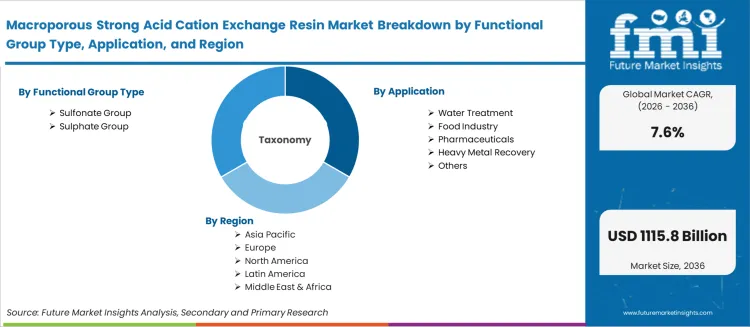
The market is segmented by functional group type, application, and region. By functional group type, the market is divided into sulfonate group and sulphate group ion exchange resins. Based on application, the market is categorized into water treatment, food industry, pharmaceuticals, heavy metal recovery, and other applications. Regionally, the market is divided into North America, Europe, East Asia, South Asia & Pacific, Latin America, and Middle East & Africa.
By Functional Group Type, Sulfonate Group Segment Accounts for 58% Market Share
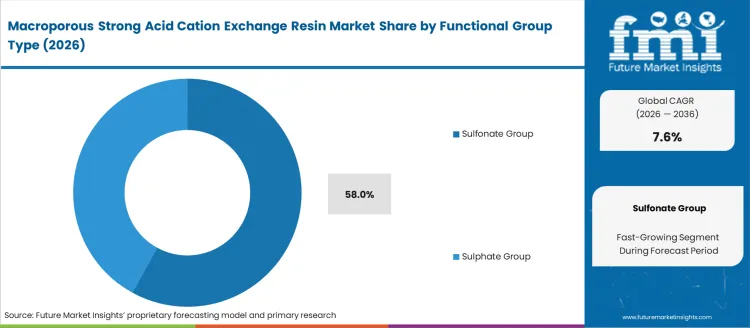
In 2026, the sulfonate group segment is projected to capture around 58% of the total market share, making it the leading functional group type category. This dominance is largely driven by the widespread adoption of sulfonic acid-based ion exchange resins that provide optimal balance between ion exchange capacity and chemical stability, catering to a wide variety of water treatment and industrial processing applications. Sulfonate group resins are particularly favored for their ability to deliver superior cation exchange efficiency and broad pH range compatibility in both municipal water treatment and industrial purification installations, ensuring consistent performance and operational reliability. Water treatment facilities, pharmaceutical manufacturers, chemical processing companies, and food industry applications increasingly prefer this functional group type, as it meets demanding ion exchange requirements without imposing excessive operational complexity or maintenance constraints.
The availability of well-established manufacturing processes, along with comprehensive technical documentation and proven performance data from leading suppliers, further reinforces the segment's market position. Additionally, this functional group category benefits from consistent demand across industries, as it is considered a versatile and reliable solution for applications requiring strong acid cation exchange and high capacity utilization. The combination of exchange efficiency, chemical resistance, and operational predictability makes sulfonate group resins a dependable choice, ensuring their continued dominance in the water treatment and chemical processing markets.
By Application, Water Treatment Segment Accounts for 46% Market Share
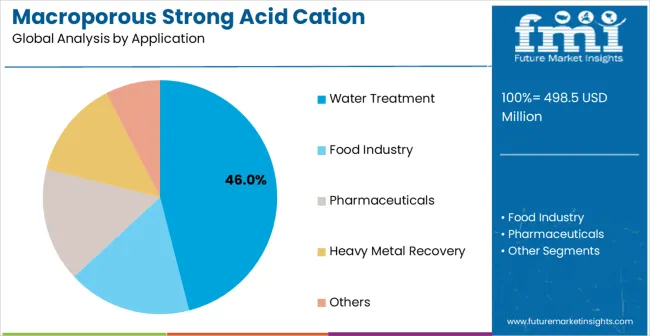
The water treatment segment is expected to represent 46% of macroporous strong acid cation exchange resin demand in 2026, highlighting its position as the most significant application sector. This dominance stems from the critical water quality requirements of modern industrial and municipal water systems, where cation removal and water softening are essential to operational efficiency and regulatory compliance. Water treatment facilities often feature extensive ion exchange systems that demand specialized resins throughout complex purification processes, requiring reliable and high-capacity exchange solutions. Macroporous strong acid cation exchange resins are particularly well-suited to these environments due to their ability to provide consistent ion removal and regeneration efficiency, even during high-flow operations and varying water quality conditions. As water quality standards become more stringent globally and emphasize improved purity requirements, the demand for advanced ion exchange resins continues to rise.
The segment also benefits from heightened environmental regulations within the water industry, where operators are increasingly prioritizing treatment effectiveness and operational sustainability as essential system capabilities. With water treatment facilities investing in advanced purification technologies and process optimization systems, ion exchange resins provide an essential component to maintain high-performance water quality standards and regulatory compliance. The growth of industrial water treatment and municipal system upgrades, coupled with increased focus on water reuse and recycling, ensures that water treatment will remain the largest and most stable demand driver for macroporous strong acid cation exchange resins in the forecast period.
What are the Drivers, Restraints, and Key Trends of the Macroporous Strong Acid Cation Exchange Resin Market?
The Macroporous Strong Acid Cation Exchange Resin market is advancing steadily due to increasing industrial water treatment requirements and growing recognition of ion exchange technology advantages over traditional water treatment methods in purification applications. However, the market faces challenges including higher costs compared to conventional treatment media, need for specialized regeneration procedures and chemical handling expertise, and complex system design requirements with varying water chemistry considerations across different treatment applications. Performance optimization efforts and advanced resin technology programs continue to influence product development and market adoption patterns.
Advancement of High-Capacity and Selective Ion Exchange Technologies
The growing development of enhanced macroporous structures and improved functional group density is enabling superior ion exchange capacity with increased selectivity and extended operational life. Advanced resin technologies and optimized polymer matrices provide superior cation removal while maintaining mechanical durability requirements. These technologies are particularly valuable for water treatment operators who require reliable ion exchange performance that can support extensive treatment operations with consistent high-efficiency results and reduced maintenance frequency.
Integration of Sustainable Manufacturing and Regeneration Processes
Modern ion exchange resin manufacturers are incorporating advanced sustainable production methods and eco-friendly regeneration systems that enhance operational efficiency while minimizing environmental impact. Integration of green chemistry principles and optimized regeneration protocols enables superior resource utilization and comprehensive environmental compliance capabilities. Advanced sustainable features support operation in environmentally conscious facilities while meeting various regulatory requirements and sustainability specifications.
Analysis of Macroporous Strong Acid Cation Exchange Resin Market by Key Country
.webp "Top Country Growth Comparison Macroporous Strong Acid Cation Exchange Resin Market Cagr (2026 2036)")
| Country | CAGR (2026-2036) |
|---|---|
| China | 10.3% |
| India | 9.5% |
| Germany | 8.7% |
| Brazil | 8.0% |
| United States | 7.2% |
| United Kingdom | 6.5% |
| Japan | 5.7% |
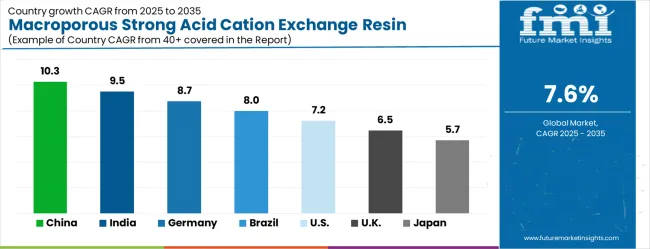
The macroporous strong acid cation exchange resin market is growing consistently, with China leading at a 10.3% CAGR through 2036, driven by expanding industrial water treatment infrastructure and increasing adoption of advanced ion exchange technologies. India follows at 9.5%, supported by growing industrial development and rising implementation of water purification systems. Germany grows strongly at 8.7%, integrating advanced resin technology into its established chemical processing infrastructure. Brazil records 8.0%, emphasizing industrial water treatment development and environmental compliance initiatives. The United States shows solid growth at 7.2%, focusing on water treatment innovation and regulatory compliance solutions. The United Kingdom demonstrates steady progress at 6.5%, maintaining established industrial applications. Japan records 5.7% growth, concentrating on technology advancement and process optimization.
The report covers an in-depth analysis of 40+ countries top-performing countries are highlighted below.
Sales Analysis of Macroporous Strong Acid Cation Exchange Resin Market in China
Revenue from macroporous strong acid cation exchange resins in China is projected to exhibit the highest growth rate with a CAGR of 10.3% through 2036, driven by unprecedented industrial expansion and increasing demand for advanced water treatment solutions. The country's massive chemical processing sector and expanding water treatment infrastructure are creating enormous demand for specialized ion exchange resin solutions. Major industrial facilities are establishing comprehensive water treatment systems to support the increasing requirements of manufacturing companies and environmental compliance across metropolitan industrial zones.
Government environmental protection initiatives are supporting establishment of advanced water treatment facilities and industrial pollution control complexes, driving demand for high-performance ion exchange resins throughout major industrial corridors. Industrial development programs are facilitating adoption of resin technologies that enhance water treatment efficiency and environmental compliance standards across manufacturing infrastructure networks.
- Industrial water treatment infrastructure expansion programs promote advanced resin adoption among manufacturing companies throughout key industrial development zones nationwide
- Environmental protection initiatives support resin technology integration and water treatment enhancement for industrial facility operators
In-depth Analysis of Macroporous Strong Acid Cation Exchange Resin Market in India
Revenue from macroporous strong acid cation exchange resins in India is expanding at a CAGR of 9.5%, supported by increasing industrial development and growing implementation of water treatment technologies. The country's expanding manufacturing sector and rising environmental standards are driving demand for advanced ion exchange resin solutions. Industrial facilities and water treatment companies are gradually implementing high-performance resin systems to maintain competitive standards and regulatory compliance.
Industrial sector growth and water treatment infrastructure development are creating opportunities for suppliers that can support diverse treatment requirements and cost-effective specifications. Professional training and technical programs are building expertise among water treatment personnel, enabling effective utilization of resin technology that meets treatment standards and efficiency requirements.
- Industrial infrastructure development programs facilitate adoption of high-performance resins that support modern water treatment standards across manufacturing sectors
- Professional training initiatives enhance water treatment capabilities among technical personnel, enabling effective resin utilization throughout industrial establishments
Opportunity Analysis of Macroporous Strong Acid Cation Exchange Resin Market in Germany
Macroporous strong acid cation exchange resins in Germany is projected to grow at a CAGR of 8.7%, supported by the country's emphasis on chemical processing quality standards and advanced resin technology adoption. German chemical facilities and water treatment companies are implementing sophisticated resin systems that meet stringent performance requirements and environmental specifications. The market is characterized by focus on treatment efficiency, operational reliability, and compliance with comprehensive environmental standards.
Chemical processing industry investments are prioritizing cutting-edge resin technology that demonstrates superior performance and environmental compliance while meeting German quality and sustainability standards. Professional certification programs are ensuring comprehensive technical expertise among water treatment personnel, enabling specialized treatment capabilities that support diverse industrial applications and environmental requirements.
- Chemical processing excellence programs emphasize advanced resin adoption and performance standards that maintain German operational and environmental requirements
- Professional training initiatives develop comprehensive technical expertise among water treatment personnel, supporting specialized treatment capabilities throughout chemical processing sectors
Market Demand Evaluation for Macroporous Strong Acid Cation Exchange Resin Market in Brazil
Macroporous strong acid cation exchange resins in Brazil is growing at a CAGR of 8.0%, driven by increasing industrial water treatment development and growing recognition of ion exchange technology advantages. The country's expanding industrial sector is gradually integrating advanced resin solutions to enhance water treatment efficiency and environmental compliance. Industrial facilities and water treatment providers are investing in resin technology to address evolving environmental requirements and operational standards.
Industrial water treatment infrastructure modernization is facilitating adoption of advanced resin technologies that support comprehensive treatment capabilities across industrial regions. Professional development programs are enhancing technical capabilities among water treatment personnel, enabling effective resin utilization that meets evolving environmental standards and performance requirements.
- Industrial water treatment infrastructure modernization initiatives promote advanced resin adoption that enhances treatment capabilities and environmental standards across industrial sectors
- Professional development programs build technical capabilities among water treatment personnel, enabling specialized resin operation skills throughout industrial establishments
Demand Outlook for Macroporous Strong Acid Cation Exchange Resin Market in the United States
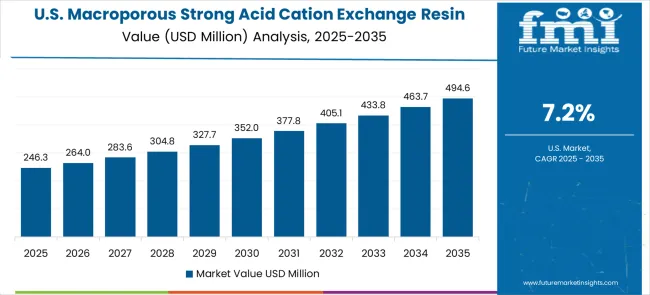
Demand for macroporous strong acid cation exchange resins in the USA is expanding at a CAGR of 7.2%, driven by established water treatment industries and growing emphasis on regulatory compliance enhancement. Large water treatment companies and industrial facilities are implementing comprehensive resin capabilities to serve diverse treatment requirements. The market benefits from established water treatment infrastructure distribution systems and professional development programs that support various industrial and municipal applications.
Water treatment industry leadership is enabling standardized resin utilization across multiple facility types, providing consistent performance standards and comprehensive treatment coverage throughout regional markets. Professional development and certification programs are building specialized technical expertise among water treatment personnel, enabling effective resin utilization that supports evolving regulatory and treatment requirements.
- Regulatory compliance integration facilitates standardized resin workflows across facility types, providing consistent performance standards and comprehensive treatment throughout regional markets
- Professional certification programs develop specialized technical expertise among water treatment personnel, enabling advanced treatment capabilities that support diverse regulatory requirements
Growth and Expansion Outlook for Macroporous Strong Acid Cation Exchange Resin Market in the United Kingdom
Macroporous strong acid cation exchange resins in the UK is projected to grow at a CAGR of 6.5%, supported by established industrial sectors and growing emphasis on water treatment efficiency capabilities. British industrial facilities and water treatment service providers are implementing resin systems that meet industry performance standards and environmental requirements. The market benefits from established industrial infrastructure and comprehensive training programs for technical professionals.
Industrial facility investments are prioritizing advanced resin solutions that support diverse water treatment applications while maintaining established performance and environmental standards. Professional development programs are building technical expertise among water treatment personnel, enabling specialized resin operation capabilities that meet evolving facility requirements and performance standards.
- Industrial facility enhancement programs support advanced resin adoption that maintains performance standards and treatment excellence throughout industrial sectors
- Professional training initiatives build comprehensive technical skills among water treatment personnel, enabling specialized resin operation capabilities throughout industrial establishments
Opportunity Analysis of Macroporous Strong Acid Cation Exchange Resin Market in Japan
Macroporous strong acid cation exchange resins in Japan is growing at a CAGR of 5.7%, driven by the country's focus on water treatment technology innovation and process optimization applications. Japanese industrial facilities and chemical companies are implementing advanced resin systems that demonstrate superior performance reliability and operational consistency. The market is characterized by emphasis on technological excellence, treatment precision, and integration with established industrial workflows.
Water treatment technology investments are prioritizing innovative resin solutions that combine advanced ion exchange technology with precision manufacturing while maintaining Japanese quality and efficiency standards. Professional development programs are ensuring comprehensive technical expertise among water treatment personnel, enabling specialized treatment capabilities that support diverse industrial applications and process requirements.
- Water treatment technology innovation programs promote advanced resin development and performance enhancement features that maintain Japanese precision and efficiency standards
- Professional certification initiatives develop comprehensive technical expertise among water treatment personnel, supporting advanced treatment capabilities and process excellence requirements
Europe Market Split by Country - Macroporous Strong Acid Cation Exchange Resin Market
The macroporous strong acid cation exchange resin market in Europe is forecast to expand from USD 130.4 million in 2026 to USD 271.3 million by 2036, registering a CAGR of 7.6%. Germany will remain the largest market, holding 29.8% share in 2026, easing to 29.3% by 2036, supported by strong chemical processing infrastructure and advanced resin adoption standards. The United Kingdom follows, rising from 22.3% in 2026 to 22.7% by 2036, driven by industrial facility modernization and water treatment enhancement initiatives. France is expected to maintain stability from 18.1% to 17.8%, reflecting consistent chemical industry investments and resin requirements. Italy holds around 12.7% throughout the forecast period, supported by industrial facility upgrades and water treatment system modernization programs. Spain grows from 9.4% to 9.7% with expanding industrial infrastructure and increased focus on advanced water treatment solutions. BENELUX markets maintain 4.9% to 4.7%, while the remainder of Europe hovers near 2.8%-2.8%, balancing emerging Eastern European industrial development against mature Nordic markets with established resin technology adoption patterns.
Competitive Landscape of Macroporous Strong Acid Cation Exchange Resin Market
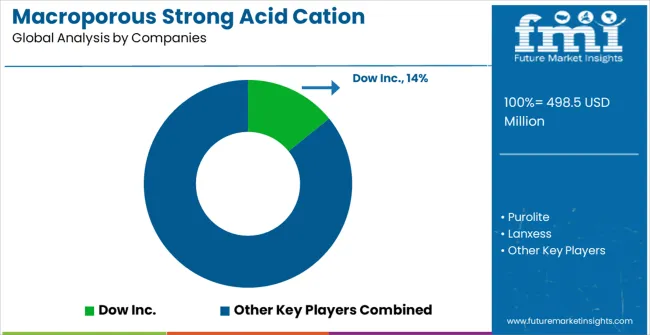
The Macroporous Strong Acid Cation Exchange Resin market is defined by competition among specialized chemical manufacturers, water treatment technology companies, and ion exchange solution providers. Companies are investing in advanced resin technology development, manufacturing process innovation, capacity optimization, and comprehensive technical support capabilities to deliver efficient, durable, and cost-effective ion exchange solutions. Strategic partnerships, technological innovation, and market expansion are central to strengthening product portfolios and market presence.
Dow Inc. offers comprehensive ion exchange solutions with established global expertise and professional-grade resin capabilities. Purolite provides specialized water treatment resins with focus on performance reliability and application versatility. Lanxess delivers advanced chemical processing materials with emphasis on quality optimization and industrial-friendly applications. DuPont specializes in specialty chemicals with advanced polymer technology capabilities.
Ion Exchange offers professional-grade water treatment solutions with comprehensive system integration capabilities. Mitsubishi Chemical Corporation delivers established chemical products with advanced manufacturing technologies. Samyang Corp. provides specialized resin solutions with focus on performance optimization. Aldex Chemical, Thermax, Eichrom, ResinTech, Zhejiang Zhengguang Industrial, Jiangsu Suqing Water Treatment Engineering Group, Suzhou Bojie Resin Technology, Bengbu Dongli Chemical, Huizhu Technology (Shanghai), and Wandong Gaoke (Tianchang) offer specialized manufacturing expertise, product reliability, and comprehensive development across global and regional ion exchange resin market segments.
Key Players in the Macroporous Strong Acid Cation Exchange Resin Market
- Dow Inc.
- Purolite
- Lanxess
- DuPont
- Ion Exchange
- Mitsubishi Chemical Corporation
- Samyang Corp.
- Aldex Chemical
- Thermax
- Eichrom
- ResinTech
- Zhejiang Zhengguang Industrial
- Jiangsu Suqing Water Treatment Engineering Group
- Suzhou Bojie Resin Technology
- Bengbu Dongli Chemical
- Huizhu Technology (Shanghai)
- Wandong Gaoke (Tianchang)
Scope of the Report
| Metric | Value |
|---|---|
| Quantitative Units | USD 536.39 million to USD 1,115.84 million, at a CAGR of 7.6% |
| Market Definition | Macroporous Strong Acid Cation Exchange Resin encompasses synthetic polymer beads with permanent porous structures and sulfonate or sulphate functional groups designed for high-capacity cation exchange in water treatment, pharmaceutical, food processing, and environmental remediation applications. |
| Functional Group Type Segmentation | Sulfonate Group, Sulphate Group |
| Application Segmentation | Water Treatment, Food Industry, Pharmaceuticals, Heavy Metal Recovery, Others |
| Regions Covered | North America, Latin America, Europe, East Asia, South Asia, Oceania, Middle East & Africa |
| Countries Covered | China, India, Germany, Brazil, USA, UK, Japan, and 40 plus countries |
| Key Companies Profiled | Dow Inc., Purolite, Lanxess, DuPont, Ion Exchange, Mitsubishi Chemical Corporation, Samyang Corp., Aldex Chemical, Thermax, ResinTech |
| Forecast Period | 2026 to 2036 |
| Approach | Forecasting models apply a bottom-up methodology starting with global installed base metrics for ion exchange treatment capacity and projecting resin replacement and new installation volumes. |
Macroporous Strong Acid Cation Exchange Resin Market by Segments
Functional Group Type:
- Sulfonate Group
- Sulphate Group
Application:
- Water Treatment
- Food Industry
- Pharmaceuticals
- Heavy Metal Recovery
- Others
Region:
- North America
- United States
- Canada
- Mexico
- Europe
- Germany
- United Kingdom
- France
- Italy
- Spain
- Nordic
- BENELUX
- Rest of Europe
- East Asia
- China
- Japan
- South Korea
- South Asia & Pacific
- India
- ASEAN
- Australia & New Zealand
- Rest of South Asia & Pacific
- Latin America
- Brazil
- Chile
- Rest of Latin America
- Middle East & Africa
- Kingdom of Saudi Arabia
- Other GCC Countries
- Turkiye
- South Africa
- Other African Union
- Rest of Middle East & Africa
Bibliography
- 1. Ministry of Ecology and Environment, People's Republic of China. (2025). Water Pollution Prevention and Control Action Plan: Implementation Progress Report. MEE.
- 2. Central Pollution Control Board, India. (2025). National Inventory of Industrial Effluent Treatment Plants. CPCB.
- 3. European Chemicals Agency. (2024). REACH Registration Dossier Updates for Ion Exchange Resin Monomers. ECHA.
- 4. United States Environmental Protection Agency. (2024). National Primary Drinking Water Regulations: Technical Fact Sheets. EPA.
- 5. World Health Organization. (2024). Guidelines for Drinking-water Quality, Fourth Edition Incorporating the First and Second Addenda. WHO.
- 6. Conselho Nacional do Meio Ambiente, Brazil. (2024). CONAMA Resolution 430: Conditions and Standards for Effluent Discharge. CONAMA.
This bibliography is provided for reader reference. The full Future Market Insights report contains the complete reference list with primary research documentation.
Frequently Asked Questions
How large is the demand for Macroporous Strong Acid Cation Exchange Resin in the global market in 2026?
Demand for Macroporous Strong Acid Cation Exchange Resin in the global market is estimated to be valued at USD 536.39 million in 2026.
What will be the market size of Macroporous Strong Acid Cation Exchange Resin by 2036?
Market size for Macroporous Strong Acid Cation Exchange Resin is projected to reach USD 1,115.84 million by 2036.
What is the expected demand growth between 2026 and 2036?
Demand for Macroporous Strong Acid Cation Exchange Resin is expected to grow at a CAGR of 7.6% between 2026 and 2036.
Which Functional Group Type is poised to lead global sales by 2026?
Sulfonate Group accounts for 58.0% share in 2026 as its superior exchange kinetics and regeneration efficiency make it the preferred specification for industrial water treatment demineralization trains.
How significant is Water Treatment in driving market adoption in 2026?
Water Treatment represents 46.0% of application share as tightening industrial effluent discharge standards and municipal water quality mandates require higher-capacity ion exchange systems.
What is driving demand in China?
The national water pollution action plan mandating upgraded treatment infrastructure across industrial parks in the Yangtze River Delta is the primary procurement trigger for macroporous resin installations.
What is the India growth outlook in this report?
India is projected to grow at a CAGR of 9.5% during 2026 to 2036.
What is included in the scope of this report?
The market covers macroporous strong acid cation exchange resins with sulfonate and sulphate functional groups for industrial, municipal, pharmaceutical, food processing, and environmental remediation applications.
Preview the report firsthand - request a free sample
Get SampleGet the brochure for pricing and purchase details.
Get PDFTable of Content
- Executive Summary
- Global Market Outlook
- Demand-side Trends
- Supply-side Trends
- Technology Roadmap Analysis
- Analysis and Recommendations
- Market Overview
- Market Coverage / Taxonomy
- Market Definition / Scope / Limitations
- Research Methodology
- Chapter Orientation
- Analytical Lens and Working Hypotheses
- Market Structure, Signals, and Trend Drivers
- Benchmarking and Cross-market Comparability
- Market Sizing, Forecasting, and Opportunity Mapping
- Research Design and Evidence Framework
- Desk Research Programme (Secondary Evidence)
- Company Annual and Sustainability Reports
- Peer-reviewed Journals and Academic Literature
- Corporate Websites, Product Literature, and Technical Notes
- Earnings Decks and Investor Briefings
- Statutory Filings and Regulatory Disclosures
- Technical White Papers and Standards Notes
- Primary Modes
- Qualitative Interviews and Expert Elicitation
- Quantitative Surveys and Structured Data Capture
- Blended Approach
- Why Primary Evidence is Used
- Field Techniques
- Interviews
- Surveys
- Focus Groups
- Observational and In-context Research
- Social and Community Interactions
- Stakeholder Universe Engaged
- C-suite Leaders
- Board Members
- Presidents and Vice Presidents
- R&D and Innovation Heads
- Technical Specialists
- Domain Subject-matter Experts
- Scientists
- Physicians and Other Healthcare Professionals
- Governance, Ethics, and Data Stewardship
- Research Ethics
- Data Integrity and Handling
- Tooling, Models, and Reference Databases
- Desk Research Programme (Secondary Evidence)
- Data Engineering and Model Build
- Data Acquisition and Ingestion
- Cleaning, Normalisation, and Verification
- Synthesis, Triangulation, and Analysis
- Quality Assurance and Audit Trail
- Market Background
- Market Dynamics
- Drivers
- Restraints
- Opportunity
- Trends
- Scenario Forecast
- Demand in Optimistic Scenario
- Demand in Likely Scenario
- Demand in Conservative Scenario
- Opportunity Map Analysis
- Product Life Cycle Analysis
- Supply Chain Analysis
- Investment Feasibility Matrix
- Value Chain Analysis
- PESTLE and Porter’s Analysis
- Regulatory Landscape
- Regional Parent Market Outlook
- Production and Consumption Statistics
- Import and Export Statistics
- Market Dynamics
- Global Market Analysis 2021 to 2025 and Forecast, 2026 to 2036
- Historical Market Size Value (USD Million) Analysis, 2021 to 2025
- Current and Future Market Size Value (USD Million) Projections, 2026 to 2036
- Y-o-Y Growth Trend Analysis
- Absolute $ Opportunity Analysis
- Global Market Pricing Analysis 2021 to 2025 and Forecast 2026 to 2036
- Global Market Analysis 2021 to 2025 and Forecast 2026 to 2036, By Functional Group Type
- Introduction / Key Findings
- Historical Market Size Value (USD Million) Analysis By Functional Group Type , 2021 to 2025
- Current and Future Market Size Value (USD Million) Analysis and Forecast By Functional Group Type , 2026 to 2036
- Sulfonate Group
- Sulphate Group
- Sulfonate Group
- Y-o-Y Growth Trend Analysis By Functional Group Type , 2021 to 2025
- Absolute $ Opportunity Analysis By Functional Group Type , 2026 to 2036
- Global Market Analysis 2021 to 2025 and Forecast 2026 to 2036, By Application
- Introduction / Key Findings
- Historical Market Size Value (USD Million) Analysis By Application, 2021 to 2025
- Current and Future Market Size Value (USD Million) Analysis and Forecast By Application, 2026 to 2036
- Water Treatment
- Food Industry
- Pharmaceuticals
- Heavy Metal Recovery
- Others
- Water Treatment
- Y-o-Y Growth Trend Analysis By Application, 2021 to 2025
- Absolute $ Opportunity Analysis By Application, 2026 to 2036
- Global Market Analysis 2021 to 2025 and Forecast 2026 to 2036, By Region
- Introduction
- Historical Market Size Value (USD Million) Analysis By Region, 2021 to 2025
- Current Market Size Value (USD Million) Analysis and Forecast By Region, 2026 to 2036
- North America
- Latin America
- Western Europe
- Eastern Europe
- East Asia
- South Asia and Pacific
- Middle East & Africa
- Market Attractiveness Analysis By Region
- North America Market Analysis 2021 to 2025 and Forecast 2026 to 2036, By Country
- Historical Market Size Value (USD Million) Trend Analysis By Market Taxonomy, 2021 to 2025
- Market Size Value (USD Million) Forecast By Market Taxonomy, 2026 to 2036
- By Country
- USA
- Canada
- Mexico
- By Functional Group Type
- By Application
- By Country
- Market Attractiveness Analysis
- By Country
- By Functional Group Type
- By Application
- Key Takeaways
- Latin America Market Analysis 2021 to 2025 and Forecast 2026 to 2036, By Country
- Historical Market Size Value (USD Million) Trend Analysis By Market Taxonomy, 2021 to 2025
- Market Size Value (USD Million) Forecast By Market Taxonomy, 2026 to 2036
- By Country
- Brazil
- Chile
- Rest of Latin America
- By Functional Group Type
- By Application
- By Country
- Market Attractiveness Analysis
- By Country
- By Functional Group Type
- By Application
- Key Takeaways
- Western Europe Market Analysis 2021 to 2025 and Forecast 2026 to 2036, By Country
- Historical Market Size Value (USD Million) Trend Analysis By Market Taxonomy, 2021 to 2025
- Market Size Value (USD Million) Forecast By Market Taxonomy, 2026 to 2036
- By Country
- Germany
- UK
- Italy
- Spain
- France
- Nordic
- BENELUX
- Rest of Western Europe
- By Functional Group Type
- By Application
- By Country
- Market Attractiveness Analysis
- By Country
- By Functional Group Type
- By Application
- Key Takeaways
- Eastern Europe Market Analysis 2021 to 2025 and Forecast 2026 to 2036, By Country
- Historical Market Size Value (USD Million) Trend Analysis By Market Taxonomy, 2021 to 2025
- Market Size Value (USD Million) Forecast By Market Taxonomy, 2026 to 2036
- By Country
- Russia
- Poland
- Hungary
- Balkan & Baltic
- Rest of Eastern Europe
- By Functional Group Type
- By Application
- By Country
- Market Attractiveness Analysis
- By Country
- By Functional Group Type
- By Application
- Key Takeaways
- East Asia Market Analysis 2021 to 2025 and Forecast 2026 to 2036, By Country
- Historical Market Size Value (USD Million) Trend Analysis By Market Taxonomy, 2021 to 2025
- Market Size Value (USD Million) Forecast By Market Taxonomy, 2026 to 2036
- By Country
- China
- Japan
- South Korea
- By Functional Group Type
- By Application
- By Country
- Market Attractiveness Analysis
- By Country
- By Functional Group Type
- By Application
- Key Takeaways
- South Asia and Pacific Market Analysis 2021 to 2025 and Forecast 2026 to 2036, By Country
- Historical Market Size Value (USD Million) Trend Analysis By Market Taxonomy, 2021 to 2025
- Market Size Value (USD Million) Forecast By Market Taxonomy, 2026 to 2036
- By Country
- India
- ASEAN
- Australia & New Zealand
- Rest of South Asia and Pacific
- By Functional Group Type
- By Application
- By Country
- Market Attractiveness Analysis
- By Country
- By Functional Group Type
- By Application
- Key Takeaways
- Middle East & Africa Market Analysis 2021 to 2025 and Forecast 2026 to 2036, By Country
- Historical Market Size Value (USD Million) Trend Analysis By Market Taxonomy, 2021 to 2025
- Market Size Value (USD Million) Forecast By Market Taxonomy, 2026 to 2036
- By Country
- Kingdom of Saudi Arabia
- Other GCC Countries
- Turkiye
- South Africa
- Other African Union
- Rest of Middle East & Africa
- By Functional Group Type
- By Application
- By Country
- Market Attractiveness Analysis
- By Country
- By Functional Group Type
- By Application
- Key Takeaways
- Key Countries Market Analysis
- USA
- Pricing Analysis
- Market Share Analysis, 2025
- By Functional Group Type
- By Application
- Canada
- Pricing Analysis
- Market Share Analysis, 2025
- By Functional Group Type
- By Application
- Mexico
- Pricing Analysis
- Market Share Analysis, 2025
- By Functional Group Type
- By Application
- Brazil
- Pricing Analysis
- Market Share Analysis, 2025
- By Functional Group Type
- By Application
- Chile
- Pricing Analysis
- Market Share Analysis, 2025
- By Functional Group Type
- By Application
- Germany
- Pricing Analysis
- Market Share Analysis, 2025
- By Functional Group Type
- By Application
- UK
- Pricing Analysis
- Market Share Analysis, 2025
- By Functional Group Type
- By Application
- Italy
- Pricing Analysis
- Market Share Analysis, 2025
- By Functional Group Type
- By Application
- Spain
- Pricing Analysis
- Market Share Analysis, 2025
- By Functional Group Type
- By Application
- France
- Pricing Analysis
- Market Share Analysis, 2025
- By Functional Group Type
- By Application
- India
- Pricing Analysis
- Market Share Analysis, 2025
- By Functional Group Type
- By Application
- ASEAN
- Pricing Analysis
- Market Share Analysis, 2025
- By Functional Group Type
- By Application
- Australia & New Zealand
- Pricing Analysis
- Market Share Analysis, 2025
- By Functional Group Type
- By Application
- China
- Pricing Analysis
- Market Share Analysis, 2025
- By Functional Group Type
- By Application
- Japan
- Pricing Analysis
- Market Share Analysis, 2025
- By Functional Group Type
- By Application
- South Korea
- Pricing Analysis
- Market Share Analysis, 2025
- By Functional Group Type
- By Application
- Russia
- Pricing Analysis
- Market Share Analysis, 2025
- By Functional Group Type
- By Application
- Poland
- Pricing Analysis
- Market Share Analysis, 2025
- By Functional Group Type
- By Application
- Hungary
- Pricing Analysis
- Market Share Analysis, 2025
- By Functional Group Type
- By Application
- Kingdom of Saudi Arabia
- Pricing Analysis
- Market Share Analysis, 2025
- By Functional Group Type
- By Application
- Turkiye
- Pricing Analysis
- Market Share Analysis, 2025
- By Functional Group Type
- By Application
- South Africa
- Pricing Analysis
- Market Share Analysis, 2025
- By Functional Group Type
- By Application
- USA
- Market Structure Analysis
- Competition Dashboard
- Competition Benchmarking
- Market Share Analysis of Top Players
- By Regional
- By Functional Group Type
- By Application
- Competition Analysis
- Competition Deep Dive
- Dow Inc.
- Overview
- Product Portfolio
- Profitability by Market Segments (Product/Age /Sales Channel/Region)
- Sales Footprint
- Strategy Overview
- Marketing Strategy
- Product Strategy
- Channel Strategy
- Purolite
- Lanxess
- DuPont
- Ion Exchange
- Mitsubishi Chemical Corporation
- Samyang Corp.
- Aldex Chemical
- Thermax
- Eichrom
- ResinTech
- Zhejiang Zhengguang Industrial
- Jiangsu Suqing Water Treatment Engineering Group
- Suzhou Bojie Resin Technology
- Bengbu Dongli Chemical
- Huizhu Technology (Shanghai)
- Wandong Gaoke (Tianchang)
- Dow Inc.
- Competition Deep Dive
- Assumptions & Acronyms Used


