

- Industry Size (2026)
- USD 0.5 Bn
- Forecast (2036)
- USD 1.52 Bn
- CAGR (2026 to 2036)
- 13.2%
Maritime and Port Operations Emissions Transparency Platforms Market Size, Market Forecast and Outlook By FMI
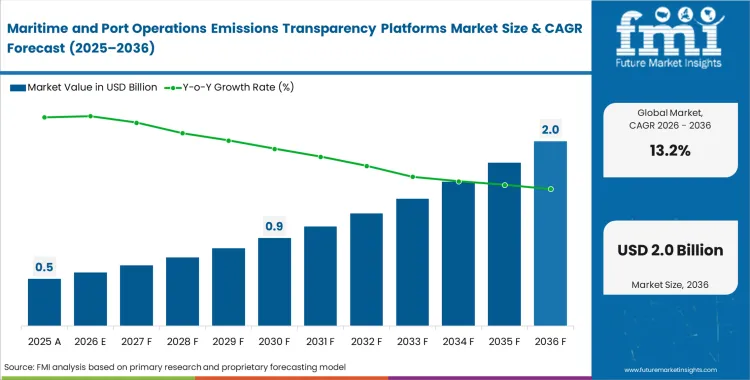
The maritime and port emissions transparency platforms market was valued at USD 0.4 billion in 2025. Industry is poised to reach USD 0.5 billion in 2026 at a CAGR of 13.2% during the forecast years. Growing investment and the adoption of supranational carbon pricing regimes are expected to propel the market to USD 1.52 billion by 2036.
Summary of Maritime and Port Operations Emissions Transparency Platforms Market
- Maritime and Port Operations Emissions Transparency Platforms Market Definition
- Specialized software architectures that ingest maritime operational data, calculate precise voyage-level carbon footprints, and generate immutable compliance records for regulatory authorities. These platforms convert raw engine telemetry into verified financial and environmental liabilities.
- Demand Drivers in the Market
- Supranational carbon pricing mechanisms force fleet performance directors to digitize bunker fuel tracking using a shipping ESG reporting platform.
- Charterer commercial requirements compel shipowners to provide continuous emission profiles for freight contracts via vessel performance and emissions software.
- Port authority decarbonization mandates require terminal operators to submit verifiable shoreside energy metrics using a port carbon footprint platform.
- Key Segments Analyzed in the FMI Report
- Vessel platforms are estimated to account for 46.0% share in 2026, by direct owner liability for voyage emissions.
- Cloud is projected to lead deployment models due to continuous remote sync requirements between ships and shoreside teams.
- Compliance reporting is anticipated to dominate functional demand as financial penalties for inaccurate EU MRV submissions escalate.
- Shipowners are set to hold 34.0% share based on primary legal accountability for vessel carbon intensity.
- Scope 1 is poised to command maximum boundary focus reflecting immediate regulatory scrutiny on direct combustion.
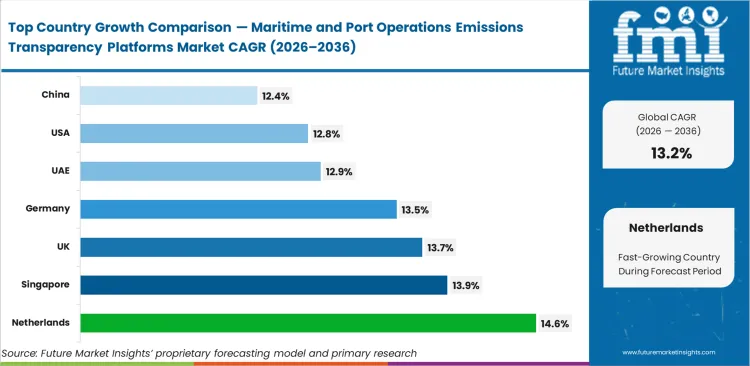
- The Netherlands maritime emissions transparency platforms segment is projected to grow at 14.6% CAGR, sustained by aggressive port-level emission taxation and dense European traffic.
- Analyst Opinion at FMI
- Rahul Pandita, Principal Analyst, Technology, at FMI, observes that, "Fleet owners routinely assume API connectivity solves regulatory reporting problems. Reality hits when technical superintendents attempt to deploy a MRV digital reporting tool and normalize conflicting telemetry signals across varied engine generations before that data ever reaches a compliance registry. Procuring software is trivial; structuring underlying vessel telemetry data to survive third-party audits is where true adoption friction lives. Platforms failing to automate this specific normalization step face immediate churn."
- Strategic Implications / Executive Takeaways
- Fleet operators face immediate contract exclusions if they cannot produce verified carbon intensity scores during charter negotiations via tanker emissions transparency tools or similar suites.
- Terminal managers must integrate shoreside power metrics with a multimodal port emissions dashboard to avoid localized emission penalties.
- Technology vendors must build direct integration layers for classification society databases to retain premium software tiers.
Key Takeaways
| Metric | Details |
|---|---|
| Industry Size (2026) | USD 0.5 billion |
| Industry Value (2036) | USD 1.52 billion |
| CAGR (2026 to 2036) | 13.2% |
Source: Future Market Insights (FMI) analysis, based on proprietary forecasting model and primary research
Fleet operators currently face direct financial exposure on every voyage entering regulated waters. Charterers actively discount vessels possessing poor Carbon Intensity Indicator profiles, forcing shipowners to validate voyage-level fuel consumption against external auditing standards using shipping emissions reporting software. Delaying this architectural upgrade exposes maritime organizations to compounding European Union Emissions Trading System surrender costs and exclusion from premium green-freight contracts. Procurement teams navigating container terminal automation frequently discover legacy bunker delivery notes fail modern verification thresholds, making automated vessel carbon intensity monitoring software a non-negotiable commercial requirement.
Standardization of high-frequency sensor data from shipboard engine control rooms triggers accelerated platform adoption. Once engine manufacturers open application programming interfaces for continuous fuel mass flow monitoring, manual spreadsheet reconciliation becomes obsolete. Maritime authorities immediately favor automated digital signatures over paper records, creating self-reinforcing cycles where audit ready maritime emissions data determines port entry prioritization.
Netherlands leads adoption at a CAGR of 14.6% as local authorities enforce strict berth emissions monitoring limits. Singapore expands at 13.9% mainly due to bunkering transparency requirements. The United Kingdom advances at 13.7% due to mandatory domestic carbon accounting integration via UK
Definition
Maritime emissions transparency platforms and port operations emissions transparency platforms function as centralized digital ledgers connecting vessel telemetry, terminal energy consumption, and regulatory reporting frameworks. These architectures ingest continuous fuel flow data, calculate precise carbon intensity profiles per voyage, and format outputs for mandatory supranational audits. This category focuses strictly on software infrastructure governing environmental accountability rather than physical hardware modifying engine performance.
Inclusions
Scope incorporates cloud-native registries, hybrid data exchanges, and specialized maritime carbon accounting platform modules designed specifically for maritime environments. Vendor solutions featuring continuous emission monitoring integration, predictive compliance modeling for specific regulatory regimes, and API connectors for electrified port equipment fall within analytical boundaries. Software architectures enabling secure auditable data transfer between shipowners and charterers represent core market components.
Exclusions
Physical exhaust scrubbers, alternative fuel handling systems, and basic fleet management applications lacking dedicated FuelEU Maritime compliance software modules sit outside this tracking perimeter. General enterprise resource planning software without maritime-specific fuel pathway algorithms receives no consideration. Hardware components like physical flow meters and physical continuous emission monitoring sensors face exclusion because they represent data generation sources rather than transparency platforms themselves.
Maritime and Port Operations Emissions Transparency Platforms Market Research Methodology
- Primary Research: Technical superintendents, fleet performance directors, and port authority sustainability officers evaluating a request for proposal port carbon platform.
- Desk Research: European Union MRV registry filings, Sea Cargo Charter disclosure reports, and recognized organization certification databases.
- Market-Sizing and Forecasting: Verified software-as-a-service licensing contracts across Tier-1 shipping registries.
- Data Validation and Update Cycle: Independent audit firm technology procurement trends cross-referenced quarterly.
Segmental Analysis
Maritime and Port Operations Emissions Transparency Platforms Market Analysis by Platform Scope
Isolated spreadsheets fail under rigorous scrutiny from modern marine emission auditors. Vessel platforms capture 46.0% share because shipboard engine rooms represent absolute origin points for regulated carbon generation. Technical superintendents require localized edge-computing architectures that function offline during mid-ocean transit, storing immutable fuel flow data until satellite connectivity permits shoreside synchronization. According to FMI's estimates, this specific offline-to-online reconciliation requirement creates high entry barriers for generic enterprise software vendors attempting to build maritime emissions software. What IT procurement directors rarely grasp during initial scoping is that vessel-side software must parse proprietary sensor protocols from decades-old main engines, not just modern digital twins. Platforms requiring extensive retrofitting of maritime cyber infrastructure encounter massive deployment resistance. Fleets attempting to bypass dedicated vessel installations in favour of purely shoreside calculations face extreme margin compression when auditors default to conservative, penalty-heavy emission estimates due to missing continuous telemetry.
- Initial pilot testing: Fleet performance directors target youngest vessels first. Software proves value by matching manual sounding records with digital flow meter data.
- Verification hurdles: External auditors review digital signature chains inside the maritime emissions verifier platform comparison frameworks. Technical superintendents must prove data remains untampered between ship and shore.
- Fleetwide rollout: Successful registry submissions trigger full deployment. Shipowners mandate platform usage across all operational assets to standardize corporate reporting.
Maritime and Port Operations Emissions Transparency Platforms Market Analysis by Deployment Model
Application programming interface connectivity dictates validation speed across maritime ecosystems. Cloud architectures represent 67.0% share of current installations because continuous regulatory updates require centralized, instant software patching. Sustainability officers managing multi-jurisdictional fleets rely on cloud environments to aggregate fuel consumption data across hundreds of moving assets simultaneously. FMI observes that legacy on-premise servers simply lack elasticity to process high-frequency telemetry required by modern carbon intensity algorithms. Cloud dominance masks significant vulnerability regarding satellite bandwidth costs; vessels traversing remote routes frequently encounter sync failures, forcing engineers to optimize data packets specifically for low-earth orbit transmissions. Maritime CIOs failing to secure offline-caching protocols within chosen cloud architectures risk losing critical voyage data during connectivity blackouts, directly triggering compliance penalties when entering strict regulatory zones.
- Procurement trigger: New supranational reporting mandates launch. Chief financial officers authorize cloud spend assessing maritime compliance software pricing to avoid impending carbon taxation.
- Integration reality: Cloud software demands constant internet access. IT directors discover satellite bandwidth expenses quickly exceed baseline software licensing fees.
- Contract renewal: Demonstrated audit success secures ongoing vendor relationships. Fleet managers refuse migrating away from platforms containing historical voyage baselines.
Maritime and Port Operations Emissions Transparency Platforms Market Analysis by Function
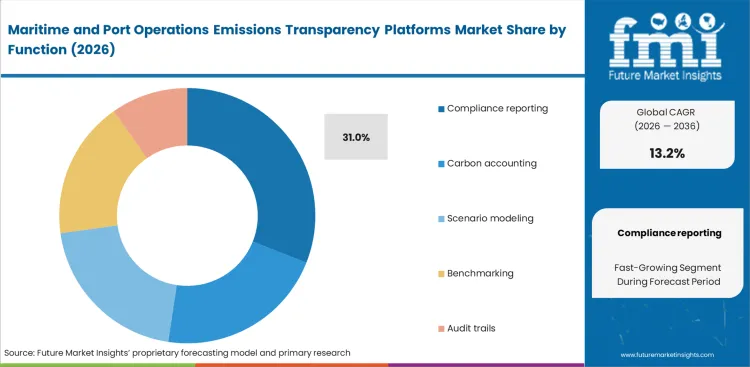
Operations managers face immediate financial exposure on every voyage traversing European waters. Compliance reporting is estimated to hold around 31.0% share of functional demand because European Union Emissions Trading System requirements transform theoretical carbon footprints into hard financial liabilities. Fleet operators utilize these modules to translate raw bunker delivery notes into formatted declarations passing strict third-party verification. In FMI's view, this module acts as mandatory entry points for broader platform integration, often positioning an EU ETS maritime reporting platform at the core. What generalist software developers frequently misunderstand is severe legal liability attached to maritime compliance; rounding errors in fuel conversion factors can cost shipowners thousands of dollars per voyage. Technical teams selecting applications with weak shore power integration reporting capabilities struggle to prove zero-emission port stays, unnecessarily inflating overall carbon cost settlement for shipping.
- Direct software licensing: Procurement departments purchase modules based on user headcount. Cost scales predictably alongside growing compliance teams.
- Hidden reconciliation hours: Analysts spend excessive time correcting sensor anomalies in voyage emissions scenario modeling. Operational budgets drain when algorithms fail to automatically flag invalid telemetry.
- Lifecycle audit protection: Immutable records prevent future regulatory fines. Chief financial officers calculate extreme return on investment based solely on avoided penalties.
Maritime and Port Operations Emissions Transparency Platforms Market Analysis by Buyer type
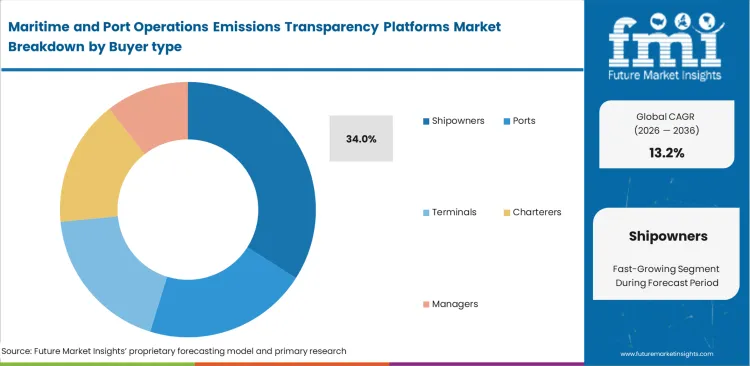
Direct asset control dictates primary accountability across maritime value chains. Shipowners control 34.0% share because maritime law places ultimate responsibility for vessel efficiency squarely on physical asset holders. Fleet performance directors leverage transparency platforms to optimize hull cleaning schedules and prove regulatory compliance to potential charterers. Based on FMI's assessment, charterers increasingly refuse to hire vessels lacking verified digital emission profiles, effectively blacklisting non-compliant shipowners from lucrative trade routes. Irony exists within this buyer dynamic; while shipowners bear costs of installing transparency software, charterers reap immediate financial benefits from resulting traffic routing models and fuel optimizations. Shipowners delaying this software investment suffer immediate revenue loss as premium freight contracts flow exclusively to digitally transparent competitors utilizing bulk shipping emissions reporting software.
- Baseline expectations: Charterers demand historical emission data. Shipowners must provide verified carbon intensity scores before finalizing any freight contract.
- Edge case performance: Extreme weather distorts fuel consumption. Technical superintendents require software capable of isolating weather penalties from underlying engine inefficiency.
- Acceptability thresholds: Classification societies set strict verification standards. Shipowners exclusively purchase platforms pre-approved by recognized maritime auditing organizations.
Maritime and Port Operations Emissions Transparency Platforms Market Analysis by Emission Boundary
Financial institutions increasingly tie vessel financing to complete fuel lifecycle profiles. Scope 1 modules dominate with 42.0% share because current regulations hyper-focus on direct onboard combustion. Port authority sustainability officers mandate accurate tracking of auxiliary engine usage during berthing operations, heavily relying on port emissions software. FMI's analysis indicates this boundary focus will shift violently toward well-to-wake methodologies within three years as alternative fuel pathways complicate basic combustion metrics. Tracking direct emissions from traditional diesel is mathematically straightforward; validating upstream production carbon of green methanol requires entirely different supply chain integrations. Vendors failing to build lifecycle analysis databases into current Scope 1 offerings will face immediate obsolescence when regulations invariably expand to encompass upstream fuel production.
- Combustion tracking: Software monitors direct engine output. Technical superintendents verify physical fuel consumed during specific voyage legs.
- Upstream blindness: Direct monitoring ignores fuel production carbon. Sustainability officers struggle to calculate total environmental impact without comprehensive well-to-wake data from a port scope 3 emissions software.
- Methodology expansion: Regulators mandate total lifecycle reporting. Buyers must upgrade entire software ecosystems to trace freight execution workflows from refinery to propeller.
Maritime and Port Operations Emissions Transparency Platforms Market Drivers, Restraints, and Opportunities
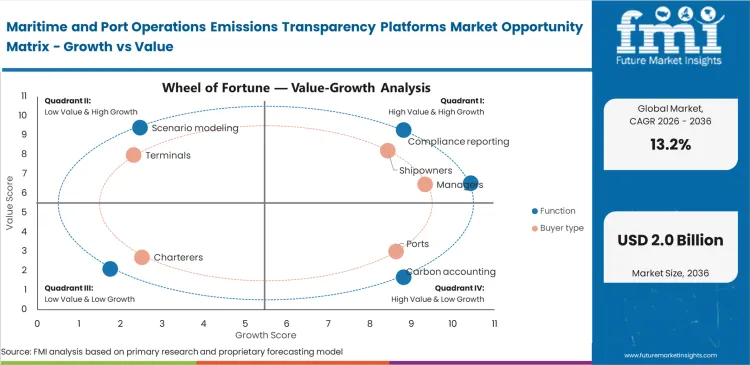
Immediate financial penalties tied to supranational carbon pricing force fleet performance directors to digitize bunker fuel tracking. Vessels entering specific regulatory zones now accrue hard tax liabilities based on calculated carbon intensity, compelling operators to seek alternatives to spreadsheet maritime emissions reporting. Relying on manual spreadsheet reporting introduces unacceptable risk; human error in fuel density conversions directly translates into massive overpayments for carbon credits. Delaying implementation forces shipowners to maintain excessive capital reserves for unpredictable compliance costs. Charterers simultaneously refuse to hire vessels lacking verified digital emission profiles, accelerating commercial requirements for immutable automated reporting through a specialized container shipping emissions platform.
Sensor calibration drift creates severe operational friction that slows adoption even when shipping companies want to move. Digital platforms require accurate hardware inputs, but maritime mass flow meters frequently degrade in harsh engine room environments. Physical reality generates conflicting data streams, requiring technical superintendents to manually intervene and justify discrepancies to external auditors. While advanced anomaly detection algorithms attempt to flag drifting sensor data automatically, fundamental requirements for physical hardware recalibration in remote global ports severely caps speed at which fully automated transparency can be achieved by maritime emissions software vendors.
Opportunities in the Maritime and Port Operations Emissions Transparency Platforms Market
- Green corridor validation: Port authorities require immutable transit data to verify zero-emission shipping lanes. Software vendors secure long-term government contracts by building dedicated corridor modules inside a just in time arrival emissions platform.
- Automated charter party settlement: Commercial operators utilize emission data to automatically execute performance clauses. Platforms integrating smart contracts directly with fuel telemetry capture premium subscription tiers.
- Supply chain integration: Beneficial cargo owners demand verifiable supply chain tracing for Scope 3 reporting. Maritime platforms linking vessel data directly to corporate sustainability disclosures secure rapid market expansion.
Regional Analysis
Based on regional analysis, Maritime and Port Operations Emissions Transparency Platforms Market is segmented into North America, Latin America, Western Europe, Eastern Europe, East Asia, South Asia and Pacific, and Middle East and Africa across 40 plus countries.
.webp "Top Country Growth Comparison Maritime And Port Operations Emissions Transparency Platforms Market Cagr (2026 2036)")
| Country | CAGR (2026 to 2036) |
|---|---|
| Netherlands | 14.6% |
| Singapore | 13.9% |
| United Kingdom | 13.7% |
| Germany | 13.5% |
| United Arab Emirates | 12.9% |
| United States | 12.8% |
| China | 12.4% |
Source: Future Market Insights (FMI) analysis, based on proprietary forecasting model and primary research
Europe Maritime and Port Operations Emissions Transparency Platforms Market Analysis
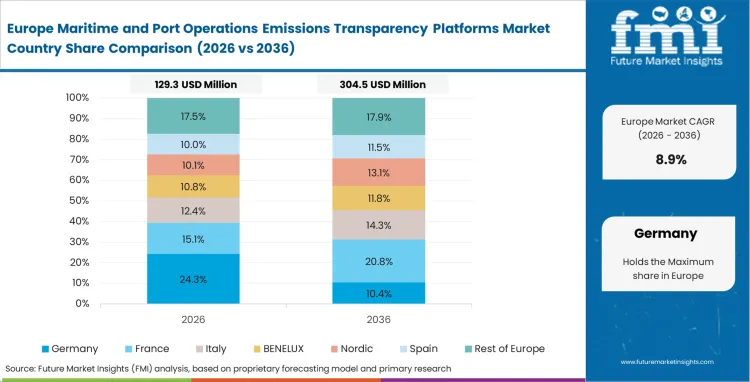
Regulatory mandates impose absolute financial liabilities on voyage emissions traversing European waters. Port authorities and regional governments have transitioned from voluntary incentives to strict taxation frameworks, forcing operators to deploy sophisticated tracking infrastructure inside the Europe maritime emissions software segment. As per FMI's projection, intense regulatory environment makes this continent primary proving ground for advanced carbon accounting for ports. Technical superintendents cannot rely on estimated fuel consumption; they must provide verified high-frequency telemetry to avoid massive surrender costs.
- Netherlands: In Netherlands, aggressive regional berth-level emission tracking mandates actively shape local compliance standards above baseline European requirements. Terminal operators must deploy advanced software to monitor complex shore power usage. This intense focus on verifiable decarbonization propels the entire Netherlands maritime and port operations emissions transparency platforms industry to a 14.6% compound annual growth rate projected between 2026 and 2036.
- United Kingdom: Expanding at an estimated 13.7% compound annual growth rate from 2026 to 2036, the United Kingdom maritime and port operations emissions transparency platforms segment responds directly to strict domestic carbon accounting rules. Ferry operators require continuous telemetry validation to satisfy national registries. This rigorous tracking establishes a fundamental digital capability that fleets subsequently leverage when securing commercial cross-border freight contracts.
- Germany: German inland waterway authorities impose severe environmental constraints on critical river freight arteries. The Germany maritime and port operations emissions transparency platforms segment expects a 13.5% compound annual growth rate across the 2026 to 2036 forecast period. Logistics managers rely heavily on localized geofencing algorithms to trace precise multi-stop fuel consumption, revealing limitations that broad generalist tracking software masks.
FMI's report includes France, Italy, and Spain. Mediterranean port authorities increasingly link terminal berthing priority directly to verified vessel carbon intensity scores utilizing port decarbonization software.
Asia Pacific Maritime and Port Operations Emissions Transparency Platforms Market Analysis
Port authorities dictate bunker qualification standards across major transshipment hubs. Focus centers on verifying integrity of alternative fuel supply chains rather than purely taxing direct emissions. Fleet performance directors operating in these corridors require platforms capable of ingesting electronic bunker delivery notes and tracing mass flow meter data to prevent blending fraud. FMI analysts note that this environment forces software to act as commercial trust layers between fuel suppliers, vessels, and port regulators.
- Singapore: Singapore maritime and port operations emissions transparency platforms industry anticipates achieving a 13.9% compound annual growth rate during the 2026 to 2036 assessment window. As a dominant global logistics hub, Singapore enforces bunkering transparency regulations that demand immutable digital custody transfers. Fuel suppliers and vessel operators heavily utilize shared blockchain ledgers to verify every transaction.
- China: Projecting a 12.4% compound annual growth rate from 2026 to 2036, China maritime and port operations emissions transparency platforms market shifts focus toward hardware-software integration at the berth. Chinese regional planners heavily prioritize massive port electrification projects to curb localized air pollution. Terminal managers actively procure specialized tools to accurately measure cold-ironing adoption rates across their coastal infrastructure.
FMI's report includes Japan and South Korea. Shipbuilding conglomerates in these nations pre-install proprietary emission tracking sensors directly into newbuild vessels, monitored via an offshore vessel MRV software.
North America Maritime and Port Operations Emissions Transparency Platforms Market Analysis
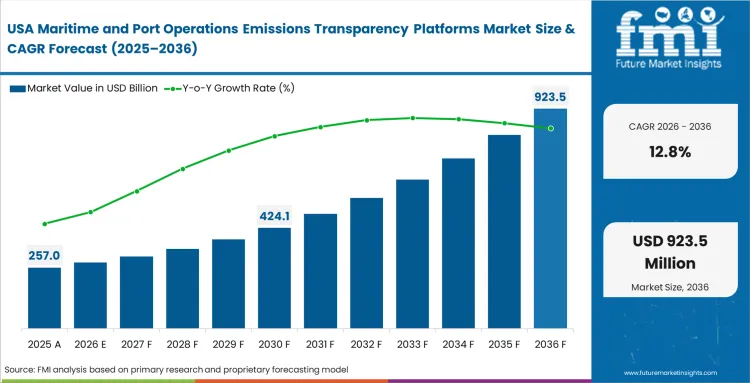
Terminal operators mandate shoreside efficiency to comply with municipal clean air requirements. Rather than focusing exclusively on supranational carbon trading, regional buyers prioritize localized particulate matter tracking and idle-time reduction. Sustainability officers require software translating vessel wait times into verifiable emission metrics for local community stakeholders. According to FMI's estimates, localized pressure forces port emissions software vendors to build highly specific geographical geofencing capabilities into core platforms.
- United States: Municipal air quality boards actively compel coastal ports to precisely quantify community environmental impacts. The United States maritime and port operations emissions transparency platforms industry is expected to chart a 12.8% compound annual growth rate from 2026 until 2036. Authorities urgently implement advanced architectures to monitor voluntary vessel speed reduction programs rather than relying on outdated estimates.
FMI's report includes Canada. Coast guard authorities emphasize cold-weather fuel efficiency tracking across northern maritime routes.
Middle East and Africa Maritime and Port Operations Emissions Transparency Platforms Market Analysis
Major logistics hubs accelerate investments in digital port operations to compete on global green corridor routes. Port directors focus on aggregating massive throughput datasets to prove terminal efficiency to international shipping lines. FMI observes that this environment prioritizes rapid vessel turnaround and automated berth scheduling tied to carbon tracking.
- United Arab Emirates: The United Arab Emirates maritime and port operations emissions transparency platforms segment captures premium transit contracts, fueling a 12.9% compound annual growth rate between 2026 and 2036. Major terminal operators across the United Arab Emirates intensely emphasize operational efficiency upgrades to maintain dominance across global shipping lanes. Logistics directors integrate real-time carbon data with enterprise-grade supply chain visibility networks.
FMI's report includes Saudi Arabia and South Africa. Strategic maritime chokepoints in these nations require specialized monitoring to manage congestion-related emissions safely.
Competitive Aligners for Market Players
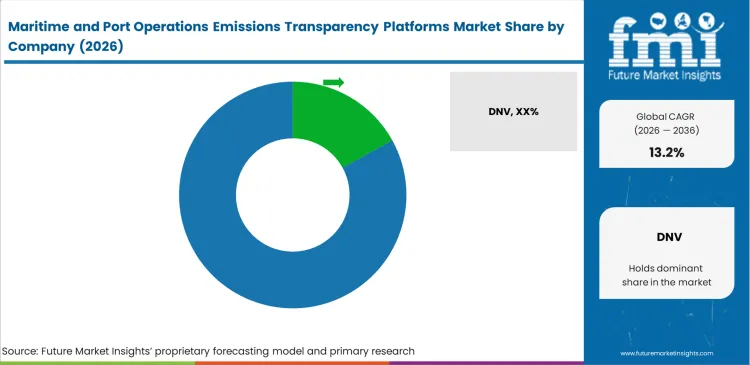
Competition in this software category hinges heavily on classification society approvals rather than traditional enterprise IT metrics. Technical superintendents outright refuse to deploy reporting tools lacking official validation from major maritime recognized organizations. DNV, ZeroNorth, and StormGeo utilize deep historical ties to naval architecture and maritime law to fast-track crucial certifications. Generalist software giants attempting to enter space frequently stall because algorithms lack specific naval engineering nuance required to calculate accurate carbon intensity across varying hull designs and weather conditions, especially when buyers schedule a maritime emissions platform demo.
Incumbent leaders possess massive proprietary databases of historical vessel performance curves that challengers cannot easily scrape or replicate. Baseline data allows established platforms to instantly spot sensor anomalies and correct drifting telemetry before it triggers compliance audits. Startups attempting to sell climate compliance stacks must overcome cold-start problems by partnering directly with digitally mature shipowners willing to share raw engine data. Without access to years of historical fuel consumption patterns, new algorithms struggle to differentiate between genuine engine inefficiency and normal severe-weather fuel penalties, leading buyers to conduct rigorous DNV vs ZeroNorth emissions platform and StormGeo vs OrbitMI compliance software evaluations.
Large fleet operators actively resist proprietary vendor lock-in by standardizing data export formats. Chief information officers demand open application programming interfaces allowing raw telemetry to migrate easily between competing reporting dashboards. Vendors refusing to support standardized data exchanges find themselves relegated to small captive fleets. Evolution points toward deep integration phases where a terminal operator carbon software merges completely with navigational routing platforms, eliminating functional divides between optimizing voyages for time and optimizing for carbon compliance.
Key Players in Maritime and Port Operations Emissions Transparency Platforms Market
- DNV
- ZeroNorth
- StormGeo
- PortXchange
- RightShip
- OrbitMI
- NAVTOR
Scope of the Report
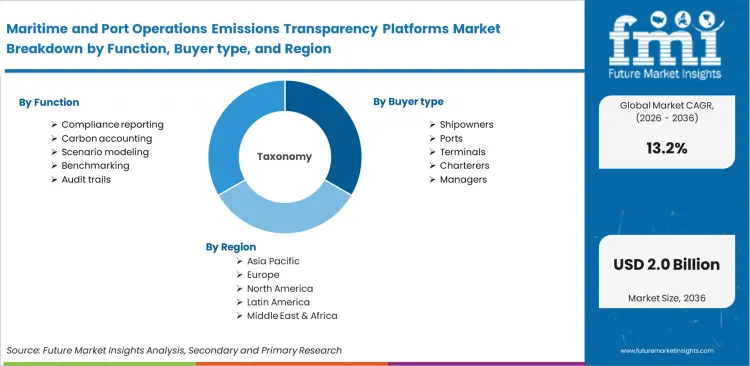
| Metric | Value |
|---|---|
| Quantitative Units | USD 0.5 billion to USD 1.52 billion, at a CAGR of 13.2% |
| Market Definition | Specialized software architectures that ingest maritime operational data, calculate precise voyage-level carbon footprints, and generate immutable compliance records for regulatory authorities. These platforms convert raw engine telemetry into verified financial and environmental liabilities. |
| Segmentation | Platform scope, Deployment model, Function, Buyer type, Emission boundary, Region |
| Regions Covered | North America, Latin America, Western Europe, Eastern Europe, East Asia, South Asia and Pacific, Middle East and Africa |
| Countries Covered | Netherlands, Singapore, United Kingdom, Germany, United Arab Emirates, United States, China |
| Key Companies Profiled | DNV, ZeroNorth, StormGeo, PortXchange, RightShip, OrbitMI, NAVTOR |
| Forecast Period | 2026 to 2036 |
| Approach | Verified software-as-a-service licensing contracts across Tier-1 shipping registries. |
Source: Future Market Insights (FMI) analysis, based on proprietary forecasting model and primary research
Maritime and Port Operations Emissions Transparency Platforms Market Analysis by Segments
Platform scope:
- Vessel platforms
- Port platforms
- Hybrid platforms
- Data exchanges
Deployment model:
- Cloud
- Hybrid
- On-premise
Function:
- Compliance reporting
- Carbon accounting
- Scenario modeling
- Benchmarking
- Audit trails
Buyer type:
- Shipowners
- Ports
- Terminals
- Charterers
- Managers
Emission boundary:
- Scope 1
- Scope 2
- Scope 3
- Well-to-wake
Region:
- North America
- United States
- Canada
- Europe
- Germany
- United Kingdom
- France
- Italy
- Spain
- Asia Pacific
- China
- Japan
- South Korea
- Taiwan
- Singapore
- Latin America
- Brazil
- Mexico
- Argentina
- Middle East & Africa
- GCC Countries
- South Africa
Bibliography
- European Maritime Safety Agency. (2024, September 11). FuelEU Maritime monitoring plans in THETIS-MRV.
- Global Maritime Forum. (2025, June 12). 2025 Sea Cargo Charter Annual Disclosure Report.
- International Association of Ports and Harbors. (2024, October 18). Digital PRL-MF tool launched at #IAPH2024.
- Transport & Environment. (2025). EU shipping emissions record high in 2024.
- World Ports Sustainability Program. (2025, May 23). Newly-upgraded IAPH World Ports Tracker identifies major sustainability and market trends.
- Zhang, Z., Rong, W., Liu, Y., & Yang, Y. (2025, July). Port carbon emission estimation: Principles, practices, and machine learning applications. Transportation Research Part E: Logistics and Transportation Review, 199, 104159.
- Giglio, D., Palma, V., & Tei, A. (2025, March). Evaluating the operational and economic impact of the introduction of S-100 and e-Navigation within shipping companies. Case Studies on Transport Policy, 19, 101331.
This bibliography is provided for reader reference. The full FMI report contains the complete reference list with primary source documentation.
This Report Addresses
- Specific architectural challenges technical superintendents face when integrating cloud-native carbon registries with legacy engine control room telemetry systems.
- Strategic software requirements for supranational regulations like the European Union Emissions Trading System mandates.
- Financial exposure shipowners navigate when attempting to validate vessel carbon intensity profiles during competitive charter negotiations.
- Barriers limiting accurate well-to-wake emission tracking across complex alternative maritime fuel supply chains.
- Operational realities that terminal managers encounter while deploying localised particulate matter tracking software.
- Classification society validation processes defining acceptable data standards for third-party maritime emission auditing platforms.
- Hidden satellite bandwidth costs IT directors face maintaining continuous application programming interface connectivity.
- Commercial strategies leading software vendors use monetizing proprietary historical vessel performance curves against emerging startup competition.
Frequently Asked Questions
What is the difference between EU MRV and FuelEU software?
EU MRV platforms focus primarily on monitoring and verifying sheer volume of carbon emitted per voyage. FuelEU tools calculate well-to-wake greenhouse gas intensity of the specific energy used, tracking compliance balances and pooling strategies across a fleet rather than simply reporting total consumption.
How do maritime emissions transparency platforms work?
These systems ingest continuous data from engine mass flow meters and electronic bunker delivery notes. The algorithms normalize this telemetry, calculate voyage-specific carbon intensity profiles against regulatory limits, and generate immutable digital records suitable for third-party verification and regulatory submission.
What data do port emissions platforms collect?
Terminal systems aggregate localized shoreside power consumption, cargo handling equipment fuel usage, and vessel auxiliary engine emissions during berthing. Advanced platforms integrate these inputs with grid carbon intensity figures to establish a precise port scope 1 2 3 accounting baseline.
Compare port and vessel emissions transparency platforms?
Vessel platforms monitor continuous dynamic combustion metrics across deep-sea voyages, prioritizing offline-to-online data synchronization. The best port emissions transparency platform focuses instead on static geographic boundaries, measuring aggregate terminal equipment usage and localized air quality impacts for municipal compliance.
Which platform helps shipowners with FuelEU and EU ETS reporting?
Vessel compliance platforms engineered specifically for European operations handle these overlapping mandates. Shipowners must buy FuelEU reporting software that seamlessly integrates with ETS accounting modules to calculate financial liabilities and intensity limits simultaneously from the same underlying fuel telemetry.
Explain maritime emissions transparency platforms for port authorities?
These digital ledgers allow public port authorities to prove the effectiveness of decarbonization initiatives to municipal stakeholders. They track the transition from diesel to electric terminal operations, validating the exact volume of carbon removed from the local airshed through onshore power compliance tracking.
Can ports measure scope 3 emissions digitally?
Yes. Advanced terminal software ingests data from visiting vessels, connecting trucks, and rail operators operating within port limits. This interconnected data stream allows sustainability officers to calculate Scope 3 impact precisely, replacing outdated theoretical estimates with verified third-party telemetry.
Which ships need emissions reporting software?
Vessels exceeding 5,000 gross tonnage calling at European ports face immediate mandatory reporting requirements. Additionally, any commercial vessel seeking premium charter contracts globally requires verified digital emission profiles, as major cargo owners increasingly blacklist ships lacking auditable carbon data.
How much does maritime emissions software cost?
Pricing structures vary significantly based on fleet size and integration complexity. Basic reporting modules scale via per-vessel monthly subscriptions, while comprehensive platforms handling automated ETS carbon cost settlement require heavy upfront enterprise integration fees and substantial ongoing satellite bandwidth expenditures.
Best maritime compliance software for EU ETS?
Top-tier platforms prioritize automated integration with recognized auditing organizations over mere data visualization. The most effective systems instantly convert raw fuel flow data into accurate financial surrender requirements, preventing the massive overpayments caused by manual spreadsheet conversion errors.
What should a port authority look for in emissions software?
Procurement directors must prioritize geofencing accuracy and multimodal integration capabilities. The software must seamlessly ingest data from both visiting deep-sea vessels and localized terminal equipment, converting complex operational metrics into transparent public-facing sustainability dashboards.
How can charterers use maritime emissions transparency data?
Commercial operators leverage verified vessel profiles to select the most carbon-efficient tonnage for specific routes. By utilizing vessel fuel and emissions reporting, charterers actively negotiate lower freight rates for inefficient ships or execute automated smart contracts tied directly to fuel performance clauses.
Summarize the maritime emissions platform market forecast?
Sustained regulatory pressure propels market valuation from USD 0.5 billion in 2026 to USD 1.52 billion by 2036. The 13.2% growth rate reflects an industry-wide transition away from manual reporting toward automated, auditable software infrastructure mandated by supranational carbon pricing mechanisms.
Why do vessel platforms lead deployment scope?
Shipboard engine rooms represent absolute origin points for regulated carbon generation. Technical superintendents require localized software to capture immutable telemetry before it ever leaves physical assets.
What drives cloud architecture dominance?
Continuous regulatory updates require centralized software patching. Sustainability officers managing multi-jurisdictional fleets rely on cloud environments aggregating fuel consumption data across hundreds of moving assets simultaneously.
Why is compliance reporting primary function?
Operations managers face immediate financial exposure on every voyage. Fleet operators utilize modules translating raw bunker delivery notes into formatted declarations passing strict third-party verification.
Why do shipowners command largest buyer share?
Maritime law places ultimate responsibility for vessel efficiency squarely on physical asset holders. Shipowners bear legal and financial burdens proving regulatory compliance to authorities.
What sustains Scope 1 boundary tracking?
Current regulations hyper-focus on direct onboard combustion. Port authorities mandate accurate tracking of auxiliary engine usage during berthing operations before expanding into complex upstream fuel production metrics.
How does Netherlands market differ from China?
Netherlands expands at 14.6% due to strict European carbon taxation on voyage emissions. China tracks at 12.4%, with regional planners prioritizing localized port electrification tracking.
What creates biggest deployment friction?
Sensor calibration drift generates conflicting data streams. Advanced algorithms struggle processing inaccurate mass flow meter readings, requiring technical superintendents to manually intervene justifying discrepancies to external auditors.
How do classification societies influence procurement?
Technical superintendents outright refuse deploying reporting tools lacking official validation. Recognized organizations define exact mathematical standards software must meet satisfying international maritime law.
Why do legacy ERP systems fail maritime audits?
Generic enterprise software struggles processing proprietary sensor protocols from decades-old main engines. They also lack offline-caching protocols required surviving mid-ocean satellite connectivity blackouts.
What hidden costs surprise maritime IT directors?
Cloud software demands constant internet access for continuous telemetry synchronization. Fleet managers frequently discover satellite bandwidth expenses quickly exceed baseline software licensing fees.
How do incumbents maintain competitive advantage?
Established leaders possess massive databases containing historical vessel performance curves. Baseline data allows them instantly spotting sensor anomalies and correcting drifting telemetry before compliance audits occur.
Preview the report firsthand - request a free sample
Get SampleGet the brochure for pricing and purchase details.
Get PDFTable of Content
- Executive Summary
- Global Market Outlook
- Demand-side Trends
- Supply-side Trends
- Technology Roadmap Analysis
- Analysis and Recommendations
- Market Overview
- Market Structure, Signals, and Trend Drivers
- Benchmarking and Cross-market Comparability
- Market Sizing, Forecasting, and Opportunity Mapping
- Research Design and Evidence Framework
- Desk Research Programme (Secondary Evidence)
- Company Annual and Sustainability Reports
- Peer-reviewed Journals and Academic Literature
- Corporate Websites, Product Literature, and Technical Notes
- Sector Databases and Reference Repositories
- FMI Internal Proprietary Databases and Historical Market Datasets
- Subscription Datasets and Paid Sources
- Social Channels, Communities, and Digital Listening Inputs
- Additional Desk Sources
- Expert Input and Fieldwork (Primary Evidence)
- Primary Modes
- Qualitative Interviews and Expert Elicitation
- Quantitative Surveys and Structured Data Capture
- Blended Approach
- Why Primary Evidence is Used
- Field Techniques
- Interviews
- Surveys
- Focus Groups
- Observational and In-context Research
- Social and Community Interactions
- Stakeholder Universe Engaged
- C-suite Leaders
- Board Members
- Presidents and Vice Presidents
- R&D and Innovation Heads
- Technical Specialists
- Domain Subject-matter Experts
- Scientists
- Physicians and Other Healthcare Professionals
- Governance, Ethics, and Data Stewardship
- Research Ethics
- Data Integrity and Handling
- Primary Modes
- Tooling, Models, and Reference Databases
- Desk Research Programme (Secondary Evidence)
- Data Engineering and Model Build
- Data Acquisition and Ingestion
- Cleaning, Normalisation, and Verification
- Synthesis, Triangulation, and Analysis
- Quality Assurance and Audit Trail
- Market Background
- Market Dynamics
- Drivers
- Restraints
- Opportunity
- Trends
- Scenario Forecast
- Demand in Optimistic Scenario
- Demand in Likely Scenario
- Demand in Conservative Scenario
- Opportunity Map Analysis
- Product Life Cycle Analysis
- Supply Chain Analysis
- Investment Feasibility Matrix
- Value Chain Analysis
- PESTLE and Porter’s Analysis
- Regulatory Landscape
- Regional Parent Market Outlook
- Production and Consumption Statistics
- Import and Export Statistics
- Market Dynamics
- Global Market Analysis 2021 to 2025 and Forecast, 2026 to 2036
- Historical Market Size Value (USD Million) Analysis, 2021 to 2025
- Current and Future Market Size Value (USD Million) Projections, 2026 to 2036
- Y-o-Y Growth Trend Analysis
- Absolute $ Opportunity Analysis
- Global Market Pricing Analysis 2021 to 2025 and Forecast 2026 to 2036
- Global Market Analysis 2021 to 2025 and Forecast 2026 to 2036, By Function
- Introduction / Key Findings
- Historical Market Size Value (USD Million) Analysis By Function , 2021 to 2025
- Current and Future Market Size Value (USD Million) Analysis and Forecast By Function , 2026 to 2036
- Compliance reporting
- Carbon accounting
- Scenario modeling
- Benchmarking
- Audit trails
- Compliance reporting
- Y-o-Y Growth Trend Analysis By Function , 2021 to 2025
- Absolute $ Opportunity Analysis By Function , 2026 to 2036
- Global Market Analysis 2021 to 2025 and Forecast 2026 to 2036, By Buyer type
- Introduction / Key Findings
- Historical Market Size Value (USD Million) Analysis By Buyer type, 2021 to 2025
- Current and Future Market Size Value (USD Million) Analysis and Forecast By Buyer type, 2026 to 2036
- Shipowners
- Ports
- Terminals
- Charterers
- Managers
- Shipowners
- Y-o-Y Growth Trend Analysis By Buyer type, 2021 to 2025
- Absolute $ Opportunity Analysis By Buyer type, 2026 to 2036
- Global Market Analysis 2021 to 2025 and Forecast 2026 to 2036, By Region
- Introduction
- Historical Market Size Value (USD Million) Analysis By Region, 2021 to 2025
- Current Market Size Value (USD Million) Analysis and Forecast By Region, 2026 to 2036
- North America
- Latin America
- Western Europe
- Eastern Europe
- East Asia
- South Asia and Pacific
- Middle East & Africa
- Market Attractiveness Analysis By Region
- North America Market Analysis 2021 to 2025 and Forecast 2026 to 2036, By Country
- Historical Market Size Value (USD Million) Trend Analysis By Market Taxonomy, 2021 to 2025
- Market Size Value (USD Million) Forecast By Market Taxonomy, 2026 to 2036
- By Country
- USA
- Canada
- Mexico
- By Function
- By Buyer type
- By Country
- Market Attractiveness Analysis
- By Country
- By Function
- By Buyer type
- Key Takeaways
- Latin America Market Analysis 2021 to 2025 and Forecast 2026 to 2036, By Country
- Historical Market Size Value (USD Million) Trend Analysis By Market Taxonomy, 2021 to 2025
- Market Size Value (USD Million) Forecast By Market Taxonomy, 2026 to 2036
- By Country
- Brazil
- Chile
- Rest of Latin America
- By Function
- By Buyer type
- By Country
- Market Attractiveness Analysis
- By Country
- By Function
- By Buyer type
- Key Takeaways
- Western Europe Market Analysis 2021 to 2025 and Forecast 2026 to 2036, By Country
- Historical Market Size Value (USD Million) Trend Analysis By Market Taxonomy, 2021 to 2025
- Market Size Value (USD Million) Forecast By Market Taxonomy, 2026 to 2036
- By Country
- Germany
- UK
- Italy
- Spain
- France
- Nordic
- BENELUX
- Rest of Western Europe
- By Function
- By Buyer type
- By Country
- Market Attractiveness Analysis
- By Country
- By Function
- By Buyer type
- Key Takeaways
- Eastern Europe Market Analysis 2021 to 2025 and Forecast 2026 to 2036, By Country
- Historical Market Size Value (USD Million) Trend Analysis By Market Taxonomy, 2021 to 2025
- Market Size Value (USD Million) Forecast By Market Taxonomy, 2026 to 2036
- By Country
- Russia
- Poland
- Hungary
- Balkan & Baltic
- Rest of Eastern Europe
- By Function
- By Buyer type
- By Country
- Market Attractiveness Analysis
- By Country
- By Function
- By Buyer type
- Key Takeaways
- East Asia Market Analysis 2021 to 2025 and Forecast 2026 to 2036, By Country
- Historical Market Size Value (USD Million) Trend Analysis By Market Taxonomy, 2021 to 2025
- Market Size Value (USD Million) Forecast By Market Taxonomy, 2026 to 2036
- By Country
- China
- Japan
- South Korea
- By Function
- By Buyer type
- By Country
- Market Attractiveness Analysis
- By Country
- By Function
- By Buyer type
- Key Takeaways
- South Asia and Pacific Market Analysis 2021 to 2025 and Forecast 2026 to 2036, By Country
- Historical Market Size Value (USD Million) Trend Analysis By Market Taxonomy, 2021 to 2025
- Market Size Value (USD Million) Forecast By Market Taxonomy, 2026 to 2036
- By Country
- India
- ASEAN
- Australia & New Zealand
- Rest of South Asia and Pacific
- By Function
- By Buyer type
- By Country
- Market Attractiveness Analysis
- By Country
- By Function
- By Buyer type
- Key Takeaways
- Middle East & Africa Market Analysis 2021 to 2025 and Forecast 2026 to 2036, By Country
- Historical Market Size Value (USD Million) Trend Analysis By Market Taxonomy, 2021 to 2025
- Market Size Value (USD Million) Forecast By Market Taxonomy, 2026 to 2036
- By Country
- Kingdom of Saudi Arabia
- Other GCC Countries
- Turkiye
- South Africa
- Other African Union
- Rest of Middle East & Africa
- By Function
- By Buyer type
- By Country
- Market Attractiveness Analysis
- By Country
- By Function
- By Buyer type
- Key Takeaways
- Key Countries Market Analysis
- USA
- Pricing Analysis
- Market Share Analysis, 2025
- By Function
- By Buyer type
- Canada
- Pricing Analysis
- Market Share Analysis, 2025
- By Function
- By Buyer type
- Mexico
- Pricing Analysis
- Market Share Analysis, 2025
- By Function
- By Buyer type
- Brazil
- Pricing Analysis
- Market Share Analysis, 2025
- By Function
- By Buyer type
- Chile
- Pricing Analysis
- Market Share Analysis, 2025
- By Function
- By Buyer type
- Germany
- Pricing Analysis
- Market Share Analysis, 2025
- By Function
- By Buyer type
- UK
- Pricing Analysis
- Market Share Analysis, 2025
- By Function
- By Buyer type
- Italy
- Pricing Analysis
- Market Share Analysis, 2025
- By Function
- By Buyer type
- Spain
- Pricing Analysis
- Market Share Analysis, 2025
- By Function
- By Buyer type
- France
- Pricing Analysis
- Market Share Analysis, 2025
- By Function
- By Buyer type
- India
- Pricing Analysis
- Market Share Analysis, 2025
- By Function
- By Buyer type
- ASEAN
- Pricing Analysis
- Market Share Analysis, 2025
- By Function
- By Buyer type
- Australia & New Zealand
- Pricing Analysis
- Market Share Analysis, 2025
- By Function
- By Buyer type
- China
- Pricing Analysis
- Market Share Analysis, 2025
- By Function
- By Buyer type
- Japan
- Pricing Analysis
- Market Share Analysis, 2025
- By Function
- By Buyer type
- South Korea
- Pricing Analysis
- Market Share Analysis, 2025
- By Function
- By Buyer type
- Russia
- Pricing Analysis
- Market Share Analysis, 2025
- By Function
- By Buyer type
- Poland
- Pricing Analysis
- Market Share Analysis, 2025
- By Function
- By Buyer type
- Hungary
- Pricing Analysis
- Market Share Analysis, 2025
- By Function
- By Buyer type
- Kingdom of Saudi Arabia
- Pricing Analysis
- Market Share Analysis, 2025
- By Function
- By Buyer type
- Turkiye
- Pricing Analysis
- Market Share Analysis, 2025
- By Function
- By Buyer type
- South Africa
- Pricing Analysis
- Market Share Analysis, 2025
- By Function
- By Buyer type
- USA
- Market Structure Analysis
- Competition Dashboard
- Competition Benchmarking
- Market Share Analysis of Top Players
- By Regional
- By Function
- By Buyer type
- Competition Analysis
- Competition Deep Dive
- DNV
- Overview
- Product Portfolio
- Profitability by Market Segments (Product/Age /Sales Channel/Region)
- Sales Footprint
- Strategy Overview
- Marketing Strategy
- Product Strategy
- Channel Strategy
- ZeroNorth
- StormGeo
- PortXchange
- RightShip
- OrbitMI
- NAVTOR
- DNV
- Competition Deep Dive
- Assumptions & Acronyms Used


