

- Market Size (2026)
- USD 380.5 Mn
- Forecast (2036)
- USD 675.0 Mn
- CAGR (2026 to 2036)
- 5.9%
How big is Microbiome-Friendly Skincare Market in 2026?
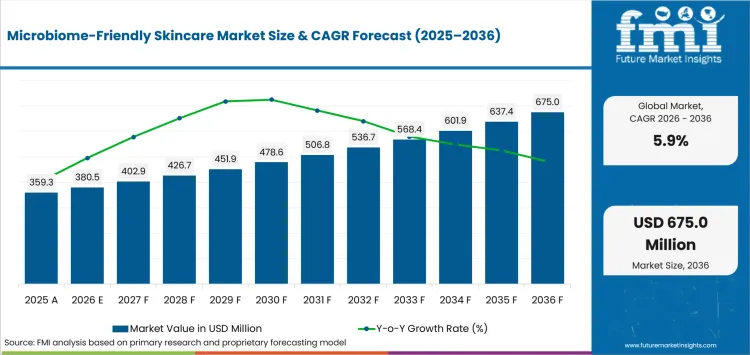
USD 380.5 million in 2026 and USD 675.0 million by 2036 at a 5.9% CAGR.
Demand for microbiome-friendly skincare is projected to expand at 5.9% CAGR between 2026 and 2036, increasing valuation from USD 380.5 million to USD 675.0 million. Routine barrier care gives probiotic cosmetics a familiar purchase route because hydration and sensitivity already support frequent replenishment. Unilever documented skin-microbiome research in May 2025 based on more than 30,000 samples. The company stated that several beauty brands already use those insights. That installed research base lowers the education burden for microbiome positioning inside ordinary cleansers and moisturizers.
Country conversion depends on whether a microbiome claim fits local cosmetic controls and mature skincare distribution. The USA Food and Drug Administration counted 16,398 active cosmetic facility registrations and 1,298,361 active product listings as of June 30, 2026. That scale makes the USA attractive for broader skincare launches, yet MoCRA renewal and listing records place a continuing documentation cost on each commercial program. Gulf and Asian markets can grow faster while requiring different product-notification or functional-claim routes.
Key Takeaways of Microbiome-Friendly Skincare Market
- Barrier-support routines are increasing demand because microbiome claims convert more readily if they accompany familiar hydration and sensitive-skin benefits.
- Based on product type, core - classic lines are projected to account for 37.0% in 2026 due to familiar daily routines that reduce trial friction.
- By nature, conventional is estimated to hold 48.0% in 2026 owing to preserved formulas that give developers wider stability and texture choices.
- In 2026, cream & balm is expected to lead format with 35.0% share because moisturization gives microbiome positioning an understood daily use case.
- Formulation stability and claim substantiation can slow launches if microbiome language moves beyond a cosmetic benefit that testing can defend.
- Some of the key players in this market include L'Oreal, Beiersdorf, Shiseido, Amorepacific, Unilever, BioGaia AB, Bausch Health Companies Inc., and Topaz Biosciences.
Analyst Perspective
“Microbiome-friendly skincare earns repeat revenue provided microbial positioning improves a job the consumer already understands, such as gentle cleansing or barrier comfort. Brand teams should compare finished-formula stability and claim evidence beside channel economics because a sophisticated microbiome story cannot compensate for weak replenishment or unclear product use.”
- Rahul Pandita , Principal Consultant, Future Market Insights
How is the Microbiome-Friendly Skincare Market segmented?
The microbiome-friendly skincare market is segmented by product type, nature, format, price positioning, sales channel and region.
Product type includes core - classic lines, targeted treatment lines, sensitive & gentle lines, premium & clinical lines, and kits & sets. Nature covers conventional, vegan & cruelty-free, natural & organic, dermocosmetic / clinical, and fragrance-free & sensitive. Format includes cream & balm, liquid & serum, stick & solid, spray & mist, sheet & patch, and powder. Price positioning covers mass, masstige, premium, and professional. Sales channels include e-commerce & DTC, specialty beauty retail, pharmacies & drugstores, supermarkets & hypermarkets, and salons & spas.
What makes Core - classic lines central to the Product Type category?
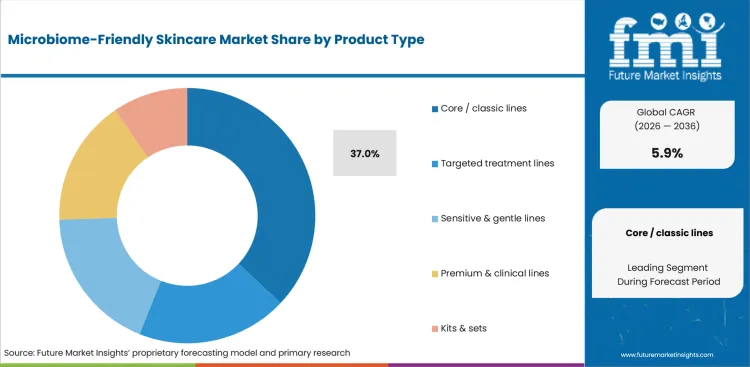
Core - classic lines put microbiome science inside familiar routines already used for probiotic cosmetics instead of asking consumers to learn a separate treatment sequence. The proposition also overlaps with sensitive skin solutions because barrier comfort is already a recognized daily skincare need.
- Based on product type, core - classic lines are projected to account for 37.0% in 2026 due to routine use that supports frequent replenishment.
- Shiseido reported in August 2025 that its sensitive-skin microbiome research identified a specific Cutibacterium acnes strain and a selective microbial extract. That evidence supports product development around microbial balance without requiring a new routine category.
Why does Conventional lead the Nature category?
Conventional formulations let developers manage preservation and shelf stability while incorporating ferments or postbiotic skincare concepts within standard cosmetic manufacturing controls. The commercial advantage is formula latitude instead of a claim that conventional chemistry itself improves the microbiome. That latitude matters because microbiome positioning must coexist with routine contamination controls.
- By nature, conventional is estimated to hold 48.0% in 2026 owing to preserved formulas that support broad texture and price architectures.
- In March 2026, Beiersdorf stated that S-Biomedic technology had entered its Microbiome Design Platform and global microbiome-based skincare pipeline. The integration shows how microbiome science can operate inside a large conventional development system.
How does Cream & balm influence selection within the Format category?
Cream and balm formats fit the barrier-care use case because consumers already associate these textures with dryness relief and regular moisturization. That familiarity also links microbiome positioning with repairing skin care routines without making the format itself the scientific claim.
- In 2026, cream & balm is expected to lead format with 35.0% share because daily moisturization supports repeated use and clear regimen placement.
- Bausch Health launched the YUN ACN line in Poland during September 2025 with a probiotic repair cream plus prebiotic cleansing formats. The line demonstrates how a cream can anchor microbiome care beside complementary cleansing steps.
What drives E-commerce & DTC within the Sales Channel category?
Digital channels give microbiome-focused brands enough space to explain ingredient roles and regimen order before the consumer reaches checkout. That education function matters in beauty and wellness categories where unfamiliar science can otherwise slow first purchase. Retailers can preserve that explanation with saved routines and repeat-order reminders after initial product trial.
- E-commerce & DTC is projected to hold 30.0% share in 2026 owing to detailed product education and simple replenishment after trial.
- MyMicrobiome documented in April 2025 that Sun Matters launched a microbiome-friendly certified sunscreen through Douglas retail. The event shows that certification and channel placement can give consumers a short proof cue at discovery.
What are the drivers, restraints and opportunities in the Microbiome-Friendly Skincare Market?
Barrier-care routines increase microbiome relevance, formulation and claim controls constrain launch speed, and stable biotic approaches widen the path to routine skincare.
- Driver: Familiar barrier and sensitive-skin routines give microbiome positioning a repeat-purchase route inside everyday skincare.
- Restraint: Preservation requirements and substantiated cosmetic claims increase the development burden for formulations making microbiome-related promises.
- Opportunity: Stable biotic formats and microbiome-derived metabolites can translate microbial science into differentiated products without relying on live organisms.
The demand for microbiome-friendly skincare is driven by daily skin concerns and microbiome terminology. BioGaia launched BioGaia New Sciences AB in July 2025 and selected skin health as its first area beyond the company’s core probiotic categories. That move places microbiome expertise closer to topical routines and supports adjacent probiotic fermentation skincare development aimed at repeated use.
Microbiome claims do not remove ordinary cosmetic safety and ingredient obligations during formulation or commercial scale-up. Commission Regulation (EU) 2025/877 amended the EU cosmetics rules in May 2025 for specified substances classified as carcinogenic, mutagenic or toxic for reproduction. Reformulation therefore imposes a real cost on microbiome-oriented products, especially if cosmetic chemicals or preservation systems change during scale-up.
The better opportunity lies in translating microbial signals into stable ingredients or targeted routines that fit existing cosmetic use. Amorepacific disclosed in May 2026 that integrated microbiome and metabolite analysis identified phenyllactic acid at higher levels in youthful healthy skin. That research widens the role of skin bioactives from microbial composition toward metabolites that can support future diagnostics and ingredient development.
Which country CAGRs are profiled in the Microbiome-Friendly Skincare Market?
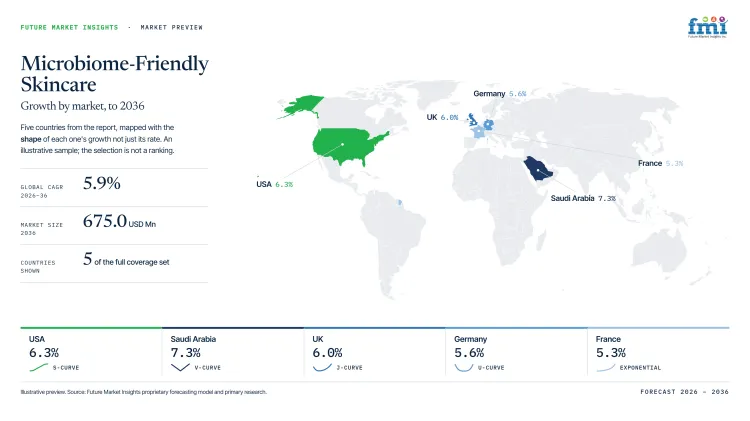
| Country | CAGR |
|---|---|
| Saudi Arabia | 7.3% |
| USA | 6.3% |
| UK | 6.0% |
| Germany | 5.6% |
| France | 5.3% |
How do country-level CAGRs compare in the Microbiome-Friendly Skincare Market?
The five-country range spans 2.0 percentage points, from Saudi Arabia at 7.3% to France at 5.3%. Saudi Arabia leads the group, followed by the USA and UK, while Germany and France form the lower-growth band. The differences reflect varying retail maturity, regulatory requirements, cosmetic innovation, and consumer adoption rather than market size alone. Consequently, similar growth rates can still require different market-entry budgets and launch sequences.
- Saudi Arabia combines rapid beauty retail expansion with formal SFDA requirements for imported skincare products.
- USA benefits from deep retail and e-commerce distribution, supported by a large and diverse skincare market.
- UK combines established pharmacy and digital beauty channels with formal Responsible Person requirements.
- Germany offers strong pharmacy, dermocosmetic, and premium skincare channels within a structured European regulatory environment.
- France benefits from its established cosmetics industry, pharmacy distribution, and strong consumer interest in premium skincare innovation.
Comparable growth rates therefore conceal different entry costs and distinct country-specific launch sequences. The full report provides country-level CAGR analysis across North America, Latin America, Europe, East Asia, South Asia, Oceania and the Middle East and Africa.
Country-wise Analysis
- Saudi Arabia is projected to record the highest growth among the profiled countries, at 7.3% CAGR through 2036. Beauty retail expansion, premium skincare adoption, and growing interest in science-backed formulations support microbiome-friendly skincare demand. Brands entering the market must manage SFDA requirements, product documentation, and Arabic-ready packaging. Experienced local importer and distributor partners can streamline regulatory coordination and retail placement, while careful cosmetic claim wording remains important before broader promotional investment.
- The USA is estimated to expand at 6.3% CAGR through 2036, supported by extensive skincare retail distribution, e-commerce penetration, and consumer interest in ingredient-focused products. Microbiome-friendly formulations can benefit from established digital education and replenishment channels. However, brands must maintain appropriate cosmetic claims and comply with applicable MoCRA-related registration and product-record requirements. Strong documentation and clear consumer-facing positioning can support wider retail and online expansion.
- The UK is forecast to grow at 6.0% CAGR through 2036, supported by established pharmacy, specialty beauty, and digital commerce channels. Microbiome-friendly skincare can benefit from consumer interest in barrier care, sensitive-skin solutions, and science-led formulations. Brands must meet Great Britain cosmetic requirements, including the appointment of a Responsible Person and appropriate product notification. Robust safety and claims documentation can help support smoother launches across pharmacy and digital channels.
- Germany is projected to register 5.6% CAGR through 2036, supported by its strong pharmacy, dermocosmetic, and premium skincare ecosystem. Consumer preference for evidence-based formulations provides an attractive environment for microbiome-friendly products, particularly those positioned around skin-barrier support and sensitive-skin routines. Compliance with EU cosmetics requirements and disciplined claims substantiation remain important for market entry. Pharmacy relationships and specialist retail partnerships can strengthen product credibility and distribution.
- France is forecast to expand at 5.3% CAGR through 2036, reflecting its mature cosmetics sector, established pharmacy networks, and strong consumer interest in premium skincare innovation. Microbiome-friendly products can leverage France's sophisticated beauty ecosystem and demand for scientifically positioned formulations. Brands must comply with EU cosmetic requirements while ensuring that microbiome-related claims remain appropriately supported. Selective pharmacy, specialty beauty, and digital distribution can provide effective routes for market development.
Who are the notable companies in the Microbiome-Friendly Skincare Market?
L'Oreal, Beiersdorf, Shiseido, Amorepacific, Unilever, BioGaia AB, Bausch Health Companies Inc., and Topaz Biosciences are the notable companies serving this market.
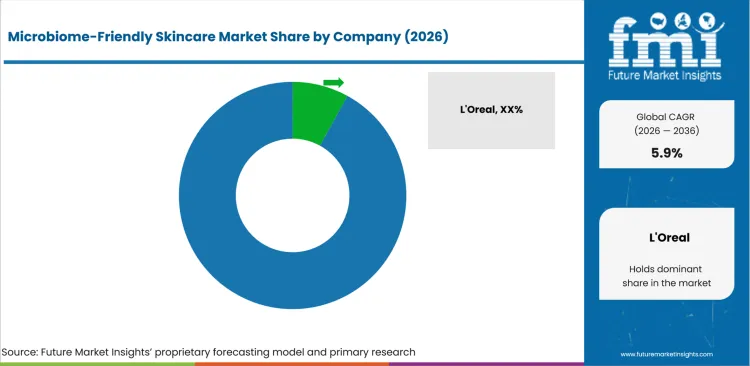
Competition is split between global beauty groups with proprietary skin science and smaller operators built around specialty skincare claims. The main entry barrier is not brand scale alone because microbiome positioning must survive formulation testing and consumer explanation. Companies that control probiotic skincare ingredients or verified microbiome platforms can shorten evidence development while commercializers still need channels that support repeat use.
- L'Oreal, Beiersdorf, Shiseido, Amorepacific, and Unilever operate broad skincare portfolios backed by documented microbiome research or development platforms.
- BioGaia AB and Bausch Health Companies Inc. translate microbiome science into commercial probiotic skincare with narrower but directly evidenced product routes.
- Topaz Biosciences competes through Hypothesis and its precision-enzyme platform for eczema-prone skin care, giving the company a focused microbiome route beside larger beauty portfolios.
Competitive Benchmarking: Microbiome-Friendly Skincare Market
| Company | Microbiome Science Depth | Skincare Translation | Commercial Skincare Breadth | Geographic Reach |
|---|---|---|---|---|
| L'Oreal | High | High | High | Global |
| Beiersdorf | High | High | High | Global |
| Shiseido | High | High | High | Global, deep Asia and prestige reach |
| Amorepacific | High | High | Medium | South Korea, wider Asia, North America |
| Unilever | High | High | High | Global |
| BioGaia AB | High | Medium | Medium | Europe and North America |
| Bausch Health Companies Inc. | Medium | High | Medium | Europe and North America |
| Topaz Biosciences | Medium | Medium | Low | North America, focused specialist reach |
Scoring basis: High microbiome science depth requires several documented research programs or a proprietary platform. Medium requires one direct program while Low identifies a narrow documented route. High skincare translation requires several documented commercial skincare forms serving distinct use cases. Medium identifies one clear line while Low marks an early or tightly focused offer. High commercial skincare breadth requires several documented topical forms or skin-care programs. Medium identifies a narrower commercial line while Low identifies one focused offer.
Key Developments in the Microbiome-Friendly Skincare Market
- In April 2026, L'Oreal entered a research partnership with Institut Pasteur covering skin biomarkers, microbiology, immunology, and the microbiome. The programme is intended to identify new biological targets that can inform future skin-health research and ingredient development.
- In June 2025, Bausch Health Companies Inc. entered a partnership with YUN NV to introduce probiotic microbiome skincare for acne-prone skin in Poland. The agreement established a commercial route for YUN products before the Polish launch announced later that year.
- In August 2025, Topaz Biosciences’ Hypothesis Precision Healing Spray received MyMicrobiome certification under the MyMicrobiome Standard 27.10 for adult eczema.
Key Players in the Microbiome-Friendly Skincare Market
Global Microbiome Science Platforms
- L'Oreal
- Beiersdorf
- Shiseido
- Amorepacific
- Unilever
Commercial Microbiome Skincare Specialists
- BioGaia AB
- Bausch Health Companies Inc.
- Topaz Biosciences
Microbiome-Friendly Skincare Market - Report Scope
| Coverage field | Report scope |
|---|---|
| Market breakdown | By product type, nature, format, price positioning, sales channel and region. |
| Quantitative Units | USD million. |
| Market Definition | Revenue includes topical skincare products explicitly designed or marketed to preserve, support, or balance the skin microbiome. Raw microbiome ingredients, ingestible supplements, standalone diagnostics, therapeutic drugs, hair-only products, and adjacent products without a qualifying microbiome-friendly proposition are excluded. |
| Regions Covered | North America, Latin America, Europe, East Asia, South Asia and Pacific, and Middle East and Africa. |
| Countries Covered | Saudi Arabia, UAE, South Korea, USA, UK, and 20+ countries included in the full report. |
| Key Companies Profiled | L'Oreal, Beiersdorf, Shiseido, Amorepacific, Unilever, BioGaia AB, Bausch Health Companies Inc., and Topaz Biosciences. |
| Forecast Period | 2026 to 2036. |
| Approach | Primary and secondary research with market triangulation. |
Microbiome-Friendly Skincare Market - Research Methodology
| Method | Approach |
|---|---|
| Primary Research | FMI analysts gathered input from manufacturers, service providers, technology developers, distributors, end users, procurement teams, and subject-matter experts. Interviews examined purchasing decisions, product or service evaluation, adoption barriers, approval requirements, pricing considerations, and expectations for technical or commercial support. Respondents were also asked what evidence is required before a trial, pilot, or initial order develops into regular purchasing. |
| Desk Research | Desk research covered government statistics, regulatory publications, trade data, industry associations, technical literature, standards, company filings, product information, and official corporate announcements. Sources were reviewed for relevance, publication date, geographic coverage, and consistency with the defined market scope. Claims relating to performance, applications, approvals, capacity, investment, and commercial activity were retained only when supported by credible public evidence. |
| Market Sizing and Forecasting | The market model combined the baseline value with historical performance, segment structure, pricing and volume indicators, adoption levels, company participation, and country-level demand conditions. Forecast assumptions considered economic activity, investment trends, regulatory developments, technology adoption, purchasing cycles, supply availability, and barriers to wider market use. Segment and regional estimates were reconciled before the final market total was calculated. |
| Data Validation | Estimates were checked against multiple independent indicators, including public data, company activity, trade patterns, industry developments, and findings from primary interviews. Validation also tested whether products, services, applications, and company revenues fell within the defined market boundaries. Adjacent categories, unsupported claims, overlapping revenues, and activities without direct market relevance were excluded to reduce double counting and maintain consistency across segments and countries. |
Microbiome-Friendly Skincare Market by Segments
Microbiome-Friendly Skincare Market segmented by Product Type:
- Core - classic lines
- Targeted treatment lines
- Sensitive & gentle lines
- Premium & clinical lines
- Kits & sets
Microbiome-Friendly Skincare Market segmented by Nature:
- Conventional
- Vegan & cruelty-free
- Natural & organic
- Dermocosmetic / clinical
- Fragrance-free & sensitive
Microbiome-Friendly Skincare Market segmented by Format:
- Cream & balm
- Liquid & serum
- Stick & solid
- Spray & mist
- Sheet & patch
- Powder
Microbiome-Friendly Skincare Market segmented by Price Positioning:
- Mass
- Masstige
- Premium
- Professional
Microbiome-Friendly Skincare Market segmented by Sales Channel:
- E-commerce & DTC
- Specialty beauty retail
- Pharmacies & drugstores
- Supermarkets & hypermarkets
- Salons & spas
Microbiome-Friendly Skincare Market by Region:
- North America
- United States
- Canada
- Latin America
- Brazil
- Mexico
- Argentina
- Chile
- Western Europe
- Germany
- France
- United Kingdom
- Italy
- Spain
- Benelux
- Nordics
- Eastern Europe
- Poland
- Czech Republic
- Romania
- Hungary
- East Asia
- China
- Japan
- South Korea
- South Asia and Pacific
- India
- ASEAN
- Australia and New Zealand
- Middle East and Africa
- GCC Countries
- South Africa
- Türkiye
- Israel
Research Sources and Bibliography
USA Food and Drug Administration. (2026, June 30). Registration & Listing of Cosmetic Product Facilities and Products.
USA Food and Drug Administration. (2026, February 11). FDA Updates Web Portal and Informational Materials to Help Cosmetic Facilities Prepare for Biennial Registration Renewal.
Office for Product Safety and Standards. (2026, July 17). New data on UK cosmetic product safety notifications.
- Dubai Municipality. (2025, October 27). Product safety at Beautyworld Middle East 2025.
- Saudi Food and Drug Authority. (2025, July 15). “الغذاء والدواء” تحيل منشأة إلى النيابة العامة لتداولها منتجات تجميلية تم التلاعب بتواريخ صلاحياتها.
- Ministry of Food and Drug Safety. (2026, July 2). ’26년 상반기 화장품 수출 70억 달러, 역대 상반기 실적 중 최대치 달성.
- Unilever. (2025, May 27). Research uncovers skin microbiome and mental wellbeing link.
- Shiseido Company, Limited. (2025, August 20). Shiseido Discovers through Microbiome Research that Sensitive Skin Contains High Levels of Specific Strain of Cutibacterium acnes which inhibits Staphylococcus epidermidis.
- Beiersdorf. (2026, March 31). New €100 million Venture Capital Fund to strengthen Beiersdorf’s Innovation Agenda.
- Bausch Health Companies Inc. (2025, September 1). Bausch Health Launches YUN Probiotherapy™ ACN Skincare Line in Poland.
- MyMicrobiome AG. (2025, April 11). Presse- und Medienberichte über MyMicrobiome.
- BioGaia AB. (2025, July 16). BioGaia AB launches a subsidiary company - BioGaia New Sciences AB - dedicated to advancing microbiome research and innovation.
- European Commission. (2025, May 12). Commission Regulation (EU) 2025/877 of 12 May 2025 amending Regulation (EC) No 1223/2009 as regards certain CMR substances.
- Amorepacific. (2026, May 21). Amorepacific Discovers Core Substance for Youthful Skin Driven by Microbiome Science.
- L'Oreal Groupe & Institut Pasteur. (2026, April 2). L’Oréal and Institut Pasteur announce historic partnership to advance skin health science.
- Bausch Health Companies Inc. (2025, June 23). Bausch Health Partners with YUN to Bring Pioneering Microbiome Skincare to Poland.
- MyMicrobiome AG. (2025, October 1). Presse- und Medienberichte über MyMicrobiome.
- Givaudan. (2025, October 16). Givaudan inaugurates a new White Biotechnology Innovation Centre in Toulouse, France.
- Symrise AG. (2026, March 17). Symrise establishes a new Care & Wellness Division.
- Kao Corporation. (2026, July 1). Curél Unveils “Moist Barrier Oil Serum” for Rough, Tight Skin Caused by Extreme Dryness.
- Galderma. (2026, March 9). Galderma introduces Cetaphil AM/PM Antioxidant Serums, a new science-driven defense and recovery system for sensitive skin.
- MyMicrobiome AG. (2025, September 3). Presse- und Medienberichte über MyMicrobiome.
- MyMicrobiome AG. (2025, September 12). Presse- und Medienberichte über MyMicrobiome.
- MyMicrobiome AG. (2025, July 21). Presse- und Medienberichte über MyMicrobiome.
- BioGaia AB. (2026, June 18). BioGaia AB’s subsidiary introduces a complete skincare routine for babies and children.
This bibliography is provided for reader reference and is not exhaustive. The full report contains the complete reference list and detailed citations.
This Report Answers
- How large is the microbiome-friendly skincare market in 2026 and 2036?
- Which routine skincare needs support microbiome positioning most directly?
- Why do core - classic lines hold 37.0% of product type demand in 2026?
- How do conventional formulas and cream & balm formats affect scalability?
- What limits launch speed for microbiome-friendly skincare claims and formulations?
- How do growth conditions differ in the five profiled countries?
- Which companies combine direct microbiome science with commercial skincare translation?
- How do the profiled companies compare on science depth and route-to-market breadth?
- What should brand teams evaluate before committing to microbiome-focused skincare?
Frequently Asked Questions
How big is the microbiome-friendly skincare market in 2026?
The microbiome-friendly skincare market is valued at USD 380.5 million in 2026 and is projected to reach USD 675.0 million by 2036. Growth is supported by routine barrier care that gives microbiome positioning a familiar replenishment route.
What is the CAGR of the microbiome-friendly skincare market from 2026 to 2036?
The microbiome-friendly skincare market is projected to grow at a CAGR of 5.9% between 2026 and 2036. Expansion is supported by sensitive-skin demand and continued company investment in microbiome research that can translate into daily skincare.
Which product type leads the microbiome-friendly skincare market?
The core - classic lines segment is expected to hold 37.0% of the microbiome-friendly skincare market in 2026, driven by its fit with familiar cleansing and moisturizing routines. Frequent daily use reduces regimen change and gives brands a clearer path to repeat purchase.
Which nature segment leads the microbiome-friendly skincare market?
The conventional segment is expected to hold 48.0% of the microbiome-friendly skincare market in 2026, attributable to preserved formulas that widen texture and stability choices. That flexibility helps microbiome positioning fit mass and premium product architectures without changing the core cosmetic use case.
How much value will the microbiome-friendly skincare market add between 2026 and 2036?
The microbiome-friendly skincare market is expected to add USD 294.5 million in value between 2026 and 2036. The increase reflects wider translation of microbiome science into daily barrier care and repeat sensitive-skin routines.
Which countries are projected to record the highest growth in the microbiome-friendly skincare market?
Saudi Arabia is projected to grow at 7.3% CAGR, followed by the UAE at 6.9% and South Korea at 6.6% through 2036. Active beauty retail and formal product oversight give these markets distinct routes for faster commercial expansion.
Which companies are active in the microbiome-friendly skincare market?
Key companies operating in the microbiome-friendly skincare market include L'Oreal, Beiersdorf, Shiseido, Amorepacific, Unilever, BioGaia AB, Bausch Health Companies Inc., and Topaz Biosciences. Their positions reflect microbiome research plus commercial skincare translation and focused certified product platforms serving distinct consumer routes.
Preview the report firsthand - request a free sample
Get SampleGet the brochure for pricing and purchase details.
Get PDFTable of Content
- Key Takeaways
- Market Size and CAGR
- Top Growth Driver
- Fastest Growing Segment
- Leading Region
- Key Companies
- Emerging Opportunities
- Executive Summary
- Global Market Outlook
- Demand-side Trends
- Supply-side Trends
- Technology Roadmap Analysis
- Analysis and Recommendations
- Analyst Perspective (What is happening? Why now? What should investors know?)
- Key Questions Answered
- How large is the market?
- What is the CAGR?
- What are key trends?
- Which region dominates?
- Who are the leaders?
- Market Overview
- Market Coverage / Taxonomy
- Market Definition / Scope / Limitations
- Research Methodology
- Chapter Orientation
- Analytical Lens and Working Hypotheses
- Market Structure, Signals, and Trend Drivers
- Benchmarking and Cross-market Comparability
- Market Sizing, Forecasting, and Opportunity Mapping
- Research Design and Evidence Framework
- Desk Research Programme (Secondary Evidence)
- Expert Input and Fieldwork (Primary Evidence)
- Tooling, Models, and Reference Databases
- Data Engineering and Model Build
- Quality Assurance and Audit Trail
- Market Background
- Market Dynamics (Drivers, Restraints, Opportunity, Trends)
- Scenario Forecast (Optimistic, Likely, Conservative)
- Impact Analysis
- AI Impact
- Sustainability Impact
- Regulatory Impact
- Technology Impact
- Consumer / Buyer Analysis
- Purchase Drivers
- Adoption Barriers
- Buyer Journey
- Opportunity Map Analysis
- Product Life Cycle Analysis
- Supply Chain Analysis
- Investment Feasibility Matrix
- Value Chain Analysis
- PESTLE and Porter's Analysis
- Regulatory Landscape
- Regional Parent Market Outlook
- Production and Consumption Statistics
- Import and Export Statistics
- Global Market Analysis and Forecast, 2021 to 2036
- Historical Market Size Value (USD Million) Analysis, 2021 to 2025
- Current and Future Market Size Value (USD Million) Projections, 2026 to 2036
- Y-o-Y Growth Trend Analysis
- Absolute $ Opportunity Analysis
- Global Market Pricing Analysis, 2021 to 2036
- Global Market Analysis and Forecast, By Product Type, 2021 to 2036
- Introduction / Key Findings
- Historical Market Size Value (USD Million) Analysis By Product Type, 2021 to 2025
- Current and Future Market Size Value (USD Million) Analysis and Forecast By Product Type, 2026 to 2036
- Core / classic lines
- Targeted treatment lines
- Sensitive & gentle lines
- Premium & clinical lines
- Kits & sets
- Core / classic lines
- Y-o-Y Growth Trend Analysis By Product Type, 2021 to 2025
- Absolute $ Opportunity Analysis By Product Type, 2026 to 2036
- Global Market Analysis and Forecast, By Nature, 2021 to 2036
- Introduction / Key Findings
- Historical Market Size Value (USD Million) Analysis By Nature, 2021 to 2025
- Current and Future Market Size Value (USD Million) Analysis and Forecast By Nature, 2026 to 2036
- Conventional
- Vegan & cruelty-free
- Natural & organic
- Dermocosmetic / clinical
- Fragrance-free & sensitive
- Conventional
- Y-o-Y Growth Trend Analysis By Nature, 2021 to 2025
- Absolute $ Opportunity Analysis By Nature, 2026 to 2036
- Global Market Analysis and Forecast, By Format, 2021 to 2036
- Introduction / Key Findings
- Historical Market Size Value (USD Million) Analysis By Format, 2021 to 2025
- Current and Future Market Size Value (USD Million) Analysis and Forecast By Format, 2026 to 2036
- Cream & balm
- Liquid & serum
- Stick & solid
- Spray & mist
- Sheet & patch
- Powder
- Cream & balm
- Y-o-Y Growth Trend Analysis By Format, 2021 to 2025
- Absolute $ Opportunity Analysis By Format, 2026 to 2036
- Global Market Analysis and Forecast, By Price Positioning, 2021 to 2036
- Introduction / Key Findings
- Historical Market Size Value (USD Million) Analysis By Price Positioning, 2021 to 2025
- Current and Future Market Size Value (USD Million) Analysis and Forecast By Price Positioning, 2026 to 2036
- Mass
- Masstige
- Premium
- Professional
- Mass
- Y-o-Y Growth Trend Analysis By Price Positioning, 2021 to 2025
- Absolute $ Opportunity Analysis By Price Positioning, 2026 to 2036
- Global Market Analysis and Forecast, By Sales Channel, 2021 to 2036
- Introduction / Key Findings
- Historical Market Size Value (USD Million) Analysis By Sales Channel, 2021 to 2025
- Current and Future Market Size Value (USD Million) Analysis and Forecast By Sales Channel, 2026 to 2036
- E-commerce & DTC
- Specialty beauty retail
- Pharmacies & drugstores
- Supermarkets & hypermarkets
- Salons & spas
- E-commerce & DTC
- Y-o-Y Growth Trend Analysis By Sales Channel, 2021 to 2025
- Absolute $ Opportunity Analysis By Sales Channel, 2026 to 2036
- Global Market Analysis and Forecast, By Region, 2021 to 2036
- Introduction
- Historical Market Size Value (USD Million) Analysis By Region, 2021 to 2025
- Current Market Size Value (USD Million) Analysis and Forecast By Region, 2026 to 2036
- North America
- Latin America
- Western Europe
- Eastern Europe
- East Asia
- South Asia and Pacific
- Middle East & Africa
- Market Attractiveness Analysis By Region
- North America Market Analysis and Forecast, By Country, 2021 to 2036
- Historical Market Size Value (USD Million) Trend Analysis By Market Taxonomy, 2021 to 2025
- Market Size Value (USD Million) Forecast By Market Taxonomy, 2026 to 2036
- By Country
- USA
- Canada
- By Product Type
- By Nature
- By Format
- By Price Positioning
- By Sales Channel
- By Country
- Market Attractiveness Analysis
- By Country
- By Product Type
- By Nature
- By Format
- By Price Positioning
- By Sales Channel
- Key Takeaways
- Latin America Market Analysis and Forecast, By Country
- Historical Market Size Value (USD Million) Trend Analysis By Market Taxonomy, 2021 to 2025
- Market Size Value (USD Million) Forecast By Market Taxonomy, 2026 to 2036
- By Country
- Brazil
- Mexico
- Chile
- Rest of Latin America
- By Product Type
- By Nature
- By Format
- By Price Positioning
- By Sales Channel
- By Country
- Market Attractiveness Analysis
- By Country
- By Product Type
- By Nature
- By Format
- By Price Positioning
- By Sales Channel
- Key Takeaways
- Western Europe Market Analysis and Forecast, By Country
- Historical Market Size Value (USD Million) Trend Analysis By Market Taxonomy, 2021 to 2025
- Market Size Value (USD Million) Forecast By Market Taxonomy, 2026 to 2036
- By Country
- Germany
- UK
- Italy
- Spain
- France
- Nordic
- BENELUX
- Rest of Western Europe
- By Product Type
- By Nature
- By Format
- By Price Positioning
- By Sales Channel
- By Country
- Market Attractiveness Analysis
- By Country
- By Product Type
- By Nature
- By Format
- By Price Positioning
- By Sales Channel
- Key Takeaways
- Eastern Europe Market Analysis and Forecast, By Country
- Historical Market Size Value (USD Million) Trend Analysis By Market Taxonomy, 2021 to 2025
- Market Size Value (USD Million) Forecast By Market Taxonomy, 2026 to 2036
- By Country
- Russia
- Poland
- Hungary
- Balkan & Baltic
- Rest of Eastern Europe
- By Product Type
- By Nature
- By Format
- By Price Positioning
- By Sales Channel
- By Country
- Market Attractiveness Analysis
- By Country
- By Product Type
- By Nature
- By Format
- By Price Positioning
- By Sales Channel
- Key Takeaways
- East Asia Market Analysis and Forecast, By Country
- Historical Market Size Value (USD Million) Trend Analysis By Market Taxonomy, 2021 to 2025
- Market Size Value (USD Million) Forecast By Market Taxonomy, 2026 to 2036
- By Country
- China
- Japan
- South Korea
- By Product Type
- By Nature
- By Format
- By Price Positioning
- By Sales Channel
- By Country
- Market Attractiveness Analysis
- By Country
- By Product Type
- By Nature
- By Format
- By Price Positioning
- By Sales Channel
- Key Takeaways
- South Asia and Pacific Market Analysis and Forecast, By Country
- Historical Market Size Value (USD Million) Trend Analysis By Market Taxonomy, 2021 to 2025
- Market Size Value (USD Million) Forecast By Market Taxonomy, 2026 to 2036
- By Country
- India
- ASEAN
- Australia & New Zealand
- Rest of South Asia and Pacific
- By Product Type
- By Nature
- By Format
- By Price Positioning
- By Sales Channel
- By Country
- Market Attractiveness Analysis
- By Country
- By Product Type
- By Nature
- By Format
- By Price Positioning
- By Sales Channel
- Key Takeaways
- Middle East & Africa Market Analysis and Forecast, By Country
- Historical Market Size Value (USD Million) Trend Analysis By Market Taxonomy, 2021 to 2025
- Market Size Value (USD Million) Forecast By Market Taxonomy, 2026 to 2036
- By Country
- Kingdom of Saudi Arabia
- Other GCC Countries
- Türkiye
- South Africa
- Other African Union
- Rest of Middle East & Africa
- By Product Type
- By Nature
- By Format
- By Price Positioning
- By Sales Channel
- By Country
- Market Attractiveness Analysis
- By Country
- By Product Type
- By Nature
- By Format
- By Price Positioning
- By Sales Channel
- Key Takeaways
- Key Countries Market Analysis
- USA
- Pricing Analysis
- Market Share Analysis, 2025
- By Product Type
- By Nature
- By Format
- By Price Positioning
- By Sales Channel
- Canada
- Pricing Analysis
- Market Share Analysis, 2025
- By Product Type
- By Nature
- By Format
- By Price Positioning
- By Sales Channel
- Mexico
- Pricing Analysis
- Market Share Analysis, 2025
- By Product Type
- By Nature
- By Format
- By Price Positioning
- By Sales Channel
- Brazil
- Pricing Analysis
- Market Share Analysis, 2025
- By Product Type
- By Nature
- By Format
- By Price Positioning
- By Sales Channel
- Chile
- Pricing Analysis
- Market Share Analysis, 2025
- By Product Type
- By Nature
- By Format
- By Price Positioning
- By Sales Channel
- Germany
- Pricing Analysis
- Market Share Analysis, 2025
- By Product Type
- By Nature
- By Format
- By Price Positioning
- By Sales Channel
- UK
- Pricing Analysis
- Market Share Analysis, 2025
- By Product Type
- By Nature
- By Format
- By Price Positioning
- By Sales Channel
- Italy
- Pricing Analysis
- Market Share Analysis, 2025
- By Product Type
- By Nature
- By Format
- By Price Positioning
- By Sales Channel
- Spain
- Pricing Analysis
- Market Share Analysis, 2025
- By Product Type
- By Nature
- By Format
- By Price Positioning
- By Sales Channel
- France
- Pricing Analysis
- Market Share Analysis, 2025
- By Product Type
- By Nature
- By Format
- By Price Positioning
- By Sales Channel
- India
- Pricing Analysis
- Market Share Analysis, 2025
- By Product Type
- By Nature
- By Format
- By Price Positioning
- By Sales Channel
- ASEAN
- Pricing Analysis
- Market Share Analysis, 2025
- By Product Type
- By Nature
- By Format
- By Price Positioning
- By Sales Channel
- Australia & New Zealand
- Pricing Analysis
- Market Share Analysis, 2025
- By Product Type
- By Nature
- By Format
- By Price Positioning
- By Sales Channel
- China
- Pricing Analysis
- Market Share Analysis, 2025
- By Product Type
- By Nature
- By Format
- By Price Positioning
- By Sales Channel
- Japan
- Pricing Analysis
- Market Share Analysis, 2025
- By Product Type
- By Nature
- By Format
- By Price Positioning
- By Sales Channel
- South Korea
- Pricing Analysis
- Market Share Analysis, 2025
- By Product Type
- By Nature
- By Format
- By Price Positioning
- By Sales Channel
- Russia
- Pricing Analysis
- Market Share Analysis, 2025
- By Product Type
- By Nature
- By Format
- By Price Positioning
- By Sales Channel
- Poland
- Pricing Analysis
- Market Share Analysis, 2025
- By Product Type
- By Nature
- By Format
- By Price Positioning
- By Sales Channel
- Hungary
- Pricing Analysis
- Market Share Analysis, 2025
- By Product Type
- By Nature
- By Format
- By Price Positioning
- By Sales Channel
- Kingdom of Saudi Arabia
- Pricing Analysis
- Market Share Analysis, 2025
- By Product Type
- By Nature
- By Format
- By Price Positioning
- By Sales Channel
- Türkiye
- Pricing Analysis
- Market Share Analysis, 2025
- By Product Type
- By Nature
- By Format
- By Price Positioning
- By Sales Channel
- South Africa
- Pricing Analysis
- Market Share Analysis, 2025
- By Product Type
- By Nature
- By Format
- By Price Positioning
- By Sales Channel
- USA
- Market Structure Analysis
- Competition Dashboard
- Competition Benchmarking
- Market Share Analysis of Top Players
- By Regional
- By Product Type
- By Nature
- By Format
- By Price Positioning
- By Sales Channel
- Emerging Startups
- Innovation Benchmarking
- Competition Analysis
- Competition Deep Dive
- L'Oreal
- Overview
- Product Portfolio
- Profitability by Market Segments
- Sales Footprint
- Strategy Overview
- Marketing Strategy
- Product Strategy
- Channel Strategy
- Kao Corporation
- Unilever
- Estee Lauder Companies
- Shiseido
- Beiersdorf
- Amorepacific
- Coty
- Procter & Gamble
- e.l.f. Beauty
- L'Oreal
- Case Studies
- Success Stories
- Recent Developments
- Competition Deep Dive
- Assumptions & Acronyms Used


