

- Industry Size (2025)
- USD 21.3 Mn
- Forecast (2035)
- USD 46.0 Mn
- CAGR (2025 to 2035)
- 8.0%
Mild Ester-Based Antimicrobial Systems Market Forecast and Outlook 2025 to 2035
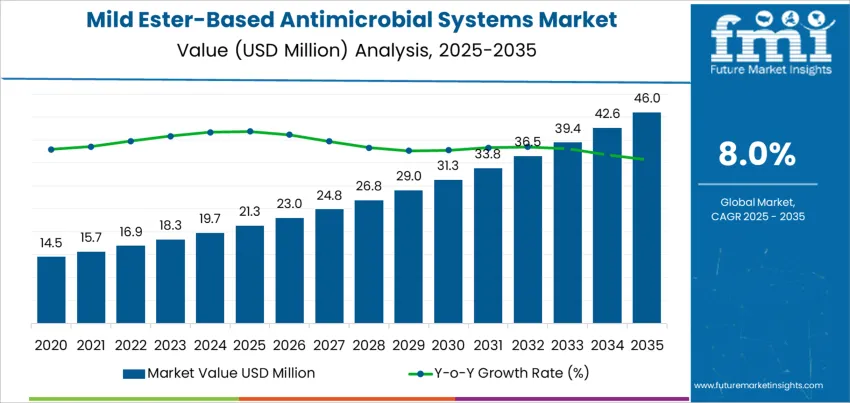
In 2025, the mild ester-based antimicrobial systems market is valued at USD 21.3 million and is projected to reach USD 46.0 million by 2035 at a CAGR of 8.0%. Early expansion is linked to rising use of low irritation antimicrobial agents in personal care, household hygiene, and surface disinfection products where conventional biocides face formulation constraints. Manufacturers favor ester-based systems for their compatibility with sensitive skin applications and lower sensory impact in leave-on formulations. Initial growth is concentrated in liquid and emulsion-based formats used in cleansers, wipes, and cosmetic preservation. Regulatory pressure on legacy preservatives also contributes to rising substitution with ester-based alternatives that meet updated safety and exposure standards.
From 2030 onward, market expansion accelerates as ester-based systems gain wider acceptance across institutional cleaning, healthcare hygiene, and professional personal care segments. Market value increases from about USD 31.3 million in 2030 toward USD 46.0 million by 2035 as demand shifts beyond preservation into broader antimicrobial performance roles. Product development emphasizes spectrum control, storage stability, and compatibility with surfactant systems. Growth is supported by higher use in baby care, facial care, and therapeutic skin products where microbial control must be balanced with barrier safety. Competitive activity centers on formulation blending, esterase resistance, and controlled release behavior to extend antimicrobial action without increasing user exposure.
Quick Stats of the Mild Ester-Based Antimicrobial Systems Market
- Mild Ester-Based Antimicrobial Systems Market Value (2025): USD 21.3 million
- Mild Ester-Based Antimicrobial Systems Market Forecast Value (2035): USD 46.0 million
- Mild Ester-Based Antimicrobial Systems Market Forecast CAGR (2025–2035): 8.0%
- Mild Ester-Based Antimicrobial Systems Market Leading End Use Application: Skin Care (10.1%)
- Mild Ester-Based Antimicrobial Systems Market Key Growth Regions: India, China, Japan, UK, Germany, USA
- Mild Ester-Based Antimicrobial Systems Market Top Players: BASF SE, Croda International, Evonik Industries, Symrise (incl. IFF/Givaudan actives), Dow / Dow Inc., Ashland, Clariant, Seppic, Lubrizol, Lonza, Inolex
What is the Growth Forecast for the Mild Ester-Based Antimicrobial Systems Market through 2035?
Global demand for mild ester-based antimicrobial systems expands from USD 21.3 million in 2025 to USD 23.0 million in 2026 and USD 24.8 million in 2027, reflecting early-stage scale-up driven by clean-label reformulation across food, personal care, and topical pharmaceutical applications. By 2030, the market reaches USD 29.0 million, adding USD 7.7 million from the 2025 base. This phase is driven by rising restrictions on harsh synthetic preservatives, growing sensitivity to skin and mucosal irritation, and wider adoption in leave-on cosmetics, wet wipes, and oral-care adjunct products. Growth follows a controlled incline because ester-based systems require formulation stability validation, compatibility testing, and regional regulatory clearance before mass deployment.
From 2030 to 2035, the global market expands from USD 29.0 million to USD 46.0 million, generating a larger USD 17.0 million in absolute growth within five years. This back-weighted acceleration reflects the transition of mild ester systems from premium niche solutions to baseline antimicrobial platforms in mainstream personal care, baby products, and sensitive-food preservation. Value density increases as multi-ester blends replace single-agent systems and as usage spreads into high-volume daily-use formats. As consumer tolerance thresholds, regulatory pressure, and microbiome-safe positioning converge, ester-based antimicrobials shift from optional differentiators to structural formulation components across multiple end-use industries.
Mild Ester Based Antimicrobial Systems Industry Key Takeaways
| Metric | Value |
|---|---|
| Industry Value (2025) | USD 21.3 million |
| Forecast Value (2035) | USD 46.0 million |
| Forecast CAGR (2025–2035) | 8.0% |
How Is the Global Mild Ester-Based Antimicrobial Systems Market Evolving?
The global market for mild ester-based antimicrobial systems emerged from increasing demand for preservative agents that balance efficacy with consumer safety and regulatory constraints. Traditional antimicrobials and preservatives often faced scrutiny for toxicity, allergenicity, or harsh chemical profiles. Ester-based antimicrobials such as esterified fatty acids or mild ester derivatives offered antimicrobial activity with lower irritation potential and better biodegradability. Food, beverage, cosmetic, and personal-care manufacturers began adopting these systems to meet stricter regulatory standards and rising consumer preference for gentle, “clean” preservative solutions. Early growth was driven by niche applications that demanded mild action such as skin care products, oral care formulations, and sensitive-content food items where conventional preservatives were problematic.
Going forward the mild ester-based antimicrobial market is likely to expand through formulation versatility and increasing regulatory pressure on conventional antimicrobials. As regulations tighten globally on traditional preservatives, ester-based systems provide a viable alternative that balances microbial control, safety, and formulation stability. Market growth will be supported by rising adoption in cosmetic, personal-care, baby-care, and functional foods segments demanding safety and low-irritation profiles. Further innovation in controlled-release ester systems, synergistic blends, and compatibility with natural and organic ingredient trends will broaden application scope. Barriers remain in demonstrating long-term efficacy, preserving sensory attributes (odour, taste), and establishing spectrum coverage equivalent to traditional preservatives. Success will depend on advancing formulation science and achieving regulatory harmonisation across regions.
How Are End Use Segments and Product Forms Structuring the Global Mild Ester Based Antimicrobial Systems Landscape?
Global demand for mild ester based antimicrobial systems is structured by end use application and product form, with consumption centered in East Asia, Western Europe, and North America. Skin care accounts for a 10.1% share, supported by sustained formulation activity in South Korea, Japan, France, Germany, and the USA. Body care, hair care, sun care, color cosmetics, men grooming, baby and kids care, and dermocosmetic or professional care follow across mass and regulated product categories. On the product form side, powders hold a 15.8% share alongside liquids, concentrates, dispersions, emulsions, gels, pastes, wax blocks, and oils. Selection trends reflect antimicrobial efficacy, formulation mildness, and compatibility with sensitive skin applications across regional cosmetic hubs.
Why Does Skin Care Lead End Use Demand in the Global Mild Ester Based Antimicrobial Systems Market?
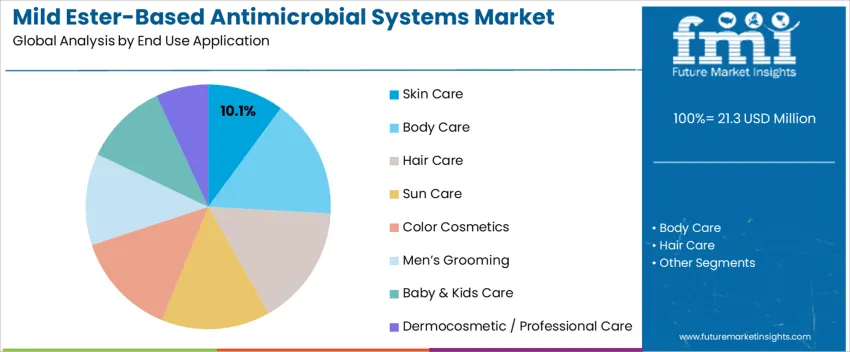
Skin care accounts for 10.1% of global mild ester based antimicrobial system usage due to rising integration of gentle preservation and antimicrobial protection in facial and leave on formulations. These systems are widely used to control microbial growth in creams, serums, cleansers, and post treatment recovery products without causing surface irritation. Demand is strongest in South Korea, Japan, Western Europe, and the USA, where microbiome safe and low irritation positioning has gained regulatory and commercial traction. Facial care products with extended shelf life and stabilized formulations continue to drive adoption at scale.
Skin care also shows higher antimicrobial loading per unit than rinse off categories. Dermocosmetic and professional brands rely on ester based systems to maintain microbial control in sensitive skin, acne care, and post procedure products. Stability testing standards in Europe and North America further reinforce use in regulated skin care categories. These formulation safety, testing, and performance driven factors sustain skin care as the leading global application for mild ester based antimicrobial systems.
Why Does Powder Form Dominate Product Positioning in the Global Mild Ester Based Antimicrobial Systems Market?
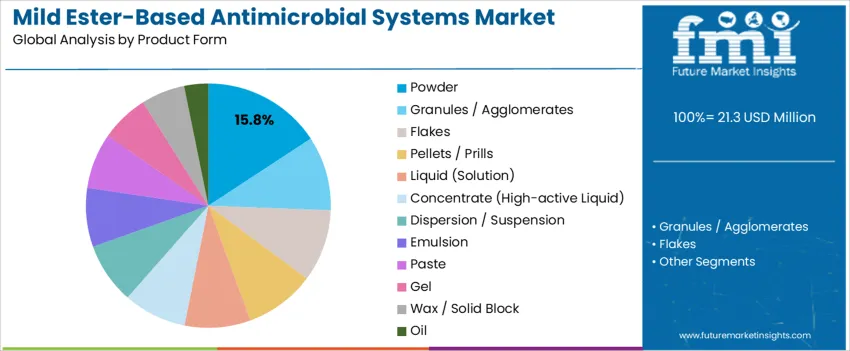
Powder form accounts for 15.8% of global mild ester based antimicrobial system demand due to superior shelf stability, reduced hydrolytic degradation risk, and consistent antimicrobial potency during storage. Powders allow precise dosing into emulsions, gels, and serums while preserving antimicrobial efficiency under extended production and warehousing conditions. Contract manufacturers across Asia, Europe, and North America favor powdered systems for repeatable batch performance and predictable dispersion across large scale cosmetic production.
Powder formats also improve logistics efficiency by lowering transport weight, minimizing leakage risk, and reducing reliance on temperature controlled shipping. Regulatory documentation and export handling for dry antimicrobial actives remain more standardized across international trade routes. Powders integrate smoothly with automated feeding and mixing equipment used in cosmetic manufacturing. These storage, processing, and compliance advantages position powder as the preferred global product form for mild ester based antimicrobial systems.
How Are Mild Ester Chemistries Repositioning Antimicrobial Performance Standards Worldwide?
Mild ester-based antimicrobials are redefining how microbial control is achieved in products that require both efficacy and biological tolerance. Unlike traditional aggressive biocides, ester systems act through membrane interaction and metabolic disruption without broad cellular destruction. This makes them suitable for applications where long-term exposure, skin contact, or microbiome stability matters. Their controlled hydrolysis behavior allows predictable activity windows rather than persistent residue. As regulatory and consumer pressure increases against harsh antimicrobial inputs, ester-based systems gain relevance as performance-balanced tools that emphasize compatibility over brute-force sterilization.
Why Are Personal Care, Food Processing, and Material Protection Converging on Ester-Based Systems?
Multiple industries now seek antimicrobial solutions that accomplish protection without sensory damage or biological stress. Personal care uses ester systems to control spoilage while maintaining skin barrier integrity. Food contact surfaces and packaging leverage esters for low-odor, low-migration microbial control. Polymer and textile producers adopt ester-based agents to prevent surface biofouling without altering mechanical properties. This convergence reflects shifting performance criteria where antimicrobial action must coexist with tactile comfort, nutritional safety, and material stability. Ester systems operate within this narrow functional window more effectively than conventional high-impact preservatives.
What Technical and Regulatory Frictions Limit Broad Substitution of Traditional Antimicrobials?
Ester-based antimicrobial systems face performance ceiling constraints in high-burden microbial environments where aggressive kill rates are still demanded. Their activity spectrum is often narrower than oxidizing or halogen-based systems. Hydrolysis sensitivity introduces formulation challenges across wide pH and temperature ranges. Regulatory frameworks still evaluate antimicrobials through legacy toxicity and kill-rate benchmarks, which can disadvantage milder chemistries. Cost pressure also limits adoption in low-margin product categories. These factors slow full replacement of traditional antimicrobial systems even as ester-based alternatives gain acceptance in controlled-contact applications.
How Is System Design Evolving Beyond Single-Function Antimicrobial Inputs?
The market is shifting from single-molecule ester inputs toward blended antimicrobial architectures that combine esters with organic acids, chelating agents, or bio-derived boosters. Controlled-release carriers and polymer-bound esters extend surface protection without continuous dosing. Product developers increasingly treat antimicrobial systems as part of full preservation and material-stability platforms rather than isolated ingredients. Digital monitoring of microbial load, spoilage response, and surface contamination is guiding system tuning. This evolution reflects a move toward engineered antimicrobial environments rather than dependence on single high-intensity chemical agents.
What is the Global Growth Outlook for the Mild Ester-Based Antimicrobial Systems Market by Country?
| Country | CAGR (%) |
|---|---|
| India | 10.8% |
| China | 10.0% |
| Japan | 9.2% |
| UK | 8.4% |
| Germany | 7.6% |
| USA | 6.8% |
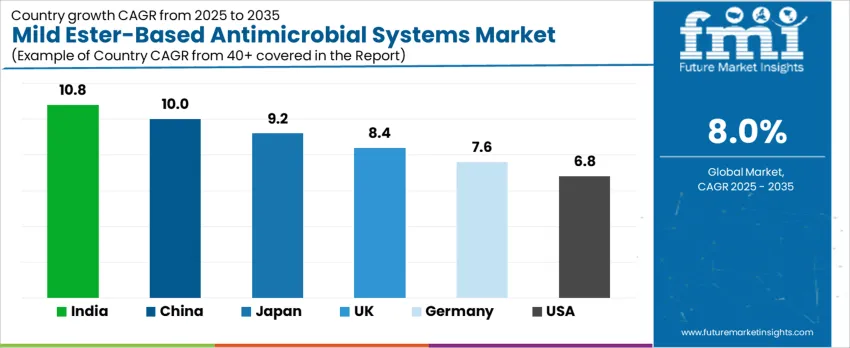
The global mild ester-based antimicrobial systems market is forecast to grow across all listed countries, with India leading at a 10.8% CAGR. Growth in India is driven by rising demand in food preservation, personal care, and hygiene products that require gentle but effective antimicrobial agents. China follows at 10.0%, supported by expanding industrial and consumer markets adopting antimicrobial systems for health, sanitation, and packaging uses. Japan at 9.2% reflects steady demand from cosmetics, food safety, and pharmaceutical segments. The UK (8.4%) and Germany (7.6%) show moderate growth, likely driven by regulatory emphasis on safer preservatives and growing clean-label product demand. The USA’s 6.8% CAGR suggests a mature but steadily expanding market for ester-based antimicrobial solutions.
Why Is India Emerging as a Strong Growth Center for Mild Ester Based Antimicrobial Systems?
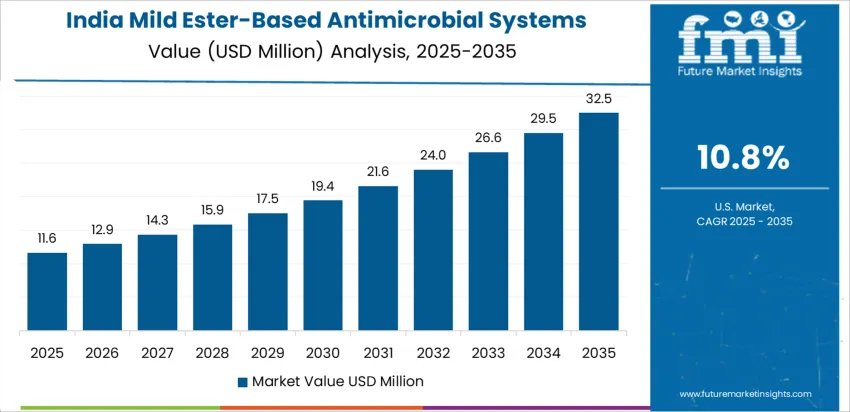
India records a CAGR of 10.8% through 2035 for mild ester based antimicrobial system growth, driven by rising hygiene awareness, packaged food expansion, and personal care manufacturing growth. Food processors adopt these systems for surface sanitation and shelf life control. Cosmetic and home care manufacturers integrate mild antimicrobials to meet skin safety and regulatory expectations. Pharmaceutical production also contributes steady demand for equipment and facility sanitation. Domestic chemical blending capability improves supply availability for mid sized manufacturers. Growth remains volume driven, aligned with mass market consumer product output and regulatory hygiene compliance.
- Packaged food processing drives sanitation demand growth
- Personal care manufacturing supports consistent formulation use
- Pharmaceutical facilities require routine hygiene control
- Domestic blending capability improves supply reach
What Is Powering Expansion of Mild Ester Based Antimicrobial Systems in China?
China posts a CAGR of 10.0% through 2035 for mild ester based antimicrobial system growth, supported by large scale personal care manufacturing, food packaging, and institutional sanitation demand. Skincare, wipes, and home disinfectant production generate steady formulation consumption. Food safety regulations encourage use of low toxicity antimicrobial solutions. Hospital hygiene programs and public sanitation services add stable volume demand. Domestic chemical producers scale ester synthesis to meet industrial needs. Growth tracks rising urban population density, packaged product output, and structured hygiene enforcement across large municipal regions.
- Personal care and wipes production anchors system demand
- Food safety rules support low toxicity antimicrobial adoption
- Hospital sanitation adds institutional volume flow
- Domestic ester synthesis capacity continues expansion
How Is Japan Sustaining Demand for Mild Ester Based Antimicrobial Systems?
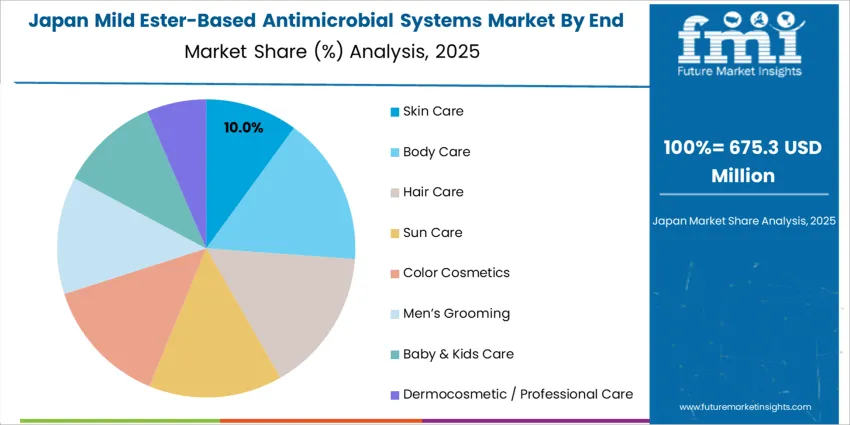
Japan reflects a CAGR of 9.2% through 2035 for mild ester based antimicrobial system growth, shaped by strict hygiene standards, advanced cosmetic manufacturing, and healthcare sanitation requirements. Skincare, baby care, and sensitive surface disinfectants favor mild antimicrobial chemistry. Pharmaceutical cleanroom sanitation and medical facility cleaning sustain institutional demand. Food processing plants maintain steady usage for equipment hygiene. Growth remains quality driven rather than volume driven, supported by formulation consistency and safety validation. Demand expansion relies on stable industrial output rather than rapid consumer market growth.
- Sensitive skincare formulations drive gentle antimicrobial use
- Medical facility sanitation sustains institutional demand
- Food equipment hygiene supports steady industrial usage
- Safety validation guides consistent formulation adoption
What Factors Are Supporting Growth of Mild Ester Based Antimicrobial Systems in the UK?
The UK records a CAGR of 8.4% through 2035 for mild ester based antimicrobial system growth, supported by rising clean label positioning, institutional hygiene programs, and home care product manufacturing. Household cleaners, surface sprays, and wipes represent major application segments. Regulatory focus on toxicity control shifts demand toward ester based actives. Public transportation sanitation and healthcare cleaning contribute steady consumption. Growth remains balanced between household and institutional usage. Demand expansion aligns with hygiene compliance rather than discretionary chemical consumption patterns across regional manufacturers and public service operators.
- Household surface cleaners anchor core product demand
- Toxicity regulations favor ester based active selection
- Public transport sanitation supports routine volume usage
- Healthcare cleaning adds steady institutional demand
Why Is Germany Experiencing Controlled Expansion of Mild Ester Based Antimicrobial Systems?
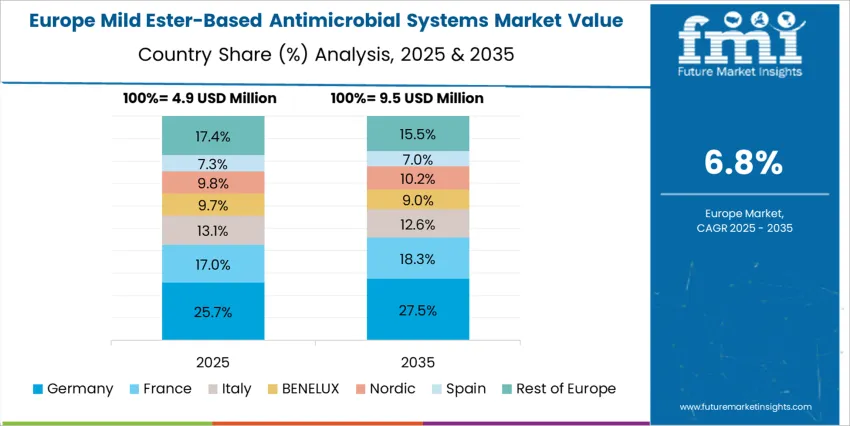
Germany shows a CAGR of 7.6% through 2035 for mild ester based antimicrobial system growth, supported by industrial hygiene, pharmaceutical manufacturing, and regulated cosmetic production. Cleanroom sanitation, surface disinfectants, and processing equipment hygiene remain core applications. Regulatory discipline encourages use of documented low risk antimicrobials. Institutional procurement dominates demand rather than retail driven consumption. Food processing plants maintain steady equipment sanitation cycles. Growth remains conservative and compliance oriented, guided by engineering standards, regulatory audits, and long term industrial production stability across health and manufacturing sectors.
- Pharmaceutical cleanroom sanitation drives consistent usage
- Regulated cosmetic production favors mild antimicrobial systems
- Food equipment hygiene sustains baseline industrial demand
- Institutional procurement governs purchasing behavior
How Is the USA Maintaining Moderate Growth in Mild Ester Based Antimicrobial Systems?
The USA records a CAGR of 6.8% through 2035 for mild ester based antimicrobial system growth, shaped by mature disinfectant markets, institutional hygiene standards, and consumer safety expectations. Home care wipes, surface cleaners, and personal hygiene products represent major volume outlets. Hospitals, foodservice facilities, and public buildings require routine sanitation using low irritation formulations. Direct to consumer brands adopt ester systems for clean ingredient positioning. Growth remains measured due to established chemical alternatives and pricing sensitivity across mass market cleaning product categories.
- Home care wipes and cleaners drive consumer market volume
- Hospitals and foodservice sustain institutional demand
- Clean ingredient positioning supports brand adoption
- Pricing sensitivity moderate’s rapid volume expansion
What Is Driving the Global Demand for Mild Ester Based Antimicrobial Systems and Who Are the Key Players Shaping the Industry?
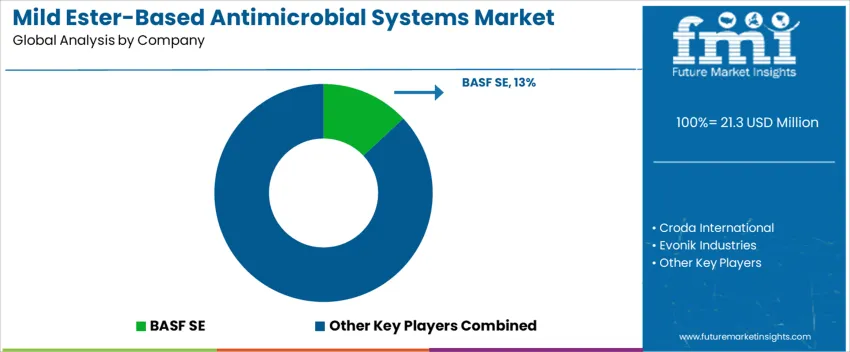
Global demand for mild ester based antimicrobial systems is rising because manufacturers across food, personal care, cosmetics, and water treatment seek effective yet gentle antimicrobial agents for sensitive applications. These ester based systems offer microbial control with low irritation potential and better compatibility with delicate formulations. Rising consumer preference for milder preservatives and clean-label claims in skin care, hygiene products, and processed foods fuels broader adoption. Expansion of global hygiene standards, stricter regulation of stronger antimicrobials, and growing demand in emerging markets all contribute. Advances in formulation science and increased use of natural derivative esters also support growth across diversified applications worldwide.
Major suppliers shaping this market include BASF SE, Croda International, Evonik Industries, Symrise (including IFF/Givaudan actives), Dow Inc., Ashland, Clariant, and specialist ingredient firms such as Seppic, Lubrizol, Lonza, and Inolex. BASF and Evonik lead globally with broad portfolios and scalable production capacity suited to industrial and consumer applications. Croda and Symrise focus on personal care and cosmetic segments where mildness and regulatory compliance are critical. Dow, Ashland, and Clariant supply mid range antimicrobial systems suited to food, hygiene, and household products. Specialist firms deliver tailored or niche ester based solutions for sensitive applications. This mix of global giants and niche players ensures supply diversity and drives innovation across regions and end uses.
Key Players in the Mild Ester Based Antimicrobial Systems
- BASF SE
- Croda International
- Evonik Industries
- Symrise (incl. IFF/Givaudan actives)
- Dow / Dow Inc.
- Ashland
- Clariant
- Seppic / Others (Seppic, Lubrizol, Lonza, Inolex etc.)
- Others
Scope of the Report
| Items | Values |
|---|---|
| Quantitative Units (2025) | USD million |
| End-Use Applications | Skin Care, Body Care, Hair Care, Sun Care, Color Cosmetics, Men’s Grooming, Baby & Kids Care, Dermocosmetic / Professional Care |
| Product Forms | Powder, Granules/Agglomerates, Flakes, Pellets/Prills, Liquid (Solution), Concentrate (High-active Liquid), Dispersion/Suspension, Emulsion, Paste, Gel, Wax / Solid Block, Oil |
| Regions Covered | East Asia, Europe, North America, South Asia, Latin America, Middle East & Africa, Eastern Europe |
| Countries Covered | China, Japan, South Korea, Taiwan, Germany, UK, France, Italy, USA, Canada, Mexico, India, Pakistan, Brazil, Argentina, Saudi Arabia, Russia, plus 40+ additional countries globally |
| Key Companies Profiled | BASF SE, Croda International, Evonik Industries, Symrise (incl. IFF/Givaudan actives), Dow Inc., Ashland, Clariant, Seppic, Lubrizol, Lonza, Inolex |
| Additional Attributes | Dollar-value breakdown by region, country, end-use, and product form, global growth projections, multi-sector adoption (personal care, hygiene, food, household cleaning), formulation mildness, antimicrobial efficacy, multi-ester and controlled-release systems, regulatory compliance, global supply chain coverage |
Mild Ester Based Antimicrobial Systems Segmentation
End Use Application:
- Skin Care
- Body Care
- Hair Care
- Sun Care
- Color Cosmetics
- Men’s Grooming
- Baby & Kids Care
- Dermocosmetic / Professional Care
Product Form:
- Powder
- Granules / Agglomerates
- Flakes
- Pellets / Prills
- Liquid (Solution)
- Concentrate (High-active Liquid)
- Dispersion / Suspension
- Emulsion
- Paste
- Gel
- Wax / Solid Block
- Oil
Region:
-
East Asia
- China
- Japan
- South Korea
- Taiwan
- Rest of East Asia
-
Europe
- Germany
- UK
- France
- Italy
- Spain
- Switzerland
- Nordic
- BENELUX
- Rest of Europe
-
North America
- USA
- Canada
- Mexico
-
South Asia
- India
- Pakistan
- Bangladesh
- Rest of South Asia
-
Latin America
- Brazil
- Argentina
- Chile
- Rest of Latin America
-
Middle East & Africa
- Kingdom of Saudi Arabia
- Other GCC Countries
- Turkey
- South Africa
- Other African Union
- Rest of Middle East & Africa
-
Eastern Europe
- Russia
- Poland
- Czech Republic
- Rest of Eastern Europe
Frequently Asked Questions
How big is the mild ester-based antimicrobial systems market in 2025?
The global mild ester-based antimicrobial systems market is estimated to be valued at USD 21.3 million in 2025.
What will be the size of mild ester-based antimicrobial systems market in 2035?
The market size for the mild ester-based antimicrobial systems market is projected to reach USD 46.0 million by 2035.
How much will be the mild ester-based antimicrobial systems market growth between 2025 and 2035?
The mild ester-based antimicrobial systems market is expected to grow at a 8.0% CAGR between 2025 and 2035.
What are the key product types in the mild ester-based antimicrobial systems market?
The key product types in mild ester-based antimicrobial systems market are skin care, body care, hair care, sun care, color cosmetics, men’s grooming, baby & kids care and dermocosmetic / professional care.
Which product form segment to contribute significant share in the mild ester-based antimicrobial systems market in 2025?
In terms of product form , powder segment to command 15.8% share in the mild ester-based antimicrobial systems market in 2025.
Preview the report firsthand - request a free sample
Get SampleGet the brochure for pricing and purchase details.
Get PDFTable of Content
- Executive Summary
- Global Market Outlook
- Demand-side Trends
- Supply-side Trends
- Technology Roadmap Analysis
- Analysis and Recommendations
- Market Overview
- Market Coverage / Taxonomy
- Market Definition / Scope / Limitations
- Market Background
- Market Dynamics
- Drivers
- Restraints
- Opportunity
- Trends
- Scenario Forecast
- Demand in Optimistic Scenario
- Demand in Likely Scenario
- Demand in Conservative Scenario
- Opportunity Map Analysis
- Product Life Cycle Analysis
- Supply Chain Analysis
- Investment Feasibility Matrix
- Value Chain Analysis
- PESTLE and Porter’s Analysis
- Regulatory Landscape
- Regional Parent Market Outlook
- Production and Consumption Statistics
- Import and Export Statistics
- Market Dynamics
- Global Market Analysis 2020 to 2024 and Forecast, 2025 to 2035
- Historical Market Size Value (USD Million) Analysis, 2020 to 2024
- Current and Future Market Size Value (USD Million) Projections, 2025 to 2035
- Y-o-Y Growth Trend Analysis
- Absolute $ Opportunity Analysis
- Global Market Pricing Analysis 2020 to 2024 and Forecast 2025 to 2035
- Global Market Analysis 2020 to 2024 and Forecast 2025 to 2035, By End Use Application
- Introduction / Key Findings
- Historical Market Size Value (USD Million) Analysis By End Use Application , 2020 to 2024
- Current and Future Market Size Value (USD Million) Analysis and Forecast By End Use Application , 2025 to 2035
- Skin Care
- Body Care
- Hair Care
- Sun Care
- Color Cosmetics
- Men’s Grooming
- Baby & Kids Care
- Dermocosmetic / Professional Care
- Y-o-Y Growth Trend Analysis By End Use Application , 2020 to 2024
- Absolute $ Opportunity Analysis By End Use Application , 2025 to 2035
- Global Market Analysis 2020 to 2024 and Forecast 2025 to 2035, By Product Form
- Introduction / Key Findings
- Historical Market Size Value (USD Million) Analysis By Product Form, 2020 to 2024
- Current and Future Market Size Value (USD Million) Analysis and Forecast By Product Form, 2025 to 2035
- Powder
- Granules / Agglomerates
- Flakes
- Pellets / Prills
- Liquid (Solution)
- Concentrate (High-active Liquid)
- Dispersion / Suspension
- Emulsion
- Paste
- Gel
- Wax / Solid Block
- Y-o-Y Growth Trend Analysis By Product Form, 2020 to 2024
- Absolute $ Opportunity Analysis By Product Form, 2025 to 2035
- Global Market Analysis 2020 to 2024 and Forecast 2025 to 2035, By Region
- Introduction
- Historical Market Size Value (USD Million) Analysis By Region, 2020 to 2024
- Current Market Size Value (USD Million) Analysis and Forecast By Region, 2025 to 2035
- North America
- Latin America
- Western Europe
- Eastern Europe
- East Asia
- South Asia and Pacific
- Middle East & Africa
- Market Attractiveness Analysis By Region
- North America Market Analysis 2020 to 2024 and Forecast 2025 to 2035, By Country
- Historical Market Size Value (USD Million) Trend Analysis By Market Taxonomy, 2020 to 2024
- Market Size Value (USD Million) Forecast By Market Taxonomy, 2025 to 2035
- By Country
- USA
- Canada
- Mexico
- By End Use Application
- By Product Form
- By Country
- Market Attractiveness Analysis
- By Country
- By End Use Application
- By Product Form
- Key Takeaways
- Latin America Market Analysis 2020 to 2024 and Forecast 2025 to 2035, By Country
- Historical Market Size Value (USD Million) Trend Analysis By Market Taxonomy, 2020 to 2024
- Market Size Value (USD Million) Forecast By Market Taxonomy, 2025 to 2035
- By Country
- Brazil
- Chile
- Rest of Latin America
- By End Use Application
- By Product Form
- By Country
- Market Attractiveness Analysis
- By Country
- By End Use Application
- By Product Form
- Key Takeaways
- Western Europe Market Analysis 2020 to 2024 and Forecast 2025 to 2035, By Country
- Historical Market Size Value (USD Million) Trend Analysis By Market Taxonomy, 2020 to 2024
- Market Size Value (USD Million) Forecast By Market Taxonomy, 2025 to 2035
- By Country
- Germany
- UK
- Italy
- Spain
- France
- Nordic
- BENELUX
- Rest of Western Europe
- By End Use Application
- By Product Form
- By Country
- Market Attractiveness Analysis
- By Country
- By End Use Application
- By Product Form
- Key Takeaways
- Eastern Europe Market Analysis 2020 to 2024 and Forecast 2025 to 2035, By Country
- Historical Market Size Value (USD Million) Trend Analysis By Market Taxonomy, 2020 to 2024
- Market Size Value (USD Million) Forecast By Market Taxonomy, 2025 to 2035
- By Country
- Russia
- Poland
- Hungary
- Balkan & Baltic
- Rest of Eastern Europe
- By End Use Application
- By Product Form
- By Country
- Market Attractiveness Analysis
- By Country
- By End Use Application
- By Product Form
- Key Takeaways
- East Asia Market Analysis 2020 to 2024 and Forecast 2025 to 2035, By Country
- Historical Market Size Value (USD Million) Trend Analysis By Market Taxonomy, 2020 to 2024
- Market Size Value (USD Million) Forecast By Market Taxonomy, 2025 to 2035
- By Country
- China
- Japan
- South Korea
- By End Use Application
- By Product Form
- By Country
- Market Attractiveness Analysis
- By Country
- By End Use Application
- By Product Form
- Key Takeaways
- South Asia and Pacific Market Analysis 2020 to 2024 and Forecast 2025 to 2035, By Country
- Historical Market Size Value (USD Million) Trend Analysis By Market Taxonomy, 2020 to 2024
- Market Size Value (USD Million) Forecast By Market Taxonomy, 2025 to 2035
- By Country
- India
- ASEAN
- Australia & New Zealand
- Rest of South Asia and Pacific
- By End Use Application
- By Product Form
- By Country
- Market Attractiveness Analysis
- By Country
- By End Use Application
- By Product Form
- Key Takeaways
- Middle East & Africa Market Analysis 2020 to 2024 and Forecast 2025 to 2035, By Country
- Historical Market Size Value (USD Million) Trend Analysis By Market Taxonomy, 2020 to 2024
- Market Size Value (USD Million) Forecast By Market Taxonomy, 2025 to 2035
- By Country
- Kingdom of Saudi Arabia
- Other GCC Countries
- Turkiye
- South Africa
- Other African Union
- Rest of Middle East & Africa
- By End Use Application
- By Product Form
- By Country
- Market Attractiveness Analysis
- By Country
- By End Use Application
- By Product Form
- Key Takeaways
- Key Countries Market Analysis
- USA
- Pricing Analysis
- Market Share Analysis, 2024
- By End Use Application
- By Product Form
- Canada
- Pricing Analysis
- Market Share Analysis, 2024
- By End Use Application
- By Product Form
- Mexico
- Pricing Analysis
- Market Share Analysis, 2024
- By End Use Application
- By Product Form
- Brazil
- Pricing Analysis
- Market Share Analysis, 2024
- By End Use Application
- By Product Form
- Chile
- Pricing Analysis
- Market Share Analysis, 2024
- By End Use Application
- By Product Form
- Germany
- Pricing Analysis
- Market Share Analysis, 2024
- By End Use Application
- By Product Form
- UK
- Pricing Analysis
- Market Share Analysis, 2024
- By End Use Application
- By Product Form
- Italy
- Pricing Analysis
- Market Share Analysis, 2024
- By End Use Application
- By Product Form
- Spain
- Pricing Analysis
- Market Share Analysis, 2024
- By End Use Application
- By Product Form
- France
- Pricing Analysis
- Market Share Analysis, 2024
- By End Use Application
- By Product Form
- India
- Pricing Analysis
- Market Share Analysis, 2024
- By End Use Application
- By Product Form
- ASEAN
- Pricing Analysis
- Market Share Analysis, 2024
- By End Use Application
- By Product Form
- Australia & New Zealand
- Pricing Analysis
- Market Share Analysis, 2024
- By End Use Application
- By Product Form
- China
- Pricing Analysis
- Market Share Analysis, 2024
- By End Use Application
- By Product Form
- Japan
- Pricing Analysis
- Market Share Analysis, 2024
- By End Use Application
- By Product Form
- South Korea
- Pricing Analysis
- Market Share Analysis, 2024
- By End Use Application
- By Product Form
- Russia
- Pricing Analysis
- Market Share Analysis, 2024
- By End Use Application
- By Product Form
- Poland
- Pricing Analysis
- Market Share Analysis, 2024
- By End Use Application
- By Product Form
- Hungary
- Pricing Analysis
- Market Share Analysis, 2024
- By End Use Application
- By Product Form
- Kingdom of Saudi Arabia
- Pricing Analysis
- Market Share Analysis, 2024
- By End Use Application
- By Product Form
- Turkiye
- Pricing Analysis
- Market Share Analysis, 2024
- By End Use Application
- By Product Form
- South Africa
- Pricing Analysis
- Market Share Analysis, 2024
- By End Use Application
- By Product Form
- USA
- Market Structure Analysis
- Competition Dashboard
- Competition Benchmarking
- Market Share Analysis of Top Players
- By Regional
- By End Use Application
- By Product Form
- Competition Analysis
- Competition Deep Dive
- BASF SE
- Overview
- Product Portfolio
- Profitability by Market Segments (Product/Age /Sales Channel/Region)
- Sales Footprint
- Strategy Overview
- Marketing Strategy
- Product Strategy
- Channel Strategy
- Croda International
- Evonik Industries
- Symrise (incl. IFF/Givaudan actives)
- Dow / Dow Inc.
- Ashland
- Clariant
- Seppic / Others (Seppic, Lubrizol, Lonza, Inolex etc.)
- Others
- BASF SE
- Competition Deep Dive
- Assumptions & Acronyms Used
- Research Methodology


