

- Industry Size (2026)
- USD 4.5 Bn
- Forecast (2036)
- USD 6.7 Bn
- CAGR (2026 to 2036)
- 4.1%
Newborn Jaundice Treatment Market Size, Market Forecast and Outlook By FMI
In 2025, the newborn jaundice treatment market was valued at USD 4.3 billion. It is expected to reach USD 4.5 billion in 2026 and USD 6.7 billion by 2036, implying a CAGR of 4.1%. This trajectory reflects a structural pivot where demand is driven less by rising birth rates and more by the clinical imperative to manage hyperbilirubinemia outside of high-cost NICU settings using specialized phototherapy equipment.
Growth is increasingly defined by a compliance-led retrofit cycle where updated clinical protocols, such as the 2025 Royal Cornwall Hospitals NHS Trust guideline updates, compel hospitals to replace legacy units with high-precision systems [3]. This shift is not merely cosmetic; it represents a hard operational gate where facilities must meet narrower spectral irradiance standards to minimize exchange transfusion risks, effectively rendering older installed bases obsolete. As protocols tighten, procurement teams are prioritizing neonatal and fetal monitors that integrate directly with therapeutic devices to streamline documentation.
Summary of Newborn Jaundice Treatment Market
- Newborn Jaundice Treatment Market Definition
- Covers devices and systems for managing neonatal hyperbilirubinemia via phototherapy and emerging adjunctive therapies.
- Demand Drivers in the Market
- Rising emphasis on preventing kernicterus through early detection.
- Shift toward home-based phototherapy to reduce hospital readmissions.
- Development of wearable devices that promote maternal bonding.
- Key Segments Analyzed in the FMI Report
- Overhead Phototherapy Units (58.7% share).
- Hospital Application (82.3% share).
- High-growth Asia Pacific versus replacement-led North America.
- Analyst Opinion at FMI
- Sabyasachi Ghosh, Principal Consultant for Healthcare at Future Market Insights, opines, "In the updated Newborn Jaundice Treatment Market Report for 2026 to 2036, vendors will find that the next growth frontier lies in integrating therapy with non-invasive diagnostics. My analysis suggests that as homecare gains traction, the ability to remotely monitor bilirubin levels while treating will become a decisive competitive advantage."
- Strategic Implications/Executive Takeaways
- Invest in wearable form factors to address the "kangaroo care" trend.
- Target emerging markets with ruggedized, battery-operable units.
- Secure FDA/CE compliance for home-use devices early.
- Methodology
- Validated through first-hand corporate production and capacity data.
- Zero reliance on speculative third-party market research reports.
- Based on verifiable industrial benchmarks and verified sources.
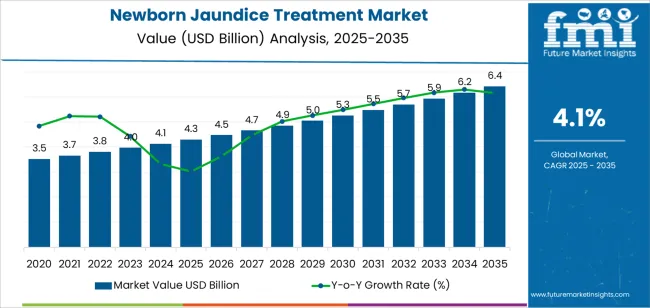
As per FMI's projection, the competitive landscape is consolidating around vendors who can bridge the hospital-to-home continuum. Chris Mathia, CEO of TheraB Medical, validated this strategic direction following the company's acquisition by Natus Sensory in February 2026: "This acquisition validates TheraB's mission to improve outcomes for infants diagnosed with neonatal jaundice, while Natus Sensory's global presence in the paediatric community enables broader access to SnugLit's innovative phototherapy across hospitals and clinical settings." [1] Consolidation allows incumbents to secure revenue streams from both acute care capital equipment and recurring homecare consumables, ensuring relevance as care shifts away from the bedside.
Global demand dispersion highlights distinct regional maturity curves, with China (5.5% CAGR) and India (5.1% CAGR) driving volume through infrastructure expansion, while Germany (4.7% CAGR), Brazil (4.3% CAGR), the USA (3.9% CAGR), the UK (3.5% CAGR), and Japan (3.1% CAGR) focus on optimizing replacement cycles and screening efficacy.
Newborn Jaundice Treatment Market Definition
The newborn jaundice treatment market encompasses the medical devices and therapeutic interventions used to manage hyperbilirubinemia in neonates. This includes phototherapy systems that utilize specific wavelengths of light (typically blue light at 460-490 nm) to convert unconjugated bilirubin into water-soluble isomers that can be excreted. The definition covers both intensive overhead units used in NICUs and wearable fiber-optic devices designed for maternity wards or home settings.
Newborn Jaundice Treatment Market Inclusions
This market includes hardware such as overhead LED arrays, bassinet-mounted systems, and flexible fiber-optic blankets (bili-blankets). It also covers essential accessories like eye protection masks (bili-masks) and radiometers used to verify irradiance levels. The scope extends to transcutaneous bilirubin analyzers when bundled with therapeutic contracts, as diagnostic screening is the primary trigger for treatment initiation.
Newborn Jaundice Treatment Market Exclusions
The market excludes pharmaceutical interventions unless they are direct pharmacological substitutes for phototherapy currently in commercial use. It also omits general infant care and baby care equipment such as standard incubators or warmers that do not have integrated phototherapy capabilities. Indirect costs associated with hospital stays, nursing labor, and general laboratory blood tests (serum bilirubin) are also outside the market valuation.
Newborn Jaundice Treatment Market Research Methodology
- Primary Research: Interviews with neonatologists, biomedical engineers, and procurement heads at Level III NICUs to understand device replacement cycles.
- Desk Research: Analysis of FDA 510(k) clearances, WHO neonatal mortality databases, and clinical guidelines from bodies like the AAP and NICE.
- Market-Sizing and Forecasting: A bottom-up approach aggregating phototherapy unit sales by region, adjusted for birth rates and jaundice incidence data.
- Data Validation and Update Cycle: Verification of vendor market shares against public financial disclosures and patent filing activities.
Segmental Analysis
Newborn Jaundice Treatment Market Analysis by Device Type
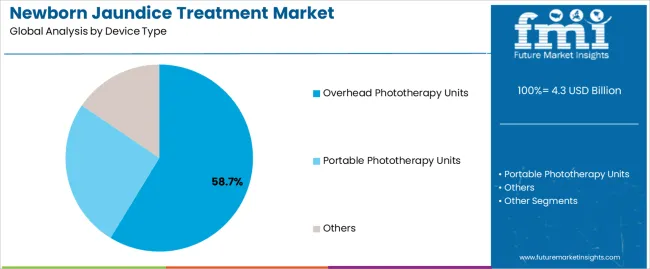
Overhead phototherapy units dominate the sector with a 58.7 percent market share in 2026, functioning as the standard of care for high-acuity cases in NICUs where intensive irradiance is non-negotiable. However, the portable segment is accelerating as hospitals seek to decouple jaundice management from expensive incubator occupancy.
- Clinical necessity: Demand for overhead units is reinforced by the critical need to treat severe hyperbilirubinemia (TSB>25 mg/dL), which occurs in approximately 1 out of 2,500 live births globally, requiring immediate high-intensity irradiance to prevent neurological damage [2].
- Form factor shift: Procurement shifts because clinicians are prioritizing devices that support breastfeeding, as interrupted nursing is a key barrier; this is evidenced by Natus Sensory's acquisition of TheraB Medical in February 2026 to secure the "SnugLit" wearable technology [1].
- Obsolescence cycle: Adoption accelerates where hospitals update protocols, such as the March 2025 Royal Cornwall Hospitals guidelines, which mandate stricter bilirubin thresholds and force the retirement of older, lower-irradiance halogen units [3].
Newborn Jaundice Treatment Market Analysis by Application
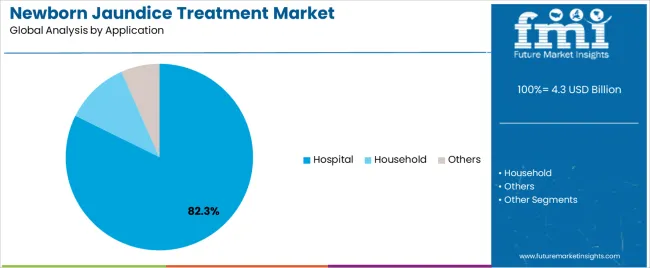
Hospitals account for 82.3 percent of the market value in 2026, serving as the central hub for screening and treating the 60 percent of term newborns who develop clinical jaundice. Despite this concentration, the household application segment is expanding as insurers and healthcare systems push for earlier discharge to alleviate bed capacity constraints.
- Clinical safety: Growth is anchored in the hospital sector's capability to manage high mortality risks, particularly in regions like China where neonatal jaundice causes 1,008 deaths per 100,000 babies in the early neonatal period [9].
- Discharge economics: FMI analysts opine that adoption of home-based phototherapy lamps accelerates as devices like the SnugLit receive FDA clearance (January 2026), allowing providers to prescribe phototherapy for home use and reduce readmission penalties [1].
- Maternal integration: Demand for home units is reinforced by the need to support breastfeeding continuity; in Germany, where exclusive breastfeeding drops from 86% at birth to 60% by month two, home-friendly wearable devices are becoming a critical tool to reverse this trend [10].
Newborn Jaundice Treatment Market Drivers, Restraints, and Opportunities
The primary demand driver is the global clinical mandate to prevent kernicterus, a devastating but preventable neurological condition caused by untreated severe jaundice. Hospitals are aggressively upgrading their new born screening equipment and treatment capabilities to align with stricter guidelines, such as the 2025 Royal Cornwall Hospitals NHS Trust updates [3]. This regulatory pressure forces healthcare facilities to adopt high-precision LED phototherapy devices that can deliver intensive irradiance, ensuring that bilirubin levels are managed effectively before permanent damage occurs. The direct link between device performance and patient safety effectively mandates a continuous replacement cycle for obsolete halogen-based equipment.
A significant restraint is the logistical and financial barrier to accessing phototherapy in low-resource settings. In many emerging economies, the lack of reliable electricity and skilled maintenance personnel limits the utility of advanced overhead units, leaving a gap in care for the estimated 500,000 newborns who develop extreme hyperbilirubinemia annually in these regions [7]. To mitigate this, manufacturers are exploring battery-operated and ruggedized designs, but the high upfront cost of medical-grade LEDs remains a hurdle for widespread procurement in rural clinics.
- Wearable Therapeutics: Manufacturers can capture premium value by developing "swaddle-like" devices that allow treatment during breastfeeding. This opportunity is exemplified by Natus Sensory's acquisition of TheraB Medical in February 2026 to scale the SnugLit wearable device, addressing the drop-off in breastfeeding rates associated with traditional isolation phototherapy [1].
- Nanotechnology Integration: Research institutes have the opportunity to disrupt the hardware monopoly by introducing pharmacological alternatives. S.N. Bose National Centre in India is pioneering manganese-based nanoparticles that degrade bilirubin in-vivo, potentially offering a "nimbupaani-like" oral therapy that could bypass the need for electricity-dependent equipment [5].
- AI-Enhanced Diagnostics: There is an opportunity to bundle phototherapy with non-invasive jaundice detector algorithms. Integrating transcutaneous screening data directly into home-treatment devices could streamline the 30-40% of cases where visual inspection fails to accurately gauge severity, reducing unnecessary hospital readmissions [2].
Regional Analysis
Based on the regional analysis, the newborn jaundice treatment market is segmented into North America, Latin America, Europe, East Asia, South Asia, Oceania and Middle East & Africa across 40+ countries. The full report also offers market attractiveness analysis based on regional trends.
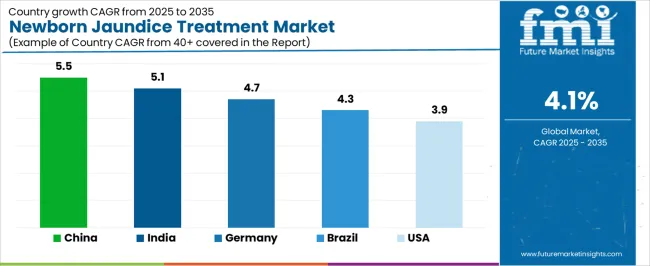
| Country | CAGR (2026 to 2036) |
|---|---|
| China | 5.5% |
| India | 5.1% |
| Germany | 4.7% |
| Brazil | 4.3% |
| USA | 3.9% |
| UK | 3.5% |
| Japan | 3.1% |
Source: Future Market Insights (FMI) analysis, based on proprietary forecasting model and primary research
Asia Pacific Newborn Jaundice Treatment Market Analysis
Asia Pacific serves as the global volume engine, driven by high birth rates and a genetic predisposition to hyperbilirubinemia in certain populations. The region's market dynamics are shaped by a dual need: expanding basic access in rural areas while upgrading metropolitan NICUs with advanced LED systems to prevent spasticity treatment costs associated with kernicterus. According to FMI's estimates, government-led infrastructure projects in China and India are rapidly closing the equipment gap, creating a robust environment for both domestic value-tier manufacturers and global premium brands.
- China: The outlook for newborn jaundice treatment in China indicates a 5.5% CAGR from 2026 to 2036 as research linking jaundice to hearing loss drives mandatory screening and early intervention programs [6]. This trajectory is supported by clinical data showing that neonatal jaundice is a risk factor in 32.8% of identified hearing loss cases, prompting hospitals to invest in integrated phototherapy and audiology screening workflows [6].
- India: Growth in newborn jaundice treatment across India is estimated at 5.1% CAGR through 2036, driven by high clinical loads where 74% of studied newborns required phototherapy interventions [9]. This demand shift is reflected in the pursuit of novel therapeutic alternatives, such as the S.N. Bose Centre's development of nanoparticle-based treatments to alleviate the burden on overcrowded phototherapy units [5].
- Japan: Japan's newborn jaundice treatment landscape is forecast to expand at 3.1% CAGR through 2036, as declining birth rates force a pivot toward high-precision management of complex cases like biliary atresia [6, 1]. Demand is reinforced by the expansion of the Japanese Biliary Atresia Registry in 2025, which tracks outcomes for thousands of patients and drives the adoption of specialized support equipment in pediatric hepatology centers [1].
FMI’s report includes a detailed growth analysis for South Korea, Indonesia, and Australia. In South Korea, the focus is shifting toward integrating neonatal and fetal monitors with phototherapy to manage preterm complications in a low-fertility environment. Indonesia presents a significant opportunity for ruggedized, portable units suitable for archipelago logistics, while Australia continues to lead in adopting at-home testing models coupled with tele-phototherapy [9].
North America Newborn Jaundice Treatment Market Analysis
North America remains a value-driven market characterized by high regulatory barriers and a strong preference for technologies that minimize hospital stays. The region's 1.8% growth profile masks a significant internal churn as hospitals replace older devices with FDA-cleared, home-use compatible systems. FMI analysts opine that the widespread prevalence of jaundice, affecting 3 in 5 babies in the USA, ensures a steady baseline demand for screening and treatment solutions, even as birth rates plateau [4].
- USA: In the USA, the newborn jaundice treatment market is forecast to advance at 3.9% CAGR through 2036, with growth anchored in universal screening mandates that require evaluation within the first 72 hours of life [4]. This compliance-driven environment was further validated when Natus Sensory acquired TheraB Medical in February 2026 to capture the growing market for FDA-cleared wearable phototherapy devices [1].
FMI’s report includes coverage of Canada and Mexico, identifying distinct growth vectors in each. Canada is prioritizing remote health initiatives to serve vast rural territories, creating demand for at-home testing kits coupled with phototherapy rentals. Mexico offers volume growth potential as public health insurance reforms expand access to phototherapy lamps and units for aesthetic medicine and neonatal care in state-run hospitals [2].
Europe Newborn Jaundice Treatment Market Analysis
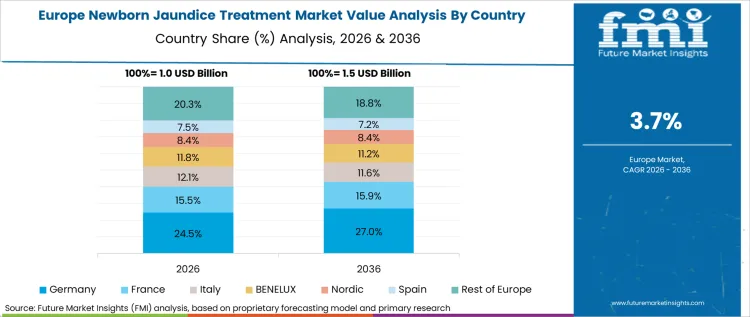
Europe acts as the global standard-setter for clinical safety, with strict guidelines governing phototherapy thresholds and device irradiance. The market is driven by replacement cycles rather than capacity expansion, with a strong emphasis on "neuro-protective" care that minimizes family separation. High breastfeeding rates in countries like Germany and the UK create specific demand for ergonomic devices that do not interrupt lactation [10].
- Germany: The Germany newborn jaundice treatment sector is poised to expand at 4.7% CAGR during 2026 to 2036 because interruptions in breastfeeding due to phototherapy remain a critical pain point for 60% of mothers [10]. This drives procurement of "bili-blankets" that allow skin-to-skin contact, directly addressing the drop in exclusive breastfeeding rates observed in the first two months of life [10].
- UK: Growth tracks a CAGR of 3.5% as the NHS enforces updated NICE guidelines to maintain kernicterus rates below 1 in 100,000 live births through rigorous screening and timely treatment [8]. This trajectory is supported by the Royal Cornwall Hospitals NHS Trust's March 2025 guideline update, which mandates precise visual and device-based checks, sustaining demand for high-quality phototherapy hardware in maternity units [3].
FMI’s report includes analysis of France, Italy, and Spain, where healthcare systems are similarly grappling with cost-containment pressures. France is seeing a rise in ambulatory care models for neonatal jaundice, while Italy focuses on upgrading regional centers to handle antibiotic resistant infections treatment alongside standard neonatal care.
Latin America Newborn Jaundice Treatment Market Analysis
Latin America serves as a critical emerging market where public health initiatives struggle against disparate resource allocation. The market is defined by the need for cost-effective solutions that can handle high patient volumes in urban centers while surviving infrastructure challenges in rural zones. Prevalence rates remain high, necessitating robust investment in basic phototherapy capacity.
- Brazil: Brazil is likely to see newborn jaundice treatment revenues increase at 4.3% CAGR during 2026 to 2036, given a 17.9% mother-reported prevalence rate that strains public health resources [7]. This expansion is tied to research linking late pregnancy complications to higher jaundice risk, prompting state-level investments in neonatal intensive care infrastructure to manage morbidity [7].
FMI’s report includes Argentina, Chile, and Colombia as key markets to watch. Argentina is witnessing a push for domestic manufacturing of medical devices to counter currency volatility. Chile has adopted advanced screening protocols similar to OECD standards, driving demand for premium north america and europe phototherapy treatment units [1].
Competitive Aligners for Market Players
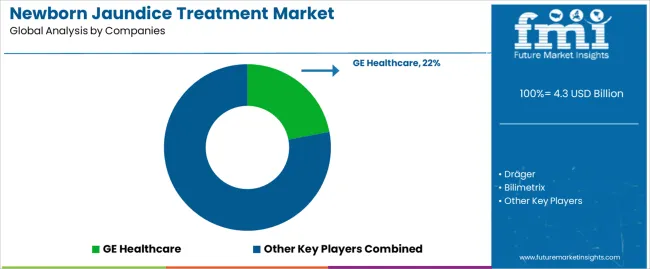
The market structure remains consolidated at the top, with players like GE HealthCare and Dräger maintaining dominance through established hospital contracts and broad infant care portfolios. However, the competitive boundary is blurring as specialized entrants like TheraB Medical disrupt the status quo with wearable form factors that appeal to parents and outpatient providers. This forces incumbents to either acquire innovation, as seen with Natus, or accelerate internal R&D to prevent market share erosion in the homecare segment.
Operational resilience is becoming a key differentiator, particularly for suppliers targeting emerging markets. Companies that can demonstrate robust supply chains and regulatory agility, navigating FDA 510(k), CE Mark, and local certifications simultaneously, are better positioned to capture growth in high-volume regions like China and India. The shift toward LED technology has leveled the playing field regarding hardware durability, making service, training, and clinical education the new battlegrounds for vendor loyalty.
Strategic pricing models are evolving from pure capex sales to "device-as-a-service" contracts, especially in the homecare application. By bundling phototherapy units with bilirubin analyzers and remote monitoring software, manufacturers can lock in recurring revenue and offer hospitals a seamless discharge solution. This approach aligns with payer incentives to reduce length of stay, creating a win-win scenario that traditional hardware-only sales models cannot match.
Recent Developments
The report includes full coverage of key trends from competitive benchmarking. Some of the recent developments covered in the reports:
- In February 2026, Natus Sensory acquired TheraB Medical with the aim to integrate the SnugLit wearable phototherapy device into its global pediatric portfolio, positioning the company to capture the expanding homecare segment [1].
- In March 2025, Royal Cornwall Hospitals NHS Trust issued updated V4.3 clinical guidelines dictating that transcutaneous bilirubin measurements over 250 micromol/l require immediate escalation to serum blood testing, influencing device procurement protocols [3].
Key Players in Newborn Jaundice Treatment Market
- GE HealthCare Technologies
- Dräger
- Bilimetrix
- Koninklijke Philips N.V.
- Atom Medical
- Nice Neotech
- Natus Medical
- TheraB Medical
- Phoenix Medical Systems
- Ibis Medical
Scope of the Report
| Metric | Value |
|---|---|
| Quantitative Units | USD 4.5 billion (2026) to USD 6.7 billion (2036), at a CAGR of 4.1% |
| Market Definition | The newborn jaundice treatment market encompasses devices and systems, primarily phototherapy units, used to manage hyperbilirubinemia in neonates to prevent kernicterus and associated morbidities. |
| Device Type Segmentation | Overhead Phototherapy Units, Portable Phototherapy Units, Others |
| Application Segmentation | Hospital, Household, Others |
| Application Coverage | Neonatal Jaundice Management, Hyperbilirubinemia Treatment, Kernicterus Prevention |
| Regions Covered | North America, Latin America, Europe, East Asia, South Asia, Oceania, Middle East and Africa |
| Countries Covered | United States, Canada, Mexico, Brazil, Argentina, Germany, France, United Kingdom, Italy, Spain, China, India, Japan, South Korea, Indonesia, Australia and 40 plus countries |
| Key Companies Profiled | GE HealthCare Technologies, Dräger, Bilimetrix, Koninklijke Philips N.V., Atom Medical, Nice Neotech, Natus Medical |
| Forecast Period | 2026 to 2036 |
| Approach | Hybrid top down and bottom up market modeling validated through primary interviews with neonatologists and procurement managers, supported by trade data benchmarking and hospital capacity verification |
Newborn Jaundice Treatment Market Analysis by Segments
Device Type:
- Overhead Phototherapy Units
- Portable Phototherapy Units
- Others
Application:
- Hospital
- Household
- Others
Region:
- Asia Pacific
- India
- China
- Japan
- South Korea
- Indonesia
- Australia & New Zealand
- ASEAN
- Rest of Asia Pacific
- Europe
- Germany
- Italy
- France
- United Kingdom
- Spain
- Benelux
- Nordics
- Central & Eastern Europe
- Rest of Europe
- North America
- United States
- Canada
- Mexico
- Latin America
- Brazil
- Argentina
- Chile
- Rest of Latin America
- Middle East & Africa
- Kingdom of Saudi Arabia
- United Arab Emirates
- South Africa
- Turkey
- Rest of Middle East & Africa
Bibliography
- [1] Medical Device Network. (2026). Natus Sensory acquires TheraB Medical. Medical Device Network.
- [2] NCBI. (2024). Neonatal Jaundice. National Center for Biotechnology Information.
- [3] Royal Cornwall Hospitals NHS Trust. (2025). Neonatal Jaundice in the First Two Weeks of Life Clinical Guideline. NHS.
- [4] March of Dimes. (2024). Newborn Jaundice. March of Dimes.
- [5] India Science and Technology. (2024). Jaundice in new born: Potential new therapy from India. Department of Science & Technology.
- [6] PLOS One. (2025). Analysis of risk factors for hearing loss in neonates: A study in Luzhou, China. PLOS One.
- [7] SciELO. (2024). Prevalence of newborn jaundice and associated factors in Bahia, Brazil. Revista da Associação Médica Brasileira.
- [8] NHS. (2025). Neonatal Jaundice. North Tees and Hartlepool NHS Foundation Trust.
- [9] PMC. (2025). Evaluation of cord blood albumin and bilirubin in prediction of neonatal jaundice. PubMed Central.
- [10] LMU Munich. (2024). Prolonged jaundice in a premature breastfed infant. Ludwig Maximilian University of Munich.
This bibliography is provided for reader reference and is not exhaustive. The full report contains the complete reference list and detailed citations.
This Report Addresses
- Market intelligence to enable structured strategic decision making across mature and emerging neonatal care economies
- Market size estimation and 10 year revenue forecasts from 2026 to 2036, supported by validated hospital admission and birth rate benchmarks
- Growth opportunity mapping across overhead and portable device forms with emphasis on homecare transitions
- Segment and regional revenue forecasts covering hospital, household, and other application settings
- Competition strategy assessment including M&A impact, cost survivability positioning, and regulatory compliance capability
- Product reformulation and clinical trend tracking including LED transition, wearable designs, and updated phototherapy guidelines
- Regulatory impact analysis covering FDA clearances, NICE guidelines, and emerging market screening mandates
- Market report delivery in PDF, Excel, PPT, and interactive dashboard formats for executive and operational use
Frequently Asked Questions
How large is the demand for Newborn Jaundice Treatment in the global market in 2026?
Demand for Newborn Jaundice Treatment in the global market is estimated to be valued at USD 4.5 billion in 2026.
What will be the market size of Newborn Jaundice Treatment in the global market by 2036?
Market size for Newborn Jaundice Treatment is projected to reach USD 6.7 billion by 2036.
What is the expected demand growth for Newborn Jaundice Treatment in the global market between 2026 and 2036?
Demand for Newborn Jaundice Treatment in the global market is expected to grow at a CAGR of 4.1% between 2026 and 2036.
Which Device Type is poised to lead global sales by 2026?
Overhead Phototherapy Units are expected to be the dominant form, capturing approximately 58.7% of global market share in 2026 due to their standard use in NICUs.
How significant is the role of Hospital Application in driving Newborn Jaundice Treatment adoption in 2026?
Hospital settings represent a critical segment, projected to hold a substantial 82.3% share of the total market in 2026 as the primary point of care for severe cases.
What is driving demand in China?
Demand is driven by government mandates for hearing loss screening, which have identified jaundice as a key risk factor, necessitating robust treatment infrastructure.
What compliance standards or regulations are referenced for the United States?
FDA clearances and AAP guidelines regarding hyperbilirubinemia management are referenced as key compliance benchmarks.
What is the China growth outlook in this report?
China is projected to grow at a CAGR of 5.5% during 2026 to 2036.
Why is Asia Pacific described as a priority region in this report?
Asia Pacific is a priority due to high birth rates and increasing healthcare expenditure, driving the modernization of neonatal care facilities.
What type of demand dominates in Europe?
Replacement driven demand for high-compliance, baby-friendly devices dominates regional consumption.
What is India growth outlook in this report?
India is projected to expand at a CAGR of 5.1% during 2026 to 2036.
Does the report cover Japan in its regional analysis?
Yes, Japan is included within East Asia under the regional scope of analysis.
What are the sources referred to for analyzing Japan?
Clinical registry data from the Japanese Biliary Atresia Society and medical device market reports are cited.
What is the main demand theme linked to Japan in its region coverage?
Demand is associated with managing complex cases amidst a declining birth rate, favoring high-precision equipment.
Does the report cover Brazil in its regional analysis?
Yes, Brazil is included within Latin America under the regional coverage framework.
What is the main Brazil related demand theme in its region coverage?
Demand is driven by high prevalence rates and public health efforts to reduce neonatal morbidity in state hospitals.
Which product formats or configurations are strategically important for North America supply chains?
Wearable and portable phototherapy units are prioritized due to the shift toward home-based care and early discharge protocols.
What is Newborn Jaundice Treatment and what is it mainly used for?
Newborn jaundice treatment involves using phototherapy devices to break down excess bilirubin in neonates, preventing neurological damage.
What does Newborn Jaundice Treatment mean in this report?
It refers to the global market for phototherapy devices and related equipment used to treat neonatal hyperbilirubinemia.
What is included in the scope of this Newborn Jaundice Treatment report?
The scope covers phototherapy units, accessories like eye masks, and associated monitoring tools for hospital and home use.
What is excluded from the scope of this report?
Pharmaceuticals (unless direct substitutes), general infant incubators without phototherapy, and hospital service fees are excluded.
What does market forecast mean on this page?
Market forecast represents a model based projection built on defined assumptions for strategic planning purposes.
How does FMI build and validate the Newborn Jaundice Treatment forecast?
Forecast is developed using hybrid top down and bottom up modeling validated through primary interviews and trade data benchmarking.
What does zero reliance on speculative third party market research mean here?
Primary interviews and verifiable public datasets are used instead of unverified syndicated market estimates.
Preview the report firsthand - request a free sample
Get SampleGet the brochure for pricing and purchase details.
Get PDFTable of Content
- Executive Summary
- Global Market Outlook
- Demand-side Trends
- Supply-side Trends
- Technology Roadmap Analysis
- Analysis and Recommendations
- Market Overview
- Market Coverage / Taxonomy
- Market Definition / Scope / Limitations
- Research Methodology
- Chapter Orientation
- Analytical Lens and Working Hypotheses
- Market Structure, Signals, and Trend Drivers
- Benchmarking and Cross-market Comparability
- Market Sizing, Forecasting, and Opportunity Mapping
- Research Design and Evidence Framework
- Desk Research Programme (Secondary Evidence)
- Company Annual and Sustainability Reports
- Peer-reviewed Journals and Academic Literature
- Corporate Websites, Product Literature, and Technical Notes
- Earnings Decks and Investor Briefings
- Statutory Filings and Regulatory Disclosures
- Technical White Papers and Standards Notes
- Trade Journals, Industry Magazines, and Analyst Briefs
- Conference Proceedings, Webinars, and Seminar Materials
- Government Statistics Portals and Public Data Releases
- Press Releases and Reputable Media Coverage
- Specialist Newsletters and Curated Briefings
- Sector Databases and Reference Repositories
- FMI Internal Proprietary Databases and Historical Market Datasets
- Subscription Datasets and Paid Sources
- Social Channels, Communities, and Digital Listening Inputs
- Additional Desk Sources
- Expert Input and Fieldwork (Primary Evidence)
- Primary Modes
- Qualitative Interviews and Expert Elicitation
- Quantitative Surveys and Structured Data Capture
- Blended Approach
- Why Primary Evidence is Used
- Field Techniques
- Interviews
- Surveys
- Focus Groups
- Observational and In-context Research
- Social and Community Interactions
- Stakeholder Universe Engaged
- C-suite Leaders
- Board Members
- Presidents and Vice Presidents
- R&D and Innovation Heads
- Technical Specialists
- Domain Subject-matter Experts
- Scientists
- Physicians and Other Healthcare Professionals
- Governance, Ethics, and Data Stewardship
- Research Ethics
- Data Integrity and Handling
- Primary Modes
- Tooling, Models, and Reference Databases
- Desk Research Programme (Secondary Evidence)
- Data Engineering and Model Build
- Data Acquisition and Ingestion
- Cleaning, Normalisation, and Verification
- Synthesis, Triangulation, and Analysis
- Quality Assurance and Audit Trail
- Market Background
- Market Dynamics
- Drivers
- Restraints
- Opportunity
- Trends
- Scenario Forecast
- Demand in Optimistic Scenario
- Demand in Likely Scenario
- Demand in Conservative Scenario
- Opportunity Map Analysis
- Product Life Cycle Analysis
- Supply Chain Analysis
- Investment Feasibility Matrix
- Value Chain Analysis
- PESTLE and Porter’s Analysis
- Regulatory Landscape
- Regional Parent Market Outlook
- Production and Consumption Statistics
- Import and Export Statistics
- Market Dynamics
- Global Market Analysis 2021 to 2025 and Forecast, 2026 to 2036
- Historical Market Size Value (USD Million) Analysis, 2021 to 2025
- Current and Future Market Size Value (USD Million) Projections, 2026 to 2036
- Y-o-Y Growth Trend Analysis
- Absolute $ Opportunity Analysis
- Global Market Pricing Analysis 2021 to 2025 and Forecast 2026 to 2036
- Global Market Analysis 2021 to 2025 and Forecast 2026 to 2036, By Device Type
- Introduction / Key Findings
- Historical Market Size Value (USD Million) Analysis By Device Type , 2021 to 2025
- Current and Future Market Size Value (USD Million) Analysis and Forecast By Device Type , 2026 to 2036
- Overhead Phototherapy Value (USD Million)s
- Portable Phototherapy Value (USD Million)s
- Others
- Overhead Phototherapy Value (USD Million)s
- Y-o-Y Growth Trend Analysis By Device Type , 2021 to 2025
- Absolute $ Opportunity Analysis By Device Type , 2026 to 2036
- Global Market Analysis 2021 to 2025 and Forecast 2026 to 2036, By Application
- Introduction / Key Findings
- Historical Market Size Value (USD Million) Analysis By Application, 2021 to 2025
- Current and Future Market Size Value (USD Million) Analysis and Forecast By Application, 2026 to 2036
- Hospital
- Household
- Others
- Hospital
- Y-o-Y Growth Trend Analysis By Application, 2021 to 2025
- Absolute $ Opportunity Analysis By Application, 2026 to 2036
- Global Market Analysis 2021 to 2025 and Forecast 2026 to 2036, By Region
- Introduction
- Historical Market Size Value (USD Million) Analysis By Region, 2021 to 2025
- Current Market Size Value (USD Million) Analysis and Forecast By Region, 2026 to 2036
- North America
- Latin America
- Western Europe
- Eastern Europe
- East Asia
- South Asia and Pacific
- Middle East & Africa
- Market Attractiveness Analysis By Region
- North America Market Analysis 2021 to 2025 and Forecast 2026 to 2036, By Country
- Historical Market Size Value (USD Million) Trend Analysis By Market Taxonomy, 2021 to 2025
- Market Size Value (USD Million) Forecast By Market Taxonomy, 2026 to 2036
- By Country
- USA
- Canada
- Mexico
- By Device Type
- By Application
- By Country
- Market Attractiveness Analysis
- By Country
- By Device Type
- By Application
- Key Takeaways
- Latin America Market Analysis 2021 to 2025 and Forecast 2026 to 2036, By Country
- Historical Market Size Value (USD Million) Trend Analysis By Market Taxonomy, 2021 to 2025
- Market Size Value (USD Million) Forecast By Market Taxonomy, 2026 to 2036
- By Country
- Brazil
- Chile
- Rest of Latin America
- By Device Type
- By Application
- By Country
- Market Attractiveness Analysis
- By Country
- By Device Type
- By Application
- Key Takeaways
- Western Europe Market Analysis 2021 to 2025 and Forecast 2026 to 2036, By Country
- Historical Market Size Value (USD Million) Trend Analysis By Market Taxonomy, 2021 to 2025
- Market Size Value (USD Million) Forecast By Market Taxonomy, 2026 to 2036
- By Country
- Germany
- UK
- Italy
- Spain
- France
- Nordic
- BENELUX
- Rest of Western Europe
- By Device Type
- By Application
- By Country
- Market Attractiveness Analysis
- By Country
- By Device Type
- By Application
- Key Takeaways
- Eastern Europe Market Analysis 2021 to 2025 and Forecast 2026 to 2036, By Country
- Historical Market Size Value (USD Million) Trend Analysis By Market Taxonomy, 2021 to 2025
- Market Size Value (USD Million) Forecast By Market Taxonomy, 2026 to 2036
- By Country
- Russia
- Poland
- Hungary
- Balkan & Baltic
- Rest of Eastern Europe
- By Device Type
- By Application
- By Country
- Market Attractiveness Analysis
- By Country
- By Device Type
- By Application
- Key Takeaways
- East Asia Market Analysis 2021 to 2025 and Forecast 2026 to 2036, By Country
- Historical Market Size Value (USD Million) Trend Analysis By Market Taxonomy, 2021 to 2025
- Market Size Value (USD Million) Forecast By Market Taxonomy, 2026 to 2036
- By Country
- China
- Japan
- South Korea
- By Device Type
- By Application
- By Country
- Market Attractiveness Analysis
- By Country
- By Device Type
- By Application
- Key Takeaways
- South Asia and Pacific Market Analysis 2021 to 2025 and Forecast 2026 to 2036, By Country
- Historical Market Size Value (USD Million) Trend Analysis By Market Taxonomy, 2021 to 2025
- Market Size Value (USD Million) Forecast By Market Taxonomy, 2026 to 2036
- By Country
- India
- ASEAN
- Australia & New Zealand
- Rest of South Asia and Pacific
- By Device Type
- By Application
- By Country
- Market Attractiveness Analysis
- By Country
- By Device Type
- By Application
- Key Takeaways
- Middle East & Africa Market Analysis 2021 to 2025 and Forecast 2026 to 2036, By Country
- Historical Market Size Value (USD Million) Trend Analysis By Market Taxonomy, 2021 to 2025
- Market Size Value (USD Million) Forecast By Market Taxonomy, 2026 to 2036
- By Country
- Kingdom of Saudi Arabia
- Other GCC Countries
- Turkiye
- South Africa
- Other African Union
- Rest of Middle East & Africa
- By Device Type
- By Application
- By Country
- Market Attractiveness Analysis
- By Country
- By Device Type
- By Application
- Key Takeaways
- Key Countries Market Analysis
- USA
- Pricing Analysis
- Market Share Analysis, 2025
- By Device Type
- By Application
- Canada
- Pricing Analysis
- Market Share Analysis, 2025
- By Device Type
- By Application
- Mexico
- Pricing Analysis
- Market Share Analysis, 2025
- By Device Type
- By Application
- Brazil
- Pricing Analysis
- Market Share Analysis, 2025
- By Device Type
- By Application
- Chile
- Pricing Analysis
- Market Share Analysis, 2025
- By Device Type
- By Application
- Germany
- Pricing Analysis
- Market Share Analysis, 2025
- By Device Type
- By Application
- UK
- Pricing Analysis
- Market Share Analysis, 2025
- By Device Type
- By Application
- Italy
- Pricing Analysis
- Market Share Analysis, 2025
- By Device Type
- By Application
- Spain
- Pricing Analysis
- Market Share Analysis, 2025
- By Device Type
- By Application
- France
- Pricing Analysis
- Market Share Analysis, 2025
- By Device Type
- By Application
- India
- Pricing Analysis
- Market Share Analysis, 2025
- By Device Type
- By Application
- ASEAN
- Pricing Analysis
- Market Share Analysis, 2025
- By Device Type
- By Application
- Australia & New Zealand
- Pricing Analysis
- Market Share Analysis, 2025
- By Device Type
- By Application
- China
- Pricing Analysis
- Market Share Analysis, 2025
- By Device Type
- By Application
- Japan
- Pricing Analysis
- Market Share Analysis, 2025
- By Device Type
- By Application
- South Korea
- Pricing Analysis
- Market Share Analysis, 2025
- By Device Type
- By Application
- Russia
- Pricing Analysis
- Market Share Analysis, 2025
- By Device Type
- By Application
- Poland
- Pricing Analysis
- Market Share Analysis, 2025
- By Device Type
- By Application
- Hungary
- Pricing Analysis
- Market Share Analysis, 2025
- By Device Type
- By Application
- Kingdom of Saudi Arabia
- Pricing Analysis
- Market Share Analysis, 2025
- By Device Type
- By Application
- Turkiye
- Pricing Analysis
- Market Share Analysis, 2025
- By Device Type
- By Application
- South Africa
- Pricing Analysis
- Market Share Analysis, 2025
- By Device Type
- By Application
- USA
- Market Structure Analysis
- Competition Dashboard
- Competition Benchmarking
- Market Share Analysis of Top Players
- By Regional
- By Device Type
- By Application
- Competition Analysis
- Competition Deep Dive
- GE HealthCare Technologies
- Overview
- Product Portfolio
- Profitability by Market Segments (Product/Age /Sales Channel/Region)
- Sales Footprint
- Strategy Overview
- Marketing Strategy
- Product Strategy
- Channel Strategy
- Dräger
- Bilimetrix
- Koninklijke Philips N.V.
- Atom Medical
- Nice Neotech
- Natus Medical
- GE HealthCare Technologies
- Competition Deep Dive
- Assumptions & Acronyms Used


