

- Industry Size (2026)
- USD 4.8 Bn
- Forecast (2036)
- USD 22.9 Bn
- CAGR (2026 to 2036)
- 17.1%
On-Demand Microhub Urban Consolidation Logistics Market Forecast and Outlook 2026 to 2036
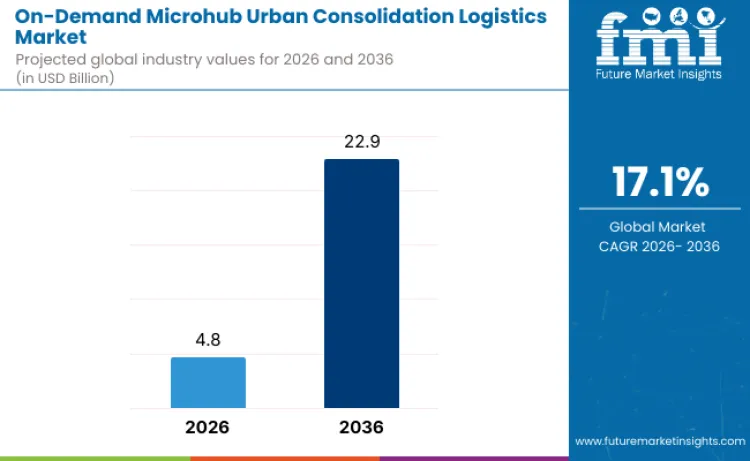
On-demand microhub urban consolidation logistics market is valued at USD 4.8 billion in 2026 and is projected to reach USD 22.9 billion by 2036, reflecting a CAGR of 17.1%. Demand increases as cities address congestion, emissions goals, and last-mile inefficiencies. Retailers, carriers, and e-commerce operators adopt flexible consolidation hubs to shorten delivery routes, reduce failed deliveries, and improve service reliability in dense urban zones.
Mobile microhubs lead hub adoption because they offer rapid deployment, route-agnostic positioning, and adaptable capacity for fluctuating parcel volumes. These units support cargo bike fleets, EV vans, and shared logistics models that lower operating costs. Integration of routing software, IoT tracking, and real-time capacity management strengthens operational efficiency and improves delivery responsiveness.
Quick Stats for On-Demand Microhub Urban Consolidation Logistics Market
- Market Value (2026): USD 4.8 billion
- Market Forecast Value (2036): USD 22.9 billion
- Forecast CAGR (2026 to 2036): 17.1%
- Leading Hub Type in Global Demand: Mobile Microhubs
- Key Growth Regions in Global Demand: China, India, Japan, USA
- Top Players in Global Demand: DHL Supply Chain, UPS, FedEx Corporation, Amazon Logistics, Geodis
China, India, Japan, and the USA represent key growth regions supported by high e-commerce activity and urban sustainability initiatives. DHL Supply Chain, UPS, FedEx Corporation, Amazon Logistics, and Geodis anchor competitive activity with investments in modular hub fleets, low-emission delivery systems, and data-driven optimization platforms that streamline urban consolidation operations.
On-Demand Microhub Urban Consolidation Logistics Market Key Takeaways
| Metric | Value |
|---|---|
| Market Value (2026) | USD 4.8 billion |
| Market Forecast Value (2036) | USD 22.9 billion |
| Forecast CAGR (2026 to 2036) | 17.1% |
How Are the Segments Classified in the On-Demand Microhub Urban Consolidation Logistics Market?
Demand for on-demand microhub consolidation logistics is shaped by urban congestion, rapid delivery expectations, and operational efficiency needs across dense city environments. Buyers evaluate mobility, footprint flexibility, cross-docking capability, and integration with last-mile fleets. Adoption patterns reflect expanding e-commerce activity, pressure to reduce delivery emissions, and dependence on micro-nodes that support parcel consolidation, temporary staging, and time-sensitive movement across metropolitan areas.
Which Hub Type Accounts for the Largest Share of Global Demand?
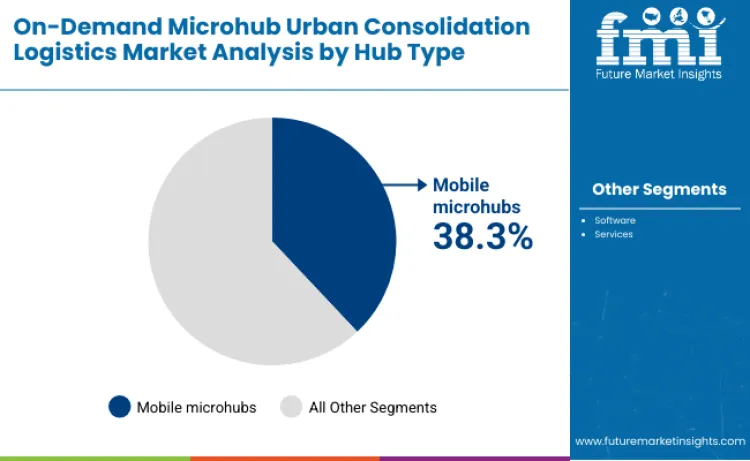
Mobile microhubs hold 38.3%, making them the leading hub-type segment globally. Mobile units support short-term deployment, adaptive positioning, and route-based optimization in districts with fluctuating delivery density. Their flexibility enables use near transit nodes, commercial areas, or temporary high-volume zones. Semi-permanent microhubs support medium-term operations where stable parcel flows justify fixed staging points. Permanent microhubs support high-volume, long-term consolidation with integrated sorting and storage infrastructure. Hub-type distribution reflects operational flexibility goals, regulatory constraints, and urban-planning requirements.
Key Points:
- Mobile microhubs support flexible deployment and density-adaptive staging.
- Semi-permanent hubs serve predictable medium-volume zones.
- Permanent hubs support long-term high-volume consolidation.
- Hub selection aligns with delivery density and operational stability.
Which Service Model Represents the Largest Segment?
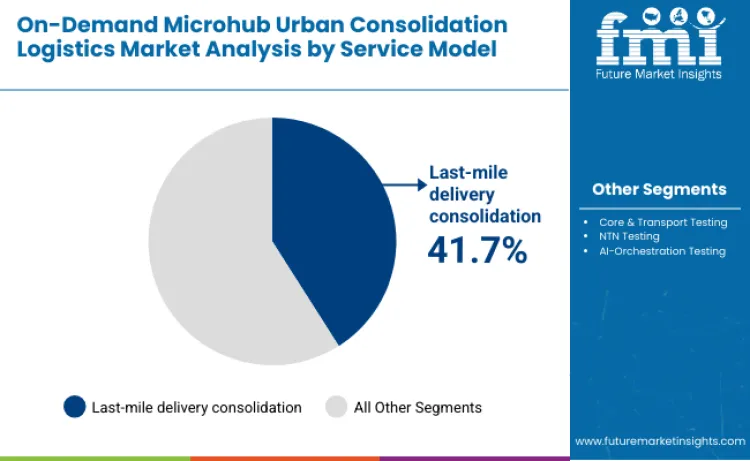
Last-mile delivery consolidation holds 41.7%, making it the leading service-model segment globally. Consolidation reduces route duplication, lowers fleet emissions, and improves delivery efficiency in congested districts. Storage and cross-docking support short-term parcel holding and rapid handoff to downstream carriers. Returns and reverse logistics support e-commerce workflows requiring scheduled pickup, inspection, or restocking. Parcel-sorting services support zone-level routing and load balancing across microhub networks. Service-model distribution reflects the dominance of delivery-density management and efficiency improvement goals.
Key Points:
- Consolidation minimizes redundant routes and improves efficiency.
- Storage and cross-docking support rapid parcel transfer.
- Reverse logistics address high-volume e-commerce return flows.
- Service choice aligns with density, volume, and operational design.
Which End-User Segment Accounts for the Largest Share of Global Demand?
E-commerce platforms hold 44.2%, making them the largest end-user segment. Platforms rely on microhubs to manage peak-volume surges, reduce delivery windows, and increase route efficiency in congested city zones. Retailers use microhubs to support Omni channel fulfillment and same-day delivery offerings. Logistics service providers use hubs for load consolidation, fleet coordination, and urban-route optimization. Food and grocery delivery companies rely on rapid-turnover staging points supporting time-sensitive distribution. End-user distribution reflects the influence of e-commerce growth and demand for accelerated last-mile operations.
Key Points:
- E-commerce platforms lead due to high parcel density.
- Retailers use hubs for Omni channel and same-day operations.
- Logistics providers depend on consolidation for routing efficiency.
- Food and grocery delivery relies on fast-turnover staging.
What are the Key Dynamics in the On-Demand Microhub Urban Consolidation Logistics Market?
Global demand grows as cities adopt microhub models to manage rising e-commerce volumes, reduce last mile congestion, and support low emission delivery requirements. Microhubs enable efficient parcel routing, short zone distribution, and consolidation workflows positioned close to dense population areas. Operators use flexible space, shared assets, and digital platforms to optimize routing and dwell times. Municipal sustainability goals strengthen interest in microhub networks that accommodate cargo bikes, electric vans, and pedestrian couriers across high traffic zones.
How are urban freight pressures and e-commerce fulfilment needs shaping microhub adoption?
City logistics programs use microhubs to manage parcel density created by expanding e-commerce transactions. Operators deploy short range consolidation points to minimize vehicle circulation within congested zones. Carriers route parcels through microhubs to reduce delivery miles and improve hit rates for first-attempt drop offs. Retailers rely on microhub proximity to support rapid fulfilment and flexible delivery windows. Cargo bike fleets use microhubs as restocking nodes during peak hours. Real estate owners repurpose underutilized assets such as parking structures and ground floor spaces for consolidation activity. Data driven platforms support continuous optimization of parcel flow and route selection across dense districts.
How do cost structures, regulatory conditions, and operational integration challenges influence scalability?
Microhub deployment requires investment in last mile technology, space leasing, sensors, and operational staffing, which affects economic feasibility in low margin delivery environments. Zoning rules differ across cities, creating uncertainty when operators evaluate suitable locations. Integration with existing carrier networks requires workflow alignment, parcel handoff timing, and data synchronization. Some carriers face difficulty shifting from vehicle centric models to multi modal fleets. Real estate availability limits expansion in districts with high commercial rents. Municipal pilot programs operate with variable funding, which impacts continuity. Operators work to standardize processes that manage high parcel rotation while maintaining predictable throughput.
How is Demand for On-Demand Microhub Urban Consolidation Logistics Market Evolving Across Key Countries?
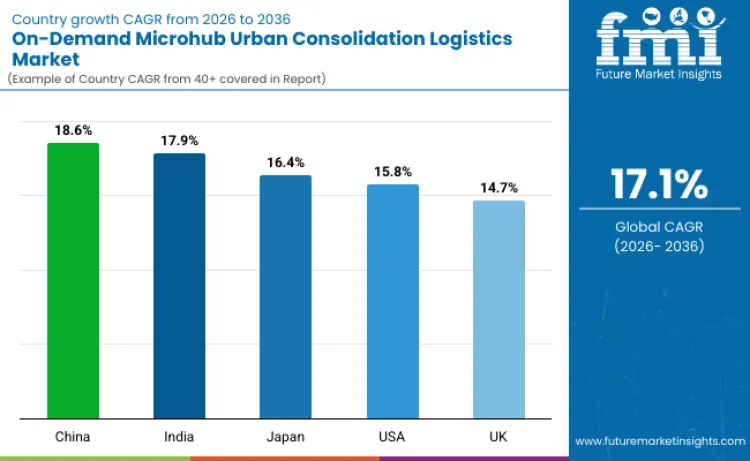
Demand for the on-demand microhub urban consolidation logistics market is rising due to increased urban delivery density, expansion of e-commerce, and stronger interest in reducing last-mile transport inefficiencies. China records a CAGR of 18.6% supported by rapid urbanization and advanced logistics digitization. India shows a 17.9% CAGR driven by rising parcel volumes and growing adoption of micro-distribution models. Japan posts a 16.4% CAGR supported by structured urban-logistics planning and efficiency-focused transport networks. USA holds a 15.8% CAGR driven by high delivery frequency and interest in congestion-reduction strategies. UK records a 14.7% CAGR linked with urban clean-transport policies and consolidation mandates.
| Country | CAGR (%) |
|---|---|
| China | 18.6% |
| India | 17.9% |
| Japan | 16.4% |
| USA | 15.8% |
| UK | 14.7% |
How is China driving demand for On-Demand Microhub Urban Consolidation Logistics?
China drives demand due to rapid urban expansion, strong e-commerce penetration, and widespread deployment of digital-logistics infrastructure. The country’s CAGR of 18.6% reflects active integration of microhubs into high-density delivery networks requiring short-distance sorting and routing efficiency. Logistics operators rely on microhubs to reduce congestion around major commercial districts. Municipal programs encourage consolidation practices to lower emissions and improve urban mobility. Delivery platforms utilize microhub-based models to optimize vehicle load factors and improve route predictability. Large-scale retail marketplaces support continuous adoption of micro-distribution systems across urban zones.
- Rapid urbanization and dense delivery ecosystems
- Strong integration of digital logistics platforms
- Municipal policies supporting consolidation practices
- Continuous e-commerce growth driving microhub expansion
How is India driving demand for On-Demand Microhub Urban Consolidation Logistics?
India supports rising demand through high e-commerce growth, dense metropolitan traffic, and expanding last-mile delivery requirements. The country’s CAGR of 17.9% reflects increasing adoption of microhubs to streamline parcel handling and improve route efficiency in congested cities. Logistics providers use microhubs to shorten delivery cycles and reduce operational delays. Urban-development policies encourage consolidation points that support cleaner mobility pathways. Retail distribution networks rely on microhubs for improved time-sensitive order fulfilment. Growing digital-logistics platforms facilitate integration of microhub routing into daily operations across major cities.
- High e-commerce expansion driving parcel density
- Use of microhubs to reduce congestion-related delays
- Integration of digital logistics workflows
- Demand for improved time-sensitive delivery performance
How is Japan driving demand for On-Demand Microhub Urban Consolidation Logistics?
Japan drives demand due to structured urban planning, strong logistics precision, and emphasis on minimizing last-mile inefficiencies. The country’s CAGR of 16.4% reflects steady adoption of microhubs supporting optimized routing, consolidated shipment handling, and reduced vehicle movements in urban cores. Logistics operators implement microhub systems to maintain punctual delivery performance under strict service expectations. Municipal strategies encourage consolidation of freight activity to limit congestion. Retail and parcel networks utilize microhubs for short-distance transfers aligned with compact urban layouts. Automation and robotics integration supports operational stability.
- Structured urban-logistics planning
- Strong emphasis on punctual, efficient delivery
- Municipal encouragement of consolidation strategies
- Use of automation supporting microhub operations
How is the USA driving demand for On-Demand Microhub Urban Consolidation Logistics?
The USA drives demand through high delivery frequency, expanding e-commerce volumes, and interest in urban congestion-management strategies. The country’s CAGR of 15.8% reflects steady adoption of microhubs to reduce last-mile travel distances and improve carrier efficiency. Delivery providers deploy microhubs in dense cities to support route clustering and reduce fuel consumption. Retailers integrate microhub operations to accelerate same-day and next-day fulfilment. Municipal programs explore consolidation nodes to address emissions and roadway constraints. Technology firms support microhub optimization through data-driven routing and real-time visibility platforms.
- Strong e-commerce-driven delivery volumes
- Use of microhubs to shorten last-mile routes
- Retail integration enhancing fulfilment speed
- Municipal focus on congestion and emissions reduction
How is the UK driving demand for On-Demand Microhub Urban Consolidation Logistics?
The UK drives demand due to strong regulatory focus on urban clean-transport goals, dense city centers, and interest in freight consolidation measures. The country’s CAGR of 14.7% reflects consistent adoption of microhubs aimed at reducing delivery vehicle entries into restricted zones. Logistics networks use microhubs to coordinate low-emission delivery fleets and improve routing efficiency. Urban freight plans encourage shared consolidation points for reducing traffic and improving delivery reliability. Retailers and parcel carriers utilize microhubs to comply with evolving environmental standards while maintaining service performance across city centers.
- Regulatory pressure supporting clean-transport adoption
- Use of microhubs to limit vehicle entry into dense zones
- Strong alignment with urban freight-management plans
- Retail and parcel integration supporting reliable deliveries
What is the competitive landscape of demand for on-demand microhub urban consolidation logistics globally?
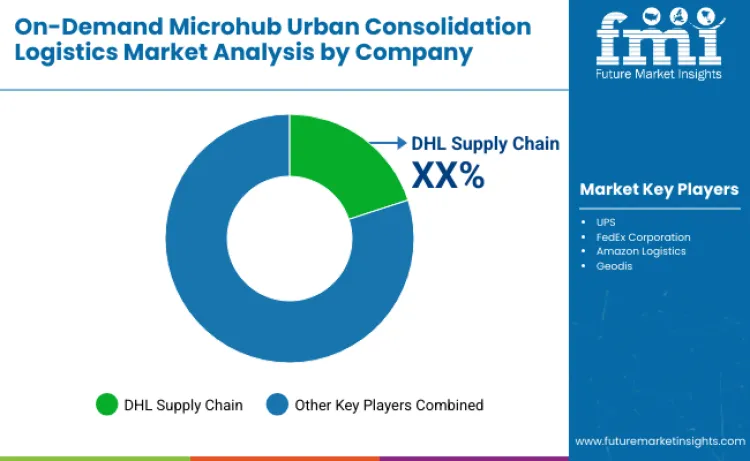
Demand for on-demand microhub urban consolidation logistics expands as cities manage congestion, last-mile emissions, and delivery density driven by e-commerce growth. Requirements center on flexible handoff points, dynamic routing, parcel cross-docking, and real-time orchestration of short-range distribution assets. Buyers evaluate hub siting models, digital coordination platforms, multimodal integration, and operational responsiveness across dense metropolitan areas. Procurement teams prioritize reliability, scalable microhub networks, and data integration that supports carrier interoperability. Trend in the global market reflects intensified interest in micro-fulfillment, shared consolidation nodes, and low-emission last-mile operations.
DHL Supply Chain holds an estimated 28.0% share. Position strengthens through extensive urban logistics programs, microhub pilots, and integrated routing platforms deployed across Europe, Asia, and North America. UPS participates through alternative delivery hubs, parcel lockers, and micro-depot deployments supporting dense urban districts. FedEx Corporation contributes with localized transfer points and digital routing systems optimized for high-volume parcels. Amazon Logistics maintains visibility through neighborhood-scale consolidation nodes linked to same-day and sub-same-day delivery workflows. Geodis operates urban consolidation centers within major cities using shared-use hubs and fleet optimization models. Competitive positioning globally reflects network density, asset coordination, digital platform capability, and operational agility supporting sustainable last-mile distribution.
Key Players in the On-Demand Microhub Urban Consolidation Logistics Market
- DHL Supply Chain
- UPS
- FedEx Corporation
- Amazon Logistics
- Geodis
Scope of the Report
| Items | Values |
|---|---|
| Quantitative Units | USD billion |
| Classification | Mobile Microhubs , Semi-Permanent Microhubs , Permanent Microhubs |
| Application (Service Model) | Last-Mile Delivery Consolidation, Storage & Cross-Docking, Returns & Reverse Logistics, Parcel Sorting Services |
| End-User | E-commerce Platforms, Retailers, Logistics Service Providers, Food & Grocery Delivery Companies |
| Regions Covered | Asia Pacific, Europe, North America, Latin America, Middle East & Africa |
| Countries Covered | India, China, USA, Germany, South Korea, Japan, Italy, and 40+ countries |
| Key Companies Profiled | DHL Supply Chain, UPS, FedEx Corporation, Amazon Logistics, Geodis |
| Additional Attributes | Dollar sales by hub type, service model, and end-user segments; adoption trends in microhub -enabled last-mile consolidation across dense urban zones; growth driven by e-commerce and quick-commerce delivery; integration with electric cargo bikes, autonomous robots, and sustainable mobility fleets; regulatory impacts on curbside microhubs and urban low-emission zones; competitive landscape featuring logistics operators expanding microhub -based urban fulfillment networks. |
On-Demand Microhub Urban Consolidation Logistics Market by Segment
By Hub Type
- Mobile Microhubs
- Semi-Permanent Microhubs
- Permanent Microhubs
By Service Model
- Last-Mile Delivery Consolidation
- Storage & Cross-Docking
- Returns & Reverse Logistics
- Parcel Sorting Services
By End-User
- E-commerce Platforms
- Retailers
- Logistics Service Providers
- Food & Grocery Delivery Companies
Region:
- Asia Pacific
- China
- Japan
- South Korea
- India
- Australia & New Zealand
- ASEAN
- Rest of Asia Pacific
- Europe
- Germany
- United Kingdom
- France
- Italy
- Spain
- Nordic
- BENELUX
- Rest of Europe
- North America
- United States
- Canada
- Mexico
- Latin America
- Brazil
- Chile
- Rest of Latin America
- Middle East & Africa
- Kingdom of Saudi Arabia
- Other GCC Countries
- Turkey
- South Africa
- Other African Union
- Rest of Middle East & Africa
Frequently Asked Questions
What is the size of the on-demand microhub urban consolidation logistics market in 2026?
The market is valued at USD 4.8 billion in 2026 as cities adopt compact consolidation points to manage rising parcel flows.
What will be the industry size by 2036?
Industry value will reach USD 22.9 billion by 2036 due to wider deployment of mobile nodes and demand for shorter, optimized delivery routes.
What is the CAGR for 2026 to 2036?
The on-demand microhub urban consolidation logistics market expands at a 17.1% CAGR during the forecast period.
Which hub-type segment leads in 2026?
Mobile microhubs hold 38.3% share in 2026 because of their flexible deployment and suitability for dense urban zones.
Which service-model segment holds the highest share?
Last-mile delivery consolidation leads with 41.7% share, reflecting its role in reducing vehicle mileage, delivery time, and intra-city congestion.
Preview the report firsthand - request a free sample
Get SampleGet the brochure for pricing and purchase details.
Get PDFTable of Content
- Executive Summary
- Market Overview
- Global Market Value, 2020-2026
- Global Market Forecast, 2026-2036
- Market Dynamics
- Drivers
- Restraints
- Opportunities
- Regulatory & Standards Landscape
- Technology & Material Innovation Outlook
- Market Segmentation Analysis
- By Hub Type
- Mobile Microhubs
- Semi-Permanent Microhubs
- Permanent Microhubs
- By Service Model
- Last-Mile Delivery Consolidation
- Storage & Cross-Docking
- Returns & Reverse Logistics
- Parcel Sorting Services
- By End-User
- E-commerce Platforms
- Retailers
- Logistics Service Providers
- Food & Grocery Delivery Companies
- By Hub Type
- Regional Outlook
- Asia Pacific
- Europe
- North America
- Latin America
- Middle East & Africa
- Country-Level Outlook
- China
- India
- Japan
- United States
- Germany
- South Korea
- Italy
- Australia & New Zealand
- ASEAN
- United Kingdom
- France
- Spain
- Nordic
- BENELUX
- Mexico
- Brazil
- Chile
- Turkey
- South Africa
- Other GCC Countries
- Rest of Middle East & Africa
- Competitive Landscape
- Market Structure Overview
- Company Positioning
- Strategic Initiatives
- Key Player Profiles
- Scope of the Report
- Research Methodology
- Assumptions & Acronyms


