

- Industry Size (2025)
- USD 421.5 Mn
- Forecast (2035)
- USD 689.3 Mn
- CAGR (2025 to 2035)
- 5.0%
Oxcarbazepine API Market Forecast and Outlook 2025 to 2035
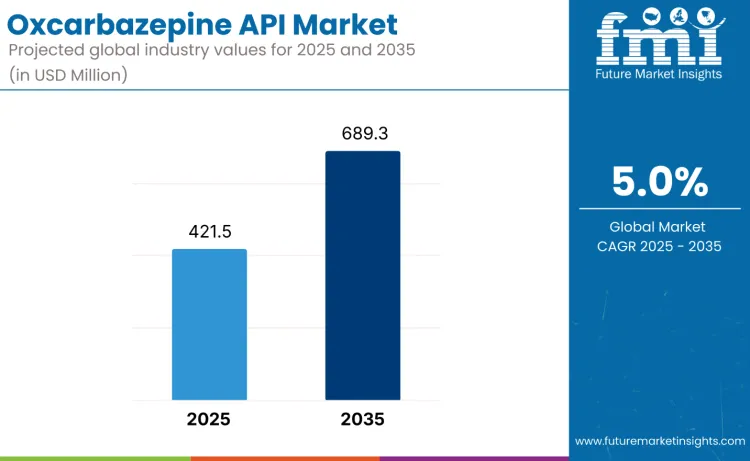
The global oxcarbazepine API market is projected to reach USD 689.3 million by 2035, expanding from USD 421.5 million in 2025 at a CAGR of 5.0% and achieving 1.6x growth over the forecast period. This expansion is driven by sustained clinical demand for oxcarbazepine in epilepsy and bipolar disorder management, rising neurological disease prevalence, and broader access to affordable antiepileptic therapies in emerging economies. Continued inclusion in public reimbursement lists and cost advantages over newer branded anticonvulsants reinforce their role as a long-term therapy option. Nevertheless, pricing pressure among generic suppliers, strict regulatory compliance requirements, and periodic supply disruptions linked to quality audits and DMF upkeep remain ongoing challenges.
Market growth reflects stable prescribing patterns across neurology clinics and hospital pharmacies, where oxcarbazepine is widely used for partial seizures and mood stabilization. Finished-dosage manufacturers increasingly prioritize API suppliers offering consistent impurity control, reliable particle-size distribution, and reproducible dissolution characteristics to ensure bioequivalence and maintain competitive positioning in tenders. Strong acceptance within government-funded healthcare systems and resource-sensitive treatment settings continues to support predictable volume demand, particularly in Asia, Latin America, and parts of Eastern Europe.
Quick Stats for Oxcarbazepine API Market
- Oxcarbazepine API Market Value (2025): USD 421.5 million
- Oxcarbazepine API Market Forecast Value (2035): USD 689.3 million
- Oxcarbazepine API Market Forecast CAGR: 5.0%
- Leading Market Segment: Pharmacopoeial Grade API (69.7% share)
- Key Growth Regions: Asia Pacific (India, China), North America, Europe
- Top Players: Sun Pharmaceutical Industries, Aurobindo Pharma, Hetero Drugs, Zhejiang Huahai Pharmaceutical, Teva API
Advancements in API manufacturing technology are strengthening supply reliability and regulatory readiness. Producers are improving crystallization techniques, solvent-recovery systems, and impurity-monitoring frameworks while reinforcing data integrity and quality-assurance practices aligned with FDA, EMA, and pharmacopoeial standards. At the same time, government healthcare spending, national epilepsy programs, and domestic manufacturing incentives, especially in India and China, are supporting long-term demand. Expanded hospital pharmacy distribution, tender-based procurement, and tele-neurology access models further enhance utilization across diverse clinical infrastructures.
Oxcarbazepine API Market Year-over-Year Forecast (2025 to 2035)
Between 2025 and 2030, the oxcarbazepine API market is projected to rise from USD 421.5 million to USD 539.0 million, generating an incremental value of USD 117.5 million and accounting for 43.9 percent of total decade growth. Expansion is driven by increasing epilepsy and bipolar disorder diagnoses, wider formulary inclusion of cost-effective antiepileptic drugs, and tender-based procurement in emerging economies. Manufacturers strengthen competitiveness through improved crystallization control, advanced impurity profiling, solvent recovery optimization, and capacity expansion to meet GMP requirements across regulated and semi-regulated pharmaceutical supply channels.
From 2030 to 2035, the market is expected to expand from USD 539.0 million to USD 689.3 million, adding USD 150.3 million and representing 56.1 percent of overall ten-year growth. This phase reflects stronger vertical integration, preference for regionally sourced APIs to reduce supply risk, and tighter regulatory scrutiny on data integrity, DMF maintenance, and cGMP documentation. Growth is reinforced by expanding neurology care infrastructure, broader access to long-term therapies, and sustained demand for bioequivalent oxcarbazepine, driving investment in process efficiency, compliance systems, and durable supplier partnerships.
Oxcarbazepine API Market Key Takeaways
| Metric | Value |
|---|---|
| Market Value (2025) | USD 421.5 million |
| Market Forecast Value (2035) | USD 689.3 million |
| Forecast CAGR (2025 to 2035) | 5.0% |
Why Is the Oxcarbazepine API Market Growing Worldwide?
The oxcarbazepine API market expands by supporting rising global treatment demand for epilepsy and bipolar disorder, where long-term therapy continuity and affordability remain critical to patient outcomes. Neurologists and psychiatric specialists increasingly favor oxcarbazepine due to its favorable tolerability and cost efficiency, sustaining steady procurement of related formulations. Clinical guidelines across multiple regions recognize the molecule for partial-onset seizure control and mood stabilization, driving utilization across hospital, retail, and public treatment channels. Growing epilepsy prevalence, improved diagnostic reach in developing economies, and heightened mental health awareness continue to reinforce consistent API demand across regulated and semi-regulated pharmaceutical markets.
Government essential-drug policies, broader insurance coverage, and public neurology programs expand access to generic anticonvulsants, enabling predictable API volume planning for producers. Rapid growth of pharmaceutical manufacturing hubs in India and China, combined with process optimization in impurity management, crystallization control, and GMP compliance, strengthens global supply reliability. These capabilities support competitive API exports to North America, Europe, and Latin America. Long-term demand remains favorable due to sustained focus on medication accessibility and chronic neurological disease management. Intense generic price competition, strict pharmacovigilance requirements, and periodic regulatory audits continue to influence margins and capacity deployment decisions.
How Is the Oxcarbazepine API Market Segmented by Product Type, Application, End User and Region?
The oxcarbazepine API market is segmented by product type, application, and end user. By product type, the market is categorized into pharmacopoeial grade API, technical/industrial grade API, and custom or contract-manufactured API. Based on application, the market is divided into epilepsy and seizure disorders, bipolar disorder, and neuropathic pain & other indications. End-user categories include generic drug manufacturers, branded formulation companies, and CDMOs & API exporters. Regionally, the market is divided into Asia Pacific, Europe, North America, Latin America, and Middle East & Africa.
By Product Type, Pharmacopoeial Grade API Accounts for a Dominant Market Share
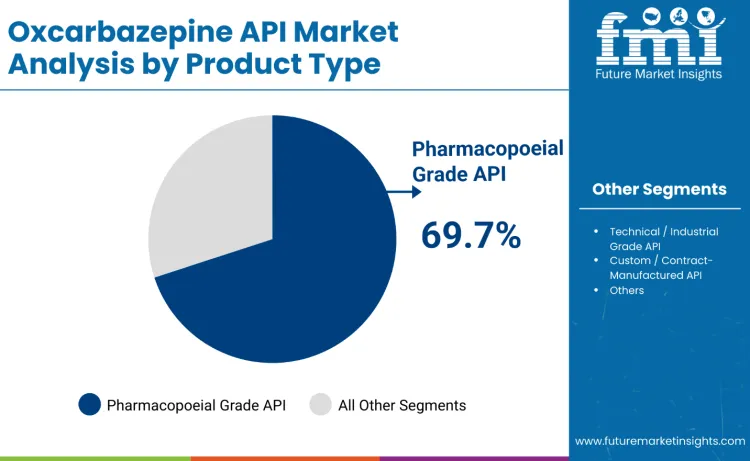
Pharmacopoeial grade API (USP/BP/Ph. Eur.) dominates revenue in 2025, holding about 69.7% share, driven by high-purity production under validated cGMP conditions, strict impurity control, stability validation, and DMF-ready regulatory compliance. Its leadership reflects strong adoption in regulated dosage manufacturing for seizure therapies requiring proven bioequivalence and long-term safety. Technical or industrial grade API accounts for 11.6%, serving cost-focused regional and pilot applications, while custom or contract-manufactured API contributes 18.7%, supported by rising outsourcing and tailored impurity requirements from multinational formulators.
By Application, Epilepsy & Seizure Disorders Represent the Largest Market Share
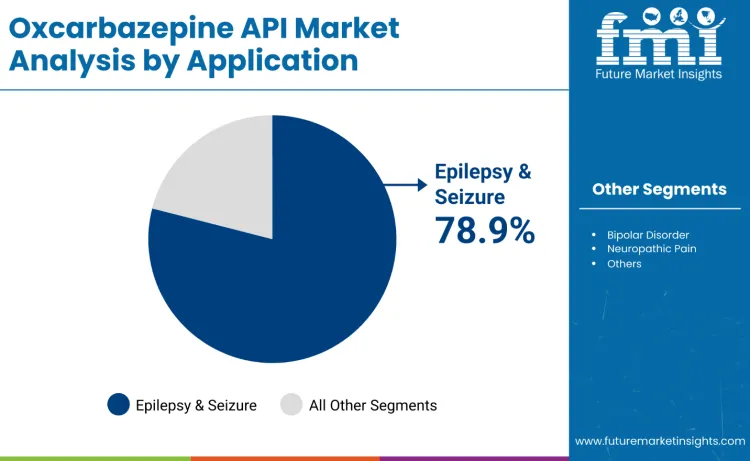
Epilepsy and seizure disorders dominate oxcarbazepine API demand in 2025, accounting for 78.9% share, reflecting its established role as a primary and adjunctive therapy for partial-onset seizures across adult and pediatric patients. Guideline endorsement, favorable tolerability, and sustained formulary inclusion within public neurology programs support consistent procurement cycles globally. Bipolar disorder applications contribute 14.6%, driven by psychiatric use in cost-efficient mood stabilization therapies. Neuropathic pain and other indications represent 6.5%, supported by off-label use. Leadership in epilepsy is reinforced by chronic treatment needs, pediatric safety preference, and government-backed essential-drug initiatives.
By End User, Generic Drug Manufacturers Hold the Largest Market Share
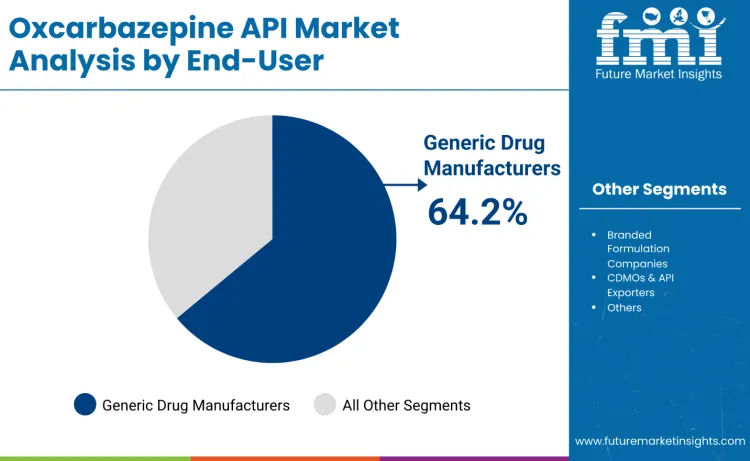
Generic drug manufacturers lead end-user demand in 2025 with a 64.2% share, driven by large-scale production of cost-effective oxcarbazepine formulations and steady procurement through tenders, reimbursement schemes, and hospital networks. Their dominance reflects DMF-based market entry, price-competitive sourcing, and scale advantages across established hubs in India and China. CDMOs and API exporters account for 23.9%, supported by contract manufacturing and export-oriented supply chains, while branded formulators hold 11.9% through legacy positioning. Leadership of generics is reinforced by chronic therapy volumes, public financing participation, mature infrastructure, and long-term institutional supply agreements.
What Are the Major Drivers, Restraints, and Emerging Trends Influencing the Oxcarbazepine API Market?
The oxcarbazepine API market is driven by rising neurological disease prevalence, expanding generic drug usage, and long-term treatment dependence. With 65-70 million people living with epilepsy globally, demand is reinforced by wider treatment access through national neurology programs and WHO essential medicine inclusion. Growing prescription volumes for oxcarbazepine in bipolar disorder management further strengthens baseline demand, as clinicians favor established mood stabilizers with predictable safety profiles. Expansion of generic manufacturing and DMF filings in India and China improves API availability, supporting global supply through cost-efficient, pharmacopoeia-compliant production.
What Are the Major Restraints Limiting the Oxcarbazepine API Market?
Market restraints include intense pricing pressure across generic antiepileptic APIs, driven by hospital tenders, public reimbursement systems, and competitive procurement practices that compress margins. Regulatory complexity and stringent GMP audits require continuous investment in documentation, stability testing, and impurity management, creating barriers for smaller manufacturers and prolonging site approvals. Supply chain vulnerabilities related to solvent availability, energy price volatility, and logistics disruptions can affect production continuity, particularly for export-oriented suppliers managing multi-region contracts and just-in-time delivery expectations across regulated pharmaceutical markets.
What Emerging Trends Are Shaping the Future of the Oxcarbazepine API Market?
Key trends include accelerated quality enhancement and regulatory optimization within major API hubs in India and China, where manufacturers are strengthening data-integrity systems and upgrading process controls to meet evolving FDA and EMA standards. Adoption of continuous manufacturing, precision crystallization, and solvent-recycling technologies is improving yield consistency, impurity control, and sustainability metrics. Competitive dynamics may shift with the emergence of alternative antiepileptic molecules, modified-release neurology formulations, and policy-driven domestic manufacturing incentives, requiring API producers to diversify supply chains and maintain rigorous regulatory alignment to sustain global competitiveness.
How Are Leading Countries Driving Growth in the Oxcarbazepine API Market?
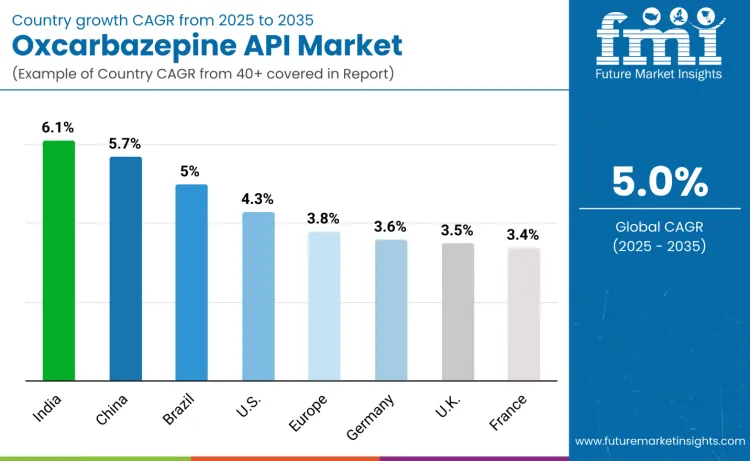
| Country | CAGR (2025 to 2035) |
|---|---|
| USA | 4.3% |
| Brazil | 5.0% |
| China | 5.7% |
| India | 6.1% |
| Europe | 3.8% |
| Germany | 3.6% |
| France | 3.4% |
| UK | 3.5% |
The oxcarbazepine API market advances globally, with India emerging as the fastest-growing region at a 6.1% CAGR, supported by large-scale manufacturing leadership, strong DMF presence, and expanding exports to regulated markets. China follows at 5.7%, driven by vertical integration and compliance upgrades. Brazil records 5.0% growth as public neurology programs expand generic access. The United States grows steadily at 4.3% through broad prescriber adoption of bioequivalent generics. Europe advances at 3.8%, with Germany (3.6%), the UK (3.5%), and France (3.4%) representing mature, reimbursement-driven markets prioritizing GMP-certified supply.
The report covers an in-depth analysis of 40+ countries top-performing countries are highlighted below.
How Is Neurology Treatment Infrastructure Accelerating Market Growth in China?
China shows strong momentum in the oxcarbazepine API landscape with a CAGR of 5.7% through 2035, supported by expanding neurology care infrastructure and large-scale pharmaceutical manufacturing capacity. National policies promoting epilepsy care access, generic substitution, and hospital formulary expansion drive sustained API demand. Growth concentrates in Zhejiang, Jiangsu, Shandong, and Guangdong, where GMP-certified manufacturers and CDMOs supply domestic and export markets. Wider insurance coverage, improved neurologist availability, and alignment with international pharmacopoeial standards strengthen long-term epilepsy management and reinforce consistent API consumption.
Why Are Neurology Treatment & Pharmaceutical Capacity Programs Enhancing Market Adoption in India?
India records the fastest growth at a 6.1% CAGR through 2035, driven by cost-competitive generic neurology drug production and expanding public healthcare coverage. National initiatives such as Ayushman Bharat and essential-medicine programs increase epilepsy and psychiatric treatment reach, while domestic API manufacturers scale GMP-compliant capacity. Pharmaceutical hubs including Hyderabad, Ahmedabad, and Visakhapatnam anchor production and exports. Strong DMF filings, expanding CDMO participation, and rising neurology prescriptions across public and private systems reinforce sustained oxcarbazepine API demand and long-term manufacturing planning.
How Does Regulatory and Quality-Driven Pharmaceutical Excellence Sustain Market Presence in Germany?
Germany maintains a stable oxcarbazepine API landscape with moderate growth of 3.6% through 2035, underpinned by rigorous regulatory standards and structured neurology care systems. University hospitals and specialty clinics emphasize evidence-based epilepsy management, supporting consistent demand for EU-GMP- and Ph. Eur.-compliant APIs. Strong reimbursement frameworks, disciplined formularies, and audit-focused procurement favor suppliers with proven quality and traceability. While volume growth is measured, Germany sustains premium API requirements and predictable offtake patterns aligned with long-term therapy continuity.
Why Is Expanding Public Neurology Access Fueling Market Demand in Brazil?
Brazil leads Latin America with a 5.0% CAGR through 2035, driven by expanding access to antiepileptic therapies under the Unified Health System. Public neurology programs, generic drug substitution, and essential-medicine procurement strengthen oxcarbazepine adoption across major urban centers. ANVISA-regulated formulation infrastructure and public tenders support stable API demand, while partnerships between local formulators and global suppliers ensure supply security. Government-backed epilepsy awareness and treatment initiatives further increase diagnosis rates and long-term therapy adherence across diverse population segments.
How Do Established Neurology Treatment Systems Strengthen Market Performance in United States?
The USA market demonstrates steady growth at a 4.3% CAGR through 2035, supported by mature neurology treatment networks and consistent epilepsy and bipolar disorder prevalence. Broad insurance coverage and strong preference for bioequivalent generics sustain oxcarbazepine utilization across hospitals, clinics, and pharmacy networks. FDA regulatory rigor drives demand for high-quality, fully compliant APIs, favoring suppliers with strong DMF maintenance and cGMP adherence. Established prescribing patterns and nationwide distribution infrastructure ensure predictable, long-term API offtake.
How Is Neurology Care Expansion Supporting Market Growth in United Kingdom?
The United Kingdom records stable growth of 3.5% through 2035, supported by strengthened NHS neurology services and standardized epilepsy care pathways. Clinicians prioritize clinically validated, cost-effective antiepileptic therapies, sustaining oxcarbazepine formulary inclusion across primary and specialist care. NHS procurement systems and reimbursement mechanisms ensure broad patient access while supporting competitive sourcing of compliant APIs. Academic-clinical collaboration and improved diagnostic pathways enhance therapy continuity, reinforcing steady API demand within a highly regulated and quality-focused healthcare environment.
How Are Neurology Care Investments Advancing Market Expansion Across Europe?
The oxcarbazepine API market in Europe is projected to grow from USD 45.9 million in 2025 to USD 67.6 million by 2035, registering a CAGR of 3.9%. Germany leads with a 24.2% share in 2025, easing to 23.8% by 2035, supported by advanced neurology care, centralized hospital procurement, and stringent GMP and regulatory compliance across major clinical hubs.
France follows with a 20.8% share in 2025, rising to 21.1% by 2035, driven by strong epileptology programs. The UK grows from 18.6% to 18.9% under NHS support, while Italy holds 14.1% throughout. Spain advances from 9.7% to 9.9%. The Netherlands remains at 6.3%, and Rest of Europe edges from 6.3% to 6.4% by 2035.
High-Precision Quality Standards Drive Pharmaceutical Requirements in Japan
The oxcarbazepine API market in Japan reflects a mature, precision-driven pharmaceutical environment defined by strict adherence to JP and Ph. Eur.-aligned specifications and advanced impurity-control frameworks. Neurology treatment systems across university hospitals, specialty centers, and long-term care facilities emphasize therapeutic reliability and long-term safety, sustaining demand for premium-grade APIs that meet rigorous performance expectations. Strong PMDA oversight reinforces quality-centric procurement and GMP-compliant manufacturing standards.
Japan’s market strength is further supported by advanced post-marketing surveillance and disciplined prescribing practices across Tokyo, Osaka, and other metropolitan hubs. Clinicians prioritize formulations offering controlled titration, favorable tolerability, and consistent seizure-management outcomes aligned with evidence-based epilepsy and psychiatric care protocols. These quality-driven clinical preferences ensure stable API demand, while validated crystallization consistency and lifecycle impurity documentation remain central to supplier selection and long-term supply partnerships.
International Suppliers Strengthen Neurology Care Support in South Korea
The oxcarbazepine API market in South Korea features a growing presence of international suppliers operating within a highly regulated pharmaceutical environment. Demand is supported by expanding epilepsy and mood-disorder management programs across Seoul, Busan, Incheon, and Daegu, where tertiary hospitals and specialty neurology centers prioritize clinically validated antiepileptic therapies aligned with national treatment guidelines and integrated electronic prescribing systems.
Major generic manufacturers and multinational API producers strengthen positioning through GMP-compliant supply, validated impurity-control frameworks, and technical dossiers meeting MFDS requirements. Hospital procurement networks and pharmacy chains emphasize documentation quality and secure supply partnerships. Increasing collaboration between global pharmaceutical firms and Korean formulators creates hybrid sourcing models that combine international manufacturing standards with strong local distribution, pharmacovigilance support, and clinician-focused medical education, reinforcing sustained oxcarbazepine API adoption.
How Competitive Is the Global Oxcarbazepine API Market and What Defines Its Structure?
The global oxcarbazepine API landscape shows moderate concentration, with a limited group of established producers holding a dominant supply position through extensive DMF coverage, vertically integrated manufacturing, and mature regulatory compliance frameworks. Competition centers on consistent quality delivery, regulatory readiness, impurity-control depth, and supply reliability rather than aggressive pricing, reflecting the expectations of regulated-market formulators and hospital procurement bodies. Manufacturers based in India and China retain strategic leadership due to strong export orientation and sustained adherence to global pharmacopoeial and documentation standards.
Leading suppliers such as Sun Pharmaceutical Industries, Aurobindo Pharma, and Hetero Drugs maintain advantage through multi-site production networks, strong regulatory track records across major regions, and well-developed quality-management systems supporting long-term neurology portfolios. Ongoing investment in impurity profiling, crystallization optimization, solvent recovery, and lifecycle stability programs enables these companies to defend positions while expanding presence across emerging therapeutic markets.
Challenger firms including Jubilant Pharmova, MSN Laboratories, and Granules India compete through efficient production economics, robust dossier support, and growing penetration in semi-regulated regions. Product-focused players and global innovators strengthen the landscape through compliance excellence, strategic partnerships, dependable logistics, and customer support spanning stability data, impurity lifecycle management, and assured long-term supply continuity.
Key Players in the Oxcarbazepine API Market
- Sun Pharmaceutical Industries
- Jubilant Pharmova (APIs)
- Aurobindo Pharma
- MSN Laboratories
- Zhejiang Huahai Pharmaceutical
- Hetero Drugs
- Teva API
- Granules India
- Alembic Pharmaceuticals
- Others
Scope of the Report
| Items | Values |
|---|---|
| Quantitative Units | USD 421.5 million |
| Product Type | Pharmacopoeial Grade API (USP/BP/Ph. Eur.), Technical / Industrial Grade API, Custom / Contract-Manufactured API |
| Application | Epilepsy & Seizure Disorders, Bipolar Disorder, Neuropathic Pain & Other Indications |
| End User | Generic Drug Manufacturers, Branded Formulation Companies, CDMOs & API Exporters |
| Regions Covered | Asia Pacific, Europe, North America, Latin America, Middle East & Africa |
| Country Covered | China, India, Germany, Brazil, USA, UK, Japan, and 40+ countries |
| Key Companies Profiled | Sun Pharmaceutical Industries, Jubilant Pharmova (APIs), Aurobindo Pharma, MSN Laboratories, Zhejiang Huahai Pharmaceutical, Hetero Drugs |
| Additional Attributes | API sales by pharmacopoeial grade and epilepsy-mood disorder applications, regional procurement across Asia Pacific, Europe, and North America, competitive landscape of DMF-active manufacturers, regulatory and impurity benchmarks, GMP integration, and innovations in crystallization, solvent recovery, and stability-validated API grades. |
Oxcarbazepine API Market by Segments
Product Type:
- Pharmacopoeial Grade API (USP/BP/Ph. Eur.)
- Technical / Industrial Grade API
- Custom / Contract-Manufactured API
Application:
- Epilepsy & Seizure Disorders
- Bipolar Disorder
- Neuropathic Pain & Other Indications
End User:
- Generic Drug Manufacturers
- Branded Formulation Companies
- CDMOs & API Exporters
Region:
- Asia Pacific
- China
- India
- Japan
- South Korea
- Vietnam
- Australia & New Zealand
- ASEAN
- Rest of Asia Pacific
- Europe
- Germany
- United Kingdom
- France
- Italy
- Spain
- Netherlands
- Nordic
- BENELUX
- Rest of Europe
- North America
- United States
- Canada
- Mexico
- Latin America
- Brazil
- Argentina
- Rest of Latin America
- Middle East & Africa
- Kingdom of Saudi Arabia
- Other GCC Countries
- Turkey
- South Africa
- Other African Union
- Rest of Middle East & Africa
Frequently Asked Questions
How big is the oxcarbazepine API market in 2025?
The global oxcarbazepine API market is valued at USD 421.5 million in 2025.
What will be the size of the oxcarbazepine API market in 2035?
The oxcarbazepine API market is projected to reach USD 689.3 million by 2035.
How much will the oxcarbazepine API market grow between 2025 and 2035?
The oxcarbazepine API market is expected to grow at a 5.0% CAGR between 2025 and 2035.
Which product type leads the oxcarbazepine API market in 2025?
Pharmacopoeial grade oxcarbazepine API leads the market with an estimated 69.7% share in 2025.
Which end-user segment contributes the largest share in the oxcarbazepine API market?
Generic drug manufacturers account for the largest share, contributing 64.2% of total demand in the oxcarbazepine API market.
Preview the report firsthand - request a free sample
Get SampleGet the brochure for pricing and purchase details.
Get PDFTable of Content
- Executive Summary
- Regional Level Market Outlook
- Demand-side Trends
- Supply-side Trends
- Technology Roadmap Analysis
- Analysis and Recommendations
- Market Overview
- Market Coverage / Taxonomy
- Market Definition / Scope / Limitations
- Market Background
- Market Dynamics
- Drivers
- Restraints
- Opportunity
- Trends
- Scenario Forecast
- Demand in Optimistic Scenario
- Demand in Likely Scenario
- Demand in Conservative Scenario
- Opportunity Assessment
- Market Trade Assessment
- Products Market Assessment
- Investment Feasibility Matrix
- Value Chain Analysis
- Participants and their Roles
- Profit Margin Analysis
- Operating Margins By Region
- PESTLE and Porter’s Analysis
- Regulatory Landscape
- By Key Regions
- By Key Countries
- Regional Parent Market Outlook
- Product Launches & Development
- Technological Innovation
- Market Dynamics
- Regional Level Market Analysis 2020 to 2024 and Forecast, 2025 to 2035
- Historical Market Size USD Million Analysis, 2020 to 2024
- Current and Future Market Size USD Million Projections, 2025 to 2035
- Y-o-Y Growth Trend Analysis
- Absolute $ Opportunity Analysis
- Regional Level Market Analysis 2020 to 2024 and Forecast 2025 to 2035, By Product Type
- Introduction / Key Findings
- Historical Market Size USD Million Analysis By Product Type, 2020 to 2024
- Current and Future Market Size USD Million Analysis and Forecast By Product Type, 2025 to 2035
- Pharmacopoeial Grade API (USP/BP/Ph. Eur.)
- Technical / Industrial Grade API
- Custom / Contract-Manufactured API
- Y-o-Y Growth Trend Analysis By Product Type, 2020 to 2024
- Absolute $ Opportunity Analysis By Product Type, 2025 to 2035
- Regional Level Market Analysis 2020 to 2024 and Forecast 2025 to 2035, By Application
- Introduction / Key Findings
- Historical Market Size USD Million Analysis By Application, 2020 to 2024
- Current and Future Market Size USD Million Analysis and Forecast By Application, 2025 to 2035
- Epilepsy & Seizure Disorders
- Bipolar Disorder
- Neuropathic Pain & Other Indications
- Y-o-Y Growth Trend Analysis By Application, 2020 to 2024
- Absolute $ Opportunity Analysis By Application, 2025 to 2035
- Regional Level Market Analysis 2020 to 2024 and Forecast 2025 to 2035, By End User
- Introduction / Key Findings
- Historical Market Size USD Million Analysis By End User, 2020 to 2024
- Current and Future Market Size USD Million Analysis and Forecast By End User, 2025 to 2035
- Generic Drug Manufacturers
- Branded Formulation Companies
- CDMOs & API Exporters
- Y-o-Y Growth Trend Analysis By End User, 2020 to 2024
- Absolute $ Opportunity Analysis By End User, 2025 to 2035
- Regional Level Market Analysis 2020 to 2024 and Forecast 2025 to 2035, By Region
- Introduction
- Historical Market Size USD Million Analysis By Region, 2020 to 2024
- Current Market Size USD Million Analysis and Forecast By Region, 2025 to 2035
- North America
- Latin America
- East Asia
- South Asia
- Western Europe
- Eastern Europe
- Middle East & Africa
- Market Attractiveness Analysis By Region
- North America Market Analysis 2020 to 2024 and Forecast 2025 to 2035, By Country
- Historical Market Size USD Million Trend Analysis By Market Taxonomy, 2020 to 2024
- Market Size USD Million Forecast By Market Taxonomy, 2025 to 2035
- By Country
- USA
- Canada
- Mexico
- By Product Type
- By Application
- By End User
- By Country
- Market Attractiveness Analysis
- By Country
- By Product Type
- By Application
- By End User
- Key Takeaways
- Latin America Market Analysis 2020 to 2024 and Forecast 2025 to 2035, By Country
- Historical Market Size USD Million Trend Analysis By Market Taxonomy, 2020 to 2024
- Market Size USD Million Forecast By Market Taxonomy, 2025 to 2035
- By Country
- Brazil
- Argentina
- Rest of Latin America
- By Product Type
- By Application
- By End User
- By Country
- Market Attractiveness Analysis
- By Country
- By Product Type
- By Application
- By End User
- Key Takeaways
- East Asia Market Analysis 2020 to 2024 and Forecast 2025 to 2035, By Country
- Historical Market Size USD Million Trend Analysis By Market Taxonomy, 2020 to 2024
- Market Size USD Million Forecast By Market Taxonomy, 2025 to 2035
- By Country
- China
- Japan
- South Korea
- By Product Type
- By Application
- By End User
- By Country
- Market Attractiveness Analysis
- By Country
- By Product Type
- By Application
- By End User
- Key Takeaways
- South Asia Market Analysis 2020 to 2024 and Forecast 2025 to 2035, By Country
- Historical Market Size USD Million Trend Analysis By Market Taxonomy, 2020 to 2024
- Market Size USD Million Forecast By Market Taxonomy, 2025 to 2035
- By Country
- India
- ASEAN Countries
- Australia & New Zealand
- Rest of South Asia
- By Product Type
- By Application
- By End User
- By Country
- Market Attractiveness Analysis
- By Country
- By Product Type
- By Application
- By End User
- Key Takeaways
- Western Europe Market Analysis 2020 to 2024 and Forecast 2025 to 2035, By Country
- Historical Market Size USD Million Trend Analysis By Market Taxonomy, 2020 to 2024
- Market Size USD Million Forecast By Market Taxonomy, 2025 to 2035
- By Country
- Germany
- UK
- France
- Italy
- Spain
- BENELUX
- Nordic Countries
- Rest of Western Europe
- By Product Type
- By Application
- By End User
- By Country
- Market Attractiveness Analysis
- By Country
- By Product Type
- By Application
- By End User
- Key Takeaways
- Eastern Europe Market Analysis 2020 to 2024 and Forecast 2025 to 2035, By Country
- Historical Market Size USD Million Trend Analysis By Market Taxonomy, 2020 to 2024
- Market Size USD Million Forecast By Market Taxonomy, 2025 to 2035
- By Country
- Russia
- Hungary
- Poland
- Rest of Eastern Europe
- By Product Type
- By Application
- By End User
- By Country
- Market Attractiveness Analysis
- By Country
- By Product Type
- By Application
- By End User
- Key Takeaways
- Middle East & Africa Market Analysis 2020 to 2024 and Forecast 2025 to 2035, By Country
- Historical Market Size USD Million Trend Analysis By Market Taxonomy, 2020 to 2024
- Market Size USD Million Forecast By Market Taxonomy, 2025 to 2035
- By Country
- Saudi Arabia
- Other GCC Countries
- Türkiye
- South Africa
- Rest of MEA
- By Product Type
- By Application
- By End User
- By Country
- Market Attractiveness Analysis
- By Country
- By Product Type
- By Application
- By End User
- Key Takeaways
- Market Structure Analysis
- Competition Dashboard
- Competition Benchmarking
- Market Share Analysis of Top Players
- By Regional
- By Product Type
- By Application
- By End User
- Competition Analysis
- Competition Deep Dive
- Sun Pharmaceutical Industries
- Overview
- Product Portfolio
- Key Financials
- Key Developments
- Global/Regional Footprint
- Strategy Overview
- Marketing Strategy
- SWOT
- Analyst Comment
- Jubilant Pharmova (APIs)
- Overview
- Product Portfolio
- Key Financials
- Key Developments
- Global/Regional Footprint
- Strategy Overview
- Marketing Strategy
- SWOT
- Analyst Comment
- Aurobindo Pharma
- Overview
- Product Portfolio
- Key Financials
- Key Developments
- Global/Regional Footprint
- Strategy Overview
- Marketing Strategy
- SWOT
- Analyst Comment
- MSN Laboratories
- Overview
- Product Portfolio
- Key Financials
- Key Developments
- Global/Regional Footprint
- Strategy Overview
- Marketing Strategy
- SWOT
- Analyst Comment
- Zhejiang Huahai Pharmaceutical
- Overview
- Product Portfolio
- Key Financials
- Key Developments
- Global/Regional Footprint
- Strategy Overview
- Marketing Strategy
- SWOT
- Analyst Comment
- Hetero Drugs
- Overview
- Product Portfolio
- Key Financials
- Key Developments
- Global/Regional Footprint
- Strategy Overview
- Marketing Strategy
- SWOT
- Analyst Comment
- Teva API
- Overview
- Product Portfolio
- Key Financials
- Key Developments
- Global/Regional Footprint
- Strategy Overview
- Marketing Strategy
- SWOT
- Analyst Comment
- Granules India
- Overview
- Product Portfolio
- Key Financials
- Key Developments
- Global/Regional Footprint
- Strategy Overview
- Marketing Strategy
- SWOT
- Analyst Comment
- Alembic Pharmaceuticals
- Overview
- Product Portfolio
- Key Financials
- Key Developments
- Global/Regional Footprint
- Strategy Overview
- Marketing Strategy
- SWOT
- Analyst Comment
- Sun Pharmaceutical Industries
- Competition Deep Dive
- Assumptions & Acronyms Used
- Research Methodology


