

- Industry Size (2026)
- USD 3.94 Bn
- Forecast (2036)
- USD 7.40 Bn
- CAGR (2026 to 2036)
- 6.5%
Paper Processing Resins Market Size, Market Forecast and Outlook By FMI
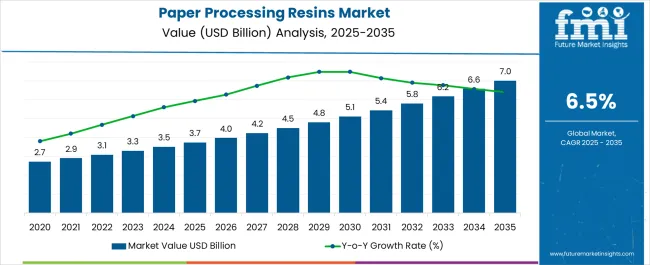
The paper processing resins market was valued at USD 3.70 billion in 2025, projected to reach USD 3.94 billion in 2026, and is forecast to expand to USD 7.40 billion by 2036 at a 6.5% CAGR. Based on Future Market Insights' analysis, this expansion translates to an incremental opportunity of USD 3.46 billion over the ten-year forecast window. FMI projects that demand patterns are shifting from standardized procurement cycles toward specification-driven purchasing, where buyers increasingly require product performance certifications and supply chain traceability documentation before approving orders. As per FMI, the structural transition underway is recalibrating supplier qualification criteria and contract renewal timelines across all major consuming regions.
Summary of Paper Processing Resins Market
- The market is on track to reach USD 7.40 billion by 2036.
- Growth is pegged at a 6.5% CAGR over the 2026 to 2036 forecast window.
- As of 2025, the market was valued at USD 3.70 billion.
- Cumulative incremental value across the forecast stands at USD 3.46 billion.
- Acrylic Resins leads by Material Type with 28% share in 2026.
- Dry Strength Resins leads by Application with 35% share in 2026.
- The market is a specialty chemicals category where food contact regulatory pre-certification and formulation performance consistency command pricing premiums and secure long-term supply contracts.
- Among key countries, China at 8.8%, India at 8.1%, Germany at 7.5%, Brazil at 6.8%, USA at 6.2%, UK at 5.5%, Japan at 4.9% CAGR through 2036.
Paper mills are increasing consumption of wet-strength and dry-strength resins to meet tightening performance specifications for packaging grades that must withstand moisture exposure during cold chain logistics and outdoor storage. The transition from single-use plastic packaging to paper-based alternatives is expanding the addressable market for surface sizing agents, barrier coatings, and binder resins that improve paper substrate performance in food contact and liquid containment applications. Regulatory restrictions on formaldehyde emissions from paper products are accelerating reformulation toward bio-based polyester and acrylic resin systems.
Country-level growth trajectories reflect divergent industrial maturity and regulatory timelines. China leads with a 8.8% CAGR through 2036, supported by scaled manufacturing infrastructure and government procurement programs. Other key markets include India (8.1%), Germany (7.5%), Brazil (6.8%), USA (6.2%), UK (5.5%), Japan (4.9%). Mature markets such as Japan maintain steady replacement demand cycles anchored by established supply contracts and quality compliance frameworks.
Paper Processing Resins Market Key Takeaways
| Metric | Details |
|---|---|
| Industry Size (2026) | USD 3.94 billion |
| Industry Value (2036) | USD 7.40 billion |
| CAGR (2026-2036) | 6.5% |
Source: Future Market Insights, 2026
Paper Processing Resins Market Definition
Paper processing resins are synthetic or bio-based chemical additives used during paper manufacturing to improve the mechanical, barrier, and surface properties of finished paper and paperboard products. Product categories include wet-strength resins that maintain paper integrity under moisture exposure, dry-strength resins that increase tensile and burst resistance, and binder resins used in coating and sizing operations. Key resin chemistries include acrylic, melamine formaldehyde, polyamide, butadiene latex, epoxy, and polyacrylamide formulations applied across writing, printing, packaging, decorative, and specialty paper grades.
Paper Processing Resins Market Inclusions
Market scope includes acrylic resins, bio polyesters, melamine formaldehyde, butadiene resin latex, epoxy polyamide, and polyacrylamide formulations. Application coverage spans dry-strength resins, wet-strength resins, and binders. End-use segments include writing paper, printing paper, kraft paper, decorative paper, duplex boards, paper napkin and towels, paper wipes, and special paper.
Paper Processing Resins Market Exclusions
The scope excludes resins used in non-paper applications such as textile, construction, and automotive coatings. Pulping chemicals, bleaching agents, and de-inking surfactants used upstream of the papermaking process are omitted. Printing inks and post-press coating materials applied after paper manufacturing are not included.
Paper Processing Resins Market Research Methodology
- Primary Research: Analysts conducted structured interviews with procurement managers, production engineers, and supply chain directors across key paper processing resins operations to map decision triggers and specification requirements.
- Desk Research: Data collection aggregated publicly available trade statistics, regulatory filings, industry association reports, and company annual disclosures relevant to paper processing resins production and consumption patterns.
- Market-Sizing and Forecasting: Baseline values derive from a bottom-up aggregation of production volume data and average selling price benchmarks, applying region-specific adoption curves to project demand through 2036.
- Data Validation and Update Cycle: Projections are cross-validated against publicly reported financial disclosures from leading market participants and verified against national trade data registries.
Why is the Paper Processing Resins Market Growing?
The Paper Processing Resins market is experiencing steady growth driven by the increasing demand for high-performance paper products across packaging, printing, and writing applications. The future outlook for this market is shaped by the rising need for improved paper strength, durability, and surface quality, which are critical for modern paper applications. Advancements in resin formulations have enabled enhanced performance characteristics such as water resistance, improved printability, and better bonding, supporting broader adoption in industrial and commercial paper production.
The market is also benefiting from the increasing adoption of sustainable and eco-friendly paper processing technologies, which are compatible with advanced resin types. Additionally, the growing paper consumption in emerging economies, fueled by population growth and expanding educational and commercial sectors, is expected to propel market expansion.
Continuous innovation in resin chemistry, coupled with the demand for high-quality writing and packaging paper, is creating opportunities for market players to enhance product offerings and capture additional revenue The market is anticipated to sustain growth as paper products continue to remain integral to both functional and aesthetic requirements across industries.
Segmental Analysis
The paper processing resins market is segmented by material type, application, end use, and geographic regions. By material type, paper processing resins market is divided into Acrylic Resins, Bio Polyesters, Melamine Formaldehyde, Butadiene Resin Latex, Epoxy Polyamide, and Polyacrylamide. In terms of application, paper processing resins market is classified into Dry Strength Resins, Wet Strength Resins, and Binders. Based on end use, paper processing resins market is segmented into Writing Paper, Printing Paper, Kraft Paper, Decorative Paper, Duplex Boards, Paper Napkin/Towels, Paper Wipes, and Special Paper. Regionally, the paper processing resins industry is classified into North America, Latin America, Western Europe, Eastern Europe, Balkan & Baltic Countries, Russia & Belarus, Central Asia, East Asia, South Asia & Pacific, and the Middle East & Africa.
Insights into the Acrylic Resins Material Type Segment
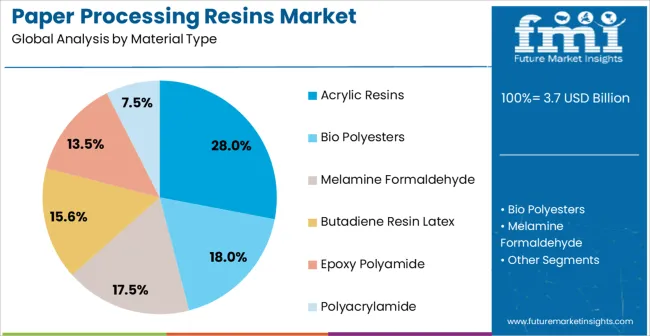
The acrylic resins segment is projected to hold 28.00% of the Paper Processing Resins market revenue share in 2026, establishing it as the leading material type. This dominance is attributed to the superior performance characteristics of acrylic resins, which enhance paper strength, gloss, and printability.
The segment has benefited from advancements in polymerization techniques that improve resin uniformity and functional versatility. High demand for high-quality writing and specialty papers has reinforced the adoption of acrylic resins, as they provide excellent bonding and surface smoothness.
The compatibility of acrylic resins with diverse processing conditions and their ability to improve efficiency in paper manufacturing further support the segment’s growth Additionally, the rising emphasis on sustainable and non-toxic paper production has encouraged the use of acrylic-based resins in environmentally conscious applications, sustaining their leading market position.
Insights into the Dry Strength Resins Application Segment
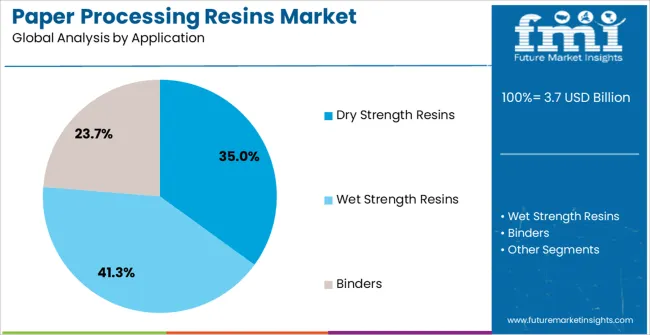
The dry strength resins application segment is expected to account for 35.00% of the Paper Processing Resins market revenue share in 2026, making it the leading application. Growth in this segment is driven by the increasing requirement for mechanically strong paper products in packaging, printing, and writing applications.
The adoption of dry strength resins improves tensile strength, stiffness, and durability, which are essential for high-performance paper. Manufacturers are increasingly integrating these resins into production lines to meet the quality demands of end-users, particularly in commercial and industrial paper segments.
The segment has also benefited from ongoing technological improvements in resin formulations, which enhance bonding efficiency while maintaining cost-effectiveness Additionally, the growing need for sustainable paper solutions that minimize fiber usage while maximizing strength has further reinforced the demand for dry strength resins, solidifying their position as the dominant application segment.
Insights into the Writing Paper End-Use Industry Segment
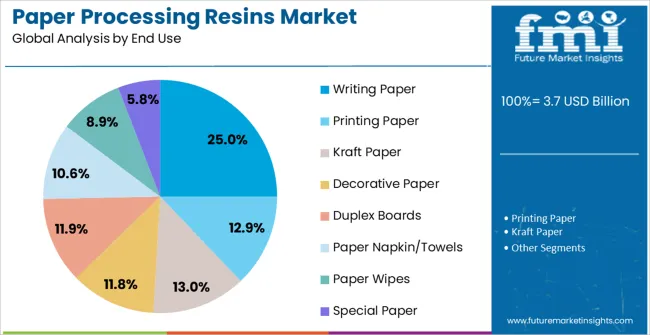
The writing paper end-use segment is projected to hold 25.00% of the Paper Processing Resins market revenue in 2026, making it the leading end-use industry. This growth is driven by the continuous demand for high-quality, durable, and aesthetically appealing writing paper in educational, commercial, and personal applications. The integration of advanced resins into writing paper production enhances smoothness, opacity, and printability, ensuring a superior user experience.
Manufacturers are increasingly adopting resin solutions to meet stringent quality standards and evolving consumer preferences. The segment has also benefited from innovations in eco-friendly resin formulations, which align with sustainability goals without compromising performance.
Additionally, the growing volume of printed educational materials, office stationery, and specialty writing papers globally supports the steady adoption of resins in this end-use category The combination of performance enhancement, sustainability, and consistent demand continues to reinforce the prominence of writing paper as a key application in the market.
Market Overview
The global sales of paper processing resins are anticipated to rise at a significant pace over the forecast period from 2025 to 2035. Demand in the market is mostly driven by increasing adoption of paper processing resins across paper a& pulp industry.
Paper processing resins are substances used during the manufacturing process of paper with the aim of modifying its (paper’s) properties. Addition of these resins help manufacturers to enhance the properties such as hardness, strength, and barrier properties of paper. Rising demand for high strength paper across diverse end-use industries will continue to push the sales of paper processing resins during the forecast period.
Various materials including polyamides, polyacrylamide, acrylic resins etc. are being increasingly used as paper processing resins for the production of paper on account of their solvent resistance, mechanical stability, and excellent bonding properties. They are used as binders, dry strength resins or wet strength resins in paper & pulp industries.
Increasing adoption of paper processing resins for the production of various types of paper such as writing paper, kraft paper, printing paper, special paper etc. is projected to boost the growth of paper processing resins market in the future.
Moreover, rising focus on replacing plastic bags and other packaging materials with paper ones will further create growth opportunities for paper processing resin manufacturers during the forecast period.
Analysis of Paper Processing Resins Market By Key Countries
.webp "Top Country Growth Comparison Paper Processing Resins Market Cagr (2026 2036)")
| Country | CAGR |
|---|---|
| China | 8.8% |
| India | 8.1% |
| Germany | 7.5% |
| Brazil | 6.8% |
| USA | 6.2% |
| UK | 5.5% |
| Japan | 4.9% |

Country-wise Analysis
The Paper Processing Resins Market is expected to register a CAGR of 6.5% during the forecast period, exhibiting varied country level momentum. China leads with the highest CAGR of 8.8%, followed by India at 8.1%. Developed markets such as Germany, France, and the UK continue to expand steadily, while the USA is likely to grow at consistent rates. Japan posts the lowest CAGR at 4.9%, yet still underscores a broadly positive trajectory for the global Paper Processing Resins Market. In 2025, Germany held a dominant revenue in the Western Europe market and is expected to grow with a CAGR of 7.5%. The USA Paper Processing Resins Market is estimated to be valued at USD 1.3 billion in 2026 and is anticipated to reach a valuation of USD 1.3 billion by 2036. Sales are projected to rise at a CAGR of 0.0% over the forecast period between 2026 and 2036. While Japan and South Korea markets are estimated to be valued at USD 169.5 million and USD 115.2 million respectively in 2026.
Key Players in the Paper Processing Resins Market

- Chang Chun Group
- Vertex Chem
- DIC Corporation
- Wacker Chemie AG
- Royal DSM
- Dow Chemical Company
- Nissin Chemical
- Sumitomo Corporation
Scope of the Report
| Metric | Value |
|---|---|
| Quantitative Units | USD 3.94 billion to USD 7.40 billion, at a CAGR of 6.5% |
| Market Definition | Paper processing resins are synthetic or bio-based chemical additives used during paper manufacturing to improve the mechanical, barrier, and surface properties of finished paper and paperboard products. Product categories include wet-strength resins that maintain paper integrity under moisture exposure, dry-strength resins that increase tensile and burst resistance, and binder resins used in coating and sizing operations. Key resin chemistries include acrylic, melamine formaldehyde, polyamide, butadiene latex, epoxy, and polyacrylamide formulations applied across writing, printing, packaging, decorative, and specialty paper grades. |
| Material Type, Application, End Use Segmentation | Material Type: Acrylic Resins, Bio Polyesters, Melamine Formaldehyde, Butadiene Resin Latex, Epoxy Polyamide, Polyacrylamide; Application: Dry Strength Resins, Wet Strength Resins, Binders; End Use: Writing Paper, Printing Paper, Kraft Paper, Decorative Paper, Duplex Boards, Paper Napkin/Towels, Paper Wipes, Special Paper |
| Regions Covered | North America, Latin America, Europe, East Asia, South Asia, Oceania, Middle East & Africa |
| Countries Covered | China, India, Germany, Brazil, USA, UK, Japan, and 40 plus countries |
| Key Companies Profiled | Chang Chun Group, Dow Chemical Company, Vertex Chem, DIC Corporation, Wacker Chemie AG, Royal DSM, Nissin Chemical, Sumitomo Corporation |
| Forecast Period | 2026 to 2036 |
| Approach | Forecasting models apply a bottom-up methodology starting with production volume benchmarks and average selling price data, cross-validated against public financial disclosures and trade statistics. |
Paper Processing Resins Market by Segments
Material Type:
- Acrylic Resins
- Bio Polyesters
- Melamine Formaldehyde
- Butadiene Resin Latex
- Epoxy Polyamide
- Polyacrylamide
Application:
- Dry Strength Resins
- Wet Strength Resins
- Binders
End Use:
- Writing Paper
- Printing Paper
- Kraft Paper
- Decorative Paper
- Duplex Boards
- Paper Napkin/Towels
- Paper Wipes
- Special Paper
Region:
- North America
- USA
- Canada
- Mexico
- Latin America
- Brazil
- Chile
- Rest of Latin America
- Western Europe
- Germany
- UK
- Italy
- Spain
- France
- Nordic
- BENELUX
- Rest of Western Europe
- Eastern Europe
- Russia
- Poland
- Hungary
- Balkan & Baltic
- Rest of Eastern Europe
- East Asia
- China
- Japan
- South Korea
- South Asia and Pacific
- India
- ASEAN
- Australia & New Zealand
- Rest of South Asia and Pacific
- Middle East & Africa
- Kingdom of Saudi Arabia
- Other GCC Countries
- Turkiye
- South Africa
- Other African Union
- Rest of Middle East & Africa
Bibliography
- European Commission, Directorate-General for Health. (2024). Regulation (EC) No 1935/2004 on food contact materials: Implementation guidance. European Commission.
- United States Food and Drug Administration. (2024). 21 CFR Parts 175-178: Indirect food additives. U.S. FDA.
- International Organization for Standardization. (2024). ISO 16065:2024 Pulps: Determination of fibre length. ISO.
- Confederation of European Paper Industries. (2024). Key statistics on European pulp and paper industry. CEPI.
- Organisation for Economic Co-operation and Development. (2024). Chemicals safety and biosafety: OECD guidelines. OECD.
This bibliography is provided for reader reference. The full Future Market Insights report contains the complete reference list with primary research documentation.
Frequently Asked Questions
How large is the demand for Paper Processing Resins in the global market in 2026?
Demand for paper processing resins in the global market is estimated to be valued at USD 3.94 billion in 2026.
What will be the market size of Paper Processing Resins in the global market by 2036?
Market size for paper processing resins is projected to reach USD 7.40 billion by 2036.
What is the expected demand growth for Paper Processing Resins in the global market between 2026 and 2036?
Demand for paper processing resins is expected to grow at a CAGR of 6.5% between 2026 and 2036.
Which Material Type is poised to lead global sales by 2026?
Acrylic Resins accounts for 28% share in 2026, as it remains the primary specification across established procurement channels.
How is the Application segment structured in 2026?
Dry Strength Resins leads with 35% of segment share in 2026, driven by established buyer preference and supply chain compatibility.
What is China's growth outlook in this report?
China is projected to grow at a CAGR of 8.8% during 2026 to 2036.
What is Paper Processing Resins and what is it mainly used for?
Paper processing resins are synthetic or bio-based chemical additives used during paper manufacturing to improve the mechanical, barrier, and surface properties of finished paper and paperboard products. Product categories include wet-strength resins that maintain paper integrity under moisture exposure, dry-strength resins that increase tensile and burst resistance, and binder resins used in coating and sizing operations.
What is included in the scope of this Paper Processing Resins report?
Market scope includes acrylic resins, bio polyesters, melamine formaldehyde, butadiene resin latex, epoxy polyamide, and polyacrylamide formulations. Application coverage spans dry-strength resins, wet-strength resins, and binders.
Preview the report firsthand - request a free sample
Get SampleGet the brochure for pricing and purchase details.
Get PDFTable of Content
- Executive Summary
- Global Market Outlook
- Demand-side Trends
- Supply-side Trends
- Technology Roadmap Analysis
- Analysis and Recommendations
- Market Overview
- Market Coverage / Taxonomy
- Market Definition / Scope / Limitations
- Research Methodology
- Chapter Orientation
- Analytical Lens and Working Hypotheses
- Market Structure, Signals, and Trend Drivers
- Benchmarking and Cross-market Comparability
- Market Sizing, Forecasting, and Opportunity Mapping
- Research Design and Evidence Framework
- Desk Research Programme (Secondary Evidence)
- Company Annual and Sustainability Reports
- Peer-reviewed Journals and Academic Literature
- Corporate Websites, Product Literature, and Technical Notes
- Earnings Decks and Investor Briefings
- Statutory Filings and Regulatory Disclosures
- Technical White Papers and Standards Notes
- Trade Journals, Industry Magazines, and Analyst Briefs
- Conference Proceedings, Webinars, and Seminar Materials
- Government Statistics Portals and Public Data Releases
- Press Releases and Reputable Media Coverage
- Specialist Newsletters and Curated Briefings
- Sector Databases and Reference Repositories
- FMI Internal Proprietary Databases and Historical Market Datasets
- Subscription Datasets and Paid Sources
- Social Channels, Communities, and Digital Listening Inputs
- Additional Desk Sources
- Expert Input and Fieldwork (Primary Evidence)
- Primary Modes
- Qualitative Interviews and Expert Elicitation
- Quantitative Surveys and Structured Data Capture
- Blended Approach
- Why Primary Evidence is Used
- Field Techniques
- Interviews
- Surveys
- Focus Groups
- Observational and In-context Research
- Social and Community Interactions
- Stakeholder Universe Engaged
- C-suite Leaders
- Board Members
- Presidents and Vice Presidents
- R&D and Innovation Heads
- Technical Specialists
- Domain Subject-matter Experts
- Scientists
- Physicians and Other Healthcare Professionals
- Governance, Ethics, and Data Stewardship
- Research Ethics
- Data Integrity and Handling
- Primary Modes
- Tooling, Models, and Reference Databases
- Desk Research Programme (Secondary Evidence)
- Data Engineering and Model Build
- Data Acquisition and Ingestion
- Cleaning, Normalisation, and Verification
- Synthesis, Triangulation, and Analysis
- Quality Assurance and Audit Trail
- Market Background
- Market Dynamics
- Drivers
- Restraints
- Opportunity
- Trends
- Scenario Forecast
- Demand in Optimistic Scenario
- Demand in Likely Scenario
- Demand in Conservative Scenario
- Opportunity Map Analysis
- Product Life Cycle Analysis
- Supply Chain Analysis
- Investment Feasibility Matrix
- Value Chain Analysis
- PESTLE and Porter’s Analysis
- Regulatory Landscape
- Regional Parent Market Outlook
- Production and Consumption Statistics
- Import and Export Statistics
- Market Dynamics
- Global Market Analysis 2021 to 2025 and Forecast, 2026 to 2036
- Historical Market Size Value (USD Million) Analysis, 2021 to 2025
- Current and Future Market Size Value (USD Million) Projections, 2026 to 2036
- Y-o-Y Growth Trend Analysis
- Absolute $ Opportunity Analysis
- Global Market Pricing Analysis 2021 to 2025 and Forecast 2026 to 2036
- Global Market Analysis 2021 to 2025 and Forecast 2026 to 2036, By Material Type
- Introduction / Key Findings
- Historical Market Size Value (USD Million) Analysis By Material Type , 2021 to 2025
- Current and Future Market Size Value (USD Million) Analysis and Forecast By Material Type , 2026 to 2036
- Acrylic Resins
- Bio Polyesters
- Melamine Formaldehyde
- Butadiene Resin Latex
- Epoxy Polyamide
- Polyacrylamide
- Acrylic Resins
- Y-o-Y Growth Trend Analysis By Material Type , 2021 to 2025
- Absolute $ Opportunity Analysis By Material Type , 2026 to 2036
- Global Market Analysis 2021 to 2025 and Forecast 2026 to 2036, By Application
- Introduction / Key Findings
- Historical Market Size Value (USD Million) Analysis By Application, 2021 to 2025
- Current and Future Market Size Value (USD Million) Analysis and Forecast By Application, 2026 to 2036
- Dry Strength Resins
- Wet Strength Resins
- Binders
- Dry Strength Resins
- Y-o-Y Growth Trend Analysis By Application, 2021 to 2025
- Absolute $ Opportunity Analysis By Application, 2026 to 2036
- Global Market Analysis 2021 to 2025 and Forecast 2026 to 2036, By End Use
- Introduction / Key Findings
- Historical Market Size Value (USD Million) Analysis By End Use, 2021 to 2025
- Current and Future Market Size Value (USD Million) Analysis and Forecast By End Use, 2026 to 2036
- Writing Paper
- Printing Paper
- Kraft Paper
- Decorative Paper
- Duplex Boards
- Paper Napkin/Towels
- Paper Wipes
- Special Paper
- Writing Paper
- Y-o-Y Growth Trend Analysis By End Use, 2021 to 2025
- Absolute $ Opportunity Analysis By End Use, 2026 to 2036
- Global Market Analysis 2021 to 2025 and Forecast 2026 to 2036, By Region
- Introduction
- Historical Market Size Value (USD Million) Analysis By Region, 2021 to 2025
- Current Market Size Value (USD Million) Analysis and Forecast By Region, 2026 to 2036
- North America
- Latin America
- Western Europe
- Eastern Europe
- East Asia
- South Asia and Pacific
- Middle East & Africa
- Market Attractiveness Analysis By Region
- North America Market Analysis 2021 to 2025 and Forecast 2026 to 2036, By Country
- Historical Market Size Value (USD Million) Trend Analysis By Market Taxonomy, 2021 to 2025
- Market Size Value (USD Million) Forecast By Market Taxonomy, 2026 to 2036
- By Country
- USA
- Canada
- Mexico
- By Material Type
- By Application
- By End Use
- By Country
- Market Attractiveness Analysis
- By Country
- By Material Type
- By Application
- By End Use
- Key Takeaways
- Latin America Market Analysis 2021 to 2025 and Forecast 2026 to 2036, By Country
- Historical Market Size Value (USD Million) Trend Analysis By Market Taxonomy, 2021 to 2025
- Market Size Value (USD Million) Forecast By Market Taxonomy, 2026 to 2036
- By Country
- Brazil
- Chile
- Rest of Latin America
- By Material Type
- By Application
- By End Use
- By Country
- Market Attractiveness Analysis
- By Country
- By Material Type
- By Application
- By End Use
- Key Takeaways
- Western Europe Market Analysis 2021 to 2025 and Forecast 2026 to 2036, By Country
- Historical Market Size Value (USD Million) Trend Analysis By Market Taxonomy, 2021 to 2025
- Market Size Value (USD Million) Forecast By Market Taxonomy, 2026 to 2036
- By Country
- Germany
- UK
- Italy
- Spain
- France
- Nordic
- BENELUX
- Rest of Western Europe
- By Material Type
- By Application
- By End Use
- By Country
- Market Attractiveness Analysis
- By Country
- By Material Type
- By Application
- By End Use
- Key Takeaways
- Eastern Europe Market Analysis 2021 to 2025 and Forecast 2026 to 2036, By Country
- Historical Market Size Value (USD Million) Trend Analysis By Market Taxonomy, 2021 to 2025
- Market Size Value (USD Million) Forecast By Market Taxonomy, 2026 to 2036
- By Country
- Russia
- Poland
- Hungary
- Balkan & Baltic
- Rest of Eastern Europe
- By Material Type
- By Application
- By End Use
- By Country
- Market Attractiveness Analysis
- By Country
- By Material Type
- By Application
- By End Use
- Key Takeaways
- East Asia Market Analysis 2021 to 2025 and Forecast 2026 to 2036, By Country
- Historical Market Size Value (USD Million) Trend Analysis By Market Taxonomy, 2021 to 2025
- Market Size Value (USD Million) Forecast By Market Taxonomy, 2026 to 2036
- By Country
- China
- Japan
- South Korea
- By Material Type
- By Application
- By End Use
- By Country
- Market Attractiveness Analysis
- By Country
- By Material Type
- By Application
- By End Use
- Key Takeaways
- South Asia and Pacific Market Analysis 2021 to 2025 and Forecast 2026 to 2036, By Country
- Historical Market Size Value (USD Million) Trend Analysis By Market Taxonomy, 2021 to 2025
- Market Size Value (USD Million) Forecast By Market Taxonomy, 2026 to 2036
- By Country
- India
- ASEAN
- Australia & New Zealand
- Rest of South Asia and Pacific
- By Material Type
- By Application
- By End Use
- By Country
- Market Attractiveness Analysis
- By Country
- By Material Type
- By Application
- By End Use
- Key Takeaways
- Middle East & Africa Market Analysis 2021 to 2025 and Forecast 2026 to 2036, By Country
- Historical Market Size Value (USD Million) Trend Analysis By Market Taxonomy, 2021 to 2025
- Market Size Value (USD Million) Forecast By Market Taxonomy, 2026 to 2036
- By Country
- Kingdom of Saudi Arabia
- Other GCC Countries
- Turkiye
- South Africa
- Other African Union
- Rest of Middle East & Africa
- By Material Type
- By Application
- By End Use
- By Country
- Market Attractiveness Analysis
- By Country
- By Material Type
- By Application
- By End Use
- Key Takeaways
- Key Countries Market Analysis
- USA
- Pricing Analysis
- Market Share Analysis, 2025
- By Material Type
- By Application
- By End Use
- Canada
- Pricing Analysis
- Market Share Analysis, 2025
- By Material Type
- By Application
- By End Use
- Mexico
- Pricing Analysis
- Market Share Analysis, 2025
- By Material Type
- By Application
- By End Use
- Brazil
- Pricing Analysis
- Market Share Analysis, 2025
- By Material Type
- By Application
- By End Use
- Chile
- Pricing Analysis
- Market Share Analysis, 2025
- By Material Type
- By Application
- By End Use
- Germany
- Pricing Analysis
- Market Share Analysis, 2025
- By Material Type
- By Application
- By End Use
- UK
- Pricing Analysis
- Market Share Analysis, 2025
- By Material Type
- By Application
- By End Use
- Italy
- Pricing Analysis
- Market Share Analysis, 2025
- By Material Type
- By Application
- By End Use
- Spain
- Pricing Analysis
- Market Share Analysis, 2025
- By Material Type
- By Application
- By End Use
- France
- Pricing Analysis
- Market Share Analysis, 2025
- By Material Type
- By Application
- By End Use
- India
- Pricing Analysis
- Market Share Analysis, 2025
- By Material Type
- By Application
- By End Use
- ASEAN
- Pricing Analysis
- Market Share Analysis, 2025
- By Material Type
- By Application
- By End Use
- Australia & New Zealand
- Pricing Analysis
- Market Share Analysis, 2025
- By Material Type
- By Application
- By End Use
- China
- Pricing Analysis
- Market Share Analysis, 2025
- By Material Type
- By Application
- By End Use
- Japan
- Pricing Analysis
- Market Share Analysis, 2025
- By Material Type
- By Application
- By End Use
- South Korea
- Pricing Analysis
- Market Share Analysis, 2025
- By Material Type
- By Application
- By End Use
- Russia
- Pricing Analysis
- Market Share Analysis, 2025
- By Material Type
- By Application
- By End Use
- Poland
- Pricing Analysis
- Market Share Analysis, 2025
- By Material Type
- By Application
- By End Use
- Hungary
- Pricing Analysis
- Market Share Analysis, 2025
- By Material Type
- By Application
- By End Use
- Kingdom of Saudi Arabia
- Pricing Analysis
- Market Share Analysis, 2025
- By Material Type
- By Application
- By End Use
- Turkiye
- Pricing Analysis
- Market Share Analysis, 2025
- By Material Type
- By Application
- By End Use
- South Africa
- Pricing Analysis
- Market Share Analysis, 2025
- By Material Type
- By Application
- By End Use
- USA
- Market Structure Analysis
- Competition Dashboard
- Competition Benchmarking
- Market Share Analysis of Top Players
- By Regional
- By Material Type
- By Application
- By End Use
- Competition Analysis
- Competition Deep Dive
- Chang Chun Group
- Overview
- Product Portfolio
- Profitability by Market Segments (Product/Age /Sales Channel/Region)
- Sales Footprint
- Strategy Overview
- Marketing Strategy
- Product Strategy
- Channel Strategy
- Dow Chemical Company
- Vertex Chem
- DIC Corporation
- Wacker Chemie AG
- Royal DSM
- Nissin Chemical
- Sumitomo Corporation
- Chang Chun Group
- Competition Deep Dive
- Assumptions & Acronyms Used


