

- Market Size (2026)
- USD 61.9 Mn
- Forecast (2036)
- USD 170.5 Mn
- CAGR (2026 to 2036)
- 10.7%
How big is Revivable Yeast Market in 2026?
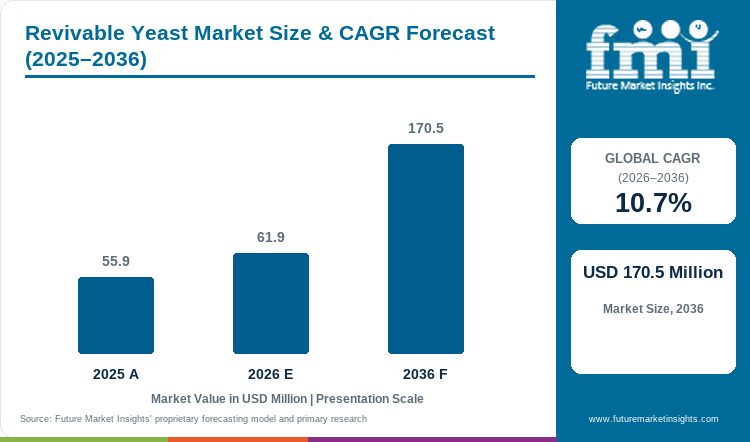
The revivable yeast market is valued at USD 61.9 million in 2026 and is projected to reach USD 170.5 million by 2036, expanding at a CAGR of 10.7% over the forecast period.
Demand for revivable yeast is projected to expand at 10.7% CAGR between 2026 and 2036. Industry value grows from USD 55.9 million in 2025 to USD 61.9 million in 2026 and is projected to reach USD 170.5 million by 2036. Consumers are already using capsules, powders and tablets, so brands are not teaching a new supplement routine. Buyers are asking suppliers to prove that enough yeast cells stay alive through storage and reach consumers in usable condition. Suppliers are supporting live-yeast supplement lines with clear strain records, shelf-life data and storage instructions. Brands are using powder as a flexible base for direct sale or later capsule and tablet filling.
Country conditions are diverging as brands are working under different supplement, claim and ingredient rules. In May 2026, CDC reported that 60.2% of U.S. adults used a dietary supplement during August 2021-August 2023. U.S. brands are following FDA labeling and new dietary ingredient rules, while European and Asian brands are using different approval systems. Suppliers are preparing different records for each route before brands approve a live yeast product. Brands are using clear strain identity, storage instructions and claim evidence to move products from ingredient review to retail sale.
Key Takeaways
- Consumers are already buying capsules, tablets and powders, giving revivable yeast a familiar route into supplement routines.
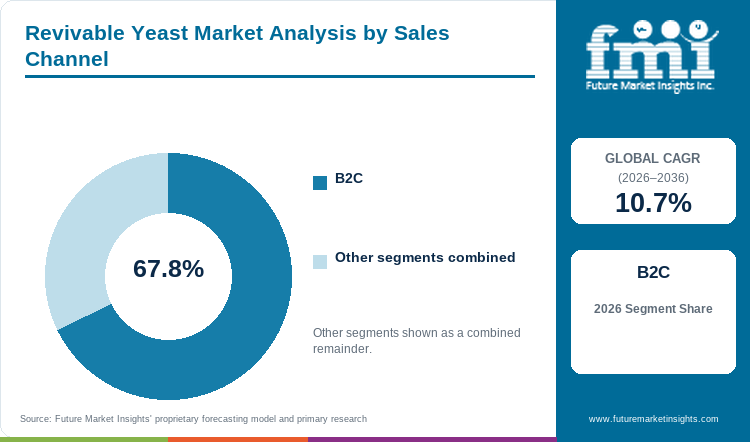
- B2C is leading sales channel demand at 67.8% in 2026 as brands are selling premeasured doses directly to consumers.
- Brands are choosing conventional yeast from a wider supplier base, supporting its 96.2% share of nature demand in 2026.
- Brands are using powder for direct sale and capsule filling, supporting its 44.7% share of form demand in 2026.
- Buyers are checking live-cell stability because heat, moisture and poor storage can lower cell counts through shelf life.
- Lesaffre, Lallemand, Angel Yeast Co., AB Mauri and Fleischmann's are serving health, fermentation and baking yeast demand.
Analyst Perspective
"Brands are finding the clearest opportunity by making live-yeast products as easy to approve as familiar supplements. Manufacturers are preparing stronger strain, shelf-life and storage files because buyers are asking harder questions before launch."
- Nandini Roy Choudhury, Principal Consultant, Future Market Insights.
How is the revivable yeast market segmented?
The revivable yeast market is segmented three ways: by Sales Channel, Nature, and Form. B2C leads the Sales Channel category with 67.8% of 2026 revenue, Conventional leads Nature with 96.2%, and Powder leads Form with 44.7%.
Sales channel separates direct consumer sales from business sales. Nature separates conventional products from certified organic products. Form covers powder, capsule and tablet products. Together, these axes show who is buying revivable yeast, how producers are making it and which form reaches the buyer.
Why does B2C lead the Sales Channel category?
Consumers are buying revivable yeast as a finished supplement without another formulation step. Capsules and powders are already matching familiar supplement routines. Brands are explaining the live-yeast benefit instead of teaching consumers how to prepare the product.
- By sales channel, B2C is estimated to hold 67.8% in 2026. Consumers are buying prepacked doses without waiting for another manufacturer to prepare a finished formula.
- Food Standards Agency guidance recognizes powders and measured doses as familiar supplement forms. Brands are using those formats to give buyers clear serving and storage instructions.
What sustains Conventional dominance in the Nature category?
Brands are using conventional yeast from a wider supplier base because organic yeast needs certified inputs and added production checks. Organic producers are documenting fermentation inputs and processing steps before using an organic claim. Regulation (EU) 2018/848 sets production rules for organic yeast used as food. These requirements are narrowing the eligible supplier pool and adding paperwork for brands.
- In 2026, conventional is expected to lead nature with 96.2% share. Brands are sourcing it from more suppliers without completing organic certification checks.
- EU organic rules set production controls for organic yeast used as food or feed. Suppliers are documenting organic inputs and processing steps that conventional products do not require.
What makes Powder central to the Form category?
Suppliers are using powder as one dry form for direct sale and later capsule or tablet production. B2B buyers are setting serving sizes and adding other ingredients before making finished doses. South Korea's health functional food system separates bulk ingredients from finished products and lists several dose forms. Powder is therefore serving both ingredient buyers and consumer brands.
- Powder is set to lead form demand with 44.7% share in 2026. Brands are using the dry form for direct sale and later capsule or tablet production.
- MFDS guidance lists powder, capsule and tablet among health functional food forms sold to consumers. Manufacturers are following a separate route for bulk ingredients used in later production.
What are the drivers, restraints and opportunities in the revivable yeast market?
In the revivable yeast market, the key driver is familiar supplement formats that help consumers adopt products, the key restraint is live-cell stability requirements during storage, and the key opportunity is organic certification and live-cell records that support premium products.
- Driver: Consumers are using familiar capsule, tablet and powder formats, making revivable yeast easier to understand and adopt.
- Restraint: Suppliers are protecting live cells through storage while brands are keeping product claims within food supplement rules.
- Opportunity: Brands are using organic certification and live-cell records to support premium products without broad health claims.
Consumers are already using capsules, tablets and powders in everyday supplement routines. Brands are placing revivable yeast in the same formats instead of teaching a new way to take it. Brands are focusing product messages on live cells, strain identity and storage. In January 2026, the Food Standards Agency said millions of people across the UK take food supplements. That familiarity is supporting retail sales of live yeast in fixed-dose products. Brands are also using powder because consumers can take it directly or companies can fill capsules. Suppliers are explaining how the yeast stays alive and how buyers should store it. Clear serving instructions are making the product easier to understand and sell.
Live yeast suppliers are keeping products stable from packing through the stated shelf life. Heat, moisture and poor storage can lower the number of living cells. Brands are avoiding probiotic claims unless strain and dose evidence supports the stated benefit. In September 2025, ISAPP updated guidance saying probiotic strains need evidence at a defined dose. The guidance states that each microorganism needs a documented health benefit. Suppliers are providing strain records, storage data and clear label support for each finished form. Brands are using those files during ingredient approval and claim review. Missing evidence can delay launches and increase review work. Shelf-life data is giving buyers a clear basis for ingredient approval.
Brands are using organic revivable yeast to support a clear production claim without making a health claim. Producers are sourcing organic inputs and controlling processing to keep certification valid. These requirements are limiting the number of plants that can make an organic product. Arkopharma sells organic revivable Saccharomyces cerevisiae capsules as a food supplement. Nat&Form sells organic revivable brewer's yeast capsules made from low-heat dried living cells. These products confirm that live organic yeast can reach consumers in fixed doses. Suppliers are providing origin records and storage data for both organic status and live-cell stability. Brands are using those records to support a premium claim without broad wellness language.
Which country CAGRs are included in the revivable yeast market?
| Country | CAGR |
|---|---|
| South Korea | 12.6% |
| Japan | 10.3% |
| UK | 9.1% |
| USA | 8.8% |
| Germany | 6.8% |
How do country-level CAGRs compare in the revivable yeast market?
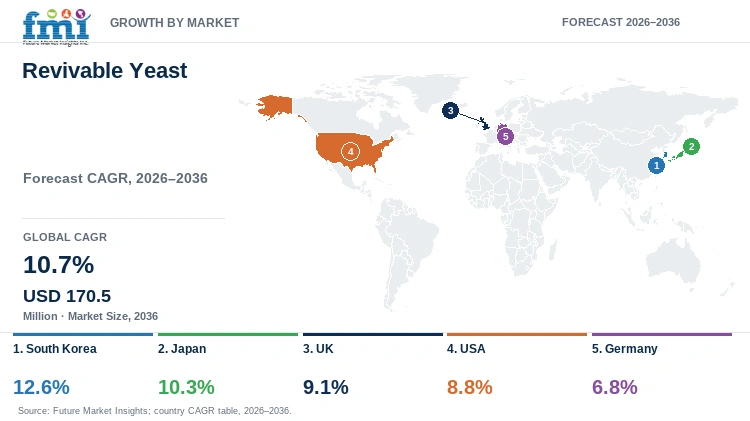
Within the revivable yeast market, South Korea is projected to grow at 12.6% CAGR through 2036, followed by Japan at 10.3%, the UK at 9.1%, the USA at 8.8%, and Germany at 6.8%.Brands are facing different approval routes across the five countries. Local rules are changing which label, ingredient and strain records suppliers must prepare for buyers.
- South Korean brands are working through a health functional food system that requires ingredient identity and product-form records for review.
- Japanese brand operators are carrying responsibility for function-claim evidence, increasing demand for clear strain and safety files from suppliers.
- UK supplement sellers are using familiar dose forms while FSA rules are keeping safe-use information and food claims central to review.
- U.S. brands are following FDA labeling and new dietary ingredient rules, increasing demand for strain identity and safety-history records.
- German brands are following EU food-claim and organic-production rules while national oversight is keeping product records central to review.
Brands are asking suppliers for different mixes of label, ingredient and strain records in each country. Local rules are shaping which files buyers review before approving live yeast products.
Country-wise Analysis
- By 2036, South Korea is projected to grow at 12.6% CAGR under its health functional food system. MFDS is using separate routes for approved functional ingredients and ordinary food claims. In August 2026, MFDS published Regulation 2026-33 covering ingredient recognition and product standards. Manufacturers are following a different route for bulk ingredients than products sold directly to consumers. Suppliers are preparing identity records and label information for local brand reviews. Brands are checking whether live yeast claims match the route allowed for each finished supplement. Weak evidence can delay launches or force brands to revise records.
- Japan's revivable yeast outlook is anticipated to advance at 10.3% CAGR through 2036 under its function-claim system. Businesses are submitting safety and function evidence for Foods with Function Claims through the national notice system. In April 2025, the Consumer Affairs Agency renewed its filing database for new and updated notices. Brand owners are carrying responsibility for the evidence behind each claim. Companies are selling revivable yeast under normal food rules without a function claim. Health claims are creating more work because brands must support the stated function. Suppliers are providing strain records that match the use printed on labels. Clear files are helping brands connect live-yeast identity with the claim they plan to make.
- Revivable yeast sales in the UK are forecast to expand at 9.1% CAGR by 2036. Brands are treating food supplements as foods and are avoiding medicinal claims without the required approval. In July 2026, FSA retail checks found labeling errors across food supplements and other retail categories. The findings are keeping label accuracy central to product review. Brands are using familiar capsule and powder formats for retail sales. Suppliers are giving buyers clear serving and storage instructions to protect live cells through shelf life. Brands are avoiding health language that food rules do not allow. Clear product wording is reducing review work and lowering the risk of label changes before launch.
- In the USA, revivable yeast demand is predicted to advance at 8.8% CAGR through 2036. Brands are following FDA labeling rules for dietary supplements and extra checks for new dietary ingredients. In June 2025, FDA released educational materials on the New Dietary Ingredient notification process. New yeast strains can require more safety evidence under those rules. Suppliers are keeping identity and production records so brands can decide whether a notification is required. Brands are also checking shelf-life controls because live-cell counts can fall during storage. Missing files can slow a new strain or formula. Complete records are helping buyers review ingredients and prepare retail labels. Brands are using approved files to move products toward consumers.
- Germany is estimated to post 6.8% CAGR over the forecast period. EU food rules and German supplement oversight are guiding local claim review. In July 2025, BfR reported that more than two thirds of respondents had used supplements during the previous year. BfR also explained that supplements are foods rather than approved medicines. Brands are keeping claims within food rules. Organic revivable yeast adds EU production requirements for yeast sold as food. Suppliers are separating food claims from treatment language and are documenting live-cell stability. Product teams are using those records during label and supplier review.
Who are the notable companies in the revivable yeast market?
Lesaffre, Lallemand, Angel Yeast Co., AB Mauri, and Fleischmann's are notable companies in this market.
Notable companies in the revivable yeast market include Lesaffre, Lallemand, Angel Yeast Co., AB Mauri, and Fleischmann's.
Human-health yeast suppliers such as Lesaffre, Lallemand and Angel Yeast Co. are serving supplement brands with live-yeast products. Gnosis by Lesaffre is offering ibSium®, a live Saccharomyces cerevisiae strain for supplements. Lallemand Health Solutions is providing probiotic strains and formulation help for supplement brands. Angel Human Health is supplying Saccharomyces cerevisiae and Saccharomyces boulardii for gut-health products. AB Mauri is making dry yeast for baking and fermentation. Fleischmann's is selling active dry Saccharomyces cerevisiae for consumer baking. Buyers are comparing strain control, technical help and supplement experience before approving a supplier.
- Human-health yeast platforms: Lesaffre, Lallemand and Angel Yeast Co. are supplying live-yeast or probiotic products for nutrition and supplement use.
- Industrial baking-yeast network: AB Mauri is supporting bakery and fermentation customers through dry-yeast manufacturing and broad distribution.
- Consumer active-dry brand: Fleischmann's is selling living Saccharomyces cerevisiae for retail baking rather than dietary supplement use.
Competitive Benchmarking: Revivable Yeast Market
| Company | Viable Dry-Yeast Production | Human Nutrition Evidence | Organic Active-Yeast Evidence | Geographic Reach |
|---|---|---|---|---|
| Lesaffre | High | High | High | Europe, North America and a global production and R&D network |
| Lallemand | High | High | High | More than 50 countries across five continents |
| Angel Yeast Co. | High | High | Medium | China-based manufacturing with nutrition products sold across more than 150 countries and regions |
| AB Mauri | High | Medium | Low | North America, Latin America, Europe, Asia, Middle East and Africa |
| Fleischmann's | Medium | Low | Low | United States and Canada retail presence with AB Mauri-linked professional channels |
The table compares company capabilities rather than market share. A High viable dry-yeast rating means the company is documenting active or live dry-yeast manufacturing. A High human nutrition rating means the company is documenting yeast products for supplements or human health. A High organic rating means the company is documenting an organic active yeast product. Medium means public evidence covers part of the capability or a related product. Low means current company materials do not show the capability. Lesaffre and Lallemand are documenting organic active yeast products. Angel receives Medium because its organic certificate covers nutritional yeast while active dry yeast appears in another product line.
Key Developments in the Revivable Yeast Market
- In June 2025, Gnosis by Lesaffre hosted Biotic Live on probiotic yeast for human health. The program covered Saccharomyces cerevisiae CNCM I-3856 for digestive and women's health products. Supplement teams are using the shared details while reviewing live-yeast formulas.
- In September 2025, Lallemand Health Solutions published a review of Oralis SB for oral-health probiotic use. Oralis SB includes Saccharomyces boulardii CNCM I-1079 among its documented strains. Buyers are using the review as added evidence for live yeast in finished probiotic products.
- In May 2026, Angel Yeast presented Saccharomyces boulardii gut-health solutions at Vitafoods Europe. Angel paired live probiotic yeast with other ingredients for human-health products. Nutrition brands are using the event information to compare documented yeast options for gut-health formulas.
Key Players in the Revivable Yeast Market
Multi-market fermentation and nutrition platforms
- Lesaffre
- Lallemand
- Angel Yeast Co.
Industrial dry-yeast manufacturing network
- AB Mauri
Consumer active-dry yeast brand
- Fleischmann's
Revivable Yeast Market - Report Scope
| Coverage field | Report scope |
|---|---|
| Market breakdown | Sales Channel, Nature and Form |
| Quantitative Units | USD Million |
| Market Definition | Revenue includes viable dried Saccharomyces cerevisiae preparations sold as revivable yeast in powder, capsule or tablet form through B2C or B2B channels. It excludes ordinary baking or brewing starter yeast sold only for processing, heat-inactivated nutritional yeast, yeast extracts and proteins, adjacent substitutes and downstream finished-product revenue. |
| Regions Covered | North America; Latin America; Western Europe; Eastern Europe; East Asia; South Asia and Pacific; Middle East and Africa |
| Countries Covered | UK, USA, South Korea, Japan, Germany |
| Key Companies Profiled | Lesaffre, Lallemand, Angel Yeast Co., AB Mauri, Fleischmann's |
| Forecast Period | 2026 to 2036 |
| Approach | Primary and secondary research with market triangulation. |
Revivable Yeast Market - Research Methodology
| Method | Approach |
|---|---|
| Primary Research | FMI analysts gathered input from manufacturers, service providers, technology developers, distributors, end users, procurement teams and subject-matter experts. Interviews examined purchasing decisions, product or service evaluation, adoption barriers, approval requirements, pricing considerations and expectations for technical or commercial support. Respondents were also asked what evidence is required before a trial, pilot, or initial order develops into regular purchasing. |
| Desk Research | Desk research covered government statistics, regulatory publications, trade data, industry associations, technical literature, standards, company filings, product information and official corporate announcements. Sources were reviewed for relevance, publication date, geographic coverage and consistency with the defined market scope. Claims relating to performance, applications, approvals, capacity, investment and commercial activity were retained only when supported by credible public evidence. |
| Market Sizing and Forecasting | The market model combined the baseline value with historical performance, segment structure, pricing and volume indicators, adoption levels, company participation and country-level demand conditions. Forecast assumptions considered economic activity, investment trends, regulatory developments, technology adoption, purchasing cycles, supply availability and barriers to wider market use. Segment and regional estimates were reconciled before the final market total was calculated. |
| Data Validation | Estimates were checked against multiple independent indicators, including public data, company activity, trade patterns, industry developments and findings from primary interviews. Validation also tested whether products, services, applications and company revenues fell within the defined market boundaries. Adjacent categories, unsupported claims, overlapping revenues and activities without direct market relevance were excluded to reduce double counting and maintain consistency across segments and countries. |
Revivable Yeast Market by Segments
Revivable Yeast Market segmented by Sales Channel:
- B2C
- B2B
Revivable Yeast Market segmented by Nature:
- Conventional
- Organic
Revivable Yeast Market segmented by Form:
- Powder
- Capsule
- Tablet
Revivable Yeast Market by Region:
- North America
- United States
- Canada
- Latin America
- Brazil
- Mexico
- Argentina
- Chile
- Western Europe
- Germany
- France
- United Kingdom
- Italy
- Spain
- Benelux
- Nordics
- Eastern Europe
- Poland
- Czech Republic
- Romania
- Hungary
- East Asia
- China
- Japan
- South Korea
- South Asia and Pacific
- India
- ASEAN
- Australia and New Zealand
- Middle East and Africa
- GCC Countries
- South Africa
- Türkiye
- Israel
Research Sources and Bibliography
- Food Standards Agency (2026, June 25). Food supplements guidance.
- Food Standards Agency (2026, January 20). New year, new guidance: FSA helps consumers navigate food supplements safely.
- National Center for Health Statistics. (2026, May 21). Dietary Supplement Use: United States, August 2021-August 2023.
- U.S. Food and Drug Administration (2005, April). Dietary Supplement Labeling Guide: Chapter I. General Dietary Supplement Labeling.
- U.S. Food and Drug Administration (n.d.). New Dietary Ingredient (NDI) Notification Process.
- European Commission (n.d.). Food supplements.
- European Commission (n.d.). Nutrition and Health Claims.
- European Parliament and Council (2018, May 30). Regulation (EU) 2018/848 on organic production and labelling of organic products.
- Ministry of Food and Drug Safety, Republic of Korea (2026, August 13). Regulation on Recognition of Functional Ingredient and of Standard·Specification for Health Functional Foods (No. 2026-33).
- Ministry of Food and Drug Safety, Republic of Korea (2011, December 21). Requirements for Health Functional Foods.
- Consumer Affairs Agency, Japan (n.d.). Foods with Function Claims.
- International Scientific Association for Probiotics and Prebiotics (2025, September 10). Probiotics.
- International Scientific Association for Probiotics and Prebiotics (2020, August 3). How do probiotics stay alive until they are consumed?.
- Schmidt, S. A., et al. (2015). Production, reactivation and nutrient requirements of active dried yeast in winemaking: theory and practice.
- Nat&Form (n.d.). Levure de bière revivifiable Bio en gélules.
- Arkopharma (n.d.). Arkocaps® Organic Brewer's yeast.
- Lesaffre (2026, March 11). What are the different forms of yeast?.
- Lesaffre (2025, August 26). Lesaffre invests in a new state-of-the-art yeast production for fermented beverages and packaging facilities on its production plant in Ghent, Belgium.
- Lesaffre (2025, June 12). MicroBioGen and Lesaffre establish exclusive global partnership to provide innovative yeast solutions for the global Baking, Food, and Biochemicals markets.
- Lesaffre (2025, June 2). Lesaffre and Zilor enter a joint venture.
- Lallemand (2025, April 30). Discover Lallemand’s New Limited Release Series and Northern IPA Yeast.
- Lallemand (n.d.). Bio-Ingredients.
- Lallemand (n.d.). Instaferm® GREEN.
- Lallemand (2025, July 17). Lallemand acquires enzyme specialist Solyve.
- Lallemand (2025, July 4). Lallemand Acquires AIT Ingredients.
- Lallemand (n.d.). Our history.
- Angel Yeast Co. (2025, February 17). Vitafoods India 2025: Angel Yeast Brings Innovative Yeast Protein to Dining Table.
- Angel Yeast Co. (2025, July 17). Angel Yeast Highlights Pioneering Yeast Protein and Sustainable Solutions at IFT FIRST 2025, Redefining the Future of Food.
- Angel Yeast Co. (2025, May). Angel Yeast Showcases Innovative "Yeast Solutions For A Sustainable Tomorrow" at Vitafoods Europe 2025.
- Angel Yeast Co. (n.d.). YeaVita Active Dry Yeast.
- AB Mauri (n.d.). North America.
- AB Mauri (n.d.). Locations.
- Fleischmann's (n.d.). Baking Yeast.
- Fleischmann's (n.d.). Yeast 101.
- Food Standards Agency. (2026, July). Retail Surveillance Survey Sampling Programme 2025/26.
- Consumer Affairs Agency, Japan. (2025, April 1). 機能性表示食品制度届出データベースを更改しました.
- U.S. Food and Drug Administration. (2025, June 11). FDA Releases Educational Materials on the New Dietary Ingredient Notification Process for Dietary Supplements.
- Federal Institute for Risk Assessment (BfR). (2025, July 18). Between hype and misconception: common misunderstandings about food supplements.
- Gnosis by Lesaffre. (2025, June 6). Biotic Live: A Successful First Edition Exploring the Power of Probiotic Yeasts.
- Lallemand Health Solutions. (2025, September 16). New Review Highlights the Oral Health Benefits of Oralis SB.
- Angel Yeast Co. (2026, May 7). Angel Yeast at Vitafoods Europe 2026, Pioneering Global Nutrition and Health Trends with AngeoPro Yeast Protein.
- Lesaffre. (2026, July 6). What is organic yeast?.
- Gnosis by Lesaffre. (2026, March 4). Join Us at Natural Products Expo West®.
- Lallemand Health Solutions. (2026, February 11). The Saint-Simon Production Plant Continues to Invest.
- Angel Yeast Co. (2026, September 2). Angel Yeast to Showcase Innovative Nutrition Solutions at Vitafoods Asia 2026 in Bangkok.
"This bibliography is provided for reader reference and is not exhaustive. The full report contains the complete reference list and detailed citations."
This Report Answers
- How large is the Revivable Yeast Market in 2026 and what value is forecast for 2036?
- Which factors support demand for revivable yeast?
- Why does B2C hold 67.8% of the sales channel category in 2026?
- Why does conventional hold 96.2% of the nature category in 2026?
- How do growth rates differ across South Korea, Japan, the UK, the USA and Germany?
- Which companies supply relevant yeast, fermentation or nutrition capabilities in this market?
- What limits adoption or switching in a product whose commercial value depends on cell viability?
- What should buyers evaluate during revivable yeast purchasing and supplier approval?
Frequently Asked Questions
How big is the Revivable Yeast Market in 2026, and what is forecast for 2036?
The revivable yeast market is valued at USD 61.9 million in 2026 and is projected to reach USD 170.5 million by 2036. Brands are using familiar supplement formats while protecting live cells through shelf life.
What is the CAGR of the Revivable Yeast Market from 2026 to 2036?
The revivable yeast market is projected to grow at a CAGR of 10.7% from 2026 to 2036. Brands are adding live-yeast products to familiar supplement formats.
Which segment leads the Sales Channel category in the Revivable Yeast Market?
The revivable yeast market Sales Channel category is led by B2C with a 67.8% share in 2026. Consumers are buying prepacked revivable yeast without another formulation step.
Which segment leads the Nature category in the Revivable Yeast Market?
The revivable yeast market Nature category is led by Conventional with a 96.2% share in 2026. Brands are sourcing it from more suppliers without organic certification requirements.
Which countries show faster forecast growth in the Revivable Yeast Market?
The revivable yeast market shows faster forecast growth in South Korea at 12.6% CAGR through 2036. Japan follows at 10.3% CAGR as brand operators are carrying responsibility for function-claim evidence.
Which companies are active in the Revivable Yeast Market?
The revivable yeast market includes notable companies such as Lesaffre, Lallemand, Angel Yeast Co., AB Mauri, and Fleischmann's. These companies are serving human-health, industrial, and retail yeast applications.
Preview the report firsthand - request a free sample
Get SampleGet the brochure for pricing and purchase details.
Get PDFTable of Content
- Key Takeaways
- Market Size and CAGR
- Top Growth Driver
- Fastest Growing Segment
- Leading Region
- Key Companies
- Emerging Opportunities
- Executive Summary
- Global Market Outlook
- Demand-side Trends
- Supply-side Trends
- Technology Roadmap Analysis
- Analysis and Recommendations
- Analyst Perspective (What is happening? Why now? What should investors know?)
- Key Questions Answered
- How large is the market?
- What is the CAGR?
- What are key trends?
- Which region dominates?
- Who are the leaders?
- Market Overview
- Market Coverage / Taxonomy
- Market Definition / Scope / Limitations
- Research Methodology
- Chapter Orientation
- Analytical Lens and Working Hypotheses
- Market Structure, Signals, and Trend Drivers
- Benchmarking and Cross-market Comparability
- Market Sizing, Forecasting, and Opportunity Mapping
- Research Design and Evidence Framework
- Desk Research Programme (Secondary Evidence)
- Expert Input and Fieldwork (Primary Evidence)
- Tooling, Models, and Reference Databases
- Data Engineering and Model Build
- Quality Assurance and Audit Trail
- Market Background
- Market Dynamics (Drivers, Restraints, Opportunity, Trends)
- Scenario Forecast (Optimistic, Likely, Conservative)
- Impact Analysis
- AI Impact
- Sustainability Impact
- Regulatory Impact
- Technology Impact
- Consumer / Buyer Analysis
- Purchase Drivers
- Adoption Barriers
- Buyer Journey
- Opportunity Map Analysis
- Product Life Cycle Analysis
- Supply Chain Analysis
- Investment Feasibility Matrix
- Value Chain Analysis
- PESTLE and Porter's Analysis
- Regulatory Landscape
- Regional Parent Market Outlook
- Production and Consumption Statistics
- Import and Export Statistics
- Global Market Analysis and Forecast, 2021 to 2036
- Historical Market Size Value (USD Million) Analysis, 2021 to 2025
- Current and Future Market Size Value (USD Million) Projections, 2026 to 2036
- Y-o-Y Growth Trend Analysis
- Absolute $ Opportunity Analysis
- Global Market Pricing Analysis, 2021 to 2036
- Global Market Analysis and Forecast, By Sales Channel, 2021 to 2036
- Introduction / Key Findings
- Historical Market Size Value (USD Million) Analysis By Sales Channel, 2021 to 2025
- Current and Future Market Size Value (USD Million) Analysis and Forecast By Sales Channel, 2026 to 2036
- B2C
- B2B
- Y-o-Y Growth Trend Analysis By Sales Channel, 2021 to 2025
- Absolute $ Opportunity Analysis By Sales Channel, 2026 to 2036
- Global Market Analysis and Forecast, By Nature, 2021 to 2036
- Introduction / Key Findings
- Historical Market Size Value (USD Million) Analysis By Nature, 2021 to 2025
- Current and Future Market Size Value (USD Million) Analysis and Forecast By Nature, 2026 to 2036
- Conventional
- Organic
- Y-o-Y Growth Trend Analysis By Nature, 2021 to 2025
- Absolute $ Opportunity Analysis By Nature, 2026 to 2036
- Global Market Analysis and Forecast, By Form, 2021 to 2036
- Introduction / Key Findings
- Historical Market Size Value (USD Million) Analysis By Form, 2021 to 2025
- Current and Future Market Size Value (USD Million) Analysis and Forecast By Form, 2026 to 2036
- Powder
- Capsule
- Tablet
- Y-o-Y Growth Trend Analysis By Form, 2021 to 2025
- Absolute $ Opportunity Analysis By Form, 2026 to 2036
- Global Market Analysis and Forecast, By Region, 2021 to 2036
- Introduction
- Historical Market Size Value (USD Million) Analysis By Region, 2021 to 2025
- Current Market Size Value (USD Million) Analysis and Forecast By Region, 2026 to 2036
- North America
- Latin America
- Western Europe
- Eastern Europe
- East Asia
- South Asia and Pacific
- Middle East and Africa
- Market Attractiveness Analysis By Region
- North America Market Analysis and Forecast, By Country, 2021 to 2036
- Historical Market Size Value (USD Million) Trend Analysis By Market Taxonomy, 2021 to 2025
- Market Size Value (USD Million) Forecast By Market Taxonomy, 2026 to 2036
- By Country
- United States
- Canada
- By Sales Channel
- By Nature
- By Form
- By Country
- Market Attractiveness Analysis
- By Country
- By Sales Channel
- By Nature
- By Form
- Key Takeaways
- Latin America Market Analysis and Forecast, By Country
- Historical Market Size Value (USD Million) Trend Analysis By Market Taxonomy, 2021 to 2025
- Market Size Value (USD Million) Forecast By Market Taxonomy, 2026 to 2036
- By Country
- Brazil
- Mexico
- Argentina
- Chile
- By Sales Channel
- By Nature
- By Form
- By Country
- Market Attractiveness Analysis
- By Country
- By Sales Channel
- By Nature
- By Form
- Key Takeaways
- Western Europe Market Analysis and Forecast, By Country
- Historical Market Size Value (USD Million) Trend Analysis By Market Taxonomy, 2021 to 2025
- Market Size Value (USD Million) Forecast By Market Taxonomy, 2026 to 2036
- By Country
- Germany
- France
- United Kingdom
- Italy
- Spain
- Benelux
- Nordics
- By Sales Channel
- By Nature
- By Form
- By Country
- Market Attractiveness Analysis
- By Country
- By Sales Channel
- By Nature
- By Form
- Key Takeaways
- Eastern Europe Market Analysis and Forecast, By Country
- Historical Market Size Value (USD Million) Trend Analysis By Market Taxonomy, 2021 to 2025
- Market Size Value (USD Million) Forecast By Market Taxonomy, 2026 to 2036
- By Country
- Poland
- Czech Republic
- Romania
- Hungary
- By Sales Channel
- By Nature
- By Form
- By Country
- Market Attractiveness Analysis
- By Country
- By Sales Channel
- By Nature
- By Form
- Key Takeaways
- East Asia Market Analysis and Forecast, By Country
- Historical Market Size Value (USD Million) Trend Analysis By Market Taxonomy, 2021 to 2025
- Market Size Value (USD Million) Forecast By Market Taxonomy, 2026 to 2036
- By Country
- China
- Japan
- South Korea
- By Sales Channel
- By Nature
- By Form
- By Country
- Market Attractiveness Analysis
- By Country
- By Sales Channel
- By Nature
- By Form
- Key Takeaways
- South Asia and Pacific Market Analysis and Forecast, By Country
- Historical Market Size Value (USD Million) Trend Analysis By Market Taxonomy, 2021 to 2025
- Market Size Value (USD Million) Forecast By Market Taxonomy, 2026 to 2036
- By Country
- India
- ASEAN
- Australia and New Zealand
- By Sales Channel
- By Nature
- By Form
- By Country
- Market Attractiveness Analysis
- By Country
- By Sales Channel
- By Nature
- By Form
- Key Takeaways
- Middle East and Africa Market Analysis and Forecast, By Country
- Historical Market Size Value (USD Million) Trend Analysis By Market Taxonomy, 2021 to 2025
- Market Size Value (USD Million) Forecast By Market Taxonomy, 2026 to 2036
- By Country
- GCC Countries
- South Africa
- Türkiye
- Israel
- By Sales Channel
- By Nature
- By Form
- By Country
- Market Attractiveness Analysis
- By Country
- By Sales Channel
- By Nature
- By Form
- Key Takeaways
- Key Countries Market Analysis
- United States
- Pricing Analysis
- Market Share Analysis, 2025
- By Sales Channel
- By Nature
- By Form
- Canada
- Pricing Analysis
- Market Share Analysis, 2025
- By Sales Channel
- By Nature
- By Form
- Mexico
- Pricing Analysis
- Market Share Analysis, 2025
- By Sales Channel
- By Nature
- By Form
- Brazil
- Pricing Analysis
- Market Share Analysis, 2025
- By Sales Channel
- By Nature
- By Form
- Chile
- Pricing Analysis
- Market Share Analysis, 2025
- By Sales Channel
- By Nature
- By Form
- Germany
- Pricing Analysis
- Market Share Analysis, 2025
- By Sales Channel
- By Nature
- By Form
- United Kingdom
- Pricing Analysis
- Market Share Analysis, 2025
- By Sales Channel
- By Nature
- By Form
- Italy
- Pricing Analysis
- Market Share Analysis, 2025
- By Sales Channel
- By Nature
- By Form
- Spain
- Pricing Analysis
- Market Share Analysis, 2025
- By Sales Channel
- By Nature
- By Form
- France
- Pricing Analysis
- Market Share Analysis, 2025
- By Sales Channel
- By Nature
- By Form
- India
- Pricing Analysis
- Market Share Analysis, 2025
- By Sales Channel
- By Nature
- By Form
- ASEAN
- Pricing Analysis
- Market Share Analysis, 2025
- By Sales Channel
- By Nature
- By Form
- Australia and New Zealand
- Pricing Analysis
- Market Share Analysis, 2025
- By Sales Channel
- By Nature
- By Form
- China
- Pricing Analysis
- Market Share Analysis, 2025
- By Sales Channel
- By Nature
- By Form
- Japan
- Pricing Analysis
- Market Share Analysis, 2025
- By Sales Channel
- By Nature
- By Form
- South Korea
- Pricing Analysis
- Market Share Analysis, 2025
- By Sales Channel
- By Nature
- By Form
- Poland
- Pricing Analysis
- Market Share Analysis, 2025
- By Sales Channel
- By Nature
- By Form
- Hungary
- Pricing Analysis
- Market Share Analysis, 2025
- By Sales Channel
- By Nature
- By Form
- Türkiye
- Pricing Analysis
- Market Share Analysis, 2025
- By Sales Channel
- By Nature
- By Form
- South Africa
- Pricing Analysis
- Market Share Analysis, 2025
- By Sales Channel
- By Nature
- By Form
- United States
- Market Structure Analysis
- Competition Dashboard
- Competition Benchmarking
- Market Share Analysis of Top Players
- By Regional
- By Sales Channel
- By Nature
- By Form
- Emerging Startups
- Innovation Benchmarking
- Competition Analysis
- Competition Deep Dive
- Lesaffre
- Overview
- Product Portfolio
- Profitability by Market Segments
- Sales Footprint
- Strategy Overview
- Marketing Strategy
- Product Strategy
- Channel Strategy
- Lallemand
- Angel Yeast Co.
- AB Mauri
- Fleischmann's
- Lesaffre
- Case Studies
- Success Stories
- Recent Developments
- Competition Deep Dive
- Assumptions & Acronyms Used


