

- Industry Size (2026)
- USD 18 Bn
- Forecast (2036)
- USD 42.6 Bn
- CAGR (2026 to 2036)
- 9.0%
Simulation Role-Playing Game Market Forecast and Outlook 2026 to 2036
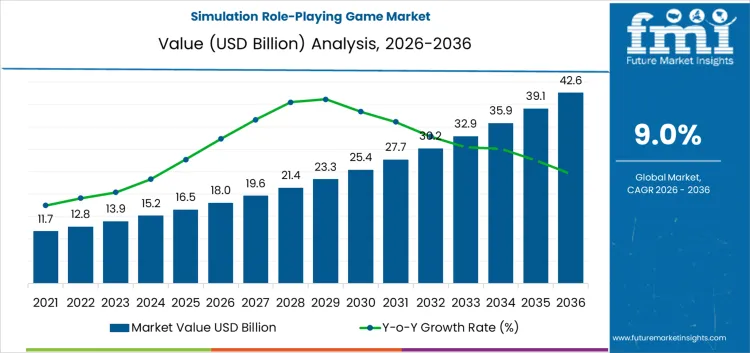
The simulation role-playing game market is projected to reach USD 18 billion in 2026 and USD 42.6 billion by 2036, reflecting a CAGR of 9.0% over the forecast period. Procurement behavior is shaped by platform-specific licensing agreements, middleware requirements, and access to proprietary IP ecosystems. Buyers are influenced by the need to mitigate risk exposure from development overruns and shifting monetization models, especially in cross-platform deployments. Procurement cycles are extended when narrative complexity, live content support, and localization are bundled into long-term contracts. Vendor lock-in is reinforced through exclusive engine usage, in-game currency integration, and persistent user profiles. Switching costs are elevated by save-state dependencies, voice-over assets, and backend architecture alignment. Stakeholders in platform operations, publishing, and IP management assess SRPG investments on engagement longevity, modularity, and technical support continuity. Decisions are framed less by upfront cost and more by player retention metrics, operational scalability, and support for episodic or community-driven content over multi-year content pipelines.
Quick Stats for Simulation Role-Playing Game Market
- Simulation Role-Playing Game Market Value (2026): USD 18 Billion
- Simulation Role-Playing Game Market Forecast Value (2036): USD 42.6 Billion
- Simulation Role-Playing Game Market Forecast CAGR 2026 to 2036: 9.0%
- Leading Platform in Simulation Role-Playing Game Market: Mobile (highest user engagement)
- Key Growth Regions in Simulation Role-Playing Game Market: Asia Pacific, North America, Europe
- Top Key Players in Simulation Role-Playing Game Market: Electronic Arts Inc.; Nintendo Co., Ltd.; Microsoft Corporation; Take-Two Interactive Software Inc.; Square Enix Holdings Co., Ltd.; Paradox Interactive AB; Ubisoft Entertainment SA; Supercell Ltd.
Simulation Role-Playing Game Market Key Takeaways
| Metric | Value |
|---|---|
| Simulation Role-Playing Game Market Value (2026) | USD 18 Billion |
| Simulation Role-Playing Game Market Forecast Value (2036) | USD 42.6 Billion |
| Simulation Role-Playing Game Market Forecast CAGR 2026 to 2036 | 9.0% |
Why Is the Simulation Role-Playing Game Market Experiencing Strong Growth?
The simulation role-playing game market is growing as players seek interactive experiences that combine storytelling, character progression, and realistic world-building. Increasing demand for immersive gameplay across PC, console, and mobile platforms is expanding the audience for simulation RPGs. Gamers favor titles that allow creative customization, scenario-based challenges, and multi-layered engagement, supporting consistent market expansion.
Technological developments are enhancing adoption in the simulation role-playing game market. Improvements in graphics rendering, AI-driven non-player character behavior, cloud gaming, and virtual reality integration are elevating game realism and interactivity. Cross-platform play and multiplayer functionality are increasing social engagement, attracting competitive and cooperative players. These innovations are extending user retention and driving revenue growth through in-game purchases.
Rising global digital connectivity and diverse gamer demographics are contributing to growth in the simulation role-playing game market. Mobile penetration, streaming platforms, and content-sharing communities increase visibility and attract new users. Developers are expanding franchises, offering episodic content, and leveraging microtransactions to maximize engagement. Together, enhanced gameplay mechanics, technological adoption, and global accessibility are sustaining steady market growth over the forecast period.
What Does The Segment Overview Indicate About The Simulation Role-Playing Game Market?
The simulation role-playing game (SRPG) market is segmented by platform and application, reflecting differences in gameplay depth, delivery format, and user motivation. Mobile platforms lead with approximately 38% share, favored for their accessibility and on-the-go character management mechanics. PC and console platforms offer more immersive gameplay for advanced users. Entertainment is the primary application segment, contributing around 40% share, supported by casual players and long-term fans seeking engaging storylines and visual experiences. Other applications like skill learning, character progression, and multiplayer social interaction reflect secondary motivations driving gameplay retention across devices.
Why Do Mobile Platforms Hold The Leading Share In The Simulation Role-Playing Game Market?
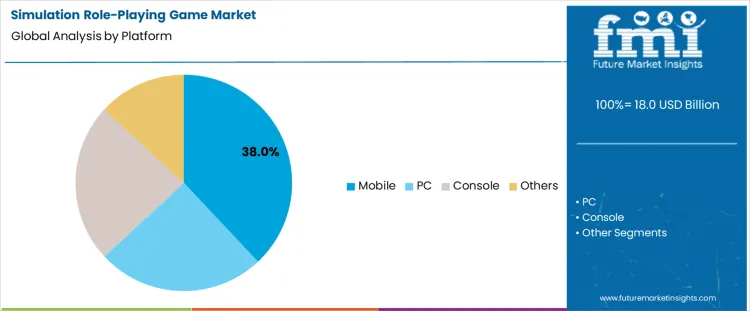
Mobile platforms hold the leading 38% share in the simulation role-playing game market due to their adaptability for character-based, time-managed gameplay suited to casual or periodic users. Touch-optimized interfaces and session-based mechanics allow players to manage virtual characters, train skills, and engage in story events with minimal time investment. Free-to-play models and in-game monetization make mobile SRPGs widely accessible, especially in Asia-Pacific markets where mobile gaming dominates. Game updates, seasonal events, and collectible character models also sustain user engagement. Platform flexibility and broader audience reach continue to drive preference for mobile-based simulation RPGs, especially among younger and mid-core users seeking entertainment without needing high-spec hardware.
How Does Entertainment Drive Application Demand In The Simulation Role-Playing Game Market?
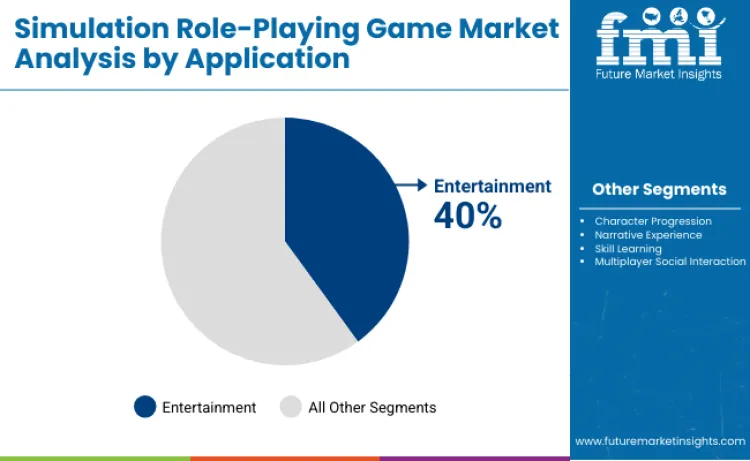
Entertainment accounts for the largest 40% share in the simulation role-playing game market, as players seek immersive escapism through dynamic characters, animated worlds, and narrative-driven missions. This segment includes story-based quests, exploration mechanics, and emotional interaction systems that enhance player connection with game environments. Demand is concentrated among casual and mid-core players who prioritize visual design, voice acting, and fantasy progression. Variations exist across platforms mobile games emphasize short bursts of entertainment, while PC and console titles support extended story arcs and branching decision paths. High production value, character personalization, and fantasy realism continue to reinforce entertainment as the primary application for simulation RPGs.
What Player Expectations Are Shaping the Simulation Role-Playing Game Market?
The simulation role-playing game market is expanding as players seek narrative-driven experiences combined with character progression, tactical decision-making, and life simulation. SRPGs attract users looking for layered mechanics, whether through farming systems, relationship building, or turn-based combat. Titles like Fire Emblem, Rune Factory, and Persona exemplify genre appeal by blending story depth with strategic planning and daily activity loops. Cross-platform availability and remastered releases are bringing older franchises to new audiences. Growth is supported by players favoring slower, immersive formats over action-heavy titles. Mobile SRPG adaptations with gacha systems have also extended market reach in Asia and monetized engagement through character collection dynamics.
Why Are Genre Hybrids and Narrative Depth Fueling SRPG Adoption?
Narrative complexity and system hybridization are key factors driving the simulation role-playing game market. SRPGs increasingly combine life simulation, relationship mechanics, and tactical elements, allowing players to control character arcs, social bonds, and combat performance. Titles now offer calendar-based progression, moral decision-making, and non-linear story outcomes, improving replay value and emotional investment. These hybrid systems appeal to players who value personalization and continuity between combat and non-combat gameplay. Publishers are integrating voice acting, cinematic cutscenes, and dynamic dialogue to strengthen narrative immersion. As genres blend, SRPGs are capturing audiences beyond traditional RPG fans, particularly in regions with high mobile and console penetration.
What Factors Are Limiting Broader Appeal of Simulation Role-Playing Games?
The simulation role-playing game market faces adoption barriers due to complex mechanics, steep learning curves, and long gameplay durations. Casual players often find time-based progression, turn-based combat, and stat-heavy interfaces difficult to navigate. Localization challenges, particularly for text-rich titles, limit release in global markets. High development costs for balancing simulation and role-playing systems constrain smaller studios. Monetization remains difficult without intrusive microtransactions, especially in premium single-player SRPGs. Some players also perceive slow pacing as less engaging compared to action-focused RPGs. As a result, many SRPGs maintain loyal but niche user bases, limiting expansion into mainstream gaming segments unless simplified or gamified.
What Is the Country-Wise Growth Outlook for the Simulation Role-Playing Game Market?
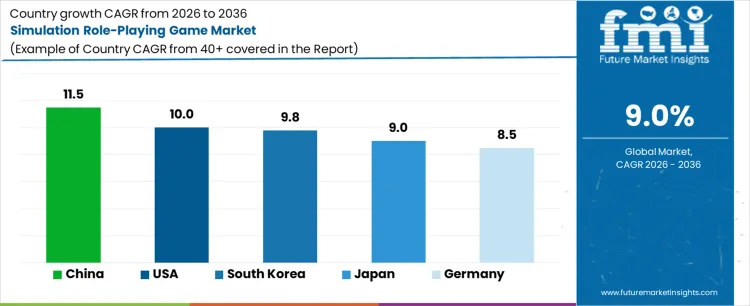
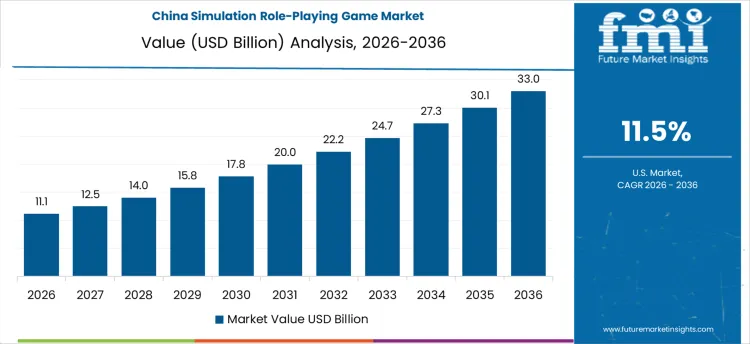
The simulation role-playing game market continues to expand across mobile, console, and PC ecosystems as players demand deeper narrative immersion, strategic character development, and hybrid genre experiences. China leads with a CAGR of 11.5%, driven by expansive fantasy IPs and real-time monetization in mobile RPG ecosystems. The USA follows at 10.0%, supported by cross-platform engagement and franchise-based simulation worlds. South Korea posts a 9.8% CAGR, fueled by competitive mobile RPGs with simulation mechanics and stylized storytelling. Japan records a 9.0% CAGR due to anime-themed simulation RPGs with collectible and tactical progression. Germany grows at 8.5% CAGR, supported by European PC-based simulation RPG communities and indie game expansions.
| Country | CAGR |
|---|---|
| China | 11.5% |
| USA | 10.0% |
| South Korea | 9.8% |
| Japan | 9.0% |
| Germany | 8.5% |
Why Is China Leading Growth in the Simulation Role-Playing Game Market?
Demand for the simulation role-playing game in China is increasing at a CAGR of 11.5%, driven by the dominance of mobile-first RPG ecosystems and a growing user base that engages in character-driven storylines. Chinese developers integrate simulation mechanics into expansive fantasy and sci-fi IPs with detailed world-building, real-time resource management, and character relationship systems. Turn-based combat, visual novels, and sandbox systems often blend into single titles, extending playtime and enhancing retention. Monetization is driven by gacha systems, seasonal content, and timed events, with high revenue concentration among a small number of top-grossing apps. National platforms like TapTap and Bilibili provide discovery channels beyond conventional app stores. Cross-media integration with web comics and animated series boosts brand loyalty and keeps users within unified ecosystems. Simulation mechanics in dating sims, idol management games, and life simulators add to user engagement across younger urban segments.
What Is Driving Growth in the USA’s Simulation Role-Playing Game Market?
Sales for the simulation role-playing game in the USA are advancing at a CAGR of 10.0%, supported by demand for console-quality storytelling, mod-friendly simulation engines, and long-tail monetization through DLC. American developers focus on immersive character development, open-ended quest progression, and decision-based branching narratives. The hybridization of simulation RPGs with survival mechanics and life management systems has driven adoption across indie and AAA platforms. Steam, Epic Games Store, and console marketplaces feature top-performing titles with both fixed and procedurally generated scenarios. Monetization comes from initial purchase, expansion content, and character customization packs. Story-rich games with inclusive character-building tools find traction in younger demographics. The USA also sees growth in simulation RPGs themed around post-apocalyptic, fantasy, and alternative-history environments. Studio-backed voice acting, cinematic cutscenes, and multi-hour campaigns improve long-term engagement.
Why Is South Korea a Competitive Player in Simulation Role-Playing Games?
Demand for the simulation role-playing game in South Korea is growing at a CAGR of 9.8%, driven by mobile-focused development, globalized character IPs, and highly stylized interfaces that appeal to regional audiences. South Korean developers specialize in creating simulation RPGs with layered social mechanics, dating sim elements, and strategic turn-based progression. Games often center around collectible characters, guild-based cooperation, and real-time events where user choices influence outcomes. Narrative arcs are delivered through episodic formats with voice acting and illustrated panels. Monetization is built around character drops, power-up materials, and ranking ladders. Local publishers rely on strong community management and frequent patch updates to keep engagement levels high. Distribution through Kakao Games and One Store allows seamless localization and direct user feedback integration. Simulation RPGs also gain visibility through cross-promotions with K-drama and anime franchises. These operational strengths help South Korea maintain competitive positioning in the global simulation RPG landscape.
Why Is Japan Expanding Its Simulation Role-Playing Game Segment?
Sales for the simulation role-playing game in Japan are rising at a CAGR of 9.0%, supported by established consumer affinity for role-play mechanics, turn-based strategy hybrids, and character-centric simulation narratives. Japanese developers dominate in fantasy and idol management genres where player decisions influence interpersonal dynamics, performance outcomes, or long-term narrative branches. Simulation RPGs in Japan often feature life-building components such as school management, tactical field missions, or career advancement arcs. Integration of daily logins, side missions, and relationship trackers is common in mobile titles. Franchises based on anime, light novels, or visual novels use simulation systems to extend storylines and maintain fan engagement across games, merchandise, and streaming platforms. Monetization remains focused on character banners, event-limited gear, and season pass mechanics. Localization for Western markets also contributes to revenue stability for top-performing titles. This genre continuity, paired with immersive storytelling, supports Japan’s consistent growth trajectory in the simulation RPG segment.
What Is Supporting Adoption of Simulation RPGs in Germany?
Demand for the simulation role-playing game in Germany is increasing at a CAGR of 8.5%, fueled by steady adoption of PC-based titles with detailed world-building, moral choice systems, and simulation-based mechanics. German players show strong preference for medieval, survival, and tactical environments where in-game decisions influence character development, social alliances, and economy management. Popular platforms include Steam and GOG, where titles offer sandbox progression, permadeath options, or skill-tree complexity. German indie studios focus on historical accuracy, system balancing, and expansive mods to support long playthroughs. Players engage with simulation RPGs through turn-based battle systems, settlement building, or environmental storytelling. Localization, depth, and community content play a major role in title longevity. While mobile growth is moderate, PC remains the primary domain for simulation RPG adoption. Community forums and early-access models drive player input into development. These preferences shape Germany’s structured and gradually growing simulation role-playing game ecosystem.
How Are Leading Companies Competing And Differentiating In The Simulation Role-Playing Game Market?
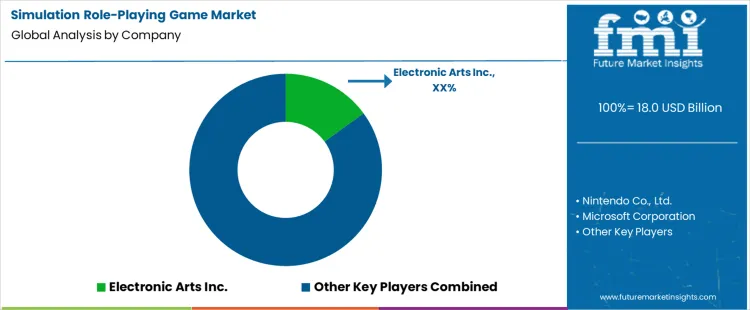
Competition in the simulation role-playing game market is being shaped by immersive world-building, character customization, and interactive storytelling. Electronic Arts Inc. is being positioned around large-scale life simulation franchises, with product brochures highlighting dynamic social systems, player-driven narratives, and expansive customization. Nintendo Co., Ltd. is being differentiated through family-friendly simulations with accessible gameplay, engaging art style, and community features. Microsoft Corporation emphasizes cross-platform integration and expansive open-world experiences, focusing on narrative depth and persistent environments.
Content variety and monetization strategies are being leveraged by Take-Two Interactive Software Inc., Square Enix Holdings Co., Ltd., and Paradox Interactive AB. Take-Two Interactive promotes hybrid simulation-RPG mechanics, with brochures highlighting deep career and management systems. Square Enix focuses on narrative-driven simulations combining role-playing mechanics with strategy, emphasizing story arcs, choice consequences, and world interactivity. Paradox Interactive AB positions its offerings on long-term strategy integration within RPG frameworks, highlighting campaign longevity, mod support, and player-driven emergent storytelling.
A different competitive angle is being taken by Ubisoft Entertainment SA and Supercell Ltd. Ubisoft emphasizes social interaction, episodic content, and cooperative play within simulated RPG worlds. Supercell markets streamlined mobile simulation RPGs with intuitive controls, micro-progression systems, and global multiplayer engagement. Across the market, differentiation is being driven by world immersion, gameplay complexity, and customization depth, with product brochures translating technical mechanics into rich, replayable player experiences that foster engagement and retention.
Key Players in Simulation Role-Playing Game Market
- Electronic Arts Inc.
- Nintendo Co., Ltd.
- Microsoft Corporation
- Take-Two Interactive Software Inc.
- Square Enix Holdings Co., Ltd.
- Paradox Interactive AB
- Ubisoft Entertainment SA
- Supercell Ltd.
Scope of Report
| Attributes | Description |
|---|---|
| Quantitative Unit | USD Billion |
| Platforms | Mobile, PC, Console, Others |
| Applications | Entertainment, Character Progression, Narrative Experience, Skill Learning, Multiplayer Social Interaction |
| Regions Covered | Asia Pacific, Europe, North America, Latin America, Middle East & Africa |
| Countries Covered | China, Japan, South Korea, India, Australia & New Zealand, ASEAN, Rest of Asia Pacific, Germany, United Kingdom, France, Italy, Spain, Nordic, BENELUX, Rest of Europe, United States, Canada, Mexico, Brazil, Chile, Rest of Latin America, Kingdom of Saudi Arabia, Other GCC Countries, Turkey, South Africa, Other African Union, Rest of Middle East & Africa |
| Key Companies Profiled | Electronic Arts Inc., Nintendo Co., Ltd., Microsoft Corporation, Take-Two Interactive Software Inc., Square Enix Holdings Co., Ltd., Paradox Interactive AB, Ubisoft Entertainment SA, Supercell Ltd. |
| Additional Attributes | Market revenue by platform and application segments; regional adoption trends across APAC, North America, and Europe; mobile vs PC vs console penetration; user engagement patterns; competitive landscape and strategic developments; forecasted market growth and CAGR for 2026-2036; emerging gameplay and social interaction trends in simulation role-playing games. |
Simulation Role-Playing Game Market by Key Segments
Platform:
- Mobile
- PC
- Console
- Others
Application:
- Entertainment
- Character Progression
- Narrative Experience
- Skill Learning
- Multiplayer Social Interaction
Region:
- Asia Pacific
- China
- Japan
- South Korea
- India
- Australia & New Zealand
- ASEAN
- Rest of Asia Pacific
- Europe
- Germany
- United Kingdom
- France
- Italy
- Spain
- Nordic
- BENELUX
- Rest of Europe
- North America
- United States
- Canada
- Mexico
- Latin America
- Brazil
- Chile
- Rest of Latin America
- Middle East & Africa
- Kingdom of Saudi Arabia
- Other GCC Countries
- Turkey
- South Africa
- Other African Union
- Rest of Middle East & Africa c
Bibliography
- Entertainment Software Association. (2025). Annual ESA study reveals video games’ universal appeal across generations. ESA.
- Organisation for Economic Co-operation and Development. (2024). The digitalisation of culture and entertainment. OECD Publishing.
- Domingues, J. M. (2024). The role-playing game genre as a case study. Information, 15(6), 294.
- United Nations Educational, Scientific and Cultural Organization. (2024). Interactive media and digital storytelling: Cultural innovation and creative economies. UNESCO.
Frequently Asked Questions
How big is the simulation role-playing game market in 2026?
The global simulation role-playing game market is estimated to be valued at USD 18.0 billion in 2026.
What will be the size of simulation role-playing game market in 2036?
The market size for the simulation role-playing game market is projected to reach USD 42.6 billion by 2036.
How much will be the simulation role-playing game market growth between 2026 and 2036?
The simulation role-playing game market is expected to grow at a 9.0% CAGR between 2026 and 2036.
What are the key product types in the simulation role-playing game market?
The key product types in simulation role-playing game market are mobile, pc, console and others.
Which application segment to contribute significant share in the simulation role-playing game market in 2026?
In terms of application, entertainment segment to command 40.0% share in the simulation role-playing game market in 2026.
Preview the report firsthand - request a free sample
Get SampleGet the brochure for pricing and purchase details.
Get PDFTable of Content
- Executive Summary
- Global Market Outlook
- Demand-side Trends
- Supply-side Trends
- Technology Roadmap Analysis
- Analysis and Recommendations
- Market Overview
- Market Coverage / Taxonomy
- Market Definition / Scope / Limitations
- Market Background
- Market Dynamics
- Drivers
- Restraints
- Opportunity
- Trends
- Scenario Forecast
- Demand in Optimistic Scenario
- Demand in Likely Scenario
- Demand in Conservative Scenario
- Opportunity Map Analysis
- Product Life Cycle Analysis
- Supply Chain Analysis
- Investment Feasibility Matrix
- Value Chain Analysis
- PESTLE and Porter’s Analysis
- Regulatory Landscape
- Regional Parent Market Outlook
- Production and Consumption Statistics
- Import and Export Statistics
- Market Dynamics
- Global Market Analysis 2021 to 2025 and Forecast, 2026 to 2036
- Historical Market Size Value (USD Million) Analysis, 2021 to 2025
- Current and Future Market Size Value (USD Million) Projections, 2026 to 2036
- Y-o-Y Growth Trend Analysis
- Absolute $ Opportunity Analysis
- Global Market Pricing Analysis 2021 to 2025 and Forecast 2026 to 2036
- Global Market Analysis 2021 to 2025 and Forecast 2026 to 2036, By Platform
- Introduction / Key Findings
- Historical Market Size Value (USD Million) Analysis By Platform, 2021 to 2025
- Current and Future Market Size Value (USD Million) Analysis and Forecast By Platform, 2026 to 2036
- Mobile
- PC
- Console
- Others
- Mobile
- Y-o-Y Growth Trend Analysis By Platform, 2021 to 2025
- Absolute $ Opportunity Analysis By Platform, 2026 to 2036
- Global Market Analysis 2021 to 2025 and Forecast 2026 to 2036, By Application
- Introduction / Key Findings
- Historical Market Size Value (USD Million) Analysis By Application, 2021 to 2025
- Current and Future Market Size Value (USD Million) Analysis and Forecast By Application, 2026 to 2036
- Entertainment
- Character Progression
- Narrative Experience
- Skill Learning
- Multiplayer Social Interaction
- Entertainment
- Y-o-Y Growth Trend Analysis By Application, 2021 to 2025
- Absolute $ Opportunity Analysis By Application, 2026 to 2036
- Global Market Analysis 2021 to 2025 and Forecast 2026 to 2036, By Region
- Introduction
- Historical Market Size Value (USD Million) Analysis By Region, 2021 to 2025
- Current Market Size Value (USD Million) Analysis and Forecast By Region, 2026 to 2036
- North America
- Latin America
- Western Europe
- Eastern Europe
- East Asia
- South Asia and Pacific
- Middle East & Africa
- Market Attractiveness Analysis By Region
- North America Market Analysis 2021 to 2025 and Forecast 2026 to 2036, By Country
- Historical Market Size Value (USD Million) Trend Analysis By Market Taxonomy, 2021 to 2025
- Market Size Value (USD Million) Forecast By Market Taxonomy, 2026 to 2036
- By Country
- USA
- Canada
- Mexico
- By Platform
- By Application
- By Country
- Market Attractiveness Analysis
- By Country
- By Platform
- By Application
- Key Takeaways
- Latin America Market Analysis 2021 to 2025 and Forecast 2026 to 2036, By Country
- Historical Market Size Value (USD Million) Trend Analysis By Market Taxonomy, 2021 to 2025
- Market Size Value (USD Million) Forecast By Market Taxonomy, 2026 to 2036
- By Country
- Brazil
- Chile
- Rest of Latin America
- By Platform
- By Application
- By Country
- Market Attractiveness Analysis
- By Country
- By Platform
- By Application
- Key Takeaways
- Western Europe Market Analysis 2021 to 2025 and Forecast 2026 to 2036, By Country
- Historical Market Size Value (USD Million) Trend Analysis By Market Taxonomy, 2021 to 2025
- Market Size Value (USD Million) Forecast By Market Taxonomy, 2026 to 2036
- By Country
- Germany
- UK
- Italy
- Spain
- France
- Nordic
- BENELUX
- Rest of Western Europe
- By Platform
- By Application
- By Country
- Market Attractiveness Analysis
- By Country
- By Platform
- By Application
- Key Takeaways
- Eastern Europe Market Analysis 2021 to 2025 and Forecast 2026 to 2036, By Country
- Historical Market Size Value (USD Million) Trend Analysis By Market Taxonomy, 2021 to 2025
- Market Size Value (USD Million) Forecast By Market Taxonomy, 2026 to 2036
- By Country
- Russia
- Poland
- Hungary
- Balkan & Baltic
- Rest of Eastern Europe
- By Platform
- By Application
- By Country
- Market Attractiveness Analysis
- By Country
- By Platform
- By Application
- Key Takeaways
- East Asia Market Analysis 2021 to 2025 and Forecast 2026 to 2036, By Country
- Historical Market Size Value (USD Million) Trend Analysis By Market Taxonomy, 2021 to 2025
- Market Size Value (USD Million) Forecast By Market Taxonomy, 2026 to 2036
- By Country
- China
- Japan
- South Korea
- By Platform
- By Application
- By Country
- Market Attractiveness Analysis
- By Country
- By Platform
- By Application
- Key Takeaways
- South Asia and Pacific Market Analysis 2021 to 2025 and Forecast 2026 to 2036, By Country
- Historical Market Size Value (USD Million) Trend Analysis By Market Taxonomy, 2021 to 2025
- Market Size Value (USD Million) Forecast By Market Taxonomy, 2026 to 2036
- By Country
- India
- ASEAN
- Australia & New Zealand
- Rest of South Asia and Pacific
- By Platform
- By Application
- By Country
- Market Attractiveness Analysis
- By Country
- By Platform
- By Application
- Key Takeaways
- Middle East & Africa Market Analysis 2021 to 2025 and Forecast 2026 to 2036, By Country
- Historical Market Size Value (USD Million) Trend Analysis By Market Taxonomy, 2021 to 2025
- Market Size Value (USD Million) Forecast By Market Taxonomy, 2026 to 2036
- By Country
- Kingdom of Saudi Arabia
- Other GCC Countries
- Turkiye
- South Africa
- Other African Union
- Rest of Middle East & Africa
- By Platform
- By Application
- By Country
- Market Attractiveness Analysis
- By Country
- By Platform
- By Application
- Key Takeaways
- Key Countries Market Analysis
- USA
- Pricing Analysis
- Market Share Analysis, 2025
- By Platform
- By Application
- Canada
- Pricing Analysis
- Market Share Analysis, 2025
- By Platform
- By Application
- Mexico
- Pricing Analysis
- Market Share Analysis, 2025
- By Platform
- By Application
- Brazil
- Pricing Analysis
- Market Share Analysis, 2025
- By Platform
- By Application
- Chile
- Pricing Analysis
- Market Share Analysis, 2025
- By Platform
- By Application
- Germany
- Pricing Analysis
- Market Share Analysis, 2025
- By Platform
- By Application
- UK
- Pricing Analysis
- Market Share Analysis, 2025
- By Platform
- By Application
- Italy
- Pricing Analysis
- Market Share Analysis, 2025
- By Platform
- By Application
- Spain
- Pricing Analysis
- Market Share Analysis, 2025
- By Platform
- By Application
- France
- Pricing Analysis
- Market Share Analysis, 2025
- By Platform
- By Application
- India
- Pricing Analysis
- Market Share Analysis, 2025
- By Platform
- By Application
- ASEAN
- Pricing Analysis
- Market Share Analysis, 2025
- By Platform
- By Application
- Australia & New Zealand
- Pricing Analysis
- Market Share Analysis, 2025
- By Platform
- By Application
- China
- Pricing Analysis
- Market Share Analysis, 2025
- By Platform
- By Application
- Japan
- Pricing Analysis
- Market Share Analysis, 2025
- By Platform
- By Application
- South Korea
- Pricing Analysis
- Market Share Analysis, 2025
- By Platform
- By Application
- Russia
- Pricing Analysis
- Market Share Analysis, 2025
- By Platform
- By Application
- Poland
- Pricing Analysis
- Market Share Analysis, 2025
- By Platform
- By Application
- Hungary
- Pricing Analysis
- Market Share Analysis, 2025
- By Platform
- By Application
- Kingdom of Saudi Arabia
- Pricing Analysis
- Market Share Analysis, 2025
- By Platform
- By Application
- Turkiye
- Pricing Analysis
- Market Share Analysis, 2025
- By Platform
- By Application
- South Africa
- Pricing Analysis
- Market Share Analysis, 2025
- By Platform
- By Application
- USA
- Market Structure Analysis
- Competition Dashboard
- Competition Benchmarking
- Market Share Analysis of Top Players
- By Regional
- By Platform
- By Application
- Competition Analysis
- Competition Deep Dive
- Electronic Arts Inc.
- Overview
- Product Portfolio
- Profitability by Market Segments (Product/Age /Sales Channel/Region)
- Sales Footprint
- Strategy Overview
- Marketing Strategy
- Product Strategy
- Channel Strategy
- Nintendo Co., Ltd.
- Microsoft Corporation
- Take-Two Interactive Software Inc.
- Square Enix Holdings Co., Ltd.
- Paradox Interactive AB
- Ubisoft Entertainment SA
- Supercell Ltd.
- Electronic Arts Inc.
- Competition Deep Dive
- Assumptions & Acronyms Used
- Research Methodology


