

- Industry Size (2026)
- USD 2100.0 Mn
- Forecast (2036)
- USD 3690.4 Mn
- CAGR (2026 to 2036)
- 5.8%
Sound Attenuator Market Forecast and Outlook 2026 to 2036
The sound attenuator market is projected to be valued at USD 2,100.0 million in 2026 and reach USD 3,690.4 million by 2036, at a CAGR of 5.8%. Value progression is tied to how airflow noise is increasingly treated as an engineering constraint rather than a secondary comfort issue. Sound attenuators are embedded within ventilation and exhaust systems where fan-generated noise, turbulence, and pressure fluctuations propagate directly into occupied zones. Specification is anchored in insertion loss performance relative to pressure drop tolerance, since excessive resistance affects energy consumption and system sizing. Adoption remains strongest in mechanically dense buildings where centralized HVAC layouts place noise sources close to workspaces, patient areas, or public interiors. Cost behavior reflects customization to duct geometry and airflow conditions, favoring engineered solutions over standardized components.
Quick Stats for Sound Attenuator Market
- Sound Attenuator Market Value (2026): USD 2,100.0 million
- Sound Attenuator Market Forecast Value (2036): USD 3,690.4 million
- Sound Attenuator Market Forecast CAGR 2026 to 2036: 5.8%
- Leading Product Type by Demand Share: Duct Silencers
- Fastest-Growing Countries: India, Saudi Arabia, UAE, Vietnam, Indonesia
- Top Players in Global Demand: TROX, Systemair, FläktGroup, Greenheck, Halton

Mechanical system densification continues to expose limitations of relying on distance or passive absorption to control noise. Retrofit activity plays a material role as older installations struggle to meet updated acoustic thresholds without reconfiguring duct layouts. Constraints emerge around available duct length, ceiling void depth, and allowable pressure losses, which narrow design options and elevate the importance of early coordination. Performance outcomes depend on correct placement and alignment within airflow paths, increasing reliance on acoustical modeling rather than rule-based selection.
Supplier advantage is linked to validated test data across octave bands, predictable fabrication tolerances, and coordination support with mechanical contractors. Distribution channels align closely with HVAC specialists and project engineers rather than general building product supply. Expansion remains governed by operational noise compliance and energy efficiency trade-offs, positioning sound attenuators as system-critical components within ventilation infrastructure rather than optional acoustic add-ons.
Sound Attenuator Market Key Takeaways
| Metric | Value |
|---|---|
| Market Value (2026) | USD 2,100.0 million |
| Market Forecast Value (2036) | USD 3,690.4 million |
| Forecast CAGR 2026 to 2036 | 5.8% |
Why is the Demand for Sound Attenuators Growing?
Demand for sound attenuators is increasing as facility engineers and HVAC designers require solutions that reduce duct-borne noise without impeding airflow in commercial, industrial, and institutional buildings. Sound attenators are specified in heating, ventilation, and air conditioning systems to control noise generated by fans, air handlers, and mechanical equipment before air is delivered into occupied spaces. Performance criteria such as insertion loss across targeted frequency bands, pressure drop characteristics, and material fire ratings influence selection because attenuators must achieve acoustic reduction while maintaining energy efficiency and safety compliance. Procurement teams assess housing construction, internal absorption media, and installation adaptability to ensure components align with duct dimensions and mechanical layout constraints. Growth in mixed-use developments, open plan offices, healthcare facilities, and educational campuses reinforces need for sound attenuators that support indoor environmental quality targets and occupant comfort objectives in spaces sensitive to noise from central plant equipment.
Expansion of building automation and integrated control systems further supports uptake of sound attenuators that can be coordinated with variable air volume systems and automated airflow balancing strategies. Facility planners and acoustical consultants specify attenuators where duct termination points or transitions intersect with occupied zones that require noise control to meet speech privacy and decibel criteria. Technical advances in absorption materials, modular housing designs, and field-adjustable baffle configurations improve attenuation performance without excessive maintenance complexity. Coordination between mechanical contractors, acoustical designers, and operations staff ensures that sound attenuators are installed in locations that optimize noise reduction while supporting planned maintenance access. These market-specific performance and integration requirements are contributing to sustained demand growth in the sound attenuator market.
How Are the Segments Classified in the Sound Attenuator Market?
Demand for sound attenuators is shaped by ventilation noise limits, airflow performance requirements, and building compliance obligations. Facilities deploy attenuation solutions to reduce fan and duct-borne noise while maintaining pressure and flow targets. Adoption aligns with expansion of HVAC installations, retrofit activity in occupied buildings, and noise-sensitive infrastructure. Product selection prioritizes insertion loss performance, pressure drop control, and installation compatibility. Segment classification reflects differentiation by attenuator configuration, end-use environment, and construction material influencing acoustic effectiveness, system integration, and long-term durability.
By Product Type, Duct Silencers Hold the Largest Share

Duct silencers hold 54.0%, representing the largest share due to direct integration within airflow paths. Inline placement enables effective broadband noise reduction from fans and air handling units. Modular lengths support tuning to specific frequency requirements without major layout changes. Compatibility with rectangular and circular ducts broadens applicability across projects. Fan inlet or outlet silencers address localized noise with limited placement flexibility. Plenum attenuators serve space-constrained systems with added design complexity. Product type segmentation reflects preference for solutions offering predictable performance and straightforward integration within standard duct systems.
Key Points
- Inline placement delivers effective broadband attenuation.
- Modular designs fit common duct geometries.
- Other types address localized or space-limited needs.
By End Use, Commercial HVAC Accounts for the Highest Share

Commercial HVAC holds 46.0%, representing the largest share due to occupant comfort requirements. Offices, retail spaces, and institutions require controlled noise levels from ventilation systems. Compliance with indoor acoustic criteria reinforces attenuator specification. Centralized air handling increases reliance on duct-based attenuation. Industrial ventilation applies silencers for equipment noise with higher sound power. Data centers require targeted attenuation near critical airflow paths. End-use segmentation reflects concentration where comfort standards, occupancy density, and centralized systems sustain consistent attenuator deployment.
Key Points
- Comfort standards drive attenuation in commercial buildings.
- Centralized HVAC increases duct silencer usage.
- Other uses manage equipment or infrastructure noise.
By Material, Galvanized Steel Represents the Leading Share
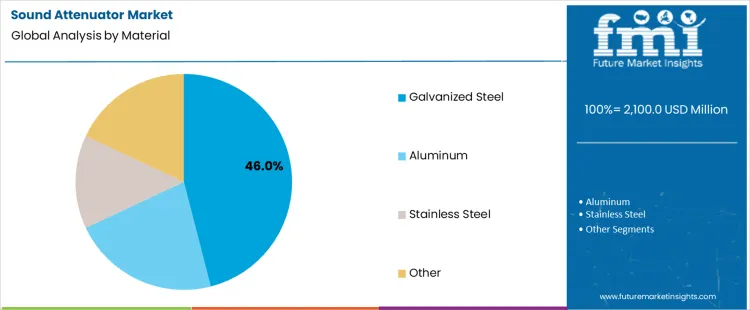
Galvanized steel holds 46.0%, representing the largest share due to strength and cost efficiency. Structural rigidity supports large attenuator sections without deformation. Corrosion resistance suits varied indoor and semi-exposed environments. Fabrication flexibility enables internal baffle and lining integration. Aluminum offers weight reduction with higher material cost. Stainless steel addresses corrosive or hygienic settings. Material segmentation reflects preference for durable, economical metals supporting acoustic lining performance and long service life across ventilation applications.
Key Points
- Galvanized steel balances strength and cost.
- Corrosion resistance supports diverse installations.
- Other materials address weight or severe environment needs.
What are the Key Dynamics in the Sound Attenuator Market?
Demand for sound attenuators reflects need to reduce airborne noise generated by airflow systems without disrupting ventilation or process continuity. Adoption concentrates in HVAC installations, industrial plants, power generation facilities, and transportation infrastructure. Global scope aligns with occupational noise limits and environmental compliance. Usage centers on duct-mounted and inline attenuators engineered to lower sound pressure levels across defined frequency bands while maintaining acceptable pressure drop.
How do airflow noise control requirements and system performance constraints shape adoption?
Ventilation and process systems generate noise from fans, turbulence, and equipment operation that propagates through ductwork. Demand increases where regulatory limits require controlled noise emission at occupied spaces and property boundaries. Sound attenuators provide targeted insertion loss without altering system layout. HVAC systems in hospitals and commercial buildings rely on attenuators to maintain speech intelligibility and occupant comfort. Industrial facilities adopt heavy-duty attenuators to limit machinery noise transmission through intake and exhaust paths. Design selection depends on frequency spectrum, airflow velocity, and available duct length. Integration with fire-rated and hygienic duct systems supports adoption in regulated environments. Adoption reflects operational need to manage noise while preserving airflow performance.
How do pressure drop limits, space constraints, and cost pressure influence market scalability?
Attenuator effectiveness trades off against airflow resistance, affecting fan energy consumption and system efficiency. Demand sensitivity rises where added pressure drop requires fan resizing or higher operating cost. Space constraints limit attenuator length and cross-section in retrofit projects. Performance varies with installation orientation and duct geometry, increasing design dependency. Material selection affects durability under moisture, grease, or corrosive exhaust conditions. Verification testing adds engineering cost for critical applications. Project-specific acoustic tuning limits standardization. Capital budget constraints in non-critical facilities constrain scalable deployment across cost-driven HVAC and industrial programs.
How Is Demand for Sound Attenuators Evolving Globally?
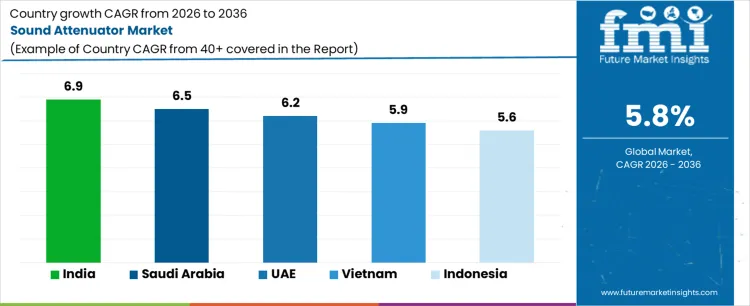
Demand for sound attenuators is expanding globally due to regulatory noise limits, mechanical system density, and proximity of equipment to occupied spaces. HVAC plants, power generation assets, data centers, and industrial facilities specify attenuators to control airborne noise without restricting airflow. Retrofit activity increases where legacy installations fail updated acoustic thresholds. Specification emphasizes pressure drop control, fire performance, and durability. Growth rates in India at 6.9%, Saudi Arabia at 6.5%, UAE at 6.2%, Vietnam at 5.9%, and Indonesia at 5.6% indicate sustained expansion driven by infrastructure build-out, compliance enforcement, and operational noise management rather than architectural aesthetics.
| Country | CAGR (%) |
|---|---|
| India | 6.9% |
| Saudi Arabia | 6.5% |
| UAE | 6.2% |
| Vietnam | 5.9% |
| Indonesia | 5.6% |
What Is Driving Strong Expansion of Sound Attenuator Demand in India?
Demand for sound attenuators in India is growing at a CAGR of 6.9%, supported by dense urban infrastructure and mechanical system proliferation. Data centers, hospitals, and metro facilities require airflow noise control near occupied zones. High-rise commercial buildings place HVAC equipment closer to workspaces, increasing attenuation requirements. Backup power installations specify attenuators for generator exhaust and intake systems. Urban noise regulation enforcement elevates compliance-driven retrofits. Domestic fabrication capacity improves lead times and customization. Growth reflects infrastructure intensity and functional noise control needs rather than discretionary building upgrades.
- Data center and hospital mechanical noise control
- HVAC proximity to occupied urban spaces
- Generator exhaust and intake attenuation needs
- Compliance-driven retrofit installations
Why Is Saudi Arabia Seeing Strong Uptake of Sound Attenuators?
Sound attenuator demand in Saudi Arabia is expanding at a CAGR of 6.5%, driven by large-scale infrastructure and energy projects. Power plants, desalination facilities, and transport hubs require airflow noise reduction for regulatory compliance. High-capacity HVAC systems increase sound emission risks. Government-led developments integrate acoustic control at design stage. Extreme climatic conditions necessitate robust materials and coatings. Growth reflects infrastructure-led specifications and operational noise management priorities rather than retrofit-heavy building activity.
- Power and desalination facility specifications
- High-capacity HVAC airflow noise control
- Design-stage acoustic integration in megaprojects
- Durability requirements under harsh climates
How Is the UAE Supporting Growth of Sound Attenuator Sales?
Sales of sound attenuators in the UAE are growing at a CAGR of 6.2%, shaped by premium commercial construction and critical infrastructure assets. Airports, data centers, and commercial towers require controlled ventilation noise. Mechanical rooms located near occupied areas increase attenuation needs. Building quality standards emphasize certified acoustic performance. Retrofit demand arises from plant upgrades and capacity expansions. Growth reflects quality-led construction and infrastructure performance requirements rather than expansion of basic industrial facilities.
- Airport and data center ventilation noise control
- Mechanical rooms near occupied zones
- Certified performance aligned with quality standards
- Plant upgrade and capacity expansion retrofits
What Factors Are Supporting Sound Attenuator Demand in Vietnam?
Sound attenuator demand in Vietnam is expanding at a CAGR of 5.9%, supported by industrial parks and urban commercial development. Manufacturing facilities require ventilation noise control to protect adjacent workspaces. Office buildings specify attenuators for HVAC and generator rooms. Urban density increases sensitivity to mechanical noise emissions. Standardized industrial construction favors proven attenuation designs. Growth reflects industrialization and urban proximity challenges rather than high-end architectural customization.
- Industrial park ventilation noise management
- Commercial HVAC and generator room applications
- Urban density increasing noise sensitivity
- Standardized attenuation design adoption
Why Is Indonesia Experiencing Measured Growth in Sound Attenuators?
Demand for sound attenuators in Indonesia is growing at a CAGR of 5.6%, driven by institutional buildings and transport infrastructure. Hospitals, airports, and government facilities require airflow noise reduction for functional spaces. High ambient noise levels heighten need for effective attenuation. Budget discipline favors standardized products with predictable pressure loss. Retrofit activity emerges from operational upgrades and compliance reviews. Growth remains measured, reflecting functional noise control requirements and cost sensitivity rather than rapid expansion of heavy industrial capacity.
- Institutional facility airflow noise reduction
- High ambient urban noise conditions
- Preference for standardized pressure-controlled units
- Upgrade-led compliance retrofits
What is the competitive landscape of demand for the sound attenuator market globally?

Demand for sound attenuators is driven by HVAC noise control requirements in commercial buildings, industrial facilities, and data centers. Buyers evaluate insertion loss across octave bands, pressure drop impact, airflow uniformity, casing leakage class, and compliance with mechanical specifications. Design engineers assess attenuator performance within full duct systems rather than standalone ratings. Procurement behavior prioritizes suppliers providing laboratory-tested acoustic data, customization for duct geometry, and coordination with HVAC layouts. Purchasing decisions emphasize reliability, corrosion protection, fire performance compatibility, and delivery alignment with mechanical installation schedules. Trend in the sound attenuator market reflects rising deployment in noise-sensitive environments with high airflow demands.
TROX leads competitive positioning through engineered sound attenuators integrated within comprehensive air distribution and acoustic control portfolios. Systemair competes with standardized and project-specific attenuators optimized for global HVAC applications and regulatory requirements. FläktGroup supports demand through high-performance attenuation solutions addressing complex airflow and low-frequency noise challenges. Greenheck maintains relevance by supplying sound attenuators aligned with ventilation, exhaust, and air handling systems across commercial projects. Halton participates by offering attenuators designed for healthcare, laboratory, and mission-critical environments requiring precise airflow and noise control. Competitive differentiation centers on validated acoustic performance, pressure loss optimization, customization capability, and project engineering support.
Key Players in the Sound Attenuator Market
- TROX
- Systemair
- FläktGroup
- Greenheck
- Halton
- Lindab
- Price Industries
- Johnson Controls
- Nailor Industries
Scope of the Report
| Items | Values |
|---|---|
| Quantitative Units | USD million |
| Product Type | Duct Silencers; Fan Inlet or Outlet Silencers; Plenum Attenuators; Other |
| End Use | Commercial HVAC; Industrial Ventilation; Data Centers; Others |
| Material | Galvanized Steel; Aluminum; Stainless Steel; Other |
| Sales Channel | HVAC Contractors; Direct OEM Sales; Distributors; Other |
| Regions Covered | Asia Pacific, Europe, North America, Latin America, Middle East & Africa |
| Countries Covered | India, Saudi Arabia, UAE, Vietnam, Indonesia, and 40+ countries |
| Key Companies Profiled | TROX; Systemair; FläktGroup; Greenheck; Halton; Lindab; Price Industries; Johnson Controls; Nailor Industries |
| Additional Attributes | Dollar sales by product type, end use, material, and sales channel; insertion loss performance and airflow pressure drop characteristics across duct, fan, and plenum attenuators; material durability and corrosion resistance in galvanized steel, aluminum, and stainless steel constructions; compliance with HVAC noise standards in commercial, industrial, and data center environments; procurement patterns driven by contractor-led installations, OEM supply agreements, and distributor networks. |
Sound Attenuator Market by Segment
Product Type:
- Duct Silencers
- Fan Inlet or Outlet Silencers
- Plenum Attenuators
- Other
End Use:
- Commercial HVAC
- Industrial Ventilation
- Data Centers
- Others
Material:
- Galvanized Steel
- Aluminum
- Stainless Steel
- Other
Sales Channel:
- HVAC Contractors
- Direct OEM Sales
- Distributors
- Other
Region:
- Asia Pacific
- China
- Japan
- South Korea
- India
- Australia & New Zealand
- ASEAN
- Rest of Asia Pacific
- Europe
- Germany
- United Kingdom
- France
- Italy
- Spain
- Nordic
- BENELUX
- Rest of Europe
- North America
- United States
- Canada
- Mexico
- Latin America
- Brazil
- Chile
- Rest of Latin America
- Middle East & Africa
- Kingdom of Saudi Arabia
- Other GCC Countries
- Turkey
- South Africa
- Other African Union
- Rest of Middle East & Africa
Bibliography
- International Organization for Standardization. (2024). Acoustics — Measurement of sound pressure levels in buildings and rooms — Engineering method (ISO 16032:2024). ISO.
- European Committee for Standardization. (2024). Ventilation for buildings — Air terminal devices — Aerodynamic and acoustic testing of silencers (EN 13141-5:2024). CEN.
- ASTM International. (2024). Standard test method for measurement of insertion loss of duct silencers and air-handling components (ASTM E477-24). ASTM International.
Frequently Asked Questions
How big is the sound attenuator market in 2026?
The global sound attenuator market is estimated to be valued at USD 2,100.0 million in 2026.
What will be the size of sound attenuator market in 2036?
The market size for the sound attenuator market is projected to reach USD 3,690.4 million by 2036.
How much will be the sound attenuator market growth between 2026 and 2036?
The sound attenuator market is expected to grow at a 5.8% CAGR between 2026 and 2036.
What are the key product types in the sound attenuator market?
The key product types in sound attenuator market are duct silencers, fan inlet or outlet silencers, plenum attenuators and other.
Which end use segment to contribute significant share in the sound attenuator market in 2026?
In terms of end use, commercial hvac segment to command 46.0% share in the sound attenuator market in 2026.
Preview the report firsthand - request a free sample
Get SampleGet the brochure for pricing and purchase details.
Get PDFTable of Content
- Executive Summary
- Global Market Outlook
- Demand-side Trends
- Supply-side Trends
- Technology Roadmap Analysis
- Analysis and Recommendations
- Market Overview
- Market Coverage / Taxonomy
- Market Definition / Scope / Limitations
- Market Background
- Market Dynamics
- Drivers
- Restraints
- Opportunity
- Trends
- Scenario Forecast
- Demand in Optimistic Scenario
- Demand in Likely Scenario
- Demand in Conservative Scenario
- Opportunity Map Analysis
- Product Life Cycle Analysis
- Supply Chain Analysis
- Investment Feasibility Matrix
- Value Chain Analysis
- PESTLE and Porter’s Analysis
- Regulatory Landscape
- Regional Parent Market Outlook
- Production and Consumption Statistics
- Import and Export Statistics
- Market Dynamics
- Global Market Analysis 2021 to 2025 and Forecast, 2026 to 2036
- Historical Market Size Value (USD Million) Analysis, 2021 to 2025
- Current and Future Market Size Value (USD Million) Projections, 2026 to 2036
- Y-o-Y Growth Trend Analysis
- Absolute $ Opportunity Analysis
- Global Market Pricing Analysis 2021 to 2025 and Forecast 2026 to 2036
- Global Market Analysis 2021 to 2025 and Forecast 2026 to 2036, By Product Type
- Introduction / Key Findings
- Historical Market Size Value (USD Million) Analysis By Product Type , 2021 to 2025
- Current and Future Market Size Value (USD Million) Analysis and Forecast By Product Type , 2026 to 2036
- Duct Silencers
- Fan Inlet or Outlet Silencers
- Plenum Attenuators
- Other
- Duct Silencers
- Y-o-Y Growth Trend Analysis By Product Type , 2021 to 2025
- Absolute $ Opportunity Analysis By Product Type , 2026 to 2036
- Global Market Analysis 2021 to 2025 and Forecast 2026 to 2036, By End Use
- Introduction / Key Findings
- Historical Market Size Value (USD Million) Analysis By End Use, 2021 to 2025
- Current and Future Market Size Value (USD Million) Analysis and Forecast By End Use, 2026 to 2036
- Commercial HVAC
- Industrial Ventilation
- Data Centers
- Others
- Commercial HVAC
- Y-o-Y Growth Trend Analysis By End Use, 2021 to 2025
- Absolute $ Opportunity Analysis By End Use, 2026 to 2036
- Global Market Analysis 2021 to 2025 and Forecast 2026 to 2036, By Material
- Introduction / Key Findings
- Historical Market Size Value (USD Million) Analysis By Material, 2021 to 2025
- Current and Future Market Size Value (USD Million) Analysis and Forecast By Material, 2026 to 2036
- Galvanized Steel
- Aluminum
- Stainless Steel
- Other
- Galvanized Steel
- Y-o-Y Growth Trend Analysis By Material, 2021 to 2025
- Absolute $ Opportunity Analysis By Material, 2026 to 2036
- Global Market Analysis 2021 to 2025 and Forecast 2026 to 2036, By Sales Channel
- Introduction / Key Findings
- Historical Market Size Value (USD Million) Analysis By Sales Channel, 2021 to 2025
- Current and Future Market Size Value (USD Million) Analysis and Forecast By Sales Channel, 2026 to 2036
- HVAC Contractors
- Direct OEM Sales
- Distributors
- Other
- HVAC Contractors
- Y-o-Y Growth Trend Analysis By Sales Channel, 2021 to 2025
- Absolute $ Opportunity Analysis By Sales Channel, 2026 to 2036
- Global Market Analysis 2021 to 2025 and Forecast 2026 to 2036, By Region
- Introduction
- Historical Market Size Value (USD Million) Analysis By Region, 2021 to 2025
- Current Market Size Value (USD Million) Analysis and Forecast By Region, 2026 to 2036
- North America
- Latin America
- Western Europe
- Eastern Europe
- East Asia
- South Asia and Pacific
- Middle East & Africa
- Market Attractiveness Analysis By Region
- North America Market Analysis 2021 to 2025 and Forecast 2026 to 2036, By Country
- Historical Market Size Value (USD Million) Trend Analysis By Market Taxonomy, 2021 to 2025
- Market Size Value (USD Million) Forecast By Market Taxonomy, 2026 to 2036
- By Country
- USA
- Canada
- Mexico
- By Product Type
- By End Use
- By Material
- By Sales Channel
- By Country
- Market Attractiveness Analysis
- By Country
- By Product Type
- By End Use
- By Material
- By Sales Channel
- Key Takeaways
- Latin America Market Analysis 2021 to 2025 and Forecast 2026 to 2036, By Country
- Historical Market Size Value (USD Million) Trend Analysis By Market Taxonomy, 2021 to 2025
- Market Size Value (USD Million) Forecast By Market Taxonomy, 2026 to 2036
- By Country
- Brazil
- Chile
- Rest of Latin America
- By Product Type
- By End Use
- By Material
- By Sales Channel
- By Country
- Market Attractiveness Analysis
- By Country
- By Product Type
- By End Use
- By Material
- By Sales Channel
- Key Takeaways
- Western Europe Market Analysis 2021 to 2025 and Forecast 2026 to 2036, By Country
- Historical Market Size Value (USD Million) Trend Analysis By Market Taxonomy, 2021 to 2025
- Market Size Value (USD Million) Forecast By Market Taxonomy, 2026 to 2036
- By Country
- Germany
- UK
- Italy
- Spain
- France
- Nordic
- BENELUX
- Rest of Western Europe
- By Product Type
- By End Use
- By Material
- By Sales Channel
- By Country
- Market Attractiveness Analysis
- By Country
- By Product Type
- By End Use
- By Material
- By Sales Channel
- Key Takeaways
- Eastern Europe Market Analysis 2021 to 2025 and Forecast 2026 to 2036, By Country
- Historical Market Size Value (USD Million) Trend Analysis By Market Taxonomy, 2021 to 2025
- Market Size Value (USD Million) Forecast By Market Taxonomy, 2026 to 2036
- By Country
- Russia
- Poland
- Hungary
- Balkan & Baltic
- Rest of Eastern Europe
- By Product Type
- By End Use
- By Material
- By Sales Channel
- By Country
- Market Attractiveness Analysis
- By Country
- By Product Type
- By End Use
- By Material
- By Sales Channel
- Key Takeaways
- East Asia Market Analysis 2021 to 2025 and Forecast 2026 to 2036, By Country
- Historical Market Size Value (USD Million) Trend Analysis By Market Taxonomy, 2021 to 2025
- Market Size Value (USD Million) Forecast By Market Taxonomy, 2026 to 2036
- By Country
- China
- Japan
- South Korea
- By Product Type
- By End Use
- By Material
- By Sales Channel
- By Country
- Market Attractiveness Analysis
- By Country
- By Product Type
- By End Use
- By Material
- By Sales Channel
- Key Takeaways
- South Asia and Pacific Market Analysis 2021 to 2025 and Forecast 2026 to 2036, By Country
- Historical Market Size Value (USD Million) Trend Analysis By Market Taxonomy, 2021 to 2025
- Market Size Value (USD Million) Forecast By Market Taxonomy, 2026 to 2036
- By Country
- India
- ASEAN
- Australia & New Zealand
- Rest of South Asia and Pacific
- By Product Type
- By End Use
- By Material
- By Sales Channel
- By Country
- Market Attractiveness Analysis
- By Country
- By Product Type
- By End Use
- By Material
- By Sales Channel
- Key Takeaways
- Middle East & Africa Market Analysis 2021 to 2025 and Forecast 2026 to 2036, By Country
- Historical Market Size Value (USD Million) Trend Analysis By Market Taxonomy, 2021 to 2025
- Market Size Value (USD Million) Forecast By Market Taxonomy, 2026 to 2036
- By Country
- Kingdom of Saudi Arabia
- Other GCC Countries
- Turkiye
- South Africa
- Other African Union
- Rest of Middle East & Africa
- By Product Type
- By End Use
- By Material
- By Sales Channel
- By Country
- Market Attractiveness Analysis
- By Country
- By Product Type
- By End Use
- By Material
- By Sales Channel
- Key Takeaways
- Key Countries Market Analysis
- USA
- Pricing Analysis
- Market Share Analysis, 2025
- By Product Type
- By End Use
- By Material
- By Sales Channel
- Canada
- Pricing Analysis
- Market Share Analysis, 2025
- By Product Type
- By End Use
- By Material
- By Sales Channel
- Mexico
- Pricing Analysis
- Market Share Analysis, 2025
- By Product Type
- By End Use
- By Material
- By Sales Channel
- Brazil
- Pricing Analysis
- Market Share Analysis, 2025
- By Product Type
- By End Use
- By Material
- By Sales Channel
- Chile
- Pricing Analysis
- Market Share Analysis, 2025
- By Product Type
- By End Use
- By Material
- By Sales Channel
- Germany
- Pricing Analysis
- Market Share Analysis, 2025
- By Product Type
- By End Use
- By Material
- By Sales Channel
- UK
- Pricing Analysis
- Market Share Analysis, 2025
- By Product Type
- By End Use
- By Material
- By Sales Channel
- Italy
- Pricing Analysis
- Market Share Analysis, 2025
- By Product Type
- By End Use
- By Material
- By Sales Channel
- Spain
- Pricing Analysis
- Market Share Analysis, 2025
- By Product Type
- By End Use
- By Material
- By Sales Channel
- France
- Pricing Analysis
- Market Share Analysis, 2025
- By Product Type
- By End Use
- By Material
- By Sales Channel
- India
- Pricing Analysis
- Market Share Analysis, 2025
- By Product Type
- By End Use
- By Material
- By Sales Channel
- ASEAN
- Pricing Analysis
- Market Share Analysis, 2025
- By Product Type
- By End Use
- By Material
- By Sales Channel
- Australia & New Zealand
- Pricing Analysis
- Market Share Analysis, 2025
- By Product Type
- By End Use
- By Material
- By Sales Channel
- China
- Pricing Analysis
- Market Share Analysis, 2025
- By Product Type
- By End Use
- By Material
- By Sales Channel
- Japan
- Pricing Analysis
- Market Share Analysis, 2025
- By Product Type
- By End Use
- By Material
- By Sales Channel
- South Korea
- Pricing Analysis
- Market Share Analysis, 2025
- By Product Type
- By End Use
- By Material
- By Sales Channel
- Russia
- Pricing Analysis
- Market Share Analysis, 2025
- By Product Type
- By End Use
- By Material
- By Sales Channel
- Poland
- Pricing Analysis
- Market Share Analysis, 2025
- By Product Type
- By End Use
- By Material
- By Sales Channel
- Hungary
- Pricing Analysis
- Market Share Analysis, 2025
- By Product Type
- By End Use
- By Material
- By Sales Channel
- Kingdom of Saudi Arabia
- Pricing Analysis
- Market Share Analysis, 2025
- By Product Type
- By End Use
- By Material
- By Sales Channel
- Turkiye
- Pricing Analysis
- Market Share Analysis, 2025
- By Product Type
- By End Use
- By Material
- By Sales Channel
- South Africa
- Pricing Analysis
- Market Share Analysis, 2025
- By Product Type
- By End Use
- By Material
- By Sales Channel
- USA
- Market Structure Analysis
- Competition Dashboard
- Competition Benchmarking
- Market Share Analysis of Top Players
- By Regional
- By Product Type
- By End Use
- By Material
- By Sales Channel
- Competition Analysis
- Competition Deep Dive
- TROX
- Overview
- Product Portfolio
- Profitability by Market Segments (Product/Age /Sales Channel/Region)
- Sales Footprint
- Strategy Overview
- Marketing Strategy
- Product Strategy
- Channel Strategy
- Systemair
- FläktGroup
- Greenheck
- Halton
- Lindab
- Price Industries
- Johnson Controls
- Nailor Industries
- TROX
- Competition Deep Dive
- Assumptions & Acronyms Used
- Research Methodology


