

- Industry Size (2026)
- USD 540.0 Mn
- Forecast (2036)
- USD 1004.2 Mn
- CAGR (2026 to 2036)
- 6.4%
Sound Control Sealants and Adhesives Market Size, Market Forecast and Outlook By FMI
The sound control sealants and adhesives market is likely to be valued at USD 540.0 million in 2026 and reach USD 1,004.2 million by 2036, at a CAGR of 6.4%. Expansion is closely linked to how acoustic performance is now delivered through construction detailing rather than through heavier wall or floor assemblies alone. As lightweight partitions, modular interiors, and service-dense buildings become standard, joints, penetrations, and interfaces increasingly determine whether rated acoustic systems perform as designed. Sealants and damping adhesives are therefore specified as functional components of tested assemblies, not as ancillary materials. Demand concentrates in commercial offices, healthcare buildings, hospitality projects, and high-density residential developments where speech privacy and inter-room noise control are scrutinized during commissioning. Product selection favors formulations that retain elasticity over long periods, adhere to multiple substrates, and remain stable under thermal cycling and structural movement.
Summary of Sound Control Sealants and Adhesives Market
- Market Snapshot
- The Sound Control Sealants and Adhesives Market is valued at USD 540.0 million in 2026.
- The Sound Control Sealants and Adhesives Market is projected to reach USD 1,004.2 million by 2036 at a CAGR of 6.4%.
- The market growth is driven by the increasing role of sealants in delivering acoustic performance through construction detailing.
- Demand and Growth Drivers
- Rising enforcement of acoustic compliance and airtightness standards is increasing demand for sealing materials.
- Growth in lightweight construction and modular interiors is shifting acoustic control toward joints and penetrations.
- Retrofit and fit-out projects are driving demand due to gaps and degraded joints in existing buildings.
- Product and Segment View
- Acrylic sealants lead with a 36.0% share due to balanced flexibility and ease of application.
- Perimeter and joint sealing accounts for 44.0% share as primary sound leakage control points.
- Commercial construction holds 38.0% share driven by strict acoustic compliance requirements.
- Geography and Competitive Outlook
- India leads with a CAGR of 7.2%, followed by Vietnam at 6.8% and Indonesia at 6.5%.
- Saudi Arabia and UAE are expected to grow at CAGRs of 6.1% and 5.8%, respectively.
- Key players include Sika, Henkel, 3M, Bostik, and Tremco CPG focusing on performance-tested acoustic solutions and contractor support.
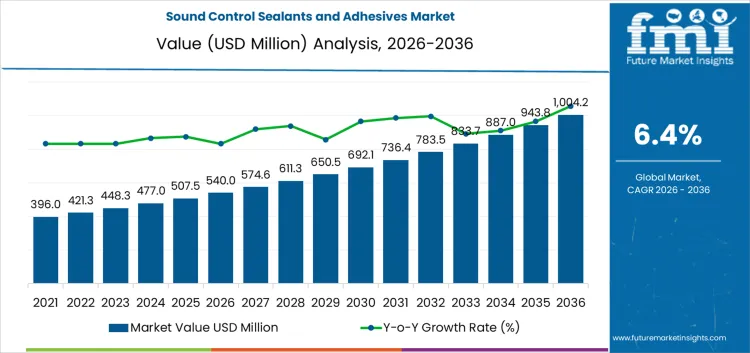
Growth patterns reflect enforcement of acoustic compliance and airtightness standards rather than decorative construction activity. Retrofit and fit-out projects contribute materially, as many existing buildings fail to meet current noise criteria due to unsealed service routes or degraded joints. Adoption increases where contractors and consultants recognize that marginal gaps can negate otherwise compliant wall systems. Cost sensitivity remains high, particularly in residential construction, encouraging use of standardized acrylic and polyurethane products rather than specialized formulations. Distribution favors suppliers that provide tested performance data and installer guidance, reducing execution risk on site. The expansion is driven by accountability for acoustic outcomes at handover, positioning sealants and adhesives as performance-critical materials embedded in modern building delivery rather than optional construction consumables.
Sound Control Sealants and Adhesives Market Key Takeaways
| Metric | Value |
|---|---|
| Market Value (2026) | USD 540.0 million |
| Market Forecast Value (2036) | USD 1,004.2 million |
| Forecast CAGR 2026 to 2036 | 6.4% |
Why is the Demand for Sound Control Sealants and Adhesives Growing?
Demand for sound control sealants and adhesives is increasing as architects, acoustic engineers, and facility planners require materials that improve airtightness and acoustic isolation in buildings. Gaps around wall intersections, floor perimeters, duct penetrations, and service penetrations are common pathways for airborne sound transmission, and specialized sealants with high sound dampening properties are specified to minimize noise transfer between spaces. Performance criteria such as low volatile organic compound emissions, permanent flexibility, and adhesion to diverse substrates including gypsum, concrete, metal, and wood influence procurement decisions because these attributes determine long-term acoustic performance and compliance with indoor air quality standards. Adhesives with high damping capacity are also used to bond resilient channels, decoupling membranes, and constrained layer damping panels, forming part of comprehensive acoustic assemblies that support targeted noise reduction in commercial offices, educational facilities, and multi-family residential buildings.
Expansion of open office layouts, healthcare facilities, hospitality venues, and mixed-use developments reinforces uptake of sound control sealants and adhesives that support enhanced speech privacy and occupant comfort. Building designers evaluate products that deliver consistent performance over expected thermal and moisture cycles without hardening or cracking, which can compromise sound isolation. Specification often includes fire rated and movement capable formulations to align with life safety codes and dynamic structural conditions. Facility managers and installers prioritize solutions that integrate with construction sequencing and minimize disruption during both new construction and renovation projects. These application-specific performance and integration requirements are contributing to sustained demand growth in the sound control sealants and adhesives market.
How Are the Segments Classified in the Sound Control Sealants and Adhesives Market?
Demand for sound control sealants and adhesives is shaped by airborne noise mitigation needs, joint integrity requirements, and building code compliance. Construction assemblies require flexible materials that prevent sound leakage through gaps, joints, and penetrations. Adoption aligns with higher-density construction, mixed-use developments, and stricter acoustic performance specifications. Product selection prioritizes elasticity retention, adhesion compatibility, and long-term durability. Segment classification reflects differentiation by chemical formulation, installation application area, and end-use environment influencing acoustic sealing effectiveness, material consumption patterns, and specification consistency.
Which Chemistry Represents the Largest Share of Demand?
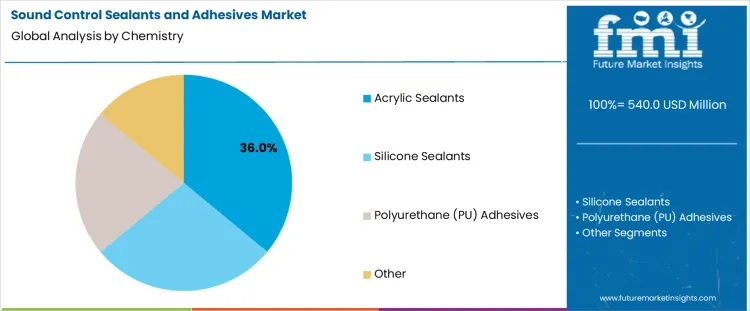
Acrylic sealants hold 36.0%, representing the largest share among chemistries due to balanced performance and ease of use. These formulations offer adequate flexibility to accommodate joint movement while maintaining acoustic sealing continuity. Paintability supports seamless integration with interior finishes. Low odor and straightforward tooling align with interior construction requirements. Silicone sealants provide higher elasticity with surface compatibility limitations. Polyurethane adhesives deliver strong bonding with greater curing control needs. Chemistry segmentation reflects preference for versatile materials supporting reliable sound sealing across common interior construction joints.
Key Points
- Acrylic sealants balance flexibility and application ease.
- Paintable surfaces support interior finish integration.
- Other chemistries address higher movement or bonding needs.
Which Application Accounts for the Highest Share of Demand?
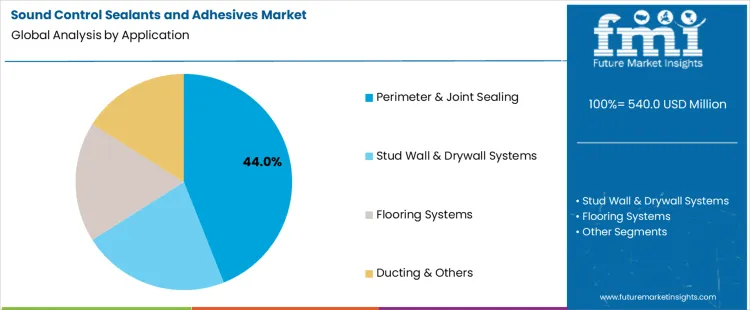
Perimeter and joint sealing holds 44.0%, representing the largest share among application areas due to sound leakage risk. Gaps around partitions, doors, and service penetrations act as primary acoustic weak points. Continuous sealant application improves overall sound transmission loss performance. High linear footage of joints increases material usage per project. Stud wall and drywall systems rely on sealants for cavity isolation. Flooring systems address impact and airborne noise transfer. Application segmentation reflects concentration where discontinuities most strongly affect acoustic performance outcomes.
Key Points
- Joints and perimeters represent primary sound leakage paths.
- Continuous sealing improves assembly acoustic integrity.
- Other applications address cavity or inter-floor noise transfer.
Which End Use Drives the Largest Share of Demand?
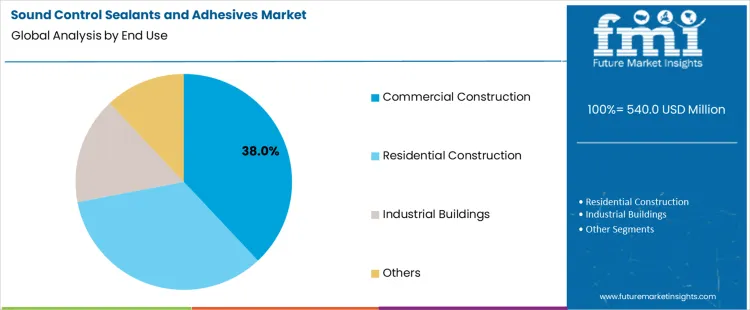
Commercial construction holds 38.0%, representing the largest share among end-use settings due to regulatory scrutiny. Offices, hospitality venues, and institutional buildings require verified acoustic separation between functional spaces. Compliance with noise criteria drives consistent sealant specification. Project scale increases aggregate sealant consumption. Residential construction follows closely with growing noise comfort expectations. Industrial buildings apply sealants selectively for enclosure control. End-use segmentation reflects dominance where occupancy density and compliance requirements sustain regular demand for sound control sealing solutions.
Key Points
- Commercial projects face strict acoustic compliance needs.
- Large-scale developments increase sealant usage volume.
- Other end uses apply sealants based on comfort or enclosure needs.
What are the Key Dynamics in the Sound Control Sealants and Adhesives Market?
Demand for sound control sealants and adhesives reflects acoustic sealing and vibration damping requirements in building envelopes and interior assemblies. Adoption concentrates in residential construction, commercial buildings, studios, healthcare facilities, and industrial enclosures. Global scope aligns with noise compliance and airtightness standards. Usage centers on viscoelastic sealants and bonding adhesives applied at joints, penetrations, and interfaces to limit sound leakage and structure-borne transmission.
How do acoustic leakage control and construction detail requirements shape adoption?
Sound transmission frequently occurs through gaps, joints, and service penetrations rather than wall surfaces. Demand increases where acoustic performance targets require airtight construction detailing. Sealants fill micro-gaps around doors, windows, drywall joints, and utility penetrations to prevent flanking paths. Adhesives with damping properties bond layered assemblies to reduce vibration transmission between panels. Multifamily housing relies on sealants to meet inter-unit sound insulation limits without increasing wall thickness. Studios and healthcare spaces require continuous acoustic sealing to protect speech privacy. Compatibility with gypsum, concrete, metal, and composite substrates supports broad use. Adoption reflects functional necessity to achieve rated acoustic performance through detailing rather than added mass.
How do application sensitivity, material aging, and cost pressure influence market scalability?
Acoustic effectiveness depends on continuous application without voids, increasing workmanship sensitivity. Demand sensitivity rises where improper installation undermines measured sound reduction. Sealant elasticity degrades over time due to temperature cycling and movement, affecting long-term performance. Fire rating and emissions compliance increase formulation and certification cost. Cure time and surface preparation affect construction scheduling. Adhesive performance varies by joint movement and load, limiting universal use. Price competition remains strong in residential segments. Limited acoustic awareness among installers affects outcome consistency, constraining scalable adoption across cost-driven construction projects.
How Is Demand for Sound Control Sealants and Adhesives Evolving Globally?
Demand for sound control sealants and adhesives is expanding globally due to stricter building acoustics requirements, airtight construction practices, and retrofit-driven noise mitigation. Usage aligns with joints, penetrations, and perimeter sealing where airborne noise leakage undermines rated assemblies. Commercial offices, healthcare facilities, hospitality projects, and residential high-rises increasingly specify acoustic sealants within tested wall and floor systems. Compliance documentation and certified performance influence procurement decisions. Growth rates in India at 7.2%, Vietnam at 6.8%, Indonesia at 6.5%, Saudi Arabia at 6.1%, and UAE at 5.8% indicate sustained expansion driven by urban construction intensity, code enforcement, and building performance optimization rather than decorative interior finishes.
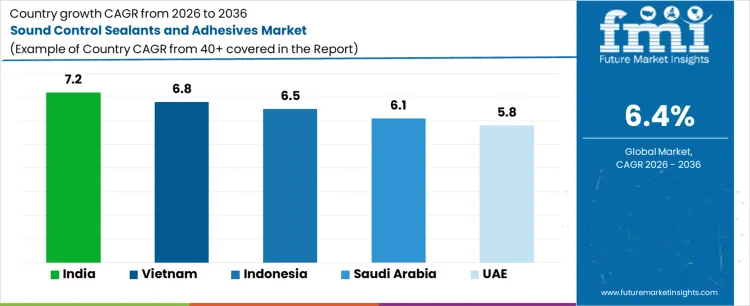
| Country | CAGR (%) |
|---|---|
| India | 7.2% |
| Vietnam | 6.8% |
| Indonesia | 6.5% |
| Saudi Arabia | 6.1% |
| UAE | 5.8% |
What Is Driving Strong Expansion of Sound Control Sealant Demand in India?
Demand for sound control sealants and adhesives in India is growing at a CAGR of 7.2%, supported by dense urban construction and tighter acoustic compliance. High-rise residential projects require effective sealing at partitions, service penetrations, and façade interfaces. Commercial offices and hospitals specify acoustic sealants to maintain tested wall performance. Urban noise exposure increases sensitivity to sound leakage through gaps. Retrofit demand emerges during tenant fit-outs and compliance audits. Expansion of organized construction chemicals suppliers improves availability and installer familiarity. Growth reflects performance-led specifications and regulatory enforcement rather than premium interior detailing.
- High-rise residential acoustic sealing needs
- Healthcare and office compliance specifications
- Urban noise leakage sensitivity
- Organized supplier and installer adoption
Why Is Vietnam Experiencing Rapid Uptake of Sound Control Sealants?
Sound control sealant demand in Vietnam is expanding at a CAGR of 6.8%, driven by commercial development and hospitality construction. Hotels and serviced apartments require effective joint sealing to prevent sound transmission between rooms. Office buildings adopt sealants to support flexible layouts and meeting spaces. Urban redevelopment emphasizes tested acoustic assemblies. Local manufacturers expand supply of compliant sealant formulations. Growth reflects hospitality-driven requirements and commercial usage intensity rather than residential luxury positioning.
- Hotel room-to-room sound isolation needs
- Office partition and meeting room sealing
- Urban redevelopment acoustic compliance
- Expanding local compliant product supply
How Is Indonesia Supporting Growth in Sound Control Adhesive Sales?
Sales of sound control sealants and adhesives in Indonesia are growing at a CAGR of 6.5%, shaped by institutional construction and urban congestion. Hospitals, universities, and government buildings require airtight acoustic assemblies. High ambient noise levels increase reliance on gap sealing to maintain wall performance. Educational facilities specify sealants for lecture halls and auditoriums. Budget sensitivity favors standardized, certified products compatible with common substrates. Growth reflects institutional demand and functional noise management rather than widespread residential adoption.
- Institutional building airtight acoustic requirements
- High ambient urban noise conditions
- Education facility assembly performance needs
- Preference for standardized certified sealants
What Factors Are Supporting Sound Control Sealant Demand in Saudi Arabia?
Sound control sealant demand in Saudi Arabia is expanding at a CAGR of 6.1%, supported by large-scale infrastructure and commercial projects. Government buildings and healthcare facilities specify acoustic sealing for privacy and functionality. Hospitality developments require airtight room assemblies to meet guest comfort standards. Design-stage integration within megaprojects sustains procurement volumes. Climate-controlled interiors increase emphasis on continuous sealing performance. Growth reflects institutional and hospitality requirements rather than retrofit-heavy residential activity.
- Government and healthcare acoustic sealing needs
- Hospitality guest comfort specifications
- Design-stage integration in megaprojects
- Climate-controlled interior performance focus
Why Is the UAE Showing Steady Growth in Sound Control Sealants?
Demand for sound control sealants and adhesives in United Arab Emirates is growing at a CAGR of 5.8%, driven by premium commercial interiors and mixed-use developments. Offices and conference facilities require effective perimeter sealing to maintain acoustic ratings. Hospitality projects emphasize airtightness for room privacy. Building quality standards reinforce use of certified sealant systems. Refurbishment projects generate replacement demand during upgrades. Growth remains steady, reflecting quality-led specifications and service-oriented construction rather than rapid expansion in building volume.
- Premium office and conference acoustic requirements
- Hospitality room privacy sealing needs
- Certified systems aligned with quality standards
- Refurbishment-driven replacement demand
What is the competitive landscape of demand for the sound control sealants and adhesives market globally?
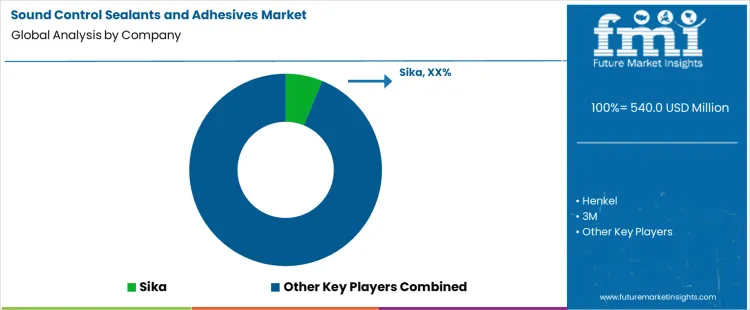
Demand for sound control sealants and adhesives is driven by building noise codes and vibration isolation needs. Use cases concentrate in wall assemblies, floor systems, glazing interfaces, and mechanical penetrations requiring acoustic continuity. Buyers evaluate damping performance, elongation, adhesion to substrates, fire behavior, curing profile, and long-term elasticity. Procurement behavior favors tested STC improvement data, compatibility with drywall systems, low VOC content, and jobsite reliability. Purchasing teams prioritize suppliers supporting specification submittals, contractor training, predictable cure times, and regional supply. Trend in the sound control sealants and adhesives market reflects increased retrofit demand and stricter interior acoustic compliance.
Sika leads competitive positioning through construction acoustics portfolios validated for perimeter sealing, joints, and service penetrations. Henkel competes with polymer-based adhesives offering vibration damping, substrate versatility, and consistent performance across assemblies. 3M supports demand using specialty tapes and sealants applied in acoustic detailing around panels and penetrations. Bostik and Tremco CPG maintain relevance through sealants specified in commercial façades, floors, and mixed-use interiors. Dow and Wacker Chemie participate via silicone technologies delivering elasticity and acoustic decoupling under thermal movement. Competitive differentiation depends on tested acoustic contribution, installation reliability, compliance documentation, and contractor acceptance.
Key Players in the Sound Control Sealants and Adhesives Market
- Sika
- Henkel
- 3M
- Bostik (Arkema)
- Tremco CPG
- Dow
- Wacker Chemie
- MAPEI
- ITW
Scope of the Report
| Items | Values |
|---|---|
| Quantitative Units | USD million |
| Chemistry | Acrylic Sealants; Silicone Sealants; Polyurethane (PU) Adhesives; Other |
| Application | Perimeter & Joint Sealing; Stud Wall & Drywall Systems; Flooring Systems; Ducting & Others |
| End Use | Commercial Construction; Residential Construction; Industrial Buildings; Others |
| Sales Channel | Building Material Distributors; Direct Manufacturer Sales; Contractor Channels; Other |
| Regions Covered | Asia Pacific, Europe, North America, Latin America, Middle East & Africa |
| Countries Covered | India, Vietnam, Indonesia, Saudi Arabia, UAE, and 40+ countries |
| Key Companies Profiled | Sika; Henkel; 3M; Bostik (Arkema); Tremco CPG; Dow; Wacker Chemie; MAPEI; ITW |
| Additional Attributes | Dollar sales by chemistry, application, end use, and sales channel; acoustic damping and vibration isolation performance across acrylic, silicone, and polyurethane formulations; adhesion strength, elasticity, and long-term durability in wall, flooring, and ducting applications; compatibility with building substrates and fire-rated assemblies; procurement dynamics shaped by distributor supply, direct manufacturer contracts, and contractor-led installations. |
Sound Control Sealants and Adhesives Market by Segment
Chemistry:
- Acrylic Sealants
- Silicone Sealants
- Polyurethane (PU) Adhesives
- Other
Application:
- Perimeter & Joint Sealing
- Stud Wall & Drywall Systems
- Flooring Systems
- Ducting & Others
End Use:
- Commercial Construction
- Residential Construction
- Industrial Buildings
- Others
Sales Channel:
- Building Material Distributors
- Direct Manufacturer Sales
- Contractor Channels
- Other
Region:
- Asia Pacific
- China
- Japan
- South Korea
- India
- Australia & New Zealand
- ASEAN
- Rest of Asia Pacific
- Europe
- Germany
- United Kingdom
- France
- Italy
- Spain
- Nordic
- BENELUX
- Rest of Europe
- North America
- United States
- Canada
- Mexico
- Latin America
- Brazil
- Chile
- Rest of Latin America
- Middle East & Africa
- Kingdom of Saudi Arabia
- Other GCC Countries
- Turkey
- South Africa
- Other African Union
- Rest of Middle East & Africa
Bibliography
- International Organization for Standardization. (2023). Building construction-Jointing products-Determination of elastic recovery (ISO 7389:2023). ISO.
- International Organization for Standardization. (2024). Building construction-Jointing products-Determination of adhesion/cohesion properties at variable temperatures (ISO 9047:2024, revised edition). ISO.
- International Organization for Standardization. (2023). Building construction-Sealants-Classification and requirements (ISO 11600:2023). ISO.
- European Committee for Standardization. (2023). Sealants for building construction-Joint sealants-Classification and requirements (EN ISO 11600:2023). CEN.
- European Committee for Standardization. (2024). Fire classification of construction products and building elements-Sealants and joint fillers (EN 13501-1:2024). CEN.
- USA Environmental Protection Agency. (2023). Indoor air quality considerations for construction sealants and adhesives (Updated technical guidance). USA EPA.
Frequently Asked Questions
How big is the sound control sealants and adhesives market in 2026?
The global sound control sealants and adhesives market is estimated to be valued at USD 540.0 million in 2026.
What will be the size of sound control sealants and adhesives market in 2036?
The market size for the sound control sealants and adhesives market is projected to reach USD 1,004.2 million by 2036.
How much will be the sound control sealants and adhesives market growth between 2026 and 2036?
The sound control sealants and adhesives market is expected to grow at a 6.4% CAGR between 2026 and 2036.
What are the key product types in the sound control sealants and adhesives market?
The key product types in sound control sealants and adhesives market are acrylic sealants, silicone sealants, polyurethane (pu) adhesives and other.
Which application segment to contribute significant share in the sound control sealants and adhesives market in 2026?
In terms of application, perimeter & joint sealing segment to command 44.0% share in the sound control sealants and adhesives market in 2026.
Preview the report firsthand - request a free sample
Get SampleGet the brochure for pricing and purchase details.
Get PDFTable of Content
- Executive Summary
- Global Market Outlook
- Demand-side Trends
- Supply-side Trends
- Technology Roadmap Analysis
- Analysis and Recommendations
- Market Overview
- Market Coverage / Taxonomy
- Market Definition / Scope / Limitations
- Market Background
- Market Dynamics
- Drivers
- Restraints
- Opportunity
- Trends
- Scenario Forecast
- Demand in Optimistic Scenario
- Demand in Likely Scenario
- Demand in Conservative Scenario
- Opportunity Map Analysis
- Product Life Cycle Analysis
- Supply Chain Analysis
- Investment Feasibility Matrix
- Value Chain Analysis
- PESTLE and Porter’s Analysis
- Regulatory Landscape
- Regional Parent Market Outlook
- Production and Consumption Statistics
- Import and Export Statistics
- Market Dynamics
- Global Market Analysis 2021 to 2025 and Forecast, 2026 to 2036
- Historical Market Size Value (USD Million) Analysis, 2021 to 2025
- Current and Future Market Size Value (USD Million) Projections, 2026 to 2036
- Y-o-Y Growth Trend Analysis
- Absolute $ Opportunity Analysis
- Global Market Pricing Analysis 2021 to 2025 and Forecast 2026 to 2036
- Global Market Analysis 2021 to 2025 and Forecast 2026 to 2036, By Chemistry
- Introduction / Key Findings
- Historical Market Size Value (USD Million) Analysis By Chemistry , 2021 to 2025
- Current and Future Market Size Value (USD Million) Analysis and Forecast By Chemistry , 2026 to 2036
- Acrylic Sealants
- Silicone Sealants
- Polyurethane (PU) Adhesives
- Other
- Acrylic Sealants
- Y-o-Y Growth Trend Analysis By Chemistry , 2021 to 2025
- Absolute $ Opportunity Analysis By Chemistry , 2026 to 2036
- Global Market Analysis 2021 to 2025 and Forecast 2026 to 2036, By Application
- Introduction / Key Findings
- Historical Market Size Value (USD Million) Analysis By Application, 2021 to 2025
- Current and Future Market Size Value (USD Million) Analysis and Forecast By Application, 2026 to 2036
- Perimeter & Joint Sealing
- Stud Wall & Drywall Systems
- Flooring Systems
- Ducting & Others
- Perimeter & Joint Sealing
- Y-o-Y Growth Trend Analysis By Application, 2021 to 2025
- Absolute $ Opportunity Analysis By Application, 2026 to 2036
- Global Market Analysis 2021 to 2025 and Forecast 2026 to 2036, By End Use
- Introduction / Key Findings
- Historical Market Size Value (USD Million) Analysis By End Use, 2021 to 2025
- Current and Future Market Size Value (USD Million) Analysis and Forecast By End Use, 2026 to 2036
- Commercial Construction
- Residential Construction
- Industrial Buildings
- Others
- Commercial Construction
- Y-o-Y Growth Trend Analysis By End Use, 2021 to 2025
- Absolute $ Opportunity Analysis By End Use, 2026 to 2036
- Global Market Analysis 2021 to 2025 and Forecast 2026 to 2036, By Sales Channel
- Introduction / Key Findings
- Historical Market Size Value (USD Million) Analysis By Sales Channel, 2021 to 2025
- Current and Future Market Size Value (USD Million) Analysis and Forecast By Sales Channel, 2026 to 2036
- Building Material Distributors
- Direct Manufacturer Sales
- Contractor Channels
- Other
- Building Material Distributors
- Y-o-Y Growth Trend Analysis By Sales Channel, 2021 to 2025
- Absolute $ Opportunity Analysis By Sales Channel, 2026 to 2036
- Global Market Analysis 2021 to 2025 and Forecast 2026 to 2036, By Region
- Introduction
- Historical Market Size Value (USD Million) Analysis By Region, 2021 to 2025
- Current Market Size Value (USD Million) Analysis and Forecast By Region, 2026 to 2036
- North America
- Latin America
- Western Europe
- Eastern Europe
- East Asia
- South Asia and Pacific
- Middle East & Africa
- Market Attractiveness Analysis By Region
- North America Market Analysis 2021 to 2025 and Forecast 2026 to 2036, By Country
- Historical Market Size Value (USD Million) Trend Analysis By Market Taxonomy, 2021 to 2025
- Market Size Value (USD Million) Forecast By Market Taxonomy, 2026 to 2036
- By Country
- USA
- Canada
- Mexico
- By Chemistry
- By Application
- By End Use
- By Sales Channel
- By Country
- Market Attractiveness Analysis
- By Country
- By Chemistry
- By Application
- By End Use
- By Sales Channel
- Key Takeaways
- Latin America Market Analysis 2021 to 2025 and Forecast 2026 to 2036, By Country
- Historical Market Size Value (USD Million) Trend Analysis By Market Taxonomy, 2021 to 2025
- Market Size Value (USD Million) Forecast By Market Taxonomy, 2026 to 2036
- By Country
- Brazil
- Chile
- Rest of Latin America
- By Chemistry
- By Application
- By End Use
- By Sales Channel
- By Country
- Market Attractiveness Analysis
- By Country
- By Chemistry
- By Application
- By End Use
- By Sales Channel
- Key Takeaways
- Western Europe Market Analysis 2021 to 2025 and Forecast 2026 to 2036, By Country
- Historical Market Size Value (USD Million) Trend Analysis By Market Taxonomy, 2021 to 2025
- Market Size Value (USD Million) Forecast By Market Taxonomy, 2026 to 2036
- By Country
- Germany
- UK
- Italy
- Spain
- France
- Nordic
- BENELUX
- Rest of Western Europe
- By Chemistry
- By Application
- By End Use
- By Sales Channel
- By Country
- Market Attractiveness Analysis
- By Country
- By Chemistry
- By Application
- By End Use
- By Sales Channel
- Key Takeaways
- Eastern Europe Market Analysis 2021 to 2025 and Forecast 2026 to 2036, By Country
- Historical Market Size Value (USD Million) Trend Analysis By Market Taxonomy, 2021 to 2025
- Market Size Value (USD Million) Forecast By Market Taxonomy, 2026 to 2036
- By Country
- Russia
- Poland
- Hungary
- Balkan & Baltic
- Rest of Eastern Europe
- By Chemistry
- By Application
- By End Use
- By Sales Channel
- By Country
- Market Attractiveness Analysis
- By Country
- By Chemistry
- By Application
- By End Use
- By Sales Channel
- Key Takeaways
- East Asia Market Analysis 2021 to 2025 and Forecast 2026 to 2036, By Country
- Historical Market Size Value (USD Million) Trend Analysis By Market Taxonomy, 2021 to 2025
- Market Size Value (USD Million) Forecast By Market Taxonomy, 2026 to 2036
- By Country
- China
- Japan
- South Korea
- By Chemistry
- By Application
- By End Use
- By Sales Channel
- By Country
- Market Attractiveness Analysis
- By Country
- By Chemistry
- By Application
- By End Use
- By Sales Channel
- Key Takeaways
- South Asia and Pacific Market Analysis 2021 to 2025 and Forecast 2026 to 2036, By Country
- Historical Market Size Value (USD Million) Trend Analysis By Market Taxonomy, 2021 to 2025
- Market Size Value (USD Million) Forecast By Market Taxonomy, 2026 to 2036
- By Country
- India
- ASEAN
- Australia & New Zealand
- Rest of South Asia and Pacific
- By Chemistry
- By Application
- By End Use
- By Sales Channel
- By Country
- Market Attractiveness Analysis
- By Country
- By Chemistry
- By Application
- By End Use
- By Sales Channel
- Key Takeaways
- Middle East & Africa Market Analysis 2021 to 2025 and Forecast 2026 to 2036, By Country
- Historical Market Size Value (USD Million) Trend Analysis By Market Taxonomy, 2021 to 2025
- Market Size Value (USD Million) Forecast By Market Taxonomy, 2026 to 2036
- By Country
- Kingdom of Saudi Arabia
- Other GCC Countries
- Turkiye
- South Africa
- Other African Union
- Rest of Middle East & Africa
- By Chemistry
- By Application
- By End Use
- By Sales Channel
- By Country
- Market Attractiveness Analysis
- By Country
- By Chemistry
- By Application
- By End Use
- By Sales Channel
- Key Takeaways
- Key Countries Market Analysis
- USA
- Pricing Analysis
- Market Share Analysis, 2025
- By Chemistry
- By Application
- By End Use
- By Sales Channel
- Canada
- Pricing Analysis
- Market Share Analysis, 2025
- By Chemistry
- By Application
- By End Use
- By Sales Channel
- Mexico
- Pricing Analysis
- Market Share Analysis, 2025
- By Chemistry
- By Application
- By End Use
- By Sales Channel
- Brazil
- Pricing Analysis
- Market Share Analysis, 2025
- By Chemistry
- By Application
- By End Use
- By Sales Channel
- Chile
- Pricing Analysis
- Market Share Analysis, 2025
- By Chemistry
- By Application
- By End Use
- By Sales Channel
- Germany
- Pricing Analysis
- Market Share Analysis, 2025
- By Chemistry
- By Application
- By End Use
- By Sales Channel
- UK
- Pricing Analysis
- Market Share Analysis, 2025
- By Chemistry
- By Application
- By End Use
- By Sales Channel
- Italy
- Pricing Analysis
- Market Share Analysis, 2025
- By Chemistry
- By Application
- By End Use
- By Sales Channel
- Spain
- Pricing Analysis
- Market Share Analysis, 2025
- By Chemistry
- By Application
- By End Use
- By Sales Channel
- France
- Pricing Analysis
- Market Share Analysis, 2025
- By Chemistry
- By Application
- By End Use
- By Sales Channel
- India
- Pricing Analysis
- Market Share Analysis, 2025
- By Chemistry
- By Application
- By End Use
- By Sales Channel
- ASEAN
- Pricing Analysis
- Market Share Analysis, 2025
- By Chemistry
- By Application
- By End Use
- By Sales Channel
- Australia & New Zealand
- Pricing Analysis
- Market Share Analysis, 2025
- By Chemistry
- By Application
- By End Use
- By Sales Channel
- China
- Pricing Analysis
- Market Share Analysis, 2025
- By Chemistry
- By Application
- By End Use
- By Sales Channel
- Japan
- Pricing Analysis
- Market Share Analysis, 2025
- By Chemistry
- By Application
- By End Use
- By Sales Channel
- South Korea
- Pricing Analysis
- Market Share Analysis, 2025
- By Chemistry
- By Application
- By End Use
- By Sales Channel
- Russia
- Pricing Analysis
- Market Share Analysis, 2025
- By Chemistry
- By Application
- By End Use
- By Sales Channel
- Poland
- Pricing Analysis
- Market Share Analysis, 2025
- By Chemistry
- By Application
- By End Use
- By Sales Channel
- Hungary
- Pricing Analysis
- Market Share Analysis, 2025
- By Chemistry
- By Application
- By End Use
- By Sales Channel
- Kingdom of Saudi Arabia
- Pricing Analysis
- Market Share Analysis, 2025
- By Chemistry
- By Application
- By End Use
- By Sales Channel
- Turkiye
- Pricing Analysis
- Market Share Analysis, 2025
- By Chemistry
- By Application
- By End Use
- By Sales Channel
- South Africa
- Pricing Analysis
- Market Share Analysis, 2025
- By Chemistry
- By Application
- By End Use
- By Sales Channel
- USA
- Market Structure Analysis
- Competition Dashboard
- Competition Benchmarking
- Market Share Analysis of Top Players
- By Regional
- By Chemistry
- By Application
- By End Use
- By Sales Channel
- Competition Analysis
- Competition Deep Dive
- Sika
- Overview
- Product Portfolio
- Profitability by Market Segments (Product/Age /Sales Channel/Region)
- Sales Footprint
- Strategy Overview
- Marketing Strategy
- Product Strategy
- Channel Strategy
- Henkel
- 3M
- Bostik (Arkema)
- Tremco CPG
- Dow
- Wacker Chemie
- MAPEI
- ITW
- Sika
- Competition Deep Dive
- Assumptions & Acronyms Used
- Research Methodology


