

- Industry Size (2026)
- USD 45.2 Mn
- Forecast (2036)
- USD 112.5 Mn
- CAGR (2026 to 2036)
- 9.5%
Demand for Intelligent Prosthetics in South Korea Forecast and Outlook 2026 to 2036
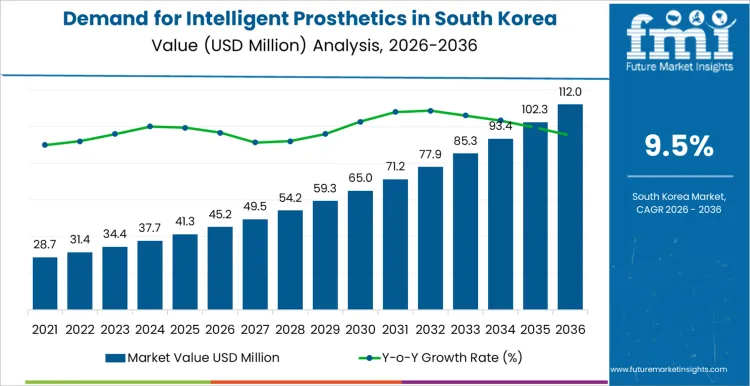
Demand for intelligent prosthetics solutions in South Korea is projected to be valued at USD 45.2 million in 2026. The industry is predicted to reach USD 112.5 million by 2036, advancing at a compound annual growth rate of 9.5%. South Korea is rapidly emerging as a testbed for the convergence of robotics, artificial intelligence, and biomechanics, transitioning from traditional passive artificial limbs to active, neural-integrated bionic systems. The nation's status as a super-aged society, combined with its world-class semiconductor and battery infrastructure, creates a unique ecosystem where high-performance mobility aids are not just medical necessities but technological imperatives.
The industry's expansion is primarily influenced by the government's aggressive investment in the "K-Robot" economy and the standardization of medical bionic implants and exoskeletons within the national healthcare framework. As the prevalence of vascular diseases and diabetes rises among the elderly population, necessitating amputations, there is a concurrent demand for prosthetic solutions that restore not just mobility but sensory feedback and intuitive control. The cultural shift towards active aging is driving retirees to seek motorized prosthesis devices that allow them to maintain independence and engage in recreational activities.
Quick Stats for Demand for Intelligent Prosthetics in South Korea
- Industry Value (2026): USD 45.2 million
- Industry Forecast Value (2036): USD 112.5 million
- Industry Forecast CAGR: 9.5%
- Leading Product Type: Lower Limb Prosthetics (58%)
- Leading Technology: Microprocessor Controlled (45%)
- Leading End User: Prosthetic Clinics (42%)
- Key Growth Regions: Seoul, Gyeonggi, Busan, Daegu
- Key Players: Ottobock Korea, Össur, Hyundai Rotem, Samsung Electronics (Assistive Tech), Cyberdyne, Endolite
Domestic research institutes and tech conglomerates are collaborating to develop upper limb prosthetics that can predict user intent, allowing for fluid hand gestures and precise grip strength adjustments. Simultaneously, the application of 3d printed prosthetics is revolutionizing the customization process, enabling clinics to produce lightweight, perfectly fitted sockets in a fraction of the time required for traditional casting methods.
The competitive sphere is characterized by the entry of major South Korean electronics firms into the assistive technology space, challenging established European manufacturers. Companies like Samsung and LG are leveraging their expertise in sensors and actuators to develop next-generation bionic gloves and wearable robotics. This influx of cross-industry innovation is fostering a landscape where carbon fibre composites prosthetics are becoming lighter and more durable, ensuring that the sector delivers solutions capable of withstanding the rigors of daily life through 2036.
Demand for Intelligent Prosthetics in South Korea Key Takeaways
| Metric | Value |
|---|---|
| Industry Size (2026) | USD 45.2 million |
| Industry Value (2036) | USD 112.5 million |
| CAGR (2026 to 2036) | 9.5% |
How South Korea’s Aging Population Is Reshaping Prosthetic Care and Reimbursement Models
The primary catalyst for growth is the accelerated demographic shift, where South Korea is set to become one of the world's oldest populations. This reality is forcing a re-evaluation of elderly care, moving away from institutionalization towards maintaining functional independence. Intelligent orthopedic prosthetic devices, particularly those that prevent falls and adapt to uneven terrain, are becoming critical tools for allowing seniors to age in place. The National Health Insurance Service is increasingly recognizing the long-term cost benefits of advanced mobility aids, which reduce secondary complications and hospitalization rates, thereby incentivizing the prescription of high-tech limbs over basic mechanical alternatives.
How is the Sector Structured Across Key Segments?
The sector is segmented to address the functional needs of amputees ranging from trauma victims to geriatric patients. It is primarily categorized by product type, reflecting the anatomical replacement. The technology segment distinguishes between passive mechanisms and active AI-driven control, while the end user segment highlights the point of care. Each segment plays a vital role, where lower limb devices drive volume through mobility restoration and clinics drive value through personalized fitting services.
Why Are Lower Limb Systems Dominating the Sector?
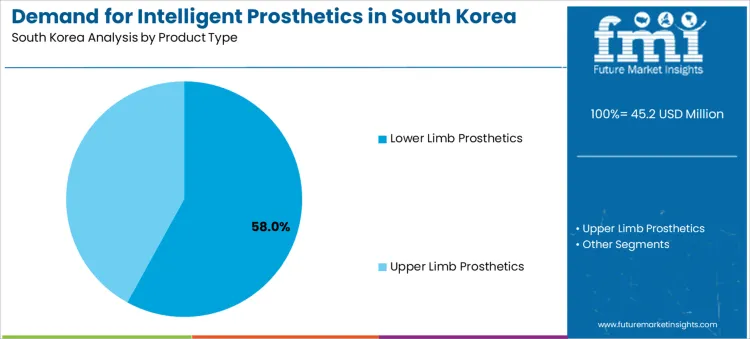
The lower limb prosthetics segment commands a 58% share of the industry. This dominance is driven by the high incidence of lower extremity amputations due to diabetic complications and vascular diseases. Patients prioritize prosthetics and orthotics that offer stability and energy efficiency for walking. The widespread adoption of microprocessor-controlled knees (MPKs) in South Korea is fueled by their ability to dynamically adjust resistance, allowing users to navigate the country's hilly terrain and urban stairs with confidence and reduced physical exertion.
How is Microprocessor Technology Enhancing User Safety?
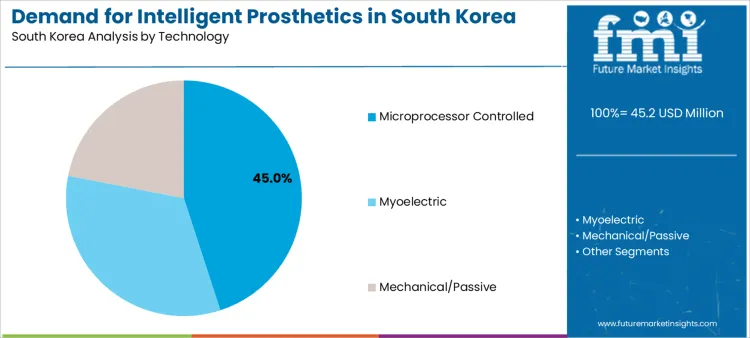
Microprocessor-controlled technology holds the majority share of 45% within the technology segment. This preference is attributed to the superior safety profile these systems offer compared to purely mechanical joints. South Korean users, often living in dense urban environments, require prosthetics that can react instantly to trips or stumbles. The integration of sensors that monitor gait cycle data 100 times per second ensures that the prosthetic limb provides the correct support at every moment, significantly reducing the fear of falling and encouraging higher activity levels.
Why Are Specialized Clinics the Preferred Distribution Channel?
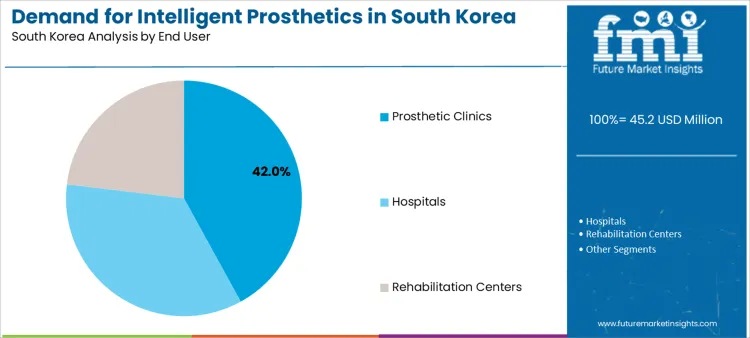
Prosthetic clinics account for 42% of the end-user share. Unlike general hospitals, these specialized centers offer the intensive rehabilitation and gait training required to master intelligent devices. The complex nature of implant borne prosthetics and myoelectric sensors necessitates long-term relationships between prosthetists and patients for fine-tuning. South Korean clinics are increasingly equipping themselves with digital gait analysis labs and VR training rooms to help patients adapt to their bionic limbs, positioning themselves as comprehensive rehabilitation hubs.
How is Osseointegration Changing the Interface?
The orthopaedic prosthetics landscape is witnessing a shift towards direct skeletal attachment. While traditional socket-based systems remain common, osseointegration is gaining traction for patients who experience discomfort or skin breakdown. This segment is driven by the demand for greater sensory feedback and "embodiment" of the prosthetic. South Korean surgeons are adopting advanced implant techniques that allow the prosthetic to snap directly into the bone, eliminating socket-related issues and enabling a wider range of motion for active users.
Sector Dynamics
Can Brain-Computer Interfaces (BCI) Redefine Control?
A major trend reshaping the landscape is the research into neural interfaces that allow users to control prosthetics with their thoughts. South Korean research institutes are at the forefront of developing non-invasive BCI headsets and nerve-cuff electrodes that translate brain signals into prosthetic movement. This trend is driven by the desire to create intuitive, "mind-controlled" limbs that function as natural extensions of the body. Successful integration of this technology would overcome the limitations of current EMG sensors, which can be affected by sweat or muscle fatigue.
Is Cost a Barrier to Universal Access?
The most significant restraint is the high out-of-pocket cost for top-tier intelligent prosthetics. While basic models are covered, advanced bionic hands and powered ankles often fall outside standard insurance reimbursement limits. This economic hurdle creates a disparity where only affluent patients can access the latest technology. Overcoming this requires the development of cost-effective domestic alternatives and expanded insurance coverage policies that recognize the socioeconomic value of returning amputees to the workforce.
How Will 3D Printing Democratize Customization?
The emerging field of additive manufacturing presents a frontier of opportunity. South Korea's strong 3D printing infrastructure allows for the decentralized production of prosthetic components. Suppliers who can offer rapid-prototyping services for sockets and cosmetic covers stand to capture significant revenue. This transitional landscape allows for hyper-personalization, where prosthetics are not only functionally fitted but also aesthetically designed to match the user's skin tone or artistic preferences, reducing the stigma associated with limb loss.
How is the Intelligent Prosthetics Landscape Evolving Across South Korea's Regions?
The regional sphere shows a concentration of medical expertise in the capital area, while industrial hubs focus on robotic rehabilitation. High-growth areas are characterizing their modernization by establishing specialized "medi-clusters." As distinct provinces leverage their technological strengths, the utilization of intelligent prosthetics is becoming integrated into regional healthcare specializations.
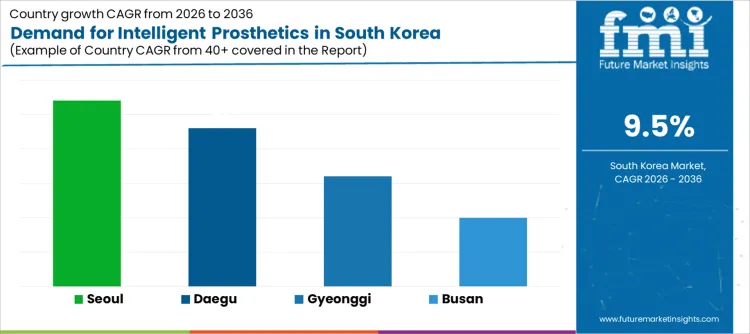
| Region | CAGR (2026 to 2036) |
|---|---|
| Seoul | 10.2% |
| Daegu | 9.8% |
| Gyeonggi | 9.1% |
| Busan | 8.5% |
Why is Seoul the Hub for Advanced Bionic Research?
Adoption of intelligent prosthetics in Seoul is projected to expand at a CAGR of 10.2%. As the center of South Korea's premier university hospitals and research institutions, Seoul attracts the most complex amputation cases. The demand here is driven by early adopters seeking cutting-edge multi-articulating hands and powered knees. The concentration of top-tier rehabilitation centers and the presence of global manufacturers' headquarters ensure that patients in the capital have immediate access to the latest product launches and clinical trials.
How is "Medicity Daegu" Fostering Innovation?
Sales of intelligent prosthetics in Daegu are likely to reach a CAGR of 9.8%. Daegu has actively branded itself as a medical hub, with strong government support for the medical device industry. The region's focus on robotics and smart healthcare creates a fertile ground for startups developing domestic intelligent prosthetic components. The demand is fueled by the integration of these devices into local rehabilitation hospitals that specialize in robotic therapy, offering a comprehensive care pathway for amputees.
What Role Does Manufacturing Play in Gyeonggi?
The intelligent prosthetics sector in Gyeonggi is anticipated to rise at a CAGR of 9.1%. Surrounding the capital, Gyeonggi is the manufacturing heartland where many tech prototypes are turned into commercial products. The presence of Pangyo Techno Valley facilitates collaboration between software developers and hardware engineers to refine AI algorithms for prosthetic control. The region's demand is also supported by a large industrial workforce, necessitating robust, durable prosthetic solutions for patients recovering from occupational injuries.
How is Geriatric Care Driving Demand in Busan?
Deployment of intelligent prosthetics in Busan is expected to increase at a CAGR of 8.5%. With a rapidly aging population, Busan's healthcare infrastructure is heavily oriented towards geriatric care. The demand is driven by the need for user-friendly, lightweight intelligent prosthetics that help elderly amputees maintain their quality of life. Local hospitals are adopting streamlined fitting processes for microprocessor knees to ensure that older patients can safely navigate the city's coastal geography and maintain social connections.
How Are Companies Competing and Strengthening Their Positions in the South Korean Prosthetics Industry?
The competitive landscape is defined by a rivalry between high-end global imports and cost-competitive domestic innovations. Industry leaders like Ottobock and Össur are strengthening their positions by offering comprehensive training programs to local prosthetists, ensuring their complex devices are fitted correctly to maximize performance. There is also a marked trend toward cross-sector partnerships, where prosthetic manufacturers collaborate with South Korean battery and motor companies to improve the power-to-weight ratio of their devices.
Mergers and acquisitions are targeted at niche sensor startups, as major players seek to enhance the intuitive control of their bionic limbs. Leading companies are actively investing in digital patient platforms that allow for remote tuning and monitoring of the device's status. Furthermore, competitive intensity is driving a shift toward "integrated mobility solutions," where companies offer not just the prosthetic limb, but a suite of rehabilitation apps and wearable trackers to support the user's entire recovery journey.
Key Companies
- Ottobock Korea
- Össur
- Hyundai Rotem
- Samsung Electronics (Assistive Tech Division)
- Cyberdyne
- Endolite
- Fillauer
- Neofect
- Angel Robotics
- SG Robotics
Scope of Report
| Items | Values |
|---|---|
| Quantitative Units | USD Million |
| Product Type | Upper Limb Prosthetics, Lower Limb Prosthetics |
| Technology | Microprocessor Controlled, Myoelectric, Mechanical/Passive |
| End User | Prosthetic Clinics, Hospitals, Rehabilitation Centers |
| Regions Covered | Seoul, Daegu, Gyeonggi, Busan |
| Key Companies Profiled | Ottobock, Össur, Hyundai Rotem, Samsung, and others. |
Demand for Intelligent Prosthetics in South Korea by Segments
By Product Type:
- Upper Limb Prosthetics
- Lower Limb Prosthetics
By Technology:
- Microprocessor Controlled
- Myoelectric
- Mechanical/Passive
By End User:
- Prosthetic Clinics
- Hospitals
- Rehabilitation Centers
By Region:
- Seoul
- Daegu
- Gyeonggi
- Busan
Bibliography
- Korea Medical Devices Industry Association (KMDIA). (2024). Domestic Medical Device Market Size.
- National Rehabilitation Center (NRC). (2024, May 6). Results of the 2023 Survey on Persons with Disabilities.
- Electronics and Telecommunications Research Institute (ETRI). (2024). Artificial Intelligence Semiconductor National Investment Strategy Study.
- Korea Health Industry Development Institute (KHIDI). (2025, April 23). 2025 Global Bio Health Industry Market Size 2019 to 2030
- Korea Health Industry Development Institute (KHIDI). (2025, September 9). Global Bio Health Industry Trends Vol 564.
Frequently Asked Questions
How big is the demand for intelligent prosthetics in south korea in 2026?
The demand for intelligent prosthetics in south korea is estimated to be valued at USD 45.2 million in 2026.
What will be the size of intelligent prosthetics in south korea in 2036?
The market size for the intelligent prosthetics in south korea is projected to reach USD 112.0 million by 2036.
How much will be the demand for intelligent prosthetics in south korea growth between 2026 and 2036?
The demand for intelligent prosthetics in south korea is expected to grow at a 9.5% CAGR between 2026 and 2036.
What are the key product types in the intelligent prosthetics in south korea?
The key product types in intelligent prosthetics in south korea are 0.42.
Which 0.45 segment is expected to contribute significant share in the intelligent prosthetics in south korea in 2026?
In terms of 0.45, 0.3 segment is expected to command 0.0% share in the intelligent prosthetics in south korea in 2026.
Preview the report firsthand - request a free sample
Get SampleGet the brochure for pricing and purchase details.
Get PDFTable of Content
- Executive Summary
- South Korea Market Outlook
- Demand-side Trends
- Supply-side Trends
- Technology Roadmap Analysis
- Analysis and Recommendations
- Market Overview
- Market Coverage / Taxonomy
- Market Definition / Scope / Limitations
- Market Background
- Market Dynamics
- Drivers
- Restraints
- Opportunity
- Trends
- Scenario Forecast
- Demand in Optimistic Scenario
- Demand in Likely Scenario
- Demand in Conservative Scenario
- Opportunity Map Analysis
- Product Life Cycle Analysis
- Supply Chain Analysis
- Investment Feasibility Matrix
- Value Chain Analysis
- PESTLE and Porter’s Analysis
- Regulatory Landscape
- Regional Parent Market Outlook
- Production and Consumption Statistics
- Import and Export Statistics
- Market Dynamics
- South Korea Market Analysis 2021 to 2025 and Forecast, 2026 to 2036
- Historical Market Size Value (USD Million) Analysis, 2021 to 2025
- Current and Future Market Size Value (USD Million) Projections, 2026 to 2036
- Y-o-Y Growth Trend Analysis
- Absolute $ Opportunity Analysis
- South Korea Market Pricing Analysis 2021 to 2025 and Forecast 2026 to 2036
- South Korea Market Analysis 2021 to 2025 and Forecast 2026 to 2036, By 0.58
- Introduction / Key Findings
- Historical Market Size Value (USD Million) Analysis By 0.58 , 2021 to 2025
- Current and Future Market Size Value (USD Million) Analysis and Forecast By 0.58 , 2026 to 2036
- 0.42
- 0.42
- Y-o-Y Growth Trend Analysis By 0.58 , 2021 to 2025
- Absolute $ Opportunity Analysis By 0.58 , 2026 to 2036
- South Korea Market Analysis 2021 to 2025 and Forecast 2026 to 2036, By 0.45
- Introduction / Key Findings
- Historical Market Size Value (USD Million) Analysis By 0.45, 2021 to 2025
- Current and Future Market Size Value (USD Million) Analysis and Forecast By 0.45, 2026 to 2036
- 0.3
- 0.25
- 0.3
- Y-o-Y Growth Trend Analysis By 0.45, 2021 to 2025
- Absolute $ Opportunity Analysis By 0.45, 2026 to 2036
- South Korea Market Analysis 2021 to 2025 and Forecast 2026 to 2036, By 0.42
- Introduction / Key Findings
- Historical Market Size Value (USD Million) Analysis By 0.42, 2021 to 2025
- Current and Future Market Size Value (USD Million) Analysis and Forecast By 0.42, 2026 to 2036
- 0.35
- 0.23
- 0.35
- Y-o-Y Growth Trend Analysis By 0.42, 2021 to 2025
- Absolute $ Opportunity Analysis By 0.42, 2026 to 2036
- Market Structure Analysis
- Competition Dashboard
- Competition Benchmarking
- Market Share Analysis of Top Players
- By Regional
- By 0.58
- By 0.45
- By 0.42
- Competition Analysis
- Competition Deep Dive
- Competition Deep Dive
- Assumptions & Acronyms Used
- Research Methodology


