

- Industry Size (2026)
- USD 2339.2 Mn
- Forecast (2036)
- USD 5437.0 Mn
- CAGR (2026 to 2036)
- 8.8%
Sterilization in Place Bioreactors Market Forecast and Outlook 2026 to 2036
The sterilization in place bioreactors market is projected to reach USD 2,339.2 million in 2026 and expand to USD 5,437.0 million by 2036, at a CAGR of 8.8%. Value behavior reflects structural dependence on automated sterilization for aseptic biomanufacturing, where contamination events carry disproportionate financial and regulatory consequences. Spending concentrates on stainless steel and hybrid bioreactor systems that support repeated sterilization cycles without disassembly, enabling high asset utilization across multiproduct facilities. Capital allocation is driven by long operating lifecycles, validation durability, and compatibility with evolving biologics pipelines rather than short-term capacity additions.
Adoption patterns are governed by regulatory scrutiny, production continuity requirements, and integration with automated cleaning and control architectures. Utilization intensity increases where monoclonal antibody, vaccine, and microbial fermentation operations require frequent turnaround with documented sterility assurance. High capital cost, utility infrastructure demands, and validation workload moderate uptake among smaller producers, reinforcing concentration within established manufacturers and CDMOs. Market structure remains shaped by compliance discipline, engineering complexity, and lifecycle service dependence, sustaining predictable growth linked to biomanufacturing scale-up and process standardization rather than episodic facility expansion.
Quick Stats for Sterilization in Place (SIP) Bioreactors Market
- Sterilization in Place Bioreactors Market Value (2026): USD 2,339.2 million
- Sterilization in Place Bioreactors Market Forecast Value (2036): USD 5,437.0 million
- Sterilization in Place Bioreactors Market Forecast CAGR 2026 to 2036: 8.8%
- Leading Product Offering by Demand Share: Stainless steel SIP bioreactor systems
- Fastest-Growing Countries: India, Brazil, China, USA, Germany
- Top Players in Global Demand: Sartorius, Thermo Fisher Scientific, Cytiva, Merck KGaA, GEA Group

Sterilization in Place Bioreactors Market Key Takeaways
| Metric | Value |
|---|---|
| Market Value (2026) | USD 2,339.2 million |
| Market Forecast Value (2036) | USD 5,437.0 million |
| Forecast CAGR 2026 to 2036 | 8.8% |
Why is the Demand for Sterilization in Place Bioreactors Growing?
Demand for sterilization in place (SIP) bioreactors is rising as biopharmaceutical manufacturers and contract development and manufacturing organizations (CDMOs) require robust systems that support high product integrity while minimizing contamination risk. SIP bioreactors incorporate automated steam generation and circulation protocols that sterilize internal surfaces, valves, and connections without disassembly, which reduces manual handling and exposure to environmental contaminants. Process engineers specify SIP capability because it supports reproducible sterility assurance across successive batches of vaccines, monoclonal antibodies, and cell and gene therapies where even trace bioburden can compromise yield or safety. Procurement teams evaluate vessel design, validation documentation, control system integration, and compliance with current good manufacturing practice expectations to ensure that selected units align with production scale and quality benchmarks. These criteria are especially relevant where regulatory oversight demands documented sterility control and rapid turnover between campaigns.
Growth in complex biologic pipelines and intensified manufacturing schedules reinforces adoption of SIP bioreactors that improve facility throughput and lower risk of cross contamination between product lines. Facilities with flexible manufacturing strategies benefit from automated SIP cycles that reduce downtime and labor costs associated with manual sterilization and cleaning. Integration of SIP with automated cleaning in place (CIP) sequences enhances overall process efficiency and supports data capture for electronic batch records. Engineering teams also consider thermal distribution, cycle reproducibility, and energy usage when comparing SIP platforms because predictable performance under varied operating conditions reduces cycle variability. These application-specific operational and quality drivers are contributing to sustained demand growth in the sterilization in place bioreactors market.
How Is the Sterilization in Place Bioreactors Industry Segmented by Product Offering, Application Area, and End User?
Demand for sterilization in place bioreactors is driven by contamination control requirements, scale-up reliability, and regulatory expectations for aseptic processing. Bioprocessing operations prioritize validated steam sterilization, repeatable cycle performance, and integration with upstream automation. Adoption aligns with biologics pipeline expansion, flexible manufacturing strategies, and lifecycle cost control. Purchasing decisions emphasize material compatibility, documentation support, and upgrade pathways. Segmentation clarifies how system components, production use cases, and organizational maturity influence deployment across biopharmaceutical manufacturing environments.
Which Product Offering Accounts for the Largest Share in SIP Bioreactor Deployments?

Stainless steel SIP bioreactor systems account for 30.0%, reflecting their role as the core asset enabling robust, repeatable sterilization cycles. These systems support high-pressure steam exposure, long operational lifetimes, and regulatory familiarity. SIP and CIP skids with steam systems at 18.0% enable centralized sterilization utilities supporting multiple vessels. Control systems and automation software at 16.0% coordinate cycle execution and data capture. Sensors and PAT instrumentation at 14.0% ensure real-time verification. Installation and validation services at 12.0%, alongside retrofit kits at 10.0%, support compliance and lifecycle extension.
Key Points:
- Stainless steel systems anchor validated sterilization capability.
- Skids and automation improve consistency and scalability.
- Services and retrofits extend operational lifespan.
How Do Application Areas Influence Demand for SIP Bioreactors?

Monoclonal antibody manufacturing represents 26.0%, driven by large-volume upstream processing requiring strict sterility assurance. Vaccine production at 20.0% relies on SIP systems to manage batch-to-batch contamination risk. Microbial fermentation at 18.0% applies SIP for high-cell-density processes with frequent turnaround. Biosimilars manufacturing at 16.0% emphasizes process comparability and documentation rigor. Cell and gene therapy upstream at 12.0% uses SIP to protect sensitive cultures within smaller batches. Process development and pilot scale at 8.0% focuses on flexibility and method optimization. Application segmentation reflects alignment between contamination risk and sterilization intensity.
Key Points:
- Antibody production drives high-capacity SIP usage.
- Vaccines and biosimilars demand consistent sterility control.
- Advanced therapies apply SIP within flexible upstream setups.
Which End User Groups Drive Adoption of SIP Bioreactor Systems?
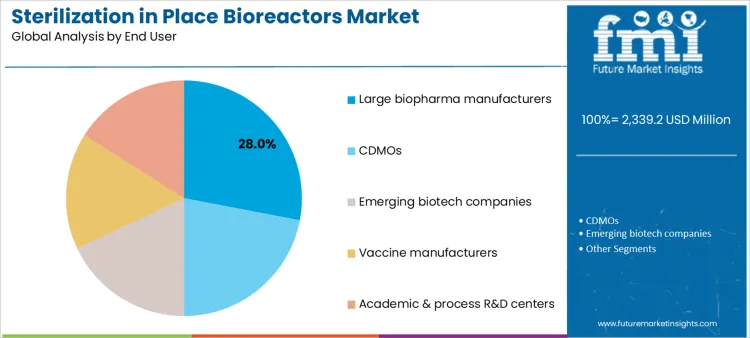
Large biopharma manufacturers account for 28.0%, reflecting established facilities with integrated sterilization infrastructure. CDMOs at 22.0% deploy SIP bioreactors to serve multiple client programs under strict quality frameworks. Emerging biotech companies at 18.0% adopt modular systems supporting phased capacity expansion. Vaccine manufacturers at 16.0% integrate SIP to maintain biosafety and throughput reliability. Academic and process R&D centers at 16.0% use SIP platforms for translational studies and scale-up validation. End-user segmentation highlights concentration where operational scale, regulatory accountability, and portfolio diversity shape equipment adoption.
Key Points:
- Large manufacturers prioritize validated, high-throughput systems.
- CDMOs require flexible and compliant sterilization platforms.
- R&D centers focus on scale-up and process learning.
What are the Key Dynamics in the Sterilization in Place Bioreactors Market?
Demand for sterilization in place bioreactors reflects bioprocessing requirements to maintain aseptic conditions without disassembly across repeated production cycles. Adoption concentrates in biopharmaceutical manufacturing, vaccine production, cell culture operations, and microbial fermentation facilities. Global scope aligns with regulatory expectations for contamination control in biologics manufacturing. Usage centers on stainless steel and advanced single-use hybrid bioreactors integrating automated SIP cycles to sterilize internal surfaces, piping, and valves.
How do contamination risk control and production continuity requirements shape adoption?
Biologic manufacturing processes remain highly sensitive to microbial contamination that can invalidate entire batches. Demand increases where frequent cleaning and sterilization are required between runs without compromising uptime. SIP bioreactors enable validated sterilization of contact surfaces using controlled steam or chemical cycles while remaining fully assembled. Automated SIP sequences reduce operator intervention and variability, supporting reproducible aseptic conditions. Facilities producing monoclonal antibodies, vaccines, and enzymes rely on SIP to meet sterility assurance levels mandated by regulators. Integration with clean in place systems streamlines turnaround between batches. Adoption reflects operational priority to protect high-value products while maintaining consistent production schedules.
How do capital intensity, system complexity, and validation burden influence market scalability?
SIP bioreactors require robust pressure-rated vessels, steam infrastructure, and precise control systems, increasing initial capital investment. Demand sensitivity rises where smaller manufacturers face cost barriers relative to disposable alternatives. System qualification and repeated validation add engineering and documentation workload. Energy consumption during steam cycles affects operating cost. Retrofitting existing facilities presents space and utility constraints. Maintenance of valves, seals, and instrumentation impacts long-term reliability. Regulatory audits increase scrutiny on SIP performance data. Scalability remains constrained by high upfront cost, technical complexity, and extensive validation requirements across diverse biomanufacturing environments.
How Is Demand for Sterilization in Place Bioreactors Evolving Globally?
Demand for sterilization in place bioreactors is expanding globally as biopharmaceutical manufacturers prioritize contamination control, batch integrity, and operational efficiency. Single-use and stainless-steel bioprocessing facilities integrate SIP systems to ensure validated sterilization without dismantling equipment. Growth in biologics, vaccines, and cell-based therapies increases reliance on reproducible sterilization cycles. Regulatory expectations for aseptic assurance reinforce adoption across development and commercial scales. Growth rates in India at 11.3%, Brazil at 10.8%, China at 10.3%, the USA at 7.3%, and Germany at 7.2% indicate sustained expansion driven by biomanufacturing capacity build-out, compliance requirements, and process standardization rather than basic laboratory expansion.
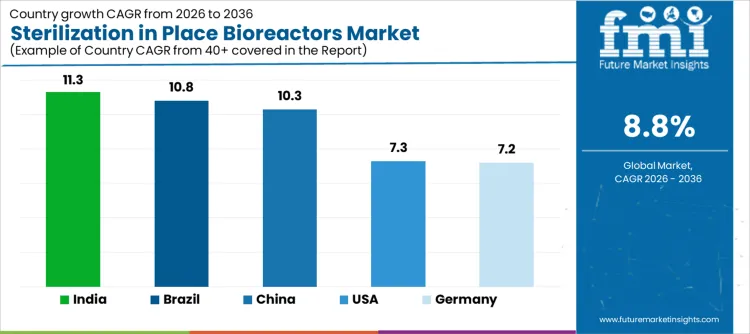
| Country | CAGR (%) |
|---|---|
| India | 11.3% |
| Brazil | 10.8% |
| China | 10.3% |
| USA | 7.3% |
| Germany | 7.2% |
What Is Driving Accelerated Adoption of Sterilization in Place Bioreactors in India?
Demand for sterilization in place bioreactors in India is growing at a CAGR of 11.3%, supported by rapid expansion of biologics and vaccine manufacturing capacity. Contract development and manufacturing organizations scale multiproduct facilities requiring validated SIP protocols. Increased focus on export-oriented biologics strengthens adherence to global regulatory standards. Automation investments improve cycle control and documentation. Local engineering firms supply customized bioreactor systems for diverse process scales. Growth reflects biopharmaceutical capacity expansion, regulatory alignment, and multiproduct manufacturing needs rather than early-stage research activity.
- Expansion of biologics and vaccine manufacturing
- Multiproduct CDMO facility requirements
- Export-driven regulatory compliance alignment
- Availability of locally engineered SIP systems
Why Is Brazil Experiencing Strong Growth in Sterilization in Place Bioreactor Utilization?
Sterilization in place bioreactor demand in Brazil is expanding at a CAGR of 10.8%, driven by public sector biologics production and biosimilar development. State-supported manufacturing facilities upgrade sterilization systems to ensure aseptic reliability. Increasing domestic vaccine and therapeutic protein production elevates need for integrated SIP solutions. Technology transfer partnerships introduce standardized bioprocessing platforms. Growth reflects institutional investment, domestic capacity strengthening, and quality assurance priorities rather than rapid diversification into novel modalities.
- Public sector biologics manufacturing upgrades
- Domestic vaccine and biosimilar production growth
- Technology transfer-driven platform standardization
- Emphasis on aseptic quality assurance
How Is China Sustaining Momentum in Sterilization in Place Bioreactor Deployment?
Sterilization in place bioreactor demand in China is growing at a CAGR of 10.3%, aligned with large-scale biologics manufacturing and process industrialization. High-volume production facilities require reliable, repeatable sterilization cycles. Regulatory oversight strengthens validation and documentation requirements. Domestic equipment manufacturers supply integrated SIP-capable bioreactors at scale. Continuous process optimization sustains replacement and upgrade demand. Growth reflects manufacturing scale, regulatory enforcement, and system standardization rather than pilot-stage experimentation.
- Large-scale biologics production facilities
- Strengthened validation and documentation oversight
- Scaled domestic bioreactor manufacturing
- Continuous process optimization initiatives
What Factors Are Supporting Sterilization in Place Bioreactor Demand in the United States?
Sterilization in place bioreactor demand in the United States is expanding at a CAGR of 7.3%, supported by mature biopharmaceutical manufacturing and regulatory rigor. Commercial biologics facilities rely on SIP for contamination control and batch consistency. Process intensification and closed-system designs increase sterilization complexity. Equipment upgrades focus on automation, monitoring, and data integrity. Replacement demand arises from lifecycle management of installed assets. Growth reflects process refinement and compliance adherence rather than expansion of manufacturing footprints.
- Mature commercial biologics manufacturing base
- Closed-system and process intensification adoption
- Automation and data integrity upgrade needs
- Installed asset lifecycle replacement demand
Why Is Germany Showing Steady Expansion in Sterilization in Place Bioreactors?
Sterilization in place bioreactor demand in Germany is growing at a CAGR of 7.2%, shaped by precision biomanufacturing and strict regulatory frameworks. Biopharmaceutical producers emphasize validated sterilization performance and documentation accuracy. Engineering-led system design ensures integration with cleanroom and utility infrastructure. Procurement decisions prioritize reliability and compliance over rapid scale-up. Incremental upgrades support long-term operational stability. Growth remains steady, reflecting structured investment, quality governance, and process discipline rather than aggressive capacity expansion.
- Precision-focused biomanufacturing practices
- Strong regulatory and documentation requirements
- Engineering-led system integration standards
- Incremental upgrades for operational stability
What is the competitive landscape of demand for the sterilization in place bioreactors market globally?
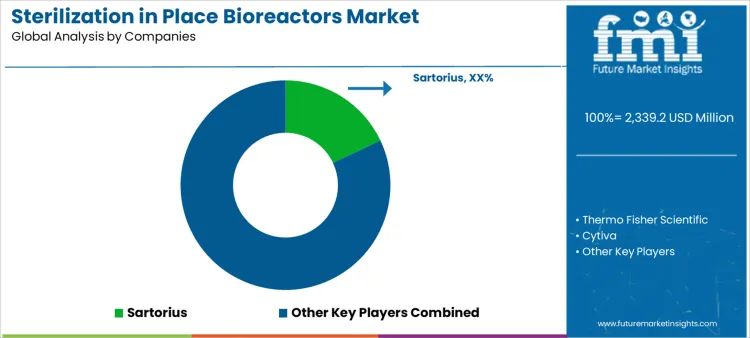
Demand for sterilization in place bioreactors is driven by biologics manufacturing scale-up, contamination risk control, and regulatory expectations for aseptic processing. Biopharmaceutical manufacturers evaluate sterilization reliability, cycle repeatability, cleanability, material compatibility, and automation integration. Buyer assessment includes validation documentation, temperature uniformity, downtime minimization, and alignment with GMP requirements. Procurement behavior reflects long capital planning cycles, preference for platform standardization, and reliance on suppliers offering strong commissioning and lifecycle support. Trend in the sterilization in place bioreactors market shows increasing adoption in monoclonal antibody and cell culture facilities emphasizing operational efficiency and compliance consistency.
Sartorius leads competitive positioning through integrated bioreactor platforms with proven sterilization performance and strong adoption in large-scale biologics production. Thermo Fisher Scientific competes by offering flexible bioreactor systems aligned with modular facility designs and rapid deployment needs. Cytiva supports demand with bioprocessing solutions emphasizing scalability, automation, and standardized sterilization workflows. Merck KGaA maintains relevance through bioreactors integrated within comprehensive upstream processing portfolios and strong regulatory support. GEA Group participates by supplying engineered bioreactor systems focused on thermal control, cleanability, and long-term operational robustness. Competitive differentiation centers on sterilization reliability, validation support depth, automation capability, and supplier experience in regulated biomanufacturing environments.
Key Players in the Sterilization in Place Bioreactors Market
- Sartorius
- Thermo Fisher Scientific
- Cytiva
- Merck KGaA
- GEA Group
- Others
Scope of the Report
| Items | Values |
|---|---|
| Quantitative Units | USD million |
| Products | Stainless steel SIP bioreactor systems; SIP/CIP skids & steam systems; Control systems & automation software; Sensors & PAT instrumentation; Installation & validation services; Retrofit & upgrade kits |
| Applications | Monoclonal antibody manufacturing; Vaccine production; Microbial fermentation; Biosimilars manufacturing; Cell & gene therapy upstream; Process development & pilot scale |
| End User | Large biopharma manufacturers; CDMOs; Emerging biotech companies; Vaccine manufacturers; Academic & process R&D centers |
| Regions Covered | Asia Pacific, Europe, North America, Latin America, Middle East & Africa |
| Countries Covered | India, Brazil, China, USA, Germany, and 40+ countries |
| Key Companies Profiled | Sartorius; Thermo Fisher Scientific; Cytiva; Merck KGaA; GEA Group; Others |
| Additional Attributes | Dollar sales by product category, application, and end user; sterilization reliability and contamination control performance in stainless steel SIP bioreactor operations; integration of CIP, steam, automation, and PAT systems for compliant bioprocessing; scalability across pilot, clinical, and commercial manufacturing; validation and qualification requirements aligned with GMP regulations; procurement dynamics influenced by biopharma capacity expansions, CDMO investments, and long-term service and upgrade contracts. |
Sterilization in Place Bioreactors Market by Segment
Products:
- Stainless steel SIP bioreactor systems
- SIP/CIP skids & steam systems
- Control systems & automation software
- Sensors & PAT instrumentation
- Installation & validation services
- Retrofit & upgrade kits
Applications:
- Monoclonal antibody manufacturing
- Vaccine production
- Microbial fermentation
- Biosimilars manufacturing
- Cell & gene therapy upstream
- Process development & pilot scale
End User:
- Large biopharma manufacturers
- CDMOs
- Emerging biotech companies
- Vaccine manufacturers
- Academic & process R&D centers
Region:
- Asia Pacific
- China
- Japan
- South Korea
- India
- Australia & New Zealand
- ASEAN
- Rest of Asia Pacific
- Europe
- Germany
- United Kingdom
- France
- Italy
- Spain
- Nordic
- BENELUX
- Rest of Europe
- North America
- United States
- Canada
- Mexico
- Latin America
- Brazil
- Chile
- Rest of Latin America
- Middle East & Africa
- Kingdom of Saudi Arabia
- Other GCC Countries
- Turkey
- South Africa
- Other African Union
- Rest of Middle East & Africa
Bibliography
- International Organization for Standardization. (2023). ISO 17665-1: Sterilization of health care products – Moist heat – Part 1: Requirements for the development, validation, and routine control of a sterilization process for medical devices. ISO.
- International Organization for Standardization. (2023). ISO 13408-1: Aseptic processing of health care products – Part 1: General requirements. ISO.
- United States Food and Drug Administration. (2023). Sterile drug products produced by aseptic processing: Current good manufacturing practice. U.S. Department of Health and Human Services.
- European Medicines Agency. (2023). Guideline on the manufacture of sterile medicinal products (EMA/CHMP/QWP/850374/2015 Rev. 2). EMA.
Frequently Asked Questions
How big is the sterilization in place bioreactors market in 2026?
The global sterilization in place bioreactors market is estimated to be valued at USD 2,339.2 million in 2026.
What will be the size of sterilization in place bioreactors market in 2036?
The market size for the sterilization in place bioreactors market is projected to reach USD 5,437.0 million by 2036.
How much will be the sterilization in place bioreactors market growth between 2026 and 2036?
The sterilization in place bioreactors market is expected to grow at a 8.8% CAGR between 2026 and 2036.
What are the key product types in the sterilization in place bioreactors market?
The key product types in sterilization in place bioreactors market are stainless steel sip bioreactor systems, sip/cip skids & steam systems, control systems & automation software, sensors & pat instrumentation, installation & validation services and retrofit & upgrade kits.
Which applications segment to contribute significant share in the sterilization in place bioreactors market in 2026?
In terms of applications, monoclonal antibody manufacturing segment to command 26.0% share in the sterilization in place bioreactors market in 2026.
Preview the report firsthand - request a free sample
Get SampleGet the brochure for pricing and purchase details.
Get PDFTable of Content
- Executive Summary
- Global Market Outlook
- Demand-side Trends
- Supply-side Trends
- Technology Roadmap Analysis
- Analysis and Recommendations
- Market Overview
- Market Coverage / Taxonomy
- Market Definition / Scope / Limitations
- Market Background
- Market Dynamics
- Drivers
- Restraints
- Opportunity
- Trends
- Scenario Forecast
- Demand in Optimistic Scenario
- Demand in Likely Scenario
- Demand in Conservative Scenario
- Opportunity Map Analysis
- Product Life Cycle Analysis
- Supply Chain Analysis
- Investment Feasibility Matrix
- Value Chain Analysis
- PESTLE and Porter’s Analysis
- Regulatory Landscape
- Regional Parent Market Outlook
- Production and Consumption Statistics
- Import and Export Statistics
- Market Dynamics
- Global Market Analysis 2021 to 2025 and Forecast, 2026 to 2036
- Historical Market Size Value (USD Million) Analysis, 2021 to 2025
- Current and Future Market Size Value (USD Million) Projections, 2026 to 2036
- Y-o-Y Growth Trend Analysis
- Absolute $ Opportunity Analysis
- Global Market Pricing Analysis 2021 to 2025 and Forecast 2026 to 2036
- Global Market Analysis 2021 to 2025 and Forecast 2026 to 2036, By Products
- Introduction / Key Findings
- Historical Market Size Value (USD Million) Analysis By Products , 2021 to 2025
- Current and Future Market Size Value (USD Million) Analysis and Forecast By Products , 2026 to 2036
- Stainless steel SIP bioreactor systems
- SIP/CIP skids & steam systems
- Control systems & automation software
- Sensors & PAT instrumentation
- Installation & validation services
- Retrofit & upgrade kits
- Stainless steel SIP bioreactor systems
- Y-o-Y Growth Trend Analysis By Products , 2021 to 2025
- Absolute $ Opportunity Analysis By Products , 2026 to 2036
- Global Market Analysis 2021 to 2025 and Forecast 2026 to 2036, By Applications
- Introduction / Key Findings
- Historical Market Size Value (USD Million) Analysis By Applications, 2021 to 2025
- Current and Future Market Size Value (USD Million) Analysis and Forecast By Applications, 2026 to 2036
- Monoclonal antibody manufacturing
- Vaccine production
- Microbial fermentation
- Biosimilars manufacturing
- Cell & gene therapy upstream
- Process development & pilot scale
- Monoclonal antibody manufacturing
- Y-o-Y Growth Trend Analysis By Applications, 2021 to 2025
- Absolute $ Opportunity Analysis By Applications, 2026 to 2036
- Global Market Analysis 2021 to 2025 and Forecast 2026 to 2036, By End User
- Introduction / Key Findings
- Historical Market Size Value (USD Million) Analysis By End User, 2021 to 2025
- Current and Future Market Size Value (USD Million) Analysis and Forecast By End User, 2026 to 2036
- Large biopharma manufacturers
- CDMOs
- Emerging biotech companies
- Vaccine manufacturers
- Academic & process R&D centers
- Large biopharma manufacturers
- Y-o-Y Growth Trend Analysis By End User, 2021 to 2025
- Absolute $ Opportunity Analysis By End User, 2026 to 2036
- Global Market Analysis 2021 to 2025 and Forecast 2026 to 2036, By Region
- Introduction
- Historical Market Size Value (USD Million) Analysis By Region, 2021 to 2025
- Current Market Size Value (USD Million) Analysis and Forecast By Region, 2026 to 2036
- North America
- Latin America
- Western Europe
- Eastern Europe
- East Asia
- South Asia and Pacific
- Middle East & Africa
- Market Attractiveness Analysis By Region
- North America Market Analysis 2021 to 2025 and Forecast 2026 to 2036, By Country
- Historical Market Size Value (USD Million) Trend Analysis By Market Taxonomy, 2021 to 2025
- Market Size Value (USD Million) Forecast By Market Taxonomy, 2026 to 2036
- By Country
- USA
- Canada
- Mexico
- By Products
- By Applications
- By End User
- By Country
- Market Attractiveness Analysis
- By Country
- By Products
- By Applications
- By End User
- Key Takeaways
- Latin America Market Analysis 2021 to 2025 and Forecast 2026 to 2036, By Country
- Historical Market Size Value (USD Million) Trend Analysis By Market Taxonomy, 2021 to 2025
- Market Size Value (USD Million) Forecast By Market Taxonomy, 2026 to 2036
- By Country
- Brazil
- Chile
- Rest of Latin America
- By Products
- By Applications
- By End User
- By Country
- Market Attractiveness Analysis
- By Country
- By Products
- By Applications
- By End User
- Key Takeaways
- Western Europe Market Analysis 2021 to 2025 and Forecast 2026 to 2036, By Country
- Historical Market Size Value (USD Million) Trend Analysis By Market Taxonomy, 2021 to 2025
- Market Size Value (USD Million) Forecast By Market Taxonomy, 2026 to 2036
- By Country
- Germany
- UK
- Italy
- Spain
- France
- Nordic
- BENELUX
- Rest of Western Europe
- By Products
- By Applications
- By End User
- By Country
- Market Attractiveness Analysis
- By Country
- By Products
- By Applications
- By End User
- Key Takeaways
- Eastern Europe Market Analysis 2021 to 2025 and Forecast 2026 to 2036, By Country
- Historical Market Size Value (USD Million) Trend Analysis By Market Taxonomy, 2021 to 2025
- Market Size Value (USD Million) Forecast By Market Taxonomy, 2026 to 2036
- By Country
- Russia
- Poland
- Hungary
- Balkan & Baltic
- Rest of Eastern Europe
- By Products
- By Applications
- By End User
- By Country
- Market Attractiveness Analysis
- By Country
- By Products
- By Applications
- By End User
- Key Takeaways
- East Asia Market Analysis 2021 to 2025 and Forecast 2026 to 2036, By Country
- Historical Market Size Value (USD Million) Trend Analysis By Market Taxonomy, 2021 to 2025
- Market Size Value (USD Million) Forecast By Market Taxonomy, 2026 to 2036
- By Country
- China
- Japan
- South Korea
- By Products
- By Applications
- By End User
- By Country
- Market Attractiveness Analysis
- By Country
- By Products
- By Applications
- By End User
- Key Takeaways
- South Asia and Pacific Market Analysis 2021 to 2025 and Forecast 2026 to 2036, By Country
- Historical Market Size Value (USD Million) Trend Analysis By Market Taxonomy, 2021 to 2025
- Market Size Value (USD Million) Forecast By Market Taxonomy, 2026 to 2036
- By Country
- India
- ASEAN
- Australia & New Zealand
- Rest of South Asia and Pacific
- By Products
- By Applications
- By End User
- By Country
- Market Attractiveness Analysis
- By Country
- By Products
- By Applications
- By End User
- Key Takeaways
- Middle East & Africa Market Analysis 2021 to 2025 and Forecast 2026 to 2036, By Country
- Historical Market Size Value (USD Million) Trend Analysis By Market Taxonomy, 2021 to 2025
- Market Size Value (USD Million) Forecast By Market Taxonomy, 2026 to 2036
- By Country
- Kingdom of Saudi Arabia
- Other GCC Countries
- Turkiye
- South Africa
- Other African Union
- Rest of Middle East & Africa
- By Products
- By Applications
- By End User
- By Country
- Market Attractiveness Analysis
- By Country
- By Products
- By Applications
- By End User
- Key Takeaways
- Key Countries Market Analysis
- USA
- Pricing Analysis
- Market Share Analysis, 2025
- By Products
- By Applications
- By End User
- Canada
- Pricing Analysis
- Market Share Analysis, 2025
- By Products
- By Applications
- By End User
- Mexico
- Pricing Analysis
- Market Share Analysis, 2025
- By Products
- By Applications
- By End User
- Brazil
- Pricing Analysis
- Market Share Analysis, 2025
- By Products
- By Applications
- By End User
- Chile
- Pricing Analysis
- Market Share Analysis, 2025
- By Products
- By Applications
- By End User
- Germany
- Pricing Analysis
- Market Share Analysis, 2025
- By Products
- By Applications
- By End User
- UK
- Pricing Analysis
- Market Share Analysis, 2025
- By Products
- By Applications
- By End User
- Italy
- Pricing Analysis
- Market Share Analysis, 2025
- By Products
- By Applications
- By End User
- Spain
- Pricing Analysis
- Market Share Analysis, 2025
- By Products
- By Applications
- By End User
- France
- Pricing Analysis
- Market Share Analysis, 2025
- By Products
- By Applications
- By End User
- India
- Pricing Analysis
- Market Share Analysis, 2025
- By Products
- By Applications
- By End User
- ASEAN
- Pricing Analysis
- Market Share Analysis, 2025
- By Products
- By Applications
- By End User
- Australia & New Zealand
- Pricing Analysis
- Market Share Analysis, 2025
- By Products
- By Applications
- By End User
- China
- Pricing Analysis
- Market Share Analysis, 2025
- By Products
- By Applications
- By End User
- Japan
- Pricing Analysis
- Market Share Analysis, 2025
- By Products
- By Applications
- By End User
- South Korea
- Pricing Analysis
- Market Share Analysis, 2025
- By Products
- By Applications
- By End User
- Russia
- Pricing Analysis
- Market Share Analysis, 2025
- By Products
- By Applications
- By End User
- Poland
- Pricing Analysis
- Market Share Analysis, 2025
- By Products
- By Applications
- By End User
- Hungary
- Pricing Analysis
- Market Share Analysis, 2025
- By Products
- By Applications
- By End User
- Kingdom of Saudi Arabia
- Pricing Analysis
- Market Share Analysis, 2025
- By Products
- By Applications
- By End User
- Turkiye
- Pricing Analysis
- Market Share Analysis, 2025
- By Products
- By Applications
- By End User
- South Africa
- Pricing Analysis
- Market Share Analysis, 2025
- By Products
- By Applications
- By End User
- USA
- Market Structure Analysis
- Competition Dashboard
- Competition Benchmarking
- Market Share Analysis of Top Players
- By Regional
- By Products
- By Applications
- By End User
- Competition Analysis
- Competition Deep Dive
- Sartorius
- Overview
- Product Portfolio
- Profitability by Market Segments (Product/Age /Sales Channel/Region)
- Sales Footprint
- Strategy Overview
- Marketing Strategy
- Product Strategy
- Channel Strategy
- Thermo Fisher Scientific
- Cytiva
- Merck KGaA
- GEA Group
- Others
- Sartorius
- Competition Deep Dive
- Assumptions & Acronyms Used
- Research Methodology


