

- Industry Size (2026)
- USD 36.66 Mn
- Forecast (2036)
- USD 127.36 Mn
- CAGR (2026 to 2036)
- 13.3%
Cloud ELN Service Outlook in the UK 2026 to 2036
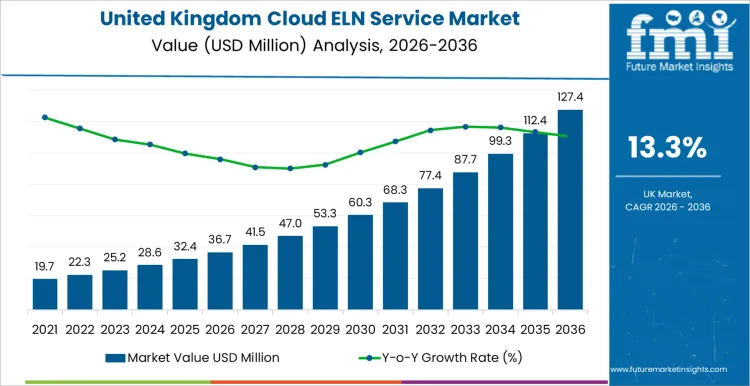
The cloud ELN service industry in the UK is projected to reach USD 36.66 million in 2026. The industry is expected to rise to USD 127.36 million by 2036, advancing at a 13.3% CAGR. This expansion reflects how UK organisations are treating research documentation and experimental traceability as operational infrastructure.
Quick Stats for Cloud ELN Service Demand in the UK
- Cloud ELN Service Valuation in the UK (2026): USD 36.66 million
- Cloud ELN Service Forecast Valuation in the UK (2036): USD 127.36 million
- Cloud ELN Service Forecast CAGR (2026 to 2036): 13.3%
- Leading Regional Growth: England (14.6%)
- Leading Component: Software (58.9% share)
- Leading Deployment: Cloud Based (45.3% share)
- Leading Enterprise Size: Small Offices (1-9 employees) (32.0% share)
- Key Companies Profiled: Dassault Systemes SA; PerkinElmer Inc.; Thermo Fisher Scientific; Agilent Technologies Inc.; Bruker Corporation
ELN platforms are no longer positioned as digital note-taking tools. They are being deployed as an execution layer that captures procedures, sample context, calculations, observations, and attachments in a format that can be reviewed, shared, and audited. For CEOs and operational leaders, the commercial reason is straightforward.
A well-run ELN environment reduces repeat work, improves cross-team handoff, and supports faster go or no-go decisions. For technology service providers, the value sits in integration work that turns lab data into structured assets rather than scattered files. For compliance teams, the priority is governance: timestamps, audit trails, access permissions, and consistent record integrity across long project cycles.
Why is the UK a High-Trust Environment for Cloud ELN Service Adoption?
The UK is a high-trust environment because regulated workflows and data governance expectations shape decision making across life sciences, diagnostics, applied research, and enterprise innovation teams. Organisations want systems that stand up to inspection readiness, internal audit scrutiny, and repeatability expectations. That preference places ELN platforms into a category of “systems of record” rather than optional productivity tools.
A core driver is data integrity. The Medicines and Healthcare products Regulatory Agency provides guidance on GxP data integrity expectations, including how organisations should consider control frameworks and reliability across the data lifecycle. This shapes ELN configuration choices such as audit trail enablement, role-based access, review workflows, and controls on record changes.
Cross-border regulatory alignment reinforces the same direction. FDA guidance explains that Part 11 applies to electronic records created, modified, maintained, archived, retrieved, or transmitted under records requirements. UK organisations that work with global partners, multinational sponsors, or US-linked submissions pay close attention to system behaviours that support credible electronic records and signatures.
Data protection posture also matters, especially when research environments include personal data. The UK Information Commissioner’s Office explains that special category data requires an Article 9 condition and, in many cases, additional safeguards under UK law. Cloud ELN adoption decisions often include a parallel review of access control, hosting location, retention settings, and governance processes.
As cloud adoption grows, security-by-design is being treated as non-negotiable. UK government guidance reinforces privacy by design as a requirement that should be considered from the start of the design process. This supports cloud ELN rollouts that include structured risk assessment and vendor controls. Many teams benchmark roadmap priorities using cloud ELN services, and then extend planning toward adjacent systems that standardise lab operations such as LIMS platforms.
How is Cloud ELN Service Demand Segmented by Component, Deployment, Enterprise Size, and Industry?
Demand in the UK clusters around four practical choices: what organisations buy (software or services), how they deploy it, which business sizes adopt first, and which industries value ELN-driven traceability.
Why does software command the largest share in UK ELN procurement decisions?
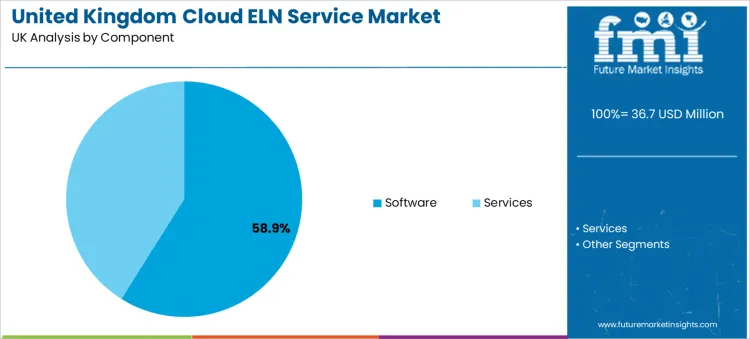
Software holds a 58.9% share, showing that organisations prioritise ownership of core capabilities such as experiment templates, protocol libraries, audit trails, structured metadata, search, and reporting. Buyers expect software to deliver durable value without requiring constant manual workarounds. They also expect configurable workflows that match how teams operate across sites and departments.
Software-led demand rises as organisations seek consistent documentation standards and faster knowledge reuse. Research leaders want a reliable place where methods and outcomes can be reused by new teams without repeating the same experimental design cycles. Universities describe ELNs as digital equivalents of paper lab notebooks that support documentation and reproducibility. (KU Leuven) This expectation strengthens the business case for platform-level adoption rather than isolated department tools.
Software selection is often evaluated alongside broader lab informatics choices such as electronic lab notebook platforms, especially when organisations want consistency across R&D groups and multi-site collaboration.
What is driving preference for cloud-based deployment in UK organisations?
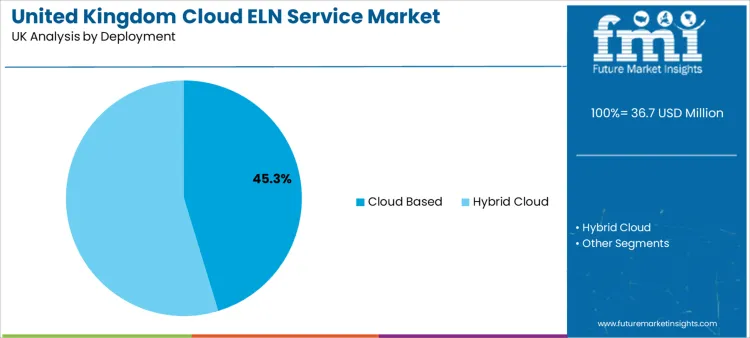
Cloud-based deployment accounts for a 45.3% share, supported by ease of scale, simplified administration, faster onboarding, and consistent update cycles. Cloud deployment makes sense for organisations that run multi-location research teams or hybrid workflows involving internal labs, external partners, and contract research teams.
Cloud architectures also make integration easier. ELN value increases when it connects to instruments, identity systems, file storage, and analytics tools. Many organisations treat the ELN as a front door for lab workflows, then link it to automation systems, sample tracking, and data processing steps. This use pattern aligns well with adoption tracked in laboratory information system platforms, where interoperability supports better operational control.
Why do small offices see strong early adoption even in a compliance-focused environment?

Small offices with 1 to 9 employees hold a 32.0% share, reflecting the role of agility. Smaller teams benefit quickly from simple templates, shared protocol libraries, and fast search across past work. They often operate with limited administrative capacity, so cloud deployment with out-of-the-box governance features can deliver strong value without heavy internal IT overhead.
Startups and small R&D teams also face investor scrutiny around evidence quality and reproducibility. A structured ELN makes it easier to demonstrate how results were produced, reviewed, and stored. This supports credibility during partnerships, due diligence, and customer validation cycles.
As teams scale, adoption expands into small enterprises, mid-sized teams, and very large enterprises where integration depth becomes a bigger priority than speed of onboarding. Larger organisations may use hybrid approaches where cloud usage grows while certain workloads remain segmented for internal governance reasons. These adoption paths often sit alongside broader priorities seen in the cloud services domain, especially where enterprise buyers standardise on cloud-first operational architectures.
How does industry segmentation shape demand patterns?
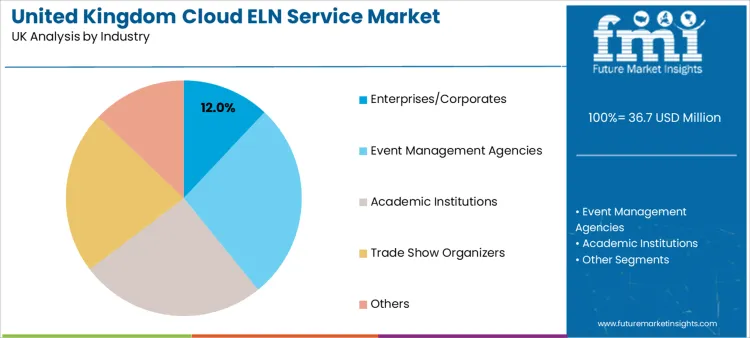
Industry focus spans enterprises and corporates, academic institutions, event management agencies, trade show organisers, and other segments. In practice, the strongest pull comes from organisations that manage complex documentation, multi-team coordination, and outcomes that must be defendable to stakeholders.
Academic institutions value collaboration and long-term record preservation, especially for reproducibility and shared research continuity. Applied enterprise environments value standardisation, faster internal transfer of methods, and traceability across product development cycles. Workflow acceleration is often amplified when ELN adoption is paired with lab automation solutions that reduce manual steps and improve consistency.
What are the Dynamics, Restraints, Opportunities, and Threats Shaping this Sector?
How are Compliance Expectations and Reproducibility Needs driving Adoption?
Data integrity expectations shape buying decisions. MHRA guidance outlines data integrity considerations across GxP activity, reinforcing the need for reliable controls and governance in electronic systems. FDA Part 11 guidance reinforces requirements for electronic records maintained under regulatory obligations. These expectations make ELNs attractive because they centralise documentation, preserve audit trails, and enable structured review.
Reproducibility is another driver. ELNs are widely described as tools that support structured documentation and easier sharing of scientific data. This matters across R&D environments where repeat runs are expensive and time-to-decision is tied to traceable evidence.
What Restraints slow Rollout Decisions even when the value case is clear?
The biggest restraint is implementation discipline. ELN adoption fails when it becomes a blank canvas with inconsistent usage. Teams need templates, naming conventions, role definitions, and review routines. Without these, search and reuse benefits remain limited.
Security review cycles can also slow procurement. UK GDPR requirements become more complex when personal or sensitive categories of data may be present. ICO guidance highlights Article 9 conditions and safeguards for special category data. This can extend legal review, vendor assessment, and contractual safeguards.
Integration effort is another restraint. ELN value is strongest when it connects to instrument data, file repositories, and identity systems. Integration work requires clear ownership across IT, lab operations, and validation stakeholders.
Where do Opportunities exist for Vendors and Service Partners?
- Integration-led adoption: ELN value rises when it is connected to lab systems, creating a single workflow layer that supports traceability and structured execution. Many organisations align this with enterprise laboratory informatics planning, where platforms work better as a connected stack rather than isolated tools.
- AI-assisted workflows: Labs increasingly want automated tagging, anomaly detection, and smarter search across project history. This supports capability expansion tied to AI-enabled laboratory solutions where predictive support reduces time spent on repetitive documentation tasks.
- Assurance and governance services: Security posture and performance assurance are becoming procurement levers, especially for enterprise buyers. This supports service opportunities linked to cloud service assurance where uptime, control monitoring, and policy enforcement strengthen confidence.
What Threats can Disrupt Growth Trajectories?
Poor data governance is a direct threat. If an ELN is not configured with clear controls, adoption can create new risk rather than reducing it. Regulatory exposure rises when audit trails, role-based permissions, and record review processes are weak.
User resistance is another threat. If the system is slow, complex, or disconnected from daily work habits, teams revert to offline files and fragmented documentation. That outcome weakens standardisation and reduces return on investment.
Vendor lock-in concern can also slow decisions. Buyers want exportability, support continuity, and integration flexibility over time. A platform that cannot evolve with the organisation risks replacement once scale increases.
How is Cloud ELN Service Demand Evolving across Key Regions in the UK?
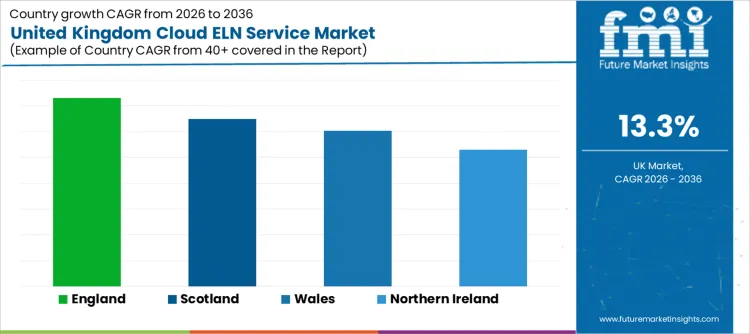
| Region | CAGR (2026-2036) |
|---|---|
| England | 14.6% |
| Scotland | 13.0% |
| Wales | 12.1% |
| Northern Ireland | 10.6% |
Why is England setting the pace through enterprise adoption and platform standardisation?
England leads at a 14.6% CAGR, supported by dense clusters of enterprise R&D teams, innovation programmes, and multi-site organisations that value standardised documentation. Adoption is tied to structured governance expectations and the need for consistent records across large project portfolios. England also benefits from stronger service capacity for system integration, validation, and operational rollout support.
How is Scotland scaling demand through research intensity and strong compliance alignment?
Scotland grows at 13.0%, supported by research-focused environments that prioritise reproducibility and structured documentation practices. Buyers often prioritise systems that make collaboration easier while supporting credible recordkeeping. ELN selection tends to be influenced by usability, governance depth, and ease of integration into existing lab workflows.
What is shaping Wales as it expands adoption through practical deployment and resource efficiency?
Wales expands at 12.1%, driven by organisations seeking better documentation discipline without creating heavy operational burden. Many teams prioritise cloud deployment models because they reduce internal administration requirements. Rollouts favour templates, quick onboarding, and clear workflow structure that keeps adoption consistent.
Why is Northern Ireland progressing through measured adoption and integration readiness?
Northern Ireland grows at 10.6%, reflecting adoption patterns driven by staged rollouts and focused use cases. Stakeholders often prioritise predictable implementation outcomes and integration feasibility. Procurement tends to favour platforms that support governance with minimal complexity, enabling steady expansion once early deployments prove value.
What defines the Competitive Landscape for Cloud ELN Service in the UK?
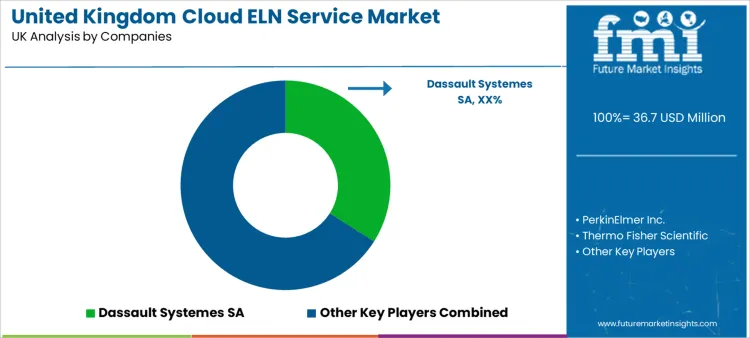
Competition is shaped by usability, integration capability, governance depth, and implementation success rates. Buyers evaluate platforms on how fast teams can adopt structured documentation without losing productivity. They also compare audit trail strength, role-based access controls, template flexibility, and ability to support consistent review workflows.
Dassault Systemes SA is positioned through enterprise software depth and lifecycle-oriented tooling that fits large organisations seeking structured knowledge workflows. PerkinElmer Inc. benefits from its life science and lab ecosystem relevance, supporting environments where platform adoption is linked to broader operational digitisation.
Thermo Fisher Scientific brings scale and credibility across research workflows, especially where labs value compatibility with widely used scientific tools. Agilent Technologies Inc. supports lab environments where data capture, traceability, and workflow discipline need to align with high-performance instrumentation ecosystems.
Bruker Corporation is relevant in specialised research environments where structured documentation supports complex analytical workflows and repeatability. Winning providers build strong onboarding playbooks, reduce friction for non-expert users, and deliver integration that turns ELN records into durable organisational assets.
Key Industry Participants
- Dassault Systemes SA
- PerkinElmer Inc.
- Thermo Fisher Scientific
- Agilent Technologies Inc.
- Bruker Corporation
Scope of Report
| Items | Values |
|---|---|
| Quantitative Units | USD Million |
| Component | Software; Services |
| Deployment | Cloud Based; Hybrid Cloud |
| Enterprise Size | Small Offices (1-9 employees); Small Enterprises (10-99 employees); Medium-sized Enterprise (100-499 employees); Large Enterprises (500-999 employees); Very Large Enterprises (1,000+ employees) |
| Industry | Enterprises/Corporates; Event Management Agencies; Academic Institutions; Trade Show Organizers; Others |
| Regions Covered | England; Scotland; Wales; Northern Ireland |
| Key Companies Profiled | Dassault Systemes SA; PerkinElmer Inc.; Thermo Fisher Scientific; Agilent Technologies Inc.; Bruker Corporation |
Cloud ELN Service Demand in the UK by Segment
By Component
- Software
- Services
By Deployment
- Cloud Based
- Hybrid Cloud
By Enterprise Size
- Small Offices (1-9 employees)
- Small Enterprises (10-99 employees)
- Medium-sized Enterprise (100-499 employees)
- Large Enterprises (500-999 employees)
- Very Large Enterprises (1,000+ employees)
By Industry
- Enterprises/Corporates
- Event Management Agencies
- Academic Institutions
- Trade Show Organizers
- Others
By Region
- England
- Scotland
- Wales
- Northern Ireland
Bibliography
- Information Commissioner’s Office. (2024). Special category data (UK GDPR Article 9 conditions and safeguards).
- Medicines and Healthcare products Regulatory Agency. (2021). Guidance on GxP data integrity.
- UK Government. (2024). Meet the requirements of data privacy regulations (privacy by design).
- KU Leuven Research Data Management. (2024). Electronic lab notebooks (ELN): Definition and advantages for reproducible research.
Frequently Asked Questions
How big is the demand for cloud eln service in uk in 2026?
The demand for cloud eln service in uk is estimated to be valued at USD 36.7 million in 2026.
What will be the size of cloud eln service in uk in 2036?
The market size for the cloud eln service in uk is projected to reach USD 127.4 million by 2036.
How much will be the demand for cloud eln service in uk growth between 2026 and 2036?
The demand for cloud eln service in uk is expected to grow at a 13.3% CAGR between 2026 and 2036.
What are the key product types in the cloud eln service in uk?
The key product types in cloud eln service in uk are software and services.
Which deployment segment is expected to contribute significant share in the cloud eln service in uk in 2026?
In terms of deployment, cloud based segment is expected to command 45.3% share in the cloud eln service in uk in 2026.
Preview the report firsthand - request a free sample
Get SampleGet the brochure for pricing and purchase details.
Get PDFTable of Content
- Executive Summary
- UK Market Outlook
- Demand-side Trends
- Supply-side Trends
- Technology Roadmap Analysis
- Analysis and Recommendations
- Market Overview
- Market Coverage / Taxonomy
- Market Definition / Scope / Limitations
- Market Background
- Market Dynamics
- Drivers
- Restraints
- Opportunity
- Trends
- Scenario Forecast
- Demand in Optimistic Scenario
- Demand in Likely Scenario
- Demand in Conservative Scenario
- Opportunity Map Analysis
- Product Life Cycle Analysis
- Supply Chain Analysis
- Investment Feasibility Matrix
- Value Chain Analysis
- PESTLE and Porter’s Analysis
- Regulatory Landscape
- Regional Parent Market Outlook
- Production and Consumption Statistics
- Import and Export Statistics
- Market Dynamics
- UK Market Analysis 2021 to 2025 and Forecast, 2026 to 2036
- Historical Market Size Value (USD Million) Analysis, 2021 to 2025
- Current and Future Market Size Value (USD Million) Projections, 2026 to 2036
- Y-o-Y Growth Trend Analysis
- Absolute $ Opportunity Analysis
- UK Market Pricing Analysis 2021 to 2025 and Forecast 2026 to 2036
- UK Market Analysis 2021 to 2025 and Forecast 2026 to 2036, By Component
- Introduction / Key Findings
- Historical Market Size Value (USD Million) Analysis By Component , 2021 to 2025
- Current and Future Market Size Value (USD Million) Analysis and Forecast By Component , 2026 to 2036
- Software
- Services
- Software
- Y-o-Y Growth Trend Analysis By Component , 2021 to 2025
- Absolute $ Opportunity Analysis By Component , 2026 to 2036
- UK Market Analysis 2021 to 2025 and Forecast 2026 to 2036, By Deployment
- Introduction / Key Findings
- Historical Market Size Value (USD Million) Analysis By Deployment, 2021 to 2025
- Current and Future Market Size Value (USD Million) Analysis and Forecast By Deployment, 2026 to 2036
- Cloud Based
- Hybrid Cloud
- Cloud Based
- Y-o-Y Growth Trend Analysis By Deployment, 2021 to 2025
- Absolute $ Opportunity Analysis By Deployment, 2026 to 2036
- UK Market Analysis 2021 to 2025 and Forecast 2026 to 2036, By Enterprise Size
- Introduction / Key Findings
- Historical Market Size Value (USD Million) Analysis By Enterprise Size, 2021 to 2025
- Current and Future Market Size Value (USD Million) Analysis and Forecast By Enterprise Size, 2026 to 2036
- Small Offices (1-9 employees)
- Small Enterprises (10-99 employees)
- Medium-sized Enterprise (100-499 employees)
- Large Enterprises (500-999 employees)
- Very Large Enterprises (1,000+ employees)
- Small Offices (1-9 employees)
- Y-o-Y Growth Trend Analysis By Enterprise Size, 2021 to 2025
- Absolute $ Opportunity Analysis By Enterprise Size, 2026 to 2036
- UK Market Analysis 2021 to 2025 and Forecast 2026 to 2036, By Industry
- Introduction / Key Findings
- Historical Market Size Value (USD Million) Analysis By Industry, 2021 to 2025
- Current and Future Market Size Value (USD Million) Analysis and Forecast By Industry, 2026 to 2036
- Enterprises/Corporates
- Event Management Agencies
- Academic Institutions
- Trade Show Organizers
- Others
- Enterprises/Corporates
- Y-o-Y Growth Trend Analysis By Industry, 2021 to 2025
- Absolute $ Opportunity Analysis By Industry, 2026 to 2036
- Market Structure Analysis
- Competition Dashboard
- Competition Benchmarking
- Market Share Analysis of Top Players
- By Regional
- By Component
- By Deployment
- By Enterprise Size
- By Industry
- Competition Analysis
- Competition Deep Dive
- Dassault Systemes SA
- Overview
- Product Portfolio
- Profitability by Market Segments (Product/Age /Sales Channel/Region)
- Sales Footprint
- Strategy Overview
- Marketing Strategy
- Product Strategy
- Channel Strategy
- PerkinElmer Inc.
- Thermo Fisher Scientific
- Agilent Technologies Inc.
- Bruker Corporation
- Dassault Systemes SA
- Competition Deep Dive
- Assumptions & Acronyms Used
- Research Methodology


