

- Industry Size (2025)
- USD 0.9 Bn
- Forecast (2035)
- USD 2.4 Bn
- CAGR (2025 to 2035)
- 10.2%
Demand for Combi Ovens in USA 2025 to 2035
The demand for combi ovens in the USA is valued at USD 0.9 billion in 2025 and is forecasted to reach USD 2.4 billion by 2035, reflecting a CAGR of 10.2%. Growth is supported by rising commercial foodservice expansion, standardization of multifunctional cooking appliances in professional kitchens, and energy-efficient upgrades driven by operational cost controls. Combi ovens enable convection, steam, and hybrid cooking within a single system, improving food consistency and allowing menu flexibility with reduced labour dependency.
Steam-generated combi ovens account for the leading share due to their suitability for bulk cooking and moisture-retention requirements in institutional and hospitality settings. Electric units dominate the power source segment as operators shift towards equipment compatible with all-electric kitchen standards and easier installation in renovated facilities. Heavy-capacity ovens remain the primary choice, reflecting demand from hotels, chain restaurants, and catering services that prioritize volume throughput and programmable automation for high-traffic operations.
Deployment is concentrated in regions with strong commercial kitchen investments and dense foodservice outlets, including the West, South, and Northeast. Replacement cycles are shortening as operators seek improved sanitation, remote monitoring, and digital cooking management functions. Key suppliers include Alto-Shaam Inc., Electrolux AB, Fujimak Corp., Giorik SpA, and The Middleby Corporation. Their development focus includes enhanced humidity control, food safety compliance, and integration with connected-kitchen ecosystems for data-driven operations.
Quick Stats for USA Combi Ovens Demand
- USA Combi Ovens Sales Value (2025): USD 0.9 billion
- USA Combi Ovens Forecast Value (2035): USD 2.4 billion
- USA Combi Ovens Forecast CAGR (2025–2035): 10.2%
- Leading Type in USA Combi Ovens Demand: Steam-Generated Combi Ovens
- Key Growth Regions in USA Combi Ovens Demand: West USA, South USA, Northeast USA
- Top Players in USA Combi Ovens Demand: Alto-Shaam Inc., Electrolux AB, Fujimak Corporation, Giorik SpA, The Middleby Corporation
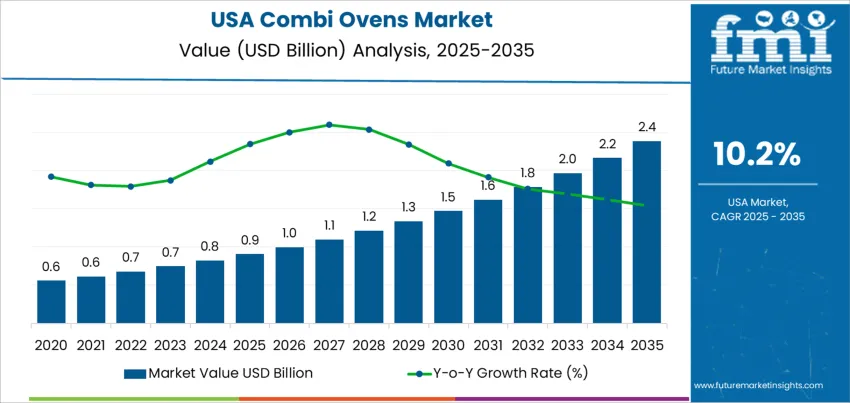
What is the Growth Forecast for Combi Ovens Industry in USA through 2035?
Demand for combi ovens in the United States is supported by strong penetration in commercial foodservice environments including quick-service restaurants, institutional kitchens, hotels, and catering operations. Early adoption in large-scale chains established a broad installed base, which now shifts demand dynamics toward replacement and upgrade cycles. The saturation level remains moderate because smaller independent food operators continue transitioning from conventional convection ovens and steamers to multifunctional systems. This creates incremental headroom for continued adoption.
Growth approaches a more measured phase as the technology becomes mature across high-volume kitchens. The energy efficiency mandates, menu diversification, and labor-saving requirements sustain interest in newer models with automated cooking controls. The saturation curve indicates slower acceleration in the later years due to limited expansion in the number of commercial kitchens relative to replacement needs. Product differentiation through digital connectivity and reduced operating cost supports delayed saturation, but not enough to produce high-growth volatility. The United States maintains ongoing demand without nearing full saturation, driven by consistent modernization rather than rapid industry entry.
USA Combi Ovens Key Takeaways
| Metric | Value |
|---|---|
| USA Combi Ovens Sales Value (2025) | USD 0.9 billion |
| USA Combi Ovens Forecast Value (2035) | USD 2.4 billion |
| USA Combi Ovens Forecast CAGR (2025-2035) | 10.2% |
Why is the Demand for Combi Ovens in the USA Growing?
Demand for combi ovens in the USA is increasing because restaurants, hotels and institutional kitchens such as schools, hospitals and corporate cafeterias require versatile cooking equipment that can steam, roast and bake with precise temperature and humidity control. Combi ovens reduce kitchen footprint by replacing multiple appliances with one unit, which appeals to businesses aiming to optimize space and improve workflow. Growth in catering, quick-service chains and meal-delivery meal prep services fuels demand because combi ovens support high-volume cooking while maintaining consistency and quality across batches. Menu diversification also encourages use of combi ovens for various cuisines and cooking styles.
Manufacturers supply models with programmable settings, energy-efficient controls and automated cleaning features, which reduce labour time and maintenance cost. Foodservice operators value reliability, repeatability and reduced food waste enabled by controlled cooking cycles. Constraints include relatively high initial equipment cost and energy consumption during heavy use. Smaller kitchens or independent operations may delay adoption until production volume justifies investment. Staff training is required to operate multifunction ovens properly, which may slow deployment in some establishments.
Which Product Types, Power Sources, and Capacity Classes Lead Demand for Combi Ovens in the United States?
Demand for combi ovens in the United States is driven by commercial kitchens prioritizing energy efficiency, space optimization, and consistent cooking performance. Adoption continues to expand across restaurants, institutional foodservice, healthcare cafeterias, and hospitality venues, supported by food safety compliance and automation features that reduce skilled-labor dependency. USA operators focus on advanced steam-circulation systems, faster cook cycles, and menu adaptability that support standardized meal output. Replacement and retrofitting trends also encourage transition from traditional convection ovens to multifunctional combi systems with reduced operational costs.
By Product Type, Steam-Generated Systems Dominate USA Demand
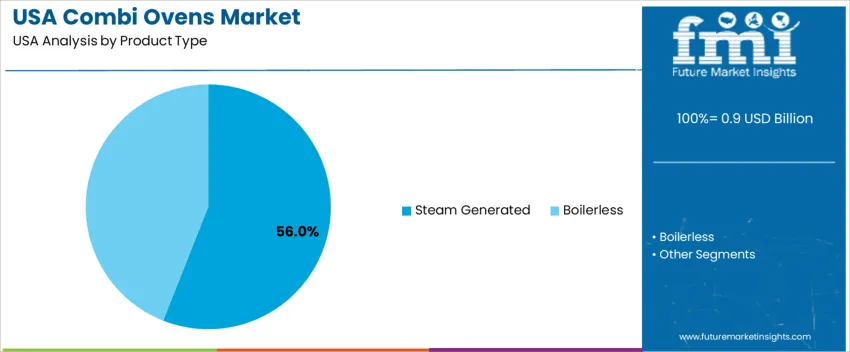
Steam-generated combi ovens hold 56.0%, supported by their strong temperature precision, rapid moisture control, and suitability for large-batch cooking environments. These systems align with high-volume commercial and institutional kitchens prioritizing texture consistency and food-waste reduction. Boilerless ovens represent 44.0%, favored in small and mid-scaled locations due to easier installation, simplified maintenance, and lower water USAge. The shift toward energy efficiency and sustainability reinforces demand for both designs, though steam-generated units maintain preference where throughput and culinary versatility remain strategic operational goals.
Key Points:
- Steam-generated systems lead large-volume food production needs
- Boilerless units grow with operational simplicity and reduced utilities
- Selection varies by cooking intensity and facility scale
By Power Source, Electric Combi Ovens Hold the Largest Share
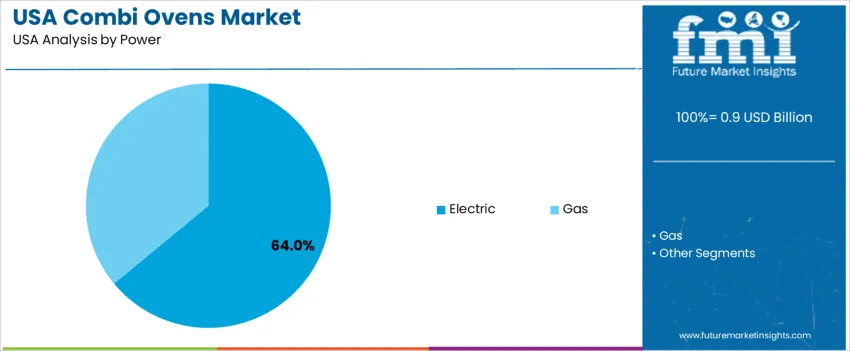
Electric units account for 64.0%, supported by expanding all-electric kitchen mandates, simplified integration in commercial facilities, and precise temperature management needed for menu standardization. Gas ovens represent 36.0%, retained in legacy kitchen infrastructures and high-heat performance environments. The migration toward electrified buildings and regulatory restrictions on commercial gas installations in some states strengthens future electric conversion. Purchasing decisions reflect infrastructure compatibility, energy cost evaluations, and maintenance streamlining within USA commercial foodservice.
Key Points:
- Electrification supports installation flexibility and accurate heat control
- Gas units remain relevant in high-heat legacy kitchens
- Sustainability initiatives favor electric adoption in urban regions
By Capacity, Heavy-Duty Combi Ovens Lead Operational Deployment
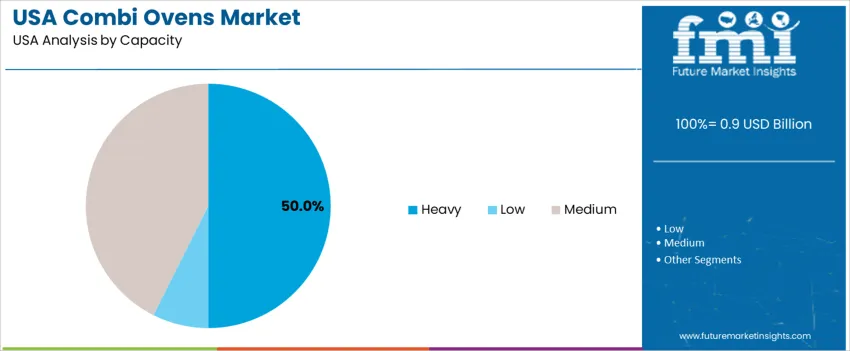
Heavy-capacity units represent 50.0%, driven by institutional cafeterias, hotel kitchens, and franchise foodservice requiring continuous-load cooking and menu volume consistency. Medium-capacity systems account for 42.6%, serving full-service restaurants conducting frequent but moderate batch cycles. Low-capacity units represent 7.4%, primarily used in convenience-focused kitchens and small independent operators with limited space. Capacity segmentation reflects foodservice consolidation and rising throughput expectations across hospital, school, and hospitality operators in the USA
Key Points:
- Heavy-capacity units serve large-scale and continuous production needs
- Medium-capacity ovens align with full-service dining throughput
- Low-capacity use remains niche due to limited volume capabilities
What are the Drivers, Restraints, and Key Trends of the Demand for Combi Ovens in USA?
Growth of commercial foodservice, expansion of ghost kitchens and rising demand for flexible cooking equipment are driving demand.
In the United States, demand for combi ovens increases as restaurants, hotels and catering operators seek versatile equipment that supports roasting, steam cooking, baking and reheating in compact kitchen footprints. Ghost kitchens, cloud-kitchen operations serving delivery-only meals rely on combi ovens to handle multiple menu items efficiently without installing separate appliances, reducing space and utility costs. Institutional foodservice providers such as hospital kitchens, school cafeterias and corporate dining facilities adopt combi ovens to produce large batch meals with consistent quality and food safety. Chains launching new outlets in suburban and urban markets emphasize equipment standardization and multi-functionality, strengthening nationwide procurement of commercial combi ovens.
High upfront cost, long payback periods and space constraints in small kitchens restrain demand.
Combi ovens typically require significant capital investment relative to basic ovens or steamers, which can delay purchase decisions in independent cafés or small restaurants. Lower-margin operations may defer upgrades because payback through labor and energy savings occurs over several years. Compact kitchens in older buildings may lack the ventilation, power supply or exhaust infrastructure needed for combi oven installation, limiting feasibility for many mid-size urban eateries. These financial and structural limitations moderate adoption among smaller operators.
Shift toward electric and energy-efficient models, increased leasing and rental solutions and rising demand in meal-prep and food-delivery segments define key trends.
Suppliers offer electric combi ovens with lower emissions and simplified installation requirements to suit urban kitchens and compliance with environmental regulations. Leasing and rental programs make high-end combi ovens accessible to smaller and ghost-kitchen operators by reducing upfront capital burden. Meal-preparation firms and meal-subscription services rely on combi ovens to produce consistent, high-volume meals for home delivery, boosting demand across the food-production and logistics sectors. Manufacturers incorporate digital controls, programmable cooking cycles and remote diagnostics to improve efficiency and reduce operational overhead. These developments indicate sustained, technology-driven demand for combi ovens across USA commercial foodservice and delivery-oriented food production.
Analysis of the Demand for Combi Ovens in the USA by Region
Demand for combi ovens in the United States is growing as foodservice operators modernize kitchens to improve efficiency, menu flexibility, and consistent cooking outcomes. Rapid-service restaurant chains, hospitals, universities, and commercial bakeries continue replacing traditional convection and steam systems with multifunctional combi platforms to reduce labor dependence and energy use. The West USA leads growth at 11.7% CAGR, driven by advanced dining and sustainability priorities. The South USA follows with 10.5% CAGR, supported by hospitality expansions. The Northeast USA records 9.4% CAGR due to dense institutional networks, while the Midwest USA grows at 8.1% CAGR, influenced by manufacturing-linked cafeteria demand and modernization cycles.
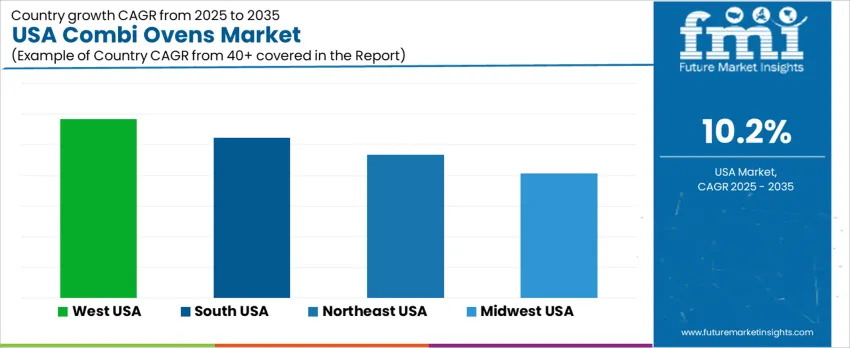
| Region | CAGR (2025-2035) |
|---|---|
| West USA | 11.7% |
| South USA | 10.5% |
| Northeast USA | 9.4% |
| Midwest USA | 8.1% |
How is the West USA driving demand for combi ovens?
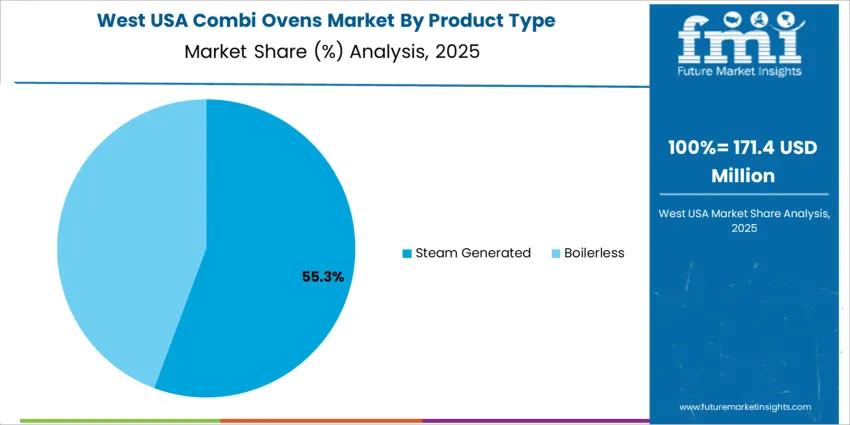
West USA leads adoption with a 11.7% CAGR, supported by early implementation of automation-focused restaurant equipment across California, Washington, and Colorado. Commercial kitchens optimize labor efficiency through programmable cooking cycles and reduced food-waste outcomes. High volumes of fast-casual and global cuisine restaurants invest in combi ovens to maintain menu versatility under space constraints. Hospitality brands and entertainment venues require high-capacity units with advanced humidity controls to support premium dining formats. Sustainability regulations encourage operators to transition from gas units to energy-efficient electric platforms compliant with local environmental rules. Distribution channels integrate chef training programs and digital service monitoring for performance optimization. Institutional foodservice facilities expand combi USAge to streamline batch preparation and maintain nutritional integrity in healthcare and education dining programs. Procurement decisions focus on energy ratings, cleaning automation, and integration with existing ventilation systems.
- Fast-casual and specialty dining increasing equipment turnover
- Environmental standards promoting electric combi installations
- Institutional adoption improving batch cooking workflows
- Smart controls supporting labor and consistency priorities
How is the South USA shaping procurement trends?
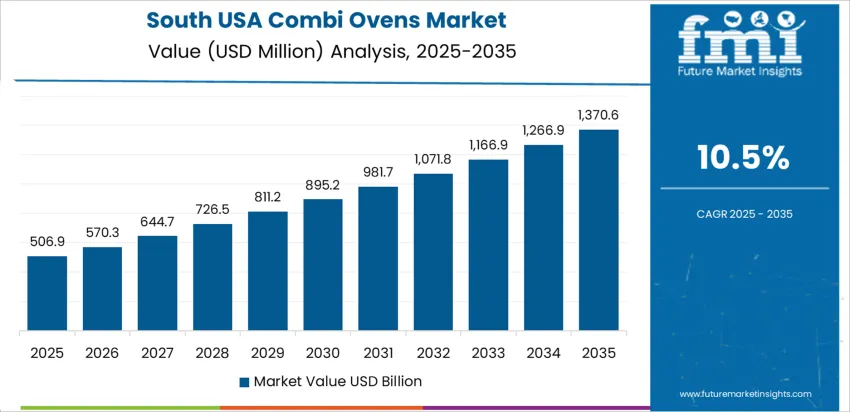
South USA registers 10.5% CAGR, driven by hospitality sector expansion in Texas, Florida, Georgia, and South Carolina. Hotels, resorts, and cruise-linked catering hubs deploy combi ovens to improve high-volume output and menu uniformity. Warm-weather tourism supports strong restaurant pipeline activity, increasing replacement cycles and first-time installation rates. Large-scale barbecue and protein-focused food concepts rely on precise humidity control for consistent texture across proteins and bakery items. Supply chains operating through Gulf Coast distribution centers enhance equipment accessibility for suburban and roadside dining growth. Institutional buyers evaluate combi ovens for reducing operational bottlenecks in healthcare dining, where dietary variation demands high customization. Local culinary education programs expand training on multifunctional systems, strengthening operator familiarity. Procurement emphasizes durable construction, maintenance support coverage, and compatibility with grease-management ventilation.
- Hospitality-driven demand across tourism economies
- Protein-focused kitchens utilizing humidity-controlled cooking
- Distribution centers supporting suburban rollout
- Training programs advancing operational adoption
How is the Northeast USA influencing combi oven utilization?
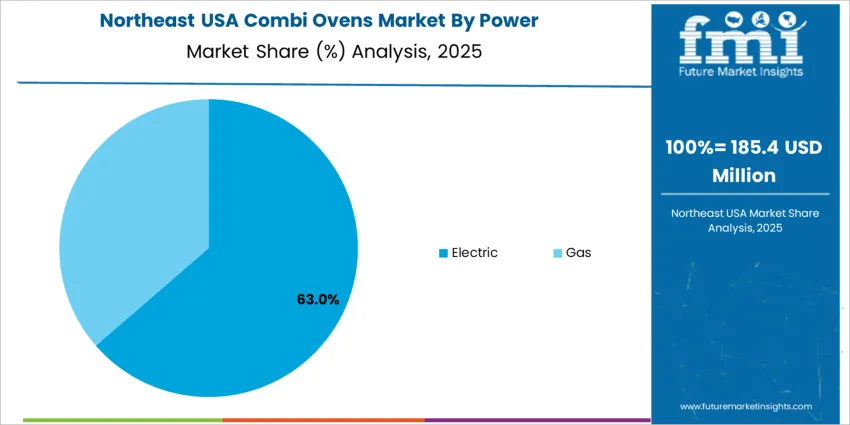
Northeast USA posts 9.4% CAGR, shaped by dense restaurant clusters in New York, New Jersey, and Massachusetts where kitchen footprints are limited and multifunctional appliances are required for cooking efficiency. Combi ovens help operators maintain speed and product consistency under high-traffic dining conditions. Hospitals and elder-care facilities adopt programmable equipment for nutrition-controlled meal preparation. University dining facilities rely on high-capacity batch cooking to serve diverse populations, strengthening procurement cycles. Independent bakeries utilize steam-boost capabilities to improve crust quality and product uniformity. Regulatory expectations around ventilation, waste heat, and operational emissions influence selection of energy-rated combi systems with enhanced safety compliance. Distribution models support short-lead-time service parts and preventive maintenance programs.
- Space-constrained kitchens prioritizing multifunction appliances
- Institutional dining driving high-capacity USAge
- Ventilation compliance affecting equipment selection
- Bakery adoption enhancing product texture and uniformity
How is the Midwest USA contributing to demand growth?
Midwest USA expands at 8.1% CAGR, linked to modernization cycles in manufacturing-affiliated cafeterias and educational facilities across Illinois, Ohio, Michigan, and Wisconsin. Operators pursue combi ovens to streamline batch preparation for workforce dining, enhancing throughput during peak meal schedules. Home-style restaurant chains prioritize durable equipment with strong service-life guarantees due to cost-focused decision making. Healthcare catering adopts combi ovens for dietary-specific consistency and food-safety compliance in extended-service environments. Local bakery networks leverage advanced steam modes to maintain texture across bread and pastry assortments. Equipment dealers emphasize lifecycle support, parts access, and technician availability to serve distributed dining facilities. Procurement focuses on rugged build quality, stable heating elements, and user-friendly programming for staff with varying training levels.
- Cost-driven replacement cycles in café and cafeteria formats
- Hospital and senior-care requirements improving adoption
- Bakery networks supporting steam-based baking needs
- Reliable after-sales servicing guiding purchasing choices
What does the competitive structure for combi oven demand in the United States show?
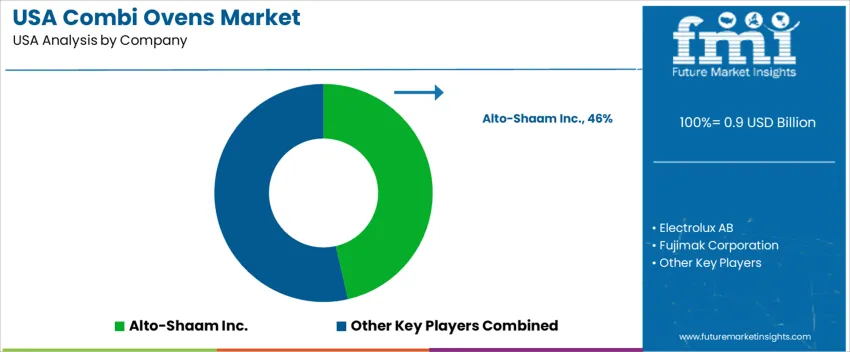
Combi oven demand in the United States is shaped by adoption in commercial kitchens, institutional foodservice, and multi-unit restaurant operations requiring controlled moisture, rapid temperature recovery, and programmable consistency. Buyers prioritize throughput, service accessibility, and certification compliance covering NSF sanitation, energy efficiency, and high-temperature safety. Replacement cycles remain steady as operators’ update legacy convection units to gain space savings and menu flexibility.
Alto-Shaam Inc. holds about 46.4% share in the United States. Its position reflects broad penetration in hospitality and healthcare dining, supported by established nationwide service infrastructure and reliability under extended-duty cooking profiles. Electrolux competes in large foodservice operations and contract catering, where automation features and workflow integration shape purchasing decisions. Fujimak maintains presence through selective adoption in operations seeking high-precision steam control and durable stainless-steel construction aligned with Japanese design heritage. Giorik supplies compact, energy-responsive units in independent restaurants emphasizing footprint optimization. The Middleby Corporation remains active through multi-brand offerings that prioritize operational efficiency and remote diagnostics capabilities for chain operators.
Key Players in USA Combi Ovens Demand
- Alto-Shaam Inc.
- Electrolux AB
- Fujimak Corporation
- Giorik SpA
- The Middleby Corporation
Scope of the Report
| Items | Values |
|---|---|
| Quantitative Units | USD billion |
| Product Type | Steam Generated, Boilerless |
| Power | Gas, Electric |
| Capacity | Low, Medium, Heavy |
| End-use | Hotels & Restaurants, Bakery Stores, Retail Outlets, Domestic & Institutional, Commercial Kitchens |
| Regions Covered | West USA, South USA, Northeast USA, Midwest USA |
| Key Companies Profiled | Alto-Shaam Inc., Electrolux AB, Fujimak Corporation, Giorik SpA, The Middleby Corporation |
| Additional Attributes | Dollar sales by product type, power source, and capacity segmentation; adoption patterns in commercial foodservice expansions; modernization of kitchen infrastructure across regional hospitality clusters; technological upgrades including IoT-integrated ovens and energy-efficient systems; competition based on performance efficiency, cooking precision, and after-sales service networks in the USA. |
USA Combi Ovens Demand by Segments
Product Type:
- Steam Generated
- Boilerless
Power:
- Gas
- Electric
Capacity
- Low
- Medium
- Heavy
End-use
- Hotels & Restaurants
- Bakery Stores
- Retail Outlets
- Domestic & Institutional
- Commercial Kitchens
Region:
- West USA
- South USA
- Northeast USA
- Midwest USA
Frequently Asked Questions
How big is the demand for combi ovens in USA in 2025?
The demand for combi ovens in USA is estimated to be valued at USD 0.9 billion in 2025.
What will be the size of combi ovens in USA in 2035?
The market size for the combi ovens in USA is projected to reach USD 2.4 billion by 2035.
How much will be the demand for combi ovens in USA growth between 2025 and 2035?
The demand for combi ovens in USA is expected to grow at a 10.2% CAGR between 2025 and 2035.
What are the key product types in the combi ovens in USA?
The key product types in combi ovens in USA are steam generated and boilerless.
Which power segment is expected to contribute significant share in the combi ovens in USA in 2025?
In terms of power, electric segment is expected to command 64.0% share in the combi ovens in USA in 2025.
Preview the report firsthand - request a free sample
Get SampleGet the brochure for pricing and purchase details.
Get PDFTable of Content
- Executive Summary
- USA Market Outlook
- Demand-side Trends
- Supply-side Trends
- Technology Roadmap Analysis
- Analysis and Recommendations
- Market Overview
- Market Coverage / Taxonomy
- Market Definition / Scope / Limitations
- Market Background
- Market Dynamics
- Drivers
- Restraints
- Opportunity
- Trends
- Scenario Forecast
- Demand in Optimistic Scenario
- Demand in Likely Scenario
- Demand in Conservative Scenario
- Opportunity Map Analysis
- Product Life Cycle Analysis
- Supply Chain Analysis
- Investment Feasibility Matrix
- Value Chain Analysis
- PESTLE and Porter’s Analysis
- Regulatory Landscape
- Regional Parent Market Outlook
- Production and Consumption Statistics
- Import and Export Statistics
- Market Dynamics
- USA Market Analysis 2020 to 2024 and Forecast, 2025 to 2035
- Historical Market Size Value (USD Million) Analysis, 2020 to 2024
- Current and Future Market Size Value (USD Million) Projections, 2025 to 2035
- Y-o-Y Growth Trend Analysis
- Absolute $ Opportunity Analysis
- USA Market Pricing Analysis 2020 to 2024 and Forecast 2025 to 2035
- USA Market Analysis 2020 to 2024 and Forecast 2025 to 2035, By Product Type
- Introduction / Key Findings
- Historical Market Size Value (USD Million) Analysis By Product Type , 2020 to 2024
- Current and Future Market Size Value (USD Million) Analysis and Forecast By Product Type , 2025 to 2035
- Steam Generated
- Boilerless
- Y-o-Y Growth Trend Analysis By Product Type , 2020 to 2024
- Absolute $ Opportunity Analysis By Product Type , 2025 to 2035
- USA Market Analysis 2020 to 2024 and Forecast 2025 to 2035, By Power
- Introduction / Key Findings
- Historical Market Size Value (USD Million) Analysis By Power, 2020 to 2024
- Current and Future Market Size Value (USD Million) Analysis and Forecast By Power, 2025 to 2035
- Electric
- Gas
- Y-o-Y Growth Trend Analysis By Power, 2020 to 2024
- Absolute $ Opportunity Analysis By Power, 2025 to 2035
- USA Market Analysis 2020 to 2024 and Forecast 2025 to 2035, By Capacity
- Introduction / Key Findings
- Historical Market Size Value (USD Million) Analysis By Capacity, 2020 to 2024
- Current and Future Market Size Value (USD Million) Analysis and Forecast By Capacity, 2025 to 2035
- Heavy
- Low
- Medium
- Y-o-Y Growth Trend Analysis By Capacity, 2020 to 2024
- Absolute $ Opportunity Analysis By Capacity, 2025 to 2035
- USA Market Analysis 2020 to 2024 and Forecast 2025 to 2035, By End-use
- Introduction / Key Findings
- Historical Market Size Value (USD Million) Analysis By End-use, 2020 to 2024
- Current and Future Market Size Value (USD Million) Analysis and Forecast By End-use, 2025 to 2035
- Hotels & Restaurants
- Bakery Stores
- Retail Outlets
- Domestic & Institutional
- Commercial Kitchens
- Y-o-Y Growth Trend Analysis By End-use, 2020 to 2024
- Absolute $ Opportunity Analysis By End-use, 2025 to 2035
- Market Structure Analysis
- Competition Dashboard
- Competition Benchmarking
- Market Share Analysis of Top Players
- By Regional
- By Product Type
- By Power
- By Capacity
- By End-use
- Competition Analysis
- Competition Deep Dive
- Alto-Shaam Inc.
- Overview
- Product Portfolio
- Profitability by Market Segments (Product/Age /Sales Channel/Region)
- Sales Footprint
- Strategy Overview
- Marketing Strategy
- Product Strategy
- Channel Strategy
- Electrolux AB
- Fujimak Corporation
- Giorik SpA
- The Middleby Corporation
- Alto-Shaam Inc.
- Competition Deep Dive
- Assumptions & Acronyms Used
- Research Methodology


