

- Industry Size (2026)
- USD 6.8 Bn
- Forecast (2036)
- USD 25.6 Bn
- CAGR (2026 to 2036)
- 12.8%
Demand for Connected TV in USA Forecast and Outlook 2026 to 2036
The demand for connected TVs in the USA is projected to grow from USD 6.8 billion in 2026 to USD 25.6 billion in 2036, reflecting a strong 12.80% CAGR. Analyzing the Year-on-Year (YoY) growth, we see consistent growth throughout the forecast period. From USD 3.7 billion in 2026, the demand grows to USD 4.2 billion in 2027, marking a 13.5% YoY increase. This growth continues steadily, with demand reaching USD 4.7 billion in 2028, reflecting an 11.9% increase, as the adoption of connected TVs expands across various demographics. By 2029, the demand rises to USD 5.3 billion, a 12.8% YoY increase, driven by higher consumer interest in streaming services and smart TV functionalities.
Quick Stats of the Demand for Connected TVs in USA
- Demand for Connected TVs in USA Value (2026): USD 6.8 billion
- Demand for Connected TVs in USA Forecast Value (2036): USD 25.6 billion
- Demand for Connected TVs in USA Forecast CAGR (2026-2036): 12.8%
- Demand for Connected TVs in USA Leading Device Type: Smart TVs
- Demand for Connected TVs in USA Key Growth Regions: West USA, South USA, Northeast USA, Midwest USA
- Demand for Connected TVs in USA Top Players: Samsung Electronics, LG Electronics, Sony Corporation, TCL, Vizio
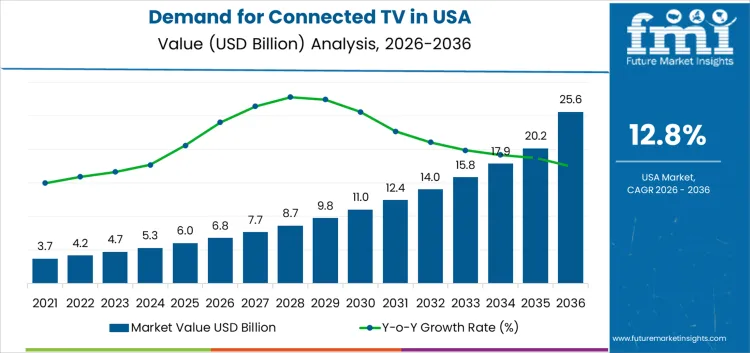
By 2030, the demand hits USD 6.0 billion, showing a 13.6% increase from 2029, followed by a more significant leap to USD 6.8 billion in 2031. This reflects an acceleration in connected TV adoption as more consumers switch to smart and internet-enabled televisions for enhanced viewing experiences. The growth rate further intensifies in the following years, with demand reaching USD 8.7 billion in 2032 (a 17.3% increase) and USD 9.8 billion in 2033, driven by advancements in streaming technologies and increasing content availability. The rapid rise continues, with demand growing to USD 20.2 billion by 2035, representing a steady climb as the connected TV industry matures and dominates the consumer electronics landscape.
Demand for Connected TV in USA Key Takeaways
| Metric | Value |
|---|---|
| Demand for Connected TV in USA Value (2026) | USD 6.8 billion |
| Demand for Connected TV in USA Forecast Value (2036) | USD 25.6 billion |
| Demand for Connected TV in USA Forecast CAGR (2026-2036) | 12.8% |
Why is the Demand for Connected TV in USA Growing?
The demand for connected TVs in the USA is growing due to the increasing shift towards smart and internet-enabled entertainment solutions. Connected TVs, which integrate with streaming services, apps, and the internet, are becoming an essential part of consumers' digital lifestyles. The widespread adoption of platforms like Netflix, Hulu, Disney+, and YouTube is driving the need for TVs that provide seamless access to these services, along with features like voice control, app integration, and screen mirroring. As consumers move away from traditional cable television in favor of over-the-top (OTT) content, the demand for connected TVs continues to rise.
Key drivers for this growth include the growing popularity of streaming services, which have shifted how people consume television content. As more households cut the cord and rely on internet-based streaming, connected TVs are becoming the preferred choice for accessing a wide variety of content. The increasing integration of artificial intelligence (AI) and voice assistants, such as Amazon Alexa and Google Assistant, in connected TVs is enhancing user experience and driving further adoption. The growth in gaming and interactive content, which often requires advanced display and connectivity features, is also contributing to the demand for connected TVs.
The increasing affordability of smart TVs, along with innovations in display technology, such as 4K and OLED screens, is further boosting the demand for connected TVs. As the trend toward home entertainment continues to grow, particularly in light of the pandemic-driven surge in at-home media consumption, the industry for connected TVs is expected to expand rapidly through 2036. Despite challenges such as industry saturation in certain segments and competition from alternative devices like streaming sticks and game consoles, the increasing shift to digital-first entertainment experiences will continue to drive demand for connected TVs in the USA.
What is the Segment-Wise Analysis of Demand for Connected TVs in USA?
Demand for connected TVs in the USA is segmented by device type, end-use, technology, and region. By device type, smart TVs lead with 58% of the demand, followed by streaming devices and other types. In terms of end-use, residential applications account for 65% of the demand, with commercial applications making up the remainder. Regarding technology, LED, LCD, OLED, and QLED are the main technologies used. Regionally, demand is distributed across West USA, South USA, Northeast USA, and Midwest USA.
How Do Smart TVs Lead the Demand for Connected TVs in USA?
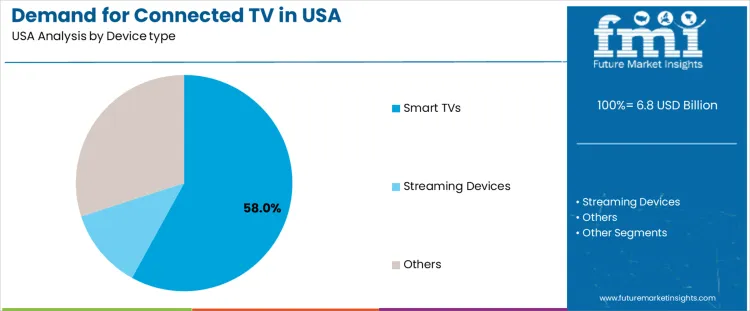
Smart TVs account for 58% of the demand for connected TVs in the USA, driven by their advanced features, including internet connectivity, streaming services, and app integration. Smart TVs provide consumers with access to a variety of content, including popular streaming platforms like Netflix, Hulu, and YouTube, without the need for additional devices. As consumers increasingly shift towards internet-based content consumption and cord-cutting, the demand for smart TVs has risen dramatically. Their ability to integrate seamlessly with other smart home devices, like voice assistants and home automation systems, further boosts their appeal. With the growing trend of streaming content and the increasing availability of high-definition and immersive viewing experiences, smart TVs are expected to maintain a dominant position in the connected TV industry.
How Does Residential End-Use Lead the Demand for Connected TVs in USA?
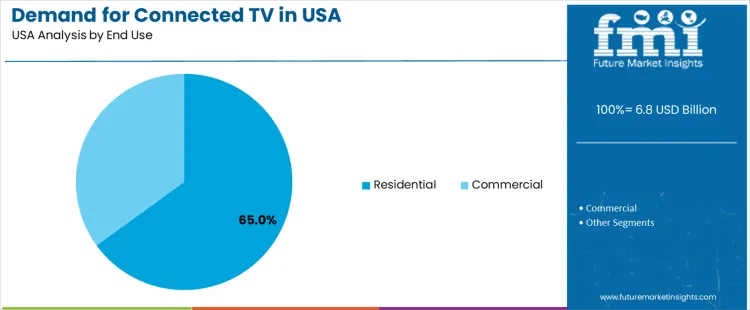
Residential applications account for 65% of the demand for connected TVs in the USA, driven by the increasing popularity of home entertainment systems and the rise in demand for streaming content. As consumers continue to embrace on-demand video services, connected TVs offer an all-in-one solution for accessing streaming platforms, cable content, and other entertainment sources. The convenience of having a smart TV in the home, coupled with features like voice control, screen mirroring, and integrated streaming services, contributes to the high demand in residential settings. The growing trend of home theaters and immersive viewing experiences, particularly with technologies like OLED and QLED, further drives demand. As home entertainment continues to evolve, connected TVs will remain a key part of residential entertainment systems, making this segment a leading driver in the industry.
What are the Key Trends, Drivers and Restraints in Demand for Connected TVs in USA?
Demand for connected TVs in the USA is growing as more consumers expect internet‑enabled features, streaming access, and smart functionality in their living rooms. Trends include larger screen sizes, 4K and 8K resolution adoption, and integration with smart home ecosystems. Drivers include growth in OTT streaming services, cord‑cutting from cable TV, and increased time spent on digital entertainment. However, restraints include affordability barriers for premium models in price‑sensitive segments, potential privacy concerns over data collection on smart devices, and industry saturation in urban areas where ownership is already high.
Why is Demand for Connected TVs Growing in USA?
Streaming platforms, live sports apps, and digital content libraries are more accessible via internet‑enabled TVs than traditional cable. Users value easy access to multiple services without external devices like streaming sticks or set‑top boxes. As households adopt multiple subscriptions, connected TVs simplify navigation between content sources. Growth in gaming, mobile mirroring, and smart home integration also boosts appeal. Higher disposable income and replacement cycles for older TVs support upgrades. Even rural households with improving broadband access are adopting connected TVs, expanding demand beyond major metropolitan industrys.
How are Technological and Industry Innovations Driving Connected TV Demand in USA?
Advancements in display technology like OLED, QLED, HDR and high refresh rates create more immersive experiences. Voice control with AI assistants and built‑in streaming platform integration reduce setup complexity and enhance usability. Improved user interfaces and recommendation engines personalize content discovery. Smart home connectivity enables TVs to interface with lighting, security and audio systems. Manufacturers are also embedding advanced sound technologies like Dolby Atmos. These innovations address consumer desires for quality, convenience and seamless digital experiences, driving broader adoption across age groups and household types.
What are the Key Challenges and Risks That Could Limit Connected TV Demand in USA?
Privacy and data security concerns over smart TV tracking, targeted ads, and third‑party data sharing may deter some buyers. Competition from external streaming devices and gaming consoles with smart capabilities provides alternatives to built‑in TV platforms. Price sensitivity around premium features and rapid technology cycles may cause consumers to delay upgrades. Fragmentation of content across multiple subscription services can overwhelm users or increase monthly costs, potentially reducing perceived value. Disparities in broadband quality and speeds, especially in rural areas, can affect the performance of streaming services and slow adoption among households with limited internet access.
What is the Regional Demand Outlook for Connected TVs in USA?
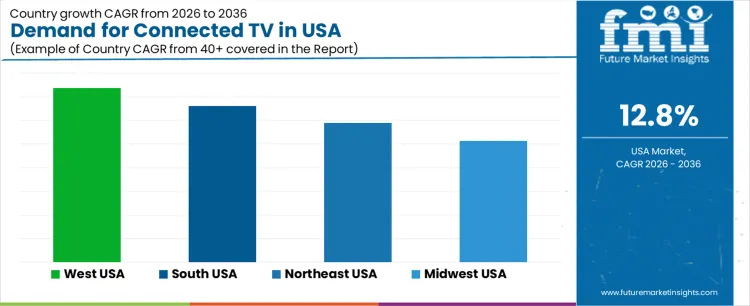
| Region | CAGR (%) |
|---|---|
| West USA | 14.7% |
| South USA | 13.2% |
| Northeast USA | 11.8% |
| Midwest USA | 10.3% |
Demand for connected TVs in the USA is growing rapidly, with West USA leading at a 14.7% CAGR, driven by its tech-savvy population, high adoption of streaming services, and strong focus on digital innovation. South USA follows with a 13.2% CAGR, fueled by increasing broadband access, a large consumer base, and a shift toward internet-based entertainment. Northeast USA shows an 11.8% CAGR, supported by high-density urban areas, strong digital media consumption, and the growing popularity of OTT platforms. Midwest USA experiences a 10.3% CAGR, with steady growth driven by improving broadband infrastructure and the adoption of affordable, feature-rich smart TVs.
How is Demand for Connected TVs Growing in West USA?
West USA leads the demand for connected TVs, growing at a 14.7% CAGR. The region’s tech-savvy population and high adoption of smart home devices are key drivers behind this growth. States like California, Oregon, and Washington are home to a large number of tech companies and early adopters of advanced technologies, including smart TVs. The increasing popularity of streaming services, along with the growing trend of cord-cutting and the shift away from traditional cable television, is fueling the demand for connected TVs in the West. The region’s strong focus on innovation and digital entertainment ensures that consumers are more likely to adopt the latest technologies, including 4K and smart TVs, which offer seamless access to a wide range of online content. As the demand for high-quality home entertainment and smart home integration continues to rise, the West will maintain its leadership in connected TV adoption.
Why is Demand for Connected TVs Rising in South USA?
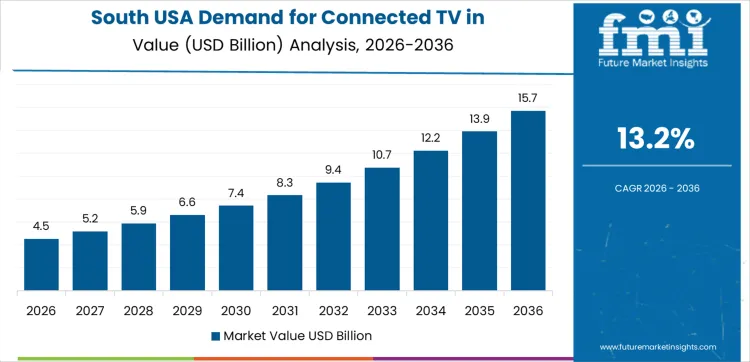
South USA is experiencing strong demand for connected TVs, with a 13.2% CAGR. The region’s growing interest in digital entertainment, streaming platforms, and home entertainment solutions is driving the increasing adoption of smart TVs. States like Texas, Florida, and Georgia are seeing a surge in connected TV sales as consumers shift away from traditional cable TV and opt for internet-based content delivery. The South’s expanding broadband infrastructure and the increasing availability of high-speed internet are also contributing factors, making streaming services more accessible to a larger population. As consumers in the South continue to embrace the convenience of on-demand content and seamless integration with other smart devices, the demand for connected TVs is expected to continue growing steadily. The region’s large population and rising interest in digital technology will ensure sustained growth in the connected TV industry.
How is Demand for Connected TVs Expanding in Northeast USA?
Northeast USA is seeing steady demand for connected TVs, with an 11.8% CAGR. The region’s high population density and strong digital media consumption patterns are contributing to the rise in connected TV adoption. States like New York, Pennsylvania, and Massachusetts are hubs for tech-driven lifestyles, where consumers are increasingly switching to streaming services and high-definition content. The demand for connected TVs is fueled by the growing popularity of OTT platforms and the increasing availability of affordable smart TVs with advanced features such as voice control, seamless app integration, and high-definition displays. As the region embraces the cord-cutting trend and moves toward internet-based entertainment, the adoption of connected TVs is expected to grow steadily. The Northeast’s interest in technology and digital innovation, coupled with a high density of tech-focused consumers, positions the region for continued growth in connected TV sales.
How is Demand for Connected TVs Growing in Midwest USA?
Midwest USA is experiencing moderate demand for connected TVs, with a 10.3% CAGR. The region’s strong manufacturing base, particularly in states like Michigan, Ohio, and Illinois, is driving the demand for connected TV products, as consumers increasingly seek integrated entertainment solutions for their homes. The shift away from traditional cable subscriptions and toward streaming services is contributing to the rise in connected TV adoption across the Midwest. As broadband infrastructure improves in rural and suburban areas, more consumers in the Midwest are gaining access to high-speed internet, enabling them to enjoy seamless streaming experiences. The growing availability of affordable smart TVs with advanced features, along with the rise in home entertainment spending, is further fueling the industry. As the trend of cord-cutting continues to gain momentum, the Midwest will continue to see steady growth in the demand for connected TVs.
What is the Competitive Landscape of Connected TVs Demand in USA?
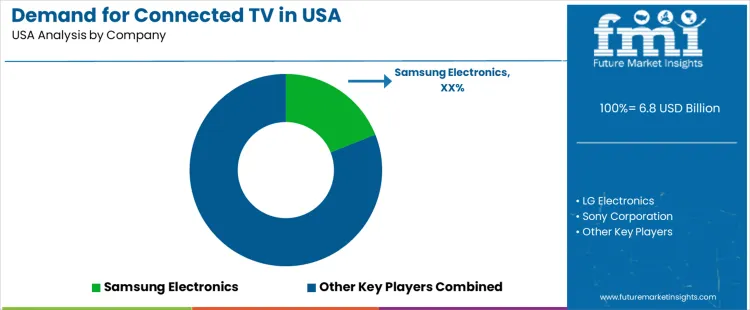
Demand for connected TVs in the USA is experiencing significant growth as consumers continue to shift toward streaming services, on-demand content, and smart home integration. Connected TVs, which combine traditional television viewing with internet connectivity, are becoming essential for accessing content from platforms like Netflix, Amazon Prime, Hulu, and other digital services. With advancements in technology and increased consumer interest in smart home ecosystems, the industry for connected TVs is expanding rapidly, particularly as the demand for high-definition and 4K viewing experiences increases.
Samsung Electronics is a leading player in the connected TV industry, offering a range of smart TVs with advanced features, including 4K and 8K resolution, smart assistants, and seamless integration with popular streaming services. Samsung’s strategy focuses on innovation and user experience, delivering high-quality display technology and smart features that cater to the growing demand for advanced home entertainment systems. Their dominance in the connected TV industry is driven by their ability to offer a wide range of models that appeal to various price points and consumer preferences.
LG Electronics stands out with its OLED technology, providing stunning picture quality and smart features powered by webOS, making it a favorite among premium TV buyers. Sony Corporation is known for its high-end televisions that feature excellent picture processing and integration with its PlayStation gaming consoles, attracting both gaming and entertainment enthusiasts. TCL offers affordable connected TVs with solid performance, positioning itself as a strong value player in the industry. Vizio provides budget-friendly smart TVs with excellent value and a focus on providing consumers with good quality at competitive prices. As the connected TV industry in the USA continues to grow, these companies are focusing on innovation, user experience, and expanding their product offerings to cater to an increasingly tech-savvy consumer base.
Key Players in USA Connected TV’s Demand
- Samsung Electronics
- LG Electronics
- Sony Corporation
- TCL
- Vizio
Scope of Report
| Items | Values |
|---|---|
| Quantitative Units (2026) | USD billion |
| Key Segments | Smart TVs, Streaming Devices, Others |
| Technology | LED, LCD, OLED, QLED |
| End Use | Residential, Commercial |
| Key Country | USA |
| Region | West USA, South USA, Northeast USA, Midwest USA |
| Key Players Profiled | Samsung Electronics, LG Electronics, Sony Corporation, TCL, Vizio |
| Additional Attributes | Dollar sales by device type, technology, and end use; regional CAGR and growth trends in Connected TV demand in the USA |
USA Connected TV’s Demand by Key Segments
Device type
- Smart TVs
- Streaming Devices
- Others
Technology
- LED
- LCD
- OLED
- QLED
End Use
- Residential
- Commercial
Region
- West USA
- South USA
- Northeast USA
- Midwest USA
Frequently Asked Questions
How big is the demand for connected TV in USA in 2026?
The demand for connected TV in USA is estimated to be valued at USD 6.8 billion in 2026.
What will be the size of connected TV in USA in 2036?
The market size for the connected TV in USA is projected to reach USD 25.6 billion by 2036.
How much will be the demand for connected TV in USA growth between 2026 and 2036?
The demand for connected TV in USA is expected to grow at a 12.8% CAGR between 2026 and 2036.
What are the key product types in the connected TV in USA?
The key product types in connected TV in USA are smart tvs, streaming devices and others.
Which technology segment is expected to contribute significant share in the connected TV in USA in 2026?
In terms of technology, led segment is expected to command 25.0% share in the connected TV in USA in 2026.
Preview the report firsthand - request a free sample
Get SampleGet the brochure for pricing and purchase details.
Get PDFTable of Content
- Executive Summary
- USA Market Outlook
- Demand-side Trends
- Supply-side Trends
- Technology Roadmap Analysis
- Analysis and Recommendations
- Market Overview
- Market Coverage / Taxonomy
- Market Definition / Scope / Limitations
- Market Background
- Market Dynamics
- Drivers
- Restraints
- Opportunity
- Trends
- Scenario Forecast
- Demand in Optimistic Scenario
- Demand in Likely Scenario
- Demand in Conservative Scenario
- Opportunity Map Analysis
- Product Life Cycle Analysis
- Supply Chain Analysis
- Investment Feasibility Matrix
- Value Chain Analysis
- PESTLE and Porter’s Analysis
- Regulatory Landscape
- Regional Parent Market Outlook
- Production and Consumption Statistics
- Import and Export Statistics
- Market Dynamics
- USA Market Analysis 2020 to 2024 and Forecast, 2025 to 2035
- Historical Market Size Value (USD Million) Analysis, 2020 to 2024
- Current and Future Market Size Value (USD Million) Projections, 2025 to 2035
- Y-o-Y Growth Trend Analysis
- Absolute $ Opportunity Analysis
- USA Market Pricing Analysis 2020 to 2024 and Forecast 2025 to 2035
- USA Market Analysis 2020 to 2024 and Forecast 2025 to 2035, By Device type
- Introduction / Key Findings
- Historical Market Size Value (USD Million) Analysis By Device type , 2020 to 2024
- Current and Future Market Size Value (USD Million) Analysis and Forecast By Device type , 2025 to 2035
- Smart TVs
- Streaming Devices
- Others
- Y-o-Y Growth Trend Analysis By Device type , 2020 to 2024
- Absolute $ Opportunity Analysis By Device type , 2025 to 2035
- USA Market Analysis 2020 to 2024 and Forecast 2025 to 2035, By Technology
- Introduction / Key Findings
- Historical Market Size Value (USD Million) Analysis By Technology, 2020 to 2024
- Current and Future Market Size Value (USD Million) Analysis and Forecast By Technology, 2025 to 2035
- LED
- LCD
- OLED
- QLED
- Y-o-Y Growth Trend Analysis By Technology, 2020 to 2024
- Absolute $ Opportunity Analysis By Technology, 2025 to 2035
- USA Market Analysis 2020 to 2024 and Forecast 2025 to 2035, By End Use
- Introduction / Key Findings
- Historical Market Size Value (USD Million) Analysis By End Use, 2020 to 2024
- Current and Future Market Size Value (USD Million) Analysis and Forecast By End Use, 2025 to 2035
- Residential
- Commercial
- Y-o-Y Growth Trend Analysis By End Use, 2020 to 2024
- Absolute $ Opportunity Analysis By End Use, 2025 to 2035
- Market Structure Analysis
- Competition Dashboard
- Competition Benchmarking
- Market Share Analysis of Top Players
- By Regional
- By Device type
- By Technology
- By End Use
- Competition Analysis
- Competition Deep Dive
- Samsung Electronics
- Overview
- Product Portfolio
- Profitability by Market Segments (Product/Age /Sales Channel/Region)
- Sales Footprint
- Strategy Overview
- Marketing Strategy
- Product Strategy
- Channel Strategy
- LG Electronics
- Sony Corporation
- TCL
- Vizio
- Samsung Electronics
- Competition Deep Dive
- Assumptions & Acronyms Used
- Research Methodology


