

- Industry Size (2025)
- USD 6.5 Bn
- Forecast (2035)
- USD 10.7 Bn
- CAGR (2025 to 2035)
- 5.2%
Demand for Level Switches in USA Forecast and Outlook 2025 to 2035
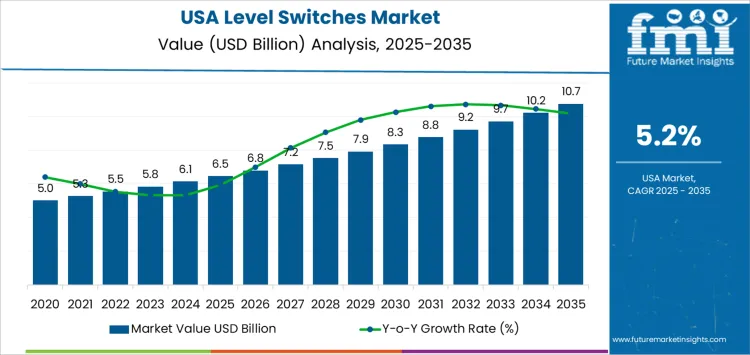
Demand for level switches in the USA is expected to grow steadily from USD 6.5 billion in 2025 to USD 10.7 billion by 2035, with a forecasted CAGR of 5.2%. Growth is driven by the increasing need for accurate monitoring of liquid and solid levels across various industries such as oil and gas, water treatment, chemicals, and manufacturing. Level switches are essential for ensuring safety, efficiency, and operational precision in systems that involve tanks, vessels, and storage. Rise in industrial automation, the growing trend toward smart sensors, and innovations such as wireless technology for remote monitoring are key factors driving this demand. Industries continue to prioritize operational efficiency, and level switches are becoming critical components in process control systems, helping to ensure optimal fluid management, prevent overflows, and minimize downtime.
Quick Stats of the Demand for Level Switches in USA
- Demand for Level Switches in USA Value (2025): USD 6.5 billion
- Demand for Level Switches in USA Forecast Value (2035): USD 10.7 billion
- Demand for Level Switches in USA Forecast CAGR (2025-2035): 5.2%
- Demand for Level Switches in USA Leading Switch Type: Float Level Switches
- Demand for Level Switches in USA Key Growth Regions: West USA, South USA, Northeast USA, Midwest USA
- Demand for Level Switches in USA Top Players: Loren Cook Company, Johnson Controls International, Ziehl-Abegg SE, Air System Components, Inc., Vent-Axia Group Limited
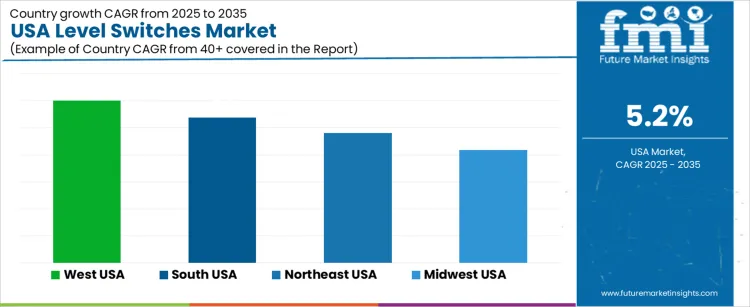
Demand is particularly high for float level switches, which make up 40% of the total demand, thanks to their reliability, ease of installation, and cost-effectiveness across a wide range of applications. Liquid holding tanks account for 44% of demand, driven by industries where precise liquid level control is crucial, such as water treatment and chemical processing. Regional growth shows West USA leading with a 6.0% CAGR, supported by its strong industrial base and focus on automation. South USA follows with 5.4%, while Northeast USA and Midwest USA exhibit moderate growth rates of 4.8% and 4.2%, respectively, with increasing demand across diverse industries, from manufacturing to energy.
Demand for Level Switches in USA Key Takeaways
| Metric | Value |
|---|---|
| Demand for Level Switches in USA Value (2025) | USD 6.5 billion |
| Demand for Level Switches in USA Forecast Value (2035) | USD 10.7 billion |
| Demand for Level Switches in USA Forecast CAGR (2025-2035) | 5.2% |
Why is the Demand for Level Switches in USA Growing?
The demand for level switches in the USA is growing due to the increasing need for accurate and reliable monitoring of liquid and solid levels across various industries. Level switches play a critical role in ensuring safety, efficiency, and precision in operations involving tanks, vessels, and storage systems. These devices are widely used in industries such as oil and gas, water treatment, chemicals, and manufacturing to prevent overflows, underflows, and ensure proper fluid management. The growth in industrial automation and the push for smart sensors are key drivers of this demand.
Key drivers include the increasing adoption of automation technologies in process control systems, where level switches are crucial for providing real-time data and controlling processes. As industries continue to emphasize operational efficiency, the demand for precise and continuous monitoring solutions is rising. Innovations in wireless level switch technology, offering remote monitoring and control capabilities, are expanding the potential applications for these devices. The growing trend towards advanced predictive maintenance and the need for minimal downtime in industrial operations are also contributing to this growth.
Challenges such as high installation costs, the need for compatibility with existing systems, and the technical complexity of certain environments may limit the adoption of advanced level switch technologies. The growing emphasis on automation, efficiency, and safety is expected to continue driving steady demand for level switches in the USA through 2035.
What is the Segment-Wise Analysis of Demand for Level Switches in USA?
Demand for level switches in the USA is segmented by switch type, application, and region. By switch type, float level switches lead with 40% of the demand, followed by capacitive level switches, conductivity level switches, tuning fork level switches, and optical level switches. In terms of application, liquid holding tanks account for 44% of the demand, with closed vessels, reservoirs, grain silos, and hoppers making up the remaining share. Regionally, demand is distributed across West USA, South USA, Northeast USA, and Midwest USA.
How Do Float Level Switches Lead the Demand for Level Switches in USA?
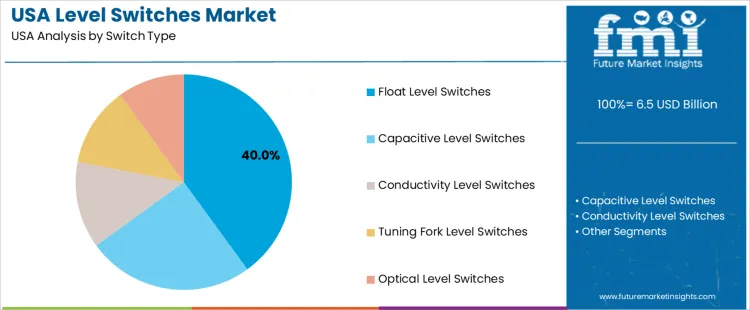
Float level switches account for 40% of the demand for level switches in the USA, driven by their simplicity, reliability, and wide application across industries. These switches are commonly used to detect and control liquid levels in tanks, reservoirs, and other storage systems, ensuring accurate and consistent monitoring. Their popularity stems from their robust performance in harsh environments and their cost-effectiveness, making them ideal for both industrial and commercial settings. Float level switches are known for their ease of installation, low maintenance requirements, and long lifespan, which contribute to their widespread adoption. Their reliable operation in various types of liquids and varying environmental conditions further enhances their demand. As industries seek efficient and dependable liquid level monitoring solutions, float level switches continue to be the preferred choice, ensuring consistent performance across applications that require precise liquid level management.
Why Do Liquid Holding Tanks Lead the Demand for Level Switches in USA?
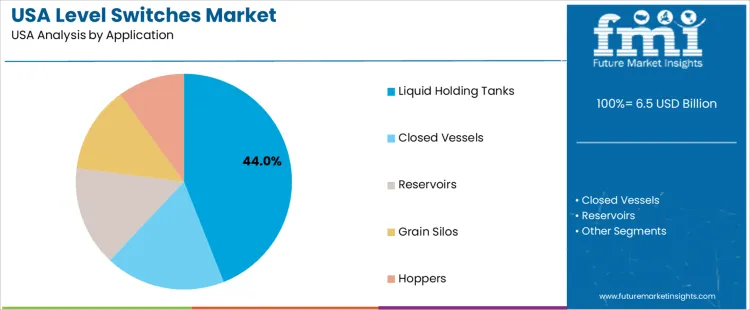
Liquid holding tanks account for 44% of the demand for level switches in the USA, driven by their critical role in industries like water treatment, chemical processing, and manufacturing. These systems are essential for maintaining liquid levels within safe operational limits, preventing overflows, and optimizing storage. In industries where precise control of liquid levels is necessary for operational efficiency, safety, and compliance with environmental regulations, level switches are indispensable. These switches provide real-time monitoring and control, ensuring that tanks are neither overfilled nor underfilled. As automation and efficiency in industrial processes continue to grow, the demand for advanced level switches in liquid holding tanks rises. The need for systems that reduce overflow risks, improve storage optimization, and increase operational safety continues to drive demand. As industries focus on enhancing performance and safety, the demand for reliable, precise level switches in liquid holding tanks is expected to stay strong and grow steadily in the future.
What are the Key Trends, Drivers, and Restraints in Demand for Level Switches in USA?
Demand for level switches in the USA is rising as industrial automation, environmental regulation, and infrastructure modernization drive need for precise monitoring of liquid and bulk material levels in tanks, silos, pipelines and treatment facilities. Level switches, used for detecting liquid or solid levels and triggering alarms or controls, are critical in water treatment, chemical processing, oil & gas, food & beverage, and wastewater management. The growing emphasis on safety, regulatory compliance, and process efficiency encourages adoption of reliable level detection solutions. Demand faces restraints such as the need for regular maintenance for mechanical types, potential sensor errors in harsh or corrosive environments, and competition from advanced continuous level sensors or alternative measurement systems. High initial cost for advanced electronic or radar level switches may also limit adoption in smaller operations.
Why is Demand for Level Switches Growing in USA?
Demand in the USA is growing because industries increasingly require dependable, automated level monitoring to ensure process safety, avoid overflow or dry‑run conditions, and maintain compliance. Sectors such as water and wastewater treatment, chemical manufacturing, oil & gas, and food processing often store or process large volumes of liquids or solids. Level switches provide a simple, cost‑effective way to control pumps or valves based on fill or empty conditions, preventing spills or overfills. Aging infrastructure and expanding capacity in utilities and industrial plants fuel replacement and new‑installation demand. The push for digital transformation and integration with control/automation systems makes level switches attractive for real-time monitoring and operational efficiency. Demand also grows among facility managers seeking low‑maintenance, reliable solutions for routine liquid‑level management.
How are Technological & Industry Innovations Driving Level Switch Demand in USA?
Technological advances are improving accuracy, reliability, and ease of use of level switches, boosting their demand. Modern electronic and radar‑ or ultrasonic‑based level switches offer non-contact detection, improved performance in harsh or corrosive environments, and reduced maintenance compared to mechanical floats or paddle switches. IoT‑ready and smart level switches now allow remote monitoring, real‑time diagnostics, and integration with building management or industrial automation systems, which streamlines operations and enhances predictive maintenance. These innovations make it easier for industries like water treatment, chemical processing, and food & beverage to adopt level switches confidently even under challenging conditions. As more plants modernize and seek automated, real-time monitoring solutions, advanced level switches become a preferred choice over legacy manual or mechanical systems.
What are the Key Challenges and Risks That Could Limit Level Switch Demand in USA?
First, some level switch types such as mechanical floats or paddle switches require regular maintenance and may suffer reliability issues in environments with sludge, sediment, or corrosion, reducing appeal. Advanced electronic or radar-based switches come with higher upfront costs and require skilled installation and calibration, which may deter smaller operations. In some applications, continuous level sensors may offer more precise measurement than simple on/off switches, reducing demand for conventional level switches. Regulatory requirements or stringent industry standards for hazardous or high‑pressure applications may impose additional compliance costs or restrict use of certain switch types. Competition from alternative level measurement techniques or process control systems may limit adoption of traditional level switches in favor of more integrated solutions.
What is the Regional Demand Outlook for Level Switches in USA?
| Region | CAGR (%) |
|---|---|
| West USA | 6.0% |
| South USA | 5.4% |
| Northeast USA | 4.8% |
| Midwest USA | 4.2% |
Demand for level switches in the USA is growing steadily, with West USA leading at a 6.0% CAGR, driven by the region's strong industrial base and focus on automation. South USA follows with a 5.4% CAGR, supported by the expanding manufacturing and energy sectors. Northeast USA shows a 4.8% CAGR, fueled by industrial automation and regulatory requirements in industries like chemical processing and water management. Midwest USA experiences a 4.2% CAGR, with demand driven by the region’s diverse industrial landscape, including manufacturing and food processing. As automation and safety regulations continue to advance, demand for level switches will remain strong across all regions.
How is Demand for Level Switches Growing in West USA?
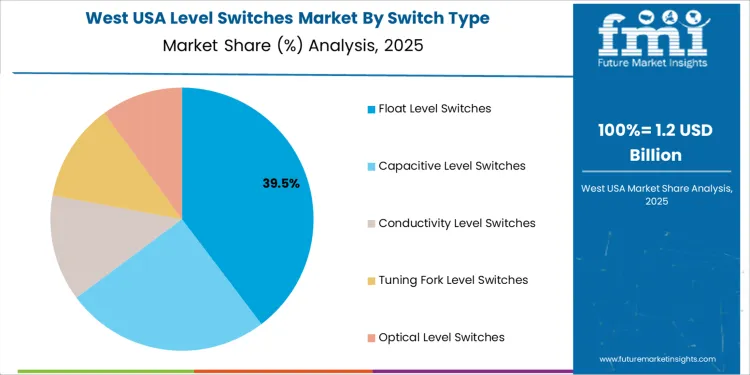
West USA leads the demand for level switches, growing at a 6.0% CAGR. The region’s strong industrial base and focus on automation are key drivers behind this growth. West USA is home to a variety of sectors, including manufacturing, energy, and water management, which rely heavily on level switches for accurate liquid and material monitoring. With the rise in automation and the increasing adoption of smart manufacturing technologies, level switches are becoming critical components in maintaining operational efficiency. Urban centers like San Francisco and Los Angeles are leading the way in adopting advanced control systems, driving demand for reliable, precise level measurement solutions. The growing need for safety and environmental compliance in various industries also boosts the use of level switches to ensure optimal performance and prevent overflows or underfills. As automation technologies continue to advance, demand for level switches in West USA is expected to remain strong.
Why is Demand for Level Switches Rising in South USA?
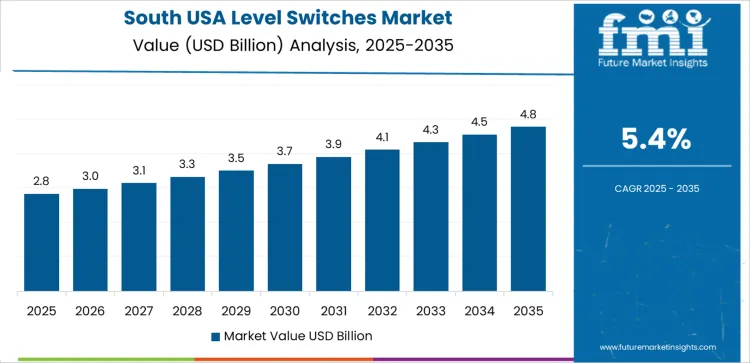
South USA is experiencing steady demand for level switches, with a 5.4% CAGR. The region’s expanding manufacturing and energy sectors, particularly in states like Texas and Louisiana, are driving the adoption of level switches for monitoring liquid and material levels in various industrial applications. As industries such as oil and gas, chemicals, and water treatment continue to grow, the need for reliable, accurate level measurement solutions is increasing. As the region embraces automation technologies, level switches are becoming integral in ensuring precise control in industrial processes. The increasing demand for energy-efficient and safety-compliant systems in the South is also contributing to the adoption of these devices. As manufacturing processes become more automated, and regulatory requirements become stricter, level switches will continue to play a crucial role in meeting operational and environmental goals, contributing to steady growth in the region.
How is Demand for Level Switches Expanding in Northeast USA?
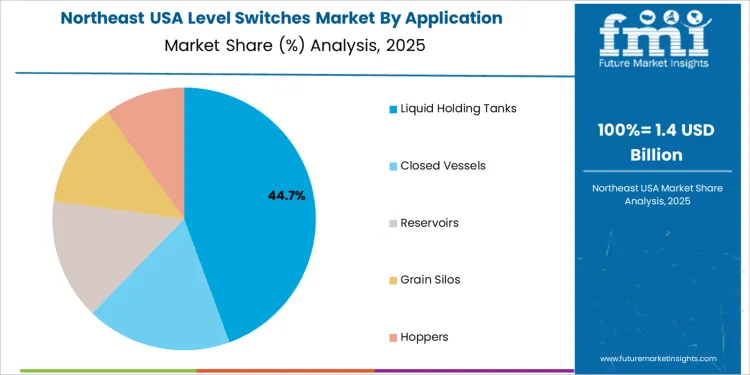
Northeast USA is seeing steady demand for level switches, with a 4.8% CAGR. The region’s strong focus on industrial automation and advanced manufacturing technologies is driving the adoption of level switches in industries such as chemical processing, water management, and food and beverage. The growing emphasis on safety, operational efficiency, and environmental regulations is encouraging the use of precise level measurement systems to prevent overflow or underfill situations. In cities like New York and Boston, industries are increasingly integrating level switches into their automated control systems to improve process accuracy and reduce operational downtime. As businesses in the Northeast continue to focus on sustainability and energy efficiency, the demand for reliable level measurement technologies will remain strong. The rising importance of automation in various industrial sectors ensures that level switches will continue to see steady growth, driven by the region’s commitment to modernizing its manufacturing capabilities.
Why is Demand for Level Switches Growing in Midwest USA?
Midwest USA is experiencing moderate demand for level switches, with a 4.2% CAGR. The region’s diverse industrial landscape, including manufacturing, agriculture, and food processing, is driving the use of level switches to monitor and control liquid and material levels. With a strong presence of production facilities, especially in states like Illinois and Michigan, the demand for precise level measurement solutions is increasing. As the region continues to embrace automation technologies, level switches are being integrated into systems for more efficient and accurate monitoring of industrial processes. The need for safety and compliance with environmental standards is boosting the use of these devices across various industries. The growing trend toward energy-efficient, automated systems in the Midwest is supporting the steady adoption of level switches, with industries seeking reliable, cost-effective solutions for maintaining operational efficiency and minimizing waste. As automation continues to advance, demand for level switches will grow steadily in this region.
What is the Competitive Landscape of Level Switches Demand in USA?
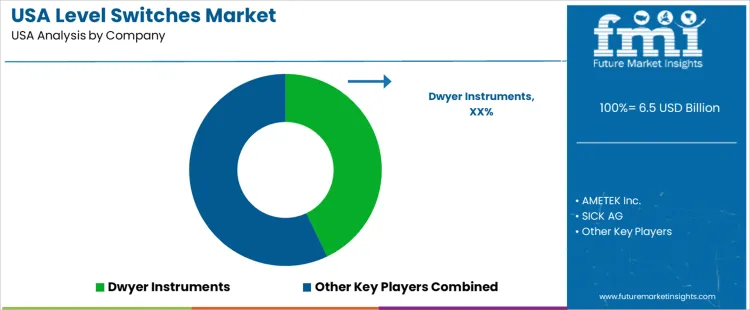
Demand for level switches in the USA is growing as industries such as water treatment, oil and gas, food and beverage, and chemicals require precise monitoring and control of fluid levels. These devices are essential for ensuring process safety, preventing equipment damage, and optimizing efficiency. With increasing automation across industries and the push for greater precision, the need for reliable, high-performance level switches is more critical than ever, especially in applications where accuracy and durability are paramount.
Dwyer Instruments leads the USA industry with a 42.9% share, offering a broad range of customizable and versatile level switches for various industrial applications. The company's focus is on providing innovative, high-quality solutions that meet specific customer needs, from standard to highly specialized uses. Dwyer stands out for its commitment to innovation, solidifying its presence in the competitive landscape by consistently meeting industry demands for reliable performance and flexibility.
Other significant players include AMETEK Inc., SICK AG, Gems Sensors & Controls, and FineTek Co. Ltd., each targeting different industry segments with their offerings. AMETEK and SICK AG emphasize high-precision and advanced instrumentation, delivering durable level switches ideal for critical and demanding environments. Their focus is on providing solutions that integrate seamlessly into automated systems. Gems Sensors & Controls and FineTek Co. Ltd. cater to cost-sensitive industries with reliable, affordable products. These companies are working to differentiate themselves by offering versatile solutions that meet the diverse needs of industrial sectors. As the industry becomes more competitive, companies that focus on innovation, customer-centric solutions, and reliable performance are poised to lead in the evolving level switch sector.
Key Players in USA Level Switches Demand
- Loren Cook Company
- Johnson Controls International
- Ziehl-Abegg SE
- Air System Components, Inc.
- Vent-Axia Group Limited
Scope of Report
| Items | Values |
|---|---|
| Quantitative Units (2025) | USD billion |
| Switch Type | Float Level Switches, Capacitive Level Switches, Conductivity Level Switches, Tuning Fork Level Switches, Optical Level Switches |
| Application | Liquid Holding Tanks, Closed Vessels, Reservoirs, Grain Silos, Hoppers |
| Regions Covered | West USA, South USA, Northeast USA, Midwest USA |
| Countries Covered | USA |
| Key Companies Profiled | Loren Cook Company, Johnson Controls International, Ziehl-Abegg SE, Air System Components, Inc., Vent-Axia Group Limited |
| Additional Attributes | Dollar sales by switch type and application; regional CAGR and growth trends; increasing demand for automation and control in liquid handling industries; focus on safety and efficiency in level detection. |
USA Level Switches Demand by Key Segments
Switch Type:
- Float Level Switches
- Capacitive Level Switches
- Conductivity Level Switches
- Tuning Fork Level Switches
- Optical Level Switches
Application:
- Liquid Holding Tanks
- Closed Vessels
- Reservoirs
- Grain Silos
- Hoppers
Region:
- West USA
- South USA
- Northeast USA
- Midwest USA
Frequently Asked Questions
How big is the demand for level switches in USA in 2025?
The demand for level switches in USA is estimated to be valued at USD 6.5 billion in 2025.
What will be the size of level switches in USA in 2035?
The market size for the level switches in USA is projected to reach USD 10.7 billion by 2035.
How much will be the demand for level switches in USA growth between 2025 and 2035?
The demand for level switches in USA is expected to grow at a 5.2% CAGR between 2025 and 2035.
What are the key product types in the level switches in USA?
The key product types in level switches in USA are float level switches, capacitive level switches, conductivity level switches, tuning fork level switches and optical level switches.
Which application segment is expected to contribute significant share in the level switches in USA in 2025?
In terms of application, liquid holding tanks segment is expected to command 44.0% share in the level switches in USA in 2025.
Preview the report firsthand - request a free sample
Get SampleGet the brochure for pricing and purchase details.
Get PDFTable of Content
- Executive Summary
- USA Market Outlook
- Demand-side Trends
- Supply-side Trends
- Technology Roadmap Analysis
- Analysis and Recommendations
- Market Overview
- Market Coverage / Taxonomy
- Market Definition / Scope / Limitations
- Market Background
- Market Dynamics
- Drivers
- Restraints
- Opportunity
- Trends
- Scenario Forecast
- Demand in Optimistic Scenario
- Demand in Likely Scenario
- Demand in Conservative Scenario
- Opportunity Map Analysis
- Product Life Cycle Analysis
- Supply Chain Analysis
- Investment Feasibility Matrix
- Value Chain Analysis
- PESTLE and Porter’s Analysis
- Regulatory Landscape
- Regional Parent Market Outlook
- Production and Consumption Statistics
- Import and Export Statistics
- Market Dynamics
- USA Market Analysis 2020 to 2024 and Forecast, 2025 to 2035
- Historical Market Size Value (USD Million) Analysis, 2020 to 2024
- Current and Future Market Size Value (USD Million) Projections, 2025 to 2035
- Y-o-Y Growth Trend Analysis
- Absolute $ Opportunity Analysis
- USA Market Pricing Analysis 2020 to 2024 and Forecast 2025 to 2035
- USA Market Analysis 2020 to 2024 and Forecast 2025 to 2035, By Switch Type
- Introduction / Key Findings
- Historical Market Size Value (USD Million) Analysis By Switch Type , 2020 to 2024
- Current and Future Market Size Value (USD Million) Analysis and Forecast By Switch Type , 2025 to 2035
- Float Level Switches
- Capacitive Level Switches
- Conductivity Level Switches
- Tuning Fork Level Switches
- Optical Level Switches
- Y-o-Y Growth Trend Analysis By Switch Type , 2020 to 2024
- Absolute $ Opportunity Analysis By Switch Type , 2025 to 2035
- USA Market Analysis 2020 to 2024 and Forecast 2025 to 2035, By Application
- Introduction / Key Findings
- Historical Market Size Value (USD Million) Analysis By Application, 2020 to 2024
- Current and Future Market Size Value (USD Million) Analysis and Forecast By Application, 2025 to 2035
- Liquid Holding Tanks
- Closed Vessels
- Reservoirs
- Grain Silos
- Hoppers
- Y-o-Y Growth Trend Analysis By Application, 2020 to 2024
- Absolute $ Opportunity Analysis By Application, 2025 to 2035
- Market Structure Analysis
- Competition Dashboard
- Competition Benchmarking
- Market Share Analysis of Top Players
- By Regional
- By Switch Type
- By Application
- Competition Analysis
- Competition Deep Dive
- Dwyer Instruments
- Overview
- Product Portfolio
- Profitability by Market Segments (Product/Age /Sales Channel/Region)
- Sales Footprint
- Strategy Overview
- Marketing Strategy
- Product Strategy
- Channel Strategy
- AMETEK Inc.
- SICK AG
- Gems Sensors & Controls
- FineTek Co. Ltd.
- Dwyer Instruments
- Competition Deep Dive
- Assumptions & Acronyms Used
- Research Methodology


