

- Industry Size (2025)
- USD 107.4 Mn
- Forecast (2035)
- USD 146.4 Mn
- CAGR (2025 to 2035)
- 3.2%
Demand for Linerless Label in Japan Forecast and Outlook 2025 to 2035
Demand for linerless labels in Japan is expected to grow from USD 107.4 million in 2025 to USD 146.4 million by 2035, reflecting a compound annual growth rate (CAGR) of 3.2%. Linerless labels, which do not require a backing paper and are more sustainable than traditional labels, are becoming increasingly popular in the packaging industry due to their eco-friendly nature and cost-efficiency. As Japan places a growing emphasis on sustainability, industries like food, beverage, and retail are shifting towards linerless labeling solutions to reduce waste and improve operational efficiency. Adoption of linerless labels is expected to rise as more companies seek to meet sustainability goals while maintaining high-quality labeling standards.
Technological advancements in the production and application of linerless labels, including improvements in adhesive technologies and printing capabilities, will also drive the market forward. As manufacturers and retailers increasingly prioritize packaging solutions that reduce environmental impact and improve efficiency, the demand for linerless labels is set to increase over the next decade.
Quick Stats of the Demand for Linerless Label in Japan
- Demand for Linerless Label in Japan Value (2025): USD 107.4 million
- Demand for Linerless Label in Japan Forecast Value (2035): USD 146.4 million
- Demand for Linerless Label in Japan Forecast CAGR (2025-2035): 3.2%
- Demand for Linerless Label in Japan Leading Printing Technology: Digital Printing (46%)
- Demand for Linerless Label in Japan Key Growth Regions: Kyushu & Okinawa, Kanto, Kansai, Chubu, Tohoku, Rest of Japan
- Demand for Linerless Label in Japan Key Players: Zebra Technologies Corp., SATO Holdings Corporation, Coveris, Ravenwood Packaging, Yupo Corporation
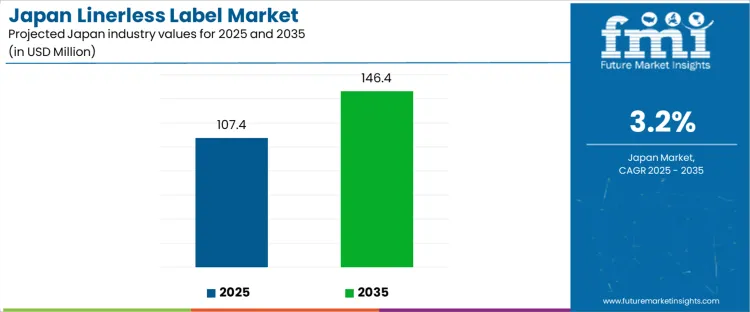
What is the Growth Forecast for the Linerless Label Market through 2035?
The 10-year growth comparison for the linerless label industry in Japan shows steady and consistent growth throughout the forecast period. Starting at USD 107.4 million in 2025, the market increases to USD 110.8 million in 2026 and USD 114.2 million in 2027, reflecting gradual growth as the adoption of linerless labels increases across various industries, particularly in the packaging sector.
From 2027 to 2030, the market grows steadily, reaching USD 117.8 million in 2028, USD 121.6 million in 2029, and USD 125.4 million in 2030. Steady rise indicates a consistent expansion of the linerless label market as sustainability efforts intensify and consumer demand for eco-friendly products increases. By 2035, the market is expected to reach USD 146.4 million, maintaining a steady upward trajectory.
Key Takeaways of Linerless Label Industry in Japan
| Metric | Value |
|---|---|
| Industry Sales Value (2025) | USD 107.4 million |
| Industry Forecast Value (2035) | USD 146.4 million |
| Industry Forecast CAGR (2025-2035) | 3.2% |
What Is Driving the Demand for Linerless Labels in Japan?
Demand for linerless labels in Japan is influenced by growing interest among manufacturers and brand owners in reducing waste and improving packaging efficiency. Linerless labels remove the need for a release liner or backing paper when applied. This reduces material usage and waste disposal needs, which has become more relevant as environmental awareness and pressure on packaging waste management increase in Japan. Industries such as food and beverage, logistics, retail, and consumer goods have begun adopting linerless labels because these labels lower storage and transport volume for label rolls, reduce downtime in printing/labeling, and simplify packaging processes. Shift toward flexible packaging formats and higher-throughput manufacturing and distribution systems has supported demand.
Future demand for linerless labels in Japan is expected to continue to grow as packaging waste reduction becomes increasingly prioritized among regulators, brands, and consumers. Growth will be supported by the expansion of the e-commerce, retail, and logistics sectors, which favour efficient, lightweight, and waste-minimizing packaging solutions. As labeling and packaging operations become more automated and integrated with printing and supply chain systems, linerless labels will likely become more widespread, especially for high-volume food, beverage, logistics, and consumer goods products. Advances in adhesive and printing technologies that improve label performance and compatibility with various packaging surfaces will further support adoption. Demand growth will also depend on how the packaging industry in Japan balances cost, operational efficiency, and environmental considerations over the coming years.
What Are the Key Segments in Linerless Label Market in Japan?
Linerless label market in Japan is segmented by printing technology and adhesive type. Digital printing leads the printing technology segment, accounting for 46% of the market share. By adhesive type, permanent adhesive is the dominant, holding 40% of the market. The growing demand for efficient, cost-effective, and sustainable labeling solutions is driving the adoption of linerless labels in various industries in Japan.
Which Printing Technology Drives Linerless Label Demand in Japan?
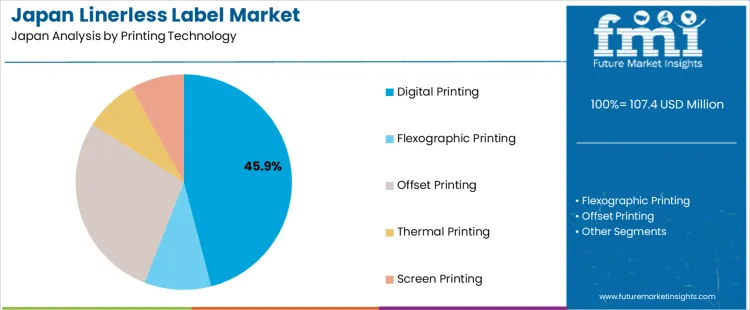
Digital printing is the most widely used printing technology in the linerless label market in Japan, accounting for 46% of market share. Digital printing enables high-quality, precise printing with minimal setup and waste, making it ideal for short runs, variable-data printing, and on-demand label production. It offers flexibility in design and customization, which is particularly important in the food and beverage, consumer goods, and retail sectors. The increasing demand for personalized and small-batch production, combined with the growing trend towards digitalization, is driving the adoption of digital printing for linerless labels. Other printing technologies, such as flexographic printing, offset printing, thermal printing, and screen printing, also contribute to the market. Still, digital printing remains the most dominant due to its efficiency, lower production costs, and ability to handle a wide range of materials and applications.
Which Adhesive Type Drives Linerless Label Demand in Japan?
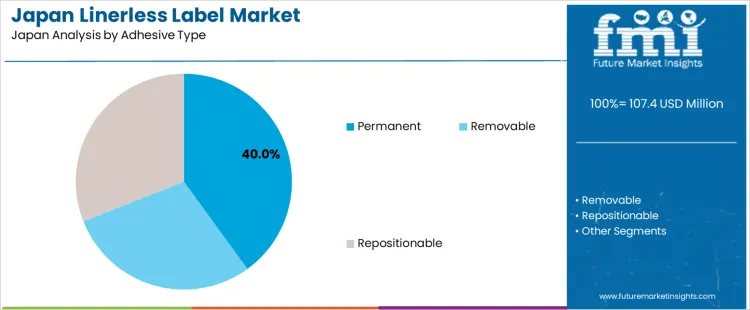
Permanent adhesive is the leading adhesive type for linerless labels in Japan, holding 40% of the market share. Permanent adhesive labels provide a strong, long-lasting bond, making them ideal for labeling products that require durability and security. They are commonly used in a variety of industries, including food and beverage, retail, logistics, and pharmaceuticals, where labels must stay securely attached throughout the product's lifecycle. Demand for permanent adhesive labels is driven by the need for reliable and secure labeling solutions that ensure labels remain intact, even in challenging conditions such as high humidity or temperature fluctuations. While removable and repositionable adhesives are used in specific applications, permanent adhesives remain the most widely used for linerless labels due to their strength, reliability, and versatility across commercial and industrial settings.
What is the Key Dynamics for Linerless Label Demand in Japan?
Linerless label industry in Japan is driven by growing efforts to reduce packaging waste and improve labeling efficiency. Demand is rising as retailers and food processors adopt linerless systems for fresh food, logistics, and packaged products. Labels without backing liners are preferred because they reduce waste, cut storage and transport costs, and integrate well with automated printing and weighing scale systems. The market is expanding under pressure from retailers seeking streamlined operations, improved adhesive and printing precision, and compliance with food safety and hygiene norms.
What are the Key Drivers for Linerless Label Demand in Japan?
The increasing demand for packaged food, fresh produce, and retail goods is driving the need for efficient, hygienic, and waste-reducing labeling solutions. Linerless labels eliminate backing liners and associated waste, lowering material use and disposal costs, making them cost-effective. The suitability of linerless labels for automated labeling, thermal printing, and integration with weighing or retail printing systems makes them attractive to retailers and logistics providers seeking operational efficiency. Growing regulatory and consumer emphasis on hygiene, clear labeling, and traceability in food and fresh produce also supports the adoption of linerless labels.
What are the Restraints for Linerless Label Demand in Japan?
A constraint is the need for specialized printing and labeling equipment to handle linerless labels. Legacy labeling lines may not be compatible, creating a barrier to adoption. Some applications may require strong adhesives or special release coatings to prevent labels from sticking together, which can increase material and manufacturing complexity. Certain niche or premium applications may still prefer traditional lined labels due to familiarity or perceived performance advantages. If raw material prices or adhesive costs rise, the cost advantage of linerless labels may be reduced, potentially constraining uptake among cost-sensitive users.
What are the Key Trends in Linerless Label Demand in Japan?
A growing trend is the adoption of linerless labels in fresh-food retail and meat and seafood departments, where hygienic labeling and efficient shelf labeling are critical. Integration of linerless labels with thermal printing, weigh scale systems, and automated retail labeling lines is becoming more common, supporting precision printing and inventory management in retail and logistics. There is increasing interest in eco-friendly and waste-reducing packaging practices; linerless labels help reduce liner waste, cut material usage, and align with environmental care goals. Demand is growing for linerless labels in logistics, e-commerce packaging, and shipping sectors where high-volume labeling, reduced waste, and cost efficiency are valuable.
What is the Regional Demand Outlook for Linerless Labels in Japan?
Demand for linerless labels in Japan is expected to grow steadily, with Kyushu & Okinawa leading the way at a projected CAGR of 3.9%. Kanto follows closely with a growth rate of 3.6%, while Kansai is expected to grow at 3.2%. Chubu is expected to grow at a rate of 2.8%, while Tohoku and Rest of Japan show more moderate growth, with CAGRs of 2.5% and 2.3%, respectively. Rising demand for sustainable packaging solutions and the growing need for efficient, cost-effective labeling are driving the adoption of linerless labels nationwide.
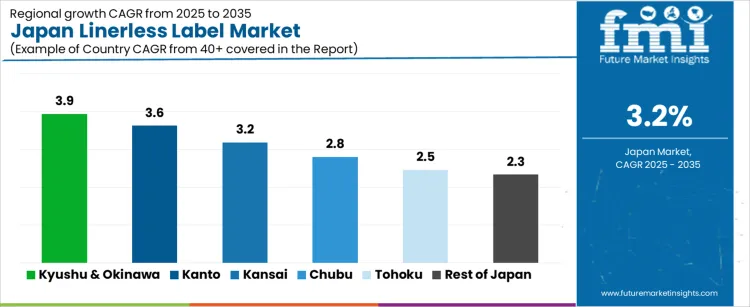
| Region | CAGR (2025-2035) |
|---|---|
| Kyushu & Okinawa | 3.9% |
| Kanto | 3.6% |
| Kansai | 3.2% |
| Chubu | 2.8% |
| Tohoku | 2.5% |
| Rest of Japan | 2.3% |
What is Driving the Growth of Linerless Labels in Kyushu & Okinawa?
Kyushu & Okinawa is projected to experience the highest growth in the linerless labels market, with a projected CAGR of 3.9%. The region’s increasing focus on sustainability and waste reduction, particularly in packaging materials, is a key driver of this growth. Linerless labels, which reduce packaging waste by eliminating the release liner, align with Kyushu & Okinawa’s efforts to adopt more eco-friendly packaging solutions. Additionally, the region’s growing demand for more efficient and cost-effective labeling methods is fueling the adoption of linerless labels. The increasing number of local manufacturers looking to improve operational efficiency and reduce material waste is expected to contribute significantly to the growth of this market in the region.
Why is the Linerless Labels Market Expanding in Kanto?
In Kanto, the demand for linerless labels is projected to grow at a CAGR of 3.6%. Kanto, home to Japan’s capital Tokyo, is a major hub for the packaging industry, and its well-developed infrastructure and high concentration of manufacturing facilities are driving the growth of the linerless labels market. The rising awareness of sustainability and the need for more eco-friendly packaging options are contributing to the growing adoption of linerless labels in the region. Furthermore, Kanto’s robust consumer market is increasingly demanding innovative and efficient labeling solutions for various products, particularly in the food and beverage sectors. The demand for cost-effective and sustainable packaging solutions is expected to keep driving growth in the linerless labels market in Kanto.
How is the Linerless Labels Market Growing in Kansai?
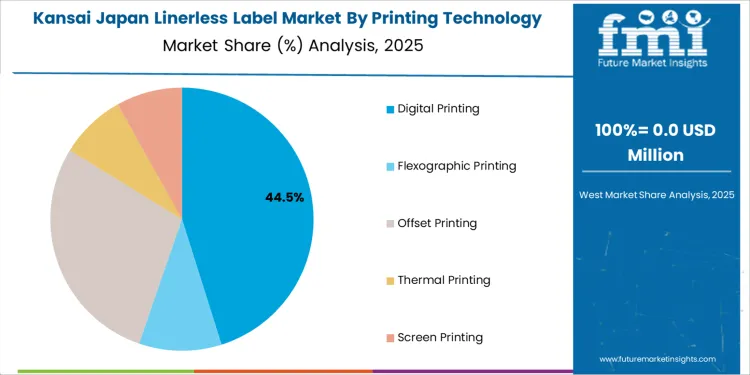
In Kansai, the linerless labels market is projected to grow at a CAGR of 3.2%. The region, which includes major cities like Osaka, has a well-established packaging industry that is increasingly adopting sustainable packaging solutions. Kansai’s focus on reducing environmental impact and improving production efficiency is driving the demand for linerless labels. As businesses in Kansai look for more cost-effective and environmentally friendly labeling solutions, the market for linerless labels is expanding. Additionally, the rise of consumer demand for eco-conscious packaging, particularly in industries like food, cosmetics, and pharmaceuticals, is contributing to the growth of this market in Kansai. As the region’s manufacturing sector continues to embrace green initiatives, the market for linerless labels is expected to grow steadily.
What is Contributing to the Growth of Linerless Labels in Chubu?
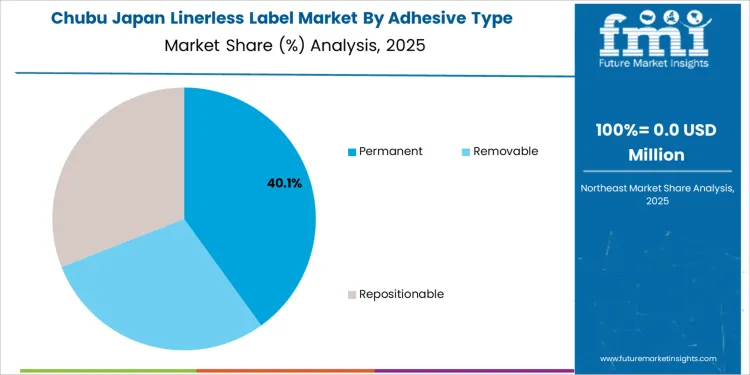
In Chubu, the linerless labels market is expected to grow at a CAGR of 2.8%. The region’s focus on sustainable manufacturing practices and reducing packaging waste is helping drive the demand for eco-friendly labeling solutions like linerless labels. Chubu, with its industrial and manufacturing base, is seeing a growing interest in efficient packaging solutions that reduce waste and improve operational efficiency. As companies in Chubu, particularly in the food and beverage sectors, look for ways to reduce material usage and minimize waste, the demand for linerless labels is increasing. The region’s emphasis on green technologies and cost-effective packaging alternatives is expected to contribute to the gradual growth of the linerless labels market.
What is Influencing the Growth of Linerless Labels in Tohoku?
In Tohoku, the linerless labels market is projected to grow at a CAGR of 2.5%. While the growth rate in Tohoku is more moderate compared to other regions, the demand for linerless labels is rising due to the region’s increasing focus on sustainability. Tohoku’s packaging industry is gradually adopting more eco-friendly solutions as businesses look for ways to reduce material costs and waste. The region’s growing awareness of environmental issues and the rising consumer demand for sustainable products are helping drive the adoption of linerless labels. As the packaging industry in Tohoku becomes more focused on efficiency and environmental sustainability, the market for linerless labels is expected to expand gradually.
What is Contributing to the Growth of Linerless Labels in Rest of Japan?
In Rest of Japan, the linerless labels market is expected to grow at a more moderate rate of 2.3%. Although demand is smaller compared to major metropolitan areas, there is still growing interest in sustainable and cost-effective packaging solutions. As awareness of sustainability continues to rise across the country, more businesses in Rest of Japan are seeking packaging options that reduce environmental impact. The demand for linerless labels in Rest of Japan is driven by the need for efficient, eco-friendly labeling solutions, especially in the food and beverage sectors. As more local manufacturers adopt green practices and expand their use of innovative packaging, the market for linerless labels is expected to continue growing steadily.
What is the Competitive Landscape for Demand for Linerless Labels in Japan?
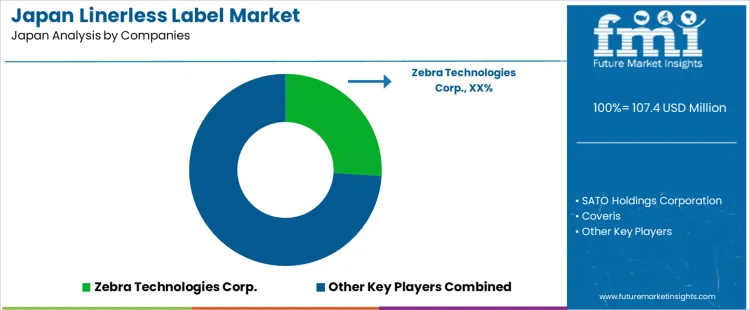
Demand for linerless labels in Japan is rising as manufacturers and retailers look for more sustainable, cost efficient, and flexible labeling solutions. Linerless labels eliminate the backing liner used in traditional pressure sensitive labels, reducing waste and lowering material and disposal costs. As sustainability becomes more important in packaging industries — particularly in food & beverage, pharmaceuticals, retail, and logistics — the appeal of linerless labels grows. Linerless labeling also improves operational efficiency: more labels per roll are possible, storage and transport space is reduced, and roll changes are less frequent, making it attractive in high-volume manufacturing and packaging operations.
On the supply side in Japan several global and regional packaging label firms compete to meet growing demand. According to your list, Zebra Technologies Corp. holds a leading share of about 26%. Other major players include SATO Holdings Corporation, Coveris, Ravenwood Packaging, and Yupo Corporation. These companies supply linerless label materials, printers/applicators and support for integrating linerless labeling into packaging operations. Competition among suppliers focuses on material quality (adhesive performance, linerless compatible facestocks), reliability in different packaging environments (food, pharma, logistics), compatibility with automatic printing and application systems, cost per label roll, and ability to assist clients with transitioning from traditional labels. Suppliers that provide high quality linerless materials, robust labeling systems, and support for sustainability driven clients are best positioned to capture growth as Japanese manufacturers increasingly adopt linerless labeling solutions.
Key Players of the Linerless Label Industry in Japan
- Zebra Technologies Corp.
- SATO Holdings Corporation
- Coveris
- Ravenwood Packaging
- Yupo Corporation
Scope of the Report
| Items | Details |
|---|---|
| Quantitative Units | USD Million |
| Regions Covered | Japan |
| Printing Technology | Digital Printing; Flexographic Printing; Offset Printing; Thermal Printing; Screen Printing |
| Adhesive Type | Permanent; Removable; Repositionable |
| Application / Format Use | Retail; Food & Beverages; Logistics & Transportation; Pharmaceuticals; Personal Care & Cosmetics; Industrial Goods |
| Product Type (Label Use) | Variable Information Print (VIP) / On demand Labels; Primary Product Labels; Functional / Security Labels |
| Key Companies | Zebra Technologies Corp.; SATO Holdings Corporation; Coveris; Ravenwood Packaging; Yupo Corporation |
| Additional Attributes | Dollar sales by label type and application reflect rising adoption of linerless labels driven by sustainability motivations (reduced liner waste), cost savings (less liner stock, shipping & storage efficiency), growth in e commerce & logistics, demand for flexible/variable data printing (VIP), and regulatory/consumer pressure for eco friendly packaging and labeling. |
Key Segments in the Demand for Linerless Label in Japan
Printing Technology:
- Digital Printing
- Flexographic Printing
- Offset Printing
- Thermal Printing
- Screen Printing
Adhesive Type
- Permanent
- Removable
- Repositionable
Application Format
- Retail
- Food & Beverages
- Logistics and Transportation
- Pharmaceuticals
- Personal Care & Cosmetics
- Industrial Goods
Product Type
- Variable Information Print (VIP) Labels
- Primary Product Labels
- Functional/Security Labels
Region
- Kyushu & Okinawa
- Kanto
- Kansai
- Chubu
- Tohoku
- Rest of Japan
Frequently Asked Questions
How big is the demand for linerless label in Japan in 2025?
The demand for linerless label in Japan is estimated to be valued at USD 107.4 million in 2025.
What will be the size of linerless label in Japan in 2035?
The market size for the linerless label in Japan is projected to reach USD 146.4 million by 2035.
How much will be the demand for linerless label in Japan growth between 2025 and 2035?
The demand for linerless label in Japan is expected to grow at a 3.2% CAGR between 2025 and 2035.
What are the key product types in the linerless label in Japan?
The key product types in linerless label in Japan are digital printing, flexographic printing, offset printing, thermal printing and screen printing.
Which adhesive type segment is expected to contribute significant share in the linerless label in Japan in 2025?
In terms of adhesive type, permanent segment is expected to command 40.0% share in the linerless label in Japan in 2025.
Preview the report firsthand - request a free sample
Get SampleGet the brochure for pricing and purchase details.
Get PDFTable of Content
- Executive Summary
- Japan Market Outlook
- Demand-side Trends
- Supply-side Trends
- Technology Roadmap Analysis
- Analysis and Recommendations
- Market Overview
- Market Coverage / Taxonomy
- Market Definition / Scope / Limitations
- Market Background
- Market Dynamics
- Drivers
- Restraints
- Opportunity
- Trends
- Scenario Forecast
- Demand in Optimistic Scenario
- Demand in Likely Scenario
- Demand in Conservative Scenario
- Opportunity Map Analysis
- Product Life Cycle Analysis
- Supply Chain Analysis
- Investment Feasibility Matrix
- Value Chain Analysis
- PESTLE and Porter’s Analysis
- Regulatory Landscape
- Regional Parent Market Outlook
- Production and Consumption Statistics
- Import and Export Statistics
- Market Dynamics
- Japan Market Analysis 2020 to 2024 and Forecast, 2025 to 2035
- Historical Market Size Value (USD Million) Analysis, 2020 to 2024
- Current and Future Market Size Value (USD Million) Projections, 2025 to 2035
- Y-o-Y Growth Trend Analysis
- Absolute $ Opportunity Analysis
- Japan Market Pricing Analysis 2020 to 2024 and Forecast 2025 to 2035
- Japan Market Analysis 2020 to 2024 and Forecast 2025 to 2035, By Printing Technology
- Introduction / Key Findings
- Historical Market Size Value (USD Million) Analysis By Printing Technology , 2020 to 2024
- Current and Future Market Size Value (USD Million) Analysis and Forecast By Printing Technology , 2025 to 2035
- Digital Printing
- Flexographic Printing
- Offset Printing
- Thermal Printing
- Screen Printing
- Y-o-Y Growth Trend Analysis By Printing Technology , 2020 to 2024
- Absolute $ Opportunity Analysis By Printing Technology , 2025 to 2035
- Japan Market Analysis 2020 to 2024 and Forecast 2025 to 2035, By Adhesive Type
- Introduction / Key Findings
- Historical Market Size Value (USD Million) Analysis By Adhesive Type, 2020 to 2024
- Current and Future Market Size Value (USD Million) Analysis and Forecast By Adhesive Type, 2025 to 2035
- Permanent
- Removable
- Repositionable
- Y-o-Y Growth Trend Analysis By Adhesive Type, 2020 to 2024
- Absolute $ Opportunity Analysis By Adhesive Type, 2025 to 2035
- Japan Market Analysis 2020 to 2024 and Forecast 2025 to 2035, By Application Format
- Introduction / Key Findings
- Historical Market Size Value (USD Million) Analysis By Application Format, 2020 to 2024
- Current and Future Market Size Value (USD Million) Analysis and Forecast By Application Format, 2025 to 2035
- Retail
- Food & Beverages
- Logistics and Transportation
- Pharmaceuticals
- Personal Care & Cosmetics
- Industrial Goods
- Y-o-Y Growth Trend Analysis By Application Format, 2020 to 2024
- Absolute $ Opportunity Analysis By Application Format, 2025 to 2035
- Japan Market Analysis 2020 to 2024 and Forecast 2025 to 2035, By Product Type
- Introduction / Key Findings
- Historical Market Size Value (USD Million) Analysis By Product Type, 2020 to 2024
- Current and Future Market Size Value (USD Million) Analysis and Forecast By Product Type, 2025 to 2035
- Variable Information Print (VIP) Labels
- Primary Product Labels
- Functional/Security Labels
- Y-o-Y Growth Trend Analysis By Product Type, 2020 to 2024
- Absolute $ Opportunity Analysis By Product Type, 2025 to 2035
- Market Structure Analysis
- Competition Dashboard
- Competition Benchmarking
- Market Share Analysis of Top Players
- By Regional
- By Printing Technology
- By Adhesive Type
- By Application Format
- By Product Type
- Competition Analysis
- Competition Deep Dive
- Zebra Technologies Corp.
- Overview
- Product Portfolio
- Profitability by Market Segments (Product/Age /Sales Channel/Region)
- Sales Footprint
- Strategy Overview
- Marketing Strategy
- Product Strategy
- Channel Strategy
- SATO Holdings Corporation
- Coveris
- Ravenwood Packaging
- Yupo Corporation
- Zebra Technologies Corp.
- Competition Deep Dive
- Assumptions & Acronyms Used
- Research Methodology


