

- Industry Size (2026)
- USD 427.2 Mn
- Forecast (2036)
- USD 757.7 Mn
- CAGR (2026 to 2036)
- 5.9%
Demand for Thinned Starch in USA 2026 to 2036
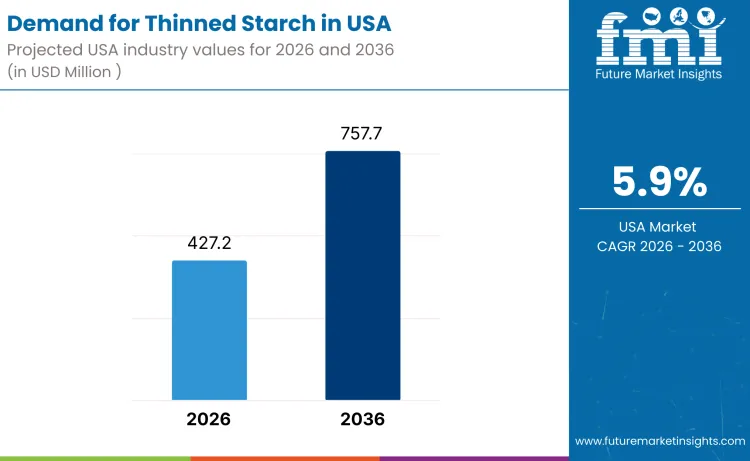
Demand for Thinned Starch in USA is valued at USD 427.2 million in 2026 and is projected to reach USD 757.7 million by 2036, reflecting a CAGR of 5.9%. Demand increases due to broad utilization across food processing, paper manufacturing, textile sizing, and adhesive formulations where controlled viscosity and film-forming properties are required. Expansion of convenience foods and packaging-grade paper products supports sustained consumption.
Dry thinned starch leads form usage because it offers longer shelf life, ease of handling, and consistent performance during rehydration and processing. Food manufacturers rely on dry grades for sauces, confectionery, and bakery fillings, while industrial users apply these starches in surface sizing and bonding applications. Process stability and compatibility with automated dosing systems strengthen preference across end-use sectors.
West USA, South USA, Northeast USA, and Midwest USA represent key growth regions supported by large food processing clusters, paper mills, and industrial manufacturing bases. Ingredion, Cargill, Tate and Lyle Americas, ADM, and Roquette anchor competitive activity through diversified starch portfolios, application-specific modifications, and reliable supply chains aligned with evolving functional and regulatory requirements across U.S. industries.
Quick Stats for Demand for Thinned Starch in USA
- USA Thinned Starch Sales Value (2026): USD 427.2 million
- USA Thinned Starch Forecast Value (2036): USD 757.7 million
- USA Thinned Starch Forecast CAGR (2026-2036): 5.9%
- Leading Form in USA Demand: Dry thinned starch
- Key Growth Regions in USA Demand: West USA, South USA, Northeast USA, Midwest USA
- Top Players in USA Demand: Ingredion, Cargill, Tate and Lyle Americas, ADM, Roquette
USA Thinned Starch Key Takeaways
| Metric | Value |
|---|---|
| USA Thinned Starch Sales Value (2026) | USD 427.2 million |
| USA Thinned Starch Forecast Value (2036) | USD 757.7 million |
| USA Thinned Starch Forecast CAGR (2026-2036) | 5.9% |
How Are the Segments Classified in the Demand for Thinned Starch in the USA?
Demand for thinned starch in the USA is shaped by processed food manufacturing scale, texture control requirements, and need for viscosity modification across thermal processing conditions. Buyers evaluate gelatinization behavior, shear stability, source consistency, and compatibility with existing formulation systems. Adoption patterns reflect extensive use in food manufacturing lines where controlled thickening, binding, and mouthfeel performance are required under standardized U.S. food processing regulations.
Which Form Accounts for the Largest Share of Demand in the USA?
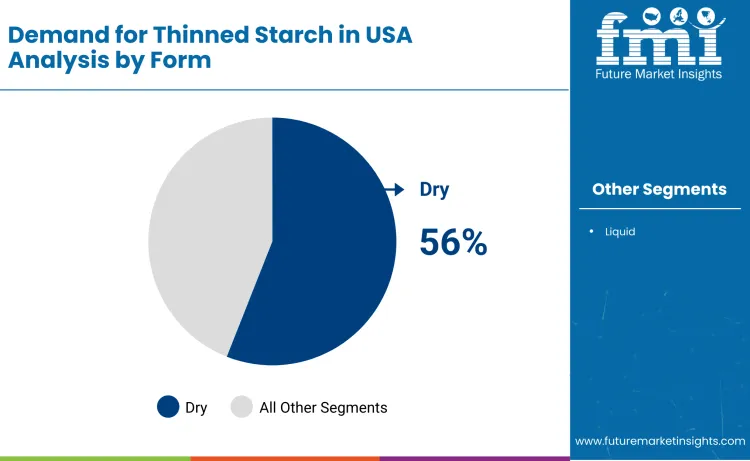
Dry thinned starch holds 56.0%, making it the leading form segment in the USA. Dry formats offer longer shelf stability, ease of transportation, and flexible dosing during food manufacturing. These characteristics support integration into bakery mixes, soup bases, and dry food formulations. Liquid thinned starch supports applications requiring immediate dispersion and rapid viscosity development in continuous processing systems. Form distribution reflects stronger reliance on dry starch due to storage efficiency, reduced microbial risk, and compatibility with high-volume U.S. food production workflows.
Key Points:
- Dry form dominates due to shelf stability and handling efficiency.
- Dry starch supports precise dosing in food manufacturing.
- Liquid starch serves niche continuous-processing requirements.
Which Source Accounts for the Largest Share of Demand in the USA?
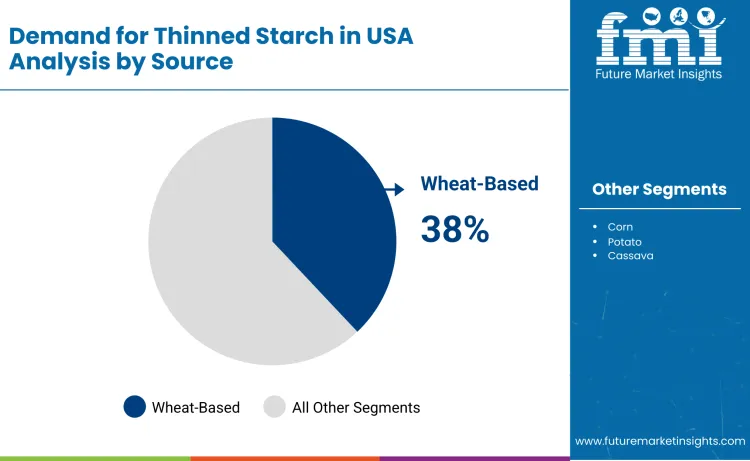
Wheat-based thinned starch holds 38.0%, making it the leading source segment in the USA. Wheat starch provides consistent viscosity control and neutral sensory impact, supporting broad food applications. Corn starch supports cost-sensitive formulations and large-scale availability within domestic agriculture. Potato starch offers higher swelling capacity for specific texture profiles. Cassava and sorghum starches serve specialized or alternative sourcing needs. Source distribution reflects preference for wheat due to functional reliability and established supply chains within U.S. food processing.
Key Points:
- Wheat starch leads due to functional consistency.
- Corn starch supports large-volume, cost-focused formulations.
- Alternative sources serve specialized texture requirements.
Which End-Use Segment Accounts for the Largest Share of Demand in the USA?
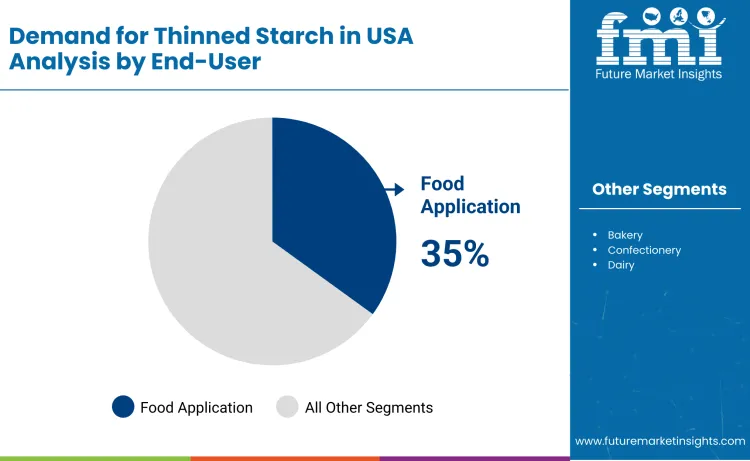
Food applications hold 35.0%, making them the leading end-use segment in the USA. Thinned starch is used to control viscosity, stabilize emulsions, and improve texture in processed foods. Bakery products use starch for crumb structure and moisture retention. Confectionery applications rely on starch for gel formation and binding. Dairy products use controlled starch addition for thickness and stability. Soups, sauces, and gravies depend on thinned starch for consistent flow and reheating performance. End-use distribution reflects dominant integration into mainstream food manufacturing.
Key Points:
- General food processing drives primary demand.
- Bakery and confectionery rely on texture control functions.
- Soups and sauces require stable viscosity performance.
What are the Key Dynamics in the Thinned Starch Industry in USA?
Demand increases as food processors, paper manufacturers, and industrial users in USA rely on thinned starch for viscosity control, film formation, and binding functions. Usage aligns with large-scale food processing, corrugated packaging production, and adhesive applications. Domestic corn-based starch availability, established wet-milling capacity, and consistent downstream demand support stable consumption across manufacturing regions in the Midwest and Southern USA.
How do food processing requirements and packaging production drive demand in USA?
USA food manufacturers use thinned starch to control texture, mouthfeel, and stability in soups, sauces, confectionery, and bakery fillings. Enzymatically or acid-thinned starches provide predictable viscosity under high-temperature processing and shear conditions. Paper and packaging producers apply thinned starch as a surface sizing and adhesive component in corrugated board and paperboard manufacturing. Growth in packaged food consumption and e-commerce-driven corrugated demand sustains volume usage. Industrial adhesive producers rely on thinned starch for cost-effective bonding solutions. Domestic starch processors benefit from proximity to corn supply and integrated logistics supporting large-volume industrial demand.
How do raw material pricing, substitution options, and processing constraints influence demand stability?
Corn price volatility affects starch production costs and contract pricing for downstream users. Food formulators evaluate alternative hydrocolloids when functional performance or clean-label positioning requires substitution. Processing limitations arise when thinned starch shows reduced stability under extreme pH or freeze-thaw conditions. Paper manufacturers adjust formulations based on strength and moisture requirements. Energy and water usage in starch processing influence operating costs. Environmental compliance adds cost pressure for wet-milling facilities. Demand remains stable in high-volume food and packaging uses, while long-term growth faces constraints from input cost sensitivity, functional limitations, and competition from modified starches and synthetic binders within USA industries.
How Is Demand for Thinned Starch in USA Evolving by Region?
Demand for thinned starch in the USA is increasing due to wider use in food processing, paper manufacturing, textile sizing, and industrial adhesives. West USA leads with a 6.8% CAGR, supported by processed food innovation, specialty packaging, and modified starch applications. South USA follows at 6.1%, driven by large-scale food manufacturing, corrugated packaging, and textile processing activity. Northeast USA records a 5.4% CAGR, shaped by paper recycling, specialty food formulations, and regulated industrial usage. Midwest USA posts a 4.7% CAGR, reflecting stable demand from corn-based starch processing, paper mills, and industrial manufacturing. Regional variation reflects end-use concentration, processing capacity, and formulation intensity across the USA.
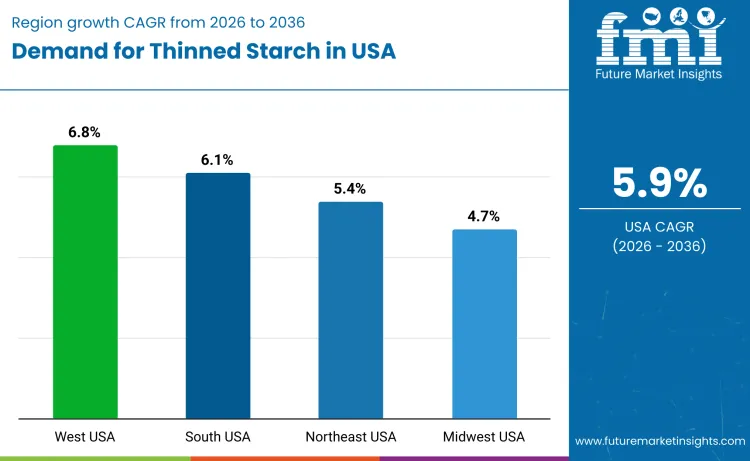
| Region | CAGR (2026-2036) |
|---|---|
| West USA | 6.8% |
| South USA | 6.1% |
| Northeast USA | 5.4% |
| Midwest USA | 4.7% |
How is West USA driving demand for Thinned Starch?
West USA demand is influenced by processed food innovation, clean-label formulation work, and specialty industrial applications. The region’s CAGR of 6.8% reflects rising use of thinned starch in sauces, dressings, dairy alternatives, and ready-to-eat foods requiring controlled viscosity and clarity. Food manufacturers favor enzyme-thinned starches for improved texture and processing stability. Packaging and specialty paper producers apply thinned starch for surface sizing and coating formulations. Industrial users adopt thinned starch in adhesives and binders where rapid hydration and consistent flow are required. Demand favors high-functionality grades supplied in controlled packaging formats.
- Processed and ready-to-eat food formulations
- Enzyme-thinned starch for texture control
- Specialty paper coating and surface sizing
- High-functionality grades with consistent flow
How is South USA driving demand for Thinned Starch?
South USA demand is volume-driven and linked to large-scale food and packaging manufacturing. The region’s CAGR of 6.1% reflects extensive use of thinned starch in bakery fillings, soups, gravies, and snack coatings. Corrugated packaging plants consume thinned starch for adhesives and board strength enhancement. Textile processors apply thinned starch for warp sizing due to its film-forming properties. Procurement emphasizes cost efficiency, bulk availability, and compatibility with high-speed processing lines. Demand remains resilient due to continuous production and diversified end-use exposure.
- Large-scale food manufacturing applications
- Corrugated packaging and adhesive usage
- Textile warp sizing demand
- Bulk procurement for continuous operations
How is Northeast USA driving demand for Thinned Starch?
Northeast USA demand reflects specialty food production, paper recycling, and regulated industrial usage. The region’s CAGR of 5.4% is supported by use of thinned starch in soups, processed meals, and premium food products requiring controlled viscosity. Paper recyclers and converters use thinned starch in surface treatment and strength enhancement. Regulatory oversight encourages consistent formulation and traceable sourcing. Demand favors customized starch grades tailored to specific processing conditions. Growth remains steady, aligned with food reformulation cycles and packaging material upgrades.
- Specialty and premium food product formulations
- Paper recycling and surface treatment applications
- Customized starch grades for controlled processing
- Emphasis on traceability and formulation consistency
How is Midwest USA driving demand for Thinned Starch?
Midwest USA demand is stable and manufacturing-focused, reflecting strong presence of corn processing, paper mills, and industrial users. The region’s CAGR of 4.7% reflects use of thinned starch in adhesives, paper coatings, and food ingredients for regional processors. Proximity to corn feedstock supports cost-effective starch production and supply reliability. Industrial buyers prioritize performance consistency and price stability. Demand growth remains moderate, supported by replacement usage and incremental efficiency improvements in downstream applications.
- Corn-based starch production and supply
- Paper mill and industrial adhesive usage
- Cost-efficient and stable procurement patterns
- Incremental growth tied to efficiency optimization
What is the competitive landscape of demand for thinned starch in the USA?
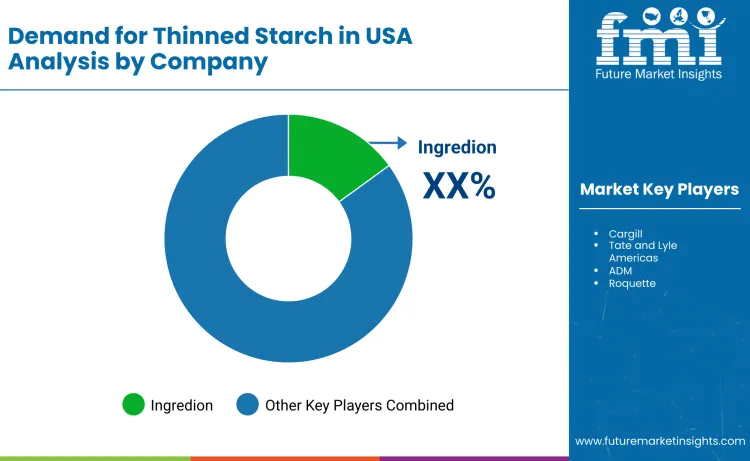
Demand for thinned starch in the USA is driven by usage across food processing, paper manufacturing, corrugated packaging, textiles, and adhesives. Applications require controlled viscosity reduction, predictable gelatinization behavior, and compatibility with high-speed processing systems. Buyers evaluate enzyme or acid thinning methods, solids consistency, moisture stability, and performance under thermal and shear conditions. Procurement teams prioritize suppliers with U.S.-based production, food and industrial grade certifications, and technical support for formulation optimization. Trend in the USA market reflects steady consumption in paper sizing and surface treatment, continued use in confectionery and bakery fillings, and growing interest in clean-label starch modifications within food applications.
Ingredion operates extensive U.S. starch manufacturing facilities supplying thinned starches for food, packaging, and industrial customers. Cargill maintains strong presence through integrated corn processing operations producing specialty and commodity thinned starches. Tate and Lyle Americas supports demand with functional starch solutions tailored for food texture control and industrial processing. ADM participates through U.S. wet milling assets supplying acid- and enzyme-thinned starches to paper, adhesive, and food sectors. Roquette America contributes specialty starch products from U.S. production sites serving food, pharmaceutical, and technical applications. Competitive positioning in the USA reflects processing scale, raw material integration, application expertise, and reliability of domestic supply supporting large-volume industrial and food-grade requirements.
Key Players in USA Thinned Starch Demand
- Ingredion
- Cargill
- Tate and Lyle Americas
- ADM
- Roquette
Scope of the Report
| Items | Values |
|---|---|
| Quantitative Units | USD million |
| Form | Dry; Liquid |
| Source | Wheat; Corn; Potato; Cassava; Sorghum |
| End Use | Food; Bakery; Confectionery; Dairy; Soups, Sauces, & Gravies |
| Regions Covered | West USA; South USA; Northeast USA; Midwest USA |
| Key Companies Profiled | Ingredion; Cargill; Tate and Lyle Americas; ADM; Roquette |
| Additional Attributes | Dollar sales by form, source, and end-use; consumption trends across processed food and bakery applications; preference shifts toward corn- and wheat-based starches; usage patterns linked to viscosity control and texture optimization; regional demand influenced by packaged food production volumes and formulation standardization practices. |
USA Thinned Starch Demand by Segments
Form:
- Dry
- Liquid
Source:
- Wheat
- Corn
- Potato
- Cassava
- Sorghum
End Use:
- Food
- Bakery
- Confectionery
- Dairy
- Soups, Sauces, & Gravies
Region:
- West USA
- South USA
- Northeast USA
- Midwest USA
Frequently Asked Questions
How big is the demand for thinned starch in USA in 2026?
The demand for thinned starch in USA is estimated to be valued at USD 427.2 million in 2026.
What will be the size of thinned starch demand in USA in 2036?
The demand size for thinned starch in USA is projected to reach USD 757.7 million by 2036.
How much will the demand for thinned starch in USA grow between 2026 and 2036?
The demand for thinned starch in USA is expected to grow at a 5.9% CAGR between 2026 and 2036.
What are the key forms in the thinned starch demand in USA?
The key forms in thinned starch demand in USA include dry thinned starch and liquid thinned starch.
Which source segment is expected to contribute a significant share in the thinned starch demand in USA in 2026?
In terms of source, wheat-based thinned starch is expected to command 38.0% share in the thinned starch demand in USA in 2026.
Preview the report firsthand - request a free sample
Get SampleGet the brochure for pricing and purchase details.
Get PDFTable of Content
- Executive Summary
- USA Market Outlook
- Demand Side Trends
- Supply Side Trends
- Food and Industrial Starch Regulatory Landscape
- Analysis and Recommendations
- Market Overview
- Market Coverage and Taxonomy
- Market Definition, Scope, and Limitations
- Market Background
- Market Dynamics
- Drivers
- Restraints
- Opportunities
- Trends
- Scenario Forecast
- Demand in Optimistic Scenario
- Demand in Likely Scenario
- Demand in Conservative Scenario
- Opportunity Map Analysis
- Product Life Cycle Analysis
- Supply Chain Analysis
- Investment Feasibility Matrix
- Value Chain Analysis
- PESTLE and Porter Analysis
- Food Ingredient and Industrial Use Regulatory Framework
- Regional Parent Market Outlook
- Production and Consumption Statistics
- Import and Export Statistics
- USA Thinned Starch Demand Analysis 2020 to 2024 and Forecast 2025 to 2035
- Historical Market Size Value (USD Million) Analysis 2020 to 2024
- Current and Future Market Size Value (USD Million) Projections 2025 to 2035
- Year-on-Year Growth Trend Analysis
- Absolute Dollar Opportunity Analysis
- USA Thinned Starch Pricing Analysis 2020 to 2024 and Forecast 2025 to 2035
- USA Thinned Starch Demand Analysis 2020 to 2024 and Forecast 2025 to 2035, By Form
- Introduction and Key Findings
- Historical Market Size Value (USD Million) Analysis by Form 2020 to 2024
- Current and Future Market Size Value (USD Million) Analysis and Forecast by Form 2025 to 2035
- Dry Thinned Starch
- Liquid Thinned Starch
- Year-on-Year Growth Trend Analysis by Form
- Absolute Dollar Opportunity Analysis by Form
- USA Thinned Starch Demand Analysis 2020 to 2024 and Forecast 2025 to 2035, By Source
- Introduction and Key Findings
- Historical Market Size Value (USD Million) Analysis by Source 2020 to 2024
- Current and Future Market Size Value (USD Million) Analysis and Forecast by Source 2025 to 2035
- Wheat
- Corn
- Potato
- Cassava
- Sorghum
- Year-on-Year Growth Trend Analysis by Source
- Absolute Dollar Opportunity Analysis by Source
- USA Thinned Starch Demand Analysis 2020 to 2024 and Forecast 2025 to 2035, By End Use
- Food
- Bakery
- Confectionery
- Dairy
- Soups, Sauces, and Gravies
- USA Thinned Starch Demand Analysis 2020 to 2024 and Forecast 2025 to 2035, By Region
- West USA
- South USA
- Northeast USA
- Midwest USA
- Market Structure Analysis
- Competition Dashboard
- Competition Benchmarking
- Market Share Analysis of Key Players
- By Form
- By Source
- By End Use
- By Region
- Competition Analysis
- Competition Deep Dive
- Ingredion
- Cargill
- Tate and Lyle Americas
- ADM
- Roquette
- Assumptions and Acronyms Used
- Research Methodology


