

- Industry Size (2026)
- USD 16.0 Bn
- Forecast (2036)
- USD 40.8 Bn
- CAGR (2026 to 2036)
- 9.8%
Forage Seeds Market Size, Market Forecast and Outlook By FMI
In 2025, the forage seeds market was valued at USD 14.6 billion. It is estimated to reach USD 16.0 billion in 2026 and USD 40.8 billion by 2036, implying a CAGR of 9.8%. That trajectory reflects a fundamental shift where forage seeds are becoming critical technology assets for climate resilience and feed efficiency, rather than simple agricultural inputs.
As per FMI's projection, the procurement landscape is shifting as farmers increasingly prioritize "climate smart" and enhanced seeds over generic varieties to secure yields against extreme weather. This specification shift is evident in the recent product strategies of major breeders, such as Germinal's launch of climate-smart grass seed mixtures in early 2025 designed to meet environmental targets while protecting forage output [7]. Buyers are now leveraging these advanced genetics to reduce reliance on external feed inputs, effectively treating high-quality forage as a cost-control mechanism for dairy and beef operations.
"We’re seeing significantly better performance with 4Most™ enhanced seed," said Susanna Sieke, Director of seed enhancements at DLF North America. [6]
Summary of Forage Seeds Market
- Forage Seeds Market Definition
- Industry covers genetic inputs for producing high-quality livestock feed, ranging from nitrogen-fixing legumes to stress-tolerant grasses.
- Demand Drivers in the Market
- Rising global demand for meat and dairy products necessitating higher feed outputs.
- Shrinking pasture land driving the need for higher-yielding seed varieties.
- Adoption of regenerative agriculture practices requiring diverse cover crop mixes.
- Key Segments Analyzed in the FMI Report
- Crop Type: Grasses (53.4% share) versus Legumes.
- Region: High-growth North America versus volume-heavy Asia Pacific.
- Technology: Enhanced/Coated seeds versus Raw seeds.
- Analyst Opinion at FMI
- Nandini Roy Choudhury, Principal Consultant for Food & Beverage, opines, "The joint venture between Corteva and Pairwise in September 2024 to accelerate gene editing signals a transformative era for forage traits. Buyers should expect a surge in nutritious, drought-resistant varieties that can stabilize feed costs in volatile climates." [8]
- Strategic Implications/Executive Takeaways
- Invest in regional breeding programs to develop locally adapted, climate-resilient varieties.
- Expand seed enhancement portfolios (coatings/inoculants) to improve stand establishment.
- Partner with dairy cooperatives to demonstrate the ROI of premium genetics on milk yield.
- Methodology
- Validated through first-hand corporate production and capacity data.
- Zero reliance on speculative third-party market research reports.
- Based on verifiable industrial benchmarks and verified sources.
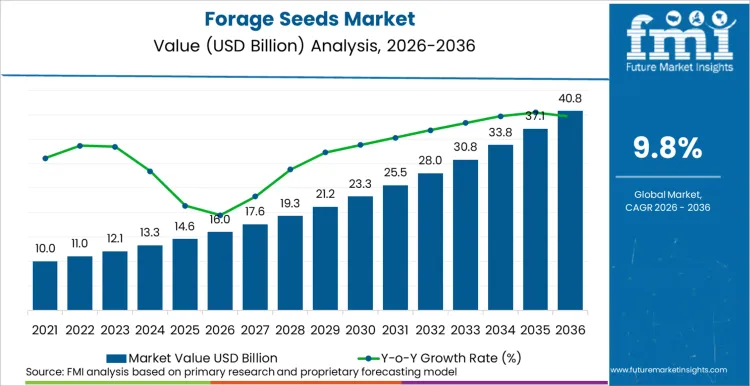
For suppliers, this feedback loop signifies that value capture is moving toward seed treatments and proprietary coatings. Future Market Insights opines that between 2026 and 2036, the market will reward players who can deliver agronomic certainty through coated technologies that improve germination rates in marginal conditions. Growth tracks a robust trajectory across the United States (26.8%), China (8.1%), the United Kingdom (7.5%), India (6.1%), and Japan (5.1%), mirroring the intense pressure to modernize livestock feed systems globally.
Forage Seeds Market Definition
The forage seeds market comprises the production, processing, and sale of plant seeds intended for growing livestock feed, including pasture, hay, and silage. These seeds cover a broad spectrum of species, primarily grasses (such as ryegrass, fescue, and timothy) and legumes (such as alfalfa, clover, and trefoil). The scope focuses on seeds certified for agricultural use, designed to optimize biomass yield, nutritional value (protein and digestibility), and persistence in various soil and climatic conditions.
Forage Seeds Market Inclusions
The report includes a comprehensive analysis of hybrid seeds and open-pollinated varieties used for grazing and mechanical harvest. It covers key technologies including seed coating, pelleting, and biological treatments that enhance establishment. The analysis extends to diverse end-use applications across dairy cattle, beef cattle, swine, and poultry sectors, tracking the adoption of specialized mixes for rotational grazing and regenerative agriculture practices.
Forage Seeds Market Exclusions
The scope excludes seeds intended for human consumption (e.g., food-grade grains or pulses) unless they are dual-purpose varieties explicitly marketed for forage. It also omits non-agricultural grass seeds used strictly for ornamental lawns, sports turf, or landscaping, focusing instead on the nutritional feed value chain. Haying and forage equipment and harvested fodder trade are also excluded from the market valuation.
Forage Seeds Market Research Methodology
- Primary Research: Interviews with seed breeders, agronomists, livestock cooperative managers, and distribution agents to verify variety performance and adoption rates.
- Desk Research: Analysis of USDA crop acreage reports, national livestock inventories, corporate R&D announcements, and variety testing lists to benchmark genetic trends.
- Market-Sizing and Forecasting: A bottom-up approach aggregating seed volume per hectare across key pasture regions, validated against top-down cattle feed market demand models.
- Data Validation and Update Cycle: Cross-referencing seed company sales data with government agricultural land use statistics to ensure accuracy in acreage and yield projections.
Segmental Analysis
Forage Seeds Market Analysis by Crop Type
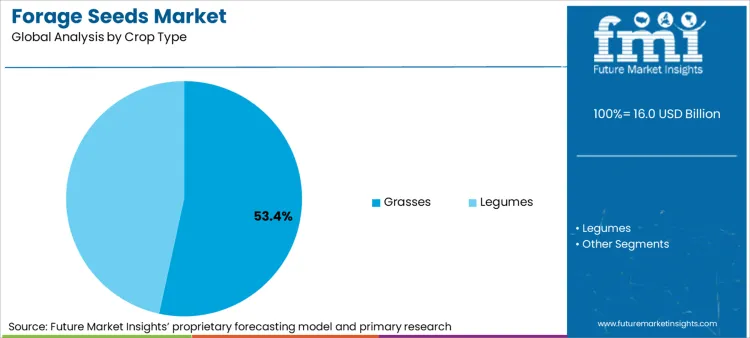
Grasses command 53.4% of the market share in 2026, serving as the caloric backbone of global livestock systems. While legumes offer protein density, grasses provide the essential fiber and biomass bulk required for rumen health and year-round grazing. FMI analysts opine that this segment is evolving through "persistence breeding," where new varieties are selected for their ability to withstand intensive grazing pressure and recover quickly after harvest.
- Yield stability: Demand is reinforced by the consistent biomass output of modern grass varieties, which is critical for maintaining the 118 million tons of hay production recorded in the US in 2023 [1].
- Climate adaptation: Adoption accelerates where breeders introduce stress-tolerant lines; for instance, Barenbrug successfully listed multiple new perennial ryegrass varieties on the German variety list in May 2024, targeting resilience in European climates [9].
- Carbon sequestration: Growth is anchored in the role of deep-rooted grasses in regenerative systems, where mixed swards are increasingly specified to improve soil health and qualify for carbon credits [7].
Forage Seeds Market Drivers, Restraints, and Opportunities
The primary driver propelling the market is the inexorable rise in global demand for animal protein. With China's total meat output reaching 96.41 million tons in 2023 and India's milk production climbing to 239.30 million tonnes in 2023-24, the pressure on the basal feed supply is intensifying [3], [4]. This necessitates a shift from extensive grazing to intensive forage management using improved seeds. Furthermore, the shrinking availability of arable land forces farmers to extract more nutrition from every hectare, making high-performance genetics a non-negotiable investment.
However, a significant restraint remains the competition for land from cash crops and urbanization. In regions like the UK, where Utilised Agricultural Area accounts for 70% of land, converting permanent grassland to arable cropping for higher short-term returns poses a threat to forage acreage [5]. Additionally, extreme weather events, such as droughts in the US Western states, can severely impact the establishment of new forage stands, creating volatility in seed demand.
- Seed Enhancement: There is a massive opportunity in seed coating technologies; DLF’s launch of 4Most™ seed enhancement in July 2024 targets improved water absorption and nutrient delivery, directly addressing establishment risks [6].
- Digital Agronomy: Companies can unlock value by integrating seed sales with data services; the Corteva and John Deere partnership in early 2024 enables precise agronomic recommendations, helping farmers optimize seeding rates and timing [8].
- Restoration Projects: The conservation sector offers a growing niche; Corteva’s partnership with the National Audubon Society restored over 7,000 acres in 2024, driving demand for native forage mixes in biodiversity projects [8].
Regional Analysis
Based on the regional analysis, the Forage Seeds Market is segmented into North America, Latin America, Europe, East Asia, South Asia, Oceania and Middle East & Africa across 40+ countries. The full report also offers market attractiveness analysis based on regional trends.
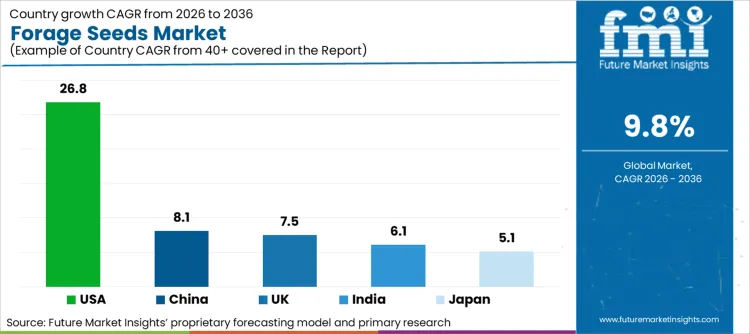
| Country | CAGR (2026 to 2036) |
|---|---|
| United States | 26.8% |
| China | 8.1% |
| United Kingdom | 7.5% |
| India | 6.1% |
| Japan | 5.1% |
Source: Future Market Insights (FMI) analysis
North America Forage Seeds Market Analysis
North America remains a high-value market driven by advanced dairy and beef production systems. The region's growth is fueled by the need to support a massive cattle inventory, 86.7 million head in the US as of early 2025, through efficient, high-yielding forage bases. As per FMI's estimates, the market is characterized by rapid adoption of technology, from alfalfa seed coatings to gene-edited traits [2].
- United States: Growth in forage seeds across the United States is estimated at 26.8% CAGR through 2036, driven by the intense need to optimize the 51.5 million acres of harvested hay land to support high-performance dairy and beef herds amidst fluctuating commodity prices [1], [2].
FMI’s report includes an in-depth analysis of North American market dynamics. Additionally, Canada presents a stable market opportunity, particularly in the lucerne market. Buyers in the region should track the pipeline of new products from companies like S&W Seed, which planned over 10 new launches in fiscal 2025, indicating a robust innovation cycle [10].
Asia Pacific Forage Seeds Market Analysis
Asia Pacific is a volume-driven market experiencing rapid modernization. The region's growth is fueled by government mandates to improve domestic milk and meat production to ensure food security. FMI analysts opine that the shift from backyard farming to commercial operations in India and China is creating a structural deficit in quality fodder, which can only be met through improved forage seeds.
- China: The market in China is poised to expand at 8.1% CAGR during 2026 to 2036 because the dairy and meat sectors, producing over 41 million tons of milk and 96 million tons of meat respectively in 2023, are aggressively professionalizing feed supply chains [3].
- India: Growth tracks a CAGR of 6.1% as the world’s largest milk producer, with output growing 3.78% YoY to 239 million tonnes, faces a critical fodder shortage, driving demand for high-yielding sorghum and alfalfa protein concentrate market inputs [4].
- Japan: The outlook for forage seeds in Japan indicates a 5.1% CAGR from 2026 to 2036 as the mature dairy sector relies on intensive pasture management and high-quality imports to maintain production efficiency [4].
FMI’s report includes a detailed growth analysis for the Asia Pacific region. Emerging markets like Australia and New Zealand represent significant opportunities due to their pasture-based export economies. Suppliers should watch for the adoption of drought-tolerant cover crop seed varieties market in these nations as climate variability challenges traditional grazing models.
Europe Forage Seeds Market Analysis
Europe is a leader in sustainable agriculture, with a strong focus on environmental stewardship and low-input systems. Demand is driven by the "Farm to Fork" strategy and national environmental land management schemes. The region's forage seed market is pivoting toward multi-species swards and nitrogen-fixing mixes that reduce chemical dependency.
- United Kingdom: Demand for forage seeds in the United Kingdom is set to grow at 7.5% CAGR through 2036, supported by the fact that permanent grassland covers 39% of agricultural land in England, creating a massive installed base for reseeding and overseeding with climate-smart varieties [5], [7].
FMI’s report includes a comprehensive assessment of the European market landscape. Markets such as Germany and France are also critical, offering opportunities in the silage additives market adjacency. A key theme to monitor is the turnover of recommended variety lists, where companies like Barenbrug are consistently placing new genetics to meet evolving climatic needs [9].
Competitive Aligners for Market Players
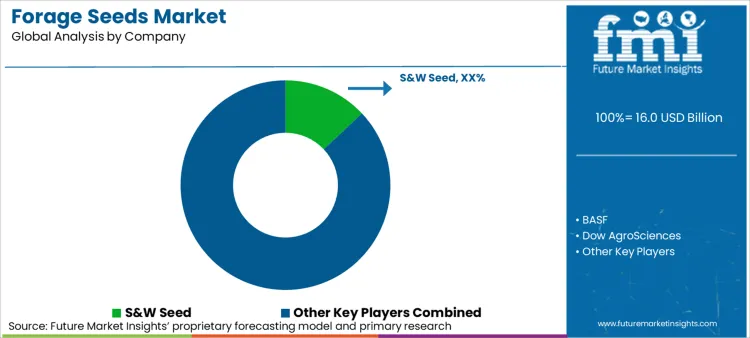
The competitive landscape is defined by the race to deliver "agronomic certainty." Major players are integrating seed genetics with biological enhancements to ensure performance. DLF’s opening of a new facility in Albany, Oregon, in August 2024, equipped with advanced seed enhancement capabilities, underscores the industry's focus on seed quality and coating technologies [6].
Partnerships are bridging the gap between genetics and management. The collaboration between Corteva and John Deere allows forage growers to access data-driven planting recommendations, moving the sales conversation from "price per bag" to "profit per acre" [8]. This integration of digital tools helps lock in customers and improve varietal performance in the field.
Innovation pipelines are robust, with a focus on climate resilience. Germinal’s launch of "climate smart" grass seeds in 2025 demonstrates how companies are aligning product portfolios with broader sustainability goals [7]. By offering seeds that support carbon sequestration or nitrogen efficiency, breeders can tap into new value pools associated with regenerative agriculture.
Recent Developments
The report includes full coverage of key trends from competitive benchmarking. Some of the recent developments covered in the reports:
- In August 2024, DLF opened a new facility in Albany, Oregon, to expand its forage and turf seed operations, enhancing its ability to serve the North American market with advanced seed technologies [6].
- In February 2025, Germinal launched a new range of "climate smart" grass seed products designed to help farmers meet environmental targets while maintaining high forage output [7].
Key Players in Forage Seeds Market
- S&W Seed
- BASF
- Dow AgroSciences
- Allied Seed
- Germinal GB
- Barenbrug Group
- DLF
- Corteva Agriscience
- Land O'Lakes
- BrettYoung
Scope of the Report
| Metric | Value |
|---|---|
| Quantitative Units | USD 16.0 billion (2026) to USD 40.8 billion (2036), at a CAGR of 9.8% |
| Market Definition | The forage seeds market comprises the production and sale of seeds for growing livestock feed, including grasses, legumes, and brassicas for pasture, hay, and silage. |
| Crop Type Segmentation | Grasses, Legumes, Others |
| Livestock Segmentation | Cattle, Poultry, Swine, Others |
| Species Segmentation | Ryegrass, Alfalfa, Clover, Fescue, Others |
| Regions Covered | North America, Latin America, Europe, East Asia, South Asia, Oceania, Middle East and Africa |
| Countries Covered | United States, China, United Kingdom, India, Japan, and 40 plus countries |
| Key Companies Profiled | S&W Seed, BASF, Germinal GB, Barenbrug, DLF, Corteva, and others |
| Forecast Period | 2026 to 2036 |
| Approach | Hybrid top down and bottom up market modeling validated through primary interviews with seed breeders and trade data benchmarking |
Forage Seeds Market Analysis by Segments
Crop Type
- Grasses
- Legumes
- Others
Livestock
- Cattle
- Poultry
- Swine
- Others
Species
- Ryegrass
- Alfalfa
- Clover
- Fescue
- Others
Region
- Asia Pacific
- India
- China
- Japan
- South Korea
- Indonesia
- Australia & New Zealand
- ASEAN
- Rest of Asia Pacific
- Europe
- Germany
- Italy
- France
- United Kingdom
- Spain
- Benelux
- Nordics
- Central & Eastern Europe
- Rest of Europe
- North America
- United States
- Canada
- Mexico
- Latin America
- Brazil
- Argentina
- Chile
- Rest of Latin America
- Middle East & Africa
- Kingdom of Saudi Arabia
- United Arab Emirates
- South Africa
- Turkey
- Rest of Middle East & Africa
Bibliography
- [1] USDA NASS. (2024). Acreage Report 2024. USDA National Agricultural Statistics Service.
- [2] USDA ERS. (2025). Livestock, Dairy, and Poultry Outlook. USDA Economic Research Service.
- [3] National Bureau of Statistics of China. (2024). Statistical Communiqué on the 2023 National Economic and Social Development. Government of China.
- [4] DAHD. (2024). Basic Animal Husbandry Statistics 2024. Government of India.
- [5] GOV.UK. (2025). Agricultural land use in England at 1 June 2025. Department for Environment, Food & Rural Affairs.
- [6] DLF. (2024). DLF opens Albany, OR facility. Corporate News.
- [7] Germinal GB. (2025). Germinal launches climate smart grass seed products. Corporate Press Release.
- [8] Corteva. (2024). Corteva and Pairwise join forces. Corporate Press Release.
- [9] Barenbrug. (2024). New Barenbrug varieties on German variety list. Corporate News.
- [10] S&W Seed Company. (2024). Annual Report 2024. SEC Filing.
This Report Addresses
- Market intelligence to enable structured strategic decision making across mature and emerging agricultural economies.
- Market size estimation and 10 year revenue forecasts from 2026 to 2036, supported by validated acreage and livestock benchmarks.
- Growth opportunity mapping across grass and legume segments with emphasis on climate-smart transitions.
- Segment and regional revenue forecasts covering cattle, poultry, and swine feed applications.
- Competition strategy assessment including partnership impact, cost survivability positioning, and breeding capability benchmarking.
- Product innovation tracking including seed enhancements, coatings, and gene-edited traits.
- Regulatory impact analysis covering variety listings, environmental schemes, and trade policies.
- Market report delivery in PDF, Excel, PPT, and interactive dashboard formats for executive and operational use.
Frequently Asked Questions
How large is the demand for Forage Seeds in the global market in 2026?
Demand for Forage Seeds in the global market is estimated to be valued at USD 16.0 billion in 2026.
What will be the market size of Forage Seeds in the global market by 2036?
Market size for Forage Seeds is projected to reach USD 40.8 billion by 2036.
What is the expected demand growth for Forage Seeds in the global market between 2026 and 2036?
Demand for Forage Seeds in the global market is expected to grow at a CAGR of 9.8% between 2026 and 2036.
Which Crop Type is poised to lead global sales by 2026?
Grasses are expected to be the dominant form, capturing approximately 53.4% of global market share in 2026 due to their essential role in providing bulk biomass for ruminants.
How significant is the role of Cattle Livestock in driving Forage Seeds adoption in 2026?
Cattle represents a critical segment, driving the majority of demand as beef and dairy operations rely heavily on high-quality pasture and silage.
What is driving demand in the United States?
Growth is driven by the massive scale of the cattle industry and the constant need to replant hay acres for high-performance feed.
What compliance standards or regulations are referenced for the United States?
USDA acreage reports and seed certification standards are referenced as key benchmarks.
What is the United States growth outlook in this report?
The United States is projected to grow at a CAGR of 26.8% during 2026 to 2036.
Why is China described as a priority region in this report?
China is prioritizing the modernization of its dairy and meat supply chains, creating a surge in demand for professional forage solutions.
What type of demand dominates in China?
Demand for high-yielding, imported forage genetics dominates regional consumption to support intensive farming.
What is India growth outlook in this report?
India is projected to expand at a CAGR of 6.1% during 2026 to 2036.
Does the report cover the United Kingdom in its regional analysis?
Yes, the United Kingdom is included within Europe under the regional scope of analysis.
What are the sources referred to for analyzing the United Kingdom?
GOV.UK land use statistics and variety listings are cited as primary reference sources.
What is the main demand theme linked to the United Kingdom in its region coverage?
Demand is linked to environmental land management and the adoption of multi-species, climate-smart swards.
Does the report cover Japan in its regional analysis?
Yes, Japan is included within Asia Pacific under the regional coverage framework
What is the main Japan related demand theme in its region coverage?
The focus is on maintaining high efficiency in a land-constrained dairy sector through premium seed genetics.
Which product formats or configurations are strategically important for North America supply chains?
Enhanced seeds with proprietary coatings that improve establishment and stress tolerance are prioritized.
What is Forage Seeds and what is it mainly used for?
Forage Seeds are seeds used to grow plants like grasses and legumes specifically for feeding livestock via grazing or harvested feed.
What does Forage Seeds Market mean in this report?
Forage Seeds Market refers to the global trade and consumption of certified seeds for agricultural pasture and fodder production.
What is included in the scope of this Forage Seeds report?
Scope covers seeds for grasses, legumes, and brassicas used in livestock feed.
What is excluded from the scope of this report?
Seeds for human food crops, ornamental turf, and non-agricultural landscaping are excluded.
What does market forecast mean on this page?
Market forecast represents a model-based projection built on defined assumptions for strategic planning purposes.
How does FMI build and validate the Forage Seeds forecast?
Forecast is developed using hybrid top-down and bottom-up modeling validated through primary interviews and agricultural land use data.
What does zero reliance on speculative third party market research mean here?
Primary interviews and verifiable public datasets are used instead of unverified syndicated market estimates.
Preview the report firsthand - request a free sample
Get SampleGet the brochure for pricing and purchase details.
Get PDFTable of Content
- Executive Summary
- Global Market Outlook
- Demand-side Trends
- Supply-side Trends
- Technology Roadmap Analysis
- Analysis and Recommendations
- Market Overview
- Market Coverage / Taxonomy
- Market Definition / Scope / Limitations
- Research Methodology
- Chapter Orientation
- Analytical Lens and Working Hypotheses
- Market Structure, Signals, and Trend Drivers
- Benchmarking and Cross-market Comparability
- Market Sizing, Forecasting, and Opportunity Mapping
- Research Design and Evidence Framework
- Desk Research Programme (Secondary Evidence)
- Company Annual and Sustainability Reports
- Peer-reviewed Journals and Academic Literature
- Corporate Websites, Product Literature, and Technical Notes
- Earnings Decks and Investor Briefings
- Statutory Filings and Regulatory Disclosures
- Technical White Papers and Standards Notes
- Trade Journals, Industry Magazines, and Analyst Briefs
- Conference Proceedings, Webinars, and Seminar Materials
- Government Statistics Portals and Public Data Releases
- Press Releases and Reputable Media Coverage
- Specialist Newsletters and Curated Briefings
- Sector Databases and Reference Repositories
- FMI Internal Proprietary Databases and Historical Market Datasets
- Subscription Datasets and Paid Sources
- Social Channels, Communities, and Digital Listening Inputs
- Additional Desk Sources
- Expert Input and Fieldwork (Primary Evidence)
- Primary Modes
- Qualitative Interviews and Expert Elicitation
- Quantitative Surveys and Structured Data Capture
- Blended Approach
- Why Primary Evidence is Used
- Field Techniques
- Interviews
- Surveys
- Focus Groups
- Observational and In-context Research
- Social and Community Interactions
- Stakeholder Universe Engaged
- C-suite Leaders
- Board Members
- Presidents and Vice Presidents
- R&D and Innovation Heads
- Technical Specialists
- Domain Subject-matter Experts
- Scientists
- Physicians and Other Healthcare Professionals
- Governance, Ethics, and Data Stewardship
- Research Ethics
- Data Integrity and Handling
- Primary Modes
- Tooling, Models, and Reference Databases
- Desk Research Programme (Secondary Evidence)
- Data Engineering and Model Build
- Data Acquisition and Ingestion
- Cleaning, Normalisation, and Verification
- Synthesis, Triangulation, and Analysis
- Quality Assurance and Audit Trail
- Market Background
- Market Dynamics
- Drivers
- Restraints
- Opportunity
- Trends
- Scenario Forecast
- Demand in Optimistic Scenario
- Demand in Likely Scenario
- Demand in Conservative Scenario
- Opportunity Map Analysis
- Product Life Cycle Analysis
- Supply Chain Analysis
- Investment Feasibility Matrix
- Value Chain Analysis
- PESTLE and Porter’s Analysis
- Regulatory Landscape
- Regional Parent Market Outlook
- Production and Consumption Statistics
- Import and Export Statistics
- Market Dynamics
- Global Market Analysis 2021 to 2025 and Forecast, 2026 to 2036
- Historical Market Size Value (USD Million) Analysis, 2021 to 2025
- Current and Future Market Size Value (USD Million) Projections, 2026 to 2036
- Y-o-Y Growth Trend Analysis
- Absolute $ Opportunity Analysis
- Global Market Pricing Analysis 2021 to 2025 and Forecast 2026 to 2036
- Global Market Analysis 2021 to 2025 and Forecast 2026 to 2036, By Crop Type
- Introduction / Key Findings
- Historical Market Size Value (USD Million) Analysis By Crop Type , 2021 to 2025
- Current and Future Market Size Value (USD Million) Analysis and Forecast By Crop Type , 2026 to 2036
- Grasses
- Legumes
- Grasses
- Y-o-Y Growth Trend Analysis By Crop Type , 2021 to 2025
- Absolute $ Opportunity Analysis By Crop Type , 2026 to 2036
- Global Market Analysis 2021 to 2025 and Forecast 2026 to 2036, By Region
- Introduction
- Historical Market Size Value (USD Million) Analysis By Region, 2021 to 2025
- Current Market Size Value (USD Million) Analysis and Forecast By Region, 2026 to 2036
- North America
- Latin America
- Western Europe
- Eastern Europe
- East Asia
- South Asia and Pacific
- Middle East & Africa
- Market Attractiveness Analysis By Region
- North America Market Analysis 2021 to 2025 and Forecast 2026 to 2036, By Country
- Historical Market Size Value (USD Million) Trend Analysis By Market Taxonomy, 2021 to 2025
- Market Size Value (USD Million) Forecast By Market Taxonomy, 2026 to 2036
- By Country
- USA
- Canada
- Mexico
- By Crop Type
- By Country
- Market Attractiveness Analysis
- By Country
- By Crop Type
- Key Takeaways
- Latin America Market Analysis 2021 to 2025 and Forecast 2026 to 2036, By Country
- Historical Market Size Value (USD Million) Trend Analysis By Market Taxonomy, 2021 to 2025
- Market Size Value (USD Million) Forecast By Market Taxonomy, 2026 to 2036
- By Country
- Brazil
- Chile
- Rest of Latin America
- By Crop Type
- By Country
- Market Attractiveness Analysis
- By Country
- By Crop Type
- Key Takeaways
- Western Europe Market Analysis 2021 to 2025 and Forecast 2026 to 2036, By Country
- Historical Market Size Value (USD Million) Trend Analysis By Market Taxonomy, 2021 to 2025
- Market Size Value (USD Million) Forecast By Market Taxonomy, 2026 to 2036
- By Country
- Germany
- UK
- Italy
- Spain
- France
- Nordic
- BENELUX
- Rest of Western Europe
- By Crop Type
- By Country
- Market Attractiveness Analysis
- By Country
- By Crop Type
- Key Takeaways
- Eastern Europe Market Analysis 2021 to 2025 and Forecast 2026 to 2036, By Country
- Historical Market Size Value (USD Million) Trend Analysis By Market Taxonomy, 2021 to 2025
- Market Size Value (USD Million) Forecast By Market Taxonomy, 2026 to 2036
- By Country
- Russia
- Poland
- Hungary
- Balkan & Baltic
- Rest of Eastern Europe
- By Crop Type
- By Country
- Market Attractiveness Analysis
- By Country
- By Crop Type
- Key Takeaways
- East Asia Market Analysis 2021 to 2025 and Forecast 2026 to 2036, By Country
- Historical Market Size Value (USD Million) Trend Analysis By Market Taxonomy, 2021 to 2025
- Market Size Value (USD Million) Forecast By Market Taxonomy, 2026 to 2036
- By Country
- China
- Japan
- South Korea
- By Crop Type
- By Country
- Market Attractiveness Analysis
- By Country
- By Crop Type
- Key Takeaways
- South Asia and Pacific Market Analysis 2021 to 2025 and Forecast 2026 to 2036, By Country
- Historical Market Size Value (USD Million) Trend Analysis By Market Taxonomy, 2021 to 2025
- Market Size Value (USD Million) Forecast By Market Taxonomy, 2026 to 2036
- By Country
- India
- ASEAN
- Australia & New Zealand
- Rest of South Asia and Pacific
- By Crop Type
- By Country
- Market Attractiveness Analysis
- By Country
- By Crop Type
- Key Takeaways
- Middle East & Africa Market Analysis 2021 to 2025 and Forecast 2026 to 2036, By Country
- Historical Market Size Value (USD Million) Trend Analysis By Market Taxonomy, 2021 to 2025
- Market Size Value (USD Million) Forecast By Market Taxonomy, 2026 to 2036
- By Country
- Kingdom of Saudi Arabia
- Other GCC Countries
- Turkiye
- South Africa
- Other African Union
- Rest of Middle East & Africa
- By Crop Type
- By Country
- Market Attractiveness Analysis
- By Country
- By Crop Type
- Key Takeaways
- Key Countries Market Analysis
- USA
- Pricing Analysis
- Market Share Analysis, 2025
- By Crop Type
- Canada
- Pricing Analysis
- Market Share Analysis, 2025
- By Crop Type
- Mexico
- Pricing Analysis
- Market Share Analysis, 2025
- By Crop Type
- Brazil
- Pricing Analysis
- Market Share Analysis, 2025
- By Crop Type
- Chile
- Pricing Analysis
- Market Share Analysis, 2025
- By Crop Type
- Germany
- Pricing Analysis
- Market Share Analysis, 2025
- By Crop Type
- UK
- Pricing Analysis
- Market Share Analysis, 2025
- By Crop Type
- Italy
- Pricing Analysis
- Market Share Analysis, 2025
- By Crop Type
- Spain
- Pricing Analysis
- Market Share Analysis, 2025
- By Crop Type
- France
- Pricing Analysis
- Market Share Analysis, 2025
- By Crop Type
- India
- Pricing Analysis
- Market Share Analysis, 2025
- By Crop Type
- ASEAN
- Pricing Analysis
- Market Share Analysis, 2025
- By Crop Type
- Australia & New Zealand
- Pricing Analysis
- Market Share Analysis, 2025
- By Crop Type
- China
- Pricing Analysis
- Market Share Analysis, 2025
- By Crop Type
- Japan
- Pricing Analysis
- Market Share Analysis, 2025
- By Crop Type
- South Korea
- Pricing Analysis
- Market Share Analysis, 2025
- By Crop Type
- Russia
- Pricing Analysis
- Market Share Analysis, 2025
- By Crop Type
- Poland
- Pricing Analysis
- Market Share Analysis, 2025
- By Crop Type
- Hungary
- Pricing Analysis
- Market Share Analysis, 2025
- By Crop Type
- Kingdom of Saudi Arabia
- Pricing Analysis
- Market Share Analysis, 2025
- By Crop Type
- Turkiye
- Pricing Analysis
- Market Share Analysis, 2025
- By Crop Type
- South Africa
- Pricing Analysis
- Market Share Analysis, 2025
- By Crop Type
- USA
- Market Structure Analysis
- Competition Dashboard
- Competition Benchmarking
- Market Share Analysis of Top Players
- By Regional
- By Crop Type
- Competition Analysis
- Competition Deep Dive
- S&W Seed
- Overview
- Product Portfolio
- Profitability by Market Segments (Product/Age /Sales Channel/Region)
- Sales Footprint
- Strategy Overview
- Marketing Strategy
- Product Strategy
- Channel Strategy
- BASF
- Dow AgroSciences
- Allied Seed
- Germinal GB
- Barenbrug Group
- DLF
- Corteva Agriscience
- S&W Seed
- Competition Deep Dive
- Assumptions & Acronyms Used


