


Pharmaceutical Solvents Market
Pharmaceutical Solvents Market Analysis and Forecast 2026-2036
Pharmaceutical Solvents Market Forecast and Outlook 2026 to 2036
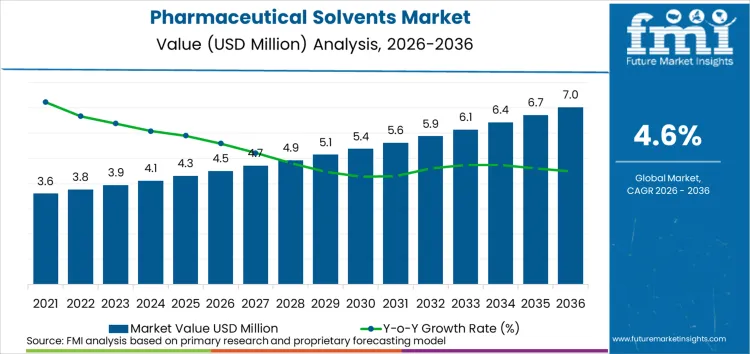
Future Market Insights anticipates the global pharmaceutical solvents market to nearly double its incremental opportunity over the next decade, expanding from roughly USD 4.5 billion in 2026 to more than USD 7 billion by 2036 at a steady 4.6% CAGR. This sustained growth is driven by the rise of complex biologics and injectable therapeutics that require ultra-high-purity solvent systems for stability, sterility, and regulatory compliance, according to FMI’s analysis. Shifting pharmaceutical supply chains, especially the acceleration of contract manufacturing and API exports from China and India,are creating volumetric demand spikes for precision solvent formulations optimized for continuous manufacturing and closed-loop recovery.
FMI highlights green chemistry transitions as a defining transformation. Formulators are embracing biodegradable, low-VOC and bio-derived solvents to meet tightening emissions standards and ESG targets. The market highlights a growing preference for solvent portfolios that balance performance with environmental compliance, particularly in Europe and North America. Regulatory compliance across pharmacopeias and residual solvent limits under ICH guidelines is further shaping procurement strategies and supplier innovation pipelines.
Recent developments from leading industry players underscore these shifts. In July 2024, BASF SE secured ISCC+ certification to supply over 60 sustainable solvent variants, strengthening its competitiveness in eco-aligned pharmaceutical production.
Future Market Insights highlights that leading solvent manufacturers are aligning innovation roadmaps with the rising complexity of biopharmaceutical manufacturing, particularly for biologics and advanced therapies. Strategic investments in GMP-compliant infrastructure and application-focused solvent development are increasingly shaping supplier differentiation. Reflecting this shift, Marion Kuhn, Vice President of Business Management, BASF Pharma Solutions, stated: “Our new GMP Solution Center exemplifies BASF’s dedication to understanding and addressing the evolving needs of our customers in both the biopharma and pharmaceutical industries.
This state-of-the-art facility will play a fundamental role in enabling us to collaborate closely with our customers worldwide on product development and GMP manufacturing in ways that are unique to the industry, further strengthening our position as an innovator in the pharmaceutical sector.” This statement supports FMI’s view that solvent innovation is no longer limited to purity enhancement alone but extends to process compatibility, regulatory readiness, and customer-specific application support. Such investments enable solvent suppliers to move upstream in the pharmaceutical value chain, supporting complex formulation and biologics manufacturing requirements. FMI expects these capability-driven strategies to intensify competitive differentiation and accelerate adoption of high-value pharmaceutical-grade solvent systems through 2036.
Summary of Pharmaceutical Solvents Market
What Is Growth Outlook for Pharmaceutical Solvents Market as per Future Market Insights Projection?
Future Market Insights projects the Pharmaceutical Solvents industry to expand at a CAGR of 4.6% from 2026 to 2036, increasing from USD 4.5 Billion in 2026 to USD 7 Billion by 2036.
FMI Research Approach: Historical market size, solvent type adoption curves, API manufacturing growth rates, and biologics pipeline metrics to model demand scenarios through 2036 with sensitivity to regulatory shifts.
How Do FMI Analysts Perceive Pharmaceutical Solvents Market to Evolve?
Future Market Insights analysts note that pharmaceutical solvent demand is increasingly driven by cell and gene therapies, where higher purity and biocompatibility standards apply than in conventional drug manufacturing.
FMI Research Approach: Analyze the influence of ICH Q3C and VOC emission rules on solvent selection, compliance costs, and substitution with low-residual/green solvents in major pharmaceutical markets.
Which Country Holds Largest Share in Global Pharmaceutical Solvents Market?
Future Market Insights notes that the USA pharmaceutical solvents market is growing due to strong biologics pipelines, expanding generic production, and regulatory emphasis on high-purity solvents, with rising biopharmaceutical R&D and injectable drug manufacturing supporting demand for premium solvent systems.
FMI Research Approach: Gathered country-level data on pharmaceutical production output, R&D spend, biologics capacity, import/export of solvents, regulatory frameworks, and regional supply chain dynamics.
How Large Will Pharmaceutical Solvents Market Be by 2036?
The global pharmaceutical solvents market is projected to reach USD 7 Billion by 2036.
FMI Research Approach: Calculated solvent demand in the largest solvent type (e.g., alcohols) by modelling end-use volumes across API synthesis, formulation, and quality control segments with weighted consumption factors.
How are Regulatory Tailwinds Fueling Pharmaceutical Solvent Adoption?
According to Future Market Insights analysts, tightening global regulatory environments,including updated ICH residual solvent guidelines and VOC control frameworks in Europe and North America, are accelerating demand for pharmaceutical solvents that offer lower toxicity and environmental impact.
FMI Research Approach: Incorporated emerging trends including green chemistry adoption, continuous manufacturing, regional API reshoring into econometric models to refine demand forecasts for specialty solvents.
Pharmaceutical Solvents Market Key Takeaways
| Metric | Details |
|---|---|
| Industry Size (2026) | USD 4.5 Billion |
| Industry Value (2036) | USD 7 Billion |
| CAGR (2026-2036) | 4.6% |
Source: Future Market Insights (FMI) analysis, based on proprietary forecasting model and primary research
Why is the Demand for Pharmaceutical Solvents Growing?
Future Market Insights analysts perceive the pharmaceutical solvents market evolving toward specialized, sustainable, and digitally optimized solvent ecosystems. Analysts highlight transitions from traditional petrochemical grades to bio-derived, low-VOC, and regulatory-aligned solvents tailored for biologics, gene therapies, and continuous manufacturing platforms. Examples include solvent portfolios engineered specifically for mRNA stabilization and closed-loop recycling systems embedded within API plants. Demand for high-purity alcohols and engineered esters is rising faster than commodity grades, while solvent selection algorithms are being integrated into drug formulation workflows to balance performance with environmental compliance.
How is the Pharmaceutical Solvents Market Segmented?
The market for Pharmaceutical Solvents is segmented into Solvent Type (alcohols, esters, ethers, ketones, aromatic hydrocarbons, and aliphatic hydrocarbons), and Application (Active Pharmaceutical Ingredients Synthesis, Excipients Manufacturing, Formulation Development, And Analytical Testing)
How Do Alcohol Solvents Secure Market Leadership?
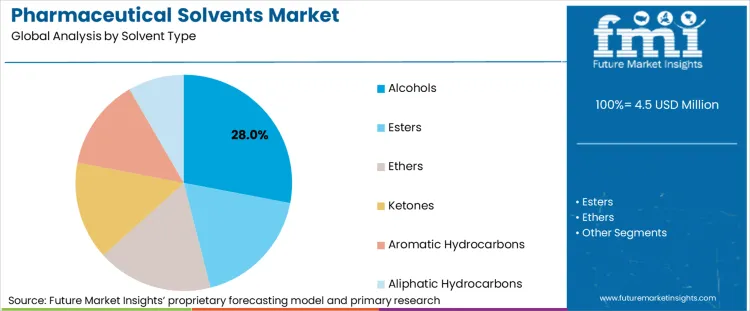
According to Future Market Insights, alcohol solvents lead the global pharmaceutical solvents market due to their broad applicability across critical manufacturing stages. With an estimated 28% share of industry revenue, ethanol and isopropanol are indispensable in API synthesis, sterile filtration, extraction, and formulation operations. Their regulatory acceptance, favorable solvency attributes, and compatibility with diverse drug chemistries make them preferred solvent systems worldwide. Alcohols’ dominance is further reinforced by robust demand in high-purity biologics, where stringent residual limits and sterilization demands favor these solvent types. They also support cleaner processing in continuous manufacturing and are integral to solvent recovery initiatives. Emerging quality standards and sustainability trends are driving incremental shifts toward advanced alcohol-based solvent portfolios.
How Does API Synthesis Lead Pharmaceutical Solvent Demand?
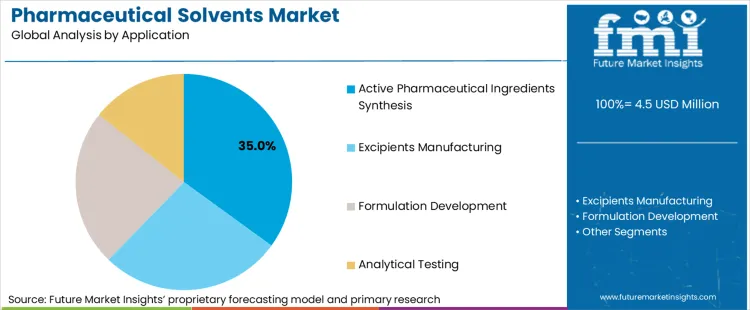
Future Market Insights identifies active pharmaceutical ingredient (API) synthesis as the largest application segment, accounting for 35% of global solvent consumption. Solvents are fundamental to reaction media, extraction, crystallization, and purification steps in API manufacture, requiring high volumes of specialized solvents with precise purity specifications to yield high-quality intermediates. This segment’s leadership is fueled by the growth of complex small molecules, off-patent generics, and biopharmaceutical intermediates that demand robust solvent performance and traceability.
API plants increasingly adopt continuous processing and closed-loop solvent recovery systems to enhance yield and reduce environmental footprint. As global pharmaceutical production scales, API synthesis remains a solvent-intensive process, sustaining its dominant share in overall market demand.
How Are Regulatory Frameworks Influencing Safer Solvent Selection?
Industry evolution is being shaped by a shift beyond conventional performance benchmarks toward solvent systems with lower hazard profiles and reduced VOC emissions. Regulatory scrutiny around residual solvent limits and emissions control is intensifying, while corporate ESG mandates are guiding procurement and formulation decisions. Innovation focus has moved toward bio derived and biodegradable solvent classes that reduce reliance on high toxicity petrochemical options. Investment momentum is being seen in low PCF solvent variants that meet functional requirements while supporting compliance objectives. As a result, legacy processes are being reworked, and premium solvent systems are being adopted to align with tightening regulatory expectations and internal risk management priorities.
Why Is Continuous Manufacturing Reshaping Solvent Demand Patterns?
The transition toward continuous pharmaceutical manufacturing is altering solvent requirements across API synthesis and formulation workflows. Continuous processing environments require solvent systems that deliver consistent purity, support closed loop recycling, and integrate smoothly with purification and recovery technologies. Solvent compatibility with distillation, membrane separation, and adsorption systems has become a key selection factor. These needs are driving demand for specialized purification solvents and recovery catalysts that lower material loss and processing cost. Waste reduction and operational efficiency are being prioritized, positioning solvents as integral components of end to end process optimization strategies.
How Are Digital Tools and Advanced Solvents Driving Innovation?
Emerging digital platforms based on machine learning are transforming solvent selection by reducing trial based experimentation and shortening formulation cycles. Predictive solubility models are being combined with regulatory and environmental screening, enabling agile and compliance oriented solvent portfolios. These tools are especially valuable in early stage biologic and gene therapy development, where solvent interactions affect stability and yield. At the same time, innovation in functional solvent classes such as ionic liquids and supercritical fluids is enabling new reaction pathways and separation techniques, improving selectivity and yields in complex pharmaceutical syntheses.
How Will Pharmaceutical Solvents Market Expansion Unfold Across Key Global Regions?
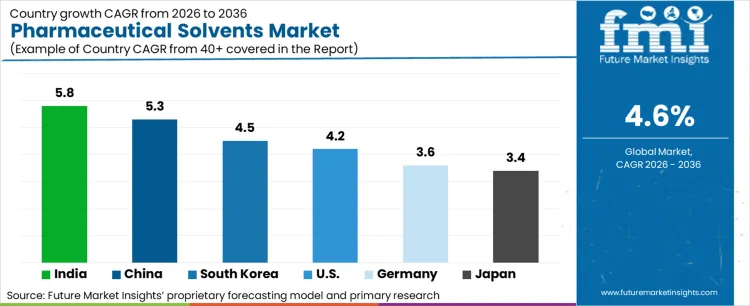
Future Market Insights identifies the United States (CAGR ~4.2%), China (~5.3%), India (~5.8%), Germany (~3.6%), Japan (~3.4%), and South Korea (~4.5%) as the six core demand drivers. The US leads through biologics and injectable drug manufacturing. China and India dominate due to API export intensity and contract manufacturing scale. Germany anchors high-purity solvent demand for regulated European pharma production. Japan’s demand is driven by specialty formulations and aging-population therapeutics. South Korea’s rapid biologics expansion fuels high-grade solvent consumption. FMI emphasizes that each country combines regulatory rigor with manufacturing scale, creating structurally resilient solvent demand through 2036.
| Country | CAGR (2026-2036) |
|---|---|
| India | 5.8% |
| China | 5.3% |
| South Korea | 4.5% |
| US | 4.2% |
| Germany | 3.6% |
| Japan | 3.4% |
Source: Future Market Insights (FMI) analysis, based on proprietary forecasting model and primary research
Is Biologics Manufacturing Redefining Pharmaceutical Solvent Demand in the United States?
Future Market Insights analysts note that the USA pharmaceutical solvents market is expected to grow at a 4.2% CAGR, driven primarily by biologics, sterile injectables, and advanced therapy production. Unlike conventional small-molecule drugs, biologics demand ultra-high-purity alcohols and specialty solvents for buffer preparation, chromatography, and aseptic processing. FMI highlights that domestic biologics capacity expansion,supported by reshoring initiatives and FDA-backed supply security measures,is increasing solvent usage intensity per batch. Continuous manufacturing adoption further raises solvent circulation volumes rather than reducing absolute consumption. Additionally, regulatory pressure to replace chlorinated solvents with safer alcohols and esters is structurally sustaining solvent demand growth.
How Is China’s API Export Orientation Accelerating Pharmaceutical Solvent Consumption?
According to Future Market Insights, China’s pharmaceutical solvents market is projected to expand at a 5.3% CAGR, underpinned by its dominance in global API exports. Multi-step chemical synthesis, crystallization, and purification processes remain solvent-intensive, particularly for antibiotics and chronic disease APIs. FMI analysts observe that China’s transition toward GMP-compliant, export-grade API facilities is shifting demand from industrial solvents to pharmacopeia-grade alcohols and ketones. Environmental regulations at provincial levels are also forcing manufacturers to upgrade solvent recovery systems, which increases solvent throughput volumes.
Why Is India Emerging as the Fastest-Growing Pharmaceutical Solvent Market?
Future Market Insights identifies India as the fastest-growing pharmaceutical solvents market, with an estimated 5.8% CAGR, driven by rapid expansion of API and CDMO operations. Indian manufacturers are increasingly producing complex molecules and high-potency APIs for regulated markets, significantly increasing solvent usage per production cycle. FMI highlights that solvent demand growth is amplified by stricter compliance with ICH Q3C guidelines, prompting a shift toward higher-purity alcohols and esters. The integration of solvent recovery units within bulk drug parks increases solvent circulation frequency, sustaining repeat demand. Government incentives for domestic API production further reinforce India’s long-term solvent consumption trajectory.
Does Germany’s Regulatory Rigor Sustain High-Value Solvent Demand?
FMI analysts project Germany’s pharmaceutical solvents market to grow at a 3.6% CAGR, supported by regulatory-driven demand rather than volume-led expansion. German pharmaceutical manufacturers consistently upgrade solvent systems to comply with European Pharmacopoeia standards and occupational safety regulations. FMI notes frequent solvent replacement cycles as companies phase out legacy solvents in favor of low-toxicity alcohols and specialty esters. Germany’s strength in specialty pharmaceuticals, injectables, and contract manufacturing ensures steady demand for premium solvent grades. Sustainability reporting mandates are accelerating adoption of bio-based solvents, further elevating the value per unit of solvent consumed.
How Does Japan’s Specialty Drug Focus Influence Solvent Usage Patterns?
According to Future Market Insights, Japan’s pharmaceutical solvents market is expected to expand at a 3.4% CAGR, shaped by its emphasis on specialty drugs, oncology therapies, and aging-population treatments. These products require solvents with extremely tight impurity thresholds, especially during formulation and finishing stages. FMI analysts emphasize that Japanese manufacturers prioritize solvent consistency, traceability, and long-term supplier reliability over cost optimization. Reformulation of legacy drugs to improve bioavailability is another solvent-intensive activity sustaining demand. Japan’s conservative regulatory approach also limits rapid solvent substitution, ensuring stable, long-term consumption of approved high-purity solvent classes.
Is South Korea’s Biologics Boom Creating a New Solvent Demand Paradigm?
Future Market Insights projects South Korea’s pharmaceutical solvents market to grow at a 4.5% CAGR, driven by aggressive expansion in biologics and biosimilar manufacturing. Large-scale biologics facilities consume pharmaceutical-grade alcohols and specialty solvents for buffer preparation, purification, and equipment sterilization. FMI analysts note that solvent demand growth is driven more by process complexity than production volume. South Korea’s export-oriented biologics sector adheres to FDA and EMA standards, necessitating consistent use of premium solvent grades. Investments in monoclonal antibodies and next-generation biologics are expected to further increase solvent intensity per batch through 2036.
What Strategic Moves Are Defining Competitive Landscape?
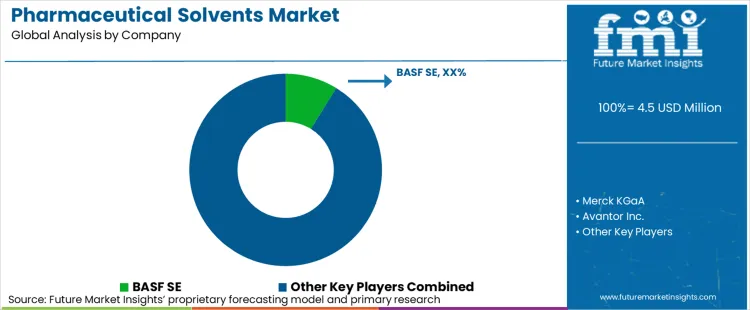
Future Market Insights analysts observe that competition in the pharmaceutical solvents market is increasingly defined by specialization, compliance readiness, and application-specific innovation, rather than sheer production scale. Leading manufacturers are expanding pharmacopeia-grade solvent capacities near pharmaceutical manufacturing hubs to reduce lead times and ensure regulatory traceability, particularly for alcohols and specialty esters used in injectables and biologics.
Another defining move is the integration of solvent recovery and purification technologies directly into customer production workflows. Companies such as Avantor and Merck KGaA are positioning themselves not just as solvent suppliers but as process partners, offering closed-loop solvent systems that improve yield consistency while meeting ICH Q3C residual solvent limits. This strategy strengthens long-term supply contracts and raises switching costs for customers.
FMI also highlights a growing focus on bio-based and low-VOC solvent portfolios, with players like BASF and Ashland investing in certified sustainable solvent lines to align with pharma ESG mandates. Strategic acquisitions targeting niche purification technologies and high-purity distillation capabilities are further reshaping the landscape. Collectively, these moves are shifting competition toward value-added solvent ecosystems, favoring innovation-led players over commodity suppliers through 2036.
Recent Developments:
- In June 2025, BASF opened its new Good Manufacturing Practice (GMP) Solution Center in Wyandotte, Michigan, enhancing production capabilities and enabling closer collaboration on biopharma and pharmaceutical ingredient chemistries.
- In March 2025, Avantor showcased its recently completed hydration solutions capacity expansion that significantly increases manufacturing/formulation output of USP purified water and high-purity solutions, supporting biologics and buffer applications.
- In June 2024, Merck KGaA expanded operations with a €62 million quality control facility in Darmstadt to enhance analytical support for life science manufacturing and ensure high product purity.
- In November 2025, BASF expanded its Asia Pacific footprint with a new Alkyl Polyglucosides (APGs) plant at Bangpakong, Thailand, strengthening sustainable chemical supply chains across industries.
Key Players in Pharmaceutical Solvents Market
- BASF SE
- Merck KGaA
- Avantor Inc.
- Thermo Fisher Scientific
- Ashland Global Holdings
- Dow Inc.
- LyondellBasell Industries
- Arkema S.A.
- Eastman Chemical Company
- Evonik Industries
Market Definition
The pharmaceutical solvents market refers to the global industry involved in the production, supply, and consumption of chemical solvents used across pharmaceutical manufacturing processes. These solvents play a critical role in active pharmaceutical ingredient (API) synthesis, formulation, crystallization, purification, extraction, granulation, coating, sterilization, and cleaning operations. The market includes both organic and inorganic solvents that meet recognized pharmacopeial and regulatory standards such as USP, EP, JP, and ICH guidelines, ensuring suitability for use in regulated drug manufacturing environments. Key solvent categories encompassed within the market include alcohols, hydrocarbons, ketones, esters, ethers, chlorinated solvents, and specialty solvent systems, provided in pharmaceutical-grade or higher purity forms.
The market excludes industrial-grade solvents not compliant with pharmaceutical regulations, laboratory reagents used solely for research-scale experiments, solvents utilized exclusively in medical devices, diagnostics, cosmetics, or agrochemicals, and chemicals employed only as intermediates without direct solvent functionality in pharmaceutical processes.
Scope of Report
| Items | Values |
|---|---|
| Quantitative Units (2026) | USD 4.5 Billion |
| Solvent Type | Alcohols, Esters, Ethers, Ketones, Aromatic Hydrocarbons, and Aliphatic Hydrocarbons |
| Application | Active Pharmaceutical Ingredients Synthesis, Excipients Manufacturing, Formulation Development, and Analytical Testing |
| Regions Covered | North America, Europe, Asia Pacific, Latin America, Middle East & Africa |
| Countries Covered | USA, Germany, China, Japan, India, South Korea, and 40+ countries |
| Key Companies Profiled | BASF SE, Merck KGaA, Avantor Inc., Thermo Fisher Scientific, Ashland Global Holdings, Dow Inc., LyondellBasell Industries, Arkema S.A., Eastman Chemical Company, and Evonik Industries |
| Additional Attributes | Revenue analysis by solvent type, application, regulatory landscape assessment, competitive market share analysis, and supplier positioning |
Pharmaceutical Solvents Market by Segments
By Solvent Type:
- Alcohols
- Esters
- Ethers
- Ketones
- Aromatic Hydrocarbons
- Aliphatic Hydrocarbons
By Application:
- Active Pharmaceutical Ingredients Synthesis
- Excipients Manufacturing
- Formulation Development
- Analytical Testing
By Region:
- North America
- Europe
- East Asia
- South Asia
- Latin America
- Middle East & Africa
Bibliography
- International Council for Harmonisation. (2024). ICH Q3C: Impurities-Residual Solvents. ICH.
- World Health Organization. (2024). WHO Technical Report Series: Pharmaceutical Quality. WHO.
- USA Food and Drug Administration. (2024). Guidance for Industry: Residual Solvents. FDA.
- European Medicines Agency. (2024). Quality Guidelines for Human Medicines. EMA.
- Organisation for Economic Co-operation and Development. (2024). Chemical Safety and Sustainability Outlook. OECD.
- United States Pharmacopeia. (2024). USP-NF General Chapters. USP.
- European Pharmacopoeia Commission. (2024). European Pharmacopoeia. EDQM.
- Ministry of Chemicals and Fertilizers, India. (2024). Bulk Drug Industry Report. Government of India.
- China National Medical Products Administration. (2024). Pharmaceutical Manufacturing Guidelines. NMPA.
- Japan Pharmaceuticals and Medical Devices Agency. (2024). Quality Compliance Framework. PMDA.
Frequently Asked Questions
What is the current global market size for Pharmaceutical Solvents?
The global market is valued at USD 4.5 Billion in 2026, driven by intersection of biologics complexity and regulatory rigor.
What is the projected CAGR for the market over the next 10 years?
The market is projected to grow at a robust 4.6% CAGR from 2026 to 2036.
Which regions are experiencing the fastest expansion?
India leads with 5.8% growth, followed closely by China at 5.3% due to transition toward GMP-compliant, export-grade API facilities.
What are the primary market drivers?
Rising biologics production, API outsourcing, regulatory solvent replacement, and continuous manufacturing adoption collectively drive pharmaceutical solvent demand.
Who are the leading suppliers in the industry?
BASF SE, Merck KGaA, Avantor Inc., and Thermo Fisher Scientific are key players, differentiating through their strengthened solvent purification capabilities and solvent recycling integration.
Table of Content
- Global Market Outlook
- Demand to side Trends
- Supply to side Trends
- Technology Roadmap Analysis
- Market Coverage / Taxonomy
- Market Definition / Scope / Limitations
- Research Methodology
- Chapter Orientation
- Analytical Lens and Working Hypotheses
- Market Structure, Signals, and Trend Drivers
- Benchmarking and Cross-market Comparability
- Market Sizing, Forecasting, and Opportunity Mapping
- Research Design and Evidence Framework
- Desk Research Programme (Secondary Evidence)
- Company Annual and Sustainability Reports
- Peer-reviewed Journals and Academic Literature
- Corporate Websites, Product Literature, and Technical Notes
- Earnings Decks and Investor Briefings
- Statutory Filings and Regulatory Disclosures
- Technical White Papers and Standards Notes
- Trade Journals, Industry Magazines, and Analyst Briefs
- Expert Input and Fieldwork (Primary Evidence)
- Primary Modes
- Qualitative Interviews and Expert Elicitation
- Quantitative Surveys and Structured Data Capture
- Blended Approach
- Why Primary Evidence is Used
- Field Techniques
- Interviews
- Surveys
- Focus Groups
- Observational and In-context Research
- Social and Community Interactions
- Stakeholder Universe Engaged
- C-suite Leaders
- Board Members
- Presidents and Vice Presidents
- R&D and Innovation Heads
- Technical Specialists
- Domain Subject-matter Experts
- Scientists
- Physicians and Other Healthcare Professionals
- Governance, Ethics, and Data Stewardship
- Research Ethics
- Data Integrity and Handling
- Primary Modes
- Tooling, Models, and Reference Databases
- Data Engineering and Model Build
- Data Acquisition and Ingestion
- Cleaning, Normalisation, and Verification
- Synthesis, Triangulation, and Analysis
- Quality Assurance and Audit Trail
- Desk Research Programme (Secondary Evidence)
- Market Background
- Market Dynamics
- Drivers
- Restraints
- Opportunity
- Trends
- Scenario Forecast
- Demand in Optimistic Scenario
- Demand in Likely Scenario
- Demand in Conservative Scenario
- Opportunity Map Analysis
- Product Life Cycle Analysis
- Supply Chain Analysis
- Investment Feasibility Matrix
- Value Chain Analysis
- PESTLE and Porter’s Analysis
- Regulatory Landscape
- Regional Parent Market Outlook
- Production and Consumption Statistics
- Import and Export Statistics
- Market Dynamics
- Global Market Analysis 2021 to 2025 and Forecast, 2026 to 2036
- Historical Market Size Value (USD Million) Analysis, 2021 to 2025
- Current and Future Market Size Value (USD Million) Projections, 2026 to 2036
- Y to o to Y Growth Trend Analysis
- Absolute $ Opportunity Analysis
- Global Market Pricing Analysis 2021 to 2025 and Forecast 2026 to 2036
- Global Market Analysis 2021 to 2025 and Forecast 2026 to 2036, By Solvent Type
- Introduction / Key Findings
- Historical Market Size Value (USD Million) Analysis By Solvent Type , 2021 to 2025
- Current and Future Market Size Value (USD Million) Analysis and Forecast By Solvent Type , 2026 to 2036
- Alcohols
- Esters
- Ethers
- Ketones
- Aromatic Hydrocarbons
- Aliphatic Hydrocarbons
- Y to o to Y Growth Trend Analysis By Solvent Type , 2021 to 2025
- Absolute $ Opportunity Analysis By Solvent Type , 2026 to 2036
- Global Market Analysis 2021 to 2025 and Forecast 2026 to 2036, By Application
- Introduction / Key Findings
- Historical Market Size Value (USD Million) Analysis By Application, 2021 to 2025
- Current and Future Market Size Value (USD Million) Analysis and Forecast By Application, 2026 to 2036
- Active Pharmaceutical Ingredients Synthesis
- Excipients Manufacturing
- Formulation Development
- Analytical Testing
- Y to o to Y Growth Trend Analysis By Application, 2021 to 2025
- Absolute $ Opportunity Analysis By Application, 2026 to 2036
- Global Market Analysis 2021 to 2025 and Forecast 2026 to 2036, By Region
- Introduction
- Historical Market Size Value (USD Million) Analysis By Region, 2021 to 2025
- Current Market Size Value (USD Million) Analysis and Forecast By Region, 2026 to 2036
- North America
- Latin America
- Western Europe
- Eastern Europe
- East Asia
- South Asia and Pacific
- Middle East & Africa
- Market Attractiveness Analysis By Region
- North America Market Analysis 2021 to 2025 and Forecast 2026 to 2036, By Country
- Historical Market Size Value (USD Million) Trend Analysis By Market Taxonomy, 2021 to 2025
- Market Size Value (USD Million) Forecast By Market Taxonomy, 2026 to 2036
- By Country
- USA
- Canada
- Mexico
- By Solvent Type
- By Application
- By Country
- Market Attractiveness Analysis
- By Country
- By Solvent Type
- By Application
- Key Takeaways
- Latin America Market Analysis 2021 to 2025 and Forecast 2026 to 2036, By Country
- Historical Market Size Value (USD Million) Trend Analysis By Market Taxonomy, 2021 to 2025
- Market Size Value (USD Million) Forecast By Market Taxonomy, 2026 to 2036
- By Country
- Brazil
- Chile
- Rest of Latin America
- By Solvent Type
- By Application
- By Country
- Market Attractiveness Analysis
- By Country
- By Solvent Type
- By Application
- Key Takeaways
- Western Europe Market Analysis 2021 to 2025 and Forecast 2026 to 2036, By Country
- Historical Market Size Value (USD Million) Trend Analysis By Market Taxonomy, 2021 to 2025
- Market Size Value (USD Million) Forecast By Market Taxonomy, 2026 to 2036
- By Country
- Germany
- UK
- Italy
- Spain
- France
- Nordic
- BENELUX
- Rest of Western Europe
- By Solvent Type
- By Application
- By Country
- Market Attractiveness Analysis
- By Country
- By Solvent Type
- By Application
- Key Takeaways
- Eastern Europe Market Analysis 2021 to 2025 and Forecast 2026 to 2036, By Country
- Historical Market Size Value (USD Million) Trend Analysis By Market Taxonomy, 2021 to 2025
- Market Size Value (USD Million) Forecast By Market Taxonomy, 2026 to 2036
- By Country
- Russia
- Poland
- Hungary
- Balkan & Baltic
- Rest of Eastern Europe
- By Solvent Type
- By Application
- By Country
- Market Attractiveness Analysis
- By Country
- By Solvent Type
- By Application
- Key Takeaways
- East Asia Market Analysis 2021 to 2025 and Forecast 2026 to 2036, By Country
- Historical Market Size Value (USD Million) Trend Analysis By Market Taxonomy, 2021 to 2025
- Market Size Value (USD Million) Forecast By Market Taxonomy, 2026 to 2036
- By Country
- China
- Japan
- South Korea
- By Solvent Type
- By Application
- By Country
- Market Attractiveness Analysis
- By Country
- By Solvent Type
- By Application
- Key Takeaways
- South Asia and Pacific Market Analysis 2021 to 2025 and Forecast 2026 to 2036, By Country
- Historical Market Size Value (USD Million) Trend Analysis By Market Taxonomy, 2021 to 2025
- Market Size Value (USD Million) Forecast By Market Taxonomy, 2026 to 2036
- By Country
- India
- ASEAN
- Australia & New Zealand
- Rest of South Asia and Pacific
- By Solvent Type
- By Application
- By Country
- Market Attractiveness Analysis
- By Country
- By Solvent Type
- By Application
- Key Takeaways
- Middle East & Africa Market Analysis 2021 to 2025 and Forecast 2026 to 2036, By Country
- Historical Market Size Value (USD Million) Trend Analysis By Market Taxonomy, 2021 to 2025
- Market Size Value (USD Million) Forecast By Market Taxonomy, 2026 to 2036
- By Country
- Kingdom of Saudi Arabia
- Other GCC Countries
- Turkiye
- South Africa
- Other African Union
- Rest of Middle East & Africa
- By Solvent Type
- By Application
- By Country
- Market Attractiveness Analysis
- By Country
- By Solvent Type
- By Application
- Key Takeaways
- Key Countries Market Analysis
- USA
- Pricing Analysis
- Market Share Analysis, 2025
- By Solvent Type
- By Application
- Canada
- Pricing Analysis
- Market Share Analysis, 2025
- By Solvent Type
- By Application
- Mexico
- Pricing Analysis
- Market Share Analysis, 2025
- By Solvent Type
- By Application
- Brazil
- Pricing Analysis
- Market Share Analysis, 2025
- By Solvent Type
- By Application
- Chile
- Pricing Analysis
- Market Share Analysis, 2025
- By Solvent Type
- By Application
- Germany
- Pricing Analysis
- Market Share Analysis, 2025
- By Solvent Type
- By Application
- UK
- Pricing Analysis
- Market Share Analysis, 2025
- By Solvent Type
- By Application
- Italy
- Pricing Analysis
- Market Share Analysis, 2025
- By Solvent Type
- By Application
- Spain
- Pricing Analysis
- Market Share Analysis, 2025
- By Solvent Type
- By Application
- France
- Pricing Analysis
- Market Share Analysis, 2025
- By Solvent Type
- By Application
- India
- Pricing Analysis
- Market Share Analysis, 2025
- By Solvent Type
- By Application
- ASEAN
- Pricing Analysis
- Market Share Analysis, 2025
- By Solvent Type
- By Application
- Australia & New Zealand
- Pricing Analysis
- Market Share Analysis, 2025
- By Solvent Type
- By Application
- China
- Pricing Analysis
- Market Share Analysis, 2025
- By Solvent Type
- By Application
- Japan
- Pricing Analysis
- Market Share Analysis, 2025
- By Solvent Type
- By Application
- South Korea
- Pricing Analysis
- Market Share Analysis, 2025
- By Solvent Type
- By Application
- Russia
- Pricing Analysis
- Market Share Analysis, 2025
- By Solvent Type
- By Application
- Poland
- Pricing Analysis
- Market Share Analysis, 2025
- By Solvent Type
- By Application
- Hungary
- Pricing Analysis
- Market Share Analysis, 2025
- By Solvent Type
- By Application
- Kingdom of Saudi Arabia
- Pricing Analysis
- Market Share Analysis, 2025
- By Solvent Type
- By Application
- Turkiye
- Pricing Analysis
- Market Share Analysis, 2025
- By Solvent Type
- By Application
- South Africa
- Pricing Analysis
- Market Share Analysis, 2025
- By Solvent Type
- By Application
- USA
- Market Structure Analysis
- Competition Dashboard
- Competition Benchmarking
- Market Share Analysis of Top Players
- By Regional
- By Solvent Type
- By Application
- Competition Analysis
- Competition Deep Dive
- BASF SE
- Overview
- Product Portfolio
- Profitability by Market Segments (Product/Age /Sales Channel/Region)
- Sales Footprint
- Strategy Overview
- Marketing Strategy
- Product Strategy
- Channel Strategy
- Merck KGaA
- Avantor Inc.
- Thermo Fisher Scientific
- Ashland Global Holdings
- Dow Inc.
- LyondellBasell Industries
- Arkema S.A.
- Eastman Chemical Company
- Evonik Industries
- BASF SE
- Competition Deep Dive
- Assumptions & Acronyms Used
List of Tables
- Table 1: Global Market Value (USD Million) Forecast by Region, 2021 to 2036
- Table 2: Global Market Value (USD Million) Forecast by Solvent Type , 2021 to 2036
- Table 3: Global Market Value (USD Million) Forecast by Application, 2021 to 2036
- Table 4: North America Market Value (USD Million) Forecast by Country, 2021 to 2036
- Table 5: North America Market Value (USD Million) Forecast by Solvent Type , 2021 to 2036
- Table 6: North America Market Value (USD Million) Forecast by Application, 2021 to 2036
- Table 7: Latin America Market Value (USD Million) Forecast by Country, 2021 to 2036
- Table 8: Latin America Market Value (USD Million) Forecast by Solvent Type , 2021 to 2036
- Table 9: Latin America Market Value (USD Million) Forecast by Application, 2021 to 2036
- Table 10: Western Europe Market Value (USD Million) Forecast by Country, 2021 to 2036
- Table 11: Western Europe Market Value (USD Million) Forecast by Solvent Type , 2021 to 2036
- Table 12: Western Europe Market Value (USD Million) Forecast by Application, 2021 to 2036
- Table 13: Eastern Europe Market Value (USD Million) Forecast by Country, 2021 to 2036
- Table 14: Eastern Europe Market Value (USD Million) Forecast by Solvent Type , 2021 to 2036
- Table 15: Eastern Europe Market Value (USD Million) Forecast by Application, 2021 to 2036
- Table 16: East Asia Market Value (USD Million) Forecast by Country, 2021 to 2036
- Table 17: East Asia Market Value (USD Million) Forecast by Solvent Type , 2021 to 2036
- Table 18: East Asia Market Value (USD Million) Forecast by Application, 2021 to 2036
- Table 19: South Asia and Pacific Market Value (USD Million) Forecast by Country, 2021 to 2036
- Table 20: South Asia and Pacific Market Value (USD Million) Forecast by Solvent Type , 2021 to 2036
- Table 21: South Asia and Pacific Market Value (USD Million) Forecast by Application, 2021 to 2036
- Table 22: Middle East & Africa Market Value (USD Million) Forecast by Country, 2021 to 2036
- Table 23: Middle East & Africa Market Value (USD Million) Forecast by Solvent Type , 2021 to 2036
- Table 24: Middle East & Africa Market Value (USD Million) Forecast by Application, 2021 to 2036
List of Figures
- Figure 1: Global Market Pricing Analysis
- Figure 2: Global Market Value (USD Million) Forecast 2021-2036
- Figure 3: Global Market Value Share and BPS Analysis by Solvent Type , 2026 and 2036
- Figure 4: Global Market Y-o-Y Growth Comparison by Solvent Type , 2026-2036
- Figure 5: Global Market Attractiveness Analysis by Solvent Type
- Figure 6: Global Market Value Share and BPS Analysis by Application, 2026 and 2036
- Figure 7: Global Market Y-o-Y Growth Comparison by Application, 2026-2036
- Figure 8: Global Market Attractiveness Analysis by Application
- Figure 9: Global Market Value (USD Million) Share and BPS Analysis by Region, 2026 and 2036
- Figure 10: Global Market Y-o-Y Growth Comparison by Region, 2026-2036
- Figure 11: Global Market Attractiveness Analysis by Region
- Figure 12: North America Market Incremental Dollar Opportunity, 2026-2036
- Figure 13: Latin America Market Incremental Dollar Opportunity, 2026-2036
- Figure 14: Western Europe Market Incremental Dollar Opportunity, 2026-2036
- Figure 15: Eastern Europe Market Incremental Dollar Opportunity, 2026-2036
- Figure 16: East Asia Market Incremental Dollar Opportunity, 2026-2036
- Figure 17: South Asia and Pacific Market Incremental Dollar Opportunity, 2026-2036
- Figure 18: Middle East & Africa Market Incremental Dollar Opportunity, 2026-2036
- Figure 19: North America Market Value Share and BPS Analysis by Country, 2026 and 2036
- Figure 20: North America Market Value Share and BPS Analysis by Solvent Type , 2026 and 2036
- Figure 21: North America Market Y-o-Y Growth Comparison by Solvent Type , 2026-2036
- Figure 22: North America Market Attractiveness Analysis by Solvent Type
- Figure 23: North America Market Value Share and BPS Analysis by Application, 2026 and 2036
- Figure 24: North America Market Y-o-Y Growth Comparison by Application, 2026-2036
- Figure 25: North America Market Attractiveness Analysis by Application
- Figure 26: Latin America Market Value Share and BPS Analysis by Country, 2026 and 2036
- Figure 27: Latin America Market Value Share and BPS Analysis by Solvent Type , 2026 and 2036
- Figure 28: Latin America Market Y-o-Y Growth Comparison by Solvent Type , 2026-2036
- Figure 29: Latin America Market Attractiveness Analysis by Solvent Type
- Figure 30: Latin America Market Value Share and BPS Analysis by Application, 2026 and 2036
- Figure 31: Latin America Market Y-o-Y Growth Comparison by Application, 2026-2036
- Figure 32: Latin America Market Attractiveness Analysis by Application
- Figure 33: Western Europe Market Value Share and BPS Analysis by Country, 2026 and 2036
- Figure 34: Western Europe Market Value Share and BPS Analysis by Solvent Type , 2026 and 2036
- Figure 35: Western Europe Market Y-o-Y Growth Comparison by Solvent Type , 2026-2036
- Figure 36: Western Europe Market Attractiveness Analysis by Solvent Type
- Figure 37: Western Europe Market Value Share and BPS Analysis by Application, 2026 and 2036
- Figure 38: Western Europe Market Y-o-Y Growth Comparison by Application, 2026-2036
- Figure 39: Western Europe Market Attractiveness Analysis by Application
- Figure 40: Eastern Europe Market Value Share and BPS Analysis by Country, 2026 and 2036
- Figure 41: Eastern Europe Market Value Share and BPS Analysis by Solvent Type , 2026 and 2036
- Figure 42: Eastern Europe Market Y-o-Y Growth Comparison by Solvent Type , 2026-2036
- Figure 43: Eastern Europe Market Attractiveness Analysis by Solvent Type
- Figure 44: Eastern Europe Market Value Share and BPS Analysis by Application, 2026 and 2036
- Figure 45: Eastern Europe Market Y-o-Y Growth Comparison by Application, 2026-2036
- Figure 46: Eastern Europe Market Attractiveness Analysis by Application
- Figure 47: East Asia Market Value Share and BPS Analysis by Country, 2026 and 2036
- Figure 48: East Asia Market Value Share and BPS Analysis by Solvent Type , 2026 and 2036
- Figure 49: East Asia Market Y-o-Y Growth Comparison by Solvent Type , 2026-2036
- Figure 50: East Asia Market Attractiveness Analysis by Solvent Type
- Figure 51: East Asia Market Value Share and BPS Analysis by Application, 2026 and 2036
- Figure 52: East Asia Market Y-o-Y Growth Comparison by Application, 2026-2036
- Figure 53: East Asia Market Attractiveness Analysis by Application
- Figure 54: South Asia and Pacific Market Value Share and BPS Analysis by Country, 2026 and 2036
- Figure 55: South Asia and Pacific Market Value Share and BPS Analysis by Solvent Type , 2026 and 2036
- Figure 56: South Asia and Pacific Market Y-o-Y Growth Comparison by Solvent Type , 2026-2036
- Figure 57: South Asia and Pacific Market Attractiveness Analysis by Solvent Type
- Figure 58: South Asia and Pacific Market Value Share and BPS Analysis by Application, 2026 and 2036
- Figure 59: South Asia and Pacific Market Y-o-Y Growth Comparison by Application, 2026-2036
- Figure 60: South Asia and Pacific Market Attractiveness Analysis by Application
- Figure 61: Middle East & Africa Market Value Share and BPS Analysis by Country, 2026 and 2036
- Figure 62: Middle East & Africa Market Value Share and BPS Analysis by Solvent Type , 2026 and 2036
- Figure 63: Middle East & Africa Market Y-o-Y Growth Comparison by Solvent Type , 2026-2036
- Figure 64: Middle East & Africa Market Attractiveness Analysis by Solvent Type
- Figure 65: Middle East & Africa Market Value Share and BPS Analysis by Application, 2026 and 2036
- Figure 66: Middle East & Africa Market Y-o-Y Growth Comparison by Application, 2026-2036
- Figure 67: Middle East & Africa Market Attractiveness Analysis by Application
- Figure 68: Global Market - Tier Structure Analysis
- Figure 69: Global Market - Company Share Analysis
Full Research Suite comprises of:

Market outlook & trends analysis
Interviews & case studies
Strategic recommendations
Vendor profiles & capabilities analysis
5-year forecasts
8 regions and 60+ country-level data splits
Market segment data splits
12 months of continuous data updates
DELIVERED AS:
PDF EXCEL ONLINE


