

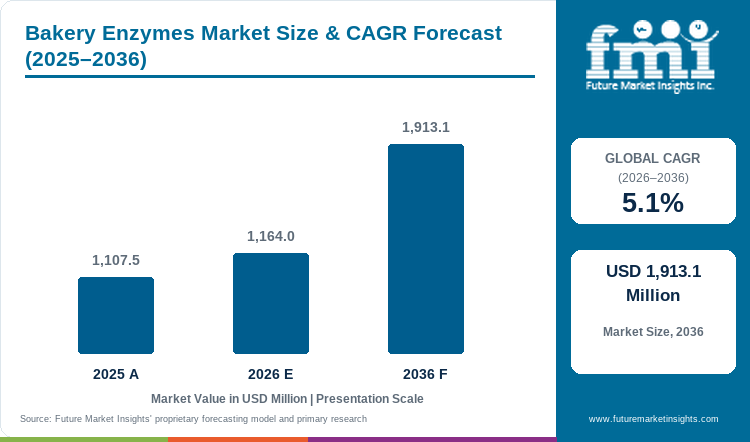
- Market Size (2026)
- USD 1164.0 Mn
- Forecast (2036)
- USD 1913.1 Mn
- CAGR (2026 to 2036)
- 5.1%
How big is Bakery Enzymes Market in 2026?
USD 1,164.0 million in 2026 and USD 1,913.1 million by 2036 at a 5.1% CAGR.
Demand for bakery enzymes is projected to expand at 5.1% CAGR between 2026 and 2036. Valuation rises from an estimated USD 1,107.5 million in 2025 to USD 1,164.0 million in 2026 and reaches USD 1,913.1 million by 2036. Industrial bakeries are using enzyme systems to manage flour changes that alter dough behavior or shelf-life performance during repeated production. Puratos opened its Flour Competence Center in June 2026 to analyze flour protein and enzyme activity alongside water absorption and moisture. Bakery teams are using flour analysis to connect ingredient variability with the line conditions that determine dough behavior and finished-product consistency.
Country conditions are changing the speed at which a technical case becomes a recurring order. USA ingredient teams are using product-specific GRAS notices to keep intended use close to qualification. FDA updated GRN No. 1335 in August 2026 for a maltogenic amylase preparation intended for baking and other uses. German buyers are working within the EU authorization framework for food enzymes. The two regulatory routes require different documentation and review steps during bakery line trials. Regulatory files and plant trials remain commercial gates because enzyme activity must match both legal use and production performance.
Key Takeaways
- Flour-quality shifts and processing changes are increasing industrial bakery use of enzyme systems for stable dough behavior and freshness during repeated production.
- Based on product type, carbohydrase is projected to account for 48.0% in 2026. Recurring starch-active and hemicellulose-active functions are supporting its use in fermentation and flour correction.
- In 2026, breads are expected to lead application demand with 69.0% share. High-throughput production supports this position by requiring repeatable dough tolerance and fresh texture.
- Cake and pastry formulators are selecting narrower enzyme combinations because sugar and fat change dough or batter behavior during production scale-up.
- Regulatory review and line-specific validation are delaying supplier changes because technically suitable enzymes must also meet dosage and intended-use requirements.
- Some of the key players in this market include Novonesis, dsm-firmenich, International Flavors & Fragrances, AB Enzymes, Lallemand, Kerry Group, Puratos, Lesaffre, Enzyme Development Corporation, and Amano Enzyme.
Analyst Perspective
“Bakery enzymes earn repeat business once a plant proves that the same dosage controls dough behavior under its actual flour and line conditions. Supplier advantage depends on regulatory documentation and application support that shorten validation without weakening finished-product quality.”
- Nandini Roy Choudhury, Principal Consultant, Future Market Insights
How is the bakery enzymes market segmented?
The bakery enzymes market is segmented by Product Type and Application.
The bakery enzymes market is segmented by product type, application and region. Product type comprises carbohydrase, protease, others and lipase. Application comprises breads, cakes and pastries and cookies and biscuits. Regional analysis follows the standard FMI hierarchy used in the report scope and market-by-region taxonomy.
How do starch-management requirements shape carbohydrase selection within product type?
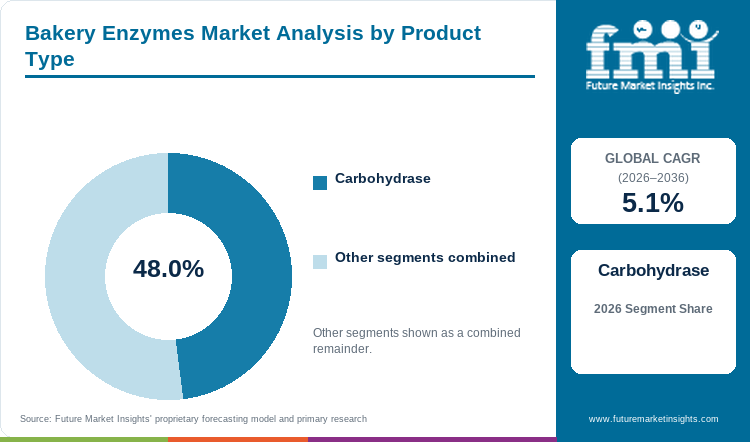
Carbohydrases act on starch and flour polysaccharides that influence fermentation behavior and crumb changes during bakery production. Industrial bakeries are using this enzyme class to correct flour variability and manage storage targets that make fixed improver recipes less reliable. Food enzymes that act on starch or hemicellulose are selected according to the substrate and process change required on the line. Bakeries are qualifying carbohydrases against their own flour and operating window because the wrong dose can improve one target and weaken another.
- Based on product type, carbohydrase is projected to account for 48.0% in 2026. Recurring industrial demand for starch-active and hemicellulose-active functions supports this position.
- FDA updated GRN No. 1335 in August 2026 for maltogenic amylase intended for baking and other uses. Commercial qualification still depends on enzyme identity and use level for routine amylase production.
Why do bread lines give enzymes repeated application value?
Bread lines expose dough to several process stages that determine commercial texture during cooling and slicing. Enzyme systems must maintain performance through mixing and baking as well as cooling and slicing. Bread improvers face the same operational tests because bakeries compare dough tolerance with crumb properties and softness retention. High-throughput plants are comparing dosage stability with process consistency under routine line conditions. Recurring bakery enzyme use depends on reproducing the same technical result with the plant’s flour and equipment.
- By application, breads are forecast to represent 69.0% in 2026. Repeated line requirements for dough tolerance and fresh texture are driving this position at commercial volume.
- IFF launched POWERFRESH ACE 2000 for USA industrial bread in August 2025 following tests in white and whole-wheat applications. The product targets softness and resilience during shelf life for industrial bread applications.
What are the drivers, restraints and opportunities in the Bakery Enzymes Market?
Flour variability raises the value of process control, regulatory evidence slows switching, and targeted reformulation expands enzyme use in additional applications.
- Driver: Variable flour changes water absorption and dough behavior, so industrial bakeries are using enzyme systems to hold performance within an accepted operating window.
- Restraint: Supplier interchangeability requires food-enzyme approval and plant validation of identity plus intended use under the bakery’s own operating conditions.
- Opportunity: Sugar reduction and label-focused reformulation are giving enzyme suppliers new routes to replace part of conventional formulation inputs with catalytic functions.
Flour Variability Increases the Value of Process Control
Flour variability is forcing bakeries to adjust mixing and water addition more often on high-throughput lines. Puratos opened its Flour Competence Center in June 2026 to study protein content and enzyme activity with water absorption and moisture. Bakeries are comparing flour improvers against the same protein and moisture shifts during formulation work. Plant trials are establishing whether a defined enzyme dose reduces adjustment work during normal line operation. Process repeatability supports purchase decisions because the enzyme must control variation without forcing a wider recipe change or another downstream quality problem.
Regulatory Evidence and Plant Trials Slow Supplier Switching
Commercial use of food enzymes requires a valid legal route for the intended application. EFSA updated its food-enzyme application procedure in May 2026 and requires dossiers covering identity plus characterization and conditions of use. Bakeries are comparing dough conditioners with established improver systems during supplier trials. Supplier changes still require dosage and flour-response validation under the bakery’s own process conditions. Regulatory evidence and line trials are extending the conversion cycle even for replacement enzymes targeting familiar functions. Suppliers can shorten qualification by bringing a clear regulatory file and application data that match the customer formulation.
Reformulation Gives Enzyme Suppliers New Functional Entry Points
Enzymes that replace part of a costly ingredient without changing the recognized product are giving suppliers a reformulation route. Novonesis launched Optiva LS Prime in June 2025 for baked goods that need lower added sugar while retaining sweetness. Formulators are comparing enzyme systems with food emulsifiers and other functional ingredients to reduce formula cost or simplify labels. Suppliers still need evidence that the revised formula maintains volume and texture at full production scale. Application teams are using validated plant results to move suitable enzyme mechanisms into recipes without weakening the finished-product specification.
Which country CAGRs are profiled in the Bakery Enzymes Market?
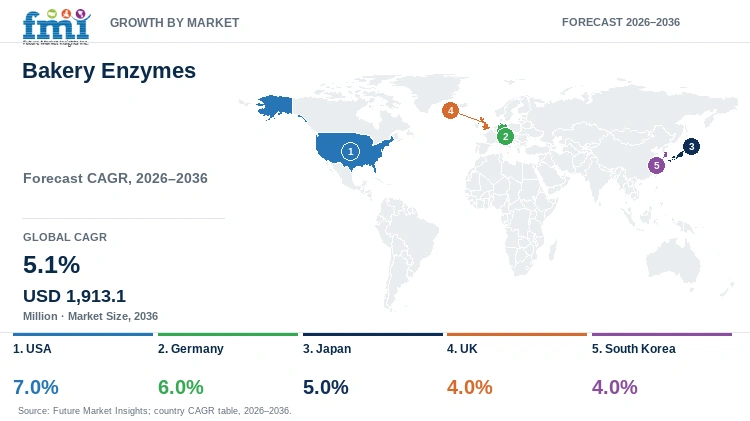
| Country | CAGR |
|---|---|
| USA | 7.0% |
| Germany | 6.0% |
| Japan | 5.0% |
| UK | 4.0% |
| South Korea | 4.0% |
How do country-level CAGRs compare in the Bakery Enzymes Market?
The profiled rates form a 3.0 percentage-point range from 4.0% to 7.0%. USA and Germany occupy the upper part of that range. Japan forms the middle position and the UK shares a 4.0% forecast with South Korea. Qualification routes and technical service conditions explain the different growth paths without ranking current market size.
- USA industrial bakeries are using the federal GRAS route to keep enzyme identity and intended use close to qualification during fresh-keeping system review.
- German bakeries are placing strong emphasis on formal food-enzyme review and are pairing regulatory documentation with plant evidence during improver replacement.
- Japanese ingredient teams are using detailed additive specifications to align enzyme identity and manufacturing requirements with repeatable softness or dough-strengthening performance.
- UK bakeries are weighing reformulation economics against established recipes while the authorization register provides a current regulatory checkpoint during line trials.
- South Korean bakeries are reconciling national additive specifications with customer trials so technical support directly affects movement into routine production.
Comparable CAGRs can still produce different entry conditions because regulatory evidence and application support change the speed of supplier approval. Mature production bases can make replacement economics more important than category expansion. The full report provides country-level CAGR analysis across North America, Latin America, Western Europe, Eastern Europe, East Asia, South Asia and Pacific, and the Middle East and Africa.
Country-wise Analysis
- USA industrial bakeries are qualifying enzyme preparations within a federal framework that separates food additives from GRAS substances and recognizes GRAS notices for enzyme preparations. Bakery enzyme demand in the USA is forecast to rise at 7.0% CAGR through 2036, reinforced by product-specific GRAS routes and plant validation for defined baking uses. FDA’s national enzyme-preparations page lists approved food-additive enzymes and GRAS routes that govern commercial use. Legal status does not establish flour response or finished texture, so bakeries are still running plant trials under their own production conditions. Teams evaluating bakery ingredients are pairing compliant documentation with production evidence to reduce switching risk and move successful trials into recurring purchase.
- German bakeries are reviewing food enzymes under the EU authorization framework and are checking dossier quality against line performance. Germany’s bakery enzymes outlook is anticipated to advance at 6.0% CAGR over the assessment period, influenced by formal authorization requirements and demand for consistent dough behavior. Germany’s Federal Institute for Risk Assessment states that EU rules govern food-enzyme marketing and require safety evaluation for Union-list inclusion. Plants are comparing dosage and flour response under current production targets. Teams assessing bakery conditioners are using regulatory dossiers and line evidence together so legal status does not replace process validation.
- Japanese bakeries are placing strong weight on defined additive specifications and repeatable product quality. Adoption of bakery enzymes in Japan is estimated to expand at 5.0% CAGR through 2036, shaped by national additive specifications and repeatable quality requirements. Japan’s Ministry of Health, Labour and Welfare maintains national food-additive standards and specifications for individual additives used in food production. Local application trials are still testing flour response and texture under actual process conditions. Japanese cake producers are evaluating cake enzymes against both regulatory fit and the texture result required on the customer line.
- British bakery plants are balancing established ingredient systems with current authorization checkpoints during supplier changes. Bakery enzyme sales in the UK are forecast to expand at 4.0% CAGR by 2036, aided by reformulation needs and current authorization requirements. The Food Standards Agency states that its regulated-products register became the primary source for relevant Great Britain authorizations from April 2025. Ingredient teams are using the register as a current checkpoint during technical trials. Plants are still comparing dough handling and finished texture under their own process conditions. Suppliers testing industrial bakery mixes are pairing compliant status with plant results to lower reformulation risk and support routine purchasing.
- South Korean food manufacturers are working under a national additive code with revised specifications and permitted uses. In South Korea, bakery enzyme demand is predicted to advance at 4.0% CAGR through 2036, tied to formulation changes that must meet national additive specifications and local product expectations. The Ministry of Food and Drug Safety issued Food Additive Code Notice No. 2025-76 in November 2025 and incorporated the revision into the national code. Ingredient teams are using the national code to confirm permitted use during formulation work. Local trials are determining texture and process performance under plant conditions. Suppliers serving sourdough products need repeatable line performance to convert permitted use into recurring orders.
Who are the notable companies in the Bakery Enzymes Market?
Novonesis, dsm-firmenich, International Flavors & Fragrances, AB Enzymes, Lallemand, Kerry Group, Puratos, Lesaffre, Enzyme Development Corporation, and Amano Enzyme are notable companies serving the bakery enzymes market.
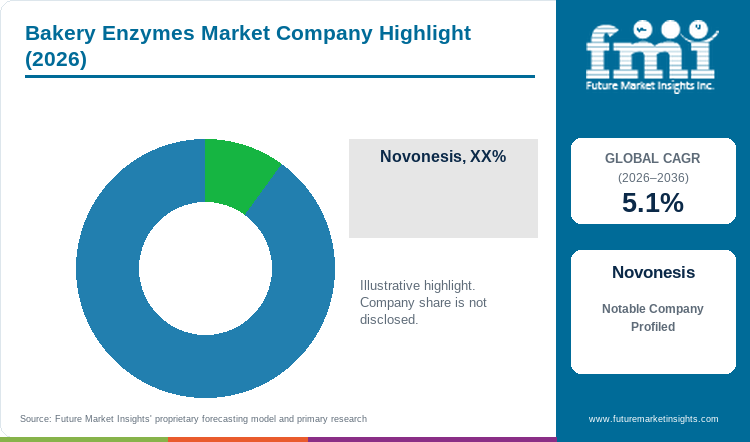
Competition combines specialist enzyme developers with food-technology groups that operate bakery application laboratories and formulation services. Entry remains demanding because established customers require both regulatory documentation and line-level performance for supplier changes. Novozymes and Chr. Hansen completed their combination in January 2024 to create Novonesis. Lallemand remains in the current set because its baking business documents enzyme-based conditioners and baking enzymes for ingredient formulators.
- Dedicated enzyme platforms include Novonesis, International Flavors & Fragrances, AB Enzymes, Enzyme Development Corporation, and Amano Enzyme.
- Integrated food and bakery technology groups include dsm-firmenich, Kerry Group, Lallemand, and Puratos.
- Lesaffre contributes breadmaking application infrastructure and industrial-scale bakery validation rather than the direct enzyme breadth documented by specialist suppliers.
Competitive Benchmarking: Bakery Enzymes Market
| Company | Bread Freshness Enzymes | Dough and Texture Enzymes | Bakery Application Support | Geographic Reach |
|---|---|---|---|---|
| Novonesis | High | High | High | Global |
| dsm-firmenich | High | High | High | North America and Europe with global food support |
| International Flavors & Fragrances | High | High | High | Global |
| AB Enzymes | High | High | High | Europe, Americas and Asia-Pacific |
| Lallemand | Medium | Medium | High | Global baking network |
| Kerry Group | High | High | High | Global |
| Puratos | Medium | Medium | High | Global bakery application network |
| Lesaffre | Low | Low | High | Global Baking Center network |
| Enzyme Development Corporation | High | Medium | Medium | United States with international supply |
| Amano Enzyme | High | High | High | Japan, North America, Europe and Asia-Pacific |
Scoring basis: High requires multiple currently documented bakery-enzyme functions plus direct application evidence. Medium requires one exact-market enzyme route or a narrower public portfolio. Low applies to documented bakery application activity without direct evidence of breadth for that enzyme function. Geographic reach is descriptive and is not scored.
Key Developments in the Bakery Enzymes Market
- In June 2025, Lallemand completed the acquisition of AIT Ingredients effective June 26 and integrated its bakery plus flour-milling expertise into Lallemand Baking Solutions. The transaction broadened application support for bakery formulations and flour treatment.
- In June 2025, Novonesis launched Optiva LS Prime for baked goods that need lower added sugar without losing sweetness. The product gives industrial bakers another enzyme route for cost-sensitive reformulation.
- In May 2025, dsm-firmenich opened the Princeton Baking Innovation Center in New Jersey for breads and other bakery applications. The site provides customer testing capacity for commercial scale-up.
Key Players in the Bakery Enzymes Market
Specialist Enzyme Platforms
- Novonesis
- International Flavors & Fragrances
- AB Enzymes
- Enzyme Development Corporation
- Amano Enzyme
Integrated Bakery and Food Technology Groups
- dsm-firmenich
- Kerry Group
- Lallemand
- Puratos
Breadmaking Application and Fermentation Specialist
- Lesaffre
Bakery Enzymes Market - Report Scope
| Coverage field | Report scope |
|---|---|
| Market breakdown | By product type, application, and region. |
| Quantitative Units | USD million. |
| Market Definition | Revenue from bakery enzyme preparations sold for bread, cakes, pastries, cookies, and biscuits. Finished bakery products and non-enzyme ingredient revenue are excluded. |
| Regions Covered | North America, Latin America, Western Europe, Eastern Europe, East Asia, South Asia and Pacific, and the Middle East and Africa. |
| Countries Covered | USA, Germany, Japan, UK, South Korea, and 20+ countries included in the full report. |
| Key Companies Profiled | Novonesis, dsm-firmenich, International Flavors & Fragrances, AB Enzymes, Lallemand, Kerry Group, Puratos, Lesaffre, Enzyme Development Corporation, Amano Enzyme. |
| Forecast Period | 2026 to 2036. |
| Approach | Primary and secondary research with market triangulation. |
Bakery Enzymes Market - Research Methodology
| Method | Approach |
|---|---|
| Primary Research | FMI analysts gathered input from manufacturers, service providers, technology developers, distributors, end users, procurement teams, and subject-matter experts. Interviews examined purchasing decisions, product or service evaluation, adoption barriers, approval requirements, pricing considerations, and expectations for technical or commercial support. Respondents were also asked what evidence is required before a trial, pilot, or initial order develops into regular purchasing. |
| Desk Research | Desk research covered government statistics, regulatory publications, trade data, industry associations, technical literature, standards, company filings, product information, and official corporate announcements. Sources were reviewed for relevance, publication date, geographic coverage, and consistency with the defined market scope. Claims relating to performance, applications, approvals, capacity, investment, and commercial activity were retained only when supported by credible public evidence. |
| Market Sizing and Forecasting | The market model combined the baseline value with historical performance, segment structure, pricing and volume indicators, adoption levels, company participation, and country-level demand conditions. Forecast assumptions considered economic activity, investment trends, regulatory developments, technology adoption, purchasing cycles, supply availability, and barriers to wider market use. Segment and regional estimates were reconciled before the final market total was calculated. |
| Data Validation | Estimates were checked against multiple independent indicators, including public data, company activity, trade patterns, industry developments, and findings from primary interviews. Validation also tested whether products, services, applications, and company revenues fell within the defined market boundaries. Adjacent categories, unsupported claims, overlapping revenues, and activities without direct market relevance were excluded to reduce double counting and maintain consistency across segments and countries. |
Bakery Enzymes Market by Segments
Bakery Enzymes Market segmented by Product Type:
- Carbohydrase
- Protease
- Others
- Lipase
Bakery Enzymes Market segmented by Application:
- Breads
- Cakes and Pastries
- Cookies and Biscuits
Bakery Enzymes Market by Region:
- North America
- United States
- Canada
- Latin America
- Brazil
- Mexico
- Argentina
- Chile
- Rest of Latin America
- Western Europe
- Germany
- France
- United Kingdom
- Italy
- Spain
- Benelux
- Nordics
- Rest of Western Europe
- Eastern Europe
- Poland
- Czech Republic
- Romania
- Hungary
- Rest of Eastern Europe
- East Asia
- China
- Japan
- South Korea
- South Asia and Pacific
- India
- ASEAN
- Australia and New Zealand
- Rest of South Asia and Pacific
- Middle East and Africa
- GCC Countries
- South Africa
- Türkiye
- Israel
- Rest of Middle East and Africa
Research Sources and Bibliography
- USA Food and Drug Administration. (2026, August 18). GRN No. 1335: Maltogenic amylase enzyme preparation produced by Escherichia coli expressing a gene encoding maltogenic amylase from Geobacillus stearothermophilus.
- European Food Safety Authority. (2026, May 6). Food enzyme application procedure.
- Puratos. (2026, June 15). Puratos Opens Flour Competence Center to Address Flour Variability.
- International Flavors & Fragrances. (2025, August 13). IFF Launches POWERFRESH ACE 2000, a Bread Fresh-Keeping Solution That Aces the Shelf-Life Test.
- Novonesis. (2025, June 11). Novonesis launches Optiva LS Prime, helping bakers cut up to 50% added sugar and create more cost-effective baked goods.
- USA Food and Drug Administration. (n.d.). Enzyme Preparations Used in Food (Partial List). Retrieved September 17, 2026.
- German Federal Institute for Risk Assessment. (n.d.). Lebensmittelenzyme. Retrieved September 17, 2026.
- Ministry of Health, Labour and Welfare, Japan. (n.d.). Food Additives. Retrieved September 17, 2026.
- Food Standards Agency. (n.d.). Guidance on using the Register of Food Additive Authorisations. Retrieved September 17, 2026.
- Ministry of Food and Drug Safety, Republic of Korea. (2025, November 27). 「식품첨가물의 기준 및 규격」 고시전문(식약처 고시 제2025-76호(2025.11.26.)).
- Lallemand. (2025, July 4). Lallemand Acquires AIT Ingredients.
- dsm-firmenich. (2025, May 20). On the rise: dsm-firmenich opens state-of-the-art Princeton Baking Innovation Center in Princeton, NJ.
- AB Enzymes. (2026, June 1). AB Enzymes Opens New Office and Baking Lab in Curitiba, Brazil.
- Lesaffre. (2025, December 15). Lesaffre opens new Industrial Baking Center in Shanghai.
- Kerry. (2025, September 24). Kerry Establishes New Biotechnology Centre in Leipzig.
- dsm-firmenich. (2025, October 2). dsm-firmenich opens global food innovation center in Delft, the Netherlands to accelerate diet transformation.
- Novonesis. (n.d.). Novamyl®. Retrieved September 17, 2026.
- dsm-firmenich. (n.d.). BakeZyme®. Retrieved September 17, 2026.
- International Flavors & Fragrances. (n.d.). POWERBAKE® Enzyme Solutions for Label-Friendly Bread. Retrieved September 17, 2026.
- AB Enzymes. (n.d.). Baking, Flour Milling and Pasta. Retrieved September 17, 2026.
- Lallemand Baking. (n.d.). Conditioners and Improvers. Retrieved September 17, 2026.
- Kerry. (n.d.). Enzymes for Bakery and Snacks. Retrieved September 17, 2026.
- Puratos. (2026, May 29). How to extend the shelf life of bread.
- Enzyme Development Corporation. (n.d.). Baking enzymes. Retrieved September 17, 2026.
- Amano Enzyme. (n.d.). Baking. Retrieved September 17, 2026.
- Novonesis. (2024, January 29). The combination of Novozymes and Chr. Hansen is now successfully completed, creating Novonesis.
- AB Enzymes. (n.d.). Global Locations. Retrieved September 17, 2026.
- Puratos. (n.d.). About Puratos. Retrieved September 17, 2026.
- International Flavors & Fragrances. (n.d.). Locations. Retrieved September 17, 2026.
- Kerry. (n.d.). Global locations. Retrieved September 17, 2026.
- Lallemand. (n.d.). Where we operate. Retrieved September 17, 2026.
- Amano Enzyme. (n.d.). Group Company Information. Retrieved September 17, 2026.
- Lesaffre. (n.d.). Our application centers. Retrieved September 17, 2026.
This bibliography is provided for reader reference and is not exhaustive. The full report contains the complete reference list and detailed citations.
This Report Answers
- How large is the bakery enzymes market in 2026 and 2036?
- Which operating problems support recurring bakery enzyme purchases?
- Why does carbohydrase hold 48.0% of product type demand?
- Why do breads account for 69.0% of application demand?
- How do regulatory requirements affect bakery enzyme supplier switching?
- Why do country CAGRs differ across the five profiled markets?
- Which companies currently supply bakery enzyme and application support?
- What competitive developments are changing bakery enzyme qualification?
Frequently Asked Questions
How big is the Bakery Enzymes Market in 2026?
The bakery enzymes market is expected to be valued at USD 1,164.0 million in 2026 and reach USD 1,913.1 million by 2036. Industrial bakeries are using enzyme systems to control dough behavior and freshness under changing flour conditions.
What is the CAGR of the Bakery Enzymes Market from 2026 to 2036?
The bakery enzymes market is projected to grow at 5.1% CAGR between 2026 and 2036. Expansion depends on validated enzyme functions that improve process consistency or reformulation economics without weakening finished-product quality.
Which product type leads the Bakery Enzymes Market?
By product type, carbohydrase is estimated to hold 48.0% in 2026. Starch-active and hemicellulose-active functions support recurring use in fermentation and flour correction.
Which application leads the Bakery Enzymes Market?
In 2026, breads are expected to account for 69.0% of application demand. High-throughput bread lines are repeatedly testing enzymes against dough tolerance and softness during production.
Which companies are active in the Bakery Enzymes Market?
Key companies operating in the bakery enzymes market include Novonesis, dsm-firmenich, International Flavors & Fragrances, AB Enzymes, Lallemand, Kerry Group, Puratos, Lesaffre, Enzyme Development Corporation, and Amano Enzyme. Their positions differ by enzyme breadth and application support.
Preview the report firsthand - request a free sample
Get SampleGet the brochure for pricing and purchase details.
Get PDFTable of Content
- Key Takeaways
- Market Size and CAGR
- Top Growth Driver
- Fastest Growing Segment
- Leading Region
- Key Companies
- Emerging Opportunities
- Executive Summary
- Global Market Outlook
- Demand-side Trends
- Supply-side Trends
- Technology Roadmap Analysis
- Analysis and Recommendations
- Analyst Perspective (What is happening? Why now? What should investors know?)
- Key Questions Answered
- How large is the market?
- What is the CAGR?
- What are key trends?
- Which region dominates?
- Who are the leaders?
- Market Overview
- Market Coverage / Taxonomy
- Market Definition / Scope / Limitations
- Research Methodology
- Chapter Orientation
- Analytical Lens and Working Hypotheses
- Market Structure, Signals, and Trend Drivers
- Benchmarking and Cross-market Comparability
- Market Sizing, Forecasting, and Opportunity Mapping
- Research Design and Evidence Framework
- Desk Research Programme (Secondary Evidence)
- Expert Input and Fieldwork (Primary Evidence)
- Tooling, Models, and Reference Databases
- Data Engineering and Model Build
- Quality Assurance and Audit Trail
- Market Background
- Market Dynamics (Drivers, Restraints, Opportunity, Trends)
- Scenario Forecast (Optimistic, Likely, Conservative)
- Impact Analysis
- AI Impact
- Sustainability Impact
- Regulatory Impact
- Technology Impact
- Consumer / Buyer Analysis
- Purchase Drivers
- Adoption Barriers
- Buyer Journey
- Opportunity Map Analysis
- Product Life Cycle Analysis
- Supply Chain Analysis
- Investment Feasibility Matrix
- Value Chain Analysis
- PESTLE and Porter's Analysis
- Regulatory Landscape
- Regional Parent Market Outlook
- Production and Consumption Statistics
- Import and Export Statistics
- Global Market Analysis and Forecast, 2021 to 2036
- Historical Market Size Value (USD Million) Analysis, 2021 to 2025
- Current and Future Market Size Value (USD Million) Projections, 2026 to 2036
- Y-o-Y Growth Trend Analysis
- Absolute $ Opportunity Analysis
- Global Market Pricing Analysis, 2021 to 2036
- Global Market Analysis and Forecast, By Product Type, 2021 to 2036
- Introduction / Key Findings
- Historical Market Size Value (USD Million) Analysis By Product Type, 2021 to 2025
- Current and Future Market Size Value (USD Million) Analysis and Forecast By Product Type, 2026 to 2036
- Carbohydrase
- Protease
- Others
- Lipase
- Y-o-Y Growth Trend Analysis By Product Type, 2021 to 2025
- Absolute $ Opportunity Analysis By Product Type, 2026 to 2036
- Global Market Analysis and Forecast, By Application, 2021 to 2036
- Introduction / Key Findings
- Historical Market Size Value (USD Million) Analysis By Application, 2021 to 2025
- Current and Future Market Size Value (USD Million) Analysis and Forecast By Application, 2026 to 2036
- Breads
- Cakes and Pastries
- Cookies and Biscuits
- Y-o-Y Growth Trend Analysis By Application, 2021 to 2025
- Absolute $ Opportunity Analysis By Application, 2026 to 2036
- Global Market Analysis and Forecast, By Region, 2021 to 2036
- Introduction
- Historical Market Size Value (USD Million) Analysis By Region, 2021 to 2025
- Current Market Size Value (USD Million) Analysis and Forecast By Region, 2026 to 2036
- North America
- Latin America
- Western Europe
- Eastern Europe
- East Asia
- South Asia and Pacific
- Middle East and Africa
- Market Attractiveness Analysis By Region
- North America Market Analysis and Forecast, By Country, 2021 to 2036
- Historical Market Size Value (USD Million) Trend Analysis By Market Taxonomy, 2021 to 2025
- Market Size Value (USD Million) Forecast By Market Taxonomy, 2026 to 2036
- By Country
- United States
- Canada
- By Product Type
- By Application
- By Country
- Market Attractiveness Analysis
- By Country
- By Product Type
- By Application
- Key Takeaways
- Latin America Market Analysis and Forecast, By Country
- Historical Market Size Value (USD Million) Trend Analysis By Market Taxonomy, 2021 to 2025
- Market Size Value (USD Million) Forecast By Market Taxonomy, 2026 to 2036
- By Country
- Brazil
- Mexico
- Argentina
- Chile
- Rest of Latin America
- By Product Type
- By Application
- By Country
- Market Attractiveness Analysis
- By Country
- By Product Type
- By Application
- Key Takeaways
- Western Europe Market Analysis and Forecast, By Country
- Historical Market Size Value (USD Million) Trend Analysis By Market Taxonomy, 2021 to 2025
- Market Size Value (USD Million) Forecast By Market Taxonomy, 2026 to 2036
- By Country
- Germany
- France
- United Kingdom
- Italy
- Spain
- Benelux
- Nordics
- Rest of Western Europe
- By Product Type
- By Application
- By Country
- Market Attractiveness Analysis
- By Country
- By Product Type
- By Application
- Key Takeaways
- Eastern Europe Market Analysis and Forecast, By Country
- Historical Market Size Value (USD Million) Trend Analysis By Market Taxonomy, 2021 to 2025
- Market Size Value (USD Million) Forecast By Market Taxonomy, 2026 to 2036
- By Country
- Poland
- Czech Republic
- Romania
- Hungary
- Rest of Eastern Europe
- By Product Type
- By Application
- By Country
- Market Attractiveness Analysis
- By Country
- By Product Type
- By Application
- Key Takeaways
- East Asia Market Analysis and Forecast, By Country
- Historical Market Size Value (USD Million) Trend Analysis By Market Taxonomy, 2021 to 2025
- Market Size Value (USD Million) Forecast By Market Taxonomy, 2026 to 2036
- By Country
- China
- Japan
- South Korea
- By Product Type
- By Application
- By Country
- Market Attractiveness Analysis
- By Country
- By Product Type
- By Application
- Key Takeaways
- South Asia and Pacific Market Analysis and Forecast, By Country
- Historical Market Size Value (USD Million) Trend Analysis By Market Taxonomy, 2021 to 2025
- Market Size Value (USD Million) Forecast By Market Taxonomy, 2026 to 2036
- By Country
- India
- ASEAN
- Australia and New Zealand
- Rest of South Asia and Pacific
- By Product Type
- By Application
- By Country
- Market Attractiveness Analysis
- By Country
- By Product Type
- By Application
- Key Takeaways
- Middle East and Africa Market Analysis and Forecast, By Country
- Historical Market Size Value (USD Million) Trend Analysis By Market Taxonomy, 2021 to 2025
- Market Size Value (USD Million) Forecast By Market Taxonomy, 2026 to 2036
- By Country
- GCC Countries
- South Africa
- Türkiye
- Israel
- Rest of Middle East and Africa
- By Product Type
- By Application
- By Country
- Market Attractiveness Analysis
- By Country
- By Product Type
- By Application
- Key Takeaways
- Key Countries Market Analysis
- United States
- Pricing Analysis
- Market Share Analysis, 2025
- By Product Type
- By Application
- Canada
- Pricing Analysis
- Market Share Analysis, 2025
- By Product Type
- By Application
- Mexico
- Pricing Analysis
- Market Share Analysis, 2025
- By Product Type
- By Application
- Brazil
- Pricing Analysis
- Market Share Analysis, 2025
- By Product Type
- By Application
- Chile
- Pricing Analysis
- Market Share Analysis, 2025
- By Product Type
- By Application
- Germany
- Pricing Analysis
- Market Share Analysis, 2025
- By Product Type
- By Application
- United Kingdom
- Pricing Analysis
- Market Share Analysis, 2025
- By Product Type
- By Application
- Italy
- Pricing Analysis
- Market Share Analysis, 2025
- By Product Type
- By Application
- Spain
- Pricing Analysis
- Market Share Analysis, 2025
- By Product Type
- By Application
- France
- Pricing Analysis
- Market Share Analysis, 2025
- By Product Type
- By Application
- India
- Pricing Analysis
- Market Share Analysis, 2025
- By Product Type
- By Application
- ASEAN
- Pricing Analysis
- Market Share Analysis, 2025
- By Product Type
- By Application
- Australia and New Zealand
- Pricing Analysis
- Market Share Analysis, 2025
- By Product Type
- By Application
- China
- Pricing Analysis
- Market Share Analysis, 2025
- By Product Type
- By Application
- Japan
- Pricing Analysis
- Market Share Analysis, 2025
- By Product Type
- By Application
- South Korea
- Pricing Analysis
- Market Share Analysis, 2025
- By Product Type
- By Application
- Poland
- Pricing Analysis
- Market Share Analysis, 2025
- By Product Type
- By Application
- Hungary
- Pricing Analysis
- Market Share Analysis, 2025
- By Product Type
- By Application
- Türkiye
- Pricing Analysis
- Market Share Analysis, 2025
- By Product Type
- By Application
- South Africa
- Pricing Analysis
- Market Share Analysis, 2025
- By Product Type
- By Application
- United States
- Market Structure Analysis
- Competition Dashboard
- Competition Benchmarking
- Market Share Analysis of Top Players
- By Regional
- By Product Type
- By Application
- Emerging Startups
- Innovation Benchmarking
- Competition Analysis
- Competition Deep Dive
- Novonesis
- Overview
- Product Portfolio
- Profitability by Market Segments
- Sales Footprint
- Strategy Overview
- Marketing Strategy
- Product Strategy
- Channel Strategy
- dsm-firmenich
- International Flavors & Fragrances
- AB Enzymes
- Lallemand
- Kerry Group
- Puratos
- Lesaffre
- Enzyme Development Corporation
- Amano Enzyme
- Novonesis
- Case Studies
- Success Stories
- Recent Developments
- Competition Deep Dive
- Assumptions & Acronyms Used


