

- Industry Size (2026)
- USD 1.8 Bn
- Forecast (2036)
- USD 4.5 Bn
- CAGR (2026 to 2036)
- 9.5%
Battery Powered Surgical Drill Market Forecast and Outlook 2026 to 2036
In 2026, the battery powered surgical drill market stands at USD 1.8 billion and is projected to reach USD 4.5 billion by 2036, implying a CAGR of 9.5%. In operating rooms, the value of these systems is tied to workflow reliability rather than to raw torque or speed. Cordless operation reduces cable management, lowers contamination risk, and simplifies instrument table layout, which matters in trauma, orthopedics, and neurosurgery. Hospitals with high case turnover place greater weight on setup time, sterilization cycles, and instrument availability than on unit price. Procurement therefore favors platforms that integrate battery management, sterilizable housings, and predictable runtime across procedure types.
Clinical governance and asset management practices shape purchasing patterns more than headline procedure volumes. Once a drill platform is approved, trained, and embedded in surgical protocols, switching carries costs in retraining, validation, and spare inventory. Battery lifecycle policies, charging logistics, and redundancy planning become part of equipment committee decisions. Smaller centers adopt selectively based on case mix, while high volume hospitals standardize fleets to stabilize operating room scheduling. Market growth follows the spread of high throughput surgical pathways and stricter infection control routines, not simple replacement of corded tools or discretionary equipment upgrades.
Quick Stats for Battery Powered Surgical Drill Market
- Battery Powered Surgical Drill Market Value (2026): USD 1.8 billion
- Battery Powered Surgical Drill Market Forecast Value (2036): USD 4.5 billion
- Battery Powered Surgical Drill Market Forecast CAGR 2026 to 2036: 9.5%
- Leading Type in Battery Powered Surgical Drill Market: Cordless handheld surgical drills
- Key Growth Regions in Battery Powered Surgical Drill Market: Asia Pacific, North America, Europe
- Top Players in Battery Powered Surgical Drill Market: DePuy Synthes (Johnson & Johnson), Stryker Corporation, Zimmer Biomet, Medtronic, Aesculap (B. Braun), Smith & Nephew, CONMED Corporation

What is the Growth Forecast for Battery Powered Surgical Drill Market through 2036?
The battery powered surgical drill segment is expanding as operating rooms prioritize mobility, workflow efficiency, and infection control rather than only mechanical performance. In the early stage, adoption remains concentrated in orthopedic and trauma centers that value cordless systems for faster setup, smoother handling, and reduced operating room clutter. As uptake widens across general hospitals and ambulatory surgery centers, factors such as quicker turnover, easier sterilization logistics, and simplified room layout become as important as torque and speed. Cordless drills are now moving from specialized tools into standard procedure sets because they improve ergonomics and reduce cable-related complexity.
With rising procedure volumes and greater device standardization, demand strengthens further through replacement of older pneumatic and corded systems and expansion of minimally invasive and outpatient surgeries. As the installed base grows, procurement decisions increasingly prioritize battery platform ecosystems, cross-device accessory compatibility, and simplified maintenance rather than drill performance alone. Over time, value growth is supported by higher device penetration per operating room, routine battery replacement cycles, and broader use across spine, neurosurgery, and trauma procedures. The segment remains reliability-led, with hospitals focusing on uptime, sterilization workflow integration, and seamless compatibility with surgical instrument systems.
Battery Powered Surgical Drill Market Key Takeaways
| Metric | Value |
|---|---|
| Market Value (2026) | USD 1.8 billion |
| Forecast Value (2036) | USD 4.5 billion |
| Forecast CAGR 2026 to 2036 | 9.5% |
How Is the Battery-Powered Surgical Drill Market Advancing Operating Room Efficiency?
Battery-powered surgical drills are increasingly adopted to provide portable, precise, and reliable bone drilling solutions in orthopedic, neurosurgical, and dental procedures. Historically, surgical drills relied on corded systems or manual instruments, which limited mobility, required complex setup, and posed sterility challenges. Modern battery-powered drills integrate high-torque motors, adjustable speed controls, and lightweight ergonomic designs to enable precise drilling, reduce procedure time, and improve surgeon comfort.
Hospitals, surgical centers, and medical device suppliers prioritize battery reliability, sterilization compatibility, and operational accuracy. Early adoption focused on orthopedic and dental surgery, while current demand spans neurosurgery, trauma surgery, and veterinary surgical applications, driven by workflow efficiency, portability, and procedural precision. Torque consistency, battery life, and ergonomic design influence supplier selection.
Procedure efficiency, surgical precision, and intraoperative safety are shaping market growth. Compared with corded or manual drills, battery-powered solutions emphasize mobility, reduced setup complexity, and uninterrupted performance during operations. Cost structures depend on motor quality, battery technology, and sterilizable design features, concentrating margins among suppliers capable of delivering high-performance, reliable systems. Healthcare providers adopt these drills to optimize operating room workflows, reduce procedure time, and maintain consistent surgical outcomes.
What Factors Are Shaping the Demand for Battery Powered Surgical Drill Market, Segment wise by Product Type and Application, in 2026?
The Battery Powered Surgical Drill Market in 2026 is segmented by product type and by application. By product category, demand in the Battery Powered Surgical Drill Market is divided into cordless handheld surgical drills, battery powered micro drills, rechargeable orthopedic drill systems, and battery integrated neurosurgical drills, each designed for different torque requirements, access constraints, and sterilization workflows. By application, demand in the Battery Powered Surgical Drill Market is organized around orthopedic surgery, neurosurgery, ENT procedures, and dental or maxillofacial surgery, which differ in procedure volume, precision requirements, and instrument turnover rates. These segments show how purchasing decisions in the Battery Powered Surgical Drill Market balance power, control, and operating room efficiency.
Why Do Cordless Handheld Surgical Drills Lead Product Demand in the Battery Powered Surgical Drill Market?
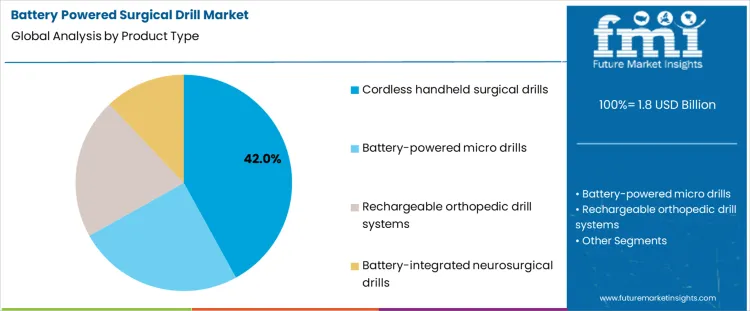
Cordless handheld surgical drills account for about 42% of demand in the Battery Powered Surgical Drill Market in 2026 because they offer a practical balance between power, mobility, and ease of handling. Surgeons value the absence of cables, which reduces clutter around the operating field and lowers the risk of contamination or accidental disconnection. In the Battery Powered Surgical Drill Market, these drills are used across a wide range of procedures, which allows hospitals to standardize instrument sets. Their simpler design also supports faster turnaround between cases and easier sterilization workflows. This broad applicability and workflow compatibility keep cordless handheld units as the most widely adopted product category in the Battery Powered Surgical Drill Market.
Micro drills, rechargeable systems, and specialized neurosurgical units in the Battery Powered Surgical Drill Market serve more specific roles. Micro drills are chosen for delicate work but are not needed in every operating room. Integrated neurosurgical drills are tied to narrow procedure types and limited case volumes. Rechargeable orthopedic systems offer higher power and endurance, yet their higher cost and more complex maintenance limit universal adoption. These categories are essential in their niches, but they do not match the cross specialty usage profile of standard cordless handheld drills in the Battery Powered Surgical Drill Market.
Why Does Orthopedic Surgery Dominate Application Demand in the Battery Powered Surgical Drill Market?
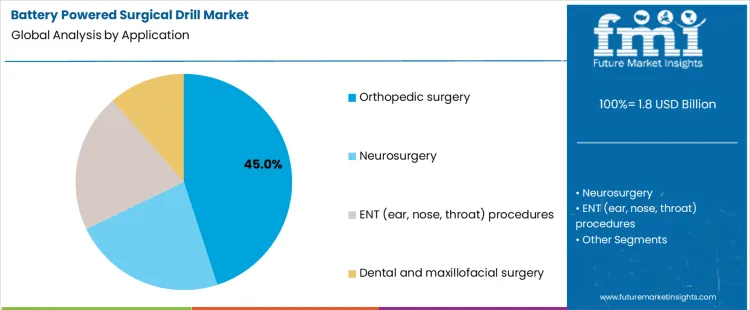
Orthopedic surgery represents about 45% of demand in the Battery Powered Surgical Drill Market in 2026 because it involves a high volume of procedures that require bone drilling, cutting, and screw placement. Trauma care, joint replacement, and fracture fixation are performed daily in many hospitals, which creates continuous usage and wear on drilling systems. In the Battery Powered Surgical Drill Market, orthopedic departments often maintain multiple drill sets to support parallel operating rooms and emergency cases. This increases both initial procurement and replacement demand. The procedural frequency and central role of drilling in orthopedic workflows explain why this application segment absorbs the largest share of demand.
Neurosurgery, ENT, and dental or maxillofacial surgery in the Battery Powered Surgical Drill Market follow different usage patterns. These specialties require higher precision but involve fewer cases and narrower instrument sets. Equipment is often shared or scheduled rather than dedicated to high throughput use. While these fields drive technical development, their overall instrument consumption remains lower. As a result, orthopedic surgery continues to anchor volume demand in the Battery Powered Surgical Drill Market.
How Are the Key Dynamics Reshaping the Battery Powered Surgical Drill Market?
The category is being shaped by operating room efficiency goals, conservative qualification barriers, and the shift toward standardized surgical instrument platforms. Battery powered drills reduce cord management, improve workflow, and support faster room turnover, but adoption is moderated by concerns around reliability, sterilization compatibility, and lifecycle cost. At the same time, hospital groups are standardizing instrument sets across sites to simplify training, spares, and service contracts. This creates a market where growth depends less on one off surgeon preference and more on inclusion in approved platform kits and capital programs, with scale coming from network level standardization rather than individual department purchases.
Why Is Operating Room Efficiency Driving Battery Drill Demand?
Demand is anchored in time and ergonomics. In orthopedics, trauma, and neurosurgery, setup speed, cable management, and freedom of movement affect both procedure time and staff workload. Battery powered drills remove cords, reduce clutter, and make room layout more flexible. Faster setup and teardown improve room utilization and reduce turnover delays. Surgeons also value consistent torque delivery and handling. Once a hospital standardizes a cordless system in its instrument sets, it is used across many procedures and specialties. Volume then follows surgical throughput and expansion of standardized sets rather than discretionary, case by case purchasing.
What Is Slowing Wider Adoption of Battery Drills?
The main barrier is reliability and governance risk. Hospitals worry about battery failure mid procedure, charging discipline, and long term battery degradation. Sterilization compatibility and sealing integrity also require proof over many cycles. Introducing a new power system triggers validation, staff training, and protocol updates. In capital constrained environments, reusable corded systems that already meet needs are kept in service. Committees also scrutinize total cost, including batteries, spares, and service contracts. These factors stretch approval cycles and keep adoption concentrated in new instrument sets or major refresh programs rather than rapid, blanket replacement.
How Are Platform Standards Changing Drill Procurement?
The trend is toward instrument platform consolidation. Hospital groups and large centers increasingly select complete power tool ecosystems that cover drills, saws, and accessories under one service and training model. This simplifies inventory, maintenance, and staff rotation across sites. Once a battery powered drill is part of an approved platform, it benefits from repeat orders with each new set or expansion. Procurement shifts to framework contracts and long term vendor relationships. Over time, success depends less on the drill alone and more on being embedded in standardized surgical instrument platforms used across departments and hospital networks.
What is the Demand for Battery Powered Surgical Drills by Country?
| Country | CAGR (%) |
|---|---|
| US | 8.8% |
| UK | 8.5% |
| China | 10.2% |
| India | 10.8% |
| Brazil | 9.2% |
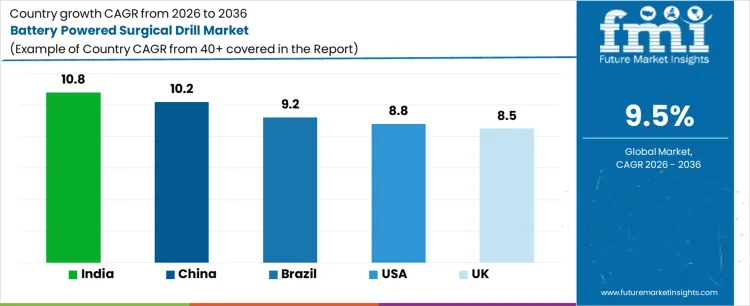
Demand for battery powered surgical drills is rising as hospitals and surgical centers adopt portable, efficient, and reliable tools for orthopedic, dental, and neurosurgical procedures. India leads with a 10.8% CAGR, driven by expanding healthcare infrastructure, rising surgical volumes, and growing adoption of battery-operated surgical devices. China follows at 10.2%, supported by hospital expansion and increasing preference for cordless surgical instruments. Brazil records 9.2% growth, shaped by modernization of operating rooms and adoption of advanced surgical tools. The US grows at 8.8%, influenced by replacement demand and integration in orthopedic and dental surgeries. The UK shows 8.5% CAGR, reflecting steady adoption of battery powered surgical drills in healthcare facilities.
How is the United States experiencing growth in the battery powered surgical drill market?
United States is experiencing growth at a CAGR of 8.8%, driven by widespread adoption in hospitals, orthopedic centers, and outpatient surgical facilities in states such as California, Texas, and New York. Installed base size and replacement cycles support recurring demand, while hospital procurement policies favor reliable, high-performance battery-powered drills. Investments focus on ergonomics, precision, and compliance with FDA standards. Growth reflects rising demand for minimally invasive surgeries, portable surgical equipment, and enhanced operational efficiency in clinical settings.
- Hospitals and surgical centers drive adoption.
- Urban healthcare hubs concentrate demand.
- Ergonomics and precision guide investment.
- Replacement cycles support recurring adoption.
How is the United Kingdom witnessing growth in the battery powered surgical drill market?
United Kingdom is witnessing growth at a CAGR of 8.5%, supported by labor cost structure and productivity pressures in NHS hospitals and private surgical centers in London, Birmingham, and Manchester. High-volume orthopedic and trauma procedures require lightweight, reliable drills to optimize surgical workflow. Industry concentration among hospital networks and medical device distributors anchors adoption. Investments focus on battery life, safety features, and integration with surgical protocols. Growth reflects operational efficiency needs, staff productivity optimization, and compliance with UK medical standards.
- NHS and private surgical centers drive adoption.
- Urban hospital hubs concentrate demand.
- Battery life and safety features guide investment.
- Productivity pressures influence adoption.
How is China experiencing growth in the battery powered surgical drill market?
China is experiencing growth at a CAGR of 10.2%, fueled by expanding hospital networks and orthopedic centers in Beijing, Shanghai, and Guangzhou. Industry concentration in metropolitan medical facilities supports rapid adoption of battery-powered surgical drills. Investments focus on precision, battery efficiency, and reliability under high surgical throughput. Growth reflects increasing demand for modern surgical tools, rapid urban hospital expansion, and adoption of portable, high-performance equipment to enhance patient outcomes.
- Hospital networks and orthopedic centers drive adoption.
- Metropolitan medical facilities concentrate demand.
- Precision and battery efficiency guide investment.
- High surgical throughput accelerates adoption.
How is India witnessing growth in the battery powered surgical drill market?
India is experiencing growth at a CAGR of 10.8%, supported by exposure to both domestic healthcare demand and global medical device standards in cities such as Mumbai, Delhi, and Bengaluru. Installed base expansion and frequent replacement cycles encourage adoption in private and public hospitals. Industry concentration exists in urban healthcare hubs. Investments focus on durability, precision, and compliance with international medical standards. Growth reflects rising surgical volumes, modernization of hospital infrastructure, and increasing adoption of portable, battery-powered surgical tools.
- Private and public hospitals drive adoption.
- Urban healthcare hubs concentrate demand.
- Durability and precision guide investment.
- Replacement cycles support recurring adoption.
How is Brazil experiencing growth in the battery powered surgical drill market?
Brazil is experiencing growth at a CAGR of 9.2%, driven by hospitals, orthopedic clinics, and surgical centers in São Paulo, Rio de Janeiro, and Paraná. Sensitivity to operational risk and downtime encourages adoption of reliable, high-performance battery-powered drills. Market concentration exists in urban healthcare centers, while regional dispersion supports demand in secondary cities. Investments focus on battery longevity, safety features, and ease of maintenance. Growth reflects increasing surgical procedures, need for reliable portable equipment, and emphasis on minimizing operational disruptions.
- Hospitals and orthopedic centers drive adoption.
- Urban healthcare hubs concentrate demand.
- Battery longevity and safety guide investment.
- Operational risk sensitivity supports adoption.
Battery Powered Surgical Drill Market: How Are Leading Companies Driving Precision and Reliability?

DePuy Synthes (Johnson & Johnson) provides battery powered surgical drills designed for consistent torque delivery, modular battery systems, and ergonomic handling to support long orthopedic and trauma procedures. Stryker Corporation offers drills with brushless motors and refined control interfaces, ensuring precision and reliability across demanding surgical applications. Zimmer Biomet focuses on compact, high torque drills suited for bone cutting and reaming, while Medtronic integrates advanced battery management for predictable run time and rapid recharge. Aesculap (B. Braun) supplies devices optimized for sterilization protocols, maintaining hygiene standards in operating rooms. Smith & Nephew delivers low vibration, well balanced drills that reduce surgeon fatigue, supporting extended procedures. These offerings address clinical needs for power, control, and ergonomic performance in surgical environments.
CONMED Corporation provides battery drills tailored for general surgery with accessory compatibility for multiple procedures. Other regional and niche manufacturers focus on specialty drills for specific surgical applications. Market differentiation arises from motor efficiency, battery longevity, torque control, and integration with navigation or robotic systems. Sterilization workflow compatibility, accessory ecosystems, and service support further influence adoption. Hospitals and surgical centers prioritize devices with documented reliability, minimal thermal transfer, and consistent feedback during procedures. Suppliers that combine engineering robustness, regulatory compliance, and clinical evidence maintain relevance in a segment where precision, safety, and operational continuity are critical.
Key Players in the Battery Powered Surgical Drill Market
- DePuy Synthes (Johnson & Johnson)
- Stryker Corporation
- Zimmer Biomet
- Medtronic
- Aesculap (B. Braun)
- Smith & Nephew
- CONMED Corporation
Scope of the Report
| Items | Values |
|---|---|
| Quantitative Units (2026) | USD billion |
| Product Type | Cordless handheld surgical drills, Battery-powered micro drills, Rechargeable orthopedic drill systems, Battery-integrated neurosurgical drills |
| Application | Orthopedic surgery, Neurosurgery, ENT procedures, Dental and maxillofacial surgery |
| Regions Covered | Asia Pacific, Europe, North America, Latin America, Middle East & Africa |
| Countries Covered | China, Japan, South Korea, India, Australia & New Zealand, ASEAN, Germany, United Kingdom, France, Italy, Spain, Nordic, BENELUX, United States, Canada, Mexico, Brazil, Chile, Saudi Arabia, Turkey, South Africa, and other regional markets |
| Key Companies Profiled | DePuy Synthes (Johnson & Johnson), Stryker Corporation, Zimmer Biomet, Medtronic, Aesculap (B. Braun), Smith & Nephew, CONMED Corporation |
| Additional Attributes | Dollar sales by product type and application; cordless handheld drills and orthopedic surgery as leading segments; demand driven by operating room efficiency, infection control, and workflow reliability; growth led by hospital standardization and replacement of corded and pneumatic systems; purchasing shaped by battery lifecycle management, sterilization compatibility, platform integration, and uptime requirements. |
Battery Powered Surgical Drill Market Segmentation
Product Type:
- Cordless handheld surgical drills
- Battery-powered micro drills
- Rechargeable orthopedic drill systems
- Battery-integrated neurosurgical drills
Application:
- Orthopedic surgery
- Neurosurgery
- ENT (ear, nose, throat) procedures
- Dental and maxillofacial surgery
Region
Asia Pacific
- China
- Japan
- South Korea
- India
- Australia & New Zealand
- ASEAN
- Rest of Asia Pacific
Europe
- Germany
- United Kingdom
- France
- Italy
- Spain
- Nordic
- BENELUX
- Rest of Europe
North America
- United States
- Canada
- Mexico
Latin America
- Brazil
- Chile
- Rest of Latin America
Middle East & Africa
- Kingdom of Saudi Arabia
- Other GCC Countries
- Turkey
- South Africa
- Other African Union
- Rest of Middle East & Africa
Bibliography
- United States Food and Drug Administration. (2024). Quality management system regulation; Final rule (89 FR 7496). U.S. Department of Health and Human Services.
- United States Food and Drug Administration. (2025). Premarket submissions for powered surgical instruments: Performance testing and sterilization validation guidance (FDA Guidance CDRH-Surg-2025-01). U.S. Department of Health and Human Services.
- World Health Organization. (2024). Global benchmarking tool plus for medical devices (GBT+MD): Resources and implementation framework. World Health Organization.
Frequently Asked Questions
How big is the battery powered surgical drill market in 2026?
The global battery powered surgical drill market is estimated to be valued at USD 1.8 billion in 2026.
What will be the size of battery powered surgical drill market in 2036?
The market size for the battery powered surgical drill market is projected to reach USD 4.5 billion by 2036.
How much will be the battery powered surgical drill market growth between 2026 and 2036?
The battery powered surgical drill market is expected to grow at a 9.5% CAGR between 2026 and 2036.
What are the key product types in the battery powered surgical drill market?
The key product types in battery powered surgical drill market are cordless handheld surgical drills , battery‑powered micro drills, rechargeable orthopedic drill systems and battery‑integrated neurosurgical drills.
Which application segment to contribute significant share in the battery powered surgical drill market in 2026?
In terms of application, orthopedic surgery segment to command 45.0% share in the battery powered surgical drill market in 2026.
Preview the report firsthand - request a free sample
Get SampleGet the brochure for pricing and purchase details.
Get PDFTable of Content
- Executive Summary
- Global Market Outlook
- Demand-side Trends
- Supply-side Trends
- Technology Roadmap Analysis
- Analysis and Recommendations
- Market Overview
- Market Coverage / Taxonomy
- Market Definition / Scope / Limitations
- Market Background
- Market Dynamics
- Drivers
- Restraints
- Opportunity
- Trends
- Scenario Forecast
- Demand in Optimistic Scenario
- Demand in Likely Scenario
- Demand in Conservative Scenario
- Opportunity Map Analysis
- Product Life Cycle Analysis
- Supply Chain Analysis
- Investment Feasibility Matrix
- Value Chain Analysis
- PESTLE and Porter’s Analysis
- Regulatory Landscape
- Regional Parent Market Outlook
- Production and Consumption Statistics
- Import and Export Statistics
- Market Dynamics
- Global Market Analysis 2021 to 2025 and Forecast, 2026 to 2036
- Historical Market Size Value (USD Million) Analysis, 2021 to 2025
- Current and Future Market Size Value (USD Million) Projections, 2026 to 2036
- Y-o-Y Growth Trend Analysis
- Absolute $ Opportunity Analysis
- Global Market Pricing Analysis 2021 to 2025 and Forecast 2026 to 2036
- Global Market Analysis 2021 to 2025 and Forecast 2026 to 2036, By Product Type
- Introduction / Key Findings
- Historical Market Size Value (USD Million) Analysis By Product Type, 2021 to 2025
- Current and Future Market Size Value (USD Million) Analysis and Forecast By Product Type, 2026 to 2036
- Cordless handheld surgical drills
- Battery‑powered micro drills
- Rechargeable orthopedic drill systems
- Battery‑integrated neurosurgical drills
- Cordless handheld surgical drills
- Y-o-Y Growth Trend Analysis By Product Type, 2021 to 2025
- Absolute $ Opportunity Analysis By Product Type, 2026 to 2036
- Global Market Analysis 2021 to 2025 and Forecast 2026 to 2036, By Application
- Introduction / Key Findings
- Historical Market Size Value (USD Million) Analysis By Application, 2021 to 2025
- Current and Future Market Size Value (USD Million) Analysis and Forecast By Application, 2026 to 2036
- Orthopedic surgery
- Neurosurgery
- ENT (ear, nose, throat) procedures
- Dental and maxillofacial surgery
- Orthopedic surgery
- Y-o-Y Growth Trend Analysis By Application, 2021 to 2025
- Absolute $ Opportunity Analysis By Application, 2026 to 2036
- Global Market Analysis 2021 to 2025 and Forecast 2026 to 2036, By Region
- Introduction
- Historical Market Size Value (USD Million) Analysis By Region, 2021 to 2025
- Current Market Size Value (USD Million) Analysis and Forecast By Region, 2026 to 2036
- North America
- Latin America
- Western Europe
- Eastern Europe
- East Asia
- South Asia and Pacific
- Middle East & Africa
- Market Attractiveness Analysis By Region
- North America Market Analysis 2021 to 2025 and Forecast 2026 to 2036, By Country
- Historical Market Size Value (USD Million) Trend Analysis By Market Taxonomy, 2021 to 2025
- Market Size Value (USD Million) Forecast By Market Taxonomy, 2026 to 2036
- By Country
- USA
- Canada
- Mexico
- By Product Type
- By Application
- By Country
- Market Attractiveness Analysis
- By Country
- By Product Type
- By Application
- Key Takeaways
- Latin America Market Analysis 2021 to 2025 and Forecast 2026 to 2036, By Country
- Historical Market Size Value (USD Million) Trend Analysis By Market Taxonomy, 2021 to 2025
- Market Size Value (USD Million) Forecast By Market Taxonomy, 2026 to 2036
- By Country
- Brazil
- Chile
- Rest of Latin America
- By Product Type
- By Application
- By Country
- Market Attractiveness Analysis
- By Country
- By Product Type
- By Application
- Key Takeaways
- Western Europe Market Analysis 2021 to 2025 and Forecast 2026 to 2036, By Country
- Historical Market Size Value (USD Million) Trend Analysis By Market Taxonomy, 2021 to 2025
- Market Size Value (USD Million) Forecast By Market Taxonomy, 2026 to 2036
- By Country
- Germany
- UK
- Italy
- Spain
- France
- Nordic
- BENELUX
- Rest of Western Europe
- By Product Type
- By Application
- By Country
- Market Attractiveness Analysis
- By Country
- By Product Type
- By Application
- Key Takeaways
- Eastern Europe Market Analysis 2021 to 2025 and Forecast 2026 to 2036, By Country
- Historical Market Size Value (USD Million) Trend Analysis By Market Taxonomy, 2021 to 2025
- Market Size Value (USD Million) Forecast By Market Taxonomy, 2026 to 2036
- By Country
- Russia
- Poland
- Hungary
- Balkan & Baltic
- Rest of Eastern Europe
- By Product Type
- By Application
- By Country
- Market Attractiveness Analysis
- By Country
- By Product Type
- By Application
- Key Takeaways
- East Asia Market Analysis 2021 to 2025 and Forecast 2026 to 2036, By Country
- Historical Market Size Value (USD Million) Trend Analysis By Market Taxonomy, 2021 to 2025
- Market Size Value (USD Million) Forecast By Market Taxonomy, 2026 to 2036
- By Country
- China
- Japan
- South Korea
- By Product Type
- By Application
- By Country
- Market Attractiveness Analysis
- By Country
- By Product Type
- By Application
- Key Takeaways
- South Asia and Pacific Market Analysis 2021 to 2025 and Forecast 2026 to 2036, By Country
- Historical Market Size Value (USD Million) Trend Analysis By Market Taxonomy, 2021 to 2025
- Market Size Value (USD Million) Forecast By Market Taxonomy, 2026 to 2036
- By Country
- India
- ASEAN
- Australia & New Zealand
- Rest of South Asia and Pacific
- By Product Type
- By Application
- By Country
- Market Attractiveness Analysis
- By Country
- By Product Type
- By Application
- Key Takeaways
- Middle East & Africa Market Analysis 2021 to 2025 and Forecast 2026 to 2036, By Country
- Historical Market Size Value (USD Million) Trend Analysis By Market Taxonomy, 2021 to 2025
- Market Size Value (USD Million) Forecast By Market Taxonomy, 2026 to 2036
- By Country
- Kingdom of Saudi Arabia
- Other GCC Countries
- Turkiye
- South Africa
- Other African Union
- Rest of Middle East & Africa
- By Product Type
- By Application
- By Country
- Market Attractiveness Analysis
- By Country
- By Product Type
- By Application
- Key Takeaways
- Key Countries Market Analysis
- USA
- Pricing Analysis
- Market Share Analysis, 2025
- By Product Type
- By Application
- Canada
- Pricing Analysis
- Market Share Analysis, 2025
- By Product Type
- By Application
- Mexico
- Pricing Analysis
- Market Share Analysis, 2025
- By Product Type
- By Application
- Brazil
- Pricing Analysis
- Market Share Analysis, 2025
- By Product Type
- By Application
- Chile
- Pricing Analysis
- Market Share Analysis, 2025
- By Product Type
- By Application
- Germany
- Pricing Analysis
- Market Share Analysis, 2025
- By Product Type
- By Application
- UK
- Pricing Analysis
- Market Share Analysis, 2025
- By Product Type
- By Application
- Italy
- Pricing Analysis
- Market Share Analysis, 2025
- By Product Type
- By Application
- Spain
- Pricing Analysis
- Market Share Analysis, 2025
- By Product Type
- By Application
- France
- Pricing Analysis
- Market Share Analysis, 2025
- By Product Type
- By Application
- India
- Pricing Analysis
- Market Share Analysis, 2025
- By Product Type
- By Application
- ASEAN
- Pricing Analysis
- Market Share Analysis, 2025
- By Product Type
- By Application
- Australia & New Zealand
- Pricing Analysis
- Market Share Analysis, 2025
- By Product Type
- By Application
- China
- Pricing Analysis
- Market Share Analysis, 2025
- By Product Type
- By Application
- Japan
- Pricing Analysis
- Market Share Analysis, 2025
- By Product Type
- By Application
- South Korea
- Pricing Analysis
- Market Share Analysis, 2025
- By Product Type
- By Application
- Russia
- Pricing Analysis
- Market Share Analysis, 2025
- By Product Type
- By Application
- Poland
- Pricing Analysis
- Market Share Analysis, 2025
- By Product Type
- By Application
- Hungary
- Pricing Analysis
- Market Share Analysis, 2025
- By Product Type
- By Application
- Kingdom of Saudi Arabia
- Pricing Analysis
- Market Share Analysis, 2025
- By Product Type
- By Application
- Turkiye
- Pricing Analysis
- Market Share Analysis, 2025
- By Product Type
- By Application
- South Africa
- Pricing Analysis
- Market Share Analysis, 2025
- By Product Type
- By Application
- USA
- Market Structure Analysis
- Competition Dashboard
- Competition Benchmarking
- Market Share Analysis of Top Players
- By Regional
- By Product Type
- By Application
- Competition Analysis
- Competition Deep Dive
- DePuy Synthes (Johnson & Johnson)
- Overview
- Product Portfolio
- Profitability by Market Segments (Product/Age /Sales Channel/Region)
- Sales Footprint
- Strategy Overview
- Marketing Strategy
- Product Strategy
- Channel Strategy
- Stryker Corporation
- Zimmer Biomet
- Medtronic
- Aesculap (B. Braun)
- Smith & Nephew
- CONMED Corporation
- DePuy Synthes (Johnson & Johnson)
- Competition Deep Dive
- Assumptions & Acronyms Used
- Research Methodology


