

- Industry Size (2026)
- USD 337.3 Mn
- Forecast (2036)
- USD 783.4 Mn
- CAGR (2026 to 2036)
- 8.8%
Bubble-Wrap Alternative Pads Market Forecast and Outlook 2026 to 2036
The bubble-wrap alternative pads market is valued at USD 337.3 million in 2026 and is projected to reach USD 783.4 million by 2036, reflecting a CAGR of 8.8%. During the first five-year growth block from 2026 to 2031, the market expands to roughly USD 472.5 million. This phase is driven by accelerated uptake in e-commerce packaging and electronics shipping, where molded fiber and kraft paper pads replace conventional plastic cushioning. Demand growth is front-loaded, supported by packaging redesign efforts, higher parcel volumes, and early standardization of airless cushioning formats.
The second growth block from 2031 to 2036 takes the market from about USD 472.5 million to USD 783.4 million, marking a phase of stronger absolute value creation. Adoption broadens across consumer and industrial goods as corrugated and hexagonal paper pads scale in production. High-speed folding and precision die-cut technologies gain prominence as manufacturers improve throughput and consistency. Growth in this block reflects volume scaling, wider geographic penetration, and repeat procurement from established users, indicating a transition from substitution-led demand to sustained packaging volume growth.
Quick Stats of the Bubble-Wrap Alternative Pads Market:
- Bubble-Wrap Alternative Pads Market Value (2026): USD 337.3 million
- Bubble-Wrap Alternative Pads Market Forecast Value (2036): USD 783.4 million
- Bubble-Wrap Alternative Pads Market Forecast CAGR (2026 to 2036): 8.8%
- Leading End Use: E-commerce Packaging (45%)
- Key Growth Regions: India, China, USA, Brazil, Germany, Japan
- Top Players: Sealed Air, DS Smith, YUTO Packaging, UFlex, Klabin, Toppan
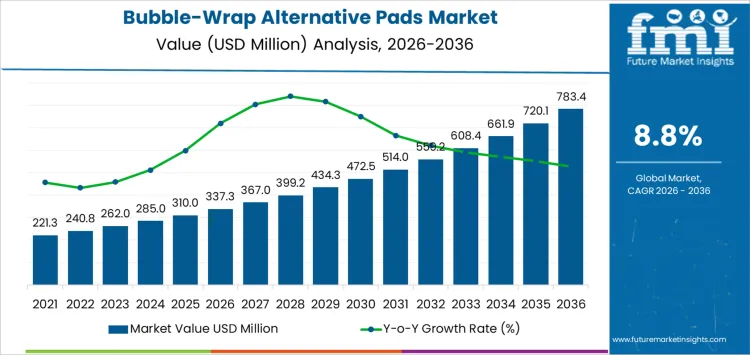
What is the Growth Forecast for the Bubble-Wrap Alternative Pads Market through 2036?
From 2026 to 2031, the bubble-wrap alternative pads market grows from USD 337.3 million to about USD 472.5 million, marking a clear shift from trial adoption toward operational use. Growth in this phase is driven by packaging engineers testing shock-absorption performance, stackability, and line compatibility in e-commerce fulfillment and consumer electronics shipping. Early demand concentrates among high-volume shippers seeking space efficiency and consistent cushioning. YeAR-on-year gains widen as pad formats are standardized, automation fit improves, and damage-rate benchmarks validate performance against traditional bubble wrap.
Between 2031 and 2036, the market expands from approximately USD 472.5 million to USD 783.4 million, indicating a stronger acceleration tied to scale rather than experimentation. Adoption broadens across third-party logistics providers, subscription commerce, and export packaging where pad density and pallet efficiency matter. Growth is reinforced by higher usage per shipment, wider SKU coverage, and repeat procurement as packaging programs lock in alternative pads as default protective materials. Earlier growth reflected qualification and conversion, while later expansion is driven by network-wide rollout, higher throughput environments, and embedded use across standardized packaging operations.
Bubble Wrap Alternative Pads Market Key Takeaways
| Metric | Value |
|---|---|
| Market Value (2026) | USD 337.3 million |
| Forecast Value (2036) | USD 783.4 million |
| Forecast CAGR (2026–2036) | 8.8% |
How Are Protective Packaging Redesigns Driving the Bubble-Wrap Alternative Pads Market from 2026 to 2036?
Bubble-wrap alternative pads gained traction as shippers and manufacturers reconsidered traditional plastic cushioning in parcel and product packaging. Electronics, home goods, cosmetics, and subscription box operators adopted paper-based, molded fiber, or honeycomb pads to protect items during handling. Historical demand reflected growth in e-commerce and rising damage sensitivity during last-mile delivery. Packaging teams selected alternatives that provided shock absorption, surface protection, and pack-out efficiency. Adoption depended on compatibility with manual and semi-automated packing operations and predictable cushioning performance under compression and vibration.
From 2026 to 2036 demand is expected to expand with further optimisation of parcel packaging and material reduction strategies. Brands seek pads that deliver consistent protection with lower material volume and easier disposal. Growth aligns with increased direct-to-consumer shipping and standardisation of box sizes. Manufacturers refine pad geometry to improve energy absorption and nesting efficiency. Buyers evaluate protection ratings, pack speed impact, and recyclability. Demand reflects logistics stress testing, retailer packaging requirements, and ongoing redesign of protective packaging systems.
What Is the Demand for the Bubble-Wrap Alternative Pads Market by End Use and Packaging Format for 2026 to 2036?
From 2026 to 2036, the bubble-wrap alternative pads market expands as shippers reduce plastic cushioning and adopt fiber-based protective solutions. E-commerce packaging accounts for 45% of end-use demand as parcel volumes rise and damage prevention remains critical during last-mile delivery. Cushioning pads lead packaging format adoption with a 48% share because they offer flexible protection across varied box sizes while integrating easily into automated packing lines. Demand reflects operational need for lightweight, space-efficient protection that supports high-throughput fulfillment environments.
Why does e-commerce package account for 45% of demand in the bubble-wrap alternative pads market by end use from 2026 to 2036?
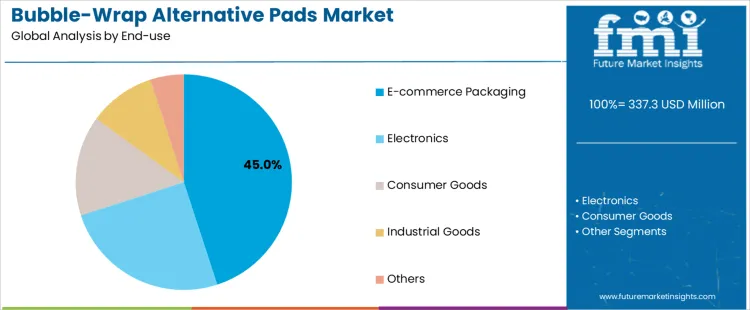
E-commerce packaging accounts for 45% of demand because parcels experience multiple handling points, vibration exposure, and drop risk during transit. Consumption intensity remains high across apparel, home goods, cosmetics, and small appliances shipped through parcel networks. Usage stays steady as fulfillment centers require fast cushioning solutions that adapt to different product geometries without slowing packing speed. Procurement decisions emphasize pads that provide consistent shock absorption while minimizing void fill volume. Buyers favor materials that reduce box weight and support dimensional efficiency. Price sensitivity remains moderate since damage reduction and return avoidance outweigh packaging unit cost. Specification control focuses on compression recovery, tear resistance, and compatibility with automated packing stations. Demand continues from 2026 to 2036 as online retail penetration grows and brands standardize fiber-based cushioning for outbound shipments. Repeat utilization remains predictable due to continuous order flow and standardized packaging workflows.
Why do cushioning pads represent 48% of demand in the bubble-wrap alternative pads market by packaging format from 2026 to 2036?
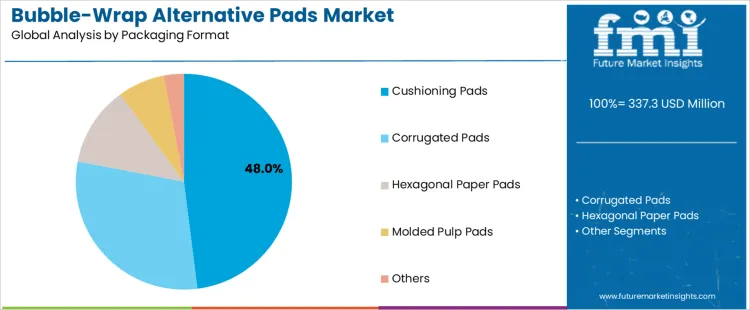
Cushioning pads represent 48% of demand because they deliver broad surface protection while remaining easy to place and remove during packing. Consumption is strong in operations handling mixed product assortments where uniform protection formats simplify inventory management. Usage remains steady as pads conform around products and absorb impact without requiring complex assembly. Procurement favors formats that stack flat, reduce storage space, and deploy quickly at pack stations. Buyers prioritize pads with reliable rebound characteristics and consistent thickness across batches. Price sensitivity stays moderate as cushioning performance directly influences product integrity during shipment. Specification control emphasizes fiber density, edge durability, and resistance to tearing under compression. Demand persists from 2026 to 2036 as logistics operators favor cushioning pads that replace plastic bubble wrap while maintaining protection standards across diverse shipping profiles.
How Are Bubble Wrap Alternative Pads Being Applied Across Packaging and Fulfillment Operations?
Use expands in shipping environments where cushioning is required without traditional plastic air bubbles. E commerce fulfillment centers place pads around boxed electronics to limit surface abrasion during parcel handling. Consumer goods brands use them inside cartons to stabilize products with flat or angular profiles. Subscription services rely on pads to protect mixed items while maintaining neat presentation on opening. Export packers apply them to reduce shifting in containers during long transit periods. These applications reflect packaging decisions focused on protection consistency, space efficiency, and compatibility with automated packing processes.
What Packaging and Handling Requirements Support Use of Bubble Wrap Alternative Pads?
Selection aligns with operations seeking predictable cushioning performance and easier material handling. Warehouses favor pads that stack flat and dispense smoothly on high speed lines. Brands adopting paper based or molded fiber packaging formats use pads to maintain material alignment. Fragile items with scratch sensitive surfaces benefit from uniform contact provided by pads. Logistics teams value formats that reduce void fill volume and carton bulging. These requirements arise from packing efficiency goals, material standardization efforts, and the need for controlled protection across varied shipment profiles.
Which Practical Factors Limit Broader Reliance on Bubble Wrap Alternative Pads?
Shock absorption varies by pad structure and thickness, affecting suitability for heavy or irregular items. Some distribution routes involve drops and vibration levels that exceed pad protection capacity. Unit costs can be higher than basic bubble wrap for high volume shippers. Storage space is required for flat pads at scale. Packing staff may need adjustments to placement techniques. Compatibility with flexible mailers remains limited. These factors lead to selective adoption where protection needs, cost tolerance, and packing workflows align.
What is the Demand for Bubble Wrap Alternative Pads by Country?
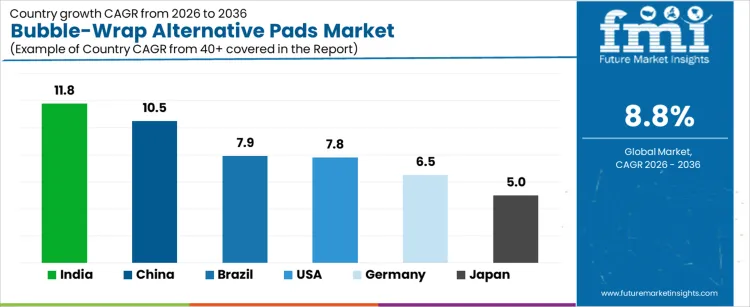
| Country | CAGR (%) |
|---|---|
| USA | 7.8% |
| Germany | 6.5% |
| China | 10.5% |
| India | 11.8% |
| Brazil | 7.9% |
| Japan | 5.0% |
The demand for bubble wrap alternative pads varies across countries based on shipping intensity, packaging preferences, and material substitution trends. India leads with an 11.80% CAGR, supported by rapid growth in e commerce shipments and increasing use of paper based protective packaging. China follows at 10.50%, driven by large scale logistics operations and export oriented packaging demand. Brazil records 7.90%, reflecting expansion in online retail and protective packaging use. The USA grows at 7.80%, supported by established distribution networks adopting alternative cushioning formats. Germany posts 6.50%, shaped by structured packaging standards and steady industrial shipments. Japan records 5.00%, reflecting mature logistics systems and stable demand for protective packaging solutions.
How Is Protective Packaging Substitution Driving Adoption in the United States?
In the United States, revenue from the Bubble Wrap Alternative Pads Market is expanding at a CAGR of 7.80% through 2035, driven by packaging substitution across e commerce, consumer goods, and industrial shipments. Shippers are replacing traditional bubble wrap with paper based and molded fiber pads to achieve cushioning performance while meeting retailer material guidelines. Demand is concentrated in direct to consumer fulfillment, electronics accessories, and subscription packaging. Domestic converters supply standardized pad formats compatible with automated packing systems. Stable shipment volumes and recurring packaging replenishment cycles are sustaining consistent procurement across logistics operators and brand owners nationwide.
- E commerce fulfillment drives cushioning pad usage.
- Retail material guidelines support alternative adoption.
- Domestic converters ensure scalable production.
- Automated packing compatibility sustains demand.
How Do Packaging Compliance Practices Support Growth in Germany?
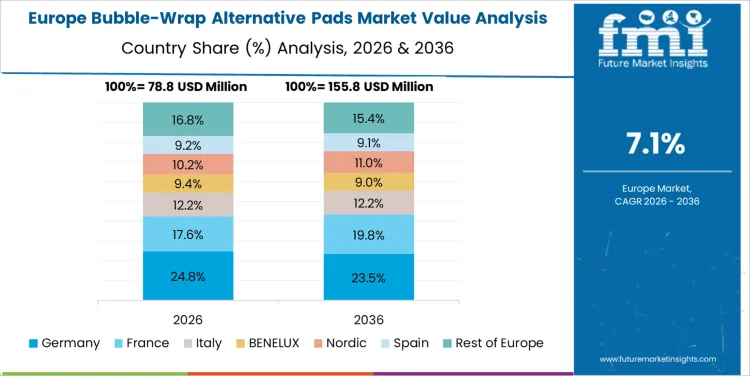
Germany continues to record measured expansion in the Bubble Wrap Alternative Pads Market at a CAGR of 6.50% through 2035, supported by structured packaging compliance practices and export oriented shipping needs. Manufacturers use alternative pads to protect goods during transport while aligning with material recovery requirements. Demand remains focused on industrial components, consumer appliances, and cross border shipments. Technical expertise in paper processing supports consistent cushioning performance. Stable export volumes and long term supplier relationships are sustaining predictable procurement across domestic packaging and logistics operations.
- Export shipments support protective pad demand.
- Compliance focused packaging drives material shifts.
- Technical expertise ensures performance reliability.
- Long term contracts stabilize procurement volumes.
How Is E Commerce Logistics Expansion Accelerating Growth in China?
In China, revenue from the Bubble Wrap Alternative Pads Market is growing at a CAGR of 10.50% through 2035, driven by rapid expansion of e commerce logistics and high parcel shipment volumes. Fulfillment centers are adopting alternative pads to reduce material complexity while maintaining product protection standards. Demand is strong across consumer electronics, household goods, and apparel shipments. Domestic manufacturers are scaling capacity to supply cost efficient cushioning solutions. High throughput distribution networks and structured procurement practices are sustaining rapid adoption across major logistics hubs nationwide.
- Parcel volume growth drives cushioning demand.
- Fulfillment centers support large scale adoption.
- Domestic capacity expansion improves availability.
- Cost efficiency supports material substitution.
How Is Organized Retail Distribution Supporting Growth in India?
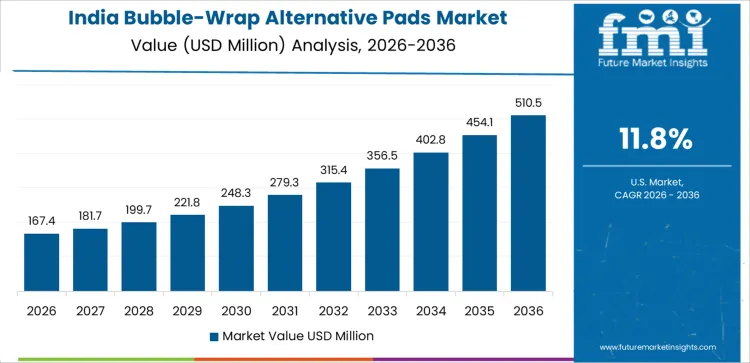
India is witnessing strong expansion in the Bubble Wrap Alternative Pads Market at a CAGR of 11.80% through 2035, supported by growth in organized retail distribution and e commerce shipments. Sellers are adopting alternative pads to protect products during transit across fragmented logistics networks. Demand is rising across electronics, home goods, and personal care shipments. Domestic converters provide cost aligned pad solutions suited to variable packaging requirements. Expanding warehouse infrastructure and rising parcel volumes are sustaining steady procurement across urban logistics and fulfillment centers nationwide.
- E commerce shipment growth supports pad adoption.
- Transit protection needs drive usage.
- Domestic converters improve cost access.
- Warehouse expansion sustains demand growth.
How Are Consumer Goods Shipments Driving Adoption in Brazil?
Brazil is seeing steady growth in the Bubble Wrap Alternative Pads Market at a CAGR of 7.90% through 2035, supported by rising consumer goods shipments and packaged product distribution. Shippers are using alternative pads to protect goods during regional transport while managing packaging costs. Demand is concentrated in electronics, household items, and specialty retail shipments. Imports supply some specialized materials, while local converters expand basic pad production. Growth in organized distribution channels is sustaining recurring procurement across logistics operators nationwide.
- Consumer goods shipments support pad usage.
- Cost management drives material substitution.
- Imports supply specialized cushioning needs.
- Distribution expansion sustains procurement activity.
How Does Mature Logistics Infrastructure Shape Demand in Japan?
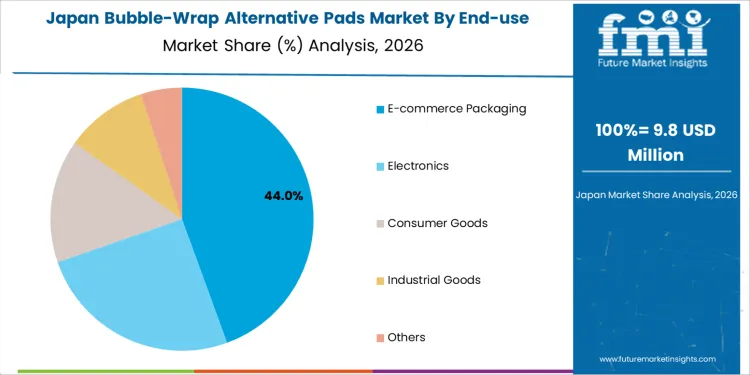
Japan is maintaining stable growth in the Bubble Wrap Alternative Pads Market at a CAGR of 5.00% through 2035, supported by mature logistics infrastructure and consistent packaging performance expectations. Shippers apply alternative pads selectively to protect precision goods and consumer products. Demand remains focused on electronics, appliances, and mail order shipments. Domestic suppliers emphasize dimensional accuracy and material consistency. Stable shipment volumes and replacement driven purchasing are sustaining predictable procurement across established logistics and distribution operations nationwide.
- Precision goods shipments anchor baseline demand.
- Quality focused packaging supports selective adoption.
- Domestic suppliers ensure reliable specifications.
- Replacement cycles sustain procurement consistency.
What Is Driving the Demand for Bubble Wrap Alternative Pads and Which Packaging Companies Influence Protective Design?
Bubble wrap alternative pads are gaining adoption as shippers reduce reliance on plastic air filled materials while maintaining impact protection during transit. E commerce fulfillment, electronics shipping, cosmetics distribution, and subscription box packaging drive steady demand for paper based and hybrid cushioning pads. Sealed Air participates through fiber based protective formats that extend its protective packaging portfolio beyond traditional air cushions. DS Smith supports adoption through paper cushioning pads engineered for shock absorption in parcel shipping. YUTO Packaging contributes through custom die cut pads used in premium retail and electronics packaging. Klabin supplies kraft based materials used in corrugated compatible cushioning solutions. These alternatives integrate easily into existing packing workflows while improving recyclability perception.
Pad selection is guided by compression resistance, vibration dampening, pack out efficiency, and compatibility with automated packing lines. UFlex supports coated and laminated pad structures used where moisture resistance is required. Toppan contributes through printed and structured inserts that combine protection with branding elements. Fulfillment operators favor pads that reduce void fill volume and speed up packing. Brand owners emphasize clean unboxing and easy disposal for consumers. Usage spans fragile consumer goods, glass containers, small appliances, and high value gift shipments. Demand visibility tracks growth in parcel volumes, retailer plastic reduction commitments, and continued innovation in paper based protective packaging across logistics and direct to consumer channels.
Key Players in the Bubble Wrap Alternative Pads Market
- Sealed Air
- DS Smith
- YUTO Packaging
- UFlex
- Klabin
- Toppan
Scope of the Report
| Items | Values |
|---|---|
| Quantitative Units (2026) | USD million |
| End Use | E-commerce Packaging; Electronics; Consumer Goods; Industrial Goods; Other End Uses |
| Packaging Format | Cushioning Pads; Corrugated Pads; Hexagonal Paper Pads; Molded Pulp Pads; Other Formats |
| Material | Molded Fiber; Kraft Paper; Paper-Honeycomb; Bagasse Fiber; Other Materials |
| Technology | Airless Cushion Technology; Precision Die-Cut; High-Speed Folding; Pulp Thermoforming; Other Technologies |
| Regions Covered | Asia Pacific; Europe; North America; Latin America; Middle East and Africa |
| Countries Covered | China; Japan; South Korea; India; Australia and New Zealand; ASEAN; Germany; United Kingdom; France; Italy; Spain; Nordic; BENELUX; United States; Canada; Mexico; Brazil; Chile; Kingdom of Saudi Arabia; Turkey; South Africa; plus additional countries across Asia Pacific, Europe, Latin America, and Middle East and Africa |
| Key Companies Profiled | Sealed Air; DS Smith; YUTO Packaging; UFlex; Klabin; Toppan |
| Additional Attributes | Dollar by sales across end uses and packaging formats; replacement of plastic bubble wrap with fiber-based and airless cushioning pads in e-commerce and electronics shipping; role of cushioning pads in shock absorption, vibration dampening, and surface protection during parcel handling; use of precision die-cutting and high-speed folding to support standardized pad geometries and throughput scaling; integration of alternative pads into automated and semi-automated packing lines; influence of parcel volume growth and standardized box sizes on repeat procurement; alignment of pad selection with pack-out efficiency, space utilization, and recyclability requirements |
Bubble Wrap Alternative Pads Market Segmentation
End-use
- E-commerce Packaging
- Electronics
- Consumer Goods
- Industrial Goods
- Others
Packaging Format
- Cushioning Pads
- Corrugated Pads
- Hexagonal Paper Pads
- Molded Pulp Pads
- Others
Material
- Molded Fiber
- Kraft Paper
- Paper-Honeycomb
- Bagasse Fiber
- Others
Technology
- Airless Cushion Tech
- Precision Die-Cut
- High-Speed Folding
- Pulp Thermoforming
- Others
Region
- Asia Pacific
- China
- Japan
- South Korea
- India
- Australia & New Zealand
- ASEAN
- Rest of Asia Pacific
- Europe
- Germany
- United Kingdom
- France
- Italy
- Spain
- Nordic
- BENELUX
- Rest of Europe
- North America
- United States
- Canada
- Mexico
- Latin America
- Brazil
- Chile
- Rest of Latin America
- Middle East & Africa
- Kingdom of Saudi Arabia
- Other GCC Countries
- Turkey
- South Africa
- Other African Union
- Rest of Middle East & Africa
Frequently Asked Questions
How big is the bubble-wrap alternative pads market in 2026?
The global bubble-wrap alternative pads market is estimated to be valued at USD 337.3 million in 2026.
What will be the size of bubble-wrap alternative pads market in 2036?
The market size for the bubble-wrap alternative pads market is projected to reach USD 783.4 million by 2036.
How much will be the bubble-wrap alternative pads market growth between 2026 and 2036?
The bubble-wrap alternative pads market is expected to grow at a 8.8% CAGR between 2026 and 2036.
What are the key product types in the bubble-wrap alternative pads market?
The key product types in bubble-wrap alternative pads market are e-commerce packaging, electronics, consumer goods, industrial goods and others.
Which packaging format segment to contribute significant share in the bubble-wrap alternative pads market in 2026?
In terms of packaging format, cushioning pads segment to command 48.0% share in the bubble-wrap alternative pads market in 2026.
Preview the report firsthand - request a free sample
Get SampleGet the brochure for pricing and purchase details.
Get PDFTable of Content
- Executive Summary
- Global Market Outlook
- Demand-side Trends
- Supply-side Trends
- Technology Roadmap Analysis
- Analysis and Recommendations
- Market Overview
- Market Coverage / Taxonomy
- Market Definition / Scope / Limitations
- Market Background
- Market Dynamics
- Drivers
- Restraints
- Opportunity
- Trends
- Scenario Forecast
- Demand in Optimistic Scenario
- Demand in Likely Scenario
- Demand in Conservative Scenario
- Opportunity Map Analysis
- Product Life Cycle Analysis
- Supply Chain Analysis
- Investment Feasibility Matrix
- Value Chain Analysis
- PESTLE and Porter’s Analysis
- Regulatory Landscape
- Regional Parent Market Outlook
- Production and Consumption Statistics
- Import and Export Statistics
- Market Dynamics
- Global Market Analysis 2021 to 2025 and Forecast, 2026 to 2036
- Historical Market Size Value (USD Million) Analysis, 2021 to 2025
- Current and Future Market Size Value (USD Million) Projections, 2026 to 2036
- Y-o-Y Growth Trend Analysis
- Absolute $ Opportunity Analysis
- Global Market Pricing Analysis 2021 to 2025 and Forecast 2026 to 2036
- Global Market Analysis 2021 to 2025 and Forecast 2026 to 2036, By End-use
- Introduction / Key Findings
- Historical Market Size Value (USD Million) Analysis By End-use , 2021 to 2025
- Current and Future Market Size Value (USD Million) Analysis and Forecast By End-use , 2026 to 2036
- E-commerce Packaging
- Electronics
- Consumer Goods
- Industrial Goods
- Others
- Y-o-Y Growth Trend Analysis By End-use , 2021 to 2025
- Absolute $ Opportunity Analysis By End-use , 2026 to 2036
- Global Market Analysis 2021 to 2025 and Forecast 2026 to 2036, By Packaging Format
- Introduction / Key Findings
- Historical Market Size Value (USD Million) Analysis By Packaging Format, 2021 to 2025
- Current and Future Market Size Value (USD Million) Analysis and Forecast By Packaging Format, 2026 to 2036
- Cushioning Pads
- Corrugated Pads
- Hexagonal Paper Pads
- Molded Pulp Pads
- Others
- Y-o-Y Growth Trend Analysis By Packaging Format, 2021 to 2025
- Absolute $ Opportunity Analysis By Packaging Format, 2026 to 2036
- Global Market Analysis 2021 to 2025 and Forecast 2026 to 2036, By Material
- Introduction / Key Findings
- Historical Market Size Value (USD Million) Analysis By Material, 2021 to 2025
- Current and Future Market Size Value (USD Million) Analysis and Forecast By Material, 2026 to 2036
- Molded Fiber
- Kraft Paper
- Paper-Honeycomb
- Bagasse Fiber
- Others
- Y-o-Y Growth Trend Analysis By Material, 2021 to 2025
- Absolute $ Opportunity Analysis By Material, 2026 to 2036
- Global Market Analysis 2021 to 2025 and Forecast 2026 to 2036, By Technology
- Introduction / Key Findings
- Historical Market Size Value (USD Million) Analysis By Technology, 2021 to 2025
- Current and Future Market Size Value (USD Million) Analysis and Forecast By Technology, 2026 to 2036
- Airless Cushion Tech
- Precision Die-Cut
- High-Speed Folding
- Pulp Thermoforming
- Others
- Y-o-Y Growth Trend Analysis By Technology, 2021 to 2025
- Absolute $ Opportunity Analysis By Technology, 2026 to 2036
- Global Market Analysis 2021 to 2025 and Forecast 2026 to 2036, By Region
- Introduction
- Historical Market Size Value (USD Million) Analysis By Region, 2021 to 2025
- Current Market Size Value (USD Million) Analysis and Forecast By Region, 2026 to 2036
- North America
- Latin America
- Western Europe
- Eastern Europe
- East Asia
- South Asia and Pacific
- Middle East & Africa
- Market Attractiveness Analysis By Region
- North America Market Analysis 2021 to 2025 and Forecast 2026 to 2036, By Country
- Historical Market Size Value (USD Million) Trend Analysis By Market Taxonomy, 2021 to 2025
- Market Size Value (USD Million) Forecast By Market Taxonomy, 2026 to 2036
- By Country
- USA
- Canada
- Mexico
- By End-use
- By Packaging Format
- By Material
- By Technology
- By Country
- Market Attractiveness Analysis
- By Country
- By End-use
- By Packaging Format
- By Material
- By Technology
- Key Takeaways
- Latin America Market Analysis 2021 to 2025 and Forecast 2026 to 2036, By Country
- Historical Market Size Value (USD Million) Trend Analysis By Market Taxonomy, 2021 to 2025
- Market Size Value (USD Million) Forecast By Market Taxonomy, 2026 to 2036
- By Country
- Brazil
- Chile
- Rest of Latin America
- By End-use
- By Packaging Format
- By Material
- By Technology
- By Country
- Market Attractiveness Analysis
- By Country
- By End-use
- By Packaging Format
- By Material
- By Technology
- Key Takeaways
- Western Europe Market Analysis 2021 to 2025 and Forecast 2026 to 2036, By Country
- Historical Market Size Value (USD Million) Trend Analysis By Market Taxonomy, 2021 to 2025
- Market Size Value (USD Million) Forecast By Market Taxonomy, 2026 to 2036
- By Country
- Germany
- UK
- Italy
- Spain
- France
- Nordic
- BENELUX
- Rest of Western Europe
- By End-use
- By Packaging Format
- By Material
- By Technology
- By Country
- Market Attractiveness Analysis
- By Country
- By End-use
- By Packaging Format
- By Material
- By Technology
- Key Takeaways
- Eastern Europe Market Analysis 2021 to 2025 and Forecast 2026 to 2036, By Country
- Historical Market Size Value (USD Million) Trend Analysis By Market Taxonomy, 2021 to 2025
- Market Size Value (USD Million) Forecast By Market Taxonomy, 2026 to 2036
- By Country
- Russia
- Poland
- Hungary
- Balkan & Baltic
- Rest of Eastern Europe
- By End-use
- By Packaging Format
- By Material
- By Technology
- By Country
- Market Attractiveness Analysis
- By Country
- By End-use
- By Packaging Format
- By Material
- By Technology
- Key Takeaways
- East Asia Market Analysis 2021 to 2025 and Forecast 2026 to 2036, By Country
- Historical Market Size Value (USD Million) Trend Analysis By Market Taxonomy, 2021 to 2025
- Market Size Value (USD Million) Forecast By Market Taxonomy, 2026 to 2036
- By Country
- China
- Japan
- South Korea
- By End-use
- By Packaging Format
- By Material
- By Technology
- By Country
- Market Attractiveness Analysis
- By Country
- By End-use
- By Packaging Format
- By Material
- By Technology
- Key Takeaways
- South Asia and Pacific Market Analysis 2021 to 2025 and Forecast 2026 to 2036, By Country
- Historical Market Size Value (USD Million) Trend Analysis By Market Taxonomy, 2021 to 2025
- Market Size Value (USD Million) Forecast By Market Taxonomy, 2026 to 2036
- By Country
- India
- ASEAN
- Australia & New Zealand
- Rest of South Asia and Pacific
- By End-use
- By Packaging Format
- By Material
- By Technology
- By Country
- Market Attractiveness Analysis
- By Country
- By End-use
- By Packaging Format
- By Material
- By Technology
- Key Takeaways
- Middle East & Africa Market Analysis 2021 to 2025 and Forecast 2026 to 2036, By Country
- Historical Market Size Value (USD Million) Trend Analysis By Market Taxonomy, 2021 to 2025
- Market Size Value (USD Million) Forecast By Market Taxonomy, 2026 to 2036
- By Country
- Kingdom of Saudi Arabia
- Other GCC Countries
- Turkiye
- South Africa
- Other African Union
- Rest of Middle East & Africa
- By End-use
- By Packaging Format
- By Material
- By Technology
- By Country
- Market Attractiveness Analysis
- By Country
- By End-use
- By Packaging Format
- By Material
- By Technology
- Key Takeaways
- Key Countries Market Analysis
- USA
- Pricing Analysis
- Market Share Analysis, 2025
- By End-use
- By Packaging Format
- By Material
- By Technology
- Canada
- Pricing Analysis
- Market Share Analysis, 2025
- By End-use
- By Packaging Format
- By Material
- By Technology
- Mexico
- Pricing Analysis
- Market Share Analysis, 2025
- By End-use
- By Packaging Format
- By Material
- By Technology
- Brazil
- Pricing Analysis
- Market Share Analysis, 2025
- By End-use
- By Packaging Format
- By Material
- By Technology
- Chile
- Pricing Analysis
- Market Share Analysis, 2025
- By End-use
- By Packaging Format
- By Material
- By Technology
- Germany
- Pricing Analysis
- Market Share Analysis, 2025
- By End-use
- By Packaging Format
- By Material
- By Technology
- UK
- Pricing Analysis
- Market Share Analysis, 2025
- By End-use
- By Packaging Format
- By Material
- By Technology
- Italy
- Pricing Analysis
- Market Share Analysis, 2025
- By End-use
- By Packaging Format
- By Material
- By Technology
- Spain
- Pricing Analysis
- Market Share Analysis, 2025
- By End-use
- By Packaging Format
- By Material
- By Technology
- France
- Pricing Analysis
- Market Share Analysis, 2025
- By End-use
- By Packaging Format
- By Material
- By Technology
- India
- Pricing Analysis
- Market Share Analysis, 2025
- By End-use
- By Packaging Format
- By Material
- By Technology
- ASEAN
- Pricing Analysis
- Market Share Analysis, 2025
- By End-use
- By Packaging Format
- By Material
- By Technology
- Australia & New Zealand
- Pricing Analysis
- Market Share Analysis, 2025
- By End-use
- By Packaging Format
- By Material
- By Technology
- China
- Pricing Analysis
- Market Share Analysis, 2025
- By End-use
- By Packaging Format
- By Material
- By Technology
- Japan
- Pricing Analysis
- Market Share Analysis, 2025
- By End-use
- By Packaging Format
- By Material
- By Technology
- South Korea
- Pricing Analysis
- Market Share Analysis, 2025
- By End-use
- By Packaging Format
- By Material
- By Technology
- Russia
- Pricing Analysis
- Market Share Analysis, 2025
- By End-use
- By Packaging Format
- By Material
- By Technology
- Poland
- Pricing Analysis
- Market Share Analysis, 2025
- By End-use
- By Packaging Format
- By Material
- By Technology
- Hungary
- Pricing Analysis
- Market Share Analysis, 2025
- By End-use
- By Packaging Format
- By Material
- By Technology
- Kingdom of Saudi Arabia
- Pricing Analysis
- Market Share Analysis, 2025
- By End-use
- By Packaging Format
- By Material
- By Technology
- Turkiye
- Pricing Analysis
- Market Share Analysis, 2025
- By End-use
- By Packaging Format
- By Material
- By Technology
- South Africa
- Pricing Analysis
- Market Share Analysis, 2025
- By End-use
- By Packaging Format
- By Material
- By Technology
- USA
- Market Structure Analysis
- Competition Dashboard
- Competition Benchmarking
- Market Share Analysis of Top Players
- By Regional
- By End-use
- By Packaging Format
- By Material
- By Technology
- Competition Analysis
- Competition Deep Dive
- DS Smith
- Overview
- Product Portfolio
- Profitability by Market Segments (Product/Age /Sales Channel/Region)
- Sales Footprint
- Strategy Overview
- Marketing Strategy
- Product Strategy
- Channel Strategy
- YUTO Packaging
- UFlex
- Klabin
- Toppan
- DS Smith
- Competition Deep Dive
- Assumptions & Acronyms Used
- Research Methodology


