

- Industry Size (2026)
- USD 560 Mn
- Forecast (2036)
- USD 1420 Mn
- CAGR (2026 to 2036)
- 9.8%
Closed-Loop On-Premise Beverage Packaging for Hospitality and Events Market Forecast and Outlook 2026 to 2036
The closed-loop on-premise beverage packaging for hospitality and events market is expected to grow from USD 560 million in 2026 to USD 1,420 million by 2036, reflecting a compound annual growth rate (CAGR) of 9.8%. Closed-loop packaging systems are designed to enhance sustainability by allowing beverage containers to be reused and recycled within a closed supply chain, reducing waste and improving efficiency. This is particularly important in the hospitality and events sectors, where large volumes of beverages are served, and reducing the environmental impact of packaging is a key concern. The increasing trend towards sustainability and the adoption of circular economy practices across industries are driving the demand for closed-loop packaging solutions.
The growth of this market is supported by the rising demand for environmentally friendly solutions in the hospitality industry, as consumers and businesses increasingly prioritize sustainability. In addition, regulatory pressure to reduce single-use plastics and promote recycling is encouraging the adoption of closed-loop systems. As the hospitality and events industries strive to align with global sustainability goals, the adoption of closed-loop beverage packaging systems is expected to accelerate, driving further market expansion.
Quick Stats of the Closed-Loop On-Premise Beverage Packaging for Hospitality and Events Market
- Closed-Loop On-Premise Beverage Packaging for Hospitality and Events Market Value (2026): USD 560 million
- Closed-Loop On-Premise Beverage Packaging for Hospitality and Events Market Forecast Value (2036): USD 1,420 million
- Closed-Loop On-Premise Beverage Packaging for Hospitality and Events Market Global Forecast CAGR (2026-2036): 9.8%
- Closed-Loop On-Premise Beverage Packaging for Hospitality and Events Market Leading Segment: Packaging Format (Reusable cups, kegs, and trays) 45%
- Key Growth Regions in Closed-Loop On-Premise Beverage Packaging for Hospitality and Events Market: China
- Top Players in Closed-Loop On-Premise Beverage Packaging for Hospitality and Events Market: CupConcept, Huhtamaki, Zhejiang reusable packaging OEMs, Schoeller Allibert, Vytal, Cambro
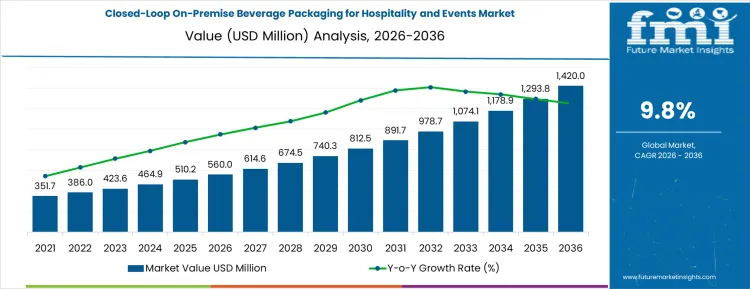
What is the Growth Forecast for the Closed-Loop On-Premise Beverage Packaging for Hospitality and Events Market through 2036?
The compound absolute growth analysis for the closed-loop on-premise beverage packaging market shows consistent growth over the forecast period, with significant expansion in the later years. Starting at USD 560 million in 2026, the market grows to USD 616.5 million in 2027 and USD 679.6 million in 2028. This gradual increase in the early years reflects initial adoption as the hospitality industry begins to shift towards more sustainable beverage packaging solutions in response to consumer preferences and environmental regulations.
From 2028 to 2030, the market continues to expand steadily, reaching USD 748.9 million in 2029 and USD 824.8 million in 2030. During this period, closed-loop systems are increasingly recognized for their ability to improve operational efficiency, reduce waste, and enhance the sustainability profile of hospitality businesses. Between 2030 and 2035, the market experiences stronger growth, reaching USD 908.2 million in 2031, USD 999.8 million in 2032, and USD 1,100.6 million in 2033, driven by broader adoption across hospitality venues and large-scale events.
By 2035, the market is projected to reach USD 1,211.9 million, with the final market value of USD 1,420 million expected in 2036. The compound absolute growth analysis highlights the strong acceleration of the market as the industry adopts more sustainable packaging solutions and aligns with broader environmental objectives. This growth is driven by the increasing preference for circular economy practices, innovations in packaging technology, and the ongoing global push towards reducing packaging waste.
Closed-Loop On-Premise Beverage Packaging for Hospitality and Events Market Key Takeaways
| Metric | Value |
|---|---|
| Industry Sales Value (2026) | USD 560 million |
| Industry Forecast Value (2036) | USD 1,420 million |
| Industry Forecast CAGR (2026-2036) | 9.8% |
What Is Driving the Demand for Closed Loop On Premise Beverage Packaging for Hospitality and Events Globally?
The global demand for closed loop on premise beverage packaging solutions in hospitality and events is driven by rising sustainability imperatives, regulatory pressure on single use containers, and evolving consumer expectations for environmentally responsible experiences. Traditional beverage service models in bars, restaurants, festivals, and large gatherings have relied heavily on disposable bottles, cans, cups, and kegs that contribute to significant waste streams and logistical costs for disposal or recycling. Closed loop systems, in which reusable vessels and containers are collected, cleaned, and returned for repeated use, help hospitality operators reduce both material waste and procurement expenditures. These systems support circularity by keeping packaging in active service rather than sending materials to landfills or recycling facilities, where recovery rates and material quality can be inconsistent. Regulatory frameworks in many regions now include restrictions on single use plastics and incentives for reuse models, pushing venues and event organisers to adopt packaging formats and reuse infrastructure that align with waste reduction mandates and extended producer responsibility policies. At the same time, consumers - especially younger and more environmentally conscious cohorts - increasingly expect live events, dining experiences, and hospitality brands to demonstrate tangible sustainability action, making reusable beverage packaging a visible and impactful differentiator.
Future demand for closed loop on premise beverage packaging for hospitality and events is expected to grow as industry stakeholders prioritise circular operations and cost effectiveness at scale. Technological advances in durable materials, modular vessel design, and automated cleaning and sanitisation systems will make reuse more operationally efficient and hygienic, reducing labour and turnaround time while ensuring food safety standards are met. Integration with digital tracking and return incentives, such as QR codes and loyalty programmes, will help venues manage container inventories and encourage customer participation in reuse schemes. Growth in live entertainment, festivals, cultural events, and experiential hospitality formats will expand the volume of beverages served on site, reinforcing the value of systems that reduce dependence on disposable packaging. As hospitality chains and event organisers set carbon reduction and waste diversion targets, procurement policies are expected to favour packaging suppliers that can support closed loop reuse and data reporting for environmental audits. The development of shared infrastructure for collection and redistribution in urban centres and event districts will further lower barriers to adoption. As regulation, consumer preference, and corporate sustainability strategies converge, closed loop on premise beverage packaging is poised to expand steadily across regions, supporting environmental goals while enhancing brand reputation and operational resiliency.
What is the Segment Analysis for the Closed-Loop On-Premise Beverage Packaging for Hospitality and Events Market?
The closed-loop on-premise beverage packaging for hospitality and events market is driven by key segments based on end-use applications and packaging formats. Festivals, events, and stadiums lead the market, accounting for 42% of the share, followed by bars, QSR & catering, large-scale venues, and weddings & mass events. Reusable cups, kegs, and trays dominate the packaging format segment, representing 45% of the market. This market is growing due to increasing demand for sustainable, eco-friendly packaging solutions in high-volume settings. Closed-loop systems, where packaging is reused and recycled, help reduce waste and support environmental goals. As sustainability efforts gain traction in the hospitality and events sectors, the adoption of closed-loop beverage packaging is expected to grow significantly.
What is Driving Growth in the Festivals, Events & Stadiums Segment of the Closed-Loop Beverage Packaging Market?
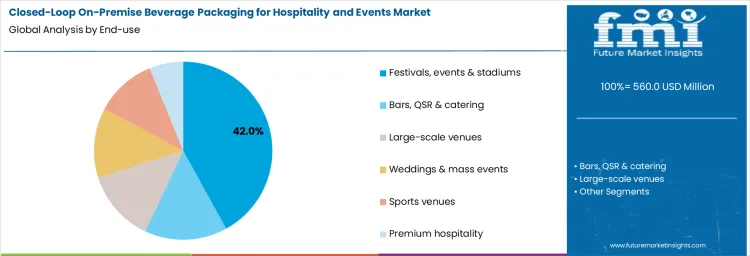
The festivals, events, and stadiums segment is the largest end-use application in the closed-loop on-premise beverage packaging market, accounting for 42% of the market share. This growth is driven by the increasing number of large-scale events, festivals, and sporting events where beverage consumption is high, and sustainability is a growing concern. Closed-loop packaging systems, such as reusable cups and kegs, are essential in these settings to reduce the massive amounts of single-use plastic waste generated during these events. The adoption of reusable packaging not only supports environmental goals but also offers cost-saving opportunities for event organizers by reducing the need for disposable items. Festivals and stadiums are increasingly adopting these solutions to align with sustainability initiatives and enhance their brand image. As eco-consciousness continues to rise among event-goers and organizers, the demand for closed-loop beverage packaging is expected to grow, positioning this segment as a key driver in the market.
What is Contributing to the Growth of Reusable Cups, Kegs & Trays in the Packaging Format Segment?
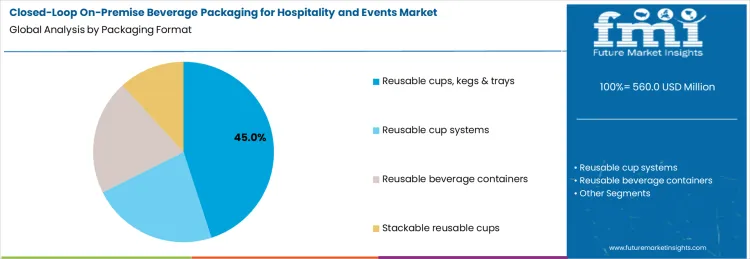
Reusable cups, kegs, and trays dominate the packaging format segment in the closed-loop on-premise beverage packaging for hospitality and events market, representing 45% of the market share. These formats are preferred for their ability to be reused multiple times, making them both cost-effective and environmentally sustainable. Reusable cups and kegs are especially popular in large venues, festivals, and events, where high volumes of beverages are served, and reducing single-use plastic waste is a priority. Additionally, reusable trays are designed for efficient beverage distribution, further contributing to operational efficiency. As sustainability becomes increasingly important for both consumers and event organizers, the adoption of reusable beverage containers is growing. These packaging formats are also supported by closed-loop systems, which ensure that the items are collected, cleaned, and returned for reuse, creating a circular system that reduces environmental impact. With the continued emphasis on waste reduction and sustainability, reusable cups, kegs, and trays are expected to remain a dominant packaging choice in the market.
What are the Key Dynamics of the Global Closed Loop On Premise Beverage Packaging for Hospitality and Events Market?
The global closed loop on premise beverage packaging for hospitality and events market is expanding as bars, restaurants, venues and event organisers adopt systems that reuse bottles, kegs, growlers and dispensers to reduce waste and cost. These systems capture, clean, refill and redistribute durable beverage packaging within defined locations or networks, supporting sustainability goals and improving operational efficiency. Growth is supported by rising demand for experiential service, regulatory focus on waste reduction, and consumer preference for environmentally responsible practices. Adoption spans foodservice chains, live event venues, hotels and destination hospitality operations seeking to minimise single use packaging footprints.
What are the Key Drivers for the Global Closed Loop On Premise Beverage Packaging for Hospitality and Events Market?
Increasing sustainability commitments by hospitality operators drive interest in closed loop packaging that cuts disposable waste and lowers material procurement costs over time. Regulations that restrict single use beverage containers and waste in urban and event settings strengthen business cases for systems that reuse durable packaging. Consumer preference for brands and venues that prioritise eco friendly practices encourages operators to invest in closed loop solutions. Advances in cleaning, sanitising and tracking technologies support safe reuse and compliance with food safety standards. Events and venues with high throughput of drinks service benefit from reduced logistical burden and improved operational visibility when packaging is returned and reused locally.
What are the Restraints for the Global Closed Loop On Premise Beverage Packaging for Hospitality and Events Market?
Operational complexity is a restraint, as closed loop systems require investment in collection, cleaning, sanitisation and asset tracking infrastructure that may be challenging for smaller venues. Costs of durable packaging, return logistics, and staff training add upfront burden that can deter early adoption where budgets are constrained. Consumer behaviour influences system effectiveness; participation in return and reuse cycles may vary by location and event type, requiring incentives and clear communication. Variability in local health and safety regulations for cleaning and reuse of beverage containers can complicate rollout and require careful compliance planning. In regions with limited support for reuse infrastructure, scaling closed loop programmes is more difficult.
What is the Key Trends in the Global Closed Loop On Premise Beverage Packaging for Hospitality and Events Market?
A key trend is use of digital tracking technologies such as QR codes, RFID tags and mobile apps that manage packaging assets, capture return data and support sanitisation workflows. Operators are adopting integrated systems that automate status updates, condition monitoring and refill scheduling to increase throughput and reduce loss. Partnerships between hospitality groups, beverage brands and reuse service providers are forming shared networks of returnable packaging that increase utilisation rates across venues and events. There is rising interest in standardised, modular packaging formats that work across drink types, venues and event scales. Growth of sustainability reporting and customer engagement programmes encourages venues to highlight closed loop achievements as part of environmental initiatives.
What is the Country-Wise Analysis of the Closed-Loop On-Premise Beverage Packaging for Hospitality and Events Market?
The closed-loop on-premise beverage packaging for hospitality and events market is expected to grow steadily, driven by increasing demand for sustainable and efficient packaging solutions in the hospitality and events industries. Closed-loop systems involve reusable packaging, reducing waste and promoting sustainability, which aligns with the growing consumer and business focus on reducing environmental impact. As the global hospitality and events sectors seek to minimize waste and comply with sustainability regulations, closed-loop packaging solutions are gaining traction. High-growth markets like India and China are experiencing rapid industrialization, urbanization, and a rising middle class, driving demand for more sustainable packaging. In developed markets like Germany and the USA, growth is fueled by a strong regulatory push and the growing need for eco-friendly packaging solutions in the hospitality and events sectors.
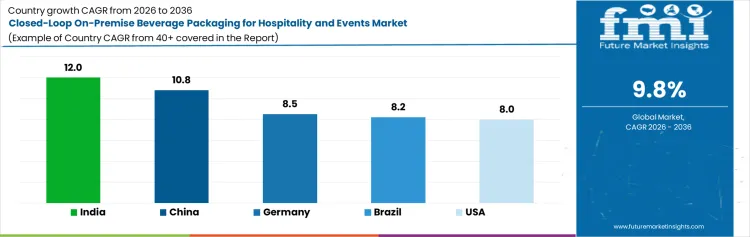
| Country | CAGR (2026-2036) |
|---|---|
| Germany | 8.5% |
| USA | 8% |
| China | 10.8% |
| India | 12% |
| Brazil | 8.2% |
What is the Growth Outlook for the Closed-Loop On-Premise Beverage Packaging for Hospitality and Events Market in Germany?
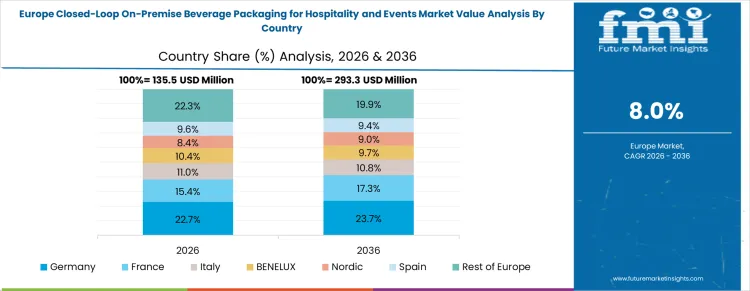
The market for closed-loop on-premise beverage packaging for hospitality and events in Germany is expected to grow at a moderate pace, with a projected CAGR of 8.5%. Germany’s strong commitment to sustainability and environmental protection is driving the adoption of closed-loop packaging systems in the hospitality and events sectors. As businesses in Germany seek to reduce waste and comply with increasingly stringent regulations, the demand for reusable and recyclable packaging solutions is growing. The German market benefits from an advanced infrastructure for waste management and recycling, making closed-loop packaging a natural fit for the hospitality industry. Additionally, consumer demand for eco-friendly solutions continues to rise, supporting the market’s steady growth in Germany.
What is the Market Outlook for the Closed-Loop On-Premise Beverage Packaging for Hospitality and Events Market in the USA?
The closed-loop on-premise beverage packaging for hospitality and events market in the United States is expected to grow at a steady pace, with a projected CAGR of 8%. The U.S. hospitality and events sectors are increasingly adopting sustainable packaging solutions as part of broader efforts to reduce waste and meet regulatory requirements. Closed-loop packaging systems, which focus on reusable containers and reduced environmental impact, are gaining popularity in industries such as foodservice, catering, and large-scale events. The demand for eco-friendly packaging is being driven by both consumer expectations and governmental regulations aimed at minimizing plastic waste. As sustainability continues to be a key priority for businesses and consumers alike, the U.S. market for closed-loop packaging in hospitality and events is poised for steady growth.
What is the Growth Forecast for the Closed-Loop On-Premise Beverage Packaging for Hospitality and Events Market in China?
The closed-loop on-premise beverage packaging for hospitality and events market in China is expected to experience significant growth, with a projected CAGR of 10.8%. China’s rapidly expanding hospitality industry, coupled with increasing consumer awareness of environmental issues, is driving the adoption of sustainable and reusable packaging solutions. The government’s growing emphasis on sustainability, particularly in reducing waste and promoting circular economy practices, is accelerating the adoption of closed-loop packaging systems. As urbanization and the middle class continue to grow, demand for eco-friendly solutions in the hospitality and events sectors is rising. These trends are expected to contribute to the robust growth of the closed-loop packaging market in China.
What is the Market Outlook for the Closed-Loop On-Premise Beverage Packaging for Hospitality and Events Market in India?
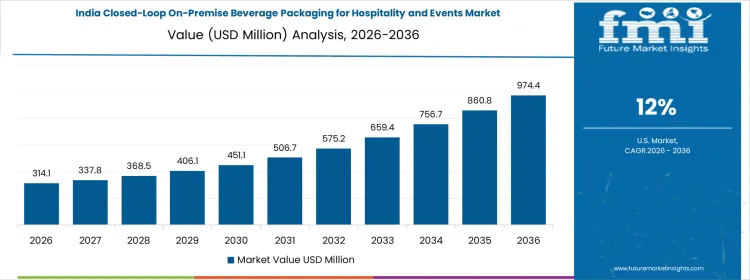
The closed-loop on-premise beverage packaging for hospitality and events market in India is projected to grow at the highest rate globally, with a CAGR of 12%. India’s booming hospitality and events industries, coupled with increasing consumer focus on sustainability, are driving the demand for closed-loop packaging systems. As the government pushes for more sustainable practices across industries, including the reduction of plastic waste, the adoption of reusable and recyclable packaging solutions is accelerating. Additionally, as India’s middle class continues to grow and demand for eco-friendly products increases, the market for closed-loop packaging is set to experience substantial growth. This shift is further supported by regulatory changes and evolving consumer behavior towards more sustainable choices.
What are the Growth Prospects for the Closed-Loop On-Premise Beverage Packaging for Hospitality and Events Market in Brazil?
The closed-loop on-premise beverage packaging for hospitality and events market in Brazil is expected to grow at a moderate pace, with a projected CAGR of 8.2%. Brazil’s hospitality and events sectors are increasingly adopting sustainable practices, including the use of closed-loop packaging systems. Consumer demand for eco-friendly solutions is rising, particularly in large-scale events, foodservice, and catering businesses. Brazil’s efforts to reduce plastic waste and improve waste management are encouraging the adoption of more sustainable packaging practices. Although market growth may be slower than in other regions, Brazil’s growing commitment to sustainability and increasing consumer awareness are expected to support steady growth in the closed-loop packaging market for hospitality and events.
What is the Competitive Landscape for the Closed-Loop On-Premise Beverage Packaging for Hospitality and Events Market?
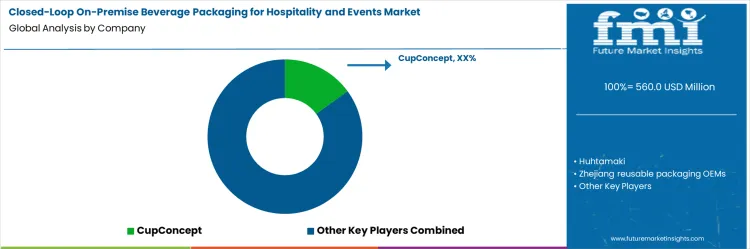
The closed-loop on-premise beverage packaging for hospitality and events market is expanding rapidly as the demand for sustainable and reusable packaging solutions grows within the foodservice industry. CupConcept leads the market with its closed-loop beverage packaging systems, providing efficient and eco-friendly solutions tailored for hospitality and event applications. Their emphasis on reusability and circular packaging systems positions them as a key player in the market. Huhtamaki, Zhejiang reusable packaging OEMs, and Schoeller Allibert are also significant competitors, each offering innovative solutions for reducing waste and enhancing the sustainability of on-premise beverage packaging. Huhtamaki specializes in sustainable and high-quality packaging, while Zhejiang reusable packaging OEMs focus on cost-effective, durable solutions for beverage service. Schoeller Allibert offers reusable packaging systems designed to meet the demands of high-volume hospitality settings.
Vytal and Cambro add further competition by offering their own advanced closed-loop beverage packaging solutions. Vytal is known for its innovative reusable container systems, catering to sustainability-conscious businesses, while Cambro focuses on durable, reusable beverage containers designed for the foodservice industry. These companies compete through their ability to offer practical, sustainable, and cost-effective packaging solutions that support the growing trend toward eco-friendly practices in hospitality and events. Their strategies focus on product innovation, ease of use, and reducing the environmental footprint of packaging in the beverage service sector.
Key Players of the Closed-Loop On-Premise Beverage Packaging for Hospitality and Events Market
- CupConcept
- Huhtamaki
- Zhejiang reusable packaging OEMs
- Schoeller Allibert
- Vytal
- Cambro
Scope of the Report
| Items | Values |
|---|---|
| Quantitative Units (2026) | USD Million |
| End-use / Application | Festivals, Events & Stadiums, Bars, QSR & Catering, Large-Scale Venues, Weddings & Mass Events, Sports Venues, Premium Hospitality |
| Packaging Format / Type | Reusable Cups, Kegs & Trays, Reusable Cup Systems, Reusable Beverage Containers, Stackable Reusable Cups, Others |
| Material | PP, Tritan, Stainless Steel, PP Blends |
| Technology | Deposit-Return Systems + Industrial Washing, RFID/QR-Enabled Reuse Tracking, Centralised Wash Hubs, Low-Cost Washing Systems |
| Companies | CupConcept, Huhtamaki, Zhejiang Reusable Packaging OEMs, Schoeller Allibert, Vytal, Cambro |
| Regions Covered | North America, Latin America, Western Europe, Eastern Europe, South Asia and Pacific, East Asia, Middle East & Africa |
| Countries Covered | United States, Canada, Mexico, Brazil, Argentina, Germany, France, United Kingdom, Italy, Spain, Netherlands, China, India, Japan, South Korea, ANZ, GCC Countries, South Africa |
| Additional Attributes | Dollar by sales by end-use/application, packaging format/type, material, technology, and region. Includes market trends in closed-loop on-premise beverage packaging, focusing on reusable cups, kegs, trays, and beverage containers. Highlights the role of deposit-return systems, RFID/QR-enabled reuse tracking, and industrial washing in festivals, events, stadiums, and hospitality sectors. Focus on sustainability, cost-effectiveness, regulatory compliance, and market share of key companies in the hospitality and events packaging sector. |
Closed-Loop On-Premise Beverage Packaging for Hospitality and Events Market Segmentation
End-use / Application:
- Festivals, events & stadium
- Bars, QSR & catering
- Large-scale venues
- Weddings & mass events
- Sports venues
- Premium hospitality
Packaging Format / Type:
- Reusable cups, kegs & trays
- Reusable cup systems
- Reusable beverage containers
- Stackable reusable cups
- Others
Material:
- PP, Tritan, stainless steel
- PP / Tritan
- PP blends
- PP
- Others
Technology
- Deposit-return systems + industrial washing
- RFID/QR-enabled reuse tracking
- Centralised wash hubs
- Low-cost washing systems
- Others
Region:
- Asia Pacific
- China
- Japan
- South Korea
- India
- Australia & New Zealand
- ASEAN
- Rest of Asia Pacific
- Europe
- Germany
- United Kingdom
- France
- Italy
- Spain
- Nordic
- BENELUX
- Rest of Europe
- North America
- United States
- Canada
- Mexico
- Latin America
- Brazil
- Chile
- Rest of Latin America
- Middle East & Africa
- Kingdom of Saudi Arabia
- Other GCC Countries
- Turkey
- South Africa
- Other African Union
- Rest of Middle East & Africa
Frequently Asked Questions
How big is the closed-loop on-premise beverage packaging for hospitality and events market in 2026?
The global closed-loop on-premise beverage packaging for hospitality and events market is estimated to be valued at USD 560.0 million in 2026.
What will be the size of closed-loop on-premise beverage packaging for hospitality and events market in 2036?
The market size for the closed-loop on-premise beverage packaging for hospitality and events market is projected to reach USD 1,420.0 million by 2036.
How much will be the closed-loop on-premise beverage packaging for hospitality and events market growth between 2026 and 2036?
The closed-loop on-premise beverage packaging for hospitality and events market is expected to grow at a 9.8% CAGR between 2026 and 2036.
What are the key product types in the closed-loop on-premise beverage packaging for hospitality and events market?
The key product types in closed-loop on-premise beverage packaging for hospitality and events market are festivals, events & stadiums, bars, qsr & catering, large-scale venues, weddings & mass events, sports venues and premium hospitality.
Which packaging format segment to contribute significant share in the closed-loop on-premise beverage packaging for hospitality and events market in 2026?
In terms of packaging format, reusable cups, kegs & trays segment to command 45.0% share in the closed-loop on-premise beverage packaging for hospitality and events market in 2026.
Preview the report firsthand - request a free sample
Get SampleGet the brochure for pricing and purchase details.
Get PDFTable of Content
- Executive Summary
- Global Market Outlook
- Demand-side Trends
- Supply-side Trends
- Technology Roadmap Analysis
- Analysis and Recommendations
- Market Overview
- Market Coverage / Taxonomy
- Market Definition / Scope / Limitations
- Market Background
- Market Dynamics
- Drivers
- Restraints
- Opportunity
- Trends
- Scenario Forecast
- Demand in Optimistic Scenario
- Demand in Likely Scenario
- Demand in Conservative Scenario
- Opportunity Map Analysis
- Product Life Cycle Analysis
- Supply Chain Analysis
- Investment Feasibility Matrix
- Value Chain Analysis
- PESTLE and Porter’s Analysis
- Regulatory Landscape
- Regional Parent Market Outlook
- Production and Consumption Statistics
- Import and Export Statistics
- Market Dynamics
- Global Market Analysis 2021 to 2025 and Forecast, 2026 to 2036
- Historical Market Size Value (USD Million) Analysis, 2021 to 2025
- Current and Future Market Size Value (USD Million) Projections, 2026 to 2036
- Y-o-Y Growth Trend Analysis
- Absolute $ Opportunity Analysis
- Global Market Pricing Analysis 2021 to 2025 and Forecast 2026 to 2036
- Global Market Analysis 2021 to 2025 and Forecast 2026 to 2036, By End-use
- Introduction / Key Findings
- Historical Market Size Value (USD Million) Analysis By End-use , 2021 to 2025
- Current and Future Market Size Value (USD Million) Analysis and Forecast By End-use , 2026 to 2036
- Festivals, events & stadiums
- Bars, QSR & catering
- Large-scale venues
- Weddings & mass events
- Sports venues
- Premium hospitality
- Y-o-Y Growth Trend Analysis By End-use , 2021 to 2025
- Absolute $ Opportunity Analysis By End-use , 2026 to 2036
- Global Market Analysis 2021 to 2025 and Forecast 2026 to 2036, By Packaging Format
- Introduction / Key Findings
- Historical Market Size Value (USD Million) Analysis By Packaging Format, 2021 to 2025
- Current and Future Market Size Value (USD Million) Analysis and Forecast By Packaging Format, 2026 to 2036
- Reusable cups, kegs & trays
- Reusable cup systems
- Reusable beverage containers
- Stackable reusable cups
- Y-o-Y Growth Trend Analysis By Packaging Format, 2021 to 2025
- Absolute $ Opportunity Analysis By Packaging Format, 2026 to 2036
- Global Market Analysis 2021 to 2025 and Forecast 2026 to 2036, By Material
- Introduction / Key Findings
- Historical Market Size Value (USD Million) Analysis By Material, 2021 to 2025
- Current and Future Market Size Value (USD Million) Analysis and Forecast By Material, 2026 to 2036
- PP, Tritan, stainless steel
- PP / Tritan
- PP blends
- PP
- Y-o-Y Growth Trend Analysis By Material, 2021 to 2025
- Absolute $ Opportunity Analysis By Material, 2026 to 2036
- Global Market Analysis 2021 to 2025 and Forecast 2026 to 2036, By Technology
- Introduction / Key Findings
- Historical Market Size Value (USD Million) Analysis By Technology, 2021 to 2025
- Current and Future Market Size Value (USD Million) Analysis and Forecast By Technology, 2026 to 2036
- Deposit-return systems + industrial washing
- RFID/QR-enabled reuse tracking
- Centralised wash hubs
- Low-cost washing systems
- Y-o-Y Growth Trend Analysis By Technology, 2021 to 2025
- Absolute $ Opportunity Analysis By Technology, 2026 to 2036
- Global Market Analysis 2021 to 2025 and Forecast 2026 to 2036, By Region
- Introduction
- Historical Market Size Value (USD Million) Analysis By Region, 2021 to 2025
- Current Market Size Value (USD Million) Analysis and Forecast By Region, 2026 to 2036
- North America
- Latin America
- Western Europe
- Eastern Europe
- East Asia
- South Asia and Pacific
- Middle East & Africa
- Market Attractiveness Analysis By Region
- North America Market Analysis 2021 to 2025 and Forecast 2026 to 2036, By Country
- Historical Market Size Value (USD Million) Trend Analysis By Market Taxonomy, 2021 to 2025
- Market Size Value (USD Million) Forecast By Market Taxonomy, 2026 to 2036
- By Country
- USA
- Canada
- Mexico
- By End-use
- By Packaging Format
- By Material
- By Technology
- By Country
- Market Attractiveness Analysis
- By Country
- By End-use
- By Packaging Format
- By Material
- By Technology
- Key Takeaways
- Latin America Market Analysis 2021 to 2025 and Forecast 2026 to 2036, By Country
- Historical Market Size Value (USD Million) Trend Analysis By Market Taxonomy, 2021 to 2025
- Market Size Value (USD Million) Forecast By Market Taxonomy, 2026 to 2036
- By Country
- Brazil
- Chile
- Rest of Latin America
- By End-use
- By Packaging Format
- By Material
- By Technology
- By Country
- Market Attractiveness Analysis
- By Country
- By End-use
- By Packaging Format
- By Material
- By Technology
- Key Takeaways
- Western Europe Market Analysis 2021 to 2025 and Forecast 2026 to 2036, By Country
- Historical Market Size Value (USD Million) Trend Analysis By Market Taxonomy, 2021 to 2025
- Market Size Value (USD Million) Forecast By Market Taxonomy, 2026 to 2036
- By Country
- Germany
- UK
- Italy
- Spain
- France
- Nordic
- BENELUX
- Rest of Western Europe
- By End-use
- By Packaging Format
- By Material
- By Technology
- By Country
- Market Attractiveness Analysis
- By Country
- By End-use
- By Packaging Format
- By Material
- By Technology
- Key Takeaways
- Eastern Europe Market Analysis 2021 to 2025 and Forecast 2026 to 2036, By Country
- Historical Market Size Value (USD Million) Trend Analysis By Market Taxonomy, 2021 to 2025
- Market Size Value (USD Million) Forecast By Market Taxonomy, 2026 to 2036
- By Country
- Russia
- Poland
- Hungary
- Balkan & Baltic
- Rest of Eastern Europe
- By End-use
- By Packaging Format
- By Material
- By Technology
- By Country
- Market Attractiveness Analysis
- By Country
- By End-use
- By Packaging Format
- By Material
- By Technology
- Key Takeaways
- East Asia Market Analysis 2021 to 2025 and Forecast 2026 to 2036, By Country
- Historical Market Size Value (USD Million) Trend Analysis By Market Taxonomy, 2021 to 2025
- Market Size Value (USD Million) Forecast By Market Taxonomy, 2026 to 2036
- By Country
- China
- Japan
- South Korea
- By End-use
- By Packaging Format
- By Material
- By Technology
- By Country
- Market Attractiveness Analysis
- By Country
- By End-use
- By Packaging Format
- By Material
- By Technology
- Key Takeaways
- South Asia and Pacific Market Analysis 2021 to 2025 and Forecast 2026 to 2036, By Country
- Historical Market Size Value (USD Million) Trend Analysis By Market Taxonomy, 2021 to 2025
- Market Size Value (USD Million) Forecast By Market Taxonomy, 2026 to 2036
- By Country
- India
- ASEAN
- Australia & New Zealand
- Rest of South Asia and Pacific
- By End-use
- By Packaging Format
- By Material
- By Technology
- By Country
- Market Attractiveness Analysis
- By Country
- By End-use
- By Packaging Format
- By Material
- By Technology
- Key Takeaways
- Middle East & Africa Market Analysis 2021 to 2025 and Forecast 2026 to 2036, By Country
- Historical Market Size Value (USD Million) Trend Analysis By Market Taxonomy, 2021 to 2025
- Market Size Value (USD Million) Forecast By Market Taxonomy, 2026 to 2036
- By Country
- Kingdom of Saudi Arabia
- Other GCC Countries
- Turkiye
- South Africa
- Other African Union
- Rest of Middle East & Africa
- By End-use
- By Packaging Format
- By Material
- By Technology
- By Country
- Market Attractiveness Analysis
- By Country
- By End-use
- By Packaging Format
- By Material
- By Technology
- Key Takeaways
- Key Countries Market Analysis
- USA
- Pricing Analysis
- Market Share Analysis, 2025
- By End-use
- By Packaging Format
- By Material
- By Technology
- Canada
- Pricing Analysis
- Market Share Analysis, 2025
- By End-use
- By Packaging Format
- By Material
- By Technology
- Mexico
- Pricing Analysis
- Market Share Analysis, 2025
- By End-use
- By Packaging Format
- By Material
- By Technology
- Brazil
- Pricing Analysis
- Market Share Analysis, 2025
- By End-use
- By Packaging Format
- By Material
- By Technology
- Chile
- Pricing Analysis
- Market Share Analysis, 2025
- By End-use
- By Packaging Format
- By Material
- By Technology
- Germany
- Pricing Analysis
- Market Share Analysis, 2025
- By End-use
- By Packaging Format
- By Material
- By Technology
- UK
- Pricing Analysis
- Market Share Analysis, 2025
- By End-use
- By Packaging Format
- By Material
- By Technology
- Italy
- Pricing Analysis
- Market Share Analysis, 2025
- By End-use
- By Packaging Format
- By Material
- By Technology
- Spain
- Pricing Analysis
- Market Share Analysis, 2025
- By End-use
- By Packaging Format
- By Material
- By Technology
- France
- Pricing Analysis
- Market Share Analysis, 2025
- By End-use
- By Packaging Format
- By Material
- By Technology
- India
- Pricing Analysis
- Market Share Analysis, 2025
- By End-use
- By Packaging Format
- By Material
- By Technology
- ASEAN
- Pricing Analysis
- Market Share Analysis, 2025
- By End-use
- By Packaging Format
- By Material
- By Technology
- Australia & New Zealand
- Pricing Analysis
- Market Share Analysis, 2025
- By End-use
- By Packaging Format
- By Material
- By Technology
- China
- Pricing Analysis
- Market Share Analysis, 2025
- By End-use
- By Packaging Format
- By Material
- By Technology
- Japan
- Pricing Analysis
- Market Share Analysis, 2025
- By End-use
- By Packaging Format
- By Material
- By Technology
- South Korea
- Pricing Analysis
- Market Share Analysis, 2025
- By End-use
- By Packaging Format
- By Material
- By Technology
- Russia
- Pricing Analysis
- Market Share Analysis, 2025
- By End-use
- By Packaging Format
- By Material
- By Technology
- Poland
- Pricing Analysis
- Market Share Analysis, 2025
- By End-use
- By Packaging Format
- By Material
- By Technology
- Hungary
- Pricing Analysis
- Market Share Analysis, 2025
- By End-use
- By Packaging Format
- By Material
- By Technology
- Kingdom of Saudi Arabia
- Pricing Analysis
- Market Share Analysis, 2025
- By End-use
- By Packaging Format
- By Material
- By Technology
- Turkiye
- Pricing Analysis
- Market Share Analysis, 2025
- By End-use
- By Packaging Format
- By Material
- By Technology
- South Africa
- Pricing Analysis
- Market Share Analysis, 2025
- By End-use
- By Packaging Format
- By Material
- By Technology
- USA
- Market Structure Analysis
- Competition Dashboard
- Competition Benchmarking
- Market Share Analysis of Top Players
- By Regional
- By End-use
- By Packaging Format
- By Material
- By Technology
- Competition Analysis
- Competition Deep Dive
- CupConcept
- Overview
- Product Portfolio
- Profitability by Market Segments (Product/Age /Sales Channel/Region)
- Sales Footprint
- Strategy Overview
- Marketing Strategy
- Product Strategy
- Channel Strategy
- Huhtamaki
- Zhejiang reusable packaging OEMs
- Schoeller Allibert
- Vytal
- Cambro
- CupConcept
- Competition Deep Dive
- Assumptions & Acronyms Used
- Research Methodology


