

- Industry Size (2026)
- USD 0.52 Bn
- Forecast (2036)
- USD 1.47 Bn
- CAGR (2026 to 2036)
- 10.9%
Self-checkout Systems Industry Forecast and Outlook in the UK 2026 to 2036
Demand for self-checkout systems in the UK is projected to reach a valuation of USD 0.52 billion in 2026. This sector is anticipated to expand to USD 1.47 billion by 2036, advancing at a 10.9% CAGR.
This growth reflects how retailers are rebuilding checkout into a digital, service-led capability rather than a fixed counter at the store exit. Decision makers are balancing customer throughput, staff availability, wage pressure, limited floor space, and rising expectations for fast and predictable transactions.
Self-service lanes, assisted self-check units, scan-and-go devices, and kiosk-led payment points are becoming essential infrastructure across grocery, convenience, specialty retail, and high-volume formats.
Checkout modernisation is also treated as a connected technology programme. Integration with POS software, loyalty systems, digital receipts, inventory signals, and device fleet management is shaping procurement choices for national rollouts and multi-site upgrades. For technology service providers and solution owners, the front-end is now a live source of operational data, supporting queue intelligence, loss prevention controls, and higher uptime through remote diagnostics.
Quick Stats for Self-checkout Systems Demand in the UK
- Self-checkout Systems Valuation in the UK (2026): USD 0.52 billion
- Self-checkout Systems Forecast Valuation in the UK (2036): USD 1.47 billion
- Self-checkout Systems Forecast CAGR (2026 to 2036): 10.9%
- Leading Regional Growth: England (CAGR 12.0%)
- Leading Product Type: Stationary Self-Checkout Kiosks
- Leading Payment Method: Cashless Self-Checkout Systems
- Leading End Use: Product Manufacturers (Direct)
- Leading Players: Diebold Nixdorf, Inc.; NCR Voyix Corporation; Fujitsu Ltd.; Toshiba Global Commerce Solutions; ITAB Group
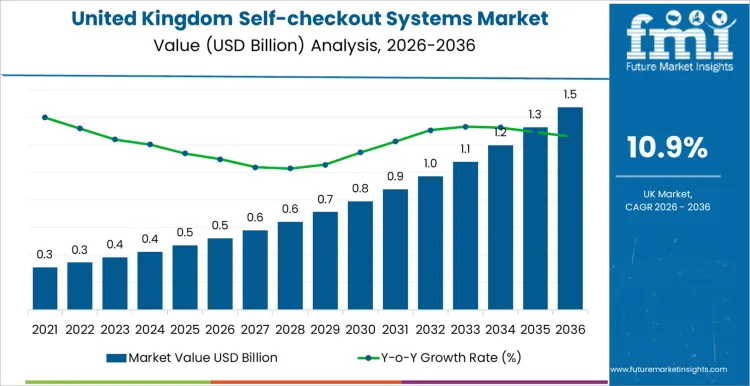
Why is the UK a High-Intensity Testbed for Self-service Retail Checkout?
The UK combines dense urban shopping corridors, mature national retail chains, and heavy peak-hour store traffic. These conditions reward solutions that shorten queues, maintain consistent service levels, and allow one associate to supervise multiple lanes. Store operators also face a strong need to improve labour productivity without degrading shopper experience, making self-service checkout a practical lever for both operational leaders and executive teams.
Payment behaviour strengthens the adoption case. Consumers made 18.9 billion contactless card payments in 2024, and mobile wallet usage continues to rise as phone-led payments become routine in everyday shopping.
Cashless self-checkout designs fit these behaviours, especially where stores want faster exits with fewer cash handling steps. The result is a checkout environment that feels natural to shoppers while simplifying reconciliation and cash management for retailers.
Retail performance patterns also keep focus on throughput and service quality. Official retail sales data shows periods of fluctuating demand, pushing store leaders to protect conversion at the front-end during promotions, seasonal surges, and unpredictable footfall. (Office for National Statistics) This supports investment in flexible checkout capacity that can scale lane availability without constant staffing increases.
Many transformation programmes place self-checkout inside a larger store automation roadmap, where connected devices and software orchestration support predictable operations at scale. Broader context can be found in retail automation solutions used across modern stores.
How is the Self-checkout Systems Landscape Segmented by Product Type, Payment Method, and End Use?
Why do portable self-checkout devices hold a Credible share in the UK despite rapid kiosk expansion?
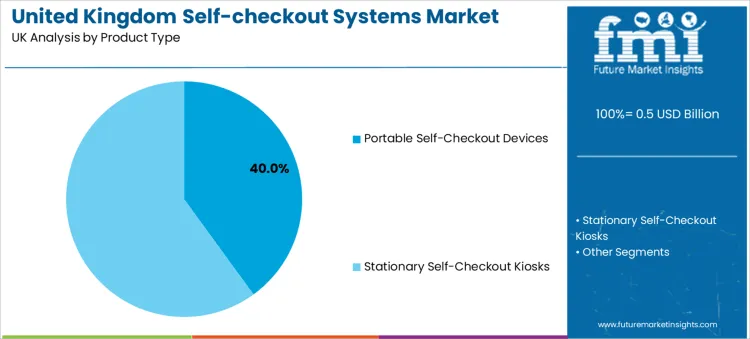
Portable self-checkout devices account for a 40% share in the UK, showing how strongly retailers value flexibility at the checkout layer. These devices help stores expand self-service capacity without heavy floor redesign, which is useful for convenience formats, smaller outlets, and locations where space constraints limit lane additions.
Retail leaders also use portable devices to ease peak-hour pressure by diverting quick missions away from fixed lanes. Technology teams favour this segment because it supports connected user journeys through scan-and-go flows, faster basket completion, and smoother integration with loyalty identification and digital receipts.
Why do cash-based self-checkout systems retain a Significant share even in a contactless-first economy?
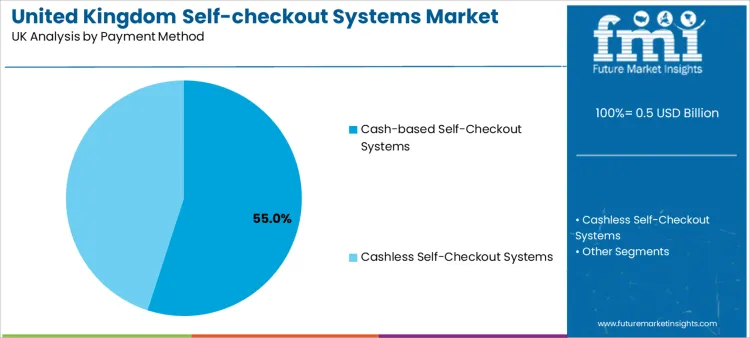
Cash-based self-checkout systems lead the payment-method split with a 55.0% share, reflecting the need for payment inclusivity and broad customer coverage. Many retailers continue to maintain cash-enabled options for shoppers who rely on physical currency for budgeting, accessibility, or habitual preference.
Cash acceptance also reduces friction for stores serving mixed demographics. Checkout planners often balance speed improvements with service fairness, keeping cash-based self-service lanes available while modernising the overall checkout experience through better supervision workflows and clearer on-screen guidance.
Why do direct deployments by product manufacturers represent a Substantial Share in UK’s end-use adoption?
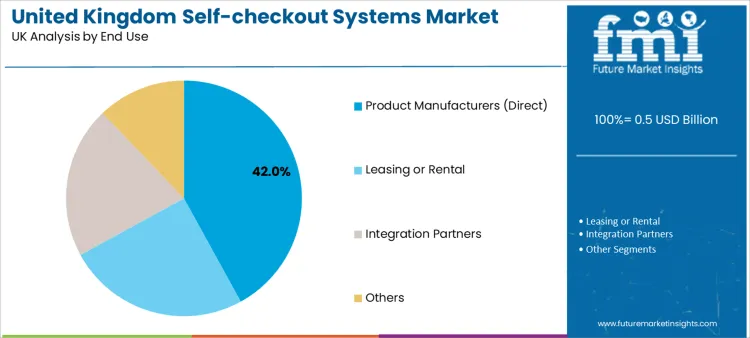
Product manufacturers hold a 42.0% share, indicating retailer preference for end-to-end accountability across installation, system uptime, and ongoing support. This route is common when chains want consistent lane design across large estates and need a single partner responsible for hardware performance, software stability, and service-level response.
Direct deployments also support standardised monitoring and structured maintenance routines, which protect customer experience during high footfall periods. For strategic decision makers mapping rollout models against the wider self-checkout systems landscape, direct supplier engagement is often tied to long-term upgrade planning and reliability assurance.
What are the Dynamics, Restraints, Opportunities, and Threats Shaping this Sector?
How are queue reduction and labour economics driving consistent demand?
The core driver is operational efficiency. Many retailers need more checkout throughput without expanding floor space, which is often constrained in city locations. Self-service lanes can increase transactions processed per square metre and help staff shift toward replenishment, customer guidance, and online order picking.
For CEOs and operational heads, the key performance outcomes are shorter queue times, stable service levels during peaks, and lower dependency on constant staffing increases. For technology partners, the buying signal is clear: retailers want predictable uptime, fast interventions, and simple training across high-turnover teams.
Do shrink exposure and shopper trust restrain faster rollout?
Checkout automation can increase risk of non-scanning, barcode swapping, and misuse of age checks. Retail crime has risen sharply in recent periods, increasing pressure on retailers to strengthen prevention and response capabilities. Self-service lanes can become flashpoints if supervision is weak or if customer flows are poorly designed.
Shopper trust also depends on a frictionless experience. Slow scanners, confusing prompts, or excessive staff overrides reduce adoption and can drive customers back to assisted tills. The best-performing deployments balance speed with visible controls, using clear UI guidance and smart exception routing to keep genuine customers moving.
How are connected services and smarter verification creating new potential?
Opportunities are emerging from intelligence at the lane. Cloud diagnostics can improve uptime by enabling proactive maintenance, remote fixes, and faster parts planning. Queue analytics can guide staffing choices and highlight performance gaps between stores. Digital receipts connected to loyalty profiles can improve returns handling and customer support.
Loss prevention capabilities are also advancing through better camera-assisted verification, item recognition, and rule-based prompts that reduce interventions while protecting accuracy. Stakeholders tracking innovation pathways often benchmark these initiatives against self-checkout deployment models and growth patterns across global retail.
What external factors could challenge sector growth and deployment continuity?
Payment security and compliance set a rising baseline for risk controls, patching discipline, and secure network handling. PCI DSS v4.0 was published in March 2022, and ongoing updates reinforce expectations for secure payment environments and consistent testing.
Regulatory changes around contactless limits can also influence checkout flows and risk models. The UK’s financial regulator announced greater flexibility for setting future contactless limits, placing greater focus on fraud controls and consumer protection. These shifts push retailers and vendors to maintain rapid software update cycles, strong monitoring, and tight governance across connected checkout fleets.
How is Self-checkout Systems Demand Evolving across Key Regions in the UK?
Regional growth is influenced by store density, retail format mix, labour conditions, rollout maturity, and technology support coverage. The projected compound annual growth rates from 2026 to 2036 illustrate these geographic distinctions.
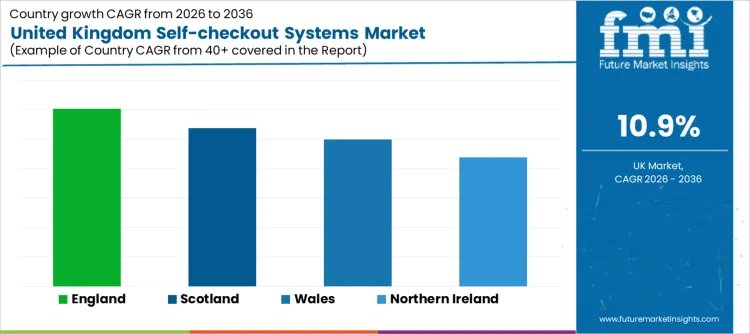
| Region | CAGR (2026-2036) |
|---|---|
| England | 12.0% |
| Scotland | 10.7% |
| Wales | 10.0% |
| Northern Ireland | 8.8% |
Why is England setting the pace for national-scale rollouts and standardised lane design?
England leads with a projected CAGR of 12.0%. Dense urban retail, large chain estates, and high commuter-driven traffic create constant demand for faster front-end throughput. Retailers also benefit from centralised operational governance, enabling consistent configuration across sites and strong performance measurement.
England is often where advanced supervision capabilities are piloted first, including improved verification flows, exception routing, and fleet-wide monitoring that reduces downtime. The region’s scale makes managed services and structured deployment playbooks valuable for smooth expansion.
How is Scotland using self-service checkout to improve productivity across varied store footprints?
Scotland shows a CAGR of 10.7%. Retailers balance city stores with rural and community locations, which puts emphasis on reliability and service logistics. Adoption tends to favour durable hardware configurations and streamlined user journeys that reduce staff interventions.
Support coverage is a key decision factor, including response times for scanner failures, payment module issues, and network disruptions. Solutions that maintain stability across weather conditions and varied footfall patterns are well-positioned.
What is driving Wales toward practical adoption in smaller and mid-size stores?
Wales records a CAGR of 10.0%. Many deployments focus on improving queue experience and offering staffing flexibility at peak hours. Compact footprints and installation simplicity influence selection, especially in stores where the front-end must remain open during upgrades. Retailers assess how self-service adoption changes staff workload, intervention frequency, and customer satisfaction. Cashless-first designs often appeal where contactless usage is high and where teams want to reduce cash handling time.
Why does Northern Ireland show steady growth anchored in value assurance and operational resilience?
Northern Ireland grows at 8.8%. Rollouts are often staged, expanding lane counts once shrink controls and shopper behaviour are validated. Vendor selection focuses on proven integration, dependable service coverage, and stable software performance across mixed checkout environments. Leasing models can support upgrades while limiting upfront cost exposure. Retailers also pay close attention to staff experience, ensuring that supervision workflows are simple and that exception handling does not slow the store during busy periods.
What Defines the Competitive Landscape for Self-checkout Systems in the UK?
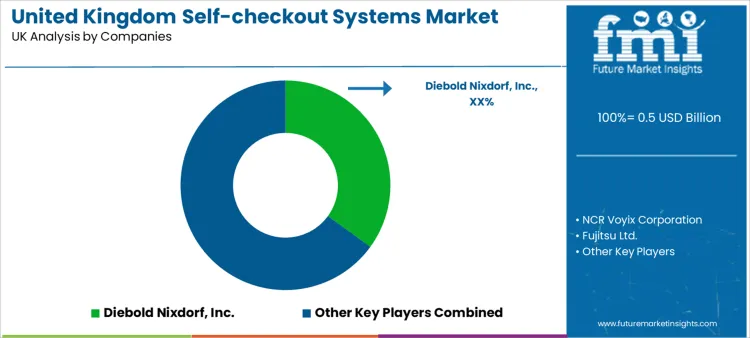
Competition is shaped by uptime, shrink controls, integration depth, and service responsiveness. Retailers expect user experiences that feel intuitive, hardware that tolerates intensive daily use, and software that reduces intervention time. The most valued suppliers are those that keep checkout stable during peaks, deliver fast field support, and provide monitoring tools that help prevent downtime before it affects customers.
Enterprise buyers typically run pilots across multiple store formats to test performance under real conditions. Assessments include scanner speed, payment stability, accessibility, ease of use for non-experts, and the ability to manage high volumes without frustration. Retailers also examine how effectively self-service lanes handle age checks, bagging issues, and unplanned exceptions. Strong implementation playbooks make a measurable difference, especially for national chains that need repeatable results across hundreds of locations.
A clear direction is the shift toward mixed checkout estates. Assisted lanes remain vital for complex baskets and customer support, kiosks handle volume efficiently, and portable scan-and-go serves time-sensitive shoppers. This mix increases demand for orchestration software that routes customers intelligently, assigns staff support effectively, and stabilises service during promotions. Retailers also evaluate sustainability indicators such as modular serviceability, energy-efficient components, and longer device lifecycles.
Providers such as Diebold Nixdorf and NCR Voyix compete on service coverage, enterprise-grade fleet tools, and integration readiness. Fujitsu, Toshiba Global Commerce Solutions, and ITAB Group support deployments that combine hardware, software integration, and store design considerations. Technology buyers also benchmark self-checkout decisions against broader POS strategies and front-end digitisation priorities reflected in POS terminal innovation and checkout infrastructure planning.
Key Industry Participants
- Diebold Nixdorf, Inc.
- NCR Voyix Corporation
- Fujitsu Ltd.
- Toshiba Global Commerce Solutions
- ITAB Group
Scope of Report
| Items | Values |
|---|---|
| Quantitative Units | USD Billion |
| Product Type | Portable Self-Checkout Devices; Stationary Self-Checkout Kiosks |
| Payment Method | Cash-based Self-Checkout Systems; Cashless Self-Checkout Systems |
| End Use | Product Manufacturers (Direct); Leasing or Rental; Integration Partners; Others |
| Regions Covered | England; Scotland; Wales; Northern Ireland |
| Key Companies Profiled | Diebold Nixdorf, Inc.; NCR Voyix Corporation; Fujitsu Ltd.; Toshiba Global Commerce Solutions; ITAB Group |
Self-checkout Systems Demand in the UK by Segments
By Product Type:
- Portable Self-Checkout Devices
- Stationary Self-Checkout Kiosks
By Payment Method:
- Cash-based Self-Checkout Systems
- Cashless Self-Checkout Systems
By End Use:
- Product Manufacturers (Direct)
- Leasing or Rental
- Integration Partners
- Others
By Region:
- England
- Scotland
- Wales
- Northern Ireland
Bibliography
- Financial Conduct Authority. (2025). Greater flexibility to be given for setting future contactless limits.
- Office for National Statistics. (2025). Retail sales, Great Britain: November 2025.
- PCI Security Standards Council. (2024). Just Published: PCI DSS v4.0.1.
- UK Finance. (2025). Over half of UK adults now use mobile wallets.
- UK Parliament. (2025). Retail sector in the UK.
Frequently Asked Questions
How big is the demand for self-checkout systems in uk in 2026?
The demand for self-checkout systems in uk is estimated to be valued at USD 0.5 billion in 2026.
What will be the size of self-checkout systems in uk in 2036?
The market size for the self-checkout systems in uk is projected to reach USD 1.5 billion by 2036.
How much will be the demand for self-checkout systems in uk growth between 2026 and 2036?
The demand for self-checkout systems in uk is expected to grow at a 10.9% CAGR between 2026 and 2036.
What are the key product types in the self-checkout systems in uk?
The key product types in self-checkout systems in uk are portable self-checkout devices and stationary self-checkout kiosks.
Which payment method segment is expected to contribute significant share in the self-checkout systems in uk in 2026?
In terms of payment method, cash-based self-checkout systems segment is expected to command 55.0% share in the self-checkout systems in uk in 2026.
Preview the report firsthand - request a free sample
Get SampleGet the brochure for pricing and purchase details.
Get PDFTable of Content
- Executive Summary
- UK Market Outlook
- Demand-side Trends
- Supply-side Trends
- Technology Roadmap Analysis
- Analysis and Recommendations
- Market Overview
- Market Coverage / Taxonomy
- Market Definition / Scope / Limitations
- Market Background
- Market Dynamics
- Drivers
- Restraints
- Opportunity
- Trends
- Scenario Forecast
- Demand in Optimistic Scenario
- Demand in Likely Scenario
- Demand in Conservative Scenario
- Opportunity Map Analysis
- Product Life Cycle Analysis
- Supply Chain Analysis
- Investment Feasibility Matrix
- Value Chain Analysis
- PESTLE and Porter’s Analysis
- Regulatory Landscape
- Regional Parent Market Outlook
- Production and Consumption Statistics
- Import and Export Statistics
- Market Dynamics
- UK Market Analysis 2021 to 2025 and Forecast, 2026 to 2036
- Historical Market Size Value (USD Million) Analysis, 2021 to 2025
- Current and Future Market Size Value (USD Million) Projections, 2026 to 2036
- Y-o-Y Growth Trend Analysis
- Absolute $ Opportunity Analysis
- UK Market Pricing Analysis 2021 to 2025 and Forecast 2026 to 2036
- UK Market Analysis 2021 to 2025 and Forecast 2026 to 2036, By Product Type
- Introduction / Key Findings
- Historical Market Size Value (USD Million) Analysis By Product Type , 2021 to 2025
- Current and Future Market Size Value (USD Million) Analysis and Forecast By Product Type , 2026 to 2036
- Portable Self-Checkout Devices
- Stationary Self-Checkout Kiosks
- Portable Self-Checkout Devices
- Y-o-Y Growth Trend Analysis By Product Type , 2021 to 2025
- Absolute $ Opportunity Analysis By Product Type , 2026 to 2036
- UK Market Analysis 2021 to 2025 and Forecast 2026 to 2036, By Payment Method
- Introduction / Key Findings
- Historical Market Size Value (USD Million) Analysis By Payment Method, 2021 to 2025
- Current and Future Market Size Value (USD Million) Analysis and Forecast By Payment Method, 2026 to 2036
- Cash-based Self-Checkout Systems
- Cashless Self-Checkout Systems
- Cash-based Self-Checkout Systems
- Y-o-Y Growth Trend Analysis By Payment Method, 2021 to 2025
- Absolute $ Opportunity Analysis By Payment Method, 2026 to 2036
- UK Market Analysis 2021 to 2025 and Forecast 2026 to 2036, By End Use
- Introduction / Key Findings
- Historical Market Size Value (USD Million) Analysis By End Use, 2021 to 2025
- Current and Future Market Size Value (USD Million) Analysis and Forecast By End Use, 2026 to 2036
- Product Manufacturers (Direct)
- Leasing or Rental
- Integration Partners
- Others
- Product Manufacturers (Direct)
- Y-o-Y Growth Trend Analysis By End Use, 2021 to 2025
- Absolute $ Opportunity Analysis By End Use, 2026 to 2036
- Market Structure Analysis
- Competition Dashboard
- Competition Benchmarking
- Market Share Analysis of Top Players
- By Regional
- By Product Type
- By Payment Method
- By End Use
- Competition Analysis
- Competition Deep Dive
- Diebold Nixdorf, Inc.
- Overview
- Product Portfolio
- Profitability by Market Segments (Product/Age /Sales Channel/Region)
- Sales Footprint
- Strategy Overview
- Marketing Strategy
- Product Strategy
- Channel Strategy
- NCR Voyix Corporation
- Fujitsu Ltd.
- Toshiba Global Commerce Solutions
- ITAB Group
- Diebold Nixdorf, Inc.
- Competition Deep Dive
- Assumptions & Acronyms Used
- Research Methodology


