

- Industry Size (2026)
- USD 860.7 Mn
- Forecast (2036)
- USD 1709.1 Mn
- CAGR (2026 to 2036)
- 7.1%
Dense Phase Vessels Market Size, Market Forecast and Outlook By FMI
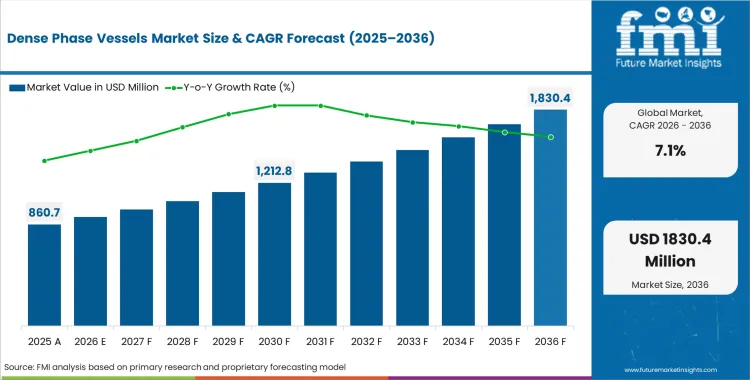
The dense phase vessels market crossed a valuation of USD 803.6 million in 2025 and is projected to reach USD 860.7 million in 2026. Industry outlook suggests the expansion predicted at a CAGR of 7.1% during 2026 to 2036, with total valuation projected at USD 1,709.1 million by 2036. Growth is supported by increasing adoption of low-velocity conveying systems in industries handling abrasive bulk materials.
Summary of Dense Phase Vessels Market
- The market is estimated at USD 803.6 million in 2025.
- The market is projected to reach USD 1,709.1 million by 2036.
- The market is expected to grow at a CAGR of 7.1% from 2026 to 2036.
- The forecast period represents an incremental opportunity of USD 848.4 million.
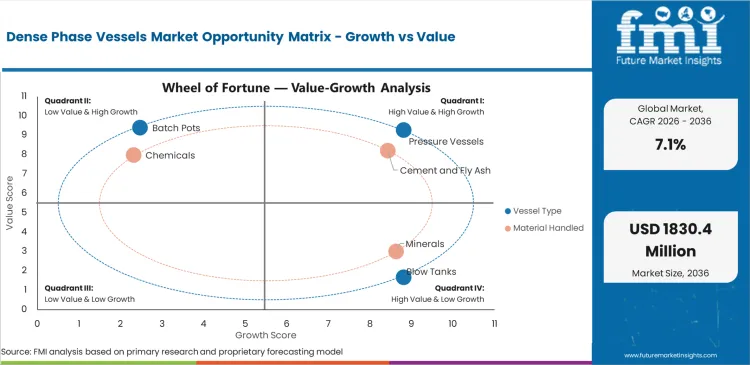
- Pressure vessels lead the vessel type segment with a 53.0% share.
- Cement/fly ash and chemicals jointly dominate the material segment with 29.0% share each.
- 3.0-6.0 bar range leads the pressure segment with a 47.0% share.
- New installations dominate the system role segment with a 61.0% share.
- Minerals (24%) and food powders (18%) are key supporting material segments.
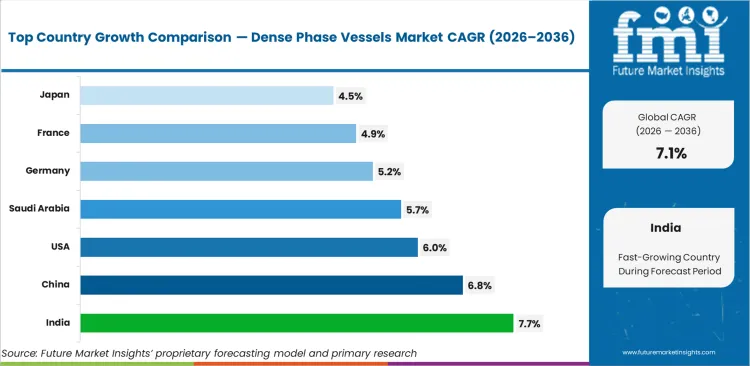
- India (7.7%), China (6.8%), and the United States (6.0%) are among the fastest-growing markets.
Material handling requirements are shifting toward reduced wear and improved product integrity. High-velocity dilute-phase systems accelerate pipeline erosion and can degrade sensitive or abrasive materials during transport. Dense phase conveying systems reduce conveying speed, lowering friction and extending equipment life. Higher upfront investment in pressure vessels is offset by reduced maintenance frequency and longer service intervals across pipelines and components.
Operational thresholds related to material abrasiveness are influencing system upgrades. When wear rates in dilute-phase systems exceed acceptable maintenance cycles, facilities transition toward dense phase configurations. Batch-based conveying supports controlled material movement and reduces damage to both equipment and product. These systems are increasingly adopted in high-tonnage processing environments where reliability and durability are critical.
India is estimated to record a CAGR of 7.7% in the dense phase vessels market during 2026 to 2036, supported by stricter dust control requirements and industrial expansion. China is projected to grow at 6.8%, driven by capacity additions in advanced materials processing. The United States is expected to register 6.0%, reflecting modernization of existing facilities. Saudi Arabia is anticipated to grow at 5.7%, followed by Germany at 5.2%, France at 4.9%, and Japan at 4.5% over the forecast period. Regional trends reflect new installations in emerging markets and efficiency-driven upgrades in established industrial regions.
Segmental Analysis
Dense Phase Vessels Market Analysis by Vessel Type
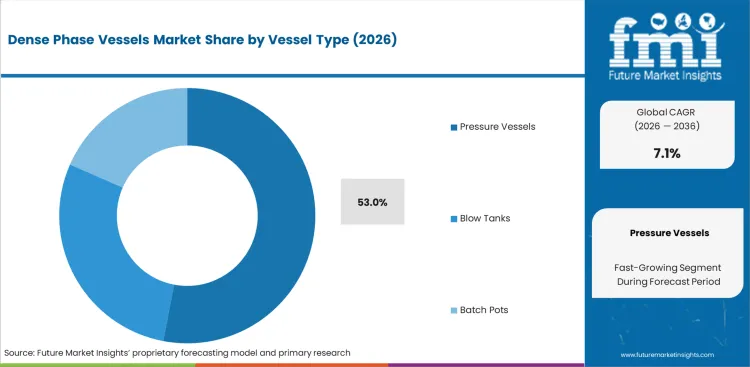
High-capacity is predicted to reach 53.0% share in dense phase vessels globally. Mineral plant engineers specify these heavy-duty units to sustain huge tonnage throughput without pausing for atmospheric refilling. Selecting heavy-duty dual-vessel configurations ensures material constantly enters transport lines, mimicking continuous flow while maintaining low kinetic speeds.
What supply chain managers rarely realize when evaluating pressure vessels vs blow tanks in dense phase systems is that operating dual pressure setups demands incredibly precise, synchronized valving, turning control logic into single points of failure. Operations managers exploring whether they should use a blow tank or pressure vessel for dense phase conveying must account for extreme wear on these inlet valves, as even slight abrasive scoring compromises entire pressurization sequences. Integrating specialized industrial hose connections dampens harsh structural vibrations generated during peak pressurization cycles.
- Throughput ceiling limits: Heavy industrial applications exceed standard gravity-feed capacities. Plant engineering managers must deploy synchronized dual-vessel setups to maintain uninterrupted material transfer across long distances.
- Valve scoring vulnerability: Highly abrasive particulates inevitably degrade primary material inlet seals. Maintenance supervisors face pressure leaks if they fail to replace worn sealing domes immediately.
- Verification certification standards: Operating at elevated internal pressures mandates strict ASME compliance. Safety directors enforce rigorous non-destructive testing protocols to guarantee vessel integrity before commissioning high-tonnage lines.
Dense Phase Vessels Market Analysis by Material Handled
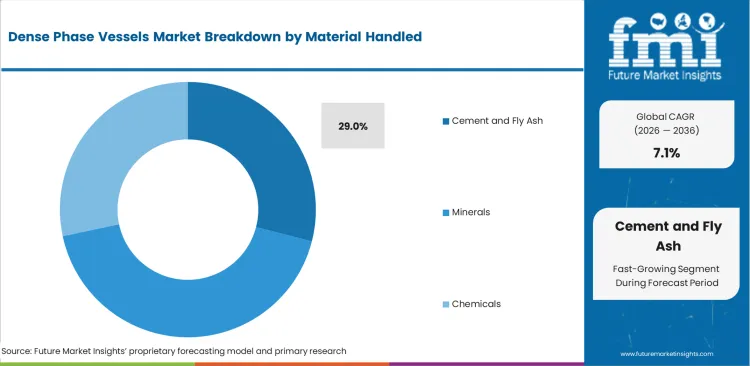
Handling abrasive bulk solids requires conveying systems that minimize wear while maintaining consistent flow. Cement and fly ash applications represent nearly 29.0% of dense phase vessel installations in 2026 due to their high-volume movement requirements. Low-velocity transport reduces pipeline erosion and limits dust generation during transfer. Material behavior under pressure becomes critical, as moisture content influences flow stability. Improper calibration of conveying parameters increases the risk of compaction, leading to blockages that disrupt operations and require system shutdown for clearing.
- Rotary valve elimination savings: Abrasive feeds destroy standard airlock rotors within weeks. Procurement directors eliminate massive recurring replacement costs by using valveless dense phase sender pots.
- Compressed air consumption penalties: Pushing heavy solid plugs requires immense intermittent air volume. Facility energy managers discover hidden operational expenses when central compressors struggle to support frequent, overlapping batch cycles.
- Total lifecycle retention: Eliminating high-speed kinetic friction preserves pipeline elbows indefinitely. Financial controllers justify expensive initial vessel hardware by calculating complete elimination of routine pipeline replacement labor.
Dense Phase Vessels Market Analysis by Pressure Range
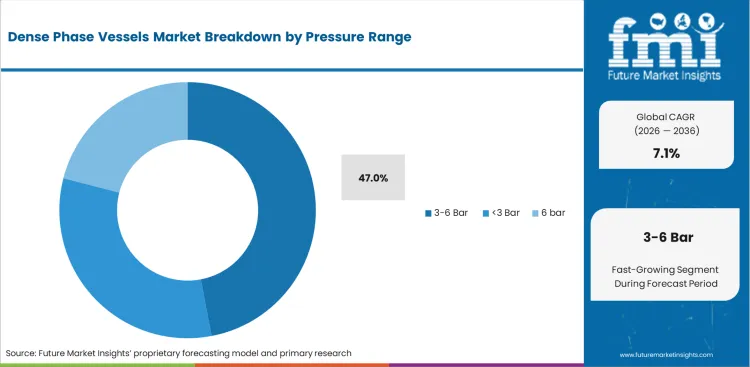
Selecting appropriate pressure levels ensures stable transport of cohesive and heavy materials across varying distances. The 3-6 bar range is predicted to contribute 47.0% share of dense phase vessel usage over the assessment period, reflecting compatibility with standard industrial compressor systems. Balanced pressure prevents both insufficient flow and excessive material compaction. System reliability depends on maintaining consistent pressure without unauthorized adjustments. Deviations from specified ranges increase the risk of pipeline blockage or equipment failure during operation.
- Line plugging prevention: Insufficient pressure allows heavy powder plugs to stall mid-pipe. Control room operators avoid total line blockages by ensuring 3-6 bar range maintains optimal pushing force.
- Regulator tampering risks: Impatient crews frequently bypass pressure limits trying to speed up batch times. Safety supervisors must physically lock regulator access to stop unauthorized internal pressure spikes.
- Air quality capture requirements: Clean, dry air is absolutely essential to prevent powder agglomeration. Maintenance planners must install advanced desiccant dryers to capture full benefit from mid-range pressure vessels.
Dense Phase Vessels Market Analysis by System Role
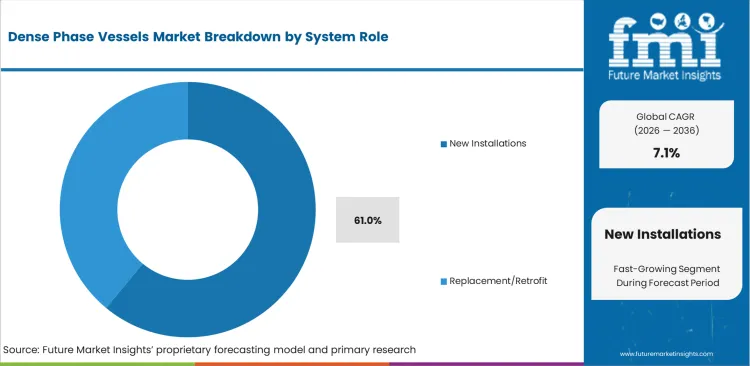
Sharp contradictions exist between theoretical efficiency of brand-new plant layouts and physical limitations of replacing aging mechanical conveyors in mature facilities. New installations are anticipated to garner 61.0% share in 2026. Design engineers evaluating dense phase vs dilute phase conveying vessels strongly favor specifying dense phase pressure vessels during greenfield construction to embed optimal pipe routing before structural steel restricts options.
Directly feeding process silos eliminates needs for complex secondary elevators and hazardous transfer towers. Details frequently missed by capacity planners involve legacy downstream dust collection systems not sized for rapid batch venting. Facility planners who force modern high-capacity senders into older receiver architectures face severe filter blinding and persistent airborne dust events.
- Greenfield baseline standards: Heavy industrial developers mandate dense phase routing during initial blueprint stages. Capital project directors gain massive layout flexibility by avoiding rigid, straight-line mechanical belt constraints.
- Retrofit friction points: Upgrading active chemical plants requires navigating congested utility corridors. Piping engineers struggle to fit bulky pressure vessels into tight basement clearances designed for smaller rotary airlocks.
- Receiver filter bottlenecks: Older destination silos cannot vent displaced air fast enough. Environmental compliance officers ultimately force system redesigns when aggressive batch pushes blow filter bags off their mounts.
Dense Phase Vessels Market Drivers, Restraints, and Opportunities
Missing single particulate emission targets on critical urban plant perimeters triggers multi-day shutdown protocols that destroy quarterly production margins. Plant managers tracking dense phase vessels market trends abandon open mechanical belts. Precision vessels become absolutely essential to eliminate fugitive dust from bulk transfer operations. This regulatory reality shortens standard replacement cycles significantly, pushing companies consulting a dense phase vessel procurement checklist to rapidly upgrade leaky dilute phase systems to completely enclosed high-pressure units. Preparing to buy dense phase pressure vessels is now a baseline compliance activity rather than a discretionary upgrade.
Incompatible compressed air infrastructure on aging industrial sites severely slows transition efforts toward dense phase architectures. Upgrading decades-old facilities requires entirely new high-volume compressor networks and advanced air drying units. Plant engineering directors struggle to justify massive utility overhauls just to accommodate modern pneumatic senders. Limited available electrical capacity creates difficult compromises where crews continue using dusty mechanical elevators simply because facility mains cannot support intermittent, massive industrial air compressor demands.
Opportunities in Dense Phase Vessels Market
- Active telemetry integration: Embedding strain gauges directly onto vessel load cells provides real-time batch weight feedback. Quality control managers gain unalterable digital proof of material transfer accuracy for critical formulations.
- Non-marring valve components: Developing advanced polymer dome seals eliminates secondary leakage pathways. Pipeline operators save thousands of hours previously wasted fixing scored inlet valves damaged by abrasive ash feeds.
- Modular control electrification: Upgrading legacy relay logic with smart architecture removes dangerous batch sequencing errors. Safety directors unlock automated line clearing protocols without sacrificing precise industrial dust collector synchronization.
Regional Analysis
Based on regional analysis, Dense Phase Vessels Market is segmented into North America, Latin America, Western Europe, Eastern Europe, Asia Pacific, Middle East, and Africa across 40 plus countries.
.webp "Top Country Growth Comparison Dense Phase Vessels Market Cagr (2026 2036)")
| Country | CAGR (2026 to 2036) |
|---|---|
| India | 7.7% |
| China | 6.8% |
| USA | 6.0% |
| Saudi Arabia | 5.7% |
| Germany | 5.2% |
| France | 4.9% |
| Japan | 4.5% |
Source: Future Market Insights (FMI) analysis, based on proprietary forecasting model and primary research
Asia Pacific Dense Phase Vessels Market Analysis
Urban infrastructure expansion across Asia Pacific increases reliance on compact bulk material handling systems that operate within limited space. Dense phase conveying gains traction where traditional mechanical systems cannot be deployed due to corridor constraints. High-pressure pneumatic systems allow material transfer through complex routing paths, supporting installation in densely built environments. Equipment compactness and adaptability remain critical across urban and industrial projects.
- India: India is projected to witness 7.7% CAGR in the dense phase vessels market from 2026 to 2036. Thermal power plants and industrial facilities are under pressure to control particulate emissions through enclosed ash handling systems. Operators prioritize compact vessel designs that fit within restricted plant layouts. Fast installation and commissioning improve turnaround times in retrofit projects. Contractors capable of executing installations in tight spaces gain a clear advantage. Equipment that supports continuous operation without dust leakage remains in high demand. These conditions support steady adoption across power generation and heavy industrial sectors.
- China: China’s industrial expansion in battery materials and bulk chemicals drives demand for high-capacity dense phase vessels. Facilities require systems that handle large volumes while maintaining material purity across long transfer distances. The dense phase vessels market in China is expected to expand at 6.8% CAGR through 2036. EPC contractors depend on heavy-duty vessels that sustain pressure stability under continuous operation. Mechanized transfer systems improve throughput and reduce handling errors. Equipment durability and scale remain key procurement factors. These requirements align with the expansion of large industrial processing clusters.
- Japan: Industrial automation plays a central role in Japan’s approach to bulk material handling. Workforce limitations encourage adoption of systems that reduce operator dependency. Self-sequencing dense phase vessels improve process control and minimize manual intervention. Growth in Japan is likely to stand at 4.5% over the forecast period, reflecting steady adoption across automated facilities. Buyers prioritize equipment that prevents operational errors, especially during pressurization cycles. Reliability and ease of operation remain essential in high-precision manufacturing environments. These factors support continued demand for automated and safety-focused vessel systems.
FMI analysis details emerging auxiliary equipment adoption across Australia and ASEAN nations. Specialized applications involving battery precursor materials accelerate heavy-duty pneumatic adoption far faster than generalized infrastructure metrics indicate.
North America Dense Phase Vessels Market Analysis
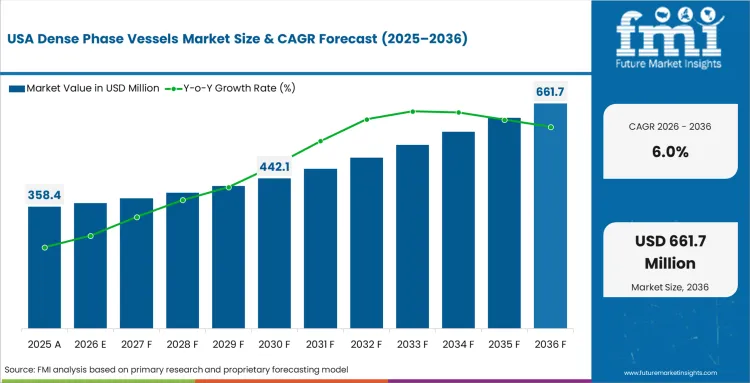
North America is recording steady expansion, driven primarily by retrofit and replacement projects rather than new builds. The USA is concentrated in Texas, Midwest cement belts, and Appalachian power retrofit zones, where aging ash and powder handling systems fail tightening particulate norms. Operators favor compact dense phase vessels that can be installed during short shutdown windows. Growth is constrained by high labor costs and outdated plant layouts, but once systems are upgraded, lifecycle savings justify adoption. Canada follows similar patterns in minerals and aggregates, while Mexico sees selective growth around industrial corridors tied to export manufacturing.
- USA: The dense phase vessels market in the United States is anticipated to grow at a CAGR of 6.0% between 2026 and 2036. Replacement of aging ash handling systems within operational power plants drives demand for compact and enclosed vessels. Installation often occurs in confined spaces where low-profile equipment becomes necessary. Contractors prioritize systems that allow quick integration without extended shutdowns. Regulatory compliance around emissions influences procurement decisions. Equipment reliability and ease of maintenance remain key factors. These conditions sustain demand across retrofit-driven projects in energy and industrial sectors.
FMI coverage expands into Canada and Mexico. Cross-border mineral processing lines rely heavily on these enclosed systems to meet tightening continental air quality standards.
Western Europe Dense Phase Vessels Market Analysis
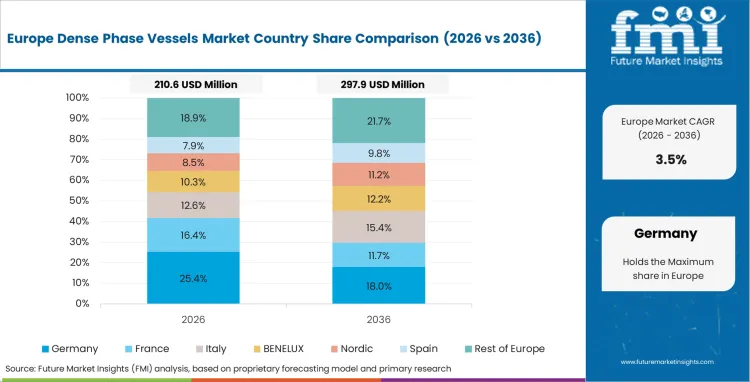
Europe’s dense phase vessels market grows at a moderate mid‑single‑digit CAGR, but demand is compliance‑driven rather than capacity‑driven. Western Europe, led by Germany, France, and Benelux, is seeing replacement of legacy dilute‑phase and mechanical systems due to emission audits, recycled material handling, and wear failures in abrasive applications like glass cullet and cement substitutes. Growth persists despite slow industrial output because operators are forced into early replacement cycles. Eastern Europe shows selective uptake in Poland and Czech Republic, mainly in cement and minerals, though adoption is slower due to capital constraints and limited compressed‑air infrastructure.
- Germany: Germany is expected to record a CAGR of 5.2% in the dense phase vessels market over the study period. Cement and industrial processing plants require systems that improve energy efficiency and reduce air consumption. Smart control integration allows vessels to operate in sync with plant demand cycles. Equipment selection focuses on durability and performance under continuous use. Operators prioritize systems that reduce energy waste while maintaining consistent throughput. These upgrades align with broader industrial efficiency targets. Demand remains steady across sectors focused on optimizing operational performance.
- France: Food processing and specialty material handling applications shape demand for dense phase vessels in France. Operators require systems that transport powders without degrading product quality. The market in France is likely to expand at 4.9% CAGR over the assessment period. Gentle conveying methods reduce breakage and maintain product consistency across processing stages. Equipment design focuses on cleanability and contamination control. Manufacturers prioritize systems that meet strict hygiene standards. These requirements support adoption across high-value processing industries where product integrity is critical.
Middle East Dense Phase Vessels Market Analysis
Environmental conditions across the Middle East influence equipment durability requirements. Sand exposure and high temperatures limit the performance of conventional mechanical systems. Pneumatic conveying solutions offer greater reliability in such environments, particularly where maintenance access is limited. Equipment designed for rugged conditions gains preference across large-scale infrastructure projects.
- Saudi Arabia: Saudi Arabia is anticipated to grow at 5.7% CAGR in the dense phase vessels market from 2026 to 2036. Large pipeline and export infrastructure projects extend across remote desert regions where operational disruptions are costly. Operators prioritize thick-walled vessels that withstand both internal abrasion and external environmental stress. Equipment must remain functional under extreme heat and continuous usage conditions. Maintenance teams favor systems that require minimal intervention in remote locations. Reliability and structural strength define procurement strategies. These factors support continued demand across energy and bulk material handling applications.
Competitive Aligners for Market Players
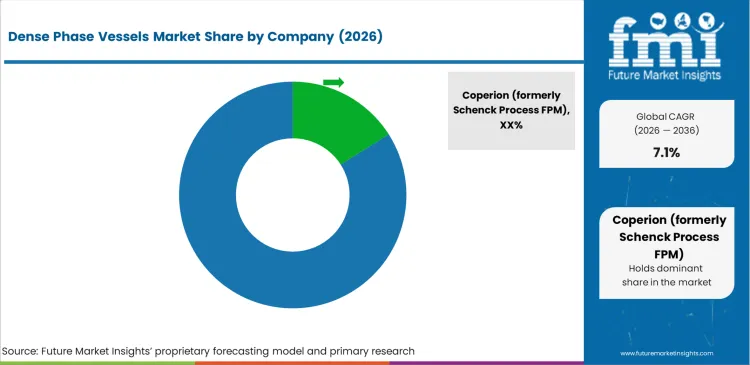
Extreme field durability separates true market leaders from low-cost commodity fabricators. Equipment buyers drafting a dense phase conveying vessel RFQ ruthlessly penalize dense phase vessel manufacturers whose vessel inlet seals fail under intense cycling during abrasive fly ash transfers. Coperion and Macawber capture premium tier contracts by forging primary load-bearing domes rather than relying on cheaper casting methods. Forged construction prevents severe wear when handling massive daily tonnages of silica sand. Basic fabrication shops can easily weld basic steel tanks, but replicating precise metallurgical resilience required for continuous cement kiln feeding demands decades of proprietary stress-testing data.
Leading dense phase vessel suppliers hold huge advantages through established global pneumatic testing laboratories and recalibration networks. Fleet maintenance directors strongly favor brands capable of simulating exact material behavior under pressure before finalizing vessel geometries. Providing unparalleled material-testing support creates almost impenetrable barriers against new entrants lacking global engineering footprints. Challengers attempting to compete purely on initial purchase price quickly fail when contractors realize basic fabricated tanks cannot maintain stable plug flow without using advanced air filters and fluidization arrays.
Large multinational mineral processing consortiums actively combat vendor lock-in by mandating standardized pneumatic connection flanges across all acquired hardware. Corporate procurement teams refuse proprietary air control manifolds that force reliance on single suppliers. Insisting on universal interoperability forces established players like Zeppelin Systems and Dynamic Air to compete strictly on cycle speed and wear resistance rather than artificial technical barriers. Operational realities moving forward demand control integration where vessels independently verify batch data to third-party distributed control systems.
Key Players in Dense Phase Vessels Market
- Coperion (formerly Schenck Process FPM)
- Claudius Peters
- Macawber
- Zeppelin Systems
- FLSmidth
- Dynamic Air
- Gericke
Scope of the Report
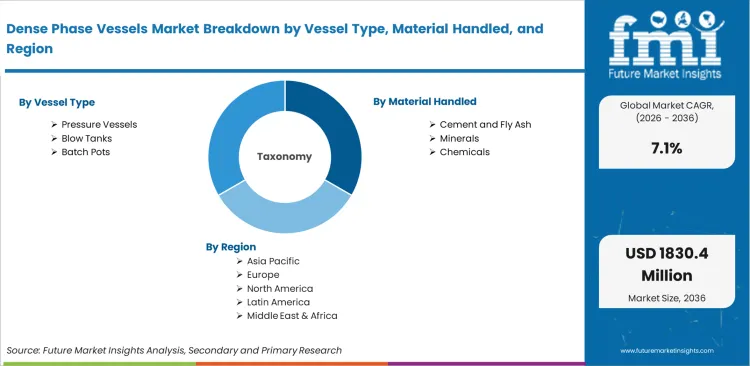
| Metric | Value |
|---|---|
| Quantitative Units | USD 860.7 million to USD 1709.1 million, at a CAGR of 7.1% |
| Market Definition | Dense phase vessels are high-pressure transfer tanks pushing abrasive or delicate bulk powders through pipelines at low speeds in concentrated plugs, avoiding pipeline wear and product breakage associated with high-velocity air streams. |
| Segmentation | By Vessel Type, Material Handled, Pressure Range, and System Role |
| Regions Covered | North America, Latin America, Western Europe, Eastern Europe, Asia Pacific, Middle East, and Africa |
| Countries Covered | USA, Germany, France, China, India, Japan, Saudi Arabia |
| Key Companies Profiled | Coperion (formerly Schenck Process FPM), Claudius Peters, Macawber, Zeppelin Systems, FLSmidth, Dynamic Air, Gericke |
| Forecast Period | 2026 to 2036 |
| Approach | Top-down pneumatic material handling integration analysis cross-validated with heavy industrial plant expansion rates |
Source: Future Market Insights (FMI) analysis, based on proprietary forecasting model and primary research
Dense Phase Vessels Market Analysis by Segments
Vessel Type
- Pressure Vessels
- Blow Tanks
- Batch Pots
Material Handled
- Cement/Fly Ash
- Minerals
- Food Powders
- Chemicals
Pressure Range
- <3 bar
- 3-6 bar
- 6 bar
System Role
- New Installations
- Replacement/Retrofit
Region
- North America
- USA
- Canada
- Latin America
- Brazil
- Mexico
- Rest of Latin America
- Western Europe
- Germany
- France
- UK
- Spain
- Italy
- Rest of Western Europe
- Eastern Europe
- Russia
- Poland
- Rest of Eastern Europe
- Asia Pacific
- China
- India
- Japan
- Australia
- ASEAN
- Rest of Asia Pacific
- Middle East
- Saudi Arabia
- GCC Countries
- Rest of Middle East
- Africa
- South Africa
- North Africa
- Rest of Africa
Bibliography
- USA Environmental Protection Agency (EPA). (2026). National Enforcement and Compliance Initiative: Protecting Communities from Coal Ash Contamination.
- Texas Commission on Environmental Quality (TCEQ). (2026). Bulk Material Handling - Air Permit and Dust Control Guidance.
- Dynamic Air. (2026). Custom Material Handling & - Pneumatic Conveying Systems.
- USA Environmental Protection Agency. (2025). Hazardous and Solid Waste Management System: Disposal of Coal Combustion Residuals From Electric Utilities. Federal Register, 90 FR 54611.
- Gericke Group. (2026, January 28). Dense phase conveying systems for gentle and efficient pneumatic transport.
This bibliography is provided for reader reference. The full FMI report contains the complete reference list with primary source documentation.
This Report Addresses
- Valve scoring vulnerability causing severe pressure leaks during abrasive material transfers.
- Compressed air consumption penalties stretching facility utility mains beyond optimal output levels.
- Retrofit friction points restricting bulky sender installations inside congested chemical plant basement layouts.
- Forged dome construction replacing weak cast components for intense silica sand operations.
- Receiver filter bottlenecks blowing environmental bags off destination silos during rapid batch pushes.
- Advanced desiccant dryers preventing cohesive powder agglomeration inside 3-6 bar pneumatic transport lines.
- Dual-vessel setups mimicking continuous high-tonnage throughput across long-distance cement kiln pipelines.
- Standardized pneumatic connection flanges actively combating vendor lock-in among large multinational consortiums.
Frequently Asked Questions
What are dense phase vessels used for?
Dense phase vessels operate as specialized holding and launching tanks that transport highly abrasive or fragile bulk solids at low velocities and high pressure-to-material ratios, effectively pushing product batches through lines as solid plugs.
How do dense phase vessels work in pneumatic conveying?
These units bypass standard rotary airlock constraints by using compressed gas injected directly into a sealed tank. The high pressure pushes the accumulated powder plug slowly down the transport pipeline, avoiding destructive high-velocity air streams.
What is the size of the dense phase vessels market?
Total revenue is projected to hit USD 1709.1 million by 2036. This growth signals permanent structural shifts toward completely enclosed, zero-emission pneumatic conveying networks across all major mineral processing facilities globally.
Which vessel type leads the market?
Pressure vessels capture 53.0% share globally. Heavy industrial applications demand these heavy-duty units to sustain massive tonnage throughput without pausing for atmospheric refilling, ensuring material constantly enters transport lines.
Why is the 3–6 bar range the largest segment?
Sizing precise pneumatic force dictates equipment selection, driving 47.0% volume for mid-range configurations. Construction managers deploy this exact pressure class because it aligns flawlessly with standard outputs of plant-wide compressor networks.
Which countries are growing fastest in this market?
Strict urban particulate emission thresholds push Indian operators to source completely enclosed handling gear, driving a 7.7% annual expansion. Subcontractors mastering rapid fit-up inside tight footprints easily outbid competitors reliant on older mechanical conveyors.
Who are the leading dense phase vessel suppliers?
Key innovators include Coperion, Claudius Peters, Macawber, Zeppelin Systems, FLSmidth, Dynamic Air, and Gericke. They compete strictly on cycle speed, wear resistance, and the ability to simulate exact material behavior under pressure.
Who are the top companies in dense phase vessels?
The market is heavily influenced by Coperion, Claudius Peters, Macawber, Zeppelin Systems, and Dynamic Air, all of which leverage proprietary metallurgical forging and advanced testing laboratories to secure premium tier contracts.
What is the difference between a pressure vessel and a blow tank?
Pressure vessels typically operate on strict fill-and-push cycles for extreme tonnage pushing and precise batch dosing, while blow tanks often continuously fluidize and transport highly cohesive materials over moderate distances without fully halting incoming feeds.
Why do cement, fly ash, and chemicals account for such a large share?
Abrasive feeds like cement destroy standard airlock rotors within weeks during high-velocity transfers. Chemical and mineral operators eliminate massive recurring replacement costs by using valveless sender pots that push material at extremely low kinetic speeds.
When should buyers choose replacement over new installation?
New installations capture 61.0% share because greenfield sites allow optimal pipe routing. Buyers only choose replacement when aging mechanical conveyors fail emission compliance tests or when line friction destroys dilute-phase piping faster than maintenance can repair it.
How do dense phase systems reduce maintenance costs?
High-speed kinetic friction destroys pipeline elbows constantly in dilute setups. Financial controllers justify expensive initial dense phase hardware by calculating the complete elimination of routine pipeline replacement labor associated with high-velocity transport.
What structural friction slows pneumatic upgrades?
Incompatible compressed air infrastructure on aging industrial sites severely slows transition momentum. Upgrading decades-old facilities requires entirely new high-volume compressor networks, creating capital delays facility directors struggle to justify.
How do buyers resist vendor lock-in?
Corporate procurement teams mandate standardized pneumatic connection flanges across all acquired hardware. Refusing proprietary air control manifolds forces established suppliers to compete strictly on cycle speed rather than artificial interoperability barriers.
How do smart valves improve quality control?
Embedding strain gauges directly onto vessel load cells provides real-time batch weight feedback. Quality control managers gain unalterable digital proof of material transfer accuracy for critical chemical formulations.
Why is sand intrusion critical for Middle Eastern buyers?
Severe desert conditions quickly destroy delicate mechanical belt bearings. Maintenance directors in Saudi Arabia stockpile thick-walled pressure vessels that withstand internal abrasion and external heat rather than awaiting imported replacement modules.
What causes filter blinding in destination silos?
Older destination silos cannot vent displaced air fast enough during rapid batch pushes. Environmental compliance officers ultimately force system redesigns when aggressive dense phase venting blows filter bags off their mounts.
Why are non-marring seals gaining traction?
Developing advanced polymer dome seals eliminates secondary leakage pathways entirely. Pipeline operators save thousands of expensive labor hours previously wasted fixing scored inlet valves damaged by abrasive fly ash.
How does battery material processing impact China?
Massive inland battery construction demands high-tonnage pressure vessels to handle extreme bulk densities. Plant supervisors depend on these heavy-duty fixtures to maintain perfect material purity without degradation.
What characterizes Japanese automation approaches?
Chronic shortages of certified plant operators force aggressive automation across industrial bulk handling. Plant managers deploy self-sequencing smart vessels that physically prevent incorrect pressurization cycles, compensating entirely for inexperienced field crews.
Why do food powder facilities require plug flow?
High-volume food processing conglomerates mandate perfectly clean pneumatic transport for fragile powder ingredients. Operations directors rely on dense phase transport to prevent severe product degradation and maintain strict hygiene standards.
How do dual-vessel configurations operate?
Plant engineering managers deploy synchronized dual-vessel setups to maintain uninterrupted material transfer. As one tank fills atmospherically, its twin pressurizes and pushes material, mimicking continuous flow across long distances.
What risks accompany unauthorized regulator tampering?
Impatient crews frequently bypass pressure limits trying to speed up batch times. Safety supervisors must physically lock regulator access to stop unauthorized internal pressure spikes that risk vessel ruptures.
Why is clean air essential for powder transport?
Moisture inside pneumatic lines causes cohesive powders to agglomerate and stall mid-pipe. Maintenance planners must install advanced desiccant dryers to ensure compressed air remains perfectly dry during mid-range pressure vessel operations.
Preview the report firsthand - request a free sample
Get SampleGet the brochure for pricing and purchase details.
Get PDFTable of Content
- Executive Summary
- Global Market Outlook
- Demand-side Trends
- Supply-side Trends
- Technology Roadmap Analysis
- Analysis and Recommendations
- Market Overview
- Market Coverage / Taxonomy
- Market Definition / Scope / Limitations
- Research Methodology
- Chapter Orientation
- Analytical Lens and Working Hypotheses
- Market Structure, Signals, and Trend Drivers
- Benchmarking and Cross-market Comparability
- Market Sizing, Forecasting, and Opportunity Mapping
- Research Design and Evidence Framework
- Desk Research Programme (Secondary Evidence)
- Company Annual and Sustainability Reports
- Peer-reviewed Journals and Academic Literature
- Corporate Websites, Product Literature, and Technical Notes
- Earnings Decks and Investor Briefings
- Statutory Filings and Regulatory Disclosures
- Technical White Papers and Standards Notes
- Trade Journals, Industry Magazines, and Analyst Briefs
- Conference Proceedings, Webinars, and Seminar Materials
- Government Statistics Portals and Public Data Releases
- Press Releases and Reputable Media Coverage
- Specialist Newsletters and Curated Briefings
- Sector Databases and Reference Repositories
- FMI Internal Proprietary Databases and Historical Market Datasets
- Subscription Datasets and Paid Sources
- Social Channels, Communities, and Digital Listening Inputs
- Additional Desk Sources
- Expert Input and Fieldwork (Primary Evidence)
- Primary Modes
- Qualitative Interviews and Expert Elicitation
- Quantitative Surveys and Structured Data Capture
- Blended Approach
- Why Primary Evidence is Used
- Field Techniques
- Interviews
- Surveys
- Focus Groups
- Observational and In-context Research
- Social and Community Interactions
- Stakeholder Universe Engaged
- C-suite Leaders
- Board Members
- Presidents and Vice Presidents
- R&D and Innovation Heads
- Technical Specialists
- Domain Subject-matter Experts
- Scientists
- Physicians and Other Healthcare Professionals
- Governance, Ethics, and Data Stewardship
- Research Ethics
- Data Integrity and Handling
- Primary Modes
- Tooling, Models, and Reference Databases
- Desk Research Programme (Secondary Evidence)
- Data Engineering and Model Build
- Data Acquisition and Ingestion
- Cleaning, Normalisation, and Verification
- Synthesis, Triangulation, and Analysis
- Quality Assurance and Audit Trail
- Market Background
- Market Dynamics
- Drivers
- Restraints
- Opportunity
- Trends
- Scenario Forecast
- Demand in Optimistic Scenario
- Demand in Likely Scenario
- Demand in Conservative Scenario
- Opportunity Map Analysis
- Product Life Cycle Analysis
- Supply Chain Analysis
- Investment Feasibility Matrix
- Value Chain Analysis
- PESTLE and Porter’s Analysis
- Regulatory Landscape
- Regional Parent Market Outlook
- Production and Consumption Statistics
- Import and Export Statistics
- Market Dynamics
- Global Market Analysis 2021 to 2025 and Forecast, 2026 to 2036
- Historical Market Size Value (USD Million) Analysis, 2021 to 2025
- Current and Future Market Size Value (USD Million) Projections, 2026 to 2036
- Y-o-Y Growth Trend Analysis
- Absolute $ Opportunity Analysis
- Global Market Pricing Analysis 2021 to 2025 and Forecast 2026 to 2036
- Global Market Analysis 2021 to 2025 and Forecast 2026 to 2036, By Vessel Type
- Introduction / Key Findings
- Historical Market Size Value (USD Million) Analysis By Vessel Type , 2021 to 2025
- Current and Future Market Size Value (USD Million) Analysis and Forecast By Vessel Type , 2026 to 2036
- Pressure Vessels
- Blow Tanks
- Batch Pots
- Pressure Vessels
- Y-o-Y Growth Trend Analysis By Vessel Type , 2021 to 2025
- Absolute $ Opportunity Analysis By Vessel Type , 2026 to 2036
- Global Market Analysis 2021 to 2025 and Forecast 2026 to 2036, By Material Handled
- Introduction / Key Findings
- Historical Market Size Value (USD Million) Analysis By Material Handled, 2021 to 2025
- Current and Future Market Size Value (USD Million) Analysis and Forecast By Material Handled, 2026 to 2036
- Cement and Fly Ash
- Minerals
- Chemicals
- Cement and Fly Ash
- Y-o-Y Growth Trend Analysis By Material Handled, 2021 to 2025
- Absolute $ Opportunity Analysis By Material Handled, 2026 to 2036
- Global Market Analysis 2021 to 2025 and Forecast 2026 to 2036, By Pressure Range
- Introduction / Key Findings
- Historical Market Size Value (USD Million) Analysis By Pressure Range, 2021 to 2025
- Current and Future Market Size Value (USD Million) Analysis and Forecast By Pressure Range, 2026 to 2036
- 3-6 Bar
- <3 Bar
- 6 bar
- 3-6 Bar
- Y-o-Y Growth Trend Analysis By Pressure Range, 2021 to 2025
- Absolute $ Opportunity Analysis By Pressure Range, 2026 to 2036
- Global Market Analysis 2021 to 2025 and Forecast 2026 to 2036, By System Role
- Introduction / Key Findings
- Historical Market Size Value (USD Million) Analysis By System Role, 2021 to 2025
- Current and Future Market Size Value (USD Million) Analysis and Forecast By System Role, 2026 to 2036
- New Installations
- Replacement/Retrofit
- New Installations
- Y-o-Y Growth Trend Analysis By System Role, 2021 to 2025
- Absolute $ Opportunity Analysis By System Role, 2026 to 2036
- Global Market Analysis 2021 to 2025 and Forecast 2026 to 2036, By Region
- Introduction
- Historical Market Size Value (USD Million) Analysis By Region, 2021 to 2025
- Current Market Size Value (USD Million) Analysis and Forecast By Region, 2026 to 2036
- North America
- Latin America
- Western Europe
- Eastern Europe
- East Asia
- South Asia and Pacific
- Middle East & Africa
- Market Attractiveness Analysis By Region
- North America Market Analysis 2021 to 2025 and Forecast 2026 to 2036, By Country
- Historical Market Size Value (USD Million) Trend Analysis By Market Taxonomy, 2021 to 2025
- Market Size Value (USD Million) Forecast By Market Taxonomy, 2026 to 2036
- By Country
- USA
- Canada
- Mexico
- By Vessel Type
- By Material Handled
- By Pressure Range
- By System Role
- By Country
- Market Attractiveness Analysis
- By Country
- By Vessel Type
- By Material Handled
- By Pressure Range
- By System Role
- Key Takeaways
- Latin America Market Analysis 2021 to 2025 and Forecast 2026 to 2036, By Country
- Historical Market Size Value (USD Million) Trend Analysis By Market Taxonomy, 2021 to 2025
- Market Size Value (USD Million) Forecast By Market Taxonomy, 2026 to 2036
- By Country
- Brazil
- Chile
- Rest of Latin America
- By Vessel Type
- By Material Handled
- By Pressure Range
- By System Role
- By Country
- Market Attractiveness Analysis
- By Country
- By Vessel Type
- By Material Handled
- By Pressure Range
- By System Role
- Key Takeaways
- Western Europe Market Analysis 2021 to 2025 and Forecast 2026 to 2036, By Country
- Historical Market Size Value (USD Million) Trend Analysis By Market Taxonomy, 2021 to 2025
- Market Size Value (USD Million) Forecast By Market Taxonomy, 2026 to 2036
- By Country
- Germany
- UK
- Italy
- Spain
- France
- Nordic
- BENELUX
- Rest of Western Europe
- By Vessel Type
- By Material Handled
- By Pressure Range
- By System Role
- By Country
- Market Attractiveness Analysis
- By Country
- By Vessel Type
- By Material Handled
- By Pressure Range
- By System Role
- Key Takeaways
- Eastern Europe Market Analysis 2021 to 2025 and Forecast 2026 to 2036, By Country
- Historical Market Size Value (USD Million) Trend Analysis By Market Taxonomy, 2021 to 2025
- Market Size Value (USD Million) Forecast By Market Taxonomy, 2026 to 2036
- By Country
- Russia
- Poland
- Hungary
- Balkan & Baltic
- Rest of Eastern Europe
- By Vessel Type
- By Material Handled
- By Pressure Range
- By System Role
- By Country
- Market Attractiveness Analysis
- By Country
- By Vessel Type
- By Material Handled
- By Pressure Range
- By System Role
- Key Takeaways
- East Asia Market Analysis 2021 to 2025 and Forecast 2026 to 2036, By Country
- Historical Market Size Value (USD Million) Trend Analysis By Market Taxonomy, 2021 to 2025
- Market Size Value (USD Million) Forecast By Market Taxonomy, 2026 to 2036
- By Country
- China
- Japan
- South Korea
- By Vessel Type
- By Material Handled
- By Pressure Range
- By System Role
- By Country
- Market Attractiveness Analysis
- By Country
- By Vessel Type
- By Material Handled
- By Pressure Range
- By System Role
- Key Takeaways
- South Asia and Pacific Market Analysis 2021 to 2025 and Forecast 2026 to 2036, By Country
- Historical Market Size Value (USD Million) Trend Analysis By Market Taxonomy, 2021 to 2025
- Market Size Value (USD Million) Forecast By Market Taxonomy, 2026 to 2036
- By Country
- India
- ASEAN
- Australia & New Zealand
- Rest of South Asia and Pacific
- By Vessel Type
- By Material Handled
- By Pressure Range
- By System Role
- By Country
- Market Attractiveness Analysis
- By Country
- By Vessel Type
- By Material Handled
- By Pressure Range
- By System Role
- Key Takeaways
- Middle East & Africa Market Analysis 2021 to 2025 and Forecast 2026 to 2036, By Country
- Historical Market Size Value (USD Million) Trend Analysis By Market Taxonomy, 2021 to 2025
- Market Size Value (USD Million) Forecast By Market Taxonomy, 2026 to 2036
- By Country
- Kingdom of Saudi Arabia
- Other GCC Countries
- Turkiye
- South Africa
- Other African Union
- Rest of Middle East & Africa
- By Vessel Type
- By Material Handled
- By Pressure Range
- By System Role
- By Country
- Market Attractiveness Analysis
- By Country
- By Vessel Type
- By Material Handled
- By Pressure Range
- By System Role
- Key Takeaways
- Key Countries Market Analysis
- USA
- Pricing Analysis
- Market Share Analysis, 2025
- By Vessel Type
- By Material Handled
- By Pressure Range
- By System Role
- Canada
- Pricing Analysis
- Market Share Analysis, 2025
- By Vessel Type
- By Material Handled
- By Pressure Range
- By System Role
- Mexico
- Pricing Analysis
- Market Share Analysis, 2025
- By Vessel Type
- By Material Handled
- By Pressure Range
- By System Role
- Brazil
- Pricing Analysis
- Market Share Analysis, 2025
- By Vessel Type
- By Material Handled
- By Pressure Range
- By System Role
- Chile
- Pricing Analysis
- Market Share Analysis, 2025
- By Vessel Type
- By Material Handled
- By Pressure Range
- By System Role
- Germany
- Pricing Analysis
- Market Share Analysis, 2025
- By Vessel Type
- By Material Handled
- By Pressure Range
- By System Role
- UK
- Pricing Analysis
- Market Share Analysis, 2025
- By Vessel Type
- By Material Handled
- By Pressure Range
- By System Role
- Italy
- Pricing Analysis
- Market Share Analysis, 2025
- By Vessel Type
- By Material Handled
- By Pressure Range
- By System Role
- Spain
- Pricing Analysis
- Market Share Analysis, 2025
- By Vessel Type
- By Material Handled
- By Pressure Range
- By System Role
- France
- Pricing Analysis
- Market Share Analysis, 2025
- By Vessel Type
- By Material Handled
- By Pressure Range
- By System Role
- India
- Pricing Analysis
- Market Share Analysis, 2025
- By Vessel Type
- By Material Handled
- By Pressure Range
- By System Role
- ASEAN
- Pricing Analysis
- Market Share Analysis, 2025
- By Vessel Type
- By Material Handled
- By Pressure Range
- By System Role
- Australia & New Zealand
- Pricing Analysis
- Market Share Analysis, 2025
- By Vessel Type
- By Material Handled
- By Pressure Range
- By System Role
- China
- Pricing Analysis
- Market Share Analysis, 2025
- By Vessel Type
- By Material Handled
- By Pressure Range
- By System Role
- Japan
- Pricing Analysis
- Market Share Analysis, 2025
- By Vessel Type
- By Material Handled
- By Pressure Range
- By System Role
- South Korea
- Pricing Analysis
- Market Share Analysis, 2025
- By Vessel Type
- By Material Handled
- By Pressure Range
- By System Role
- Russia
- Pricing Analysis
- Market Share Analysis, 2025
- By Vessel Type
- By Material Handled
- By Pressure Range
- By System Role
- Poland
- Pricing Analysis
- Market Share Analysis, 2025
- By Vessel Type
- By Material Handled
- By Pressure Range
- By System Role
- Hungary
- Pricing Analysis
- Market Share Analysis, 2025
- By Vessel Type
- By Material Handled
- By Pressure Range
- By System Role
- Kingdom of Saudi Arabia
- Pricing Analysis
- Market Share Analysis, 2025
- By Vessel Type
- By Material Handled
- By Pressure Range
- By System Role
- Turkiye
- Pricing Analysis
- Market Share Analysis, 2025
- By Vessel Type
- By Material Handled
- By Pressure Range
- By System Role
- South Africa
- Pricing Analysis
- Market Share Analysis, 2025
- By Vessel Type
- By Material Handled
- By Pressure Range
- By System Role
- USA
- Market Structure Analysis
- Competition Dashboard
- Competition Benchmarking
- Market Share Analysis of Top Players
- By Region
- By Vessel Type
- By Material Handled
- By Pressure Range
- By System Role
- Competition Analysis
- Competition Deep Dive
- Coperion (formerly Schenck Process FPM)
- Overview
- Product Portfolio
- Profitability by Market Segments (Product/Age /Sales Channel/Region)
- Sales Footprint
- Strategy Overview
- Marketing Strategy
- Product Strategy
- Channel Strategy
- Claudius Peters
- Macawber
- Zeppelin Systems
- FLSmidth
- Coperion (formerly Schenck Process FPM)
- Competition Deep Dive
- Assumptions & Acronyms Used


