

- Industry Size (2026)
- USD 3700.4 Mn
- Forecast (2036)
- USD 8108.1 Mn
- CAGR (2026 to 2036)
- 8.2%
Europe Savory Ingredients Market Forecast and Outlook 2026 to 2036
The global Europe savory ingredients sector is on track to achieve a valuation of USD 8,108.1 million by 2036, expanding from USD 3,700.4 million in 2026 at a CAGR of 8.2%. As per Future Market Insights, expansion is structurally underpinned by the EU's binding sodium reduction framework under the Farm to Fork Strategy, the accelerating growth of plant-based and flexitarian food categories requiring sophisticated savory flavoring, and the investment by major flavor houses in European manufacturing capacity for next-generation taste solutions.
The European Commission's Farm to Fork Strategy targets a 10% reduction in salt content across processed food categories by 2030, creating a binding reformulation mandate for food manufacturers. This regulatory pressure compels ingredient suppliers to develop sodium reduction technologies, kokumi enhancers, and yeast extract systems that maintain savory flavor intensity at lower sodium levels. Simultaneously, the European plant-based food market's growth is creating demand for savory ingredients that can replicate the umami and mouthfeel profiles of animal-derived products.
Edmond Scanlon, CEO of Kerry Group, stated that Kerry is 'well positioned for volume growth and strong margin expansion heading into year-end, with continued investment in customer-led innovation.' This confirms that the world's largest taste and nutrition company is investing in customer-specific savory innovation as its primary growth strategy in Europe. FMI opines that Kerry Group's integrated approach, combining taste technology with nutritional science, positions it as the benchmark competitor in European savory ingredients, particularly as sodium reduction mandates require ingredient solutions that address both flavor and health simultaneously.
The product development landscape in 2025 and 2026 has been defined by capacity investment and technology launches. Ajinomoto Health and Nutrition launched Savor-Boost K in late 2024, a kokumi-enhancing savory ingredient designed for the European market using specific peptides to improve richness in plant-based applications without increasing sodium. Kerry Group opened a 10,000-square-meter taste manufacturing facility in Hamm, Germany in May 2024, targeting savory taste solutions for the European snack and ready-meal markets.
Symrise entered a strategic partnership in early 2025 to expand its natural savory flavor portfolio for the European clean-label market. Givaudan reported strong 2025 full-year results in January 2026, with CEO Gilles Andrier confirming it was 'a strong testament to the unique position of Givaudan in supporting the growth of our customers.' As per FMI, this combination of sodium reduction technology, European manufacturing investment, and clean-label savory innovation confirms that the Europe savory ingredients market is being reshaped by regulatory-driven reformulation demand rather than discretionary flavor trends.
Key Takeaways
The Europe savory ingredients market is controlled by a concentrated group of global flavor and nutrition houses where Kerry Group, Givaudan, Symrise, IFF, and Ajinomoto collectively command the majority of European savory ingredient supply. FMI analysts observe that these five companies invest heavily in application laboratories across Europe, creating a technical capability barrier that smaller regional flavor houses cannot match, particularly for complex sodium reduction and plant-based savory applications.
Pricing asymmetry in the Europe savory ingredients market exists between commodity yeast extracts and MSG (USD 3 to 8 per kg) and proprietary kokumi enhancers and clean-label natural flavor systems (USD 25 to 80 per kg). As per FMI, the premium segment is growing faster than the commodity segment as food manufacturers seek differentiated savory solutions that meet both sodium reduction targets and clean-label consumer expectations.
Sourcing fragility is concentrated in the natural flavor raw material supply chain. European clean-label savory ingredients rely on mushroom extracts, tomato concentrates, fermented soy, and seaweed-derived umami components, many of which are subject to agricultural yield variability and import dependency. FMI is of the opinion that flavor houses with secured European agricultural supply chains for natural savory raw materials will hold a cost and availability advantage.
Brand and compliance risks center on EU Novel Food Regulation classification for new savory ingredients and the tightening of clean-label claim verification. Ingredients marketed as 'natural flavor' must meet EU Regulation 1334/2008 definition, and any novel fermentation-derived savory component requires Novel Food authorization. Ajinomoto's Savor-Boost K kokumi technology navigates this by using peptide-based enhancement within existing regulatory frameworks.
Geographic leverage within Europe is concentrated in Germany, France, the UK, and the Netherlands, which collectively account for the largest food manufacturing output and savory ingredient consumption. Southern Europe (Italy, Spain) is a significant market for traditional savory ingredients (tomato, olive, herb-based), while Northern Europe leads in plant-based savory innovation.
The executive reframing for the Europe savory ingredients market is that sodium reduction is now a binding regulatory mandate, not a voluntary reformulation trend. FMI analysts emphasize that food manufacturing executives must partner with ingredient suppliers who can deliver verified sodium reduction while maintaining consumer-acceptable flavor profiles, as failure to meet Farm to Fork sodium targets will restrict product placement in European retail.
Summary of Europe Savory Ingredients Market
What Is Growth Outlook for Europe Savory Ingredients Market as per Future Market Insights Projection?
Future Market Insights projects the Europe savory ingredients market to expand at a CAGR of 8.2% from 2026 to 2036, increasing from USD 3,700.4 Million in 2026 to USD 8,108.1 Million by 2036.
FMI Research Approach: FMI proprietary forecasting model based on European food manufacturing output and sodium reduction reformulation cycle tracking.
How Do FMI Analysts Perceive Europe Savory Ingredients Market to Evolve?
FMI analysts perceive the market evolving toward kokumi-enhanced, clean-label savory systems where sodium reduction compliance and plant-based application versatility determine ingredient selection.
FMI Research Approach: EU Farm to Fork sodium reduction targets and Novel Food Regulation tracking.
Which Country Holds Largest Share in Global Europe Savory Ingredients Market?
Germany holds a significant share of the Europe savory ingredients market by value which is supported by the largest food manufacturing base in Europe and Kerry Group's Hamm facility investment.
FMI Research Approach: FMI country-level revenue modeling by food manufacturing output and ingredient consumption per capita.
How Large Will Europe Savory Ingredients Market Be by 2036?
The Europe savory ingredients market is projected to reach USD 8,108.1 Million by 2036.
FMI Research Approach: FMI long-term revenue forecast derived from European processed food production projections and sodium reduction reformulation impact modeling.
What Is Definition of Europe Savory Ingredients Market?
The Europe savory ingredients market includes revenue from taste enhancers, flavor systems, and functional ingredients that deliver umami, kokumi, and savory profiles in processed food, snacks, ready meals, and plant-based applications within Europe.
FMI Research Approach: FMI market taxonomy and inclusion-exclusion framework.
What Are Globally Unique Trends Shaping Europe Savory Ingredients Market?
Globally unique trends include kokumi peptide technology for sodium reduction (Ajinomoto Savor-Boost K), dedicated European savory manufacturing investments (Kerry Hamm facility), and clean-label natural flavor system development for plant-based meat alternatives.
FMI Research Approach: Ajinomoto product launch data and Kerry Group facility investment announcements.
Europe Savory Ingredients Market Key Takeaways
| Metric | Details |
|---|---|
| Industry Size (2026) | USD 3,700.4 Million |
| Industry Value (2036) | USD 8,108.1 Million |
| CAGR (2026 to 2036) | 8.2% |
Source: Future Market Insights (FMI) analysis, based on proprietary forecasting model and primary research
Key Industry Highlights in the European Savory Ingredients Sector
Increased Demand for Bold International Flavors in European Food
International cuisines have become something European consumers are trying out more often, creating demand for global flavors like Asian, Latin American, and Mediterranean. Consumers are finding out more and more about new taste experiences with the increasing pressure to try new ones in big cities.
Response to this has been from manufacturers like Sensient Technologies and International Flavors & Fragrances Inc., where the product lines have expanded into global cuisine-inspired spices, herbs, and seasonings. These diversified flavors are the most prominent usage in ready-to-eat meals, sauces, and snacks.
The demand for international flavors will continue to boost the market because more and more European food brands are developing new innovative products to match adventurous palates.
Growth of Plant-based Savory Products Driving Flavor Innovation
As the trend of plant-based diets continues to grow across Europe, there is a growing demand for flavourful plant-based options. Most of the traditional plant-based foods available in the market lack the intense, umami flavors that people desire. In this regard, the demand for savoury products like spices, flavor enhancers, and high-umami products has experienced a sharp surge.
Savory flavor profiles from companies such as Tate & Lyle PLC and Ingredion Incorporated, using ingredients such as yeast extract, mushrooms, and seaweed, are now focused on catering to plant-based consumers.
Comparison of 2021 to 2025 Sales vs Demand Forecasts for 2026 to 2036
From 2021 to 2025, the European savoury ingredients market has grown steadily, driven by a growing demand for natural and clean-label ingredients. During this period, there has been a great shift in consumer preferences towards more sustainable, plant-based, and organic food options, which has resulted in increased demand for seasonings, spices, and flavor enhancers that align with these trends.
The market also grew in the convenience foods sector with an increasing number of consumers looking for ready-to-eat meals and snacks that not only provide convenience but would deliver on taste as well. In 2025, growth in this market will continue.
Consumers' interest in international flavors and innovative plant-based solutions will propel demand for more diverse and complex savoury ingredients. The European market will grow even faster by 2035, especially with further technological advancements in food and a deeper commitment to sustainability.
Market Concentration and Supply Chain Dynamics Across Europe
European savoury ingredients have in their fold a mix of large MNCs as well as smaller, regional players. Dominant players and biggies like Kerry Group, Givaudan SA, and Cargill, accounting for significant amounts, have been able to take advantage of their enormous production capacities and more sophisticated R&D capabilities, as well as very active distribution networks.
These companies are investing heavily in new flavoring technologies and growing their portfolios in response to this increasing demand for natural, sustainable, and plant-based savoury solutions. Smaller players such as Advanced Enzyme Technologies Limited and Sensient Technologies focus on niche applications, providing bespoke flavor solutions suited to specific regional preferences or dietary requirements.
Country-wise Insights into Usage Across Processed Food and Snacks
The following table shows the estimated growth rates of the top geographies.
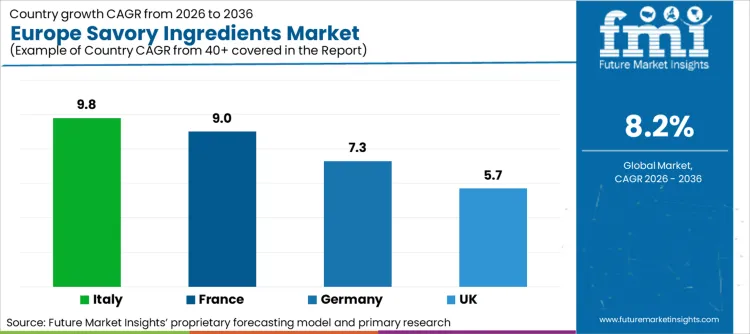
| Countries | CAGR 2026 to 2036 |
|---|---|
| UK | 5.7% |
| Germany | 7.3% |
| France | 9.0% |
| Italy | 9.8% |
Germany Industry is Driven by Evolving Consumer Preferences and its Dynamic Food and Beverages Industry
Germany continues to be a strong consumer of savoury ingredients in Europe, influenced by the healthy strength of the country's food processing industry, which calls for natural and clean-label ingredients. Of course, German market leaders also have keen interests in plant-based foods where savoury ingredients play an essential role in flavouring plant-based alternatives to meat, dairy, and eggs.
Manufacturers such as Kerry Group are capitalizing on the demand for unique flavor enhancers and seasonings that target not only traditional but also plant-based food products. Moreover, a rising taste for international flavors across Germany-Asia and Mediterranean spices-is increasingly requiring diverse savoury ingredients for packaged foods and ready-to-eat meals.
France has a Great Demand for International Flavors and Seasonings
The motivation of savoury ingredients in France comes about through strong cultural activity in good and savoury food settings, along with greater interest among people in terms of global flavors. French consumers who are very adventurous about trying new spices and new seasonings welcome cumin, chili, and ginger being used in French kitchens.
This trend is being driven by the food service industry particularly as restaurants and catering services seek to introduce innovative and exciting flavor combinations to meet evolving client tastes. Companies such as Givaudan SA and Tate & Lyle are increasing their offerings with a whole host of spices and flavorings.
Category-wise Insights Across Yeast Extracts, Hydrolyzed Proteins, and Flavor Enhancers
Spices and Seasonings Lead the European Savory Ingredients Market Growth
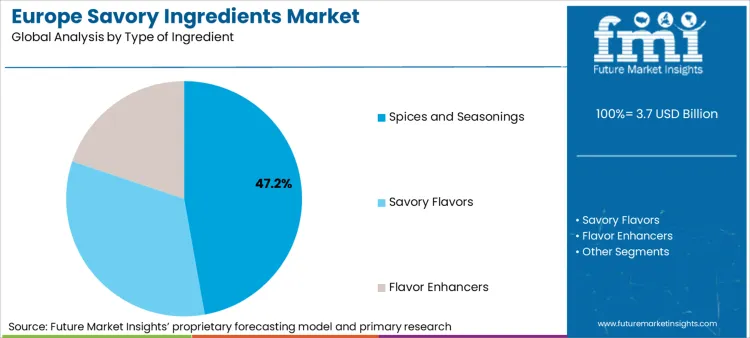
| Segment | Value Share (2026) |
|---|---|
| Spices and Seasonings (Type of Ingredients) | 47.2% |
Spices and seasonings should continue dominating the European market in savoury ingredients on account of high utilization in household preparations as well as within the food service industry. Such demand in this category is boosted through various means; these are increased consumers interest in multiple cuisines, increasing healthy diets demand, and more demands for clean label products.
Responding to such an increasing demand is Kerry Group in developing diverse innovations of spice mixes and seasoning for both old traditional tastes and the present ones. Rising consumers with exploration of flavors and cuisines internationally make the demands on spices and seasonings go ahead in Europe.
Natural Savoury Ingredients: Responding to the Clean Label Trend
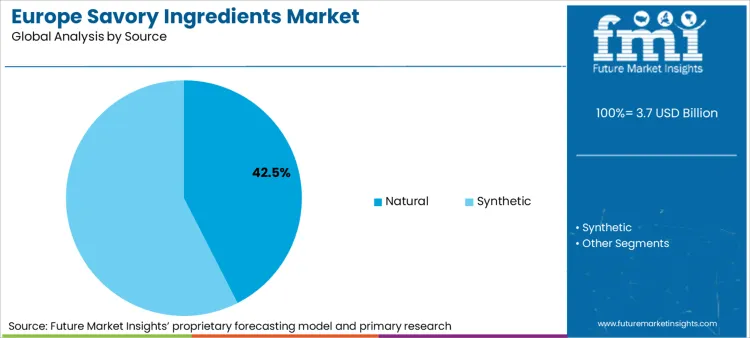
| Segment | Value Share (2026) |
|---|---|
| Natural (Source) | 42.5% |
Europe will witness tremendous growth in terms of preference for natural savoury ingredients in view of a high demand among consumers for transparency on the labels for food and high preference for consumption of natural unprocessed products. It is very dominant in countries such as Germany and UK, especially health-conscious people demand more use of natural seasoning herbs and spices.
Ingredion Incorporated and Koninklijke DSM NV are focusing on the expansion of natural ingredient offerings as consumers demand more clean-label products. This growth in the natural savoury ingredients market will be one of the significant forces shaping the future of the European savoury ingredients market.
Competition Outlook Among Global and Regional Ingredient Suppliers
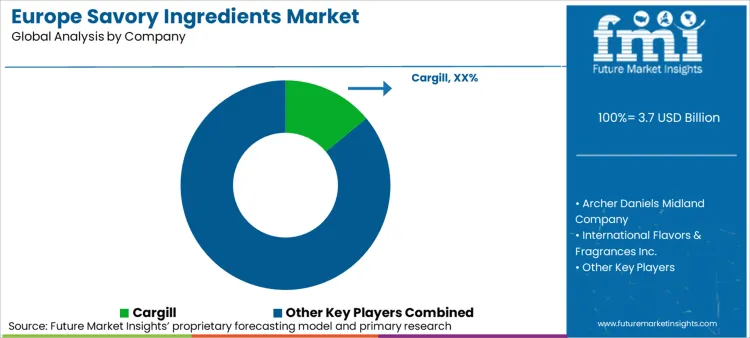
Competition in the European savoury ingredients market is tough, and innovation by market leaders to ensure demand for diversity, flavor, and sustainability continues. Kerry Group, Cargill, and Givaudan SA are leaders of this market through a high investment in R&D as well as powerful distribution networks for the broad array of savoury ingredients designed to cater to consumer needs.
Companies are putting heavy investments in developing new flavors and natural ingredients for better positioning in an evolving market. On the other hand, players like Sensient Technologies, the smaller ones, are also eyeing niches, like plant-based flavors and functional seasonings, which will eventually become key sources of demand for highly specialized savoury ingredients.
Recent Developments:
- In late 2024, Ajinomoto Health and Nutrition launched Savor-Boost K, a kokumi-enhancing savory ingredient designed for the European market using specific peptides to improve richness in plant-based applications without increasing sodium content.
- In May 2024, Kerry Group opened a 10,000-square-meter taste manufacturing facility in Hamm, Germany, targeting savory taste solutions and functional ingredients for the European snack and ready-meal markets.
- In early 2025, Symrise entered a strategic partnership to expand its natural savory flavor portfolio for the European clean-label market, addressing growing demand for authentic regional taste profiles.
Leading Savory Ingredients Brands in the European Market
- Cargill
- Archer Daniels Midland Company
- International Flavors & Fragrances Inc.
- Kerry Group
- Givaudan SA
- Tate & Lyle PLC
- Koninklijke DSM NV
- Sensient Technologies
- Advanced Enzyme Technologies Limited
- Ingredion Incorporated
Market Definition
The Europe savory ingredients market represents revenue generated from the manufacture and sale of taste enhancers, flavor systems, and functional ingredients that deliver umami, kokumi, and savory profiles in processed food applications within Europe. The market measures the value of yeast extracts, hydrolyzed vegetable proteins, natural flavors, reaction flavors, kokumi enhancers, and MSG alternatives sold to European food manufacturers.
Inclusions cover yeast extracts and autolyzed yeast, hydrolyzed vegetable and animal proteins (HVP, HAP), natural savory flavors (mushroom, tomato, seaweed-derived), reaction flavors (Maillard), kokumi and umami enhancers, MSG and MSG alternatives, and savory seasoning blends for industrial food manufacturing.
Exclusions include retail consumer spices and seasonings, fresh herbs, table salt, and vinegar. Sweet flavor ingredients, dairy flavors, and beverage flavor systems are outside the scope. Raw agricultural commodities (tomatoes, mushrooms) not processed into ingredient form are excluded.
Scope of Report
| Items | Values |
|---|---|
| Quantitative Units (2026) | USD 3,700.4 Million |
| Product Type | Yeast Extracts, HVP/HAP, Natural Savory Flavors, Reaction Flavors, Kokumi Enhancers, MSG Alternatives, Savory Seasoning Blends |
| Material Type | Fermentation-Derived, Hydrolysis-Derived, Natural Extraction, Thermal Reaction, Peptide-Based |
| End-Use / Channel | Food Manufacturers (Snacks, Ready Meals, Soups), Plant-Based Protein Producers, Bakery and Confectionery, Foodservice Ingredient Distributors |
| Regions Covered | Western Europe, Northern Europe, Southern Europe, Central and Eastern Europe |
| Countries Covered | Germany, France, UK, Netherlands, Italy, Spain, Poland, and 30+ European countries |
| Key Companies Profiled | Kerry Group, Givaudan, Symrise, IFF, Ajinomoto, DSM-Firmenich, Tate & Lyle, Ohly (ABF Ingredients) |
| Additional Attributes | Revenue analysis by ingredient type and application, sodium reduction technology tracking, clean-label compliance monitoring, plant-based savory application growth, and Novel Food authorization pipeline |
Top Segments Studied in the Europe Savory Ingredients Market Report
By Product Type:
- Yeast Extracts and Autolyzed Yeast
- Hydrolyzed Vegetable and Animal Proteins
- Natural Savory Flavors (Mushroom, Tomato, Seaweed)
- Reaction Flavors (Maillard)
- Kokumi and Umami Enhancers
- Savory Seasoning Blends
By Material Type:
- Fermentation-Derived
- Hydrolysis-Derived
- Natural Extraction
- Thermal Reaction (Maillard)
- Peptide-Based Enhancement
By Region:
- Western Europe
- Northern Europe
- Southern Europe
- Central and Eastern Europe
Bibliography
- Kerry Group plc. (2024, May). Hamm Germany taste manufacturing facility opening. Kerry Group.
- Ajinomoto Co. Inc. (2024, December). Savor-Boost K kokumi ingredient launch for Europe. Ajinomoto.
- Givaudan SA. (2026, January). 2025 full-year financial results. Givaudan.
- European Commission. (2024, March). Farm to Fork Strategy sodium reduction progress report. European Commission.
Frequently Asked Questions
What is the current market size for Europe Savory Ingredients?
The market is valued at USD 3,700.4 Million in 2026, driven by EU sodium reduction mandates and plant-based reformulation demand.
What is the projected CAGR for the market over the next 10 years?
The market is projected to grow at a CAGR of 8.2% from 2026 to 2036.
Which countries lead in Europe?
Germany leads by savory ingredient consumption, followed by France, the UK, and the Netherlands.
What are the primary market drivers?
EU Farm to Fork sodium reduction targets, plant-based food category growth, and clean-label reformulation demand are the primary drivers.
Who are the leading suppliers?
Kerry Group, Givaudan, Symrise, and Ajinomoto are key players, differentiating through kokumi technology, European manufacturing, and customer-specific innovation.
Preview the report firsthand - request a free sample
Get SampleGet the brochure for pricing and purchase details.
Get PDFTable of Content
- Executive Summary
- Global Market Outlook
- Demand-side Trends
- Supply-side Trends
- Technology Roadmap Analysis
- Analysis and Recommendations
- Market Overview
- Market Coverage / Taxonomy
- Market Definition / Scope / Limitations
- Research Methodology
- Chapter Orientation
- Analytical Lens and Working Hypotheses
- Market Structure, Signals, and Trend Drivers
- Benchmarking and Cross-market Comparability
- Market Sizing, Forecasting, and Opportunity Mapping
- Research Design and Evidence Framework
- Desk Research Programme (Secondary Evidence)
- Company Annual and Sustainability Reports
- Peer-reviewed Journals and Academic Literature
- Corporate Websites, Product Literature, and Technical Notes
- Earnings Decks and Investor Briefings
- Statutory Filings and Regulatory Disclosures
- Technical White Papers and Standards Notes
- Trade Journals, Industry Magazines, and Analyst Briefs
- Conference Proceedings, Webinars, and Seminar Materials
- Government Statistics Portals and Public Data Releases
- Press Releases and Reputable Media Coverage
- Specialist Newsletters and Curated Briefings
- Sector Databases and Reference Repositories
- FMI Internal Proprietary Databases and Historical Market Datasets
- Subscription Datasets and Paid Sources
- Social Channels, Communities, and Digital Listening Inputs
- Additional Desk Sources
- Expert Input and Fieldwork (Primary Evidence)
- Primary Modes
- Qualitative Interviews and Expert Elicitation
- Quantitative Surveys and Structured Data Capture
- Blended Approach
- Why Primary Evidence is Used
- Field Techniques
- Interviews
- Surveys
- Focus Groups
- Observational and In-context Research
- Social and Community Interactions
- Stakeholder Universe Engaged
- C-suite Leaders
- Board Members
- Presidents and Vice Presidents
- R&D and Innovation Heads
- Technical Specialists
- Domain Subject-matter Experts
- Scientists
- Physicians and Other Healthcare Professionals
- Governance, Ethics, and Data Stewardship
- Research Ethics
- Data Integrity and Handling
- Primary Modes
- Tooling, Models, and Reference Databases
- Desk Research Programme (Secondary Evidence)
- Data Engineering and Model Build
- Data Acquisition and Ingestion
- Cleaning, Normalisation, and Verification
- Synthesis, Triangulation, and Analysis
- Quality Assurance and Audit Trail
- Market Background
- Market Dynamics
- Drivers
- Restraints
- Opportunity
- Trends
- Scenario Forecast
- Demand in Optimistic Scenario
- Demand in Likely Scenario
- Demand in Conservative Scenario
- Opportunity Map Analysis
- Product Life Cycle Analysis
- Supply Chain Analysis
- Investment Feasibility Matrix
- Value Chain Analysis
- PESTLE and Porter’s Analysis
- Regulatory Landscape
- Regional Parent Market Outlook
- Production and Consumption Statistics
- Import and Export Statistics
- Market Dynamics
- Global Market Analysis 2021 to 2025 and Forecast, 2026 to 2036
- Historical Market Size Value (USD Million) Analysis, 2021 to 2025
- Current and Future Market Size Value (USD Million) Projections, 2026 to 2036
- Y-o-Y Growth Trend Analysis
- Absolute $ Opportunity Analysis
- Global Market Pricing Analysis 2021 to 2025 and Forecast 2026 to 2036
- Global Market Analysis 2021 to 2025 and Forecast 2026 to 2036, By Type of Ingredient
- Introduction / Key Findings
- Historical Market Size Value (USD Million) Analysis By Type of Ingredient , 2021 to 2025
- Current and Future Market Size Value (USD Million) Analysis and Forecast By Type of Ingredient , 2026 to 2036
- Spices and Seasonings
- Savory Flavors
- Flavor Enhancers
- Spices and Seasonings
- Y-o-Y Growth Trend Analysis By Type of Ingredient , 2021 to 2025
- Absolute $ Opportunity Analysis By Type of Ingredient , 2026 to 2036
- Global Market Analysis 2021 to 2025 and Forecast 2026 to 2036, By Source
- Introduction / Key Findings
- Historical Market Size Value (USD Million) Analysis By Source, 2021 to 2025
- Current and Future Market Size Value (USD Million) Analysis and Forecast By Source, 2026 to 2036
- Natural
- Synthetic
- Natural
- Y-o-Y Growth Trend Analysis By Source, 2021 to 2025
- Absolute $ Opportunity Analysis By Source, 2026 to 2036
- Global Market Analysis 2021 to 2025 and Forecast 2026 to 2036, By Region
- Introduction
- Historical Market Size Value (USD Million) Analysis By Region, 2021 to 2025
- Current Market Size Value (USD Million) Analysis and Forecast By Region, 2026 to 2036
- North America
- Latin America
- Western Europe
- Eastern Europe
- East Asia
- South Asia and Pacific
- Middle East & Africa
- Market Attractiveness Analysis By Region
- North America Market Analysis 2021 to 2025 and Forecast 2026 to 2036, By Country
- Historical Market Size Value (USD Million) Trend Analysis By Market Taxonomy, 2021 to 2025
- Market Size Value (USD Million) Forecast By Market Taxonomy, 2026 to 2036
- By Country
- USA
- Canada
- Mexico
- By Type of Ingredient
- By Source
- By Country
- Market Attractiveness Analysis
- By Country
- By Type of Ingredient
- By Source
- Key Takeaways
- Latin America Market Analysis 2021 to 2025 and Forecast 2026 to 2036, By Country
- Historical Market Size Value (USD Million) Trend Analysis By Market Taxonomy, 2021 to 2025
- Market Size Value (USD Million) Forecast By Market Taxonomy, 2026 to 2036
- By Country
- Brazil
- Chile
- Rest of Latin America
- By Type of Ingredient
- By Source
- By Country
- Market Attractiveness Analysis
- By Country
- By Type of Ingredient
- By Source
- Key Takeaways
- Western Europe Market Analysis 2021 to 2025 and Forecast 2026 to 2036, By Country
- Historical Market Size Value (USD Million) Trend Analysis By Market Taxonomy, 2021 to 2025
- Market Size Value (USD Million) Forecast By Market Taxonomy, 2026 to 2036
- By Country
- Germany
- UK
- Italy
- Spain
- France
- Nordic
- BENELUX
- Rest of Western Europe
- By Type of Ingredient
- By Source
- By Country
- Market Attractiveness Analysis
- By Country
- By Type of Ingredient
- By Source
- Key Takeaways
- Eastern Europe Market Analysis 2021 to 2025 and Forecast 2026 to 2036, By Country
- Historical Market Size Value (USD Million) Trend Analysis By Market Taxonomy, 2021 to 2025
- Market Size Value (USD Million) Forecast By Market Taxonomy, 2026 to 2036
- By Country
- Russia
- Poland
- Hungary
- Balkan & Baltic
- Rest of Eastern Europe
- By Type of Ingredient
- By Source
- By Country
- Market Attractiveness Analysis
- By Country
- By Type of Ingredient
- By Source
- Key Takeaways
- East Asia Market Analysis 2021 to 2025 and Forecast 2026 to 2036, By Country
- Historical Market Size Value (USD Million) Trend Analysis By Market Taxonomy, 2021 to 2025
- Market Size Value (USD Million) Forecast By Market Taxonomy, 2026 to 2036
- By Country
- China
- Japan
- South Korea
- By Type of Ingredient
- By Source
- By Country
- Market Attractiveness Analysis
- By Country
- By Type of Ingredient
- By Source
- Key Takeaways
- South Asia and Pacific Market Analysis 2021 to 2025 and Forecast 2026 to 2036, By Country
- Historical Market Size Value (USD Million) Trend Analysis By Market Taxonomy, 2021 to 2025
- Market Size Value (USD Million) Forecast By Market Taxonomy, 2026 to 2036
- By Country
- India
- ASEAN
- Australia & New Zealand
- Rest of South Asia and Pacific
- By Type of Ingredient
- By Source
- By Country
- Market Attractiveness Analysis
- By Country
- By Type of Ingredient
- By Source
- Key Takeaways
- Middle East & Africa Market Analysis 2021 to 2025 and Forecast 2026 to 2036, By Country
- Historical Market Size Value (USD Million) Trend Analysis By Market Taxonomy, 2021 to 2025
- Market Size Value (USD Million) Forecast By Market Taxonomy, 2026 to 2036
- By Country
- Kingdom of Saudi Arabia
- Other GCC Countries
- Turkiye
- South Africa
- Other African Union
- Rest of Middle East & Africa
- By Type of Ingredient
- By Source
- By Country
- Market Attractiveness Analysis
- By Country
- By Type of Ingredient
- By Source
- Key Takeaways
- Key Countries Market Analysis
- USA
- Pricing Analysis
- Market Share Analysis, 2025
- By Type of Ingredient
- By Source
- Canada
- Pricing Analysis
- Market Share Analysis, 2025
- By Type of Ingredient
- By Source
- Mexico
- Pricing Analysis
- Market Share Analysis, 2025
- By Type of Ingredient
- By Source
- Brazil
- Pricing Analysis
- Market Share Analysis, 2025
- By Type of Ingredient
- By Source
- Chile
- Pricing Analysis
- Market Share Analysis, 2025
- By Type of Ingredient
- By Source
- Germany
- Pricing Analysis
- Market Share Analysis, 2025
- By Type of Ingredient
- By Source
- UK
- Pricing Analysis
- Market Share Analysis, 2025
- By Type of Ingredient
- By Source
- Italy
- Pricing Analysis
- Market Share Analysis, 2025
- By Type of Ingredient
- By Source
- Spain
- Pricing Analysis
- Market Share Analysis, 2025
- By Type of Ingredient
- By Source
- France
- Pricing Analysis
- Market Share Analysis, 2025
- By Type of Ingredient
- By Source
- India
- Pricing Analysis
- Market Share Analysis, 2025
- By Type of Ingredient
- By Source
- ASEAN
- Pricing Analysis
- Market Share Analysis, 2025
- By Type of Ingredient
- By Source
- Australia & New Zealand
- Pricing Analysis
- Market Share Analysis, 2025
- By Type of Ingredient
- By Source
- China
- Pricing Analysis
- Market Share Analysis, 2025
- By Type of Ingredient
- By Source
- Japan
- Pricing Analysis
- Market Share Analysis, 2025
- By Type of Ingredient
- By Source
- South Korea
- Pricing Analysis
- Market Share Analysis, 2025
- By Type of Ingredient
- By Source
- Russia
- Pricing Analysis
- Market Share Analysis, 2025
- By Type of Ingredient
- By Source
- Poland
- Pricing Analysis
- Market Share Analysis, 2025
- By Type of Ingredient
- By Source
- Hungary
- Pricing Analysis
- Market Share Analysis, 2025
- By Type of Ingredient
- By Source
- Kingdom of Saudi Arabia
- Pricing Analysis
- Market Share Analysis, 2025
- By Type of Ingredient
- By Source
- Turkiye
- Pricing Analysis
- Market Share Analysis, 2025
- By Type of Ingredient
- By Source
- South Africa
- Pricing Analysis
- Market Share Analysis, 2025
- By Type of Ingredient
- By Source
- USA
- Market Structure Analysis
- Competition Dashboard
- Competition Benchmarking
- Market Share Analysis of Top Players
- By Regional
- By Type of Ingredient
- By Source
- Competition Analysis
- Competition Deep Dive
- Cargill
- Overview
- Product Portfolio
- Profitability by Market Segments (Product/Age /Sales Channel/Region)
- Sales Footprint
- Strategy Overview
- Marketing Strategy
- Product Strategy
- Channel Strategy
- Archer Daniels Midland Company
- International Flavors & Fragrances Inc.
- Kerry Group
- Givaudan SA
- Tate & Lyle PLC
- Koninklijke DSM NV
- Cargill
- Competition Deep Dive
- Assumptions & Acronyms Used


