

- Industry Size (2026)
- USD 0.9 Bn
- Forecast (2036)
- USD 2.1 Bn
- CAGR (2026 to 2036)
- 8.4%
Explosion Isolation Valve Market Size, Market Forecast and Outlook By FMI
The explosion isolation valve market secured a valuation of USD 0.8 billion in 2025. Industry is estimated to reach USD 0.9 billion in 2026, reflecting rising focus on dust explosion risk control. Sector is projected to grow at a CAGR of 8.4% from 2026 to 2036, with total revenue expected to reach USD 2.1 billion by 2036. Growth is driven by the shift toward treating explosion propagation control as a required engineering function in dust-handling systems.
Summary of Explosion Isolation Valve Market
- The market is forecast to reach USD 2.1 billion by 2036.
- The market is expected to grow at a CAGR of 8.4% from 2026 to 2036.
- The market was estimated at USD 0.8 billion in 2025.
- The forecast period represents an incremental opportunity of USD 1.5 billion.
- Explosion isolation valves are critical safety devices used to prevent flame and pressure propagation across connected industrial systems.
- Demand is driven by rising safety investments in dust-generating industries such as food processing, chemicals, mining, and biomass.
- Flap valves lead the product segment with a 42.0% share due to simpler design and lower maintenance requirements.
- The chemicals sector dominates end use with a 27.0% share, supported by strict safety controls and powder handling risks.
- ATEX-certified systems account for 47.0% share, reflecting strong compliance requirements in European and export markets.
- Ducting applications hold 54.0% share as isolation is commonly installed in process line sections.
- Retrofit and safety upgrades represent 51.0% share, driven by audits and modernization of older facilities.
- India, China, and the United States are the fastest-growing markets, while Europe and Japan remain stable demand regions.
- Market growth is moderated by complex qualification requirements tied to system design, dust properties, and safety integration.
- Leading companies include BS&B Safety Systems, Fike, REMBE, IEP Technologies, CV Technology, RICO Sicherheitstechnik, StuvEx, and Camfil.
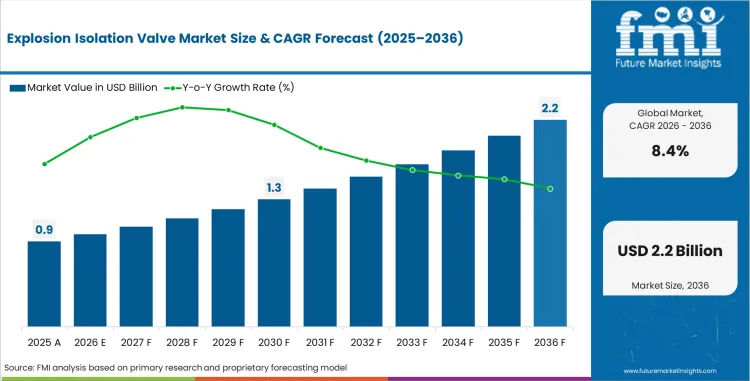
Plant owners are changing how they approach safety system selection. Decisions now focus on how to stop flame and pressure from moving through ducts, filters, and conveying lines rather than only selecting venting or detection systems. Equipment evaluation depends on restart time, certification requirements, duct compatibility, hygiene constraints, and the impact on airflow. Delayed decisions often lead to higher retrofit costs when isolation valves must be added to existing layouts not designed for them.
Adoption improves after initial system qualification. Once a plant completes hazard analysis, layout validation, and acceptance testing on one installation, additional systems are deployed more easily. Engineering teams apply existing knowledge of spacing, actuation, and maintenance practices across similar process lines.
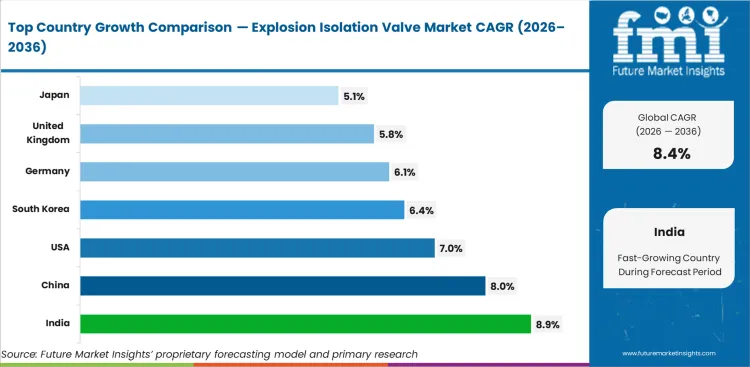
India is projected to reach 8.9% CAGR in the explosion isolation valve market from 2026 to 2036, supported by new capacity in powder handling, milling, and dust collection systems. China is expected to expand at a CAGR of 8.0% over the same period, driven by continued industrial processing activity. The United States is anticipated to grow at 7.0%, while South Korea is forecast to record 6.4% growth through 2036. Germany is likely to reach a CAGR of 6.1%, followed by the United Kingdom at 5.8% and Japan at 5.1%. Growth in Asia is linked to new process installations, while demand in North America and Europe is shaped by retrofit activity, compliance requirements, and replacement across existing systems.
Explosion Isolation Valve Market Key Takeaways
| Metric | Details |
|---|---|
| Industry Size (2026) | USD 0.9 billion |
| Industry Value (2036) | USD 2.1 billion |
| CAGR (2026 to 2036) | 8.4% |
Source: Future Market Insights (FMI) analysis, based on proprietary forecasting model and primary research
Segmental Analysis
Explosion Isolation Valve Market Analysis by Valve Type
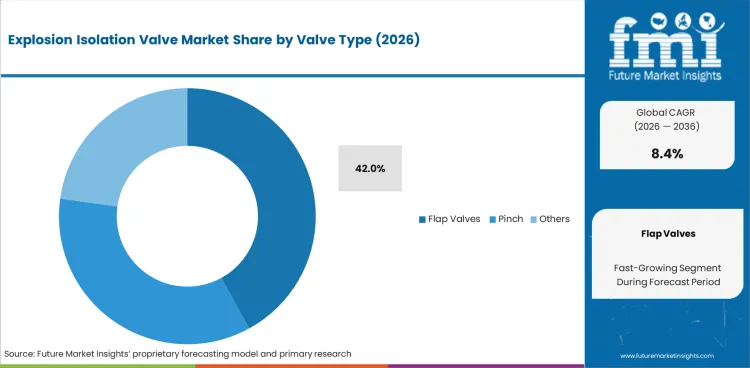
Airflow interruption only works when the valve can close reliably under actual operating conditions. Flap valves remain the preferred option in many dust-handling systems because they offer passive isolation without adding complex control requirements. Flap valves are expected to account for 42.0% share of the valve type segment in 2026, as plants favor lower maintenance effort, simple reset procedures, and fewer dependencies on external actuation. This approach suits facilities where dust collectors and duct lines run continuously and maintenance windows are limited. High-speed knife and slide valves are selected in cases where faster closure or bidirectional isolation is required, while pinch and quick-action valves are used in systems that need a full-bore flow path with minimal buildup. Incorrect selection often leads to pressure drop issues, hygiene concerns, or installation constraints that complicate certified placement.
- Passive closure: Passive flap designs reduce control-system dependence during normal operation, which appeals to maintenance heads who want fewer components to monitor between inspections.
- Bore access: Full-path flow and simpler internal geometry help process engineers limit buildup points that can interfere with airflow or cleaning routines.
- Reset discipline: Sites choosing the wrong valve often discover that rearming time and line access carry more operating weight than the purchase price.
Explosion Isolation Valve Market Analysis by End Use
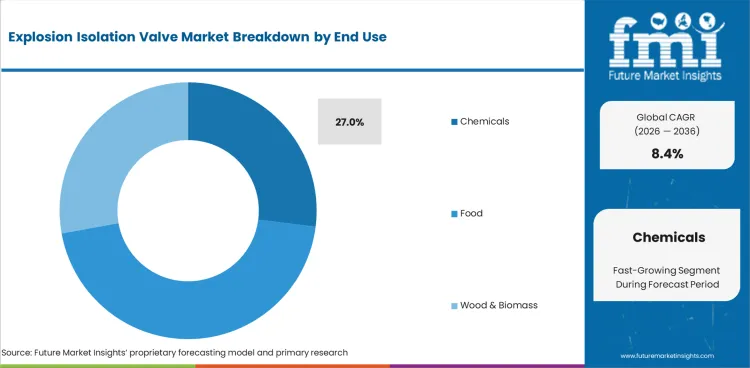
Chemicals is expected to represent 27.0% share of the end-use segment over the forecast period, as powder handling lines, reactors, storage vessels, and dust collection systems operate under strict process control. Buyers in this segment evaluate isolation devices based on hazardous area compatibility, product buildup risk, inspection access, and the ability to manage shutdown without disrupting batch operations. Food processing also maintains strong demand, as hygiene, combustible dust control, and product integrity are addressed within the same system design. Wood and biomass applications require consistent protection due to recurring dust risks and collector exposure. Metals and mining demand remains more selective, linked to specific particulate hazards and process layouts. Facilities that under-specify isolation systems often face additional upgrades later, as connected ducts and vessels require similar protection once one section is improved.
- Process severity: Chemical plants buy around containment logic, cleaning burden, and auditability because one weak point can compromise the rest of the protection design.
- Hygiene fit: Food processors need valves that support sanitation routines without turning inspection or access into a production bottleneck.
- Line dependency: Plants with multiple connected units often expand isolation scope after the first installation reveals how many adjacent assets remain exposed.
Explosion Isolation Valve Market Analysis by Protection Standard
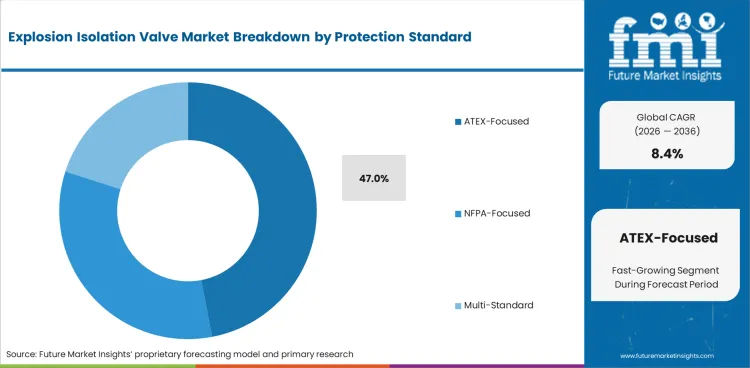
Certification language shapes specification writing long before an order is placed. ATEX-focused systems are expected to contribute 47.0% share of protection-standard demand in 2026 as European installations and export-oriented OEM projects continue to favor equipment families that fit notified-body testing and documented conformity pathways. Buyers looking across hazardous area gear, workplace safety, and safety instrumentation references are rarely comparing labels alone; they are checking how the valve fits the rest of the plant protection file, whether placement rules can be met, and how smoothly certification documentation moves through engineering approval. NFPA-focused demand remains substantial in North America where hazard analysis and plant insurance scrutiny keep explosion isolation active in collector and conveying work. Multistandard products gain ground where OEMs sell into more than one regulatory environment and want to limit portfolio fragmentation. Weak standards fit creates immediate commercial drag because it delays approvals even when the mechanical design itself is acceptable.
- Certification fit: Documented conformity shortens engineering review for teams that must align the valve with the rest of the protection package.
- Approval burden: North American and European projects often buy different documentation logic even when the operational hazard looks similar.
- Portfolio control: Multistandard designs matter most to OEMs trying to serve several geographies without duplicating every product family.
Explosion Isolation Valve Market Analysis by Installation
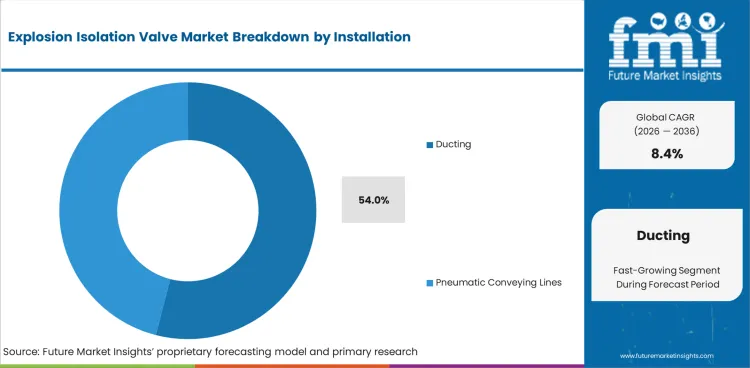
Line placement determines whether isolation performs as intended or remains ineffective in operation. Many plants first address duct sections connecting collectors, filters, and upstream equipment to stop flame and pressure before they spread through the process. Engineers evaluate available straight-run length, inspection access, and the impact of valve installation on airflow and pressure loss. Ducting is expected to account for 54.0% share of the installation segment in 2026, reflecting this priority. Pneumatic conveying lines also remain important due to long transfer distances and dependence on continuous flow. Installation issues usually appear later when space constraints, access limitations, or pressure loss make the selected location difficult to implement.
- Placement logic: Straight-run availability and access clearance often decide the installation point before brand choice is finalized.
- Flow balance: Airflow impact matters because a safety device that disrupts conveying performance quickly loses operator support.
- Service access: Maintenance teams favor layouts that let them inspect, reset, and clean the valve without dismantling half the line.
Explosion Isolation Valve Market Analysis by Channel
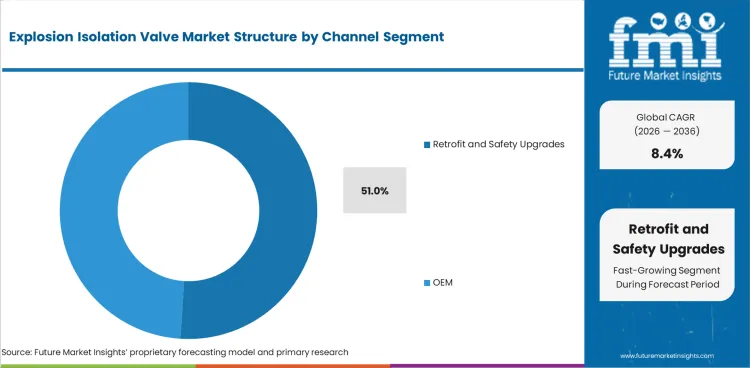
Most sales still come after a plant realizes the original line design left isolation unfinished. Retrofit and safety upgrades are expected to represent 51.0% share of channel demand in 2026, ahead of OEM supply, because many operating sites add valves only after dust hazard reviews, insurer pressure, collector replacement, or broader process upgrades expose missing protection between connected assets. FMI sees this pattern echoed across industrial valves, process automation, and handling integration decisions, where brownfield engineering creates a different commercial problem than a line designed correctly at the outset. OEM sales stay important in new systems, especially where exporters want pre-qualified packages and cleaner documentation transfer. Retrofit work remains harder to execute because contractors must fit certified hardware around fixed duct routes, legacy collectors, and shutdown schedules that were never planned for valve installation.
- Brownfield work: Retrofit demand persists because existing plants often discover isolation gaps only when audits or equipment changes force a closer review.
- Shutdown pressure: Installers who cannot work within narrow outage windows lose ground even if their hardware clears the technical screen.
- Package transfer: OEM inclusion matters where buyers prefer one accountable supplier for collector, duct, control, and protection integration.
Explosion Isolation Valve Market Drivers, Restraints, and Opportunities
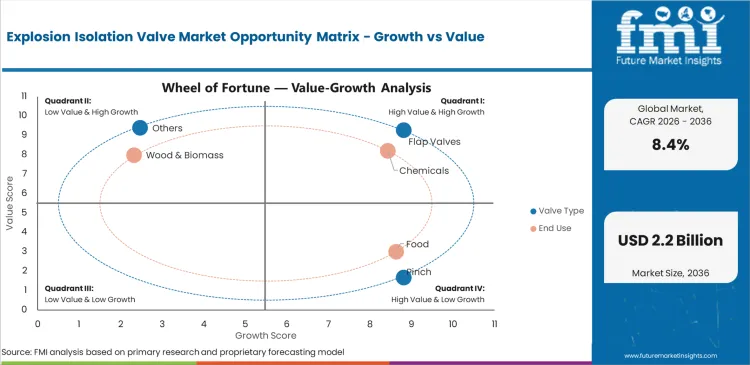
Operations leaders are deciding whether line protection should extend beyond venting and detection to include controlled isolation of explosion propagation. This shift is increasing demand for isolation valves, as connected collectors, cyclones, mills, and conveying lines create multiple pathways for pressure and flame movement. Mechanical isolation is being treated as part of system design rather than an add-on after an incident. Early planning allows alignment with duct layout, airflow direction, maintenance access, and shutdown requirements. Delayed decisions often lead to difficult retrofits in systems that were not designed for isolation hardware.
Engineering approval remains the main constraint on adoption. Projects slow down because multiple teams must agree on valve type, placement, certification requirements, and impact on airflow and hygiene. Each facility has unique layout and equipment conditions, which limits the ability to replicate solutions across lines. Suppliers can reduce delays through stronger application support and clearer technical documentation. The core challenge remains that isolation systems must be validated within active production environments, where any design compromise directly affects operation.
Opportunities in the Explosion Isolation Valve Market
- Collector retrofits: Dust collector replacement and line modernization programs create room for isolation hardware because access, duct routing, and budget are already under review.
- Export packages: OEMs selling across North America and Europe can capture more orders with product families that support both ATEX-led and NFPA-led specification pathways.
- Control pairing: Suppliers linking valves with safety relays, safety actuators, and smart pneumatics can improve buyer confidence where response logic and system status have to be interpreted quickly by plant teams.
Regional Analysis
Based on the regional analysis, the Explosion Isolation Valve Market is segmented into North America, Latin America, Europe, East Asia, South Asia and Pacific, and the Middle East and Africa across 40 plus countries.
.webp "Top Country Growth Comparison Explosion Isolation Valve Market Cagr (2026 2036)")
| Country | CAGR (2026 to 2036) |
|---|---|
| India | 8.9% |
| China | 8.0% |
| United States | 7.0% |
| South Korea | 6.4% |
| Germany | 6.1% |
| United Kingdom | 5.8% |
| Japan | 5.1% |
Source: Future Market Insights (FMI) analysis, based on proprietary forecasting model and primary research
North America Explosion Isolation Valve Market Analysis
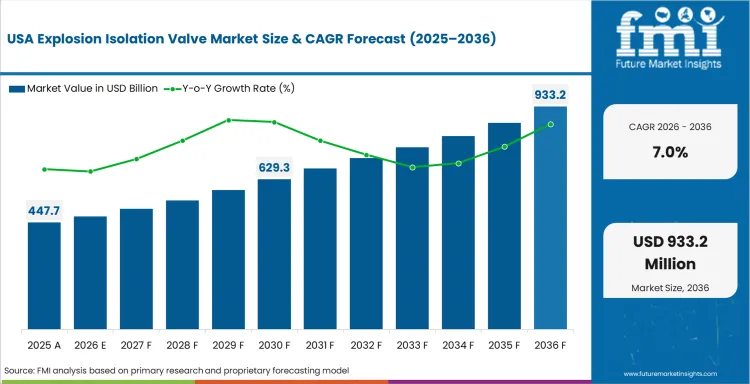
Demand across North America is shaped by post-assessment action rather than proactive system design. Most installations begin after a dust hazard analysis or insurer-driven review identifies propagation risk across connected equipment. Engineering teams are not selecting valves in isolation. They evaluate how the device affects airflow, restart time, and integration with existing ducting and collectors. Retrofit complexity often determines whether a project moves forward.
- United States: The United States remains commercially relevant due to its large installed base of dust collection and conveying systems, with growth tracking near 7.0% from 2026 to 2036. Procurement teams focus on whether the valve can be installed in a certified position without introducing pressure-drop issues. Reset time after activation also becomes a deciding factor in high-utilization plants. Buyers often reject technically compliant solutions if they complicate restart procedures. Vendors that simplify installation within live systems tend to secure repeat business. These factors sustain steady demand despite limited greenfield expansion.
Europe Explosion Isolation Valve Market Analysis
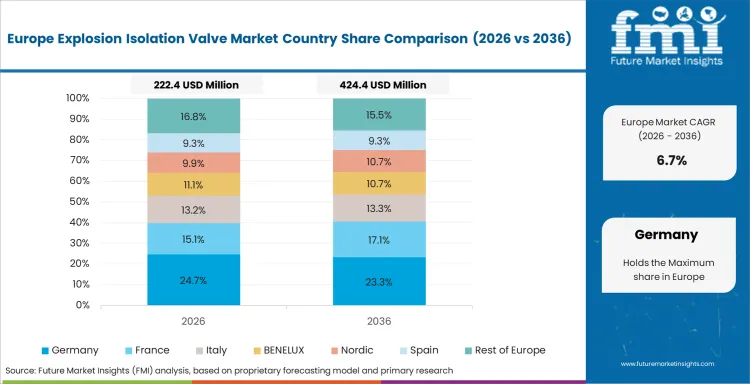
Certification discipline carries more commercial weight in Europe because buyers have to think through conformity, documentation flow, notified-body expectations, and how the isolation device interacts with the rest of the protected system. That setting favors vendors with stronger application files and established familiarity with collector, silo, and conveying protection. FMI sees the region's buying pattern overlapping with hazardous area gear, explosion-proof equipment, and machine safety procurement, where compliance fit can delay a project even when the hardware itself is acceptable. Europe does not need the fastest growth rate to remain influential. It shapes specification language, supplier credibility, and the certification expectations that many exporters must meet before they can win outside their home region.
- Germany: Process engineers in Germany usually approach isolation as part of a wider system design problem rather than a standalone purchase. Strong process industries, established dust-handling infrastructure, and a documentation-heavy approval culture keep demand stable. Germany is projected to record a CAGR of 6.1% in explosion isolation valves during the forecast period. Buyers tend to reward suppliers that can show predictable placement rules, repeatable testing support, and good alignment with plant maintenance practice.
- United Kingdom: Retrofit-driven activity keeps the United Kingdom active in this category, where many installations begin with line-specific risk evaluations. Growth remains measured, reaching close to 5.8% over the forecast period, as projects depend heavily on shutdown planning and installation access. Buyers focus on practical installation constraints rather than theoretical performance. Systems that require complex modifications often face delays or rejection. Equipment must fit within limited access zones while maintaining compliance. These factors shape purchasing decisions across legacy process sites.
Asia Pacific Explosion Isolation Valve Market Analysis
New process capacity and modernization of powder handling lines keep Asia Pacific ahead on growth. Buyers in this region are adding dust collection, conveying, and storage assets while also tightening engineering expectations around safe plant layout. That combination favors suppliers that can support both new-build projects and later-stage upgrades. Demand patterns also connect with bulk handling, automated handling systems, automated handling gear, and handling integration investments because plant managers are building more connected process lines that cannot leave propagation paths uncontrolled. FMI expects regional buyers to keep sorting suppliers by delivery reliability, engineering response, and whether valve hardware can be adapted cleanly across several plant formats.
- India: India leads the growth range, with the explosion isolation valve market expected to move at 8.9% CAGR between 2026 and 2036. Rapid industrial expansion is increasing the number of connected process lines where propagation risks must be addressed. Plant teams are incorporating isolation earlier in system design rather than treating it as a later upgrade. Equipment must align with evolving layout standards and integration requirements. Delays in engineering support can slow overall project timelines. These conditions support strong demand for suppliers with fast technical response capabilities.
- China: Industrial scale and operational intensity define demand in China, where facilities manage high-throughput powder handling systems. The market in China is projected to expand at a CAGR of 8.0% through 2036, supported by ongoing upgrades in process design and safety integration. Buyers place strong emphasis on lead time and installed performance. Equipment must function reliably without disrupting production continuity. Documentation and compliance remain critical during procurement. These factors keep both replacement and new installations active across industrial sectors.
- South Korea: Precision-focused industrial operations and tighter engineering control support a healthy replacement and upgrade path in South Korea. Buyers usually expect cleaner documentation, disciplined execution, and predictable service response before approving a specialized safety device. South Korea is expected to register 6.4% CAGR in the explosion isolation valve industry through 2036. Vendors that treat local support as an afterthought often struggle once projects move from quotation to plant qualification.
- Japan: Japan’s market reflects steady rather than accelerated movement, shaped by careful capital allocation and established operational discipline. Growth in Japan is predicted to be around 5.1% through 2036, with demand tied to selective upgrades within mature facilities. Buyers prioritize reliability and minimal disruption to existing systems. Equipment must integrate without adding complexity to maintenance routines. Long evaluation cycles influence procurement timelines. These factors support demand for proven and stable solutions rather than large-scale expansion.
FMI's report includes additional country-level assessment across the rest of Europe, East Asia, South Asia and Pacific, Latin America, and the Middle East and Africa. Markets outside the seven highlighted countries often follow one of two patterns: newer process investments that bring isolation into initial layout decisions, or mature facilities that return to the category when retrofit economics finally outweigh the risk of leaving connected equipment exposed.
Competitive Aligners for Market Players
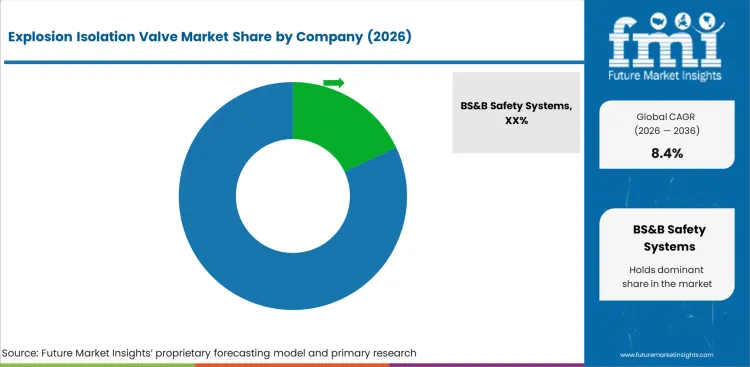
Fragmentation persists because application fit matters as much as brand visibility. Buyers evaluate suppliers based on line geometry, dust loading, certification requirements, reset procedures, and maintenance effort for the intended installation. Suppliers such as BS&B Safety Systems, Fike, REMBE, IEP Technologies, CV Technology, RICO Sicherheitstechnik, StuvEx, and Camfil compete across these criteria, but selection depends on specific use cases. Some suppliers are chosen for active isolation expertise or certification alignment, while others are preferred for simpler passive designs with lower pressure drop and easier upkeep. Selection typically favors the option that creates the least engineering complexity rather than the widest product range.
Established suppliers maintain their position through application support, documentation clarity, and familiarity with field conditions. New entrants must demonstrate that systems can be certified, installed, and maintained without disrupting operations. Suppliers with experience across dust control, material handling, pneumatic systems, and process control are better positioned because equipment is assessed within the full operating environment. Entry opportunities remain where suppliers can simplify retrofits, improve maintenance access, or address specific application gaps.
Large industrial operators avoid dependence on a single supplier by standardizing documentation, placement practices, and equipment types that maintenance teams already understand. This approach limits rapid consolidation. Market concentration is expected to increase gradually through 2036, but site-specific requirements will continue to support specialized suppliers that can address complex layouts, hygienic systems, and collector-specific configurations without extending approval timelines.
Key Players in Explosion Isolation Valve Market
- BS&B Safety Systems
- Fike
- REMBE
- IEP Technologies
- CV Technology
- RICO Sicherheitstechnik
- StuvEx
- Camfil
Scope of the Report
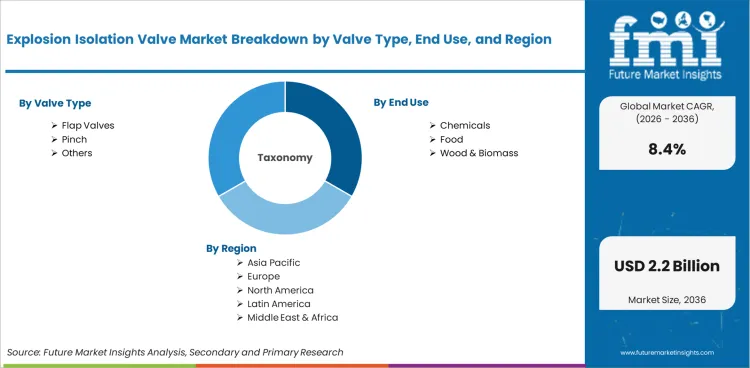
| Metric | Value |
|---|---|
| Quantitative Units | USD 0.9 billion to USD 2.1 billion, at a CAGR of 8.4% |
| Market Definition | Explosion isolation valves are mechanical devices used to stop flame and pressure propagation through ducts and connected process lines in combustible dust or related explosion-risk applications. |
| Valve Type Segmentation | Flap Valves, Pinch/Quick-action Valves, High-speed Knife/Slide Isolation, Other |
| End Use Segmentation | Food, Chemicals, Metals/Mining, Wood & Biomass, Other |
| Protection Standard Segmentation | ATEX-focused, NFPA-focused, Multi-standard |
| Installation Segmentation | Ducting, Pneumatic Conveying Lines |
| Channel Segmentation | OEM, Retrofit/Safety Upgrade |
| Regions Covered | North America, Latin America, Europe, East Asia, South Asia and Pacific, Middle East and Africa |
| Countries Covered | United States, Germany, United Kingdom, China, India, Japan, South Korea, and 40 plus countries |
| Key Companies Profiled | BS&B Safety Systems, Fike, REMBE, IEP Technologies, CV Technology, RICO Sicherheitstechnik, StuvEx, Camfil |
Source: Future Market Insights (FMI) analysis, based on proprietary forecasting model and primary research
Explosion Isolation Valve Market Analysis by Segments
By Valve Type:
- Flap Valves
- Pinch/Quick-action Valves
- High-speed Knife/Slide Isolation
- Other
By End Use:
- Food
- Chemicals
- Metals/Mining
- Wood & Biomass
- Other
By Protection Standard:
- ATEX-focused
- NFPA-focused
- Multi-standard
By Installation:
- Ducting
- Pneumatic Conveying Lines
By Channel:
- OEM
- Retrofit/Safety Upgrade
Region
- North America
- United States
- Canada
- Europe
- Germany
- United Kingdom
- France
- Italy
- Spain
- Asia Pacific
- China
- Japan
- South Korea
- Taiwan
- Singapore
- Latin America
- Brazil
- Mexico
- Argentina
- Middle East & Africa
- GCC Countries
- South Africa
- Israel
Bibliography
- European Commission. (2025, June 10). Equipment used in potentially explosive atmospheres. EUR-Lex.
- European Union. (2026, January 14). Commission Implementing Decision (EU) 2022/1668 on harmonised standards for equipment and protective systems intended for use in potentially explosive atmospheres drafted in support of Directive 2014/34/EU. EUR-Lex.
- National Fire Protection Association. (2026). NFPA 69 Standard Development. NFPA.
- Oregon Occupational Safety and Health Division. (2024). Combustible Dust Program Directive 268. Oregon OSHA.
- USA Chemical Safety and Hazard Investigation Board. (2025, September 17). Fatal Combustible Wood Dust Explosion and Fire at Horizon Biofuels Facility: Investigation Update. CSB Public Record.
This Report Addresses
- How large is the Explosion Isolation Valve Market in 2025, 2026, and 2036?
- Which valve type is expected to lead demand in 2026?
- Why do retrofit and safety upgrades account for a larger share than OEM demand?
- How do ATEX-focused and NFPA-focused requirements influence product specification?
- Which end-use sectors create the strongest installed-base demand for explosion isolation valves?
- Why does ducting remain the leading installation route for this category?
- Which countries are expected to outpace the global CAGR through 2036?
- What factors shape competition among specialized explosion isolation valve suppliers?
Frequently Asked Questions
What is the estimated size of the Explosion Isolation Valve Market in 2025?
FMI estimates the Explosion Isolation Valve Market at USD 0.8 billion in 2025. That figure is the pre-forecast base used to interpret the move toward USD 0.9 billion in 2026.
How large is the Explosion Isolation Valve Market expected to be in 2026?
Industry value is expected to reach USD 0.9 billion in 2026. That year acts as the starting point for the 2026 to 2036 forecast window used in this article.
What is the projected value of the Explosion Isolation Valve Market by 2036?
FMI projects the market to reach USD 2.1 billion by 2036. Growth to that level reflects wider use of explosion isolation in connected dust-handling and conveying systems.
What CAGR is expected for the Explosion Isolation Valve Market from 2026 to 2036?
The market is expected to expand at a CAGR of 8.4% from 2026 to 2036. That pace is supported by compliance-led upgrades and broader use of line-level propagation control.
Which valve type is expected to lead demand in 2026?
Flap valves are expected to lead valve-type demand with 42.0% share in 2026. Buyers continue to favor them in many passive applications because they offer simpler mechanical operation and lower maintenance burden.
Which end-use segment leads the market?
Chemicals is expected to remain the leading end-use segment, with 27.0% share in 2026. Powder handling discipline and the cost of uncontrolled propagation keep this sector commercially important.
Which protection standard segment leads the market?
ATEX-focused systems are expected to represent 47.0% share in 2026. European certification needs and export-oriented equipment design keep that specification route highly influential.
Which installation route accounts for the highest share?
Ducting is expected to account for 54.0% share in 2026. Many plants place isolation at duct sections where pressure and flame transfer can be blocked before upstream equipment is exposed.
Why does retrofit demand exceed OEM demand?
Retrofit and safety upgrades are expected to account for 51.0% share in 2026 because many plants add isolation after audits, collector replacements, or hazard reviews. Brownfield work still drives a large part of current buying activity.
Which country is projected to grow fastest?
India leads the country outlook with 8.9% CAGR through 2036. New process capacity and wider use of dust collection and conveying systems lift demand faster than in mature retrofit-led markets.
How fast is China expected to grow?
China is expected to expand at 8.0% CAGR through 2036. Scale of industrial operations and continued process modernization support that pace.
What does the United States outlook look like?
The United States is expected to grow at 7.0% CAGR through 2036. A large installed base and strong retrofit logic keep the country important even without the fastest growth rate.
How does South Korea compare with the global outlook?
South Korea is projected to post 6.4% CAGR through 2036. Demand there is tied to disciplined engineering practice and steady upgrades in precision-oriented industrial operations.
How fast are Germany and the United Kingdom expected to expand?
Germany is expected to record 6.1% CAGR and the United Kingdom 5.8% through 2036. Both remain shaped more by retrofit logic and certification discipline than by first-time capacity additions.
What is the outlook for Japan?
Japan is expected to grow at 5.1% CAGR through 2036. Mature manufacturing practice and careful qualification keep demand steady rather than fast.
Why do buyers spend on explosion isolation valves?
Buyers spend on these valves because venting or detection alone does not stop pressure and flame from entering connected lines. Isolation adds a physical barrier inside the process route itself.
What slows adoption even when plants recognize the need?
Project approval often slows because engineers, maintenance teams, safety managers, and outside reviewers all have to agree on placement, device type, and operational impact. Each line layout creates its own qualification burden.
What do buyers usually compare when selecting a supplier?
Certification fit, application engineering, airflow impact, reset routine, service access, and retrofit practicality usually matter more than catalog breadth. Plants buy the device that creates the fewest engineering objections.
Is this market concentrated or fragmented?
The category remains fragmented. Site-specific line design and application diversity leave room for several specialized suppliers rather than one dominant vendor.
Which companies are most visible in this market?
BS&B Safety Systems, Fike, REMBE, IEP Technologies, CV Technology, RICO Sicherheitstechnik, StuvEx, and Camfil are among the key participants assessed in this article. Their positions differ by certification route, device type, and application fit.
What changes are expected in the market by 2036?
By 2036, explosion isolation is expected to be specified earlier in line design rather than added only after a retrofit trigger. That shift should make placement logic and documentation quality even more important in supplier selection.
How should readers interpret the forecast values in this article?
These values reflect FMI's analytical view of a specialized industrial safety category rather than a generic valve total. The forecast should be read alongside the segment structure, country range, and retrofit-heavy buying pattern described throughout the article.
Preview the report firsthand - request a free sample
Get SampleGet the brochure for pricing and purchase details.
Get PDFTable of Content
- Executive Summary
- Global Market Outlook
- Demand-side Trends
- Supply-side Trends
- Technology Roadmap Analysis
- Analysis and Recommendations
- Market Overview
- Market Coverage / Taxonomy
- Market Definition / Scope / Limitations
- Research Methodology
- Chapter Orientation
- Analytical Lens and Working Hypotheses
- Market Structure, Signals, and Trend Drivers
- Benchmarking and Cross-market Comparability
- Market Sizing, Forecasting, and Opportunity Mapping
- Research Design and Evidence Framework
- Desk Research Programme (Secondary Evidence)
- Company Annual and Sustainability Reports
- Peer-reviewed Journals and Academic Literature
- Corporate Websites, Product Literature, and Technical Notes
- Earnings Decks and Investor Briefings
- Statutory Filings and Regulatory Disclosures
- Technical White Papers and Standards Notes
- Trade Journals, Industry Magazines, and Analyst Briefs
- Conference Proceedings, Webinars, and Seminar Materials
- Government Statistics Portals and Public Data Releases
- Press Releases and Reputable Media Coverage
- Specialist Newsletters and Curated Briefings
- Sector Databases and Reference Repositories
- FMI Internal Proprietary Databases and Historical Market Datasets
- Subscription Datasets and Paid Sources
- Social Channels, Communities, and Digital Listening Inputs
- Additional Desk Sources
- Expert Input and Fieldwork (Primary Evidence)
- Primary Modes
- Qualitative Interviews and Expert Elicitation
- Quantitative Surveys and Structured Data Capture
- Blended Approach
- Why Primary Evidence is Used
- Field Techniques
- Interviews
- Surveys
- Focus Groups
- Observational and In-context Research
- Social and Community Interactions
- Stakeholder Universe Engaged
- C-suite Leaders
- Board Members
- Presidents and Vice Presidents
- R&D and Innovation Heads
- Technical Specialists
- Domain Subject-matter Experts
- Scientists
- Physicians and Other Healthcare Professionals
- Governance, Ethics, and Data Stewardship
- Research Ethics
- Data Integrity and Handling
- Primary Modes
- Tooling, Models, and Reference Databases
- Desk Research Programme (Secondary Evidence)
- Data Engineering and Model Build
- Data Acquisition and Ingestion
- Cleaning, Normalisation, and Verification
- Synthesis, Triangulation, and Analysis
- Quality Assurance and Audit Trail
- Market Background
- Market Dynamics
- Drivers
- Restraints
- Opportunity
- Trends
- Scenario Forecast
- Demand in Optimistic Scenario
- Demand in Likely Scenario
- Demand in Conservative Scenario
- Opportunity Map Analysis
- Product Life Cycle Analysis
- Supply Chain Analysis
- Investment Feasibility Matrix
- Value Chain Analysis
- PESTLE and Porter’s Analysis
- Regulatory Landscape
- Regional Parent Market Outlook
- Production and Consumption Statistics
- Import and Export Statistics
- Market Dynamics
- Global Market Analysis 2021 to 2025 and Forecast, 2026 to 2036
- Historical Market Size Value (USD Million) Analysis, 2021 to 2025
- Current and Future Market Size Value (USD Million) Projections, 2026 to 2036
- Y-o-Y Growth Trend Analysis
- Absolute $ Opportunity Analysis
- Global Market Pricing Analysis 2021 to 2025 and Forecast 2026 to 2036
- Global Market Analysis 2021 to 2025 and Forecast 2026 to 2036, By Valve Type
- Introduction / Key Findings
- Historical Market Size Value (USD Million) Analysis By Valve Type , 2021 to 2025
- Current and Future Market Size Value (USD Million) Analysis and Forecast By Valve Type , 2026 to 2036
- Flap Valves
- Pinch
- Others
- Flap Valves
- Y-o-Y Growth Trend Analysis By Valve Type , 2021 to 2025
- Absolute $ Opportunity Analysis By Valve Type , 2026 to 2036
- Global Market Analysis 2021 to 2025 and Forecast 2026 to 2036, By End Use
- Introduction / Key Findings
- Historical Market Size Value (USD Million) Analysis By End Use, 2021 to 2025
- Current and Future Market Size Value (USD Million) Analysis and Forecast By End Use, 2026 to 2036
- Chemicals
- Food
- Wood & Biomass
- Chemicals
- Y-o-Y Growth Trend Analysis By End Use, 2021 to 2025
- Absolute $ Opportunity Analysis By End Use, 2026 to 2036
- Global Market Analysis 2021 to 2025 and Forecast 2026 to 2036, By Protection Standard
- Introduction / Key Findings
- Historical Market Size Value (USD Million) Analysis By Protection Standard, 2021 to 2025
- Current and Future Market Size Value (USD Million) Analysis and Forecast By Protection Standard, 2026 to 2036
- ATEX-Focused
- NFPA-Focused
- Multi-Standard
- ATEX-Focused
- Y-o-Y Growth Trend Analysis By Protection Standard, 2021 to 2025
- Absolute $ Opportunity Analysis By Protection Standard, 2026 to 2036
- Global Market Analysis 2021 to 2025 and Forecast 2026 to 2036, By Installation
- Introduction / Key Findings
- Historical Market Size Value (USD Million) Analysis By Installation, 2021 to 2025
- Current and Future Market Size Value (USD Million) Analysis and Forecast By Installation, 2026 to 2036
- Ducting
- Pneumatic Conveying Lines
- Ducting
- Y-o-Y Growth Trend Analysis By Installation, 2021 to 2025
- Absolute $ Opportunity Analysis By Installation, 2026 to 2036
- Global Market Analysis 2021 to 2025 and Forecast 2026 to 2036, By Channel
- Introduction / Key Findings
- Historical Market Size Value (USD Million) Analysis By Channel, 2021 to 2025
- Current and Future Market Size Value (USD Million) Analysis and Forecast By Channel, 2026 to 2036
- Retrofit and Safety Upgrades
- OEM
- Retrofit and Safety Upgrades
- Y-o-Y Growth Trend Analysis By Channel, 2021 to 2025
- Absolute $ Opportunity Analysis By Channel, 2026 to 2036
- Global Market Analysis 2021 to 2025 and Forecast 2026 to 2036, By Region
- Introduction
- Historical Market Size Value (USD Million) Analysis By Region, 2021 to 2025
- Current Market Size Value (USD Million) Analysis and Forecast By Region, 2026 to 2036
- North America
- Latin America
- Western Europe
- Eastern Europe
- East Asia
- South Asia and Pacific
- Middle East & Africa
- Market Attractiveness Analysis By Region
- North America Market Analysis 2021 to 2025 and Forecast 2026 to 2036, By Country
- Historical Market Size Value (USD Million) Trend Analysis By Market Taxonomy, 2021 to 2025
- Market Size Value (USD Million) Forecast By Market Taxonomy, 2026 to 2036
- By Country
- USA
- Canada
- Mexico
- By Valve Type
- By End Use
- By Protection Standard
- By Installation
- By Channel
- By Country
- Market Attractiveness Analysis
- By Country
- By Valve Type
- By End Use
- By Protection Standard
- By Installation
- By Channel
- Key Takeaways
- Latin America Market Analysis 2021 to 2025 and Forecast 2026 to 2036, By Country
- Historical Market Size Value (USD Million) Trend Analysis By Market Taxonomy, 2021 to 2025
- Market Size Value (USD Million) Forecast By Market Taxonomy, 2026 to 2036
- By Country
- Brazil
- Chile
- Rest of Latin America
- By Valve Type
- By End Use
- By Protection Standard
- By Installation
- By Channel
- By Country
- Market Attractiveness Analysis
- By Country
- By Valve Type
- By End Use
- By Protection Standard
- By Installation
- By Channel
- Key Takeaways
- Western Europe Market Analysis 2021 to 2025 and Forecast 2026 to 2036, By Country
- Historical Market Size Value (USD Million) Trend Analysis By Market Taxonomy, 2021 to 2025
- Market Size Value (USD Million) Forecast By Market Taxonomy, 2026 to 2036
- By Country
- Germany
- UK
- Italy
- Spain
- France
- Nordic
- BENELUX
- Rest of Western Europe
- By Valve Type
- By End Use
- By Protection Standard
- By Installation
- By Channel
- By Country
- Market Attractiveness Analysis
- By Country
- By Valve Type
- By End Use
- By Protection Standard
- By Installation
- By Channel
- Key Takeaways
- Eastern Europe Market Analysis 2021 to 2025 and Forecast 2026 to 2036, By Country
- Historical Market Size Value (USD Million) Trend Analysis By Market Taxonomy, 2021 to 2025
- Market Size Value (USD Million) Forecast By Market Taxonomy, 2026 to 2036
- By Country
- Russia
- Poland
- Hungary
- Balkan & Baltic
- Rest of Eastern Europe
- By Valve Type
- By End Use
- By Protection Standard
- By Installation
- By Channel
- By Country
- Market Attractiveness Analysis
- By Country
- By Valve Type
- By End Use
- By Protection Standard
- By Installation
- By Channel
- Key Takeaways
- East Asia Market Analysis 2021 to 2025 and Forecast 2026 to 2036, By Country
- Historical Market Size Value (USD Million) Trend Analysis By Market Taxonomy, 2021 to 2025
- Market Size Value (USD Million) Forecast By Market Taxonomy, 2026 to 2036
- By Country
- China
- Japan
- South Korea
- By Valve Type
- By End Use
- By Protection Standard
- By Installation
- By Channel
- By Country
- Market Attractiveness Analysis
- By Country
- By Valve Type
- By End Use
- By Protection Standard
- By Installation
- By Channel
- Key Takeaways
- South Asia and Pacific Market Analysis 2021 to 2025 and Forecast 2026 to 2036, By Country
- Historical Market Size Value (USD Million) Trend Analysis By Market Taxonomy, 2021 to 2025
- Market Size Value (USD Million) Forecast By Market Taxonomy, 2026 to 2036
- By Country
- India
- ASEAN
- Australia & New Zealand
- Rest of South Asia and Pacific
- By Valve Type
- By End Use
- By Protection Standard
- By Installation
- By Channel
- By Country
- Market Attractiveness Analysis
- By Country
- By Valve Type
- By End Use
- By Protection Standard
- By Installation
- By Channel
- Key Takeaways
- Middle East & Africa Market Analysis 2021 to 2025 and Forecast 2026 to 2036, By Country
- Historical Market Size Value (USD Million) Trend Analysis By Market Taxonomy, 2021 to 2025
- Market Size Value (USD Million) Forecast By Market Taxonomy, 2026 to 2036
- By Country
- Kingdom of Saudi Arabia
- Other GCC Countries
- Turkiye
- South Africa
- Other African Union
- Rest of Middle East & Africa
- By Valve Type
- By End Use
- By Protection Standard
- By Installation
- By Channel
- By Country
- Market Attractiveness Analysis
- By Country
- By Valve Type
- By End Use
- By Protection Standard
- By Installation
- By Channel
- Key Takeaways
- Key Countries Market Analysis
- USA
- Pricing Analysis
- Market Share Analysis, 2025
- By Valve Type
- By End Use
- By Protection Standard
- By Installation
- By Channel
- Canada
- Pricing Analysis
- Market Share Analysis, 2025
- By Valve Type
- By End Use
- By Protection Standard
- By Installation
- By Channel
- Mexico
- Pricing Analysis
- Market Share Analysis, 2025
- By Valve Type
- By End Use
- By Protection Standard
- By Installation
- By Channel
- Brazil
- Pricing Analysis
- Market Share Analysis, 2025
- By Valve Type
- By End Use
- By Protection Standard
- By Installation
- By Channel
- Chile
- Pricing Analysis
- Market Share Analysis, 2025
- By Valve Type
- By End Use
- By Protection Standard
- By Installation
- By Channel
- Germany
- Pricing Analysis
- Market Share Analysis, 2025
- By Valve Type
- By End Use
- By Protection Standard
- By Installation
- By Channel
- UK
- Pricing Analysis
- Market Share Analysis, 2025
- By Valve Type
- By End Use
- By Protection Standard
- By Installation
- By Channel
- Italy
- Pricing Analysis
- Market Share Analysis, 2025
- By Valve Type
- By End Use
- By Protection Standard
- By Installation
- By Channel
- Spain
- Pricing Analysis
- Market Share Analysis, 2025
- By Valve Type
- By End Use
- By Protection Standard
- By Installation
- By Channel
- France
- Pricing Analysis
- Market Share Analysis, 2025
- By Valve Type
- By End Use
- By Protection Standard
- By Installation
- By Channel
- India
- Pricing Analysis
- Market Share Analysis, 2025
- By Valve Type
- By End Use
- By Protection Standard
- By Installation
- By Channel
- ASEAN
- Pricing Analysis
- Market Share Analysis, 2025
- By Valve Type
- By End Use
- By Protection Standard
- By Installation
- By Channel
- Australia & New Zealand
- Pricing Analysis
- Market Share Analysis, 2025
- By Valve Type
- By End Use
- By Protection Standard
- By Installation
- By Channel
- China
- Pricing Analysis
- Market Share Analysis, 2025
- By Valve Type
- By End Use
- By Protection Standard
- By Installation
- By Channel
- Japan
- Pricing Analysis
- Market Share Analysis, 2025
- By Valve Type
- By End Use
- By Protection Standard
- By Installation
- By Channel
- South Korea
- Pricing Analysis
- Market Share Analysis, 2025
- By Valve Type
- By End Use
- By Protection Standard
- By Installation
- By Channel
- Russia
- Pricing Analysis
- Market Share Analysis, 2025
- By Valve Type
- By End Use
- By Protection Standard
- By Installation
- By Channel
- Poland
- Pricing Analysis
- Market Share Analysis, 2025
- By Valve Type
- By End Use
- By Protection Standard
- By Installation
- By Channel
- Hungary
- Pricing Analysis
- Market Share Analysis, 2025
- By Valve Type
- By End Use
- By Protection Standard
- By Installation
- By Channel
- Kingdom of Saudi Arabia
- Pricing Analysis
- Market Share Analysis, 2025
- By Valve Type
- By End Use
- By Protection Standard
- By Installation
- By Channel
- Turkiye
- Pricing Analysis
- Market Share Analysis, 2025
- By Valve Type
- By End Use
- By Protection Standard
- By Installation
- By Channel
- South Africa
- Pricing Analysis
- Market Share Analysis, 2025
- By Valve Type
- By End Use
- By Protection Standard
- By Installation
- By Channel
- USA
- Market Structure Analysis
- Competition Dashboard
- Competition Benchmarking
- Market Share Analysis of Top Players
- By Regional
- By Valve Type
- By End Use
- By Protection Standard
- By Installation
- By Channel
- Competition Analysis
- Competition Deep Dive
- BS&B Safety Systems
- Overview
- Product Portfolio
- Profitability by Market Segments (Product/Age /Sales Channel/Region)
- Sales Footprint
- Strategy Overview
- Marketing Strategy
- Product Strategy
- Channel Strategy
- Fike
- REMBE
- IEP Technologies
- CV Technology
- RICO Sicherheitstechnik
- StuvEx
- BS&B Safety Systems
- Competition Deep Dive
- Assumptions & Acronyms Used


