

- Industry Size (2026)
- USD USD 2.28 Bn
- Forecast (2036)
- USD USD 2.92 Bn
- CAGR (2026 to 2036)
- 2.5%
Hydro-processing Catalysts Market Forecast and Outlook 2026 to 2036
The global hydro-processing catalysts sector is on track to achieve a valuation of USD 2.92 billion by 2036, accelerating from USD 2.28 billion in 2026 at a CAGR of 2.5%. As per Future Market Insights, expansion is structurally underpinned by tightening fuel quality specifications worldwide and the accelerating demand for sustainable aviation fuel (SAF) feedstock processing. The International Energy Agency confirmed in its World Energy Outlook 2024 that global refining throughput will remain above 80 million barrels per day through 2030, validating sustained catalyst replacement cycles.
This operational baseline compels catalyst producers to invest in next-generation formulations that extend cycle lengths while handling heavier and more contaminated crude slates. Simultaneously, the regulatory landscape is shifting from voluntary low-sulfur targets to binding IMO 2020 enforcement and EU RED III mandates, which forces a fundamental overhaul in catalyst performance specifications across the refining supply chain.
Thomas Deman, President of Grace, stated: 'Grace's acquisition of ART reflects our dedication to the hydroprocessing sector, bringing customers even more value from our worldwide manufacturing network.' This statement followed W. R. Grace's acquisition of Chevron's interest in the Advanced Refining Technologies (ART) joint venture in November 2025, a deal that made Grace the sole owner of one of the largest hydroprocessing catalyst platforms globally.
FMI opines that this consolidation, combined with the parallel divestiture of Albemarle's 51% controlling stake in Ketjen to KPS Capital Partners for USD 660 million in October 2025, signals a structural reset in market control. Refiners now face a landscape where fewer, more vertically integrated suppliers control the bulk of catalyst supply, which will likely compress procurement optionality over the forecast period.
The operational reality for catalyst converters is defined by the need to balance cost efficiency with performance longevity under increasingly demanding processing conditions. BASF announced in December 2025 that it is on track to start up a commercial-scale plant in Ludwigshafen for 3D-printed catalysts using its proprietary X3D technology in Q1 2026. Christian Schulz, New Business Development Manager at BASF, noted: 'BASF's breakthrough is producing 3D-printed catalysts at an industrial scale, with a typical plant capable of producing up to 10,000 tonnes per year.' As per FMI, additive manufacturing of catalysts is a material process innovation that can improve surface area geometry and reduce pressure drop, addressing the growing refiner demand for higher activity per unit volume. In January 2026, Topsoe was selected by Tangshan Jinlihai to deliver hydroprocessing technology and catalysts for a major SAF project in China, confirming that the energy transition is creating new volume streams for specialist catalyst suppliers.
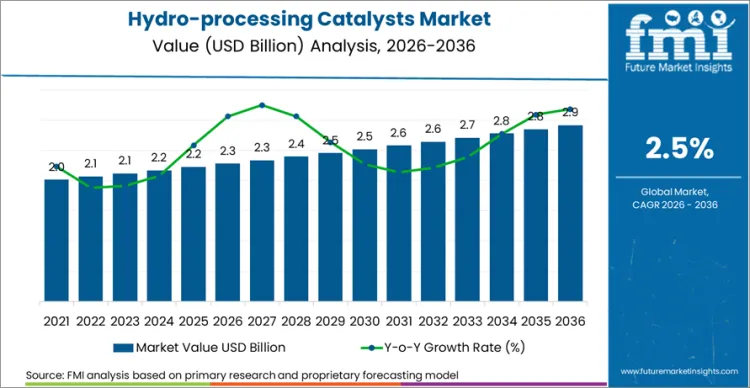
Summary of Hydro-processing Catalysts Market
What Is Growth Outlook for Hydro-processing Catalysts Market as per Future Market Insights Projection?
Future Market Insights projects the hydro-processing catalysts market to expand at a CAGR of 2.5% from 2026 to 2036, increasing from USD 2.28 Billion in 2026 to USD 2.92 Billion by 2036.
FMI Research Approach: FMI proprietary forecasting model based on global refining throughput volumes and catalyst replacement cycle frequency.
How Do FMI Analysts Perceive Hydro-processing Catalysts Market to Evolve?
FMI analysts perceive the market evolving toward a consolidated supplier landscape where fewer vertically integrated producers control catalyst supply, driving innovation in 3D-printed catalyst geometries and SAF-grade formulations.
FMI Research Approach: Ownership restructuring analysis of Grace-ART and Albemarle-Ketjen transactions (2025).
Which Country Holds Largest Share in Global Hydro-processing Catalysts Market?
The United States holds a significant share of the global hydro-processing catalysts market by value, which is supported by its large installed refining base and the headquarters of major catalyst producers including Grace and Albemarle.
FMI Research Approach: FMI country-level revenue modeling by installed refinery capacity and catalyst procurement contracts.
How Large Will Hydro-processing Catalysts Market Be by 2036?
The global hydro-processing catalysts market is projected to reach USD 2.92 Billion by 2036.
FMI Research Approach: FMI long-term revenue forecast derived from IEA refining throughput projections and IMO sulfur compliance requirements.
What Is Definition of Hydro-processing Catalysts Market?
The hydro-processing catalysts market includes revenue from catalysts used in hydrotreating, hydrocracking, and hydrodesulfurization processes within petroleum refining and renewable fuel production facilities.
FMI Research Approach: FMI market taxonomy and inclusion-exclusion framework.
What Are Globally Unique Trends Shaping Hydro-processing Catalysts Market?
Globally unique trends include the consolidation of catalyst joint ventures under single ownership, the commercialization of 3D-printed catalyst geometries, and the growing allocation of hydroprocessing capacity to SAF production.
FMI Research Approach: Grace-ART acquisition (November 2025) and BASF X3D commercial plant startup (Q1 2026).
Hydro-processing Catalysts Market Key Takeaways
| Metric | Details |
|---|---|
| Industry Size (2026) | USD USD 2.28 Billion |
| Industry Value (2036) | USD USD 2.92 Billion |
| CAGR (2026 to 2036) | 2.5% |
Source: Future Market Insights (FMI) analysis, based on proprietary forecasting model and primary research
Category-wise Insights
Hydro-processing catalysts sales are also expected to have hydrotreating catalysts at the leading edge, commanding a share of 66.8%. From the ingredient segment, metals-based catalysts dominated the market share of 54.9%. These segments hold growth potential through increased demand for high-quality fuel and petrochemical products, which require the use of more advanced catalyst solutions for efficient processing.
Hydrotreating Catalysts Remain the Global Leader for Cleaner Fuels and Enhanced Processing Efficiency
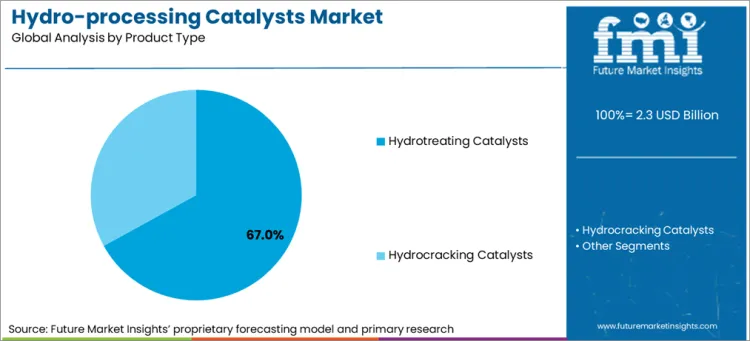
| Segment | Value Share (2026) |
|---|---|
| Hydrotreating Catalysts (by Product Type) | 66.8% |
Hydrotreating catalysts are the most widely used in the world today, since they play an important role in the refining processes, especially for producing cleaner fuels. The impurities to be removed include sulfur, nitrogen, and metals from crude oil and its derivatives. As the regulations of environmental concerns are tightening up, especially in regions such as the EU and North America, hydrotreating plays a crucial role in ensuring that the fuels comply with stringent emission standards, and therefore high demand is expected for these catalysts.
Generally, the global move to lower sulfur content in fuels has encouraged the increased use of hydrotreating catalysts. The policies that most governments have put in place about reducing the environmental effects of fuels, such as sulfur emissions, caused refiners to switch to using hydrotreating catalysts. Therefore, this push by regulators ensures continuous dominance in the market of hydrotreating catalysts.
Metals-Based Hydro-Processing Catalysts Drive Global Sales Growth with Superior Efficiency and Versatility
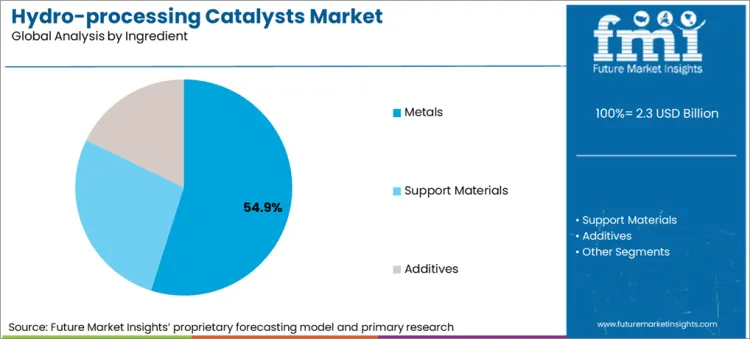
| Segment | Value Share (2026) |
|---|---|
| Metal-based (by Ingredient) | 54.9% |
The hydro-processing catalysts based on metals are the most widely used because of their efficiency in refining processes. These catalysts contain nickel, molybdenum, and cobalt, which are the main metals that have a critical role in hydrogenation and hydrocracking. They have been used extensively in the oil and gas refining industry across the globe due to their ability to enhance fuel quality while maintaining high processing efficiency.
It also goes with the principle that metals-based catalysts hold strong catalytic activity and durability that makes them fit for industries wishing to meet tough environmental standards. As refiners focus on making low-sulfur fuels to adapt to the demands of regulations, these metals-based catalysts are there to stay because they are even effective in giving petrochemical products a much better quality as well, adding to their strength in industries using them for high-performance chemical feedstock.
Semi-annual market update
The following table is a graphical illustration of the annual growth rates of the hydro-processing catalysts industry from 2026 to 2036. This report starts with the base year of 2024 and extends into the present year, studying how the industry growth curve shifts between the first half of the year, namely January through June (H1) to the second half comprising July through December (H2). This will give stakeholders a great perspective of how the sector has evolved and possible development directions.
Below is the table demonstrating sector growth between the half-year periods from 2024 through 2026. The growth for H1 in 2025 was predicted at a CAGR of 2.2%. For the half-year period H2, there is an upward trend is seen.
| Particular | Value CAGR |
|---|---|
| H1 2025 | 2.2% (2025 to 2035) |
| H2 2025 | 2.5% (2025 to 2035) |
| H1 2026 | 2.3% (2026 to 2036) |
| H2 2026 | 2.7% (2026 to 2036) |
Moving into the next period, from H1 2026 to H2 2026, the CAGR is expected to be 2.3% in the first half and rise to 2.7% in the second half. In the first half (H1) and the second half (H2), the sales saw a rise of 10 and 20 BPS respectively.
Key Industry Highlights
Rising Demand for Clean and Sustainable Fuels Drives Hydro-Processing Catalysts in Global Energy Transition
A great demand for cleaner, more sustainable fuels is being noticed and experienced all around the globe. The pressure on individual countries to comply with very high environmental targets is making them incorporate the usage of biofuels and renewable diesel, among other low-carbon alternatives in transportation, industries, and even power generation.
The Hydro-processing catalysts have been found to be of high importance in the upgrading of feedstocks such as vegetable oils, waste materials, and animal fats into high-quality renewable fuels. Such catalysts facilitate the HDO process, and hence, the biofuels produced can be blended with traditional fuels because of their quality as required. These catalysts find great application in reducing the greenhouse gas emissions involved in refueling activities.
As one example, the USA Environmental Protection Agency has created a Renewable Fuel Standard program, a programme of annual renewable fuel volume requirements to be blended into transportation fuels. The Renewal Fuel Standard, enacted into law in 2005, reduces the consumption of fossil fuel and minimizes carbon emissions in the environment.
Renewable diesel, along with hydro-processing catalysts, is witnessing fast popularity because of its high energy content and low emissions that enable refineries to fulfill these regulatory requirements efficiently as part of this program.
Transition to Low-Carbon Economy Drives Hydro-Processing Catalysts for Cleaner Fuels and Climate Goals
Global efforts are now in an intensification mode toward decreasing carbon emissions and developing a low-carbon economy in line with this urgency of climate change. The governments in different parts of the world have challenged industries in energy or transportation to introduce cleaner and more sustainable fuel alternatives by drawing ambitious climate objectives.
In this regard, refineries focus on producing low-carbon fuels such as renewable diesel and biofuels. Only through the application of high-quality hydro-processing catalysts can such a transition be facilitated to fully convert renewable feedstocks like vegetable oils, animal fats, and waste into high-quality low-carbon fuels that are commensurate with regulatory targets on carbon reduction.
The Green Deal and the Fit for 55 package are the core parts of the low-carbon transition process in the European Union. Both these packages are aimed at reducing the greenhouse gas emissions of the EU by 55% by 2030.
The largest cuts in carbon emission from transport fuels are scheduled, and this reduction in carbon emission can be done by renewable diesel. It is a sort of diesel, which is manufactured using hydro-processing catalysts. This is expected to be sufficiently high in the EU, henceforth opening up a robust market for refineries to be able to employ hydro-processing technologies and support such aims.
High Initial Investment Costs Hinder Widespread Adoption of Hydro-Processing Catalysts in Emerging Markets
Advanced hydro-processing catalysts are important for producing high-quality, low-carbon fuels. However, developing and installing such technologies involves considerable capital expenditures. Refineries require substantial investments not only in the catalysts but also in the accompanying infrastructure, namely upgrading processing units and implementing new operational systems.
These huge investment requirements form a challenge for most refineries, especially emerging industries whose source of funding might not be robust enough to manage large expenditures and hence tend to absorb only little fractions, limiting the widespread integration and absorption rate in a wider geography of refineries.
For instance, in developing regions such as Asia-Pacific and Africa, where refining infrastructure is still evolving, the capital-intensive nature of hydro-processing catalyst installations may be a challenge.
Refineries in these areas may opt for lower-cost alternatives that do not provide the same level of efficiency or environmental benefits as hydro-processing catalysts, delaying their transition to cleaner fuels. As regards the new refineries, financial constraints have generally been the bottleneck for emerging countries, according to the International Energy Agency, IEA.
Development of Hybrid Catalysts for Multifunctional Use Presents Major Opportunities for Refineries
One of the major opportunities for players in the hydro-processing catalysts industry is hybrid catalysts, which involve hydrocracking and hydrotreating functionalities combined into a single one. Hybrid multifunctional catalysts are slowly becoming more appealing since they reduce complexity and promote better efficiency due to less time and lower capital costs for refineries.
Simplicity has reduced maintenance times and fewer stages using different catalysts minimize complexity in such operations. This innovation has the potential to increase refinery profitability by enhancing fuel production while minimizing the number of catalysts required.
The advantage of hybrid catalysts is their ability to process a variety of feedstocks, which means that they can be used for refineries targeting both conventional crude oils and renewable biofuels.
The hydrocracking and hydrotreating functions could be integrated into one catalyst in order to achieve better fuel quality and yield and save energy while lowering operational costs. This trend falls into the general desire for cleaner fuels and environmentally friendly refining methods and for refineries looking to increase bottom-line profitability under growing environmental regulation demands.
2021 to 2025 Global Synthetic Polyisoprene Rubber Sales Outlook Compared to Demand Forecast from 2026 to 2036
Some key growth drivers for continued expansion in sales of hydro-processing catalysts come from major sectors like petroleum refining, chemical manufacturing, and renewable fuels. This is because more and more feedstocks will be upgraded, using hydro-processing catalysts to meet the tough fuel quality specifications that will likely be mandated with the ever-increasing deployment of sustainable feedstocks and further regulatory pressure toward low-carbon fuels.
The development of hybrid catalysts that have multifunctional capabilities is another growth factor in sales. These catalysts are cheaper and more efficient in the refining process. As countries tighten their environmental regulations and commit to sustainable energy transitions, hydro-processing catalysts will be more vital in meeting these demands.
Increased attention to waste-to-energy technologies, as well as the move to cleaner, lower-sulfur fuels, will continue to power this industry as it becomes increasingly important to the global energy sector's transformation to sustainability.
Market Concentration
Among Tier 1 players in the Hydro-Processing Catalysts industry are ExxonMobil Chemical Company, Shell Catalysts & Technologies, Chevron Phillips Chemical Company, BASF SE, and UOP LLC (A Honeywell Company). Their share of value and revenue exceeds USD 200 million. Its revenue is comprised 50-55%, and it has a high production capacity, cutting-edge technologies, and a vast range of products.
Such giant resources and scales of operation empower them to accelerate innovation and technological progress across various industries. Such global giants' presence, catering to different regional needs, confirms their position at the top of the hydro-processing catalysts industry.
Companies under Tier 2 & 3 include Clariant International Ltd., Haldor Topsoe A/S, Johnson Matthey PLC, SABIC, LG Chem Ltd., and others, which take 45-50% value share. Their revenues are below USD 200 million, with a focus on regional industries and specific applications.
While they may not have the same level of global reach as Tier 1 players, they are niche players catering to specific markets and providing targeted technological solutions. Their contributions are crucial for driving regional growth and meeting specific local demands, which makes them important in the hydro-processing catalysts industry.
Country-wise Insights
The hydro-processing catalysts sales are expected to experience great growth in regions such as China, India, Saudi Arabia, South Korea, and Brazil. These countries have a higher demand for advanced catalysts because of an expanding energy and petrochemical industry. Strong demand growth will be observed in China and India due to their rapidly developing industries.
The investments by Saudi Arabia and South Korea in refining technologies are further supporting the increasing demand for efficient hydro-processing solutions, and Brazil's oil and gas industry is growing and adding to the market potential.
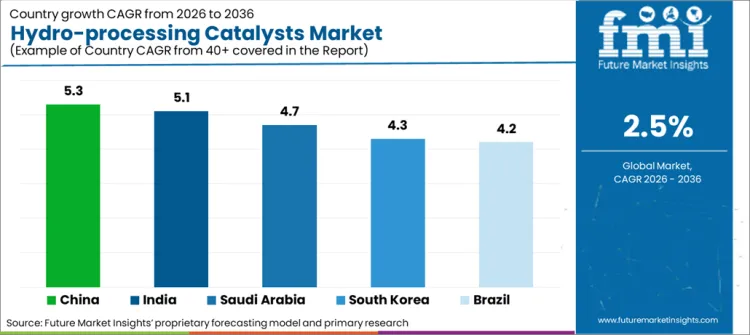
| Countries | Value CAGR (2026 to 2036) |
|---|---|
| China | 5.3% |
| India | 5.1% |
| Saudi Arabia | 4.7% |
| South Korea | 4.3% |
| Brazil | 4.2% |
Saudi Arabia's Growing Oil Refining Investments Drive Demand for Hydro-Processing Catalysts in the Market
In Saudi Arabia, the hydro-processing catalysts sales are projected to reach a value of USD 59.8 million by 2036, growing at a CAGR of 4.7%.
The oil and gas refining industry is a key driver of the hydro-processing catalysts industry in Saudi Arabia. As one of the world's largest oil producers, the country has a large refining capacity and is committed to improving its production facilities.
According to the Saudi Ministry of Energy, the country intends to invest heavily in its refining sector to meet both domestic fuel needs and growing international demand. This investment in upgrades of refineries increases the requirements for high-class hydro-processing catalysts, to be used essentially in enhancing refined fuel quality, be it diesel or gasoline.
The Saudi Arabian refinery expansion projects include new facilities and the modernization of existing ones. In this, the adoption of high-performance catalysts is considered, which aid in the removal of impurities such as sulfur, nitrogen, and metals from crude oil so that the products meet the increasingly strict environmental standards.
Hydro-processing catalysts are in high demand due to the ease with which such methods can be introduced to achieve better energy efficiency, decrease industrial emissions, and further sustainable developments in the oil and gas sector, as envisioned in Saudi Vision 2030.
Upgrading of refinery capacities has been notable for Saudi Arabia over the recent years. Driving such developments has been Aramco, the largest oil company globally in the Kingdom. It has a plan of investment in the projects both domestic and international towards the refining of over 8 million barrels per day of crude oil. Hydro-processing catalysts will continue to play a crucial role in keeping the fuel quality and in-line with the country's environmental targets as these projects progress.
South Korea’s Growing Petrochemical Sector Spurs Demand for Hydro-Processing Catalysts in the Market
In South Korea, the sales are expected to reach USD 111.8 million by 2036, with a CAGR of 4.3%.
South Korea's drive for high-value petrochemicals is significantly driving the market for hydro-processing catalysts. The country stands as one of the world leaders in the chemical industry, specializing in a plethora of chemicals employed in plastics and electronics, amongst others.
Indeed, South Korean petrochemical exports have seen a record stand at USD 32.3 billion in 2022, according to a report by KPIA. To meet the fast-growing demand while improving the quality of its petrochemicals, the nation has been concerned with upgrading refining processes, leading to a bigger demand for more efficient hydro-processing catalysts.
Hydro-processing catalysts have become a critical part of South Korea's refining industry due to the need to upgrade feedstock and improve the efficiency of chemical production processes. The catalysts help in the hydrogenation and hydrocracking of feedstocks, thus ensuring that the products meet the strict specifications required by both domestic and international industries.
With South Korea aspiring to remain ahead of its peers in terms of petrochemical production, its refining processes' efficiency and environmental performance have now become an absolute priority that enhances the demand for advanced catalysts.
Brazil’s Biofuel Industry Drives Demand for Hydro-Processing Catalysts in the Market
Brazil's hydro-processing catalysts industry is anticipated to reach USD 78.7 million by 2036, growing at a CAGR of 4.2%.
The Brazilian biofuel sector is a massive driver for hydro-processing catalysts. Brazil stands as one of the world's top biofuel manufacturers, and strong encouragement for renewable fuel sources has expanded its biofuel sector significantly.
The Brazilian Ministry of Mines and Energy- MME, said that in 2021, the country produced nearly 6.6 billion liters of biodiesel. Brazil has planned to reach up to 13 billion liters of biodiesel production by 2030. Such a development scenario is generating great demand for sophisticated hydro-processing catalysts, as they are essential for converting feedstocks like vegetable oils and animal fats into quality biofuels.
Efficient processing technologies for biodiesel should convert different feedstocks into renewable fuels. Hydro-processing catalysts are strategically important as they enhance the conversion of these feedstocks into renewable fuels, improve quality and yield biodiesel, and strip away impurities like sulfur. Recent growth in Brazil's biofuel production with an environmentally friendly approach to this energy source has, to a greater degree, increased the use of such catalysts in many plants throughout Brazil.
Competitive Landscape
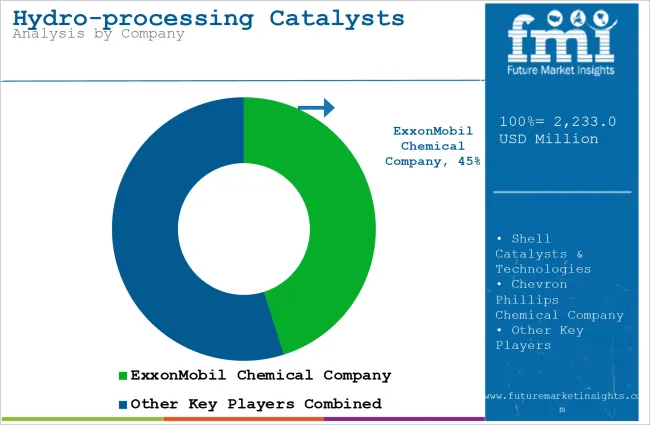
The key players in the market have been focusing more on increasing capacity and optimizing resources to meet demand from the refining and petrochemical industries. These companies would be looking to invest in advanced technologies that would result in higher efficiencies operationally and increase the quality of their catalysts so that they can be sure of delivering reliable high-performance solutions.
The companies look to strengthen their resource base, ensuring that they can maintain competitiveness and address the changing requirements of global markets, especially in areas with tight environmental regulations.
The leaders in the hydro-processing catalysts industry are also building strategic alliances and joint ventures to co-develop innovative catalyst solutions. These partnerships promote technological advancement, where companies can capitalize on each other's strengths in research, development, and production. Such alliances allow manufacturers to diversify their product lines and offer more specialized solutions for specific industries like oil refining, petrochemicals, and biofuels, besides accessing new growth opportunities.
Key players focus on geographical growth to access those emerging industries while diversifying income streams. While establishing a dominant position in more regions, be it Asia-Pacific, the Middle East, and Latin America; these companies prevent market saturation, increase client base, as well as garner growth prospects by both developed as well as by developing sectors.
Recent Developments:
- In November 2025, W. R. Grace acquired Chevron's interest in Advanced Refining Technologies (ART), becoming the sole owner of the hydroprocessing catalyst joint venture and dividing the portfolio with Chevron Lummus Global retaining hydrocracking and renewables catalysts.
- In October 2025, Albemarle entered a definitive agreement to sell a 51% controlling stake in its Ketjen refining catalyst business to KPS Capital Partners for USD 660 million, while separately signing an agreement to sell its 50% stake in the Eurecat joint venture to Axens SA.
- In September 2024, Shell Catalysts and Technologies partnered with Licella to develop an integrated solution for converting biomass into sustainable aviation fuel using Shell's proprietary hydroprocessing technology to upgrade biocrude from Licella's Cat-HTR reactor.
Key Players of the Industry
- ExxonMobil Chemical Company
- Shell Catalysts & Technologies
- Chevron Phillips Chemical Company
- Clariant International Ltd.
- Haldor Topsoe A/S
- Johnson Matthey PLC
- BASF SE
- SABIC
- LG Chem Ltd.
- UOP LLC (A Honeywell Company)
Market Definition
The hydro-processing catalysts market represents revenue generated from catalysts used in hydrotreating, hydrocracking, hydrodesulfurization, and hydrodenitrogenation processes within petroleum renewable and refineries fuel production units. The market measures the value of fresh catalyst charges, regenerated catalysts, and associated activation services sold to refinery operators and fuel processors.
Inclusions cover nickel-molybdenum (NiMo), cobalt-molybdenum (CoMo), and nickel-tungsten (NiW) catalyst formulations for distillate hydrotreating, residue upgrading, hydrocracking, and renewable feedstock processing. It includes catalyst regeneration and rejuvenation services, as well as specialty catalysts for sustainable aviation fuel (SAF) and biodiesel hydroprocessing.
Exclusions include fluid catalytic cracking (FCC) catalysts, reforming catalysts, and catalysts used in petrochemical processes outside the refining hydrogen-addition chain. Bulk industrial chemical catalysts and emission control catalysts for automotive applications are outside the scope.
Scope of Report
| Items | Values |
|---|---|
| Quantitative Units (2026) | USD 2.28 Billion |
| Product Type | Hydrotreating Catalysts, Hydrocracking Catalysts, Resid Upgrading Catalysts, SAF Hydroprocessing Catalysts |
| Material Type | NiMo, CoMo, NiW, Zeolite-based |
| End User | Petroleum Refineries, Renewable Fuel Producers, Integrated Oil Companies |
| Regions Covered | North America, Europe, Asia Pacific, Latin America, Middle East and Africa |
| Key Companies Profiled | W. R. Grace, Albemarle/Ketjen, BASF, Topsoe, Axens, Shell Catalysts and Technologies |
Key Segments of the Industry
By Product Type:
In terms of Product Type, the industry is divided into Hydrotreating Catalysts and Hydrocracking Catalysts.
By Ingredient:
In terms of Ingredients, the industry is divided into Metals, Support Materials, and Additives.
By End-Use Industry:
In terms of End-Use Industry, the industry is divided into Petroleum Refineries, Chemical Manufacturing, Renewable Fuels, and Others.
By Region:
The report covers key regions, including North America, Latin America, Western Europe, Eastern Europe, East Asia, South Asia Pacific, and the Middle East and Africa (MEA).
Bibliography
- W. R. Grace and Co. (2025, November). Grace acquires ART Hydroprocessing. Grace Newsroom.
- Albemarle Corporation. (2025, October). Albemarle announces sale of controlling stake in Ketjen to KPS Capital Partners. Albemarle Investor Relations.
- BASF SE. (2025, December). BASF to start up commercial-scale 3D-printed catalyst plant in Q1 2026. ICIS.
- International Energy Agency. (2024, October). World Energy Outlook 2024. IEA.
Frequently Asked Questions
What is the current global market size for Hydro-processing Catalysts?
The global market is valued at USD 2.28 Billion in 2026, driven by sustained refining throughput and tightening fuel sulfur specifications.
What is the projected Compound Annual Growth Rate (CAGR) for the market over the next 10 years?
The market is projected to grow at a CAGR of 2.5% from 2026 to 2036.
Which regions are experiencing the fastest expansion?
Asia Pacific leads due to expanding refining capacity in China and India, followed by the Middle East where new complex refineries require high-activity catalyst charges.
What are the primary market drivers?
IMO 2020 sulfur compliance enforcement and the growing allocation of hydroprocessing capacity to sustainable aviation fuel production are the primary catalysts for market growth.
Who are the leading suppliers in the industry?
W. R. Grace, Albemarle/Ketjen, BASF, and Topsoe are key players, differentiating through vertically integrated manufacturing and SAF-grade catalyst formulations.
Preview the report firsthand - request a free sample
Get SampleGet the brochure for pricing and purchase details.
Get PDFTable of Content
- Executive Summary
- Global Market Outlook
- Demand-side Trends
- Supply-side Trends
- Technology Roadmap Analysis
- Analysis and Recommendations
- Market Overview
- Market Coverage / Taxonomy
- Market Definition / Scope / Limitations
- Research Methodology
- Chapter Orientation
- Analytical Lens and Working Hypotheses
- Market Structure, Signals, and Trend Drivers
- Benchmarking and Cross-market Comparability
- Market Sizing, Forecasting, and Opportunity Mapping
- Research Design and Evidence Framework
- Desk Research Programme (Secondary Evidence)
- Company Annual and Sustainability Reports
- Peer-reviewed Journals and Academic Literature
- Corporate Websites, Product Literature, and Technical Notes
- Earnings Decks and Investor Briefings
- Statutory Filings and Regulatory Disclosures
- Technical White Papers and Standards Notes
- Trade Journals, Industry Magazines, and Analyst Briefs
- Conference Proceedings, Webinars, and Seminar Materials
- Government Statistics Portals and Public Data Releases
- Press Releases and Reputable Media Coverage
- Specialist Newsletters and Curated Briefings
- Sector Databases and Reference Repositories
- FMI Internal Proprietary Databases and Historical Market Datasets
- Subscription Datasets and Paid Sources
- Social Channels, Communities, and Digital Listening Inputs
- Additional Desk Sources
- Expert Input and Fieldwork (Primary Evidence)
- Primary Modes
- Qualitative Interviews and Expert Elicitation
- Quantitative Surveys and Structured Data Capture
- Blended Approach
- Why Primary Evidence is Used
- Field Techniques
- Interviews
- Surveys
- Focus Groups
- Observational and In-context Research
- Social and Community Interactions
- Stakeholder Universe Engaged
- C-suite Leaders
- Board Members
- Presidents and Vice Presidents
- R&D and Innovation Heads
- Technical Specialists
- Domain Subject-matter Experts
- Scientists
- Physicians and Other Healthcare Professionals
- Governance, Ethics, and Data Stewardship
- Research Ethics
- Data Integrity and Handling
- Primary Modes
- Tooling, Models, and Reference Databases
- Desk Research Programme (Secondary Evidence)
- Data Engineering and Model Build
- Data Acquisition and Ingestion
- Cleaning, Normalisation, and Verification
- Synthesis, Triangulation, and Analysis
- Quality Assurance and Audit Trail
- Market Background
- Market Dynamics
- Drivers
- Restraints
- Opportunity
- Trends
- Scenario Forecast
- Demand in Optimistic Scenario
- Demand in Likely Scenario
- Demand in Conservative Scenario
- Opportunity Map Analysis
- Product Life Cycle Analysis
- Supply Chain Analysis
- Investment Feasibility Matrix
- Value Chain Analysis
- PESTLE and Porter’s Analysis
- Regulatory Landscape
- Regional Parent Market Outlook
- Production and Consumption Statistics
- Import and Export Statistics
- Market Dynamics
- Global Market Analysis 2021 to 2025 and Forecast, 2026 to 2036
- Historical Market Size Value (USD Million) Analysis, 2021 to 2025
- Current and Future Market Size Value (USD Million) Projections, 2026 to 2036
- Y-o-Y Growth Trend Analysis
- Absolute $ Opportunity Analysis
- Global Market Pricing Analysis 2021 to 2025 and Forecast 2026 to 2036
- Global Market Analysis 2021 to 2025 and Forecast 2026 to 2036, By Product Type
- Introduction / Key Findings
- Historical Market Size Value (USD Million) Analysis By Product Type , 2021 to 2025
- Current and Future Market Size Value (USD Million) Analysis and Forecast By Product Type , 2026 to 2036
- Hydrotreating Catalysts
- Hydrocracking Catalysts
- Hydrotreating Catalysts
- Y-o-Y Growth Trend Analysis By Product Type , 2021 to 2025
- Absolute $ Opportunity Analysis By Product Type , 2026 to 2036
- Global Market Analysis 2021 to 2025 and Forecast 2026 to 2036, By Ingredient
- Introduction / Key Findings
- Historical Market Size Value (USD Million) Analysis By Ingredient, 2021 to 2025
- Current and Future Market Size Value (USD Million) Analysis and Forecast By Ingredient, 2026 to 2036
- Metals
- Support Materials
- Additives
- Metals
- Y-o-Y Growth Trend Analysis By Ingredient, 2021 to 2025
- Absolute $ Opportunity Analysis By Ingredient, 2026 to 2036
- Global Market Analysis 2021 to 2025 and Forecast 2026 to 2036, By End-Use Industry
- Introduction / Key Findings
- Historical Market Size Value (USD Million) Analysis By End-Use Industry, 2021 to 2025
- Current and Future Market Size Value (USD Million) Analysis and Forecast By End-Use Industry, 2026 to 2036
- Petroleum Refineries
- Chemical Manufacturing
- Renewable Fuels
- Others
- Petroleum Refineries
- Y-o-Y Growth Trend Analysis By End-Use Industry, 2021 to 2025
- Absolute $ Opportunity Analysis By End-Use Industry, 2026 to 2036
- Global Market Analysis 2021 to 2025 and Forecast 2026 to 2036, By Region
- Introduction
- Historical Market Size Value (USD Million) Analysis By Region, 2021 to 2025
- Current Market Size Value (USD Million) Analysis and Forecast By Region, 2026 to 2036
- North America
- Latin America
- Western Europe
- Eastern Europe
- East Asia
- South Asia and Pacific
- Middle East & Africa
- Market Attractiveness Analysis By Region
- North America Market Analysis 2021 to 2025 and Forecast 2026 to 2036, By Country
- Historical Market Size Value (USD Million) Trend Analysis By Market Taxonomy, 2021 to 2025
- Market Size Value (USD Million) Forecast By Market Taxonomy, 2026 to 2036
- By Country
- USA
- Canada
- Mexico
- By Product Type
- By Ingredient
- By End-Use Industry
- By Country
- Market Attractiveness Analysis
- By Country
- By Product Type
- By Ingredient
- By End-Use Industry
- Key Takeaways
- Latin America Market Analysis 2021 to 2025 and Forecast 2026 to 2036, By Country
- Historical Market Size Value (USD Million) Trend Analysis By Market Taxonomy, 2021 to 2025
- Market Size Value (USD Million) Forecast By Market Taxonomy, 2026 to 2036
- By Country
- Brazil
- Chile
- Rest of Latin America
- By Product Type
- By Ingredient
- By End-Use Industry
- By Country
- Market Attractiveness Analysis
- By Country
- By Product Type
- By Ingredient
- By End-Use Industry
- Key Takeaways
- Western Europe Market Analysis 2021 to 2025 and Forecast 2026 to 2036, By Country
- Historical Market Size Value (USD Million) Trend Analysis By Market Taxonomy, 2021 to 2025
- Market Size Value (USD Million) Forecast By Market Taxonomy, 2026 to 2036
- By Country
- Germany
- UK
- Italy
- Spain
- France
- Nordic
- BENELUX
- Rest of Western Europe
- By Product Type
- By Ingredient
- By End-Use Industry
- By Country
- Market Attractiveness Analysis
- By Country
- By Product Type
- By Ingredient
- By End-Use Industry
- Key Takeaways
- Eastern Europe Market Analysis 2021 to 2025 and Forecast 2026 to 2036, By Country
- Historical Market Size Value (USD Million) Trend Analysis By Market Taxonomy, 2021 to 2025
- Market Size Value (USD Million) Forecast By Market Taxonomy, 2026 to 2036
- By Country
- Russia
- Poland
- Hungary
- Balkan & Baltic
- Rest of Eastern Europe
- By Product Type
- By Ingredient
- By End-Use Industry
- By Country
- Market Attractiveness Analysis
- By Country
- By Product Type
- By Ingredient
- By End-Use Industry
- Key Takeaways
- East Asia Market Analysis 2021 to 2025 and Forecast 2026 to 2036, By Country
- Historical Market Size Value (USD Million) Trend Analysis By Market Taxonomy, 2021 to 2025
- Market Size Value (USD Million) Forecast By Market Taxonomy, 2026 to 2036
- By Country
- China
- Japan
- South Korea
- By Product Type
- By Ingredient
- By End-Use Industry
- By Country
- Market Attractiveness Analysis
- By Country
- By Product Type
- By Ingredient
- By End-Use Industry
- Key Takeaways
- South Asia and Pacific Market Analysis 2021 to 2025 and Forecast 2026 to 2036, By Country
- Historical Market Size Value (USD Million) Trend Analysis By Market Taxonomy, 2021 to 2025
- Market Size Value (USD Million) Forecast By Market Taxonomy, 2026 to 2036
- By Country
- India
- ASEAN
- Australia & New Zealand
- Rest of South Asia and Pacific
- By Product Type
- By Ingredient
- By End-Use Industry
- By Country
- Market Attractiveness Analysis
- By Country
- By Product Type
- By Ingredient
- By End-Use Industry
- Key Takeaways
- Middle East & Africa Market Analysis 2021 to 2025 and Forecast 2026 to 2036, By Country
- Historical Market Size Value (USD Million) Trend Analysis By Market Taxonomy, 2021 to 2025
- Market Size Value (USD Million) Forecast By Market Taxonomy, 2026 to 2036
- By Country
- Kingdom of Saudi Arabia
- Other GCC Countries
- Turkiye
- South Africa
- Other African Union
- Rest of Middle East & Africa
- By Product Type
- By Ingredient
- By End-Use Industry
- By Country
- Market Attractiveness Analysis
- By Country
- By Product Type
- By Ingredient
- By End-Use Industry
- Key Takeaways
- Key Countries Market Analysis
- USA
- Pricing Analysis
- Market Share Analysis, 2025
- By Product Type
- By Ingredient
- By End-Use Industry
- Canada
- Pricing Analysis
- Market Share Analysis, 2025
- By Product Type
- By Ingredient
- By End-Use Industry
- Mexico
- Pricing Analysis
- Market Share Analysis, 2025
- By Product Type
- By Ingredient
- By End-Use Industry
- Brazil
- Pricing Analysis
- Market Share Analysis, 2025
- By Product Type
- By Ingredient
- By End-Use Industry
- Chile
- Pricing Analysis
- Market Share Analysis, 2025
- By Product Type
- By Ingredient
- By End-Use Industry
- Germany
- Pricing Analysis
- Market Share Analysis, 2025
- By Product Type
- By Ingredient
- By End-Use Industry
- UK
- Pricing Analysis
- Market Share Analysis, 2025
- By Product Type
- By Ingredient
- By End-Use Industry
- Italy
- Pricing Analysis
- Market Share Analysis, 2025
- By Product Type
- By Ingredient
- By End-Use Industry
- Spain
- Pricing Analysis
- Market Share Analysis, 2025
- By Product Type
- By Ingredient
- By End-Use Industry
- France
- Pricing Analysis
- Market Share Analysis, 2025
- By Product Type
- By Ingredient
- By End-Use Industry
- India
- Pricing Analysis
- Market Share Analysis, 2025
- By Product Type
- By Ingredient
- By End-Use Industry
- ASEAN
- Pricing Analysis
- Market Share Analysis, 2025
- By Product Type
- By Ingredient
- By End-Use Industry
- Australia & New Zealand
- Pricing Analysis
- Market Share Analysis, 2025
- By Product Type
- By Ingredient
- By End-Use Industry
- China
- Pricing Analysis
- Market Share Analysis, 2025
- By Product Type
- By Ingredient
- By End-Use Industry
- Japan
- Pricing Analysis
- Market Share Analysis, 2025
- By Product Type
- By Ingredient
- By End-Use Industry
- South Korea
- Pricing Analysis
- Market Share Analysis, 2025
- By Product Type
- By Ingredient
- By End-Use Industry
- Russia
- Pricing Analysis
- Market Share Analysis, 2025
- By Product Type
- By Ingredient
- By End-Use Industry
- Poland
- Pricing Analysis
- Market Share Analysis, 2025
- By Product Type
- By Ingredient
- By End-Use Industry
- Hungary
- Pricing Analysis
- Market Share Analysis, 2025
- By Product Type
- By Ingredient
- By End-Use Industry
- Kingdom of Saudi Arabia
- Pricing Analysis
- Market Share Analysis, 2025
- By Product Type
- By Ingredient
- By End-Use Industry
- Turkiye
- Pricing Analysis
- Market Share Analysis, 2025
- By Product Type
- By Ingredient
- By End-Use Industry
- South Africa
- Pricing Analysis
- Market Share Analysis, 2025
- By Product Type
- By Ingredient
- By End-Use Industry
- USA
- Market Structure Analysis
- Competition Dashboard
- Competition Benchmarking
- Market Share Analysis of Top Players
- By Regional
- By Product Type
- By Ingredient
- By End-Use Industry
- Competition Analysis
- Competition Deep Dive
- ExxonMobil Chemical Company
- Overview
- Product Portfolio
- Profitability by Market Segments (Product/Age /Sales Channel/Region)
- Sales Footprint
- Strategy Overview
- Marketing Strategy
- Product Strategy
- Channel Strategy
- Shell Catalysts & Technologies
- Chevron Phillips Chemical Company
- Clariant International Ltd.
- Johnson Matthey PLC
- BASF SE
- SABIC
- LG Chem Ltd.
- UOP LLC (A Honeywell Company)
- Other Major Players
- Haldor Topsoe A/S
- ExxonMobil Chemical Company
- Competition Deep Dive
- Assumptions & Acronyms Used


