

- Industry Size (2026)
- USD 1.2 Bn
- Forecast (2036)
- USD 2.7 Bn
- CAGR (2026 to 2036)
- 8.4%
Infant Heart Monitor Market Forecast and Outlook 2026 to 2036
Infant heart monitor market is valued at USD 1.2 billion in 2026 and is projected to reach USD 2.7 billion by 2036, expanding at a CAGR of 8.4% over 2026 to 2036. Market value capture is being concentrated in clinical-grade platforms where procurement cycles, compliance requirements, and interoperability rules narrow vendor choice and raise switching friction. With hospital procurement at 54%, demand is anchored in NICU and pediatric ward budgets that favor proven accuracy, low-perfusion performance, alarm governance, and integration into centralized monitoring stacks-conditions that support recurring service revenue and multi-year replacement cadence.
At the same time, growth is being pulled forward by post-discharge monitoring and caregiver demand for reassurance, but home adoption is being shaped by regulatory scrutiny, data privacy expectations, and liability risk tied to false alarms and missed events. Pricing power is therefore uneven: premium margins are typically retained where devices are clinically validated and bundled with software, consumables, and support, while consumer-focused offerings face faster commoditization. Between 2026 and 2036, durable outcomes are expected to be driven by vendors that control sensor IP, maintain clinical evidence, and lock into hospital ecosystems without raising workflow burden.
Quick Stats for Infant Heart Monitor Market
- Infant Heart Monitor Market Value (2026): USD 1.2 Billion
- Infant Heart Monitor Market Forecast Value (2036): USD 2.7 Billion
- Infant Heart Monitor Market Forecast CAGR 2026 to 2036: 8.4%
- Leading Product Type in Infant Heart Monitor Market: Wearable ECG Patches
- Leading Sales Channel in Infant Heart Monitor Market: Hospital Procurement
- Key Growth Regions in Infant Heart Monitor Market: Asia Pacific, Middle East & Africa, Latin America
- Top Key Players in Infant Heart Monitor Market: Philips, GE HealthCare, Masimo, Medtronic, Dräger, Nihon Kohden
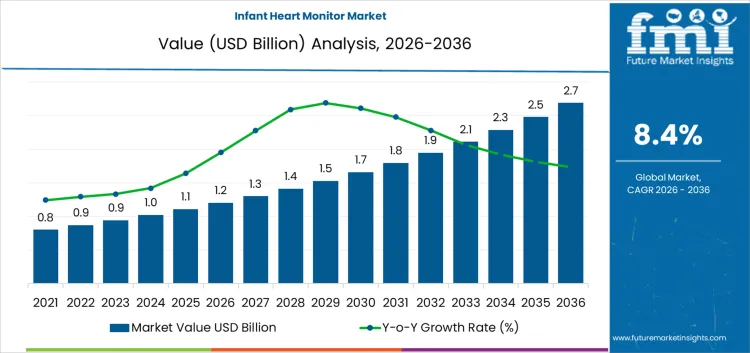
Infant Heart Monitor Market Key Takeaways
| Metric | Value |
|---|---|
| Industry Value (2026) | USD 1.2 Billion |
| Forecast Value (2036) | USD 2.7 Billion |
| Forecast CAGR 2026 to 2036 | 8.4% |
How Is the Global Infant Heart Monitor Market Advancing?
The global infant heart monitor market is advancing at a robust pace, driven by growing emphasis on early-stage detection of cardiac and respiratory irregularities in newborns and infants. Infant heart monitors are increasingly deployed across hospitals, neonatal intensive care units, and home care environments to enable continuous tracking of heart rate patterns and overall physiological stability. These devices play a critical role in supporting timely clinical intervention and improving infant health outcomes during early developmental stages.
A key driver supporting market growth is the rising adoption of home-based and remote infant monitoring solutions. Parents and caregivers are increasingly seeking reliable monitoring devices that provide real-time alerts and health insights outside traditional clinical settings. Wearable and contactless infant heart monitors allow continuous observation without restricting infant movement, improving comfort while maintaining consistent data collection. This shift is particularly notable among working parents and households seeking added reassurance during sleep and unattended periods.
Technological advancements are further strengthening market expansion. Improvements in biosensors, signal processing algorithms, and wireless connectivity are enhancing monitoring accuracy while reducing false alarms. Integration with mobile applications and cloud-based platforms enables caregivers and healthcare professionals to review historical trends, receive alerts, and share data seamlessly. Ongoing refinements in device miniaturization and battery efficiency are improving usability for long-duration monitoring. As digital health adoption continues to expand in pediatric care, the infant heart monitor market is expected to experience sustained growth throughout the forecast period.
What Is the Segment-Wise Overview of the Infant Heart Monitor Market?
The infant heart monitor market is shaped by increasing demand for continuous cardiac monitoring and institutional purchasing dominance. Wearable ECG patches lead the product type segment with a 34% share, driven by their ability to provide continuous, non-invasive heart rhythm monitoring while allowing infant mobility and comfort. These devices are increasingly used for early detection of arrhythmias and post-discharge monitoring. On the sales channel side, hospital procurement accounts for 54% of demand, reflecting the central role of hospitals and neonatal intensive care units in infant cardiac care. Hospitals prioritize clinically validated monitoring systems that integrate with existing patient monitoring infrastructure.
Why Do Wearable ECG Patches Lead the Infant Heart Monitor Market?
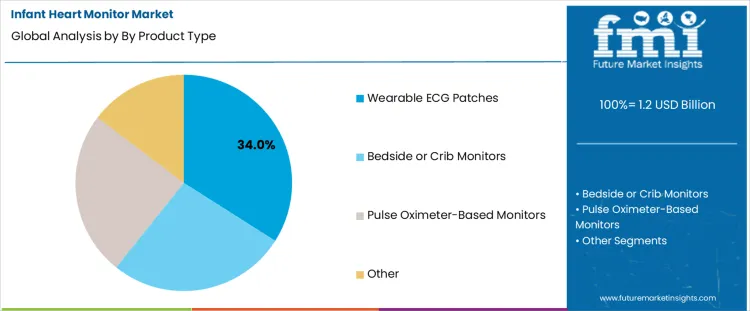
Wearable ECG patches account for 34% of the infant heart monitor market due to their ability to deliver continuous, non-invasive cardiac monitoring with minimal discomfort. These devices are designed to be lightweight and skin-friendly, allowing prolonged monitoring without restricting infant movement or causing irritation. Wearable ECG patches provide real-time heart rhythm data, enabling early detection of arrhythmias and cardiac abnormalities in both clinical and post-discharge settings. Their compatibility with wireless data transmission and remote monitoring platforms supports continuous observation beyond hospital environments. Clinicians value their accuracy, ease of application, and reduced need for complex bedside equipment. As neonatal and pediatric care increasingly emphasizes continuous monitoring and early intervention, wearable ECG patches remain the preferred product type for infant cardiac surveillance.
Why Does Hospital Procurement Dominate Sales Channels in the Infant Heart Monitor Market?
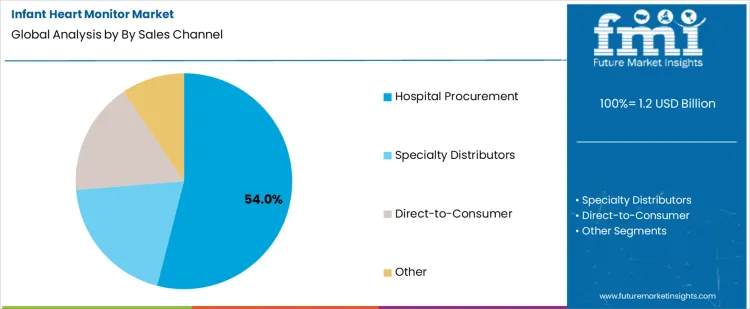
Hospital procurement represents 54% of total sales channel demand, making it the dominant route in the infant heart monitor market. Hospitals, particularly neonatal and pediatric intensive care units, require reliable, clinically validated monitoring systems to manage high-risk infants and newborns. Procurement decisions are driven by stringent safety standards, integration with existing patient monitoring infrastructure, and long-term service support. Hospitals also prioritize devices that support centralized data access and real-time alerts for clinical staff. Bulk purchasing agreements and standardized equipment adoption further reinforce hospital-led procurement. Given the critical nature of infant cardiac monitoring and the need for continuous professional oversight, hospitals remain the primary purchasing channel, sustaining consistent demand for advanced infant heart monitoring technologies.
What Are the Key Dynamics for the Infant Heart Monitor Market?
The infant heart monitor market is driven by the increasing focus on early detection and continuous monitoring of cardiac health in newborns and infants. Infant heart monitors are medical devices used in hospitals, neonatal care units, and home settings to track heart rate and rhythm, allowing timely identification of abnormalities. Key market dynamics include rising global birth rates, heightened awareness of congenital heart defects and other pediatric cardiac conditions, and growing emphasis on preventive neonatal care. Technological improvements such as wireless connectivity, wearable form factors, and real-time alert systems are enhancing clinical utility and caregiver confidence.
Why Is the Infant Heart Monitor Market Growing?
The market is expanding due to rising incidence and diagnosis of infant cardiac irregularities, prompting demand for reliable monitoring solutions in both clinical and home care settings. Advances in sensor technology, miniaturization, and low-power electronics have made heart monitors more accurate, comfortable, and easier to deploy for continuous use. Increased access to pediatric healthcare services and a growing emphasis on remote patient monitoring post-discharge are supporting market growth. Integration with mobile apps and cloud-based platforms enables caregivers and clinicians to receive real-time data and alerts, improving response times and clinical outcomes.
How Are the Key Drivers Shaping the Infant Heart Monitor Market?
Key drivers shaping the market include enhanced technological capabilities such as high-precision biosensors, improved signal processing algorithms, and integration of wireless communication. Healthcare providers and parents increasingly prefer non-invasive and wearable monitoring devices that allow greater mobility while ensuring safety. Expansion of neonatal intensive care units (NICUs) and pediatric cardiology services in emerging regions is increasing demand. The adoption of telehealth and remote monitoring programs is accelerating use of infant heart monitors for follow-up care outside hospital environments, enabling continuous tracking without frequent clinic visits.
What Is the Growth Outlook for the Infant Heart Monitor Market by Country?
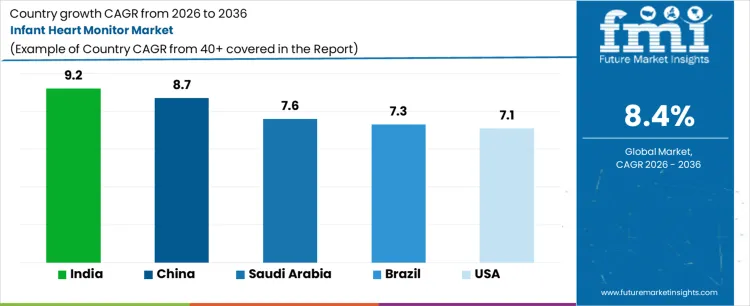
| Country | CAGR (%) |
|---|---|
| India | 9.2% |
| China | 8.7% |
| Saudi Arabia | 7.6% |
| Brazil | 7.3% |
| USA | 7.1% |
The infant heart monitor market is expanding steadily as neonatal care standards improve worldwide. India leads with a 9.2% CAGR, driven by expanding NICU infrastructure, high birth volumes, and growing awareness of early cardiac monitoring. China follows at 8.7%, supported by hospital modernization, rising healthcare investment, and increased focus on neonatal outcomes. Saudi Arabia grows at 7.6%, benefiting from strong government funding and advanced maternity and pediatric facilities. Brazil expands at 7.3%, driven by gradual improvements in public and private neonatal care services. The USA grows at 7.1%, supported by advanced monitoring technologies, strong reimbursement frameworks, and widespread adoption in NICUs. As early detection and continuous monitoring become central to infant care, demand for infant heart monitors is expected to increase across all regions.
What Is Driving the Growth of the Infant Heart Monitor Market in India?
The Infant Heart Monitor Market in India is growing at a CAGR of 9.2%, driven by improving neonatal care infrastructure and rising awareness of early cardiac monitoring in infants. Expansion of neonatal intensive care units (NICUs) across public and private hospitals is increasing adoption of continuous heart monitoring devices. High birth rates and a growing incidence of premature births further support demand for infant monitoring solutions. Government programs focused on reducing infant mortality and strengthening maternal-child healthcare are improving access to advanced diagnostic and monitoring technologies. Increasing penetration of private healthcare providers and specialty pediatric hospitals is also accelerating adoption. In addition, falling device costs and availability of compact, non-invasive monitors are making heart monitoring more accessible. As awareness of early detection of cardiac irregularities improves among clinicians and parents, demand for infant heart monitors in India is expected to rise steadily.
How Is the Infant Heart Monitor Market Expanding in China?
The Infant Heart Monitor Market in China is expanding at a CAGR of 8.7%, supported by strong investment in hospital infrastructure and pediatric healthcare modernization. China’s expanding NICU capacity and growing focus on improving neonatal outcomes are driving demand for advanced heart monitoring systems. Increased incidence of preterm births and congenital heart conditions is encouraging hospitals to adopt continuous and high-accuracy monitoring solutions. Government initiatives aimed at improving healthcare quality and expanding access to advanced medical devices further support market growth. Domestic medical device manufacturers are also introducing cost-effective and technologically advanced infant heart monitors, improving accessibility across hospitals. In addition, rising healthcare spending and increased parental awareness about infant health are influencing adoption. As China continues to upgrade neonatal care standards, demand for infant heart monitoring devices is expected to grow consistently.
What Is Supporting Growth of the Infant Heart Monitor Market in Saudi Arabia?
The Infant Heart Monitor Market in Saudi Arabia is growing at a CAGR of 7.6%, driven by strong government investment in healthcare infrastructure and neonatal care services. Expansion of advanced hospitals and NICUs under national healthcare development programs is increasing demand for infant monitoring technologies. High standards of care in maternity and pediatric hospitals support adoption of sophisticated heart monitoring systems. Increasing awareness of congenital heart conditions and early diagnosis is also contributing to market growth. In addition, rising birth rates and emphasis on reducing infant morbidity are strengthening demand for continuous monitoring solutions. Adoption is further supported by availability of advanced imported medical devices and trained healthcare professionals. As Saudi Arabia continues to enhance neonatal care quality and invest in modern medical technologies, demand for infant heart monitors is expected to increase steadily.
How Is the Infant Heart Monitor Market Developing in Brazil?
The Infant Heart Monitor Market in Brazil is expanding at a CAGR of 7.3%, supported by gradual improvement in neonatal healthcare services and hospital infrastructure. Expansion of NICUs in public and private hospitals is increasing the use of continuous heart monitoring devices for infants. Rising awareness of early detection of cardiac abnormalities and improved pediatric care standards are supporting adoption. Government healthcare programs focused on maternal and child health are also increasing access to monitoring equipment. Growth of private hospitals and specialty pediatric clinics further supports market expansion. In addition, increasing availability of affordable monitoring devices is improving adoption across mid-sized healthcare facilities. As Brazil continues to invest in neonatal healthcare and reduce infant mortality rates, demand for infant heart monitors is expected to grow at a steady pace.
How Is the Infant Heart Monitor Market Expanding in the USA?
The Infant Heart Monitor Market in the USA is growing at a CAGR of 7.1%, driven by advanced neonatal care standards and widespread availability of monitoring technologies. High adoption of continuous cardiac monitoring in NICUs supports steady demand for infant heart monitors. Rising focus on early diagnosis of congenital heart diseases and management of premature infants is reinforcing market growth. Technological advancements, including wireless and wearable monitoring solutions, are improving ease of use and data accuracy. In addition, strong reimbursement frameworks and established healthcare infrastructure support consistent adoption. Growing interest in remote monitoring solutions for post-discharge infant care is also influencing demand. As neonatal care continues to advance and monitoring technologies evolve, the infant heart monitor market in the USA is expected to maintain stable growth.
How Are Companies Competing in the Infant Heart Monitor Market?
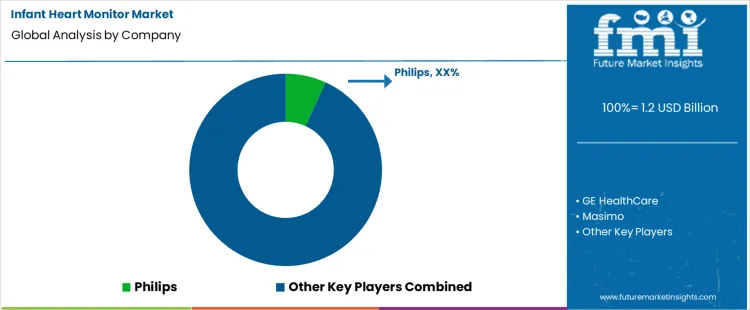
Competition in the infant heart monitor market is driven by measurement accuracy at low perfusion, patient safety, ease of use in neonatal settings, and seamless integration with broader patient monitoring systems. Infant and neonatal monitoring requires highly sensitive sensors capable of delivering reliable heart rate data despite motion, small body size, and fragile skin. Manufacturers differentiate through advanced signal processing, gentle sensor designs, wireless connectivity, and alarm management systems that support continuous monitoring in neonatal intensive care units (NICUs), pediatric wards, and home-care environments.
Philips, GE HealthCare, Siemens Healthineers, and Dräger compete through comprehensive neonatal monitoring platforms and deep clinical integration. Philips emphasizes scalable patient monitoring systems with advanced analytics, central station connectivity, and neonatal-optimized sensors. GE HealthCare differentiates through robust multiparameter monitors that combine heart rate, oxygen saturation, and respiratory monitoring with proven reliability in NICU settings. Siemens Healthineers focuses on interoperability and data integration across hospital systems, while Dräger competes with neonatal-specific monitoring solutions designed for high-acuity environments and long-term continuous use.
Masimo, Medtronic, Nihon Kohden, Mindray, Nonin Medical, and Welch Allyn (Hillrom/Baxter) compete through sensor innovation, precision algorithms, and application flexibility. Masimo differentiates through signal extraction technologies that improve accuracy during motion and low perfusion, critical for infant monitoring. Medtronic leverages clinical expertise and device integration to support neonatal care pathways. Nihon Kohden and Mindray compete by offering reliable, cost-effective monitoring solutions with strong global adoption. Nonin Medical emphasizes pulse oximetry accuracy and portability, while Welch Allyn focuses on clinician-friendly devices suited for both hospital and outpatient pediatric care. Across the market, competitive advantage is defined by monitoring accuracy, sensor comfort, system integration, alarm reliability, and the ability to support safe, continuous infant cardiac monitoring across care settings.
Key Players in Infant Heart Monitor Market
- Philips
- GE HealthCare
- Masimo
- Medtronic
- Dräger
- Nihon Kohden
- Mindray
- Siemens Healthineers
- Nonin Medical
- Welch Allyn (Hillrom/Baxter)
Scope of Report
| Attributes | Description |
|---|---|
| Quantitative Unit (2026) | USD Billion |
| Product Type | Wearable ECG Patches, Bedside or Crib Monitors, Pulse Oximeter-Based Monitors, Other |
| Sales Channel | Hospital Procurement, Specialty Distributors, Direct-to-Consumer, Other |
| Regions Covered | Asia Pacific, Europe, North America, Latin America, Middle East & Africa |
| Countries Covered | China, Japan, South Korea, India, Australia & New Zealand, ASEAN, Rest of Asia Pacific, Germany, United Kingdom, France, Italy, Spain, Nordic, BENELUX, Rest of Europe, United States, Canada, Mexico, Brazil, Chile, Rest of Latin America, Kingdom of Saudi Arabia, Other GCC Countries, Turkey, South Africa, Other African Union, Rest of Middle East & Africa |
| Key Companies Profiled | Philips, GE HealthCare, Masimo, Medtronic, Dräger, Nihon Kohden, Mindray, Siemens Healthineers, Nonin Medical, Welch Allyn (Hillrom/Baxter) |
| Additional Attributes | Dollar sales by product type and sales channel; regional market size and forecast analysis; growth outlook across major regions; adoption trends for infant heart monitoring solutions in clinical and home settings; assessment of monitoring accuracy, connectivity features, and demand patterns across hospital procurement, specialty distribution, and direct-to-consumer channels. |
Infant Heart Monitor Market by Key Segments
By Product Type
- Wearable ECG Patches
- Bedside or Crib Monitors
- Pulse Oximeter-Based Monitors
- Other
By Sales Channel
- Hospital Procurement
- Specialty Distributors
- Direct-to-Consumer
- Other
Region
- Asia Pacific
- China
- Japan
- South Korea
- India
- Australia & New Zealand
- ASEAN
- Rest of Asia Pacific
- Europe
- Germany
- United Kingdom
- France
- Italy
- Spain
- Nordic
- BENELUX
- Rest of Europe
- North America
- United States
- Canada
- Mexico
- Latin America
- Brazil
- Chile
- Rest of Latin America
- Middle East & Africa
- Kingdom of Saudi Arabia
- Other GCC Countries
- Turkey
- South Africa
- Other African Union
- Rest of Middle East & Africa
Bibliography
- U.S. Food and Drug Administration. (2025). Pulse Oximeters for Medical Purposes: Non-Clinical and Clinical Performance, and Labeling Recommendations (Draft Guidance). U.S. FDA.
- U.S. Food and Drug Administration. (2023). Cybersecurity in Medical Devices: Quality System Considerations and Content of Premarket Submissions. U.S. FDA.
- European Commission. (2023). Regulation (EU) 2023/607 amending Regulations (EU) 2017/745 and (EU) 2017/746 as regards transitional provisions for certain medical devices and in vitro diagnostic medical devices. Official Journal of the European Union.
- European Commission. (2024). Regulation (EU) 2024/1860 amending Regulation (EU) 2017/745 as regards the gradual roll-out of EUDAMED, information obligation in case of supply interruption, and transitional provisions for certain medical devices. Official Journal of the European Union.
- Medical Device Coordination Group (MDCG). (2024). MDCG 2024-5: Guidance on content of the Investigator’s Brochure for clinical investigations of medical devices. European Commission.
Frequently Asked Questions
How big is the infant heart monitor market in 2026?
The global infant heart monitor market is estimated to be valued at USD 1.2 billion in 2026.
What will be the size of infant heart monitor market in 2036?
The market size for the infant heart monitor market is projected to reach USD 2.7 billion by 2036.
How much will be the infant heart monitor market growth between 2026 and 2036?
The infant heart monitor market is expected to grow at a 8.4% CAGR between 2026 and 2036.
What are the key product types in the infant heart monitor market?
The key product types in infant heart monitor market are wearable ecg patches, bedside or crib monitors, pulse oximeter-based monitors and other.
Which by sales channel segment to contribute significant share in the infant heart monitor market in 2026?
In terms of by sales channel, hospital procurement segment to command 54.0% share in the infant heart monitor market in 2026.
Preview the report firsthand - request a free sample
Get SampleGet the brochure for pricing and purchase details.
Get PDFTable of Content
- Executive Summary
- Global Market Outlook
- Demand-side Trends
- Supply-side Trends
- Technology Roadmap Analysis
- Analysis and Recommendations
- Market Overview
- Market Coverage / Taxonomy
- Market Definition / Scope / Limitations
- Market Background
- Market Dynamics
- Drivers
- Restraints
- Opportunity
- Trends
- Scenario Forecast
- Demand in Optimistic Scenario
- Demand in Likely Scenario
- Demand in Conservative Scenario
- Opportunity Map Analysis
- Product Life Cycle Analysis
- Supply Chain Analysis
- Investment Feasibility Matrix
- Value Chain Analysis
- PESTLE and Porter’s Analysis
- Regulatory Landscape
- Regional Parent Market Outlook
- Production and Consumption Statistics
- Import and Export Statistics
- Market Dynamics
- Global Market Analysis 2021 to 2025 and Forecast, 2026 to 2036
- Historical Market Size Value (USD Million) Analysis, 2021 to 2025
- Current and Future Market Size Value (USD Million) Projections, 2026 to 2036
- Y-o-Y Growth Trend Analysis
- Absolute $ Opportunity Analysis
- Global Market Pricing Analysis 2021 to 2025 and Forecast 2026 to 2036
- Global Market Analysis 2021 to 2025 and Forecast 2026 to 2036, By By Product Type
- Introduction / Key Findings
- Historical Market Size Value (USD Million) Analysis By By Product Type , 2021 to 2025
- Current and Future Market Size Value (USD Million) Analysis and Forecast By By Product Type , 2026 to 2036
- Wearable ECG Patches
- Bedside or Crib Monitors
- Pulse Oximeter-Based Monitors
- Other
- Wearable ECG Patches
- Y-o-Y Growth Trend Analysis By By Product Type , 2021 to 2025
- Absolute $ Opportunity Analysis By By Product Type , 2026 to 2036
- Global Market Analysis 2021 to 2025 and Forecast 2026 to 2036, By By Sales Channel
- Introduction / Key Findings
- Historical Market Size Value (USD Million) Analysis By By Sales Channel, 2021 to 2025
- Current and Future Market Size Value (USD Million) Analysis and Forecast By By Sales Channel, 2026 to 2036
- Hospital Procurement
- Specialty Distributors
- Direct-to-Consumer
- Other
- Hospital Procurement
- Y-o-Y Growth Trend Analysis By By Sales Channel, 2021 to 2025
- Absolute $ Opportunity Analysis By By Sales Channel, 2026 to 2036
- Global Market Analysis 2021 to 2025 and Forecast 2026 to 2036, By Region
- Introduction
- Historical Market Size Value (USD Million) Analysis By Region, 2021 to 2025
- Current Market Size Value (USD Million) Analysis and Forecast By Region, 2026 to 2036
- North America
- Latin America
- Western Europe
- Eastern Europe
- East Asia
- South Asia and Pacific
- Middle East & Africa
- Market Attractiveness Analysis By Region
- North America Market Analysis 2021 to 2025 and Forecast 2026 to 2036, By Country
- Historical Market Size Value (USD Million) Trend Analysis By Market Taxonomy, 2021 to 2025
- Market Size Value (USD Million) Forecast By Market Taxonomy, 2026 to 2036
- By Country
- USA
- Canada
- Mexico
- By By Product Type
- By By Sales Channel
- By Country
- Market Attractiveness Analysis
- By Country
- By By Product Type
- By By Sales Channel
- Key Takeaways
- Latin America Market Analysis 2021 to 2025 and Forecast 2026 to 2036, By Country
- Historical Market Size Value (USD Million) Trend Analysis By Market Taxonomy, 2021 to 2025
- Market Size Value (USD Million) Forecast By Market Taxonomy, 2026 to 2036
- By Country
- Brazil
- Chile
- Rest of Latin America
- By By Product Type
- By By Sales Channel
- By Country
- Market Attractiveness Analysis
- By Country
- By By Product Type
- By By Sales Channel
- Key Takeaways
- Western Europe Market Analysis 2021 to 2025 and Forecast 2026 to 2036, By Country
- Historical Market Size Value (USD Million) Trend Analysis By Market Taxonomy, 2021 to 2025
- Market Size Value (USD Million) Forecast By Market Taxonomy, 2026 to 2036
- By Country
- Germany
- UK
- Italy
- Spain
- France
- Nordic
- BENELUX
- Rest of Western Europe
- By By Product Type
- By By Sales Channel
- By Country
- Market Attractiveness Analysis
- By Country
- By By Product Type
- By By Sales Channel
- Key Takeaways
- Eastern Europe Market Analysis 2021 to 2025 and Forecast 2026 to 2036, By Country
- Historical Market Size Value (USD Million) Trend Analysis By Market Taxonomy, 2021 to 2025
- Market Size Value (USD Million) Forecast By Market Taxonomy, 2026 to 2036
- By Country
- Russia
- Poland
- Hungary
- Balkan & Baltic
- Rest of Eastern Europe
- By By Product Type
- By By Sales Channel
- By Country
- Market Attractiveness Analysis
- By Country
- By By Product Type
- By By Sales Channel
- Key Takeaways
- East Asia Market Analysis 2021 to 2025 and Forecast 2026 to 2036, By Country
- Historical Market Size Value (USD Million) Trend Analysis By Market Taxonomy, 2021 to 2025
- Market Size Value (USD Million) Forecast By Market Taxonomy, 2026 to 2036
- By Country
- China
- Japan
- South Korea
- By By Product Type
- By By Sales Channel
- By Country
- Market Attractiveness Analysis
- By Country
- By By Product Type
- By By Sales Channel
- Key Takeaways
- South Asia and Pacific Market Analysis 2021 to 2025 and Forecast 2026 to 2036, By Country
- Historical Market Size Value (USD Million) Trend Analysis By Market Taxonomy, 2021 to 2025
- Market Size Value (USD Million) Forecast By Market Taxonomy, 2026 to 2036
- By Country
- India
- ASEAN
- Australia & New Zealand
- Rest of South Asia and Pacific
- By By Product Type
- By By Sales Channel
- By Country
- Market Attractiveness Analysis
- By Country
- By By Product Type
- By By Sales Channel
- Key Takeaways
- Middle East & Africa Market Analysis 2021 to 2025 and Forecast 2026 to 2036, By Country
- Historical Market Size Value (USD Million) Trend Analysis By Market Taxonomy, 2021 to 2025
- Market Size Value (USD Million) Forecast By Market Taxonomy, 2026 to 2036
- By Country
- Kingdom of Saudi Arabia
- Other GCC Countries
- Turkiye
- South Africa
- Other African Union
- Rest of Middle East & Africa
- By By Product Type
- By By Sales Channel
- By Country
- Market Attractiveness Analysis
- By Country
- By By Product Type
- By By Sales Channel
- Key Takeaways
- Key Countries Market Analysis
- USA
- Pricing Analysis
- Market Share Analysis, 2025
- By By Product Type
- By By Sales Channel
- Canada
- Pricing Analysis
- Market Share Analysis, 2025
- By By Product Type
- By By Sales Channel
- Mexico
- Pricing Analysis
- Market Share Analysis, 2025
- By By Product Type
- By By Sales Channel
- Brazil
- Pricing Analysis
- Market Share Analysis, 2025
- By By Product Type
- By By Sales Channel
- Chile
- Pricing Analysis
- Market Share Analysis, 2025
- By By Product Type
- By By Sales Channel
- Germany
- Pricing Analysis
- Market Share Analysis, 2025
- By By Product Type
- By By Sales Channel
- UK
- Pricing Analysis
- Market Share Analysis, 2025
- By By Product Type
- By By Sales Channel
- Italy
- Pricing Analysis
- Market Share Analysis, 2025
- By By Product Type
- By By Sales Channel
- Spain
- Pricing Analysis
- Market Share Analysis, 2025
- By By Product Type
- By By Sales Channel
- France
- Pricing Analysis
- Market Share Analysis, 2025
- By By Product Type
- By By Sales Channel
- India
- Pricing Analysis
- Market Share Analysis, 2025
- By By Product Type
- By By Sales Channel
- ASEAN
- Pricing Analysis
- Market Share Analysis, 2025
- By By Product Type
- By By Sales Channel
- Australia & New Zealand
- Pricing Analysis
- Market Share Analysis, 2025
- By By Product Type
- By By Sales Channel
- China
- Pricing Analysis
- Market Share Analysis, 2025
- By By Product Type
- By By Sales Channel
- Japan
- Pricing Analysis
- Market Share Analysis, 2025
- By By Product Type
- By By Sales Channel
- South Korea
- Pricing Analysis
- Market Share Analysis, 2025
- By By Product Type
- By By Sales Channel
- Russia
- Pricing Analysis
- Market Share Analysis, 2025
- By By Product Type
- By By Sales Channel
- Poland
- Pricing Analysis
- Market Share Analysis, 2025
- By By Product Type
- By By Sales Channel
- Hungary
- Pricing Analysis
- Market Share Analysis, 2025
- By By Product Type
- By By Sales Channel
- Kingdom of Saudi Arabia
- Pricing Analysis
- Market Share Analysis, 2025
- By By Product Type
- By By Sales Channel
- Turkiye
- Pricing Analysis
- Market Share Analysis, 2025
- By By Product Type
- By By Sales Channel
- South Africa
- Pricing Analysis
- Market Share Analysis, 2025
- By By Product Type
- By By Sales Channel
- USA
- Market Structure Analysis
- Competition Dashboard
- Competition Benchmarking
- Market Share Analysis of Top Players
- By Regional
- By By Product Type
- By By Sales Channel
- Competition Analysis
- Competition Deep Dive
- Philips
- Overview
- Product Portfolio
- Profitability by Market Segments (Product/Age /Sales Channel/Region)
- Sales Footprint
- Strategy Overview
- Marketing Strategy
- Product Strategy
- Channel Strategy
- GE HealthCare
- Masimo
- Medtronic
- Dräger
- Nihon Kohden
- Mindray
- Siemens Healthineers
- Nonin Medical
- Welch Allyn (Hillrom/Baxter)
- Philips
- Competition Deep Dive
- Assumptions & Acronyms Used
- Research Methodology


