

- Industry Size (2026)
- USD 2.8 Bn
- Forecast (2036)
- USD 6.9 Bn
- CAGR (2026 to 2036)
- 10.80%
Infant Gut Health Market Forecast and Outlook 2026 to 2036
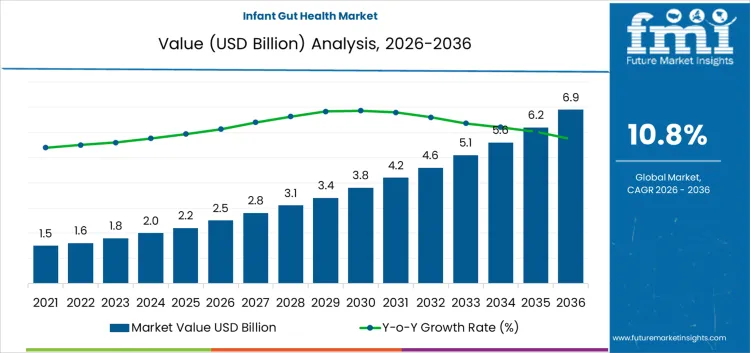
The infant gut health market is likely to be valued at USD 2.8 billion in 2026 and is projected to reach USD 6.9 billion by 2036, expanding at a CAGR of 10.8% over the forecast period. Capital deployment in this market is increasingly selective, reflecting the high cost of clinical validation, strain development, and regulatory compliance required for infant-use products. Investment is being channeled toward platforms with defensible microbiome science, proprietary probiotic strains, and integration into infant nutrition portfolios, where returns are supported by repeat consumption and strong caregiver trust.
Manufacturing scale alone is insufficient; capital efficiency is shaped by formulation stability, cold-chain or shelf-life control, and the ability to meet pediatric safety standards across regions. Large nutrition and healthcare companies prioritize bolt-on acquisitions, long-term research partnerships, and incremental line extensions over greenfield expansion to manage risk and accelerate payback timelines. Between 2026 and 2036, capital flows favor businesses that combine scientific credibility with predictable demand cycles, while early-stage innovation is often externalized through licensing rather than balance-sheet-intensive development.
Quick Stats for Infant Gut Health Market
- Infant Gut Health Market Value (2026): USD 2.8 Billion
- Infant Gut Health Market Forecast Value (2036): USD 6.9 Billion
- Infant Gut Health Market Forecast CAGR 2026 to 2036: 10.80%
- Leading Product Type in Infant Gut Health Market: Infant Probiotics
- Leading Distribution Channel in Infant Gut Health Market: Retail Pharmacies
- Key Growth Regions in Infant Gut Health Market: Asia Pacific, Latin America, Middle East & Africa, North America
- Top Key Players in Infant Gut Health Market: Nestlé Health Science, Danone, Abbott, Bayer, BioGaia, DSM-Firmenich, Probi, Kerry Group, Yakult Honsha, Reckitta
Infant Gut Health Market Key Takeaways
| Metric | Value |
|---|---|
| Industry Value (2026) | USD 2.8 Billion |
| Forecast Value (2036) | USD 6.9 Billion |
| Forecast CAGR 2026 to 2036 | 10.80% |
How Is the Global Infant Gut Health Market Advancing?
The global infant gut health market is advancing rapidly, driven by increasing awareness of the role of early-life digestive health in overall infant development. Products targeting infant gut health, including specialized formulas, probiotics, prebiotics, and digestive support supplements, are increasingly used to support nutrient absorption, immune function, and digestive comfort during early growth stages.
A key driver supporting market growth is the rising focus on early nutritional interventions to address digestive issues such as colic, constipation, and feeding intolerance. Pediatric healthcare providers are increasingly recommending gut health solutions as part of broader infant nutrition and care strategies. This trend is reinforced by growing parental awareness and demand for clinically supported products that promote balanced gut microbiota development.
Advancements in microbiome research and product formulation are further strengthening market adoption. Improved strain selection, dosage optimization, and formulation stability are enhancing product efficacy and safety for infant use. In addition, expanded distribution through hospitals, pharmacies, and online channels is improving market accessibility. As infant nutrition and digestive care continue to receive increased clinical and parental attention, the infant gut health market is expected to experience sustained growth over the forecast period.
What Is the Segment-Wise Overview of the Infant Gut Health Market?
The infant gut health market is driven by rising focus on early-life digestive support and trusted point-of-care distribution. Infant probiotics lead with a 44% share, reflecting strong acceptance for managing common gastrointestinal issues such as colic, irregular digestion, and antibiotic-related imbalance. These products benefit from growing clinical validation and easy-to-administer formats. On the distribution side, retail pharmacies account for 38% of demand, as parents value immediate access, pharmacist guidance, and trusted brand availability. Together, these segments highlight a market centered on preventive gut health, clinically supported formulations, and accessible retail-based purchasing.
Why Do Infant Probiotics Lead the Infant Gut Health Market?
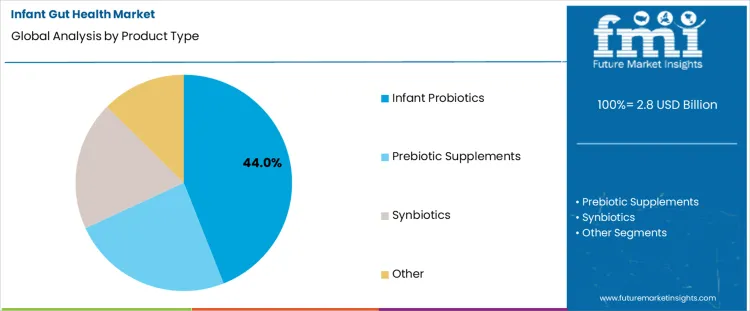
Infant probiotics account for 44% of the infant gut health market due to their well-established role in supporting digestive balance, immune development, and overall gastrointestinal health during early life stages. Probiotic formulations are commonly recommended to manage issues such as colic, diarrhea, constipation, and antibiotic-associated gut imbalance in infants. Their clinical acceptance is supported by growing evidence around specific probiotic strains that are safe and effective for pediatric use. Infant probiotics are available in easy-to-administer formats such as drops and sachets, improving caregiver compliance. Increasing parental awareness of early-life microbiome development further supports adoption. As preventive gut health gains importance in infant nutrition and care, probiotics remain the most widely used and trusted product category.
Why Do Retail Pharmacies Dominate Distribution in the Infant Gut Health Market?
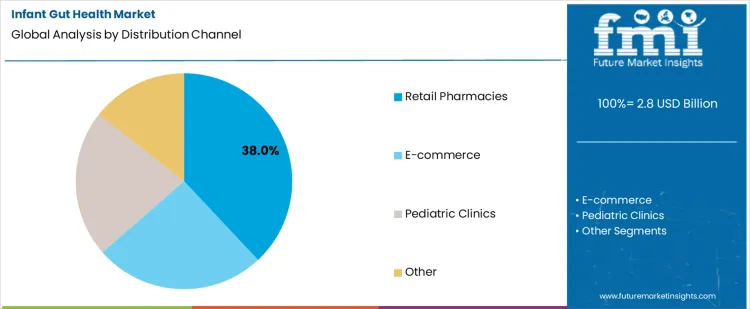
Retail pharmacies represent 38% of distribution channel demand, making them the leading access point in the infant gut health market. Parents rely on retail pharmacies for immediate availability, pharmacist guidance, and reassurance when selecting gut health products for infants. These outlets commonly stock trusted probiotic brands and pediatric supplements, supporting both prescription-based and over-the-counter purchases. Retail pharmacies also play a key role in repeat purchases, as infant gut health products are often used over extended periods. The presence of trained pharmacists enhances caregiver confidence, particularly for first-time parents. Compared to online or clinic-based channels, retail pharmacies offer faster access and personalized support, reinforcing their dominance in infant gut health product distribution.
What Are the Key Dynamics for the Infant Gut Health Market?
Infant gut health products include probiotics, prebiotics, synbiotics, specialized nutrition formulas, and supplements designed to support balanced intestinal flora and digestive function. Key market dynamics include increased awareness among caregivers and healthcare professionals about the long-term implications of healthy gut development, rising prevalence of gastrointestinal disturbances in infants, and expanding research on microbiome-related health outcomes. The expanding availability of scientifically validated products tailored for infants, along with growing pediatric nutritional guidance, is encouraging product adoption. Technological advances in formulation and delivery platforms that enhance stability, efficacy, and palatability further support market growth.
Why Is the Infant Gut Health Market Growing?
The infant gut health market is growing as parents and pediatric healthcare providers increasingly focus on preventive care and early-life nutritional support that benefits gut health. Rising incidence of infant colic, constipation, diarrhea, and other digestive concerns is prompting demand for targeted solutions that support digestive comfort and immune resilience. Scientific evidence linking healthy gut microbiota to improved nutrient absorption and overall well-being is elevating interest in infant gut health supplements and fortified formulations. Enhanced product accessibility through e-commerce channels and retail pharmacies enables caregivers to source appropriate options conveniently. Educational outreach by pediatric associations and nutrition experts about the importance of balanced gut microbiota in early childhood is driving broader consumer awareness and product adoption.a
How Are the Key Drivers Shaping the Infant Gut Health Market?
Key drivers shaping the infant gut health market include increased investment in research that elucidates the role of the gut microbiome in infant health and metabolic development, driving product innovation. Advances in culture techniques, strain selection, and delivery technologies enable more targeted probiotic and prebiotic formulations with improved stability and efficacy. Growing emphasis on preventive pediatric nutrition and supportive digestive care is encouraging caregivers to seek products that promote gut health proactively rather than reactively. Influencer and digital health platforms are amplifying information about infant gut health, educating caregivers on the benefits of early digestive support. Partnerships between pediatric healthcare practitioners and nutraceutical manufacturers are also enhancing product credibility and recommendations, reinforcing demand across clinical and retail settings.
What Is the Growth Outlook for the Infant Gut Health Market by Country?
| Country | CAGR (%) |
|---|---|
| India | 12.4% |
| China | 11.8% |
| Indonesia | 10.9% |
| Brazil | 10.1% |
| Mexico | 9.8% |
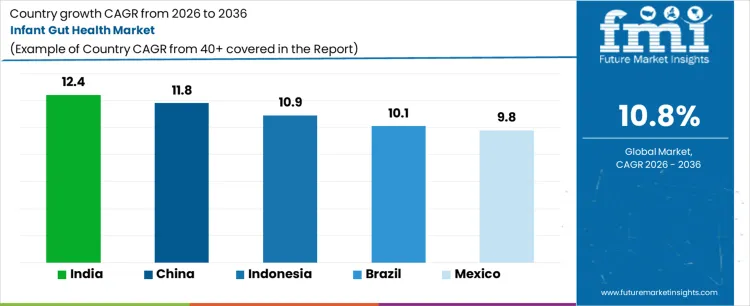
The infant gut health market is experiencing strong growth as awareness of early-life digestive health increases globally. India leads with a 12.4% CAGR, driven by expanding pediatric care and rising focus on preventive nutrition. China follows at 11.8%, supported by strong infant nutrition manufacturing and digital consumer engagement. Indonesia grows at 10.9%, benefiting from improving healthcare access and nutrition awareness. Brazil (10.1%) and Mexico (9.8%) show steady growth, driven by expanding pediatric services and increasing adoption of probiotic-based infant products. As parents increasingly prioritize digestive wellness in early development, demand for infant gut health solutions is expected to rise across all regions.
What Is Driving the Growth of the Infant Gut Health Market in India?
The infant gut health market in India is growing at a CAGR of 12.4%, driven by rising awareness of digestive health during early childhood and increasing incidence of infant digestive issues such as colic, constipation, and antibiotic-related imbalance. Pediatricians are increasingly recommending probiotics, prebiotics, and gut-support formulations to improve digestion and immunity in infants. Growth in institutional deliveries and pediatric follow-up care is improving exposure to gut health interventions. Expanding middle-class populations and rising spending on infant nutrition products further support demand. In addition, increasing availability of gut health supplements through pharmacies and online channels is improving accessibility. Government focus on maternal and child health is also strengthening early-life nutrition awareness. As parents become more proactive about preventive infant care, demand for gut health solutions in India is expected to grow rapidly.
How Is the Infant Gut Health Market Expanding in China?
The infant gut health market in China is expanding at a CAGR of 11.8%, supported by growing parental focus on early nutrition, immunity, and digestive balance. Increasing use of probiotics and functional infant formulas is driving market growth, particularly in urban areas. China’s strong infant nutrition manufacturing ecosystem supports rapid product development and availability of gut health solutions tailored for infants. Pediatricians and maternal hospitals are increasingly emphasizing microbiome health, especially following antibiotic treatments. Growth of e-commerce platforms and digital parenting communities is also improving awareness and product reach. In addition, rising healthcare expenditure and focus on early childhood development are influencing purchasing decisions. As scientific understanding of infant gut microbiota increases, adoption of gut health products in China is expected to remain strong.
What Is Supporting Growth of the Infant Gut Health Market in Indonesia?
The infant gut health market in Indonesia is growing at a CAGR of 10.9%, driven by improving awareness of infant nutrition and digestive wellness. Common digestive issues among infants, combined with expanding pediatric healthcare access, are supporting demand for gut health supplements and fortified nutrition products. Growth of primary healthcare centers and maternal clinics is increasing exposure to pediatric nutrition guidance. Parents are increasingly using probiotic syrups and fortified formulas to support digestion and nutrient absorption. Public health initiatives focused on child nutrition and growth monitoring are also improving awareness. Cost-effective and locally available formulations play an important role in adoption. As Indonesia continues to strengthen maternal and child healthcare programs, demand for infant gut health solutions is expected to grow steadily.
How Is the Infant Gut Health Market Developing in Brazil?
The Infant Gut Health Market in Brazil is expanding at a CAGR of 10.1%, supported by increasing focus on infant nutrition and preventive healthcare. Pediatricians commonly recommend gut health products to manage feeding intolerance, colic, and post-illness recovery. Expansion of private healthcare services and improved access to pediatric nutrition products are supporting market growth. Parents are increasingly aware of the role of gut health in immunity and overall development, encouraging early adoption of probiotics and prebiotics. Growth of pharmacy chains and specialty infant nutrition brands is improving product availability. Rsing exposure to global pediatric nutrition trends is influencing consumer behavior. As infant care standards continue to improve, demand for gut health products in Brazil is expected to grow steadily.
How Is the Infant Gut Health Market Expanding in Mexico?
The infant gut health market in Mexico is growing at a CAGR of 9.8%, driven by rising awareness of infant digestive health and expanding pediatric care access. Increased use of probiotic supplements and fortified infant foods is supporting market growth. Pediatric healthcare providers are placing greater emphasis on managing digestive discomfort and supporting gut balance during early development. Expansion of pharmacy networks and improved availability of pediatric nutrition products are strengthening market penetration. Parents are increasingly informed about the link between gut health, immunity, and growth. While affordability remains important, availability of cost-effective formulations supports broader adoption. As nutrition education improves and preventive infant care gains traction, demand for gut health solutions in Mexico is expected to rise steadily.
How Are Companies Competing in the Infant Gut Health Market?
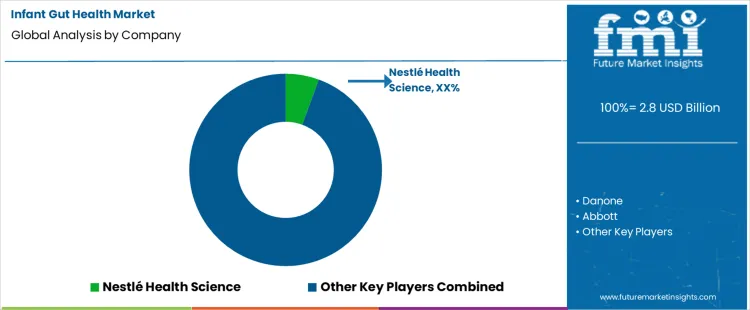
Competition in the infant gut health market is shaped by scientific credibility, strain-level differentiation, safety assurance for early-life consumption, and the ability to demonstrate measurable benefits for digestion, immunity, and microbiome development. Products targeting infant gut health such as probiotics, prebiotics, synbiotics, and specialized nutritional formulations must meet stringent regulatory and clinical standards while addressing parental concerns around tolerance, efficacy, and long-term impact on infant development. Companies increasingly compete on validated clinical evidence, proprietary strains, formulation stability, and integration with pediatric nutrition and infant formula ecosystems rather than on price alone.
Nestlé Health Science, Danone, Abbott, and Reckitt lead competition through strong positions in infant nutrition, pediatric healthcare, and trusted consumer health brands. Nestlé Health Science and Danone leverage deep microbiome research, clinically supported formulations, and global infant nutrition platforms to integrate gut health solutions into specialized formulas and early-life nutrition products. Abbott differentiates through clinically backed pediatric nutrition portfolios that link gut health to overall growth and immunity outcomes. Reckitt competes by extending consumer health expertise into infant digestive wellness, emphasizing safety, accessibility, and brand trust across pharmacy and retail channels.
BioGaia, DSM-Firmenich, Probi, Kerry Group, Yakult Honsha, and Bayer compete through strain innovation, ingredient leadership, and functional nutrition capabilities. BioGaia and Probi differentiate with proprietary probiotic strains supported by infant-specific clinical studies. DSM-Firmenich and Kerry Group focus on ingredient science, formulation stability, and partnerships with formula manufacturers. Yakult Honsha leverages long-standing probiotic expertise and microbiome credibility, while Bayer applies healthcare-grade standards to infant digestive solutions. Across the market, competitive advantage is defined by clinical validation, regulatory reliability, strain ownership, and the ability to align gut health benefits with early-life nutrition and immune development.
Key Players in Infant Gut Health Market
- Nestlé Health Science
- Danone
- Abbott
- Bayer
- BioGaia
- DSM-Firmenich
- Probi
- Kerry Group
- Yakult Honsha
- Reckitt
Scope of Report
| Attributes | Description |
|---|---|
| Quantitative Unit (2026) | USD Billion |
| Product Type | Infant Probiotics, Prebiotic Supplements, Synbiotics, Other |
| Distribution Channel | Retail Pharmacies, E-Commerce, Pediatric Clinics, Other |
| Regions Covered | Asia Pacific, Europe, North America, Latin America, Middle East & Africa |
| Countries Covered | China, Japan, South Korea, India, Australia & New Zealand, ASEAN, Rest of Asia Pacific, Germany, United Kingdom, France, Italy, Spain, Nordic, BENELUX, Rest of Europe, United States, Canada, Mexico, Brazil, Chile, Rest of Latin America, Kingdom of Saudi Arabia, Other GCC Countries, Turkey, South Africa, Other African Union, Rest of Middle East & Africa |
| Key Companies Profiled | Nestlé Health Science, Danone, Abbott, Bayer, BioGaia, DSM-Firmenich, Probi, Kerry Group, Yakult Honsha, Reckitt |
| Additional Attributes | Dollar sales by product type and distribution channel; regional market size and forecast analysis; growth outlook across major regions; adoption trends for infant gut health solutions; assessment of pediatric recommendation patterns, caregiver awareness, formulation preferences, and demand dynamics across pharmacy, clinical, and online distribution channels. |
Infant Gut Health Market by Key Segments
Product Type
- Infant Probiotics
- Prebiotic Supplements
- Synbiotics
- Other
Distribution Channel
- Retail Pharmacies
- E-commerce
- Pediatric Clinics
- Other
Region:
- Asia Pacific
- China
- Japan
- South Korea
- India
- Australia & New Zealand
- ASEAN
- Rest of Asia Pacific
- Europe
- Germany
- United Kingdom
- France
- Italy
- Spain
- Nordic
- BENELUX
- Rest of Europe
- North America
- United States
- Canada
- Mexico
- Latin America
- Brazil
- Chile
- Rest of Latin America
- Middle East & Africa
- Kingdom of Saudi Arabia
- Other GCC Countries
- Turkey
- South Africa
- Other African Union
- Rest of Middle East & Africa
Bibliography
- DSM-Firmenich AG. (2025). Integrated annual report 2024. DSM-Firmenich AG.
- European Society for Paediatric Gastroenterology, Hepatology and Nutrition (ESPGHAN) Committee on Nutrition. (2024). Prebiotics, probiotics, and synbiotics in infant nutrition: An updated position paper. Journal of Pediatric Gastroenterology and Nutrition, 78(3), 361-378.
- Reckitt Benckiser Group plc. (2025). Annual report and financial statements 2024. Reckitt Benckiser Group plc.
- World Gastroenterology Organisation. (2023). Global guidelines: Probiotics and prebiotics. World Gastroenterology Organisation.
- Yakult Honsha Co., Ltd. (2024). Annual report 2023-2024. Yakult Honsha Co., Ltd.
Frequently Asked Questions
How big is the infant gut health market in 2026?
The global infant gut health market is estimated to be valued at USD 2.8 billion in 2026.
What will be the size of infant gut health market in 2036?
The market size for the infant gut health market is projected to reach USD 7.8 billion by 2036.
How much will be the infant gut health market growth between 2026 and 2036?
The infant gut health market is expected to grow at a 10.8% CAGR between 2026 and 2036.
What are the key product types in the infant gut health market?
The key product types in infant gut health market are infant probiotics, prebiotic supplements, synbiotics and other.
Which distribution channel segment to contribute significant share in the infant gut health market in 2026?
In terms of distribution channel, retail pharmacies segment to command 38.0% share in the infant gut health market in 2026.
Preview the report firsthand - request a free sample
Get SampleGet the brochure for pricing and purchase details.
Get PDFTable of Content
- Executive Summary
- Global Market Outlook
- Demand-side Trends
- Supply-side Trends
- Technology Roadmap Analysis
- Analysis and Recommendations
- Market Overview
- Market Coverage / Taxonomy
- Market Definition / Scope / Limitations
- Market Background
- Market Dynamics
- Drivers
- Restraints
- Opportunity
- Trends
- Scenario Forecast
- Demand in Optimistic Scenario
- Demand in Likely Scenario
- Demand in Conservative Scenario
- Opportunity Map Analysis
- Product Life Cycle Analysis
- Supply Chain Analysis
- Investment Feasibility Matrix
- Value Chain Analysis
- PESTLE and Porter’s Analysis
- Regulatory Landscape
- Regional Parent Market Outlook
- Production and Consumption Statistics
- Import and Export Statistics
- Market Dynamics
- Global Market Analysis 2021 to 2025 and Forecast, 2026 to 2036
- Historical Market Size Value (USD Million) Analysis, 2021 to 2025
- Current and Future Market Size Value (USD Million) Projections, 2026 to 2036
- Y-o-Y Growth Trend Analysis
- Absolute $ Opportunity Analysis
- Global Market Pricing Analysis 2021 to 2025 and Forecast 2026 to 2036
- Global Market Analysis 2021 to 2025 and Forecast 2026 to 2036, By Product Type
- Introduction / Key Findings
- Historical Market Size Value (USD Million) Analysis By Product Type , 2021 to 2025
- Current and Future Market Size Value (USD Million) Analysis and Forecast By Product Type , 2026 to 2036
- Infant Probiotics
- Prebiotic Supplements
- Synbiotics
- Other
- Infant Probiotics
- Y-o-Y Growth Trend Analysis By Product Type , 2021 to 2025
- Absolute $ Opportunity Analysis By Product Type , 2026 to 2036
- Global Market Analysis 2021 to 2025 and Forecast 2026 to 2036, By Distribution Channel
- Introduction / Key Findings
- Historical Market Size Value (USD Million) Analysis By Distribution Channel, 2021 to 2025
- Current and Future Market Size Value (USD Million) Analysis and Forecast By Distribution Channel, 2026 to 2036
- Retail Pharmacies
- E-commerce
- Pediatric Clinics
- Other
- Retail Pharmacies
- Y-o-Y Growth Trend Analysis By Distribution Channel, 2021 to 2025
- Absolute $ Opportunity Analysis By Distribution Channel, 2026 to 2036
- Global Market Analysis 2021 to 2025 and Forecast 2026 to 2036, By Region
- Introduction
- Historical Market Size Value (USD Million) Analysis By Region, 2021 to 2025
- Current Market Size Value (USD Million) Analysis and Forecast By Region, 2026 to 2036
- North America
- Latin America
- Western Europe
- Eastern Europe
- East Asia
- South Asia and Pacific
- Middle East & Africa
- Market Attractiveness Analysis By Region
- North America Market Analysis 2021 to 2025 and Forecast 2026 to 2036, By Country
- Historical Market Size Value (USD Million) Trend Analysis By Market Taxonomy, 2021 to 2025
- Market Size Value (USD Million) Forecast By Market Taxonomy, 2026 to 2036
- By Country
- USA
- Canada
- Mexico
- By Product Type
- By Distribution Channel
- By Country
- Market Attractiveness Analysis
- By Country
- By Product Type
- By Distribution Channel
- Key Takeaways
- Latin America Market Analysis 2021 to 2025 and Forecast 2026 to 2036, By Country
- Historical Market Size Value (USD Million) Trend Analysis By Market Taxonomy, 2021 to 2025
- Market Size Value (USD Million) Forecast By Market Taxonomy, 2026 to 2036
- By Country
- Brazil
- Chile
- Rest of Latin America
- By Product Type
- By Distribution Channel
- By Country
- Market Attractiveness Analysis
- By Country
- By Product Type
- By Distribution Channel
- Key Takeaways
- Western Europe Market Analysis 2021 to 2025 and Forecast 2026 to 2036, By Country
- Historical Market Size Value (USD Million) Trend Analysis By Market Taxonomy, 2021 to 2025
- Market Size Value (USD Million) Forecast By Market Taxonomy, 2026 to 2036
- By Country
- Germany
- UK
- Italy
- Spain
- France
- Nordic
- BENELUX
- Rest of Western Europe
- By Product Type
- By Distribution Channel
- By Country
- Market Attractiveness Analysis
- By Country
- By Product Type
- By Distribution Channel
- Key Takeaways
- Eastern Europe Market Analysis 2021 to 2025 and Forecast 2026 to 2036, By Country
- Historical Market Size Value (USD Million) Trend Analysis By Market Taxonomy, 2021 to 2025
- Market Size Value (USD Million) Forecast By Market Taxonomy, 2026 to 2036
- By Country
- Russia
- Poland
- Hungary
- Balkan & Baltic
- Rest of Eastern Europe
- By Product Type
- By Distribution Channel
- By Country
- Market Attractiveness Analysis
- By Country
- By Product Type
- By Distribution Channel
- Key Takeaways
- East Asia Market Analysis 2021 to 2025 and Forecast 2026 to 2036, By Country
- Historical Market Size Value (USD Million) Trend Analysis By Market Taxonomy, 2021 to 2025
- Market Size Value (USD Million) Forecast By Market Taxonomy, 2026 to 2036
- By Country
- China
- Japan
- South Korea
- By Product Type
- By Distribution Channel
- By Country
- Market Attractiveness Analysis
- By Country
- By Product Type
- By Distribution Channel
- Key Takeaways
- South Asia and Pacific Market Analysis 2021 to 2025 and Forecast 2026 to 2036, By Country
- Historical Market Size Value (USD Million) Trend Analysis By Market Taxonomy, 2021 to 2025
- Market Size Value (USD Million) Forecast By Market Taxonomy, 2026 to 2036
- By Country
- India
- ASEAN
- Australia & New Zealand
- Rest of South Asia and Pacific
- By Product Type
- By Distribution Channel
- By Country
- Market Attractiveness Analysis
- By Country
- By Product Type
- By Distribution Channel
- Key Takeaways
- Middle East & Africa Market Analysis 2021 to 2025 and Forecast 2026 to 2036, By Country
- Historical Market Size Value (USD Million) Trend Analysis By Market Taxonomy, 2021 to 2025
- Market Size Value (USD Million) Forecast By Market Taxonomy, 2026 to 2036
- By Country
- Kingdom of Saudi Arabia
- Other GCC Countries
- Turkiye
- South Africa
- Other African Union
- Rest of Middle East & Africa
- By Product Type
- By Distribution Channel
- By Country
- Market Attractiveness Analysis
- By Country
- By Product Type
- By Distribution Channel
- Key Takeaways
- Key Countries Market Analysis
- USA
- Pricing Analysis
- Market Share Analysis, 2025
- By Product Type
- By Distribution Channel
- Canada
- Pricing Analysis
- Market Share Analysis, 2025
- By Product Type
- By Distribution Channel
- Mexico
- Pricing Analysis
- Market Share Analysis, 2025
- By Product Type
- By Distribution Channel
- Brazil
- Pricing Analysis
- Market Share Analysis, 2025
- By Product Type
- By Distribution Channel
- Chile
- Pricing Analysis
- Market Share Analysis, 2025
- By Product Type
- By Distribution Channel
- Germany
- Pricing Analysis
- Market Share Analysis, 2025
- By Product Type
- By Distribution Channel
- UK
- Pricing Analysis
- Market Share Analysis, 2025
- By Product Type
- By Distribution Channel
- Italy
- Pricing Analysis
- Market Share Analysis, 2025
- By Product Type
- By Distribution Channel
- Spain
- Pricing Analysis
- Market Share Analysis, 2025
- By Product Type
- By Distribution Channel
- France
- Pricing Analysis
- Market Share Analysis, 2025
- By Product Type
- By Distribution Channel
- India
- Pricing Analysis
- Market Share Analysis, 2025
- By Product Type
- By Distribution Channel
- ASEAN
- Pricing Analysis
- Market Share Analysis, 2025
- By Product Type
- By Distribution Channel
- Australia & New Zealand
- Pricing Analysis
- Market Share Analysis, 2025
- By Product Type
- By Distribution Channel
- China
- Pricing Analysis
- Market Share Analysis, 2025
- By Product Type
- By Distribution Channel
- Japan
- Pricing Analysis
- Market Share Analysis, 2025
- By Product Type
- By Distribution Channel
- South Korea
- Pricing Analysis
- Market Share Analysis, 2025
- By Product Type
- By Distribution Channel
- Russia
- Pricing Analysis
- Market Share Analysis, 2025
- By Product Type
- By Distribution Channel
- Poland
- Pricing Analysis
- Market Share Analysis, 2025
- By Product Type
- By Distribution Channel
- Hungary
- Pricing Analysis
- Market Share Analysis, 2025
- By Product Type
- By Distribution Channel
- Kingdom of Saudi Arabia
- Pricing Analysis
- Market Share Analysis, 2025
- By Product Type
- By Distribution Channel
- Turkiye
- Pricing Analysis
- Market Share Analysis, 2025
- By Product Type
- By Distribution Channel
- South Africa
- Pricing Analysis
- Market Share Analysis, 2025
- By Product Type
- By Distribution Channel
- USA
- Market Structure Analysis
- Competition Dashboard
- Competition Benchmarking
- Market Share Analysis of Top Players
- By Regional
- By Product Type
- By Distribution Channel
- Competition Analysis
- Competition Deep Dive
- Nestlé Health Science
- Overview
- Product Portfolio
- Profitability by Market Segments (Product/Age /Sales Channel/Region)
- Sales Footprint
- Strategy Overview
- Marketing Strategy
- Product Strategy
- Channel Strategy
- Danone
- Abbott
- Bayer
- BioGaia
- DSM-Firmenich
- Probi
- Kerry Group
- Yakult Honsha
- Reckitt
- Nestlé Health Science
- Competition Deep Dive
- Assumptions & Acronyms Used
- Research Methodology


