

- Industry Size (2026)
- USD 2.49 Mn
- Forecast (2036)
- USD 3.62 Mn
- CAGR (2026 to 2036)
- 3.8%
Demand for Banana Milk in Japan Market Size, Market Forecast and Outlook By FMI
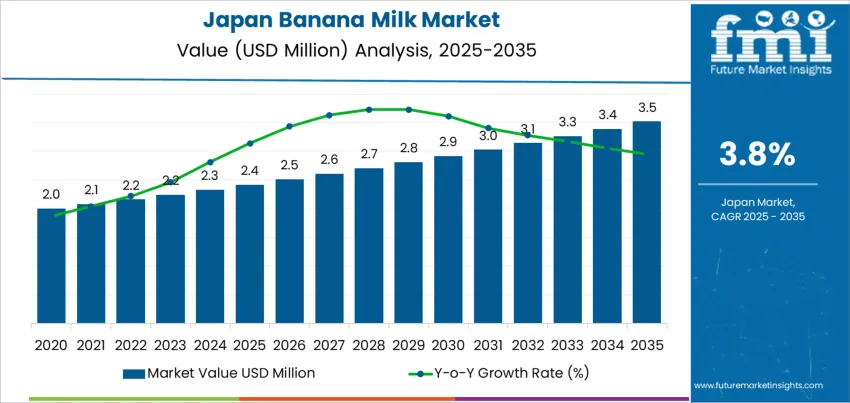
The demand for banana milk in japan market was valued at USD 2.40 million in 2025, projected to reach USD 2.49 million in 2026, and is forecast to expand to USD 3.62 million by 2036 at a 3.8% CAGR. As per FMI, sustained purchasing patterns across multiple end-use channels and a widening distributor base are reinforcing steady volume throughput over the forecast horizon. Procurement cycles tied to contractual supply agreements continue to anchor repeat purchase activity, keeping baseline revenue flows predictable for established suppliers.
Summary of Demand for Banana Milk in Japan Market
- Market Overview
- The market is valued at USD 2.40 million in 2025 and is projected to reach USD 3.62 million by 2036.
- The industry is expected to grow at a 3.8% CAGR from 2026 to 2036, creating an incremental opportunity of USD 1.13 million.
- The market is a convenience-retail-driven, flavor-differentiated dairy beverage category where shelf rotation cycles and seasonal promotional strategies determine volume throughput.
- Demand and Growth Drivers
- Japanese consumer preference for mild, naturally sweet dairy beverages gives banana milk a flavor-positioning advantage over other variants.
- Convenience store shelf rotation strategies and seasonal promotions are the primary volume drivers for packaged banana milk.
- Growth is further supported by expanding retail distribution of single-serve banana milk formats through vending machine networks.
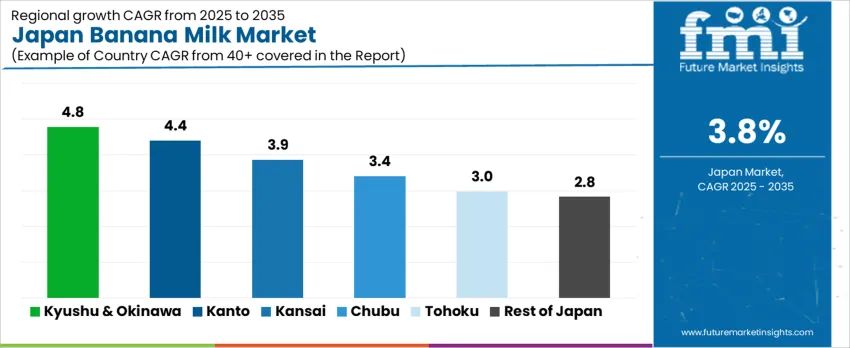
- Among key regions, Kyushu & Okinawa at 4.8% CAGR, Kanto at 4.4% CAGR, Kansai at 3.9% CAGR, Chubu at 3.4% CAGR, Tohoku at 3% CAGR, Rest of Japan at 2.8% CAGR.
- Product and Segment View
- The market covers conventional and organic banana-flavored milk products in sweetened and unsweetened variants distributed through indirect (retail/vending) and direct channels.
- Conventional leads by Nature with 72.0% share in 2026.
- Sweetened leads by Flavor with 65.0% share in 2026.
- The scope includes packaged banana-flavored milk products, excluding banana-flavored plant-based beverages and banana-flavored yogurt drinks.
- Geography and Competitive Outlook
- Kyushu and Okinawa lead growth at 4.8% CAGR, driven by younger consumer demographics and convenience store rotation strategies.
- Kanto represents the largest absolute volume base due to Tokyo metropolitan retail density.
- Competition is shaped by dairy brand equity and retail shelf access, with key players including Morinaga Milk Industry Co., Ltd., Meiji Co., Ltd., Megmilk Snow Brand Co., Ltd., Koiwai Dairy Products Co., Ltd., Ito En, Ltd..
Demand for Banana Milk in Japan Market Key Takeaways
| Metric | Details |
|---|---|
| Industry Size (2026) | USD 2.49 million |
| Industry Value (2036) | USD 3.62 million |
| CAGR (2026-2036) | 3.8% |
Source: Future Market Insights, 2026
An absolute dollar opportunity of USD 1.13 million over the forecast period reflects incremental gains from expanding retail shelf allocation and growing consumer acceptance of plant-adjacent dairy alternatives. FMI analysts observe that Japanese consumer preference for mild, naturally sweet flavor profiles gives banana milk a positioning advantage over other flavored milk variants. Convenience store distribution remains the primary volume channel, with seasonal promotional cycles driving periodic demand spikes.
Regional consumption patterns across Japan reflect urban retail density and dairy beverage purchasing habits. Kyushu & Okinawa at 4.8%, Kanto at 4.4%, Kansai at 3.9%, Chubu at 3.4%, Tohoku at 3%, Rest of Japan at 2.8%. Kyushu and Okinawa lead growth, supported by a younger consumer demographic with higher receptivity to flavored dairy innovations and active convenience store rotation strategies in these prefectures. Kanto, anchored by the Tokyo metropolitan area, represents the largest absolute volume base due to the sheer density of retail outlets and vending machine networks. Kansai markets maintain steady demand through established dairy brand presence and consistent supermarket shelf allocation for flavored milk categories.
Demand for Banana Milk in Japan Market Definition
Banana milk is a flavored dairy beverage produced by combining pasteurized milk with banana puree, concentrate, or flavoring agents to deliver a naturally sweet taste profile. The product is packaged in single-serve and multi-serve formats for distribution through convenience stores, supermarkets, and vending machine networks. Consumer purchase decisions in Japan are influenced by flavor mildness, packaging convenience, and brand familiarity within the broader flavored milk category.
Demand for Banana Milk in Japan Market Inclusions
Market scope includes conventional and organic banana-flavored milk products in sweetened and unsweetened variants. The scope covers both indirect distribution channels (convenience stores, supermarkets, vending machines) and direct-to-consumer channels.
Demand for Banana Milk in Japan Market Exclusions
The scope excludes banana-flavored plant-based beverages, banana yogurt drinks, banana smoothie products sold through foodservice, and banana-flavored confectionery items. Raw banana puree sold as a food ingredient is also excluded.
Demand for Banana Milk in Japan Market Research Methodology
- Primary Research: Analysts conducted structured interviews with procurement managers, distribution executives, and category specialists to map purchasing decision criteria, contract renewal cycles, and supplier qualification processes.
- Desk Research: Data collection aggregated publicly available trade statistics, regulatory filings, industry association reports, and company financial disclosures to establish baseline market parameters.
- Market-Sizing and Forecasting: Baseline values derive from a bottom-up aggregation of trade volumes, applying category-specific growth coefficients and regional penetration rates to project forward demand trajectories.
- Data Validation and Update Cycle: Projections are cross-checked against reported company revenues, trade body statistics, and periodic primary research updates to maintain forecast accuracy.
Why is the Demand for Banana Milk in Japan Growing?
Demand for banana milk in Japan is increasing because consumers show strong interest in flavored dairy beverages that offer a familiar and mildly sweet taste suited to both children and adults. Convenience stores and supermarkets promote single serve banana milk varieties that support on the go drinking during commutes and school activities. The product fits well within Japan’s preference for limited edition beverages, encouraging brands to introduce seasonal packaging and collaborations that drive trial purchases.
Growth in home consumption of snacks and beverages reinforces demand for drinks that combine flavor enjoyment with the nutritional familiarity of milk. Banana milk is also used as a dessert style drink, which appeals to younger consumers seeking novelty without strong or unfamiliar flavors. Product placement near coffee drinks and flavored milk supports frequent visibility at retail.
Constraints include competition from plant based milk alternatives and other flavored dairy beverages that offer lower sugar options. Health conscious shoppers may limit consumption when sugar content is high, and some buyers prefer fresh fruit smoothies instead of processed beverages. Shelf space competition in convenience channels may restrict the number of variants offered at one time.
Which Nature Types, Flavors, and Sales Channels Lead Demand for Banana Milk in Japan?
Demand for banana milk in Japan is supported by its popularity as a convenient, flavored dairy beverage appealing to children, students, and on-the-go consumers. Growth is linked to product placement in convenience retail, vending machines, and ready-to-drink categories. Functional positioning with calcium and vitamin enrichment sustains household uptake. Demand also aligns with limited-edition flavors and brand collaborations that enhance consumer curiosity and repeat purchases.
By Nature, Conventional Banana Milk Dominates
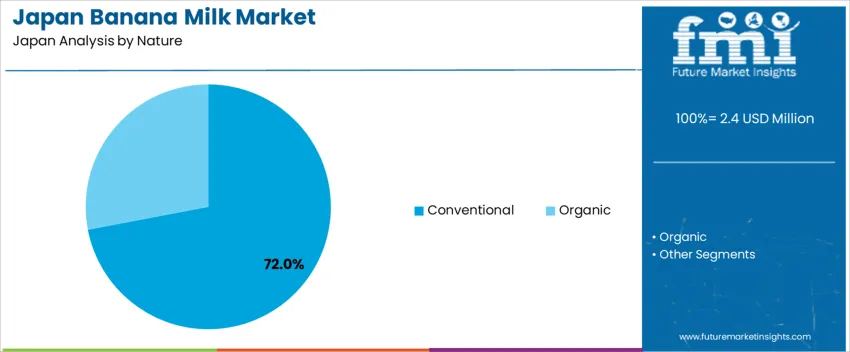
Conventional banana milk holds 72.0%, supported by affordable mass-market offerings widely distributed across convenience stores, supermarkets, and foodservice outlets. Manufacturers focus on long shelf-life UHT variants and cost-efficient dairy sourcing to maintain competitive pricing. Organic variants represent 28.0%, gaining traction among health-aware shoppers prioritizing clean-label ingredients and reduced pesticide exposure. Adoption remains moderate due to premium pricing and limited SKU availability outside metropolitan areas. Conventional products continue to lead due to broad consumption among younger demographics and high brand familiarity. Production and distribution efficiencies support steady preference for everyday consumption formats across multipacks and single-serve options.
Key Points:
- Conventional variants favored for affordability and easy availability
- Organic adoption linked to clean-label and nutritional preferences
- Premium cost limits rapid expansion of organic choices
By Flavor, Sweetened Products Lead Consumption
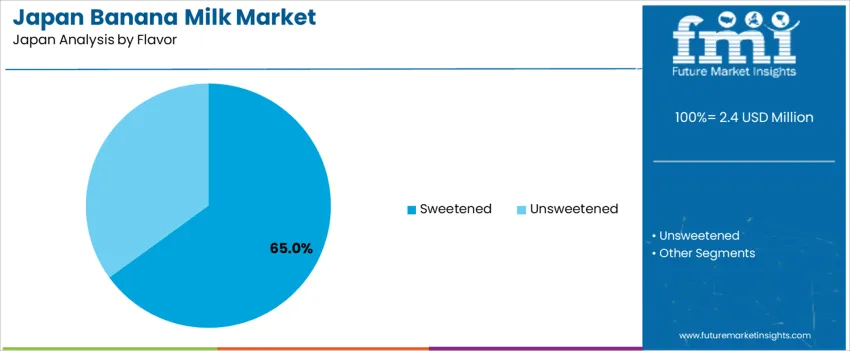
Sweetened banana milk accounts for 65.0%, driven by Japan’s strong preference for indulgent dairy tastes and flavored RTD beverages. These products target school-age consumers and teens drawn to creamy, dessert-like finishes. Unsweetened variants represent 35.0%, positioned for calorie-conscious adults and households managing sugar intake. Their growth is supported by improved formulations that retain fruit flavor without artificial sweeteners. Sweetened varieties remain dominant due to habitual consumption patterns and greater representation in vending channels. Flavor innovation focuses on balanced sweetness, texture enhancement, and reduced additives to meet evolving nutrition labeling requirements.
Key Points:
- Sweetened products aligned with traditional taste preferences
- Unsweetened options expanding with health-focused consumer behavior
- Flavor reformulation supports label transparency requirements
By Sales Channel, Indirect Distribution Leads
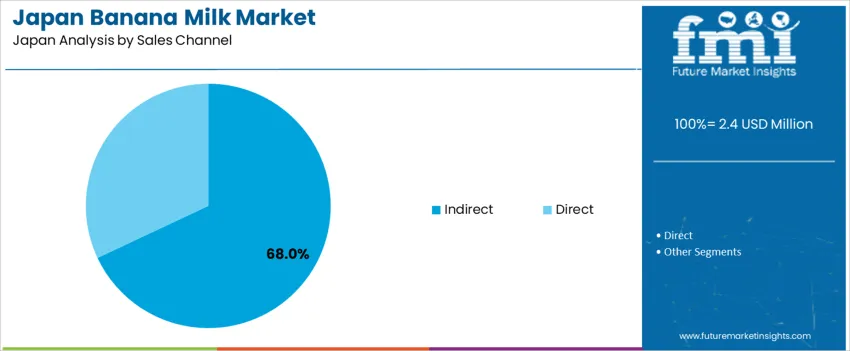
Indirect channels account for 68.0%, including supermarkets, convenience stores, and wholesalers that enable extensive national reach. Convenience stores play a significant role due to impulse buying and chilled drink accessibility near schools and transit hubs. Direct channels represent 32.0%, covering brand-owned delivery, cafés, and e-commerce platforms. Online growth is steady, supported by multipack ordering and subscription deliveries. Indirect retail dominance persists due to high foot traffic and rapid replenishment cycles. Channel strategies emphasize cold chain reliability and prominent shelf positioning within flavored dairy and breakfast drink segments.
Key Points:
- Indirect distribution drives volume through widespread retail access
- Direct channels grow via online subscriptions and brand experiences
- Vending and convenience stores remain major sales touchpoints
What are the Drivers, Restraints, and Key Trends of the Demand for Banana Milk in Japan?
Expansion of flavored dairy beverages, nostalgia-driven consumer interest and increased visibility in convenience retail channels are driving demand.
In Japan, banana milk adoption grows as flavored dairy products remain popular among students, young adults and office workers seeking sweet, portable beverages. Convenience stores located near train stations and residential zones promote single-serve banana milk as a refreshing snack drink available throughout the day. Retro-themed flavors and packaging tap into nostalgia, which resonates with consumers familiar with banana-flavored products historically marketed in Japan. Cafes and dessert shops incorporate banana milk into specialty beverages, supporting brand collaboration and seasonal promotions. These factors contribute to steady demand within the chilled beverage category.
Competition from plant-based milks, sugar-reduction concerns and limited household storage space restrain demand.
Plant-based alternatives such as oat and almond beverages attract consumers seeking lower-calorie or lactose-free options, potentially displacing flavored dairy choices. Public health guidance encouraging reduced sugar intake influences purchasing decisions, especially for parents selecting drinks for children. Refrigeration storage in compact urban kitchens can limit multipack purchases, reducing volume growth for large-format sales. These dietary and lifestyle trends create measured demand growth despite strong impulse buying in convenience stores.
Shift toward low-sugar formulations, increased use of limited-edition packaging and rising demand in dessert-inspired variants define key trends.
Producers are reducing sugar content and introducing fiber-enriched options to align with wellness preferences while maintaining familiar sweetness. Limited-edition graphics tied to characters, regional events or seasonal fruit promotions help maintain consumer interest in a category driven by novelty appeal. Dessert-inspired variants such as banana pudding and chocolate-banana blends are gaining visibility on convenience-store shelves. Online grocery platforms and chilled vending placements are expanding access beyond traditional retail sites. These trends suggest that banana milk maintains niche but durable demand within Japan’s flavored dairy landscape.
Analysis of the Demand for Banana Milk in Japan by Region
Demand for banana milk in Japan reflects interest in flavored dairy beverages suited to chilled convenience retail and home consumption. Product rotation aligns with breakfast convenience, snack occasions, and limited-edition flavor experimentation. Growth shows regional variation based on retail density, student populations, tourism activity, and distribution coverage. Kyushu & Okinawa lead at 4.8% CAGR, followed by Kanto (4.4%), Kansai (3.9%), Chubu (3.4%), Tohoku (3.0%), and the Rest of Japan (2.8%).
.webp "Top Country Growth Comparison Japan Banana Milk Market Cagr (2026 2036)")
| Region | CAGR (2026-2036) |
|---|---|
| Kyushu & Okinawa | 4.8% |
| Kanto | 4.4% |
| Kansai | 3.9% |
| Chubu | 3.4% |
| Tohoku | 3.0% |
| Rest of Japan | 2.8% |
How are Kyushu & Okinawa influencing demand for banana milk?
Kyushu & Okinawa record 4.8% CAGR due to a strong convenience-store presence, high tourism interaction, and wide refrigerated distribution across warm-weather coastal locations. Local consumption patterns support sweet dairy beverages as portable refreshment for transit and leisure routines. Student populations in cities like Fukuoka drive frequent single-serve purchases linked to snack times, reinforcing repeat volume.
Hospitality venues and hotels maintain beverage availability as part of breakfast offerings for visiting travelers. Banana milk marketed with regional fruit branding finds acceptance due to familiarity with sweet flavor preferences. Packaged formats with mild texture and portion-controlled sizing appeal to buyers seeking quick energy intake during daily activities. Retailers maintain broad coverage of seasonal SKUs that change based on school holidays and tourism peaks. Shelf stability expectations emphasize packaging that withstands temperature variation during high-turnover restocking cycles.
- Tourism and student demand supporting frequent purchases
- Convenience retail driving frontline volume
- Seasonal SKU rotation supporting novelty interest
- Durability in distribution enabling stable refrigeration performance
How is Kanto shaping beverage category expansion?
Kanto posts 4.4% CAGR with Tokyo, Kanagawa, and Chiba driving strong retail throughput through convenience, supermarket, and station-area vending channels. High commuter activity supports grab-and-go beverage selection where banana milk fits short-duration consumption behavior. Product availability covers national dairy brands and distributed license variants that match established flavor preferences. Nutrition-positioned messaging focusing on energy intake and fruit association maintains shelf presence in youth-focused retail zones.
Food-service channels include banana milk in student cafeterias and smaller eateries. Packaging formats that accommodate small backpack space perform well. Promotions emphasize limited seasonal launches aligned with large events such as school entry months and summer breaks. Distribution centers in Greater Tokyo ensure consistent inventory flow across high-traffic stores to maintain cold-chain reliability.
- High transit movement shaping grab-and-go choices
- Nationwide brand coverage ensuring baseline availability
- Youth-focused positioning maintaining interest
- Logistics networks supporting rapid inventory turnover
How is Kansai reinforcing demand stability?
Kansai grows at 3.9% CAGR with Osaka, Kyoto, and Kobe contributing through dense retail zones and culinary-culture influence. Banana milk complements snack purchasing tied to convenience retailers located near schools, residential areas, and sightseeing routes. Regional beverage suppliers evaluate packaging ease for vending-machine compatibility, ensuring accessibility in public spaces. University districts contribute regular small-pack sales linked to daily study breaks. Retailers emphasize competitive price positioning to encourage steady impulse purchasing. Distribution planning aligns with weekend consumer flows and holiday tourism spikes. Packaged banana milk appeals as a sweet refreshment option balancing flavor and mild nutrition familiarity.
- Proximity retail encouraging recurring purchases
- Vending distribution supporting accessibility
- Student populations maintaining weekday demand
- Tourism paths influencing short-term sales increases
How is Chubu contributing to banana milk usage?
Chubu advances at 3.4% CAGR, influenced by commuter routes surrounding Nagoya and surrounding prefectures. Beverage selection in convenience and supermarket channels supports quick access for workers seeking refreshing options during breaks or after transit. Local dairy producers partner with retailers for rotating flavor variants aligned to regional marketing. Logistics teams emphasize temperature stability through inland transport. Retail assortments center on core SKUs offering recognizable flavor consistency.
- Workplace routines shaping consumption
- Regional dairy collaborations increasing availability
- Cold-chain focus ensuring product stability
- Mainstream SKUs guiding purchasing behavior
How is Tohoku shaping growth?
Tohoku records 3.0% CAGR with demand emerging from convenience-oriented purchasing in smaller cities where chilled beverage sections remain core to local retail. Household shopping trips include selected flavored dairy options that accompany breakfast or snack use. Seasonal climate shifts require packaging that maintains quality under colder conditions. Price sensitivity influences inventory decisions for smaller stores managing limited chilled-shelf capacity.
- Climate-aligned packaging performance expectations
- Retail footprint supporting small-pack positioning
- Budget-aware purchasing guiding store assortments
- Seasonal changes affecting product rotation
How is the Rest of Japan contributing to ongoing adoption?
The Rest of Japan posts 2.8% CAGR, supported by gradual acceptance in suburban and rural retail settings where demand rises through familiarity with mainstream dairy beverages. Multi-pack promotions support household stocking. Distribution ensures steady availability dependent on weekly supply cycles. Retailers retain staple flavors that align with predictable consumption patterns observed in family-shopping behavior.
- Suburban household purchases driving demand
- Multi-pack pricing promoting unit turnover
- Standardized flavors ensuring recognition
- Stable distribution reinforcing continued access
What is the competitive landscape of demand for banana milk in Japan?
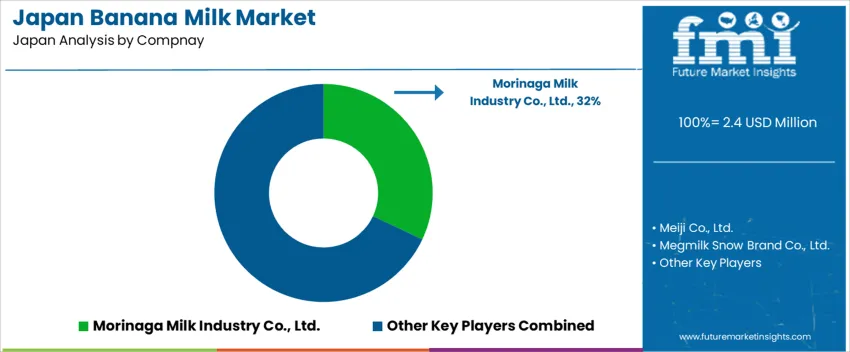
Demand for banana milk in Japan is supported by dairy companies supplying flavoured milk beverages through convenience stores, supermarkets, and vending platforms. Morinaga Milk Industry Co., Ltd. holds an estimated 32.0% share, supported by controlled flavour-stability performance, consistent pasteurization standards, and strong nationwide refrigeration logistics. Its banana-milk products maintain predictable texture and reliable shelf handling in Japan’s high-turnover retail environment.
Meiji Co., Ltd. maintains strong participation with banana-flavoured milk lines designed for stable sweetness balance and uniform sensory experience across packaging formats. Megmilk Snow Brand Co., Ltd. contributes through chilled beverages aimed at children and office-worker consumption routines, with dependable protein composition and distribution into suburban outlets.
Koiwai Dairy Products Co., Ltd. supports niche demand using premium dairy bases that emphasize mouthfeel consistency. Ito En, Ltd. provides selective plant-based alternatives where lactose-free formulations and lighter flavour profiles support dietary-preference segments. Competition focuses on flavour uniformity, cold-chain reliability, packaging convenience, and retail shelf efficiency. Demand remains steady as banana milk continues to serve daily refreshment and snack-time consumption in Japan’s established dairy-beverage ecosystem.
Key Players in Japan Banana Milk Demand
- Morinaga Milk Industry Co., Ltd.
- Meiji Co., Ltd.
- Megmilk Snow Brand Co., Ltd.
- Koiwai Dairy Products Co., Ltd.
- Ito En, Ltd.
Scope of the Report
| Metric | Value |
|---|---|
| Quantitative Units | USD 2.49 million to USD 3.62 million, at a CAGR of 3.8% |
| Market Definition | Banana milk encompasses flavored dairy beverages combining pasteurized milk with banana flavoring for retail and vending distribution. |
| Segmentation | Nature: Conventional, Organic; Flavor: Sweetened, Unsweetened; Sales Channel: Indirect, Direct |
| Regions Covered | Kyushu & Okinawa, Kanto, Kansai, Chubu, Tohoku, Rest of Japan |
| Key Companies Profiled | Morinaga Milk Industry Co., Ltd., Meiji Co., Ltd., Megmilk Snow Brand Co., Ltd., Koiwai Dairy Products Co., Ltd., Ito En, Ltd. |
| Forecast Period | 2026 to 2036 |
| Approach | Forecasting models apply a bottom-up methodology starting from trade volume baselines, applying category-specific growth coefficients and cross-validating against reported company financials and trade statistics. |
Japan Banana Milk Demand by Segments
Nature:
- Conventional
- Organic
Flavor:
- Sweetened
- Unsweetened
Sales Channel:
- Indirect
- Direct
Region:
- Kyushu & Okinawa
- Kanto
- Kansai
- Chubu
- Tohoku
- Rest of Japan
Bibliography
- Ministry of Agriculture, Forestry and Fisheries, Japan. (2025). Dairy Industry Statistics Annual Report. MAFF Japan.
- Japan Dairy Association. (2024). National Dairy Consumption Trends Report. J-Milk.
- Consumer Affairs Agency, Japan. (2024). Food Labeling Standards: Dairy Product Classification. CAA Japan.
- Food and Agriculture Organization of the United Nations. (2024). Dairy Market Review. FAO.
- Organisation for Economic Co-operation and Development. (2024). OECD-FAO Agricultural Outlook: Dairy Products. OECD.
This bibliography is provided for reader reference. The full Future Market Insights report contains the complete reference list with primary research documentation.
Frequently Asked Questions
How large is the demand for banana milk in japan market in 2026?
The demand for banana milk in japan market is estimated to be valued at USD 2.49 million in 2026.
What will be the market size of demand for banana milk in japan by 2036?
Market size for demand for banana milk in japan is projected to reach USD 3.62 million by 2036.
What is the expected CAGR for demand for banana milk in japan between 2026 and 2036?
The demand for banana milk in japan market is expected to grow at a CAGR of 3.8% between 2026 and 2036.
Which nature segment is poised to lead in 2026?
Conventional accounts for 72.0% share in 2026, making it the leading nature segment.
Which flavor segment holds a leading position?
Sweetened holds 65.0% share in 2026, commanding the leading position by flavor.
Which region records the highest growth rate?
Kyushu & Okinawa records the highest CAGR at 4.8% during 2026 to 2036.
What is included in the scope of this report?
Market scope includes conventional and organic banana-flavored milk products in sweetened and unsweetened variants. The scope covers both indirect distribution channels (convenience stores, supermarke.
What is excluded from the scope of this report?
The scope excludes banana-flavored plant-based beverages, banana yogurt drinks, banana smoothie products sold through foodservice, and banana-flavored confectionery items. Raw banana puree sold as a f.
Preview the report firsthand - request a free sample
Get SampleGet the brochure for pricing and purchase details.
Get PDFTable of Content
- Executive Summary
- Japan Market Outlook
- Demand-side Trends
- Supply-side Trends
- Technology Roadmap Analysis
- Analysis and Recommendations
- Market Overview
- Market Coverage / Taxonomy
- Market Definition / Scope / Limitations
- Research Methodology
- Chapter Orientation
- Analytical Lens and Working Hypotheses
- Market Structure, Signals, and Trend Drivers
- Benchmarking and Cross-market Comparability
- Market Sizing, Forecasting, and Opportunity Mapping
- Research Design and Evidence Framework
- Desk Research Programme (Secondary Evidence)
- Company Annual and Sustainability Reports
- Peer-reviewed Journals and Academic Literature
- Corporate Websites, Product Literature, and Technical Notes
- Earnings Decks and Investor Briefings
- Statutory Filings and Regulatory Disclosures
- Technical White Papers and Standards Notes
- Trade Journals, Industry Magazines, and Analyst Briefs
- Conference Proceedings, Webinars, and Seminar Materials
- Government Statistics Portals and Public Data Releases
- Press Releases and Reputable Media Coverage
- Specialist Newsletters and Curated Briefings
- Sector Databases and Reference Repositories
- FMI Internal Proprietary Databases and Historical Market Datasets
- Subscription Datasets and Paid Sources
- Social Channels, Communities, and Digital Listening Inputs
- Additional Desk Sources
- Expert Input and Fieldwork (Primary Evidence)
- Primary Modes
- Qualitative Interviews and Expert Elicitation
- Quantitative Surveys and Structured Data Capture
- Blended Approach
- Why Primary Evidence is Used
- Field Techniques
- Interviews
- Surveys
- Focus Groups
- Observational and In-context Research
- Social and Community Interactions
- Stakeholder Universe Engaged
- C-suite Leaders
- Board Members
- Presidents and Vice Presidents
- R&D and Innovation Heads
- Technical Specialists
- Domain Subject-matter Experts
- Scientists
- Physicians and Other Healthcare Professionals
- Governance, Ethics, and Data Stewardship
- Research Ethics
- Data Integrity and Handling
- Primary Modes
- Tooling, Models, and Reference Databases
- Desk Research Programme (Secondary Evidence)
- Data Engineering and Model Build
- Data Acquisition and Ingestion
- Cleaning, Normalisation, and Verification
- Synthesis, Triangulation, and Analysis
- Quality Assurance and Audit Trail
- Market Background
- Market Dynamics
- Drivers
- Restraints
- Opportunity
- Trends
- Scenario Forecast
- Demand in Optimistic Scenario
- Demand in Likely Scenario
- Demand in Conservative Scenario
- Opportunity Map Analysis
- Product Life Cycle Analysis
- Supply Chain Analysis
- Investment Feasibility Matrix
- Value Chain Analysis
- PESTLE and Porter’s Analysis
- Regulatory Landscape
- Regional Parent Market Outlook
- Production and Consumption Statistics
- Import and Export Statistics
- Market Dynamics
- Japan Market Analysis 2021 to 2025 and Forecast, 2026 to 2036
- Historical Market Size Value (USD Million) Analysis, 2021 to 2025
- Current and Future Market Size Value (USD Million) Projections, 2026 to 2036
- Y-o-Y Growth Trend Analysis
- Absolute $ Opportunity Analysis
- Japan Market Pricing Analysis 2021 to 2025 and Forecast 2026 to 2036
- Japan Market Analysis 2021 to 2025 and Forecast 2026 to 2036, By Nature
- Introduction / Key Findings
- Historical Market Size Value (USD Million) Analysis By Nature , 2021 to 2025
- Current and Future Market Size Value (USD Million) Analysis and Forecast By Nature , 2026 to 2036
- Conventional
- Organic
- Conventional
- Y-o-Y Growth Trend Analysis By Nature , 2021 to 2025
- Absolute $ Opportunity Analysis By Nature , 2026 to 2036
- Japan Market Analysis 2021 to 2025 and Forecast 2026 to 2036, By Flavor
- Introduction / Key Findings
- Historical Market Size Value (USD Million) Analysis By Flavor, 2021 to 2025
- Current and Future Market Size Value (USD Million) Analysis and Forecast By Flavor, 2026 to 2036
- Sweetened
- Unsweetened
- Sweetened
- Y-o-Y Growth Trend Analysis By Flavor, 2021 to 2025
- Absolute $ Opportunity Analysis By Flavor, 2026 to 2036
- Japan Market Analysis 2021 to 2025 and Forecast 2026 to 2036, By Sales Channel
- Introduction / Key Findings
- Historical Market Size Value (USD Million) Analysis By Sales Channel, 2021 to 2025
- Current and Future Market Size Value (USD Million) Analysis and Forecast By Sales Channel, 2026 to 2036
- Indirect
- Direct
- Indirect
- Y-o-Y Growth Trend Analysis By Sales Channel, 2021 to 2025
- Absolute $ Opportunity Analysis By Sales Channel, 2026 to 2036
- Japan Market Analysis 2021 to 2025 and Forecast 2026 to 2036, By Region
- Introduction
- Historical Market Size Value (USD Million) Analysis By Region, 2021 to 2025
- Current Market Size Value (USD Million) Analysis and Forecast By Region, 2026 to 2036
- Kyushu & Okinawa
- Kanto
- Kinki
- Chubu
- Tohoku
- Rest of Japan
- Market Attractiveness Analysis By Region
- Kyushu & Okinawa Market Analysis 2021 to 2025 and Forecast 2026 to 2036, By Country
- Historical Market Size Value (USD Million) Trend Analysis By Market Taxonomy, 2021 to 2025
- Market Size Value (USD Million) Forecast By Market Taxonomy, 2026 to 2036
- By Country
- By Nature
- By Flavor
- By Sales Channel
- By Country
- Market Attractiveness Analysis
- By Country
- By Nature
- By Flavor
- By Sales Channel
- Key Takeaways
- Kanto Market Analysis 2021 to 2025 and Forecast 2026 to 2036, By Country
- Historical Market Size Value (USD Million) Trend Analysis By Market Taxonomy, 2021 to 2025
- Market Size Value (USD Million) Forecast By Market Taxonomy, 2026 to 2036
- By Country
- By Nature
- By Flavor
- By Sales Channel
- By Country
- Market Attractiveness Analysis
- By Country
- By Nature
- By Flavor
- By Sales Channel
- Key Takeaways
- Kinki Market Analysis 2021 to 2025 and Forecast 2026 to 2036, By Country
- Historical Market Size Value (USD Million) Trend Analysis By Market Taxonomy, 2021 to 2025
- Market Size Value (USD Million) Forecast By Market Taxonomy, 2026 to 2036
- By Country
- By Nature
- By Flavor
- By Sales Channel
- By Country
- Market Attractiveness Analysis
- By Country
- By Nature
- By Flavor
- By Sales Channel
- Key Takeaways
- Chubu Market Analysis 2021 to 2025 and Forecast 2026 to 2036, By Country
- Historical Market Size Value (USD Million) Trend Analysis By Market Taxonomy, 2021 to 2025
- Market Size Value (USD Million) Forecast By Market Taxonomy, 2026 to 2036
- By Country
- By Nature
- By Flavor
- By Sales Channel
- By Country
- Market Attractiveness Analysis
- By Country
- By Nature
- By Flavor
- By Sales Channel
- Key Takeaways
- Tohoku Market Analysis 2021 to 2025 and Forecast 2026 to 2036, By Country
- Historical Market Size Value (USD Million) Trend Analysis By Market Taxonomy, 2021 to 2025
- Market Size Value (USD Million) Forecast By Market Taxonomy, 2026 to 2036
- By Country
- By Nature
- By Flavor
- By Sales Channel
- By Country
- Market Attractiveness Analysis
- By Country
- By Nature
- By Flavor
- By Sales Channel
- Key Takeaways
- Rest of Japan Market Analysis 2021 to 2025 and Forecast 2026 to 2036, By Country
- Historical Market Size Value (USD Million) Trend Analysis By Market Taxonomy, 2021 to 2025
- Market Size Value (USD Million) Forecast By Market Taxonomy, 2026 to 2036
- By Country
- By Nature
- By Flavor
- By Sales Channel
- By Country
- Market Attractiveness Analysis
- By Country
- By Nature
- By Flavor
- By Sales Channel
- Key Takeaways
- Key Countries Market Analysis
- Kyushu & Okinawa
- Pricing Analysis
- Market Share Analysis, 2025
- By Nature
- By Flavor
- By Sales Channel
- Kanto
- Pricing Analysis
- Market Share Analysis, 2025
- By Nature
- By Flavor
- By Sales Channel
- Kinki
- Pricing Analysis
- Market Share Analysis, 2025
- By Nature
- By Flavor
- By Sales Channel
- Chubu
- Pricing Analysis
- Market Share Analysis, 2025
- By Nature
- By Flavor
- By Sales Channel
- Tohoku
- Pricing Analysis
- Market Share Analysis, 2025
- By Nature
- By Flavor
- By Sales Channel
- Rest of Japan
- Pricing Analysis
- Market Share Analysis, 2025
- By Nature
- By Flavor
- By Sales Channel
- Kyushu & Okinawa
- Market Structure Analysis
- Competition Dashboard
- Competition Benchmarking
- Market Share Analysis of Top Players
- By Regional
- By Nature
- By Flavor
- By Sales Channel
- Competition Analysis
- Competition Deep Dive
- Morinaga Milk Industry Co., Ltd.
- Overview
- Product Portfolio
- Profitability by Market Segments (Product/Age /Sales Channel/Region)
- Sales Footprint
- Strategy Overview
- Marketing Strategy
- Product Strategy
- Channel Strategy
- Meiji Co., Ltd.
- Megmilk Snow Brand Co., Ltd.
- Koiwai Dairy Products Co., Ltd.
- Ito En, Ltd.
- Morinaga Milk Industry Co., Ltd.
- Competition Deep Dive
- Assumptions & Acronyms Used


