

- Industry Size (2026)
- USD 25.52 Mn
- Forecast (2036)
- USD 33.96 Mn
- CAGR (2026 to 2036)
- 2.9%
Demand for Single Serve Wine in Japan Market Size, Market Forecast and Outlook By FMI
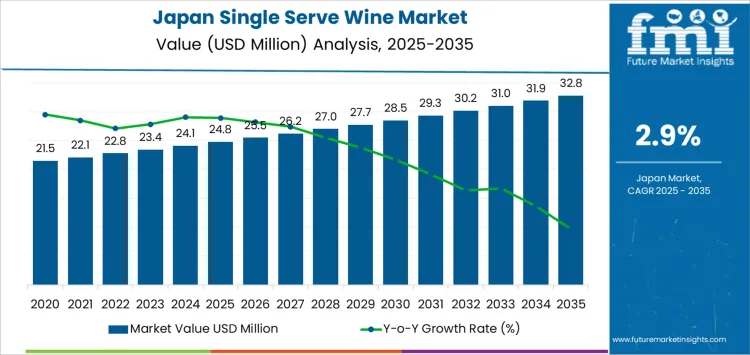
The demand for single serve wine in Japan market was valued at USD 24.80 million in 2025, projected to reach USD 25.52 million in 2026, and is forecast to expand to USD 33.96 million by 2036 at a 2.9% CAGR. Shifting household demographics in Japan, including rising single-person households and aging populations seeking portion-controlled consumption, are driving steady adoption of single serve wine formats across convenience and retail channels. Buyers across Japan are recalibrating procurement strategies to align with evolving consumption patterns and tightening regulatory frameworks that compel measurable product traceability across the supply chain. Convenience store operators in urban prefectures are restructuring beverage planograms to allocate dedicated shelf space for 180ml to 250ml wine containers, capturing impulse purchase occasions that traditional 750ml bottles cannot address.
Summary of Demand for Single Serve Wine in Japan Market
- Market Overview
- The market is valued at USD 24.80 million in 2025 and is projected to reach USD 33.96 million by 2036.
- The industry is expected to grow at a 2.9% CAGR from 2026 to 2036, creating an incremental opportunity of USD 8.44 million.
- The market remains a convenience-driven, format-innovation category where portion control, premiumization, and retail shelf optimization define competitive positioning in Japan.
- Demand and Growth Drivers
- Rising single-person and dual-income households in Japan are driving permanent structural demand for portion-controlled wine formats, with the National Institute of Population and Social Security Research projecting continued household size contraction through 2040.
- Convenience store chains across Japan are allocating dedicated shelf space for single serve wine, converting impulse purchase traffic into a measurable wine consumption occasion that traditional bottle formats cannot capture in high-footfall urban locations.
- Consumers are selecting varietal-specific, higher-quality wines in single serve packaging rather than defaulting to generic blended options, creating a revenue-per-unit growth trajectory that outpaces volume growth and rewards brand-specific product development investment.
- Among key regions, Kyushu & Okinawa at 3.6%, Kanto at 3.3%, Kansai at 2.9%, Chubu at 2.5%, Tohoku at 2.2%, Rest of Japan at 2.1%.
- Product and Segment View
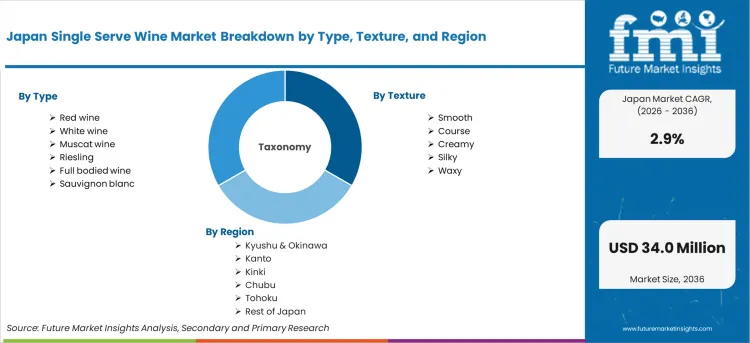
- The market includes products segmented by Type, Texture, covering Red wine, White wine, Muscat wine, Riesling, Full bodied wine, Sauvignon blanc under Type and Smooth, Course, Creamy, Silky, Waxy under Texture.
- Red wine leads Type segmentation with 46.0% share in 2026.
- Smooth leads Texture segmentation with 37.0% share in 2026.
- Geography and Competitive Outlook
- Kyushu & Okinawa is the fastest-growing area at 3.6% CAGR, while Rest of Japan registers steady but lower expansion.
- Competition is shaped by product diversification, distribution reach, and pricing discipline, with key players including Constellation Brands, E&J Gallo Winery, Caviro, The Wine Group, Grupo Penaflor S.A..
- Analyst Opinion at FMI
- Nandini Roy Choudhury, Principal Consultant at FMI, opines: 'In my analysis, I have observed that the core inflection point in Japan single serve wine demand is not volume growth but margin recomposition. Producers who anchor strategy on premium single serve varietals rather than discounted miniature bottle runs will capture disproportionate value as convenience channel operators restructure shelf allocations to reward higher per-unit revenue.'
- Strategic Implications / Executive Takeaways
- Wine producers must develop dedicated single serve product lines with varietal-specific branding rather than simply repackaging existing bulk inventory into smaller containers.
- Distribution partners should negotiate dedicated shelf space agreements with convenience store chains that reward per-unit revenue performance over volume throughput.
- Packaging engineers must invest in lightweight, resealable, and recyclable single serve container technologies to meet tightening waste reduction mandates in Japan.
Demand for Single Serve Wine in Japan Market Key Takeaways
| Metric | Details |
|---|---|
| Industry Size (2026) | USD 25.52 Million |
| Industry Value (2036) | USD 33.96 Million |
| CAGR (2026-2036) | 2.9% |
Source: Future Market Insights, 2026
FMI analysts observe that the transition from traditional bottle formats to single serve packaging in Japan reflects a broader consumer preference for convenience and waste reduction. Retailers in urban centers are expanding shelf allocations for 180ml to 250ml wine containers to capture impulse purchase occasions. Premiumization is occurring alongside format downsizing, as consumers opt for higher-quality varietals in smaller portions rather than bulk purchases. Regulatory requirements around alcohol labeling and responsible serving sizes further support the shift toward controlled-volume packaging across licensed and unlicensed retail environments. The National Tax Agency reporting framework for alcoholic beverages now tracks single serve categories as a distinct statistical line, providing market participants with consumption visibility previously unavailable for format-level planning.
Regional demand trajectories reflect distinct structural conditions within Japan. Kyushu & Okinawa leads with a 3.6% CAGR, followed by Kanto at 3.3%, Kansai at 2.9%, Chubu at 2.5%, Tohoku at 2.2%, Rest of Japan at 2.1%. As per FMI, these regional variations are tied to local distribution infrastructure maturity, consumer purchasing behavior, and the pace at which convenience store chains expand wine-dedicated shelf categories. Kyushu and Okinawa benefit from tourism-driven consumption patterns and a younger demographic profile that favors single serve convenience formats. Kanto, anchored by Tokyo metropolitan demand, generates the largest absolute volume but faces shelf space saturation that moderates growth rates relative to less penetrated regions. Chubu and Tohoku markets are transitioning from traditional sake consumption toward wine adoption, with single serve formats serving as an entry point for first-time wine consumers in these prefectures.
Demand for Single Serve Wine in Japan Market Definition
Single serve wine encompasses wine products packaged in individual consumption units typically ranging from 180ml to 375ml, designed for immediate personal consumption without the need for resealing or shared serving. These formats include miniature bottles, cans, pouches, and single-glass containers across red, white, rose, and sparkling wine categories. The primary commercial function is to provide portion-controlled, impulse-accessible wine options suited to convenience retail, vending, food service, and home consumption occasions. In the Japan market context, the category is tracked separately from standard bottle wine sales, reflecting its distinct pricing structure, distribution channels, and consumer demographic profile.
Demand for Single Serve Wine in Japan Market Inclusions
Market scope includes all wine products packaged in single serve formats of 375ml or below, covering red wine, white wine, muscat wine, riesling, full bodied wine, and sauvignon blanc varietals. The analysis covers smooth, course, creamy, silky, and waxy texture profiles. Regional coverage spans all major prefectural regions within Japan. Market sizing includes retail value, food service value, and forecast period projections from 2026 to 2036.
Demand for Single Serve Wine in Japan Market Exclusions
Standard 750ml and larger wine bottle formats are excluded from the scope. Bulk wine sold in bag-in-box containers above 1 liter, non-alcoholic wine alternatives, wine coolers, and wine-based cocktail products fall outside analytical parameters. Sparkling wine and champagne in standard bottle sizes are excluded unless packaged in single serve units below 375ml.
Demand for Single Serve Wine in Japan Market Research Methodology
- Primary Research: Analysts conducted structured interviews with supply chain managers, product procurement leads, and distribution network operators to map decision triggers that shape purchasing volumes and vendor selection criteria.
- Desk Research: Data collection phases aggregated regulatory filings, trade body publications, national consumption surveys, and public procurement records from government statistical agencies.
- Market-Sizing and Forecasting: Baseline values derive from a bottom-up aggregation of category-level consumption volumes, applying region-specific penetration curves and pricing benchmarks to project future demand trajectories.
- Data Validation and Update Cycle: Projections are cross-checked against publicly reported trade statistics, manufacturer shipment disclosures, and import-export databases maintained by customs authorities.
Demand for Single Serve Wine in Japan Market Drivers, Restraints, and Opportunities
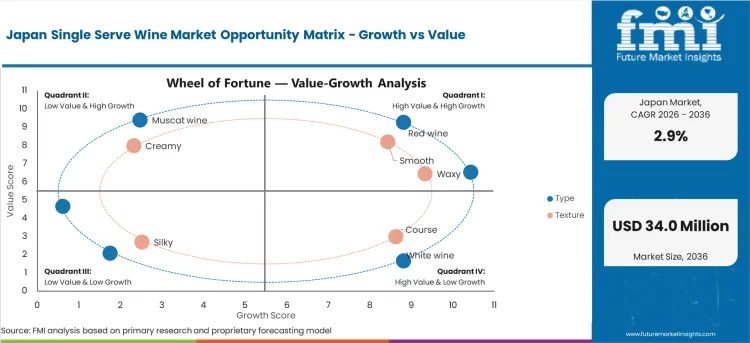
Future Market Insights analysis indicates the single serve wine market in Japan has evolved from a novelty packaging experiment into a structurally embedded retail category. Convenience store chains, which account for a dominant share of packaged alcohol transactions in urban Japan, have standardized single serve wine placement within their beverage planograms. The shift is not temporary: it reflects a permanent reconfiguration of consumer alcohol purchasing behavior driven by demographic fragmentation, declining average household size, and increasing preference for portion control. Municipal waste reduction targets in major cities provide additional regulatory tailwinds, as single serve packaging generates less post-consumer waste per consumption occasion compared to partially consumed standard bottles that enter residential waste streams.
The pricing architecture of single serve wine in Japan is undergoing rebalancing. Per-milliliter pricing in premium single serve formats exceeds standard bottle equivalents by 25% to 40%, creating a margin opportunity for producers willing to invest in varietal-specific single serve product lines. FMI is of the opinion that this pricing premium is sustainable because the target consumer segment prioritizes convenience and quality assurance over unit cost optimization. Domestic wine producers in Yamanashi and Nagano prefectures are investing in dedicated single serve bottling lines to capture this margin premium, while import distributors are restructuring their portfolio strategies to prioritize international wine brands that offer Japan-specific single serve SKUs.
- Demographic Fragmentation: Rising single-person and dual-income households in Japan are driving permanent structural demand for portion-controlled wine formats, with the National Institute of Population and Social Security Research projecting continued household size contraction through 2040.
- Convenience Channel Integration: Convenience store chains across Japan are allocating dedicated shelf space for single serve wine, converting impulse purchase traffic into a measurable wine consumption occasion that traditional bottle formats cannot capture in high-footfall urban locations.
- Premiumization in Miniature Formats: Consumers are selecting varietal-specific, higher-quality wines in single serve packaging rather than defaulting to generic blended options, creating a revenue-per-unit growth trajectory that outpaces volume growth and rewards brand-specific product development investment.
Why is the Demand for Single Serve Wine in Japan Growing?
The demand for single serve wine in Japan is growing as consumers increasingly seek convenience and portion control in their beverage choices. Single serve wine, typically packaged in bottles, cans, or pouches, offers a practical solution for individuals who want to enjoy a glass of wine without opening a full bottle. This is particularly appealing to consumers who live alone, have smaller households, or enjoy occasional wine consumption. The convenience of single servings allows for an easy and hassle-free experience, making it an attractive option in Japan’s fast-paced urban lifestyle.
A key driver behind the growth of single serve wine is the increasing demand for convenient and portable alcoholic beverages. As consumer preferences shift towards products that fit easily into busy, on-the-go lifestyles, single serve wine offers a practical option for both social gatherings and individual enjoyment. Moreover, the growing interest in outdoor activities such as picnics and travel has further contributed to the appeal of single serve wine, which is easy to carry and consume in various settings.
The increasing variety of single serve wine offerings, including both premium and affordable options, is driving the sector’s growth. Innovations in packaging and the introduction of new wine varieties in single serve formats are catering to a wide range of tastes and preferences. As consumer demand for more convenient, portion-controlled alcoholic beverages continues to rise, the demand for single serve wine in Japan is expected to grow steadily through 2035.
What is the Segment-Wise Analysis of Demand for Single Serve Wine in Japan?
Demand for single-serve wine in Japan is segmented by type, texture, and region. By type, demand is divided into red wine, white wine, muscat wine, riesling, full-bodied wine, and sauvignon blanc, with red wine leading at 46%. The demand is also segmented by texture, including smooth, course, creamy, silky, and waxy, with smooth leading at 37%. Regionally, demand is spread across Kyushu & Okinawa, Kanto, Kansai, Chubu, Tohoku, and the rest of Japan.
How Does Red Wine Lead the Demand for Single Serve Wine in Japan?
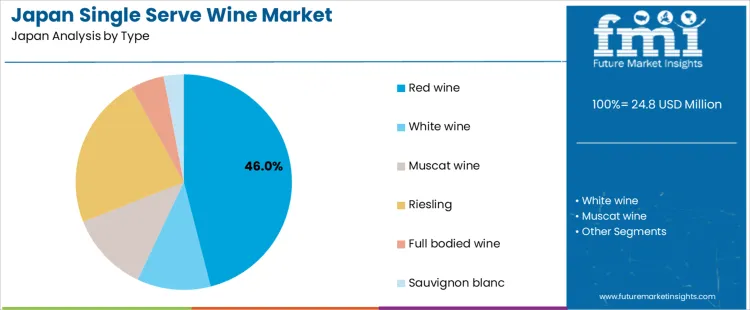
Red wine accounts for 46% of the demand for single-serve wine in Japan, driven by its versatility and widespread popularity. Red wine is favored for its rich, complex flavors, making it an ideal pairing for a variety of foods, such as grilled meats, cheese, and even Japanese cuisine. The growing interest in wine pairings and the health benefits attributed to red wine, including its antioxidant properties, also contribute to its dominance in the industry.
The convenience of single-serve packaging makes it easier for consumers to enjoy red wine without opening a full bottle, catering to those who want a quick, enjoyable experience. As Japan's wine culture expands and consumers increasingly seek premium and convenient options, red wine remains the top choice in the single-serve wine segment, offering both quality and convenience.
Why Does Smooth Texture Lead the Demand for Single Serve Wine in Japan?
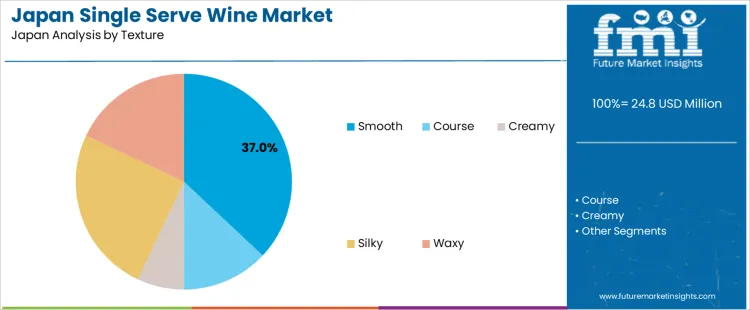
Smooth texture accounts for 37% of the demand for single-serve wine in Japan, driven by its broad appeal and drinkability. Wines with a smooth texture are highly valued for their velvety mouthfeel and balanced flavors, making them accessible to a wide range of consumers, from casual drinkers to wine enthusiasts. Smooth wines are particularly popular for casual settings and social occasions, where easy drinking is preferred.
This texture also enhances the overall dining experience, as it pairs well with a variety of foods, making it versatile for different tastes and preferences. The rising trend in Japan for approachable, enjoyable wines that don’t require extensive knowledge to appreciate has made smooth-textured wines a dominant choice. As convenience and versatility continue to be in demand, smooth wines in single-serve formats are expected to remain the preferred option for consumers looking for both quality and ease of drinking.
What is the Demand Outlook for Single Serve Wine in Japan?
.webp "Top Country Growth Comparison Japan Single Serve Wine Market Cagr (2026 2036)")
| Region | CAGR (%) |
|---|---|
| Kyushu & Okinawa | 3.6% |
| Kanto | 3.3% |
| Kansai | 2.9% |
| Chubu | 2.5% |
| Tohoku | 2.2% |
| Rest of Japan | 2.1% |
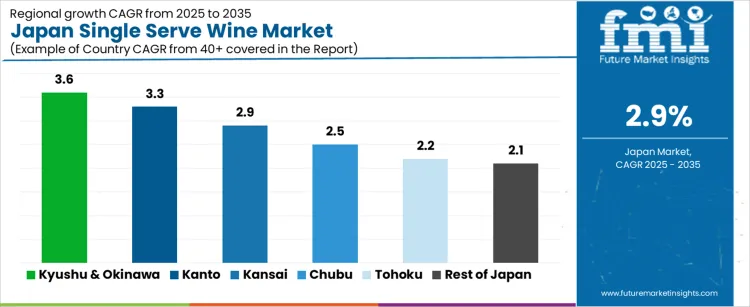
Demand for single serve wine in Japan is growing steadily across all regions, with Kyushu & Okinawa leading at a 3.6% CAGR, driven by the region's rising interest in convenient and portable wine options. Kanto follows closely with a 3.3% CAGR, supported by its large urban population, where busy lifestyles encourage the consumption of single-serve beverages.
Kansai shows a 2.9% CAGR, with a growing wine culture and a preference for convenient, smaller portions of wine that fit into fast-paced living. Chubu experiences a 2.5% CAGR, reflecting a shift toward more accessible wine options, especially as urbanization increases. Tohoku and the Rest of Japan see more moderate growth at 2.2% and 2.1%, respectively, as single serve wine gains traction in both urban and rural areas.
How is Demand for Single Serve Wine Growing in Kyushu & Okinawa?
Kyushu & Okinawa leads the demand for single serve wine, growing at a 3.6% CAGR. The region’s growing interest in convenience and portable drinking options is a key driver of this trend. In Okinawa, which is a popular tourist destination, visitors and locals alike are increasingly opting for single serve wine, as it fits the region's casual dining culture and outdoor lifestyle. Okinawa’s focus on health and wellness, along with the aging population, is encouraging consumers to seek more accessible and manageable portions of wine.
Local retailers and restaurants are expanding their product offerings to include more single serve wine, catering to consumers looking for easy-to-consume, high-quality options. As more people adopt healthier and more convenient drinking habits, the demand for single serve wine is expected to continue growing, with both tourists and residents contributing to the regional growth.
Why is Demand for Single Serve Wine Rising in Kanto?
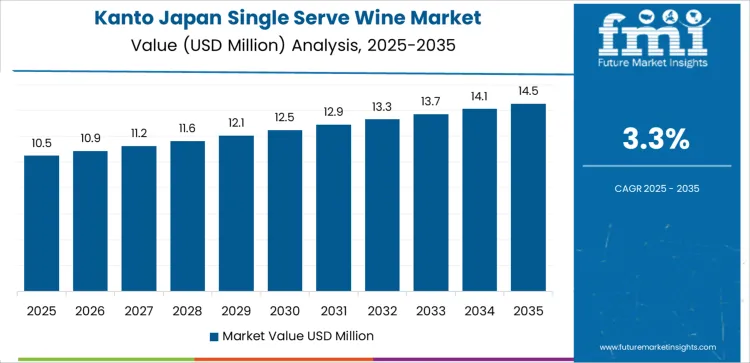
In Kanto, demand for single serve wine is growing at a 3.3% CAGR. The region’s large urban population, particularly in Tokyo, is a major factor driving this growth. With busy urban lifestyles and increasing interest in convenience, many consumers in Kanto are turning to single serve wine as a way to enjoy premium wine in smaller, more manageable portions. The rise of single serve wine is also fueled by its availability through convenience stores, superindustrys, and online platforms, making it more accessible to a broader range of consumers.
Younger generations are increasingly interested in wine and casual drinking, driving the trend toward single serve options. As the trend of on-the-go consumption continues to rise in Kanto, the demand for single serve wine is expected to remain strong. This growing interest in single serve wine reflects the region’s broader trends of convenience, premiumization, and casual consumption.
How is Demand for Single Serve Wine Expanding in Kansai?
Kansai shows steady growth in single serve wine demand, with a 2.9% CAGR. Known for its rich culinary culture, particularly in cities like Osaka and Kyoto, Kansai has witnessed increasing interest in wine pairing with local cuisine. Single serve wine has become a popular option, especially for smaller households, busy professionals, and people seeking convenience. The rise in health-conscious behaviors, especially among younger consumers, has further fueled the demand for single serve wine, as it allows for controlled portions and more accessible wine experiences.
As wine culture continues to evolve in Kansai, local restaurants, cafes, and convenience stores are incorporating more single serve options into their menus and product offerings. The growing popularity of single serve wine also reflects the region's trend towards premiumization in food and beverage choices. With more consumers embracing wine for both casual and formal occasions, demand for single serve wine is expected to continue rising in Kansai.
Why is Demand for Single Serve Wine Growing in Chubu?
Chubu is witnessing steady demand for single serve wine, growing at a 2.5% CAGR. As urbanization increases in cities like Nagoya, more consumers are seeking convenient, smaller wine portions that fit into their busy lives. The growing awareness of wine as a casual and accessible drink option, combined with the region’s increasing focus on health and wellness, has led to a rise in demand for single serve wine. With smaller households and busy professionals being key consumers, the appeal of single serve wine lies in its convenience and portion control.
Retailers in Chubu are increasingly stocking a variety of single serve wine options to cater to this rising demand, making it easier for consumers to enjoy premium wine without the commitment of a full bottle. As Chubu continues to urbanize and its food and beverage trends evolve, single serve wine is expected to remain a popular choice, supporting steady growth in the region.
How is Demand for Single Serve Wine Expanding in Tohoku?
Tohoku is seeing moderate growth in single serve wine demand, with a 2.2% CAGR. While the region’s wine consumption is lower compared to major urban areas, there is a gradual increase in interest, particularly as more consumers in larger cities like Sendai look for convenient drinking options. The growing awareness of health-conscious living, along with the trend towards smaller household sizes, is contributing to the rise in demand for single serve wine.
Tohoku’s consumers are becoming more exposed to wine culture through retail expansion and foodservice offerings that provide single serve options. As distribution networks improve and consumer preferences evolve, single serve wine is becoming more accessible in Tohoku. With increasing exposure to global wine trends, the demand for single serve wine is expected to rise, especially among younger generations and those seeking more convenient ways to enjoy wine. Tohoku’s wine industry, though smaller, is poised for steady growth.
Why is Demand for Single Serve Wine Steady in the Rest of Japan?
The Rest of Japan is experiencing steady demand for single serve wine, with a 2.1% CAGR. While the demand is lower than in major urban centers, there is a growing shift toward convenience as consumers in rural and smaller cities increasingly adopt single serve wine for its portability and easy consumption. The trend is driven by the rising awareness of health and wellness, especially among older consumers, who prefer smaller portions.
As wine consumption continues to rise in these areas, the availability of single serve wine through convenience stores and local retailers is helping increase its accessibility. The adoption of online shopping is making it easier for people in less urbanized regions to purchase single serve wine. As consumer attitudes toward wine change and convenience becomes a larger factor, demand for single serve wine in the Rest of Japan is expected to grow gradually, reflecting broader trends of convenience and casual consumption.
Competitive Aligners for Market Players
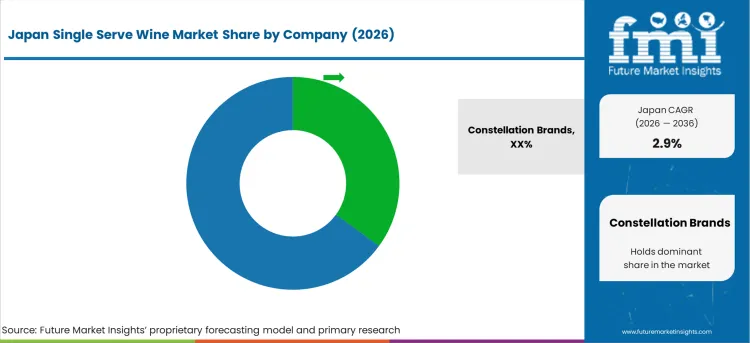
The competitive structure of the single serve wine market in Japan is moderately concentrated, with five major international producers holding a combined share that exceeds 60% of organized retail value. Constellation Brands, E&J Gallo Winery, Caviro, The Wine Group, and Grupo Penaflor S.A. maintain their positioning through established import distribution agreements with major convenience store and supermarket chains. Competitive differentiation is driven by varietal range, packaging format innovation, and the ability to secure premium shelf placement within the convenience store beverage aisle.
Vertical integration provides a structural advantage for producers who control both vineyard operations and packaging facilities. Companies with captive bottling lines dedicated to single serve formats achieve faster SKU rotation and lower per-unit packaging costs compared to competitors relying on third-party co-packaging. Buyer leverage in Japan is concentrated among three major convenience store groups and two dominant supermarket chains, which collectively control access to the highest-traffic retail points. These buyers negotiate annual supply agreements that reward producers for consistent delivery performance, promotional support, and packaging exclusivity within format categories.
New entrants face barriers related to import licensing, distribution network access, and the significant marketing investment required to establish brand recognition in a market where consumer loyalty to familiar wine labels is high. Domestic Japanese wine producers from Yamanashi, Nagano, and Hokkaido are increasingly competing for single serve shelf space, leveraging local provenance appeal as a differentiator against imported products.
Key Players in Demand for Single Serve Wine in Japan Market
- Constellation Brands
- E&J Gallo Winery
- Caviro
- The Wine Group
- Grupo Penaflor S.A.
Scope of the Report
| Metric | Value |
|---|---|
| Quantitative Units | USD 25.52 Million to USD 33.96 Million, at a CAGR of 2.9% |
| Market Definition | Single serve wine encompasses wine products packaged in individual consumption units typically ranging from 180ml to 375ml, designed for immediate personal consumption without the need for resealing or shared serving. These formats include miniature bottles, cans, pouches, and single-glass containers across red, white, rose, and sparkling wine categories. |
| Type Segmentation | Red wine, White wine, Muscat wine, Riesling, Full bodied wine, Sauvignon blanc |
| Texture Segmentation | Smooth, Course, Creamy, Silky, Waxy |
| Regions Covered | Kyushu & Okinawa, Kanto, Kansai/Kinki, Chubu, Tohoku, and Rest of Japan |
| Key Companies Profiled | Constellation Brands, E&J Gallo Winery, Caviro, The Wine Group, Grupo Penaflor S.A. |
| Forecast Period | 2026 to 2036 |
| Approach | Bottom-up methodology starting with category-level consumption data and applying regional penetration assumptions. |
Demand for Single Serve Wine in Japan Market Analysis by Segments
By Type:
Red wine, White wine, Muscat wine, Riesling, Full bodied wine, Sauvignon blanc
By Texture:
Smooth, Course, Creamy, Silky, Waxy
By Region:
Kyushu & Okinawa, Kanto, Kansai/Kinki, Chubu, Tohoku, and Rest of Japan
Bibliography
- 1. National Tax Agency Japan. (2024). Liquor Tax Law Enforcement Regulations and Statistical Survey of Alcoholic Beverages. NTA.
- 2. Organisation for Economic Co-operation and Development. (2024). Agricultural Outlook: Wine Market Trends. OECD.
- 3. Ministry of Agriculture, Forestry and Fisheries Japan. (2024). Food Balance Sheet and Domestic Supply Statistics. MAFF.
- 4. Japan External Trade Organization. (2024). Alcoholic Beverages Market Report for Japan. JETRO.
- 5. World Health Organization. (2024). Global Status Report on Alcohol and Health. WHO.
This bibliography is provided for reader reference. The full Future Market Insights report contains the complete reference list with primary research documentation.
Frequently Asked Questions
How large is the Demand for Single Serve Wine in Japan Market in 2026?
The Demand for Single Serve Wine in Japan market is estimated to be valued at USD 25.52 million in 2026.
What will be the market size of Demand for Single Serve Wine in Japan by 2036?
The Demand for Single Serve Wine in Japan market is projected to reach USD 33.96 million by 2036.
What is the expected CAGR for Demand for Single Serve Wine in Japan between 2026 and 2036?
The Demand for Single Serve Wine in Japan market is expected to grow at a CAGR of 2.9% between 2026 and 2036.
Which Type is poised to lead in 2026?
Red wine accounts for 46.0% share in 2026, maintaining its position as the leading type segment.
Which region is projected to grow the fastest?
Kyushu & Okinawa is projected to grow at a CAGR of 3.6% during 2026 to 2036, the fastest among all covered regions.
What does Demand for Single Serve Wine in Japan mean in this report?
Single serve wine encompasses wine products packaged in individual consumption units typically ranging from 180ml to 375ml, designed for immediate personal consumption without the need for resealing or shared serving. These formats include miniature bottles, cans, pouches, and single-glass containers across red, white, rose, and sparkling wine categories.
What is included in the scope of this report?
Market scope includes all wine products packaged in single serve formats of 375ml or below, covering red wine, white wine, muscat wine, riesling, full bodied wine, and sauvignon blanc varietals. The analysis covers smooth, course, creamy, silky, and waxy texture profiles.
How does FMI build and validate the Demand for Single Serve Wine in Japan forecast?
Forecasting models apply a bottom-up methodology starting with category-level consumption data and cross-validate projections against trade statistics, manufacturer shipment disclosures, and regulatory filings.
Preview the report firsthand - request a free sample
Get SampleGet the brochure for pricing and purchase details.
Get PDFTable of Content
- Executive Summary
- Japan Market Outlook
- Demand-side Trends
- Supply-side Trends
- Technology Roadmap Analysis
- Analysis and Recommendations
- Market Overview
- Market Coverage / Taxonomy
- Market Definition / Scope / Limitations
- Research Methodology
- Chapter Orientation
- Analytical Lens and Working Hypotheses
- Market Structure, Signals, and Trend Drivers
- Benchmarking and Cross-market Comparability
- Market Sizing, Forecasting, and Opportunity Mapping
- Research Design and Evidence Framework
- Desk Research Programme (Secondary Evidence)
- Company Annual and Sustainability Reports
- Peer-reviewed Journals and Academic Literature
- Corporate Websites, Product Literature, and Technical Notes
- Earnings Decks and Investor Briefings
- Statutory Filings and Regulatory Disclosures
- Technical White Papers and Standards Notes
- Trade Journals, Industry Magazines, and Analyst Briefs
- Conference Proceedings, Webinars, and Seminar Materials
- Government Statistics Portals and Public Data Releases
- Press Releases and Reputable Media Coverage
- Specialist Newsletters and Curated Briefings
- Sector Databases and Reference Repositories
- FMI Internal Proprietary Databases and Historical Market Datasets
- Subscription Datasets and Paid Sources
- Social Channels, Communities, and Digital Listening Inputs
- Additional Desk Sources
- Expert Input and Fieldwork (Primary Evidence)
- Primary Modes
- Qualitative Interviews and Expert Elicitation
- Quantitative Surveys and Structured Data Capture
- Blended Approach
- Why Primary Evidence is Used
- Field Techniques
- Interviews
- Surveys
- Focus Groups
- Observational and In-context Research
- Social and Community Interactions
- Stakeholder Universe Engaged
- C-suite Leaders
- Board Members
- Presidents and Vice Presidents
- R&D and Innovation Heads
- Technical Specialists
- Domain Subject-matter Experts
- Scientists
- Physicians and Other Healthcare Professionals
- Governance, Ethics, and Data Stewardship
- Research Ethics
- Data Integrity and Handling
- Primary Modes
- Tooling, Models, and Reference Databases
- Desk Research Programme (Secondary Evidence)
- Data Engineering and Model Build
- Data Acquisition and Ingestion
- Cleaning, Normalisation, and Verification
- Synthesis, Triangulation, and Analysis
- Quality Assurance and Audit Trail
- Market Background
- Market Dynamics
- Drivers
- Restraints
- Opportunity
- Trends
- Scenario Forecast
- Demand in Optimistic Scenario
- Demand in Likely Scenario
- Demand in Conservative Scenario
- Opportunity Map Analysis
- Product Life Cycle Analysis
- Supply Chain Analysis
- Investment Feasibility Matrix
- Value Chain Analysis
- PESTLE and Porter’s Analysis
- Regulatory Landscape
- Regional Parent Market Outlook
- Production and Consumption Statistics
- Import and Export Statistics
- Market Dynamics
- Japan Market Analysis 2021 to 2025 and Forecast, 2026 to 2036
- Historical Market Size Value (USD Million) Analysis, 2021 to 2025
- Current and Future Market Size Value (USD Million) Projections, 2026 to 2036
- Y-o-Y Growth Trend Analysis
- Absolute $ Opportunity Analysis
- Japan Market Pricing Analysis 2021 to 2025 and Forecast 2026 to 2036
- Japan Market Analysis 2021 to 2025 and Forecast 2026 to 2036, By Type
- Introduction / Key Findings
- Historical Market Size Value (USD Million) Analysis By Type , 2021 to 2025
- Current and Future Market Size Value (USD Million) Analysis and Forecast By Type , 2026 to 2036
- Red wine
- White wine
- Muscat wine
- Riesling
- Full bodied wine
- Sauvignon blanc
- Red wine
- Y-o-Y Growth Trend Analysis By Type , 2021 to 2025
- Absolute $ Opportunity Analysis By Type , 2026 to 2036
- Japan Market Analysis 2021 to 2025 and Forecast 2026 to 2036, By Texture
- Introduction / Key Findings
- Historical Market Size Value (USD Million) Analysis By Texture, 2021 to 2025
- Current and Future Market Size Value (USD Million) Analysis and Forecast By Texture, 2026 to 2036
- Smooth
- Course
- Creamy
- Silky
- Waxy
- Smooth
- Y-o-Y Growth Trend Analysis By Texture, 2021 to 2025
- Absolute $ Opportunity Analysis By Texture, 2026 to 2036
- Japan Market Analysis 2021 to 2025 and Forecast 2026 to 2036, By Region
- Introduction
- Historical Market Size Value (USD Million) Analysis By Region, 2021 to 2025
- Current Market Size Value (USD Million) Analysis and Forecast By Region, 2026 to 2036
- Kyushu & Okinawa
- Kanto
- Kinki
- Chubu
- Tohoku
- Rest of Japan
- Market Attractiveness Analysis By Region
- Kyushu & Okinawa Market Analysis 2021 to 2025 and Forecast 2026 to 2036, By Country
- Historical Market Size Value (USD Million) Trend Analysis By Market Taxonomy, 2021 to 2025
- Market Size Value (USD Million) Forecast By Market Taxonomy, 2026 to 2036
- By Country
- By Type
- By Texture
- By Country
- Market Attractiveness Analysis
- By Country
- By Type
- By Texture
- Key Takeaways
- Kanto Market Analysis 2021 to 2025 and Forecast 2026 to 2036, By Country
- Historical Market Size Value (USD Million) Trend Analysis By Market Taxonomy, 2021 to 2025
- Market Size Value (USD Million) Forecast By Market Taxonomy, 2026 to 2036
- By Country
- By Type
- By Texture
- By Country
- Market Attractiveness Analysis
- By Country
- By Type
- By Texture
- Key Takeaways
- Kinki Market Analysis 2021 to 2025 and Forecast 2026 to 2036, By Country
- Historical Market Size Value (USD Million) Trend Analysis By Market Taxonomy, 2021 to 2025
- Market Size Value (USD Million) Forecast By Market Taxonomy, 2026 to 2036
- By Country
- By Type
- By Texture
- By Country
- Market Attractiveness Analysis
- By Country
- By Type
- By Texture
- Key Takeaways
- Chubu Market Analysis 2021 to 2025 and Forecast 2026 to 2036, By Country
- Historical Market Size Value (USD Million) Trend Analysis By Market Taxonomy, 2021 to 2025
- Market Size Value (USD Million) Forecast By Market Taxonomy, 2026 to 2036
- By Country
- By Type
- By Texture
- By Country
- Market Attractiveness Analysis
- By Country
- By Type
- By Texture
- Key Takeaways
- Tohoku Market Analysis 2021 to 2025 and Forecast 2026 to 2036, By Country
- Historical Market Size Value (USD Million) Trend Analysis By Market Taxonomy, 2021 to 2025
- Market Size Value (USD Million) Forecast By Market Taxonomy, 2026 to 2036
- By Country
- By Type
- By Texture
- By Country
- Market Attractiveness Analysis
- By Country
- By Type
- By Texture
- Key Takeaways
- Rest of Japan Market Analysis 2021 to 2025 and Forecast 2026 to 2036, By Country
- Historical Market Size Value (USD Million) Trend Analysis By Market Taxonomy, 2021 to 2025
- Market Size Value (USD Million) Forecast By Market Taxonomy, 2026 to 2036
- By Country
- By Type
- By Texture
- By Country
- Market Attractiveness Analysis
- By Country
- By Type
- By Texture
- Key Takeaways
- Key Countries Market Analysis
- Kyushu & Okinawa
- Pricing Analysis
- Market Share Analysis, 2025
- By Type
- By Texture
- Kanto
- Pricing Analysis
- Market Share Analysis, 2025
- By Type
- By Texture
- Kinki
- Pricing Analysis
- Market Share Analysis, 2025
- By Type
- By Texture
- Chubu
- Pricing Analysis
- Market Share Analysis, 2025
- By Type
- By Texture
- Tohoku
- Pricing Analysis
- Market Share Analysis, 2025
- By Type
- By Texture
- Rest of Japan
- Pricing Analysis
- Market Share Analysis, 2025
- By Type
- By Texture
- Kyushu & Okinawa
- Market Structure Analysis
- Competition Dashboard
- Competition Benchmarking
- Market Share Analysis of Top Players
- By Regional
- By Type
- By Texture
- Competition Analysis
- Competition Deep Dive
- Constellation Brands
- Overview
- Product Portfolio
- Profitability by Market Segments (Product/Age /Sales Channel/Region)
- Sales Footprint
- Strategy Overview
- Marketing Strategy
- Product Strategy
- Channel Strategy
- E&J Gallo Winery
- Caviro
- The Wine Group
- Grupo Penaflor S.A.
- Constellation Brands
- Competition Deep Dive
- Assumptions & Acronyms Used


