

- Industry Size (2025)
- USD 2.4 Bn
- Forecast (2035)
- USD 6.7 Bn
- CAGR (2025 to 2035)
- 10.9%
Demand for Tablet in Japan Forecast and Outlook 2025 to 2035
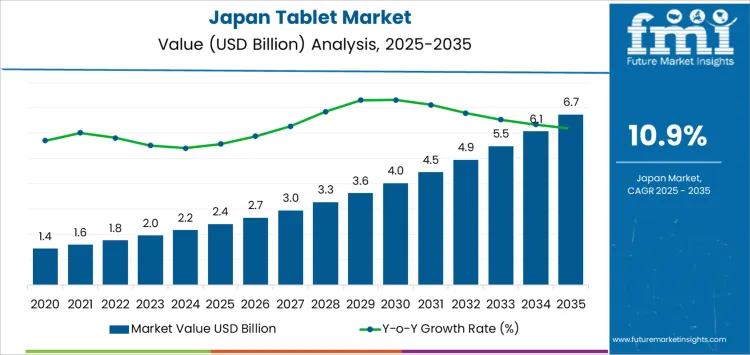
Demand for tablet in Japan is valued at USD 2.4 billion in 2025 and is expected to reach USD 6.7 billion by 2035, reflecting a CAGR of 10.9%. The historical rise from USD 1.4 billion in 2020 to USD 2.4 billion in 2025 shows steady acceleration in personal and household device adoption. Detachable tablets hold the larger product share due to dual use for media consumption and light productivity.
Consumer use accounts for most unit shipments as home education, video streaming, and casual computing remain central use cases. Android leads the operating system share due to its coverage of device price ranges and hardware variety. iOS maintains a strong base in higher value segments. Early-phase demand reflects second-device purchases rather than first-time digital access.
Quick Stats for Demand for Tablet in Japan
- Demand for Tablet in Japan Market Value (2025): USD 2.4 billion
- Demand for Tablet in Japan Forecast Value (2035): USD 6.7 billion
- Demand for Tablet in Japan Forecast CAGR (2025 to 2035): 10.9%
- Top Product Type by Share in Demand for Tablet in Japan: Detachable Tablets (62.0%)
- Top End Use by Share in Demand for Tablet in Japan: Consumer (76.0%)
- Key Growth Region in Demand for Tablet in Japan: Kyushu & Okinawa
- Top Players in Demand for Tablet in Japan: Apple (iPad), Samsung, Amazon (Fire Tablets), Lenovo, Microsoft (Surface)
What is the Growth Forecast for Tablet in Japan through 2035?
From 2026 onward, demand increases from USD 2.7 billion to USD 4.5 billion by 2031, then advances to USD 6.7 billion by 2035 through widening annual increments. Commercial adoption expands across retail, field services, and education support functions, where lightweight computing improves task mobility. Windows-based tablets retain a smaller but stable presence in enterprise environments that require application compatibility with desktop systems.
Consumer replacement cycles shorten as display quality, battery performance, and processing speed improve incrementally. After 2030, value growth reflects both rising unit volumes and higher average selling prices for premium detachable models. Annual value additions widen steadily, indicating rising spending per user rather than unit growth alone.
Between 2025 and 2030, demand for tablets in Japan increases from USD 2.4 billion to USD 4.0 billion, reflecting an absolute expansion of USD 1.6 billion across five years. Average annual value addition during this phase remains close to USD 0.32 billion. Growth is shaped by rising adoption in education, enterprise mobility programs, and home-based digital consumption. Device refresh cycles in commercial and government use support baseline volumes. Earlier demand was supported by media consumption and remote work adoption. Near-term expansion reflects wider institutional procurement, learning platform integration, and steady hardware replacement across distributed work and study environments.
From 2030 to 2035, demand rises from USD 4.0 billion to USD 6.7 billion, representing an additional USD 2.7 billion over the latter half of the forecast window. Average yearly value addition moves to about USD 0.54 billion, indicating a faster expansion profile than the earlier period. Higher penetration in healthcare delivery, logistics operations, and field service applications supports growth. Integration with cloud platforms and vertical-specific software strengthens utility. Earlier growth relied on consumer demand cycles, while later expansion reflects enterprise-scale deployments, multi-device workplace strategies, and sustained public-sector digitization programs across administrative and service-delivery functions.
Tablet Industry in Japan Key Takeaways
| Metric | Value |
|---|---|
| Industry Value (2025) | USD 2.4 billion |
| Forecast Value (2035) | USD 6.7 billion |
| Forecast CAGR (2025 to 2035) | 10.9% |
What Is Driving the Demand for Tablets in Japan Across Historical and Future Growth Cycles?
Demand for tablets in Japan expanded during the past decade as households adopted mobile computing for media use, education support, and casual productivity. Schools introduced digital learning tools, which increased student level tablet penetration. Households used tablets as secondary screens for video viewing and reading due to screen size advantages over smartphones. Corporate demand developed through sales teams, inventory control, and on site data access.
Healthcare providers used tablets for patient records and bedside documentation. Historical growth relied on hardware affordability, domestic electronics brand trust, and stable broadband access. Replacement demand formed a steady base as operating systems advanced and battery performance declined. Procurement followed seasonal consumer sales cycles and periodic institutional refresh programs across schools, hospitals, and corporate users nationwide.
Future demand for tablets in Japan is expected to rely on hybrid work patterns, digital classrooms, and platform based content delivery. Education authorities continue device based instruction across primary and secondary levels. Corporate users adopt tablets for field operations, logistics coordination, and customer engagement tools. Healthcare usage expands through teleconsultation support and digital imaging access. Historical growth relied on screen portability and media use.
Future growth centers on keyboard integration, cloud workflow access, and application based task specialization. Hardware demand aligns with software ecosystem development rather than entertainment alone. Long term demand depends on enterprise licensing, school funding stability, network capacity expansion, and lifecycle management across institutional fleets in urban and regional markets nationwide.
What Is the Demand for Tablet in Japan by Product Type and End Use?
The demand for tablet in Japan is shaped by education digitization, hybrid work culture, and high household device penetration. Detachable tablets lead by product type as users favor dual use devices that support both media consumption and light productivity. Consumer use leads by end use because tablets remain central to personal entertainment, digital learning, and casual work tasks. Procurement is driven by electronics retailers, online platforms, and institutional bulk buyers in education. Import reliance remains high due to dependence on overseas assembly and core semiconductor sourcing. Substitution pressure exists from large screen smartphones and ultra-thin laptops. Demand stability is supported by routine device replacement and school led digital learning programs.
Why do detachable tablets account for 62% of the demand for tablet in Japan by product type?
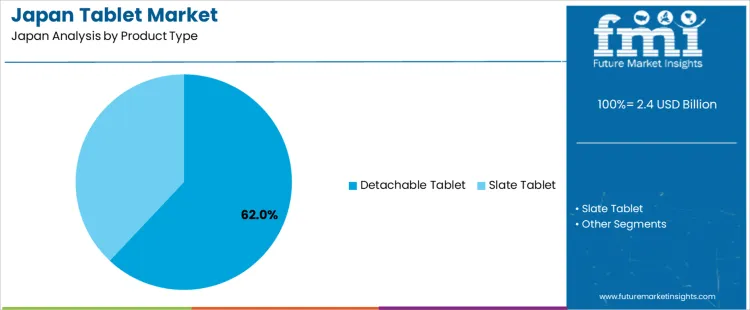
Detachable tablets account for 62% of the demand for tablet in Japan by product type, reflecting preference for flexible form factors that combine portability with basic keyboard functionality. Consumption intensity is driven by students, remote workers, and creative users who require both touch and typing input. Usage remains stable because these devices support note taking, streaming, document editing, and online classes within a single platform. Procurement is led by consumers and educational institutions sourcing through retail and bulk contracts. Price sensitivity remains moderate because detachable devices sit between standard tablets and entry laptops. Specification control emphasizes hinge durability, battery endurance, lightweight chassis, and reliable keyboard connectivity.
Detachable tablets also generate steady repeat demand through academic intake cycles and device upgrade programs within households. Repeat utilization remains predictable as users replace units every few years based on operating system updates and performance needs. Buyers favor models that support stylus input and cloud synchronization across personal devices. Margin structure remains controlled under strong competition among international device brands. Regulatory exposure centers on radio transmission certification and electrical safety compliance. Import reliance persists for processors, displays, and memory components. Substitution pressure from clamshell laptops remains present for full workload use.
Why does consumer use represent 76.0% of the demand for tablet in Japan by end use?
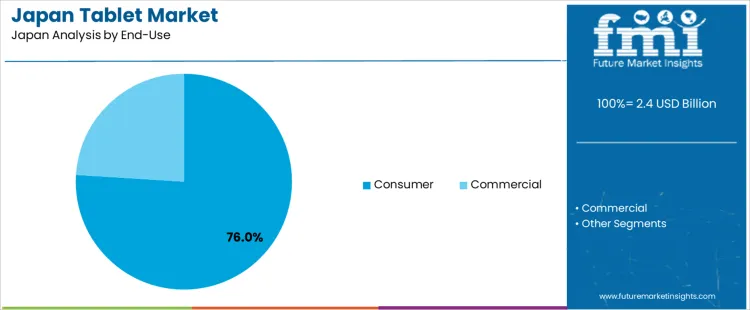
Consumer use represents 76.0% of the demand for tablet in Japan by end use, reflecting dominant adoption for entertainment, casual productivity, and digital learning at home. Consumption intensity is driven by video streaming, gaming, online classes, social communication, and document viewing. Usage remains stable because tablets serve shared household roles across age groups. Procurement is dominated by individual buyers through consumer electronics chains and online marketplaces. Price sensitivity remains moderate as buyers compare screen size, storage capacity, and ecosystem compatibility before purchase. Specification control emphasizes display resolution, battery life, audio quality, and operating system update support.
Consumer tablet demand also generates consistent repeat volume through family device upgrades and replacement of aging units. Repeat utilization remains predictable as children transition through school levels and digital study needs expand. Buyers favor devices with parental controls, content ecosystem access, and reliable after sales support. Margin structure remains controlled under aggressive retail pricing and promotional cycles. Regulatory exposure centers on consumer electronics safety standards and data privacy compliance. Import reliance persists across finished device supply. Substitution pressure from large screen smartphones remains present for casual viewing tasks but does not displace tablet use for education and shared media consumption.
What Is Driving the Demand for Tablet in Japan Across Work, Education, and Home Media Use?
Demand for tablets in Japan reflects mobile work habits, compact living spaces, and education digitization across age groups. Students depend on tablets for homework platforms, exam preparation, and classroom note taking. Office workers use portable screens for presentations, inventory checks, and remote meetings during travel. Households favor tablets for video streaming, gaming, and reading due to limited living room space. Elderly users adopt large screen models for healthcare apps and family communication. Retail channels emphasize thin design, long battery life, and stylus support. Demand links to portability needs, hybrid work routines, and lifelong learning activity across urban and regional populations.
How Are Education Policies and Classroom Digitization Structuring Tablet Demand in Japan?
Japan education policy supports one device per student programs across primary and secondary schools. Tablets replace printed textbooks and support cloud based assignments, attendance tracking, and teacher feedback. Municipal budgets allocate funds for durable devices with shock resistance and content filtering. Universities extend tablet use into laboratory work, field surveys, and digital testing environments. Students prefer handwriting input with stylus tools for math and language studies. Parents view tablets as structured learning screens compared with unrestricted smartphones. This institutional adoption builds predictable replacement cycles tied to enrollment volume, hardware life span, and curriculum software updates across national education systems nationwide.
How Are Retail, Logistics, Healthcare, and Field Operations Using Tablets in Japan?
Enterprises in Japan deploy tablets for field inspection, inventory scanning, customer registration, and maintenance reporting. Retail staff use tablets for mobile checkout and shelf verification. Logistics workers rely on rugged models for route proof, damage imaging, and parcel confirmation. Restaurants apply tablets for ordering, kitchen display, and queue management. Hospitals assign tablets for bedside charting and patient education. Demand reflects shift from paper forms to real time data capture. Buyers focus on durability, wireless reliability, and security controls. Replacement cycles follow operating system updates, battery degradation, and enterprise software compatibility across corporate fleets nationwide deployment programs within organized business environments.
What Factors Limit Wider Expansion of Tablet Usage in Japan?
Tablet demand in Japan faces limits tied to smartphone dominance, price sensitivity, and content ecosystem lock in. Many users rely on large screen phones for daily tasks which reduces secondary device purchases. Students from lower income households depend on school supplied units only. Aging users show hesitation toward frequent interface changes and software updates. Repair cost for cracked screens discourages long term retention. Domestic brands face strong competition from global suppliers under tight retail margins. These factors restrain rapid unit expansion and emphasize careful purchase timing linked to education, work upgrades, and device failure replacement rather than frequent upgrading behavior.
What is the Demand for Tablet in Japan by Region?
| Region | CAGR (%) |
|---|---|
| Kyushu & Okinawa | 13.6% |
| Kanto | 12.5% |
| Kansai | 11.0% |
| Chubu | 9.7% |
| Tohoku | 8.5% |
| Rest of Japan | 8.0% |
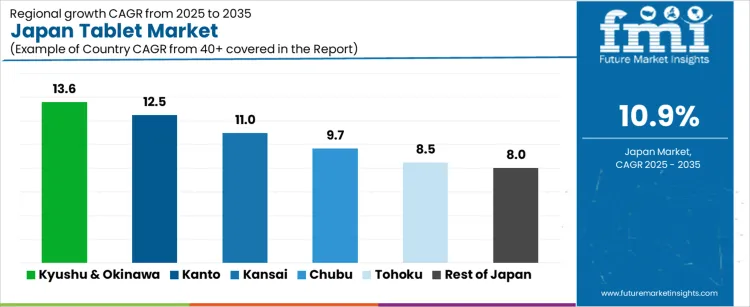
The demand for tablets in Japan is expanding rapidly across consumer and enterprise segments, led by Kyushu and Okinawa at a 13.6% CAGR. Growth in this region is supported by digital education programs, increasing use in hospitality and retail operations, and rising household adoption for entertainment and communication. Kanto follows at 12.5%, driven by dense urban populations, strong corporate device deployment, and high penetration of e-commerce and digital services.
Kansai records 11.0% growth, reflecting steady demand from students, small businesses, and field service operations. Chubu at 9.7% shows moderate uptake linked to manufacturing workflows and logistics. Tohoku and the Rest of Japan, at 8.5% and 8.0%, reflect slower growth shaped by aging demographics, budget sensitivity, and longer device replacement cycles.
How Is Education Digitization Accelerating Tablet Demand in Kyushu and Okinawa?
Demand for tablet in Kyushu and Okinawa is advancing at a CAGR of 13.6% through 2035, supported by digital classroom programs, tourism driven mobile workforce needs, and rising adoption in healthcare documentation. Schools deploy tablets for interactive learning and exam preparation. Resort management teams apply tablets for guest services and operations. Growth reflects steady government funding for digital education, rising remote working activity, and expanding use of mobile computing across small business operations in coastal and island economies.
- Digital classrooms drive large scale student tablet usage
- Tourism operations apply tablets for service coordination
- Remote work adoption increases professional device demand
- Local government programs support education device funding
Why Is Urban Work and Media Consumption Sustaining Tablet Growth in Kanto?
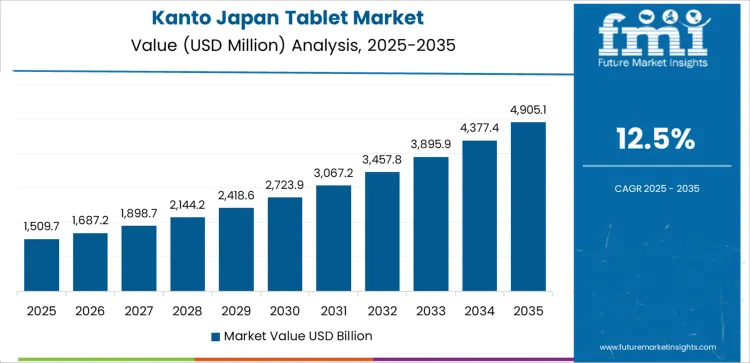
Demand for tablet in Kanto is rising at a CAGR of 12.5% through 2035, driven by dense professional workforce, strong digital media consumption, and wide application across enterprise mobility platforms. Corporate teams rely on tablets for presentations, field reporting, and workflow automation. Households show high usage for streaming, digital reading, and children's education. Growth reflects continuous device replacement cycles, premium model upgrades, and broad integration of tablets into work and home digital environments.
- Corporate mobility platforms drive professional tablet demand
- Streaming and digital reading support daily household usage
- Children education apps expand family level adoption
- Premium device upgrades sustain high replacement rates
What Is Supporting Balanced Tablet Adoption Across Kansai Households and Offices?
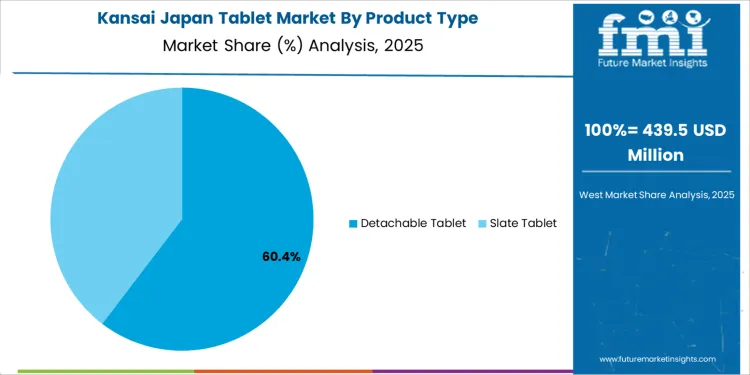
Demand for tablet in Kansai is progressing at a CAGR of 11.0% through 2035, supported by stable household purchasing power, growing small business mobility needs, and steady use in education support activities. Kansai shows balanced adoption between consumer entertainment and productivity driven usage. Retail sales reflect strong uptake of mid range tablets suited for family use and office support roles. Growth reflects moderate income stability, expansion of mobile point of service systems, and steady digital learning adoption.
- Small business operations apply tablets for billing and tracking
- Family entertainment supports regular device usage
- Mid range models dominate retail sales volume
- Digital learning tools drive household adoption
How Is Industrial Workforce Digitization Shaping Tablet Demand in Chubu?
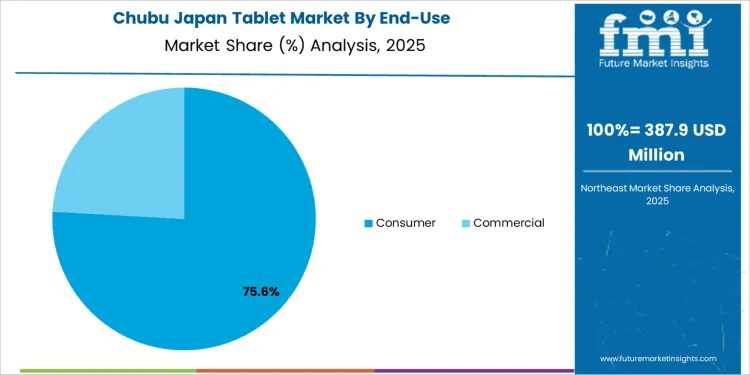
Demand for tablet in Chubu is advancing at a CAGR of 9.7% through 2035, supported by field service digitization, factory floor data access, and warehouse operations management. Industrial firms deploy tablets for inspection logs, maintenance reporting, and inventory tracking. Educational institutions also show steady use for blended learning. Growth reflects rising demand for ruggedized tablet formats, connected workforce management platforms, and gradual replacement of paper based operational documentation.
- Field service teams rely on tablets for inspection reporting
- Warehouse operations apply mobile inventory tracking
- Ruggedized device demand supports industrial usage
- Paperless workflows drive steady device replacement
Why Is Population Structure Influencing Tablet Growth in Tohoku?
Demand for tablet in Tohoku is advancing at a CAGR of 8.5% through 2035, supported by remote healthcare access, aging population communication needs, and steady education sector deployment. Tablets support teleconsultation platforms, patient monitoring access, and family communication among older residents. School usage remains stable through government supply programs. Growth reflects moderate replacement demand, rising digital healthcare service usage, and steady household technology upgrades across small urban centers.
- Telehealth platforms apply tablets for patient interaction
- Senior communication needs support steady household use
- School supply programs sustain education driven demand
- Moderate income growth shapes controlled upgrade cycles
How Is Small City Connectivity Expansion Guiding Tablet Demand in Rest of Japan?
Demand for tablet in Rest of Japan is advancing at a CAGR of 8.0% through 2035, supported by broadband rollout, distance learning adoption, and mobile entertainment usage across small towns. Tablets serve as primary computing devices for many households with limited desktop ownership. Retail purchases remain focused on affordable models. Growth remains steady and guided by network expansion, online education support, and continued uptake of digital public services that depend on mobile device access.
- Broadband rollout expands access to digital services
- Online education supports household tablet penetration
- Affordable models dominate rural purchase patterns
- E government services increase mobile device reliance
What Is Driving the Demand for Tablet in Japan and Which Brands Shape Consumer and Enterprise Adoption
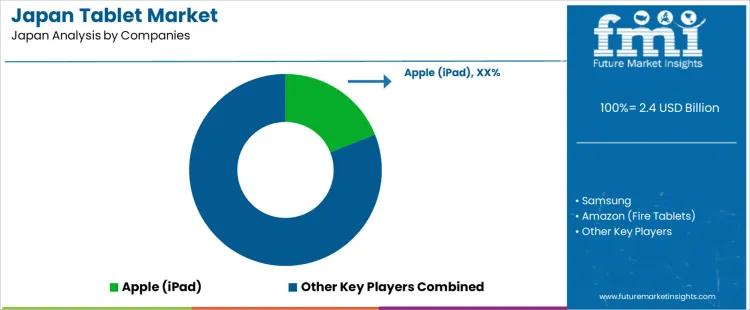
The demand for tablet in Japan is shaped by education digitization, remote work adoption, and steady use in retail, healthcare, and logistics operations. Apple iPad holds a central position through strong penetration in schools, creative industries, and enterprise mobility programs supported by local carriers and resellers. Microsoft Surface supports professional use through detachable form factors adopted in corporate offices and government agencies.
Samsung participates through Android based tablets positioned for media consumption, gaming, and business use across electronics retail. Lenovo supports demand through cost focused Windows and Android tablets supplied to schools and small businesses. Amazon Fire Tablets serve the value segment through e commerce driven household adoption focused on video streaming and reading.
Sharp and Panasonic anchor domestic usage in industrial and public sector deployments through rugged and semi rugged tablets used in manufacturing, field service, and emergency response. NEC and Fujitsu support secure enterprise and government use through domestically integrated hardware and software procurement frameworks.
Device selection in Japan is governed by screen clarity, pen input accuracy, battery life for long duty cycles, and compatibility with Japanese language software environments. Buyer preference favors suppliers with domestic service centers, stable OS update support, and tight integration with carrier networks. Demand visibility tracks school one device programs, corporate device refresh cycles, hospital bedside digitization, and continued growth in content consumption across younger urban users.
Key Players in the Tablet Industry in Japan
- Apple (iPad)
- Samsung
- Amazon (Fire Tablets)
- Lenovo
- Microsoft (Surface)
Scope of the Report
| Items | Values |
|---|---|
| Quantitative Units (2025) | USD billion |
| Type | Detachable Tablet, Slate Tablet |
| End Use | Consumer, Commercial (including education, healthcare, retail, logistics, field services, public sector) |
| Operating System | Android, iOS, Windows |
| Regions Covered | Kyushu & Okinawa, Kanto, Kansai, Chubu, Tohoku, Rest of Japan |
| Countries Covered | Japan |
| Key Companies Profiled | Apple (iPad), Samsung, Amazon (Fire Tablets), Lenovo, Microsoft (Surface), Sharp, Panasonic, NEC, Fujitsu |
| Additional Attributes | Dollar sales by product type, end use, and operating system; unit volumes by consumer and commercial deployment; penetration in education digitization, hybrid work, and field operations; replacement cycles driven by performance, battery, and OS support; import reliance for components and finished devices; distribution via electronics retail, carriers, and online channels; impact of large screen smartphones and ultra-thin laptops on substitution; regional CAGR variation by digital infrastructure and income levels. |
Tablet Industry in Japan Segmentation
Product Type:
- Detachable Tablet
- Slate Tablet
End-Use:
- Consumer
- Commercial
Operating System:
- Android
- iOS
- Windows
Region
- Kyushu & Okinawa
- Kanto
- Kansai
- Chubu
- Tohoku
- Rest of Japan
Frequently Asked Questions
How big is the demand for tablet in Japan in 2025?
The demand for tablet in Japan is estimated to be valued at USD 2.4 billion in 2025.
What will be the size of tablet in Japan in 2035?
The market size for the tablet in Japan is projected to reach USD 6.7 billion by 2035.
How much will be the demand for tablet in Japan growth between 2025 and 2035?
The demand for tablet in Japan is expected to grow at a 10.9% CAGR between 2025 and 2035.
What are the key product types in the tablet in Japan?
The key product types in tablet in Japan are detachable tablet and slate tablet.
Which end-use segment is expected to contribute significant share in the tablet in Japan in 2025?
In terms of end-use, consumer segment is expected to command 76.0% share in the tablet in Japan in 2025.
Preview the report firsthand - request a free sample
Get SampleGet the brochure for pricing and purchase details.
Get PDFTable of Content
- Executive Summary
- Japan Market Outlook
- Demand-side Trends
- Supply-side Trends
- Technology Roadmap Analysis
- Analysis and Recommendations
- Market Overview
- Market Coverage / Taxonomy
- Market Definition / Scope / Limitations
- Market Background
- Market Dynamics
- Drivers
- Restraints
- Opportunity
- Trends
- Scenario Forecast
- Demand in Optimistic Scenario
- Demand in Likely Scenario
- Demand in Conservative Scenario
- Opportunity Map Analysis
- Product Life Cycle Analysis
- Supply Chain Analysis
- Investment Feasibility Matrix
- Value Chain Analysis
- PESTLE and Porter’s Analysis
- Regulatory Landscape
- Regional Parent Market Outlook
- Production and Consumption Statistics
- Import and Export Statistics
- Market Dynamics
- Japan Market Analysis 2020 to 2024 and Forecast, 2025 to 2035
- Historical Market Size Value (USD Million) Analysis, 2020 to 2024
- Current and Future Market Size Value (USD Million) Projections, 2025 to 2035
- Y-o-Y Growth Trend Analysis
- Absolute $ Opportunity Analysis
- Japan Market Pricing Analysis 2020 to 2024 and Forecast 2025 to 2035
- Japan Market Analysis 2020 to 2024 and Forecast 2025 to 2035, By Product Type
- Introduction / Key Findings
- Historical Market Size Value (USD Million) Analysis By Product Type , 2020 to 2024
- Current and Future Market Size Value (USD Million) Analysis and Forecast By Product Type , 2025 to 2035
- Detachable Tablet
- Slate Tablet
- Y-o-Y Growth Trend Analysis By Product Type , 2020 to 2024
- Absolute $ Opportunity Analysis By Product Type , 2025 to 2035
- Japan Market Analysis 2020 to 2024 and Forecast 2025 to 2035, By End-Use
- Introduction / Key Findings
- Historical Market Size Value (USD Million) Analysis By End-Use, 2020 to 2024
- Current and Future Market Size Value (USD Million) Analysis and Forecast By End-Use, 2025 to 2035
- Consumer
- Commercial
- Y-o-Y Growth Trend Analysis By End-Use, 2020 to 2024
- Absolute $ Opportunity Analysis By End-Use, 2025 to 2035
- Japan Market Analysis 2020 to 2024 and Forecast 2025 to 2035, By Operating System
- Introduction / Key Findings
- Historical Market Size Value (USD Million) Analysis By Operating System, 2020 to 2024
- Current and Future Market Size Value (USD Million) Analysis and Forecast By Operating System, 2025 to 2035
- Android
- iOS
- Windows
- Y-o-Y Growth Trend Analysis By Operating System, 2020 to 2024
- Absolute $ Opportunity Analysis By Operating System, 2025 to 2035
- Market Structure Analysis
- Competition Dashboard
- Competition Benchmarking
- Market Share Analysis of Top Players
- By Regional
- By Product Type
- By End-Use
- By Operating System
- Competition Analysis
- Competition Deep Dive
- Apple (iPad)
- Overview
- Product Portfolio
- Profitability by Market Segments (Product/Age /Sales Channel/Region)
- Sales Footprint
- Strategy Overview
- Marketing Strategy
- Product Strategy
- Channel Strategy
- Samsung
- Amazon (Fire Tablets)
- Lenovo
- Microsoft (Surface)
- Apple (iPad)
- Competition Deep Dive
- Assumptions & Acronyms Used
- Research Methodology


