

The leadership development program market is projected to expand from USD 98.7 billion in 2026 to USD 263.1 billion by 2036, reflecting a sustained compound annual growth rate of 10.3%. Industry is driven by strategic decisions related to delivery capacity and market channel access, which increasingly determine which providers are positioned to capture incremental demand. Enterprise data confirms this shift; for instance, Udemy reported that its enterprise segment revenue grew 18% year-over-year to USD 494.5 million in 2024, signaling that organizations are prioritizing scalable, B2B skills platforms over sporadic consumer-grade learning. As per FMI’s projection, this trajectory implies that future growth will concentrate around vendors who can demonstrate clear linkages between training hours and promotion readiness.
Gary D. Burnison, CEO of Korn Ferry, highlighted this momentum in June 2024: “I am pleased with our fourth quarter results, as we generated $691 million in fee revenue. Earnings and profitability increased year-over-year and sequentially as we delivered $112 million of Adjusted EBITDA, at a 16.3% margin, which is our fourth consecutive quarter of profitability improvement.”
This performance underscores how established consulting firms are successfully pivoting their business models to integrate high-margin digital advisory services with traditional leadership structures. Operational efficiency in this sector is increasingly driven by the ability to blend human expertise with digital scalability, ensuring that profitability improves even as the scope of delivery expands to cover broader employee bases.
Simultaneously, the "middle manager" has become the critical bottleneck that organizations are rushing to unblock through technology. A 1,060% year-over-year increase in global GenAI course enrollments reported by Coursera in 2024 highlights how learners are actively preparing for AI’s impact on their careers. This surge drives a mechanism where individual learner intent forces organizations to upgrade their internal infrastructure, moving from static learning management systems to dynamic, AI-enabled experience platforms. Consequently, suppliers must now offer "human-in-the-loop" coaching at scale, as the market moves away from exclusive executive retreats toward democratized leadership access for mid-level supervisors.
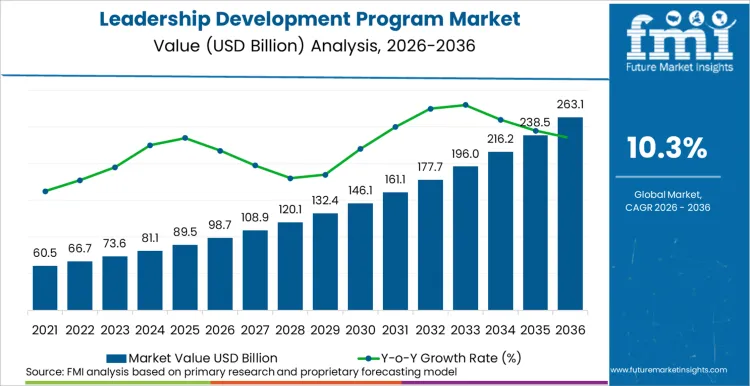
Future Market Insights projects the global sector to grow from USD 98.7 billion in 2026 to USD 263.1 billion by 2036, representing a robust 10.3% CAGR over the forecast period.
FMI Research Approach: Based on FMI’s proprietary global modeling framework incorporating major operator capex plans (Korn Ferry, FranklinCovey), corporate spending indices on L&D, and funding inflows into the United States leadership development program ecosystem.
The United States holds a dominant value share, supported by a massive corporate training expenditure and the presence of global education giants investing billions in domestic infrastructure.
FMI Research Approach: Built using country-level participation reports (US OPM), analysis of Europe leadership development program revenue streams, and mapping of educational outreach spending by institutions like Harvard Business School.
The industry is transitioning away from generic classroom-based instruction toward specialized "skill-building" hubs and high-tech immersive coaching destinations.
FMI Research Approach: Developed using analysis of patent filings (USPTO AI guidance), venture capital trends in ed-tech (Torch, BetterUp), and enrollment data from early learning centers and corporate academies.
The market encompasses revenue generated from commercial activities designed for executive education, mid-level management training, and digital coaching subscriptions.
FMI Research Approach: Definition structured using FMI’s segmentation taxonomy covering training methods, industry verticals, and service delivery models, explicitly excluding general K-12 education.
Globally, the sector is shaped by the "AI-Augmentation Pivot" in developed economies and the "Capacity Building" mandate in emerging markets, where leadership supply is the primary constraint.
FMI Research Approach: Insights derived from global sustainability reports (TCS), startup funding patterns in India, and consumer behavior analysis regarding digital certification adoption.
The global market is expected to reach USD 263.1 billion by 2036, with the In-person Workshops and Seminars segment currently commanding a 45.0% share.
FMI Research Approach: Long-term forecasts rely on demographic trends (workforce entry rates), disposable income projections for corporate budgets, and the scaling of digital booking platforms.
| Metric | Value |
|---|---|
| Industry Size (2026) | USD 98.7 billion |
| Industry Value (2036) | USD 263.1 billion |
| CAGR (2026-2036) | 10.3% |
Source: Future Market Insights (FMI) analysis, based on proprietary forecasting model and primary research.
Procurement teams now evaluate leadership vendors based on their ability to deliver "precision at scale" rather than just content depth. Tata Consultancy Services (TCS) demonstrated this shift in FY2025 by logging 56 million learning hours and acquiring 5.2 million competencies, proving that massive scale is achievable when digital infrastructure is aligned with strategic intent. As per FMI's estimates, this drives a mechanism where buyers prioritize platforms that offer granular skills mapping over broad catalogs, forcing legacy providers to partner with tech firms or risk obsolescence. The value proposition shifts from "access to knowledge" to "speed of capability acquisition," making technical integration a non-negotiable criteria for winning large enterprise contracts in the Singapore leadership development program sector and beyond.
Budgetary allocations are simultaneously tightening around measurable outcomes, pushing providers to justify every dollar with performance data. OPM’s budget request of $465.8 million in discretionary resources for FY 2025 reflects a commitment to serving the Federal workforce that is increasingly contingent on data-backed results. This constraint forces government and public sector buyers to move away from multi-year, opaque consulting retainers toward transparent, milestone-based learning agreements. For providers in the Australia leadership development program space, this means that renewal rates will hinge on the ability to demonstrate how training interventions directly reduced turnover or improved leadership bench strength.
The segmentation outlook reveals a complex interplay between Training Method, Industry, and Company Type, with value concentrating where high-touch interaction meets digital scale. Currently, In-person Workshops and Seminars hold 45.0% of the market, while Healthcare leads industries with 35.0%, yet by 2036, the "Digital Learning" and "Personalized Mentoring" segments are expected to capture the majority of incremental growth. Skillsoft’s revenue of USD 129 million in Q2 FY2026, down 3% year-over-year, indicates that legacy digital libraries are facing pressure from more interactive, outcome-oriented formats. This divergence suggests that future profit pools will not sit with content aggregators but with those who can blend the intimacy of the custom leadership development program with the efficiency of AI, fundamentally altering the economics of delivery.
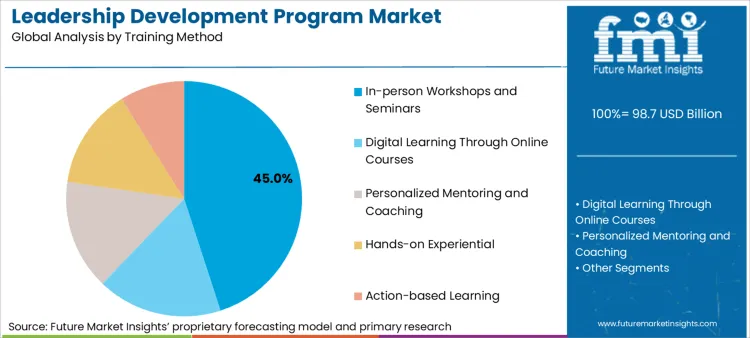
Despite the digital surge, In-person Workshops and Seminars command 45.0% of the market, serving as the premium tier for C-suite and high-potential talent development. FranklinCovey’s adjusted EBITDA drop to USD 28.8 million in FY2025 illustrates the high cost structure of maintaining a human-centric delivery model, yet buyers continue to pay a premium for the "network effect" and behavioral change that physical presence ensures. This dominance is driven by the critical need for soft-skill mastery, empathy, negotiation, and influence, which organizations find difficult to replicate purely through an online leadership development program. Consequently, providers are "premiumizing" their offline offerings, positioning them as exclusive retreats while offloading standard curriculum to digital channels.
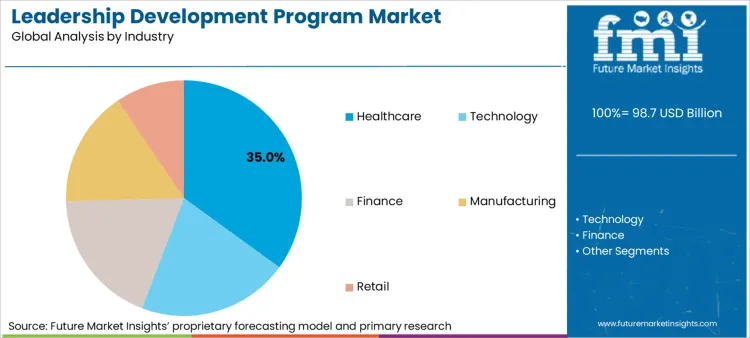
Healthcare captures a 35.0% share, driven by an urgent need to reduce burnout and improve administrative leadership among clinical staff. Learners are increasingly turning to industry micro-credentials, including Professional Certificates, for which Coursera saw a 69% year-on-year increase in enrollments in 2024. This trend highlights a mechanism where healthcare providers utilize stackable credentials to rapidly upskill nurse managers and department heads without removing them from the floor for extended periods. As FMI analysts opine, the implication for 2036 is a shift toward "flow-of-work" training tools that integrate directly with clinical workflows, ensuring that leadership development enhances rather than obstructs patient care delivery.
Increasing reliance on hybrid learning architectures is also reflected in leadership vendors’ strategic communications, as industry leaders openly acknowledge the role of AI‑enabled coaching in reshaping engagement models. Matti Niebelschütz, CEO of CoachHub, stated in December 2024:
“AI plays a crucial role in our growth strategy, allowing us to deliver powerful, personalized coaching experiences at scale to meet the evolving needs of our clients. This strategic capital marks a significant milestone as we further our mission to democratize coaching, making it accessible and impactful for people worldwide - especially at a time when support and resilience are critical to navigating change.”
This statement emphasizes how hybrid platforms are scaling "democratized coaching" to thousands of employees, effectively proving that the barrier to entry for personalized development is collapsing. By merging AI-driven diagnostics with human accountability, vendors can now offer C-suite level attention to first-time managers, creating a cohesive, integrated user experience that legacy corporate leadership training vendors struggle to match.
Simultaneously, public sector demand is creating a floor for hybrid engagement models that prioritize diversity and inclusion. For the 2024 campaign, there were 49,988 registrations and 44,362 applications for the UK Civil Service Fast Stream, signaling a massive appetite for structured, government-led career pathways. This "return to public service" is fueling demand for executive education program formats that blend academic rigor with practical civic problem-solving. Consequently, operators are expanding their capacity for large-scale cohort management, investing in digital assessment tools that can process high volumes of applicants while identifying diverse talent pools that traditional recruitment might overlook.
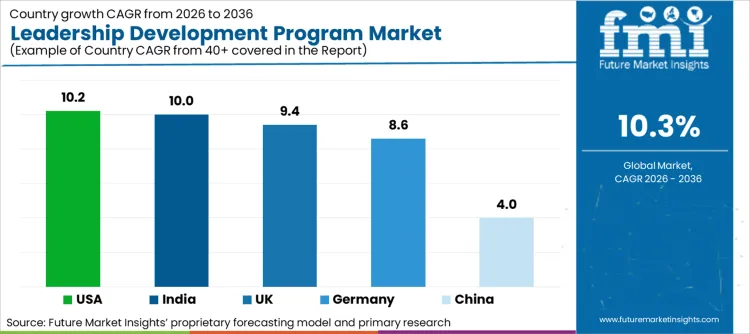
North America leads with infrastructure maturity, yet India is projected to lead growth with a 10.0% CAGR, driven by a booming "talent export" sector, while the USA follows with 10.2% as corporate renewal strengthens. The mature markets of the UK and Germany are growing at 9.4% and 8.6% respectively, focused on deep specialization rather than broad volume. An executive education program share analysis suggests that while Western markets spend more per head, Asian markets are scaling capacity faster to meet global workforce deficits.
| Country | CAGR (2026 to 2036) |
|---|---|
| United States | 10.2% |
| India | 10.0% |
| United Kingdom | 9.4% |
| Germany | 8.6% |
| China | 4.0% |
Source: Future Market Insights (FMI) analysis, based on proprietary forecasting model and primary research.
Sales of leadership development programs in the United States are set to rise at 10.2% CAGR. Growth is reinforced by sustained federal and corporate investment in large‑scale workforce upskilling initiatives, which continue to expand procurement demand across USA enterprise and public sector institutions.
Paul Walker, CEO of FranklinCovey, noted in January 2025: “This result compares with USD 11.0 million of Adjusted EBITDA in fiscal 2024 and includes the first quarter impact of $16 million of expected growth investments in fiscal 2025 to transform our sales structure and accelerate sales growth in North America.”
Such aggressive capital allocation highlights a mechanism where established players are overhauling their go-to-market engines to better serve complex enterprise buyers. OPM’s strategic goal to improve the Government-wide satisfaction index score by 4 points by 2025 further amplifies this demand, as federal agencies act as massive anchor clients for the united states executive education program. The market is bifurcating into massive, capital-intensive sales operations and agile, localized providers who can offer niche services.
Demand for leadership development in India is anticipated to grow at 10.0% CAGR. Momentum is reinforced by government‑backed skilling initiatives such as the IndiaAI FutureSkills program, which is expanding the pipeline of technically trained leaders through support for PhD scholars and large‑scale AI research participation. Under the initiative, the government is supporting 500 PhD scholars and thousands of students in AI research, creating a direct pipeline of high-end technical leaders. As per FMI's estimates, this structural support ensures sustained investment in educational play formats that align with global technology standards.
Leadership at the Infosys Foundation remarked in 2024: “From programs that help educated youth train for meaningful employment, to initiatives that integrate technology into healthcare projects to maximize impact, Infosys Foundation’s interventions last year helped so many people amplify their potential and discover their purpose.” Such focus on "purposeful skilling" underscores a unique regional dynamic where leadership training is inextricably linked to employability and social mobility.
The leadership development industry in the United Kingdom is projected to expand at 9.4% CAGR. Demand is driven by the government's sustained emphasis on building inclusive leadership pipelines, supported by initiatives such as the Civil Service Fast Stream, which continues to drive large‑scale demand for structured leadership training. Official figures show that 35.9% of Fast Stream applicants in 2024 were from an ethnic minority background, indicating a strong policy-led push for inclusive leadership pipelines. This metric drives a mechanism where government procurement rules favor suppliers who can demonstrate robust diversity and inclusion curriculums. For providers in the united states executive education program share analysis looking across the Atlantic, this signals that entry into the UK public sector requires more than just content; it requires a proven methodology for equitable talent identification.
Leadership development in Germany is poised to register a 8.6% CAGR. The sector serves as a stronghold for "digital-first" coaching formats, where innovation is applied to data security and pedagogical precision rather than just content volume, ensuring a stable and loyal customer base for established executive education program providers looking to export.
CoachHub secured $40 million in growth financing in late 2024 to fuel AI innovation, a move that typifies the German market's preference for engineering-led solutions to HR problems. This investment allows operators to refresh experiences without heavy human capital costs, maintaining high client recurrence rates by simply updating software algorithms.
The leadership development sector in China is projected to grow at a 4.0% CAGR. China's State Council reports the 2025-2027 Vocational Skills Training Initiative targets over 30 million workers for technical upskilling, prioritizing state industrial goals over liberal arts leadership programs amid strict data localization laws. Regulatory environment forces international players to partner with local institutions to navigate strict content censorship and data localization laws. According to FMI's estimates, while volume is high, the addressable market for western-style "liberal arts" leadership training is constrained, shifting value toward technical management and vocational efficiency programs that align with state industrial goals.
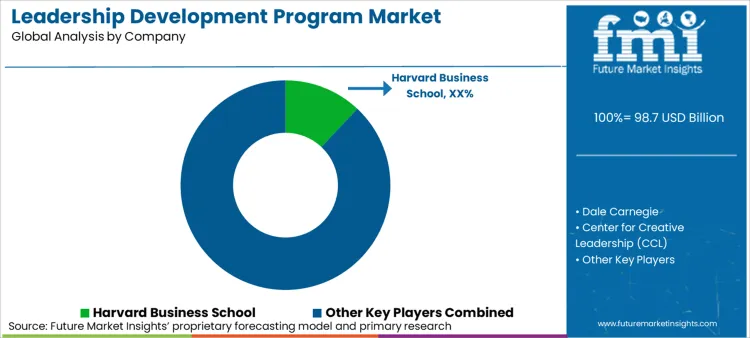
In the leadership development sector, competitive advantage is increasingly determined by a provider’s ability to manage the key constraints that limit scalable growth, such as evidence generation, regulatory compliance, distribution channel access, and operational capacity, rather than by the breadth of its brand alone. Harvard Business School commands a dominant share, proving that brand heritage still anchors the premium end of the market, yet the "middle" is being eroded by agile aggregators. As FMI analysts opine, this level of fragmentation creates a high barrier to entry for smaller nordics executive education program operators, forcing them to consolidate or specialize in niche markets to survive. The market is bifurcating into massive, capital-intensive destination resorts and agile, localized providers who can offer personalized services that the giants cannot replicate at scale.
Strategy in the leadership development market is set by a simple asymmetry: some players own distribution leverage, while others win through differentiated proof, capacity, or specialized workflows. Torch acquired AI learning company Praxis Labs in July 2025 to redefine coaching as a catalyst for organizational change, a move that signals the start of an M&A super-cycle focused on "AI-acquihires." This acquisition expands Torch's coaching platform capabilities into a comprehensive suite, enhancing operational efficiency for enterprise clients who want a single vendor for diversity and leadership. Meanwhile, adjacent sectors like learning management systems are seeing similar convergence, as pure-play software vendors seek to add content layers to increase stickiness.
Recent Developments:
The Leadership Development Program market is defined as the aggregate of commercial activities and service ecosystems specifically designed to provide skills training, executive coaching, and management education for professionals. It encompasses a broad spectrum of service delivery models, ranging from location-based e-learning solutions venues such as university campuses and training centers, to structured program-based offerings like online workshops, mentorship apps, and academic certifications. This definition focuses on the service component of the value chain, measuring the revenue generated from tuitions, corporate subscriptions, program fees, and ancillary consulting spending that facilitates the learning experience.
The market is characterized by its dual focus on immediate performance improvement for the individual and long-term succession planning benefits that appeal to the purchasing organization. The scope of this market explicitly includes revenue streams derived from both physical and digital-hybrid massive open online course mooc formats. This covers all forms of organized training (workshops, seminars, bootcamps), personalized coaching (executive, peer-to-peer), and specialized edutainment centers where learning is gamified.
It also includes the burgeoning sector of online booking platforms and aggregators that monetize the discovery and registration process for these activities. Furthermore, the market sizing incorporates spending on institutional partnerships, such as microlearning platforms run by private entities for corporate clients, and destination tourism revenue specifically attributed to executive retreats. Revenue from general K-12 education or degree-seeking university programs is excluded unless it is directly tied to a specific executive education certificate or non-degree leadership track.
| Items | Values |
|---|---|
| Quantitative Units (2026) | USD 98.7 billion |
| Training Method | In-person Workshops and Seminars (45.0%), Digital Learning, Mentoring, Hands-on |
| Industry | Healthcare (35.0%), Technology, Finance, Manufacturing, Retail |
| Company Type | Small, Medium, Large Enterprises |
| Regions covered | North America, Europe, Asia Pacific, Latin America, Middle East & Africa |
| Countries covered | USA, India, UK, Germany, China, and key global markets |
| Key companies profiled | Harvard Business School, Korn Ferry, FranklinCovey, Udemy |
| Additional attributes | Revenue analysis by segments, adoption trends across settings, regulatory and compliance landscape (as relevant), pricing and reimbursement considerations (when relevant), channel mix economics, supply chain exposure, and competitive positioning analysis |
Source: FMI analysis based on primary research and proprietary forecasting model.
What is the projected value of the Leadership Development Program market in 2036?
The market is projected to reach USD 263.1 billion by 2036, reflecting a significant expansion in digital and hybrid training modalities.
Which training method currently holds the largest market share?
In-person Workshops and Seminars currently account for 45.0% of the market, favored for high-stakes executive networking and behavioral coaching.
Which industry is the largest consumer of leadership development services?
The Healthcare industry leads with a 35.0% share, driven by the critical need for administrative and clinical leadership training to combat burnout.
Who are the key players in the global market?
Major players include Harvard Business School, Korn Ferry, FranklinCovey, and digital disruptors like Udemy and Coursera.
What is the primary growth driver for the market?
The integration of AI-driven personalized coaching and the urgent need to upskill middle managers are the dual engines driving the 10.3% CAGR.
Full Research Suite comprises of:

Market outlook & trends analysis
Interviews & case studies
Strategic recommendations
Vendor profiles & capabilities analysis
5-year forecasts
8 regions and 60+ country-level data splits
Market segment data splits
12 months of continuous data updates
DELIVERED AS:
PDF EXCEL ONLINE

Leadership Development Program Market

Thank you!
You will receive an email from our Business Development Manager. Please be sure to check your SPAM/JUNK folder too.

