

- Industry Size (2026)
- USD 980.0 Mn
- Forecast (2036)
- USD 1771.7 Mn
- CAGR (2026 to 2036)
- 6.10%
Lube Oil Consoles Market Forecast and Outlook 2026 to 2036
The lube oil consoles market is projected to expand from USD 980.0 million in 2026 to USD 1,771.7 million by 2036, advancing at a CAGR of 6.10%. Within the broader industrial equipment ecosystem, lube oil consoles occupy a foundational yet quietly influential position. They function as enabling systems that determine the reliability envelope of turbines, compressors, and other high-value rotating assets, rather than as discretionary add-ons. Their importance is reflected in how frequently they are specified early in project design and retained across multiple equipment generations.
Competitive weight in this space is shaped less by product novelty and more by engineering credibility, installed base depth, and alignment with OEM lubrication philosophies. Suppliers with proven field performance tend to become embedded partners, particularly in power generation and energy-intensive industries where downtime tolerance is low. The market’s structure favors disciplined players capable of delivering consistent execution across OEM supply, project delivery, and aftermarket support.
Quick Stats for Lube Oil Consoles Market
- Lube Oil Consoles Market Value (2026): USD 980.0 Million
- Lube Oil Consoles Market Forecast Value (2036): USD 1,771.7 Million
- Lube Oil Consoles Market Forecast CAGR 2026 to 2036: 6.10%
- Leading Equipment Served in Lube Oil Consoles Market: Gas Turbines (34% share)
- Key Growth Regions in Lube Oil Consoles Market: Asia Pacific, Middle East & Africa, Europe, North America, Latin America
- Top Key Players in Lube Oil Consoles Market: Siemens Energy, GE Vernova, Baker Hughes, MAN Energy Solutions, Elliott Group, Howden, Atlas Copco, Sulzer, Ingersoll Rand, SKF
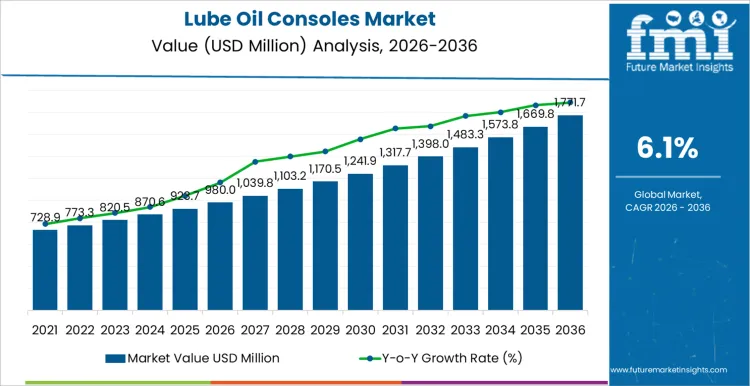
Lube Oil Consoles Market Key Takeaways
| Metric | Value |
|---|---|
| Lube Oil Consoles Market Value (2026) | USD 980.0 Million |
| Lube Oil Consoles Market Forecast Value (2036) | USD 1,771.7 Million |
| Lube Oil Consoles Market Forecast CAGR 2026 to 2036 | 6.10% |
How Are Reliability-Centered Maintenance and Turbomachinery Integration Driving the Lube Oil Consoles Market?
The lube oil consoles market is expanding as operators intensify focus on equipment reliability and lifecycle protection across critical rotating assets. Gas turbines, steam turbines, compressors, and large pumps rely on stable lubrication conditions to prevent bearing wear, thermal damage, and unplanned outages. As plants push for higher availability and longer maintenance intervals, demand is rising for integrated lube oil consoles that deliver precise pressure control, filtration efficiency, and temperature management under continuous operation.
Procurement decisions are increasingly shaped by system integration and standardization requirements. End users and EPCs prefer modular, skid-mounted lube oil consoles that can be configured to match specific turbomachinery packages while simplifying installation and commissioning. Features such as duplex filters, redundant pumps, condition monitoring sensors, and automated controls are becoming baseline expectations rather than optional upgrades. Suppliers that align console design with OEM lubrication specifications and provide FAT/SAT support are better positioned in competitive project bids.
Retrofit demand and brownfield upgrades are also supporting market growth. Aging power plants, refineries, and industrial facilities are replacing legacy lubrication systems to improve reliability, reduce oil degradation, and meet updated safety and monitoring standards. Operators increasingly evaluate lube oil consoles based on total cost of ownership, including maintenance access, spare parts commonality, and service responsiveness. For manufacturers and system integrators, competitive advantage depends on application engineering depth, customization capability, and global service support positioning lube oil consoles as a steady, reliability-driven investment in critical asset protection.
How Is the Lube Oil Consoles Market Categorized?
The lube oil consoles market is segmented by equipment served and end use, reflecting how lubrication reliability and operating criticality drive system specification. By equipment served, gas turbines represent the leading segment, as they require continuous, precisely controlled lubrication to ensure stable high-speed operation. Other equipment categories include steam turbines, centrifugal compressors, large pumps, and generators, each relying on dedicated lube oil consoles to manage temperature, pressure, and oil cleanliness. By end use, power generation forms the primary demand base, followed by oil and gas, petrochemicals, industrial manufacturing, and marine applications, where equipment uptime and asset protection remain operational priorities.
Why Do Gas Turbines Drive The Highest Demand In The Lube Oil Consoles Market?
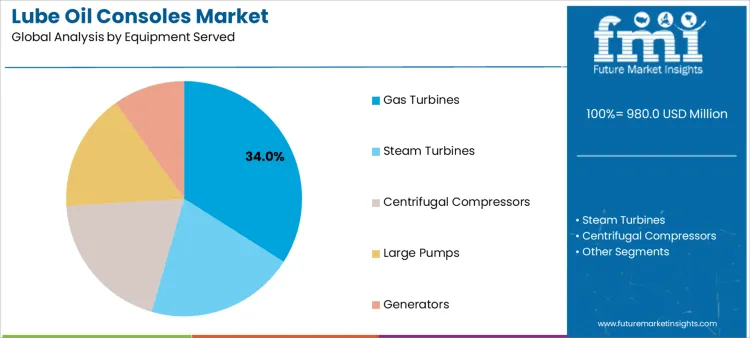
Gas turbines account for 34% share of the lube oil consoles market because they operate at high rotational speeds and temperatures, making lubrication system performance critical to equipment integrity. Lube oil consoles supply clean, temperature-controlled oil to bearings, gears, and auxiliary systems, preventing wear and thermal damage. Power plants and industrial facilities prioritize redundant pumping, filtration, and cooling features to avoid unplanned outages. Gas turbines often run continuously, increasing oil circulation requirements and console utilization. For console manufacturers, gas turbine applications involve customized designs and stringent specifications. These reliability, performance, and risk-mitigation factors explain why gas turbines remain the leading equipment segment.
Why Does Power Generation Dominate End-Use Demand for Lube Oil Consoles?
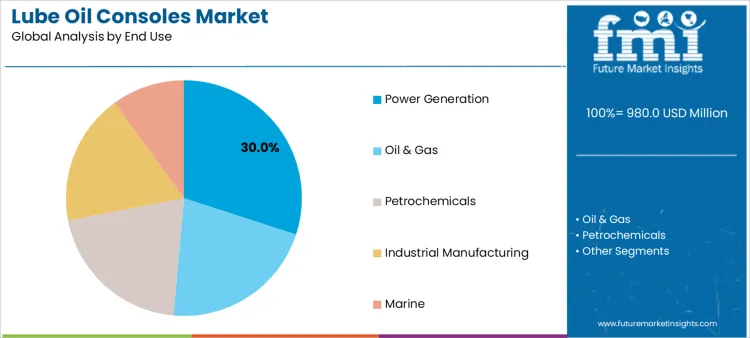
Power generation holds 30% share of the lube oil consoles market because turbines, generators, and auxiliary rotating equipment form the backbone of electricity production. Continuous operation and grid reliability requirements demand robust lubrication systems with real-time monitoring and fail-safe design. Thermal, combined-cycle, and captive power plants depend on lube oil consoles to maintain bearing health and operational stability. Scheduled maintenance cycles and life-extension programs drive replacement and upgrade demand. For suppliers, power generation projects offer large system sizes and long-term service potential. These operational intensity and uptime-driven requirements explain why power generation remains the dominant end-use segment.
What Are The Key Dynamics Of The Lube Oil Consoles Market?
The lube oil consoles market is driven by demand for reliable lubrication supply and control systems across machinery-intensive industries such as power generation, petrochemicals, oil and gas, marine, metals, and heavy manufacturing. Lube oil consoles provide centralized conditioning, filtration, cooling, monitoring, and distribution for critical bearings, gears, turbines, compressors, and engines. For system manufacturers and solution providers, system uptime reliability, precision monitoring of particle count/wear metals, ease of integration with plant automation, and total lifecycle cost are primary factors influencing procurement by plant engineers and maintenance teams. Increasing focus on reducing unplanned downtime and extending equipment life continues to support investment in advanced console solutions.
How Are Technology And Monitoring Trends Shaping This Market?
Technology and monitoring trends are shaping the lube oil consoles market through increased digital integration, condition-based monitoring, and predictive diagnostics. Modern consoles come equipped with real-time sensors for temperature, viscosity, particle count, and elemental analysis that feed data to maintenance dashboards and enterprise systems. Integration with distributed control systems (DCS), programmable logic controllers (PLC), and asset management platforms allows centralized visibility of lubrication health across multiple machines and facilities. Analytics platforms that track trends in contamination and wear signatures enable predictive maintenance, reducing unplanned failures and optimizing lubricant replacement intervals. For suppliers, offering modular consoles with plug-and-play data connectivity and easy upgrades enhances customer value.
Why Do Installation, Standardization, And Operational Challenges Restrain Market Growth?
Installation, standardization, and operational challenges restrain the lube oil consoles market due to the intricate nature of lubrication systems and varied machinery contexts. Customization of consoles for specific flow rates, pressure requirements, and environmental conditions (e.g., offshore, high-temperature zones) increases design and engineering lead times. Integration with legacy control and monitoring systems often requires bespoke interfacing, delaying deployment. Lack of standardized performance metrics and differing industry practices in lubrication strategies can create hesitation among end users considering upgrades. Operational challenges such as technician training, change management, and ensuring cleanliness during installation also affect adoption rates, particularly in smaller plants with limited maintenance personnel.
What is The Country-Level Growth Outlook for the Lube Oil Consoles Market?
The lube oil consoles market is expanding steadily as industries rely on dependable lubrication systems to support turbines, compressors, and other critical rotating equipment. These systems play a central role in controlling oil cleanliness, temperature, and flow to ensure uninterrupted operation in power generation, oil & gas, and industrial processing facilities. Growth differs by country based on infrastructure investment, project activity, and replacement cycles for aging equipment. Faster-growing markets are driven by new power plants and industrial projects, while mature regions show demand from maintenance and modernization. Market value is shaped by system reliability, filtration performance, and long-term service capability.
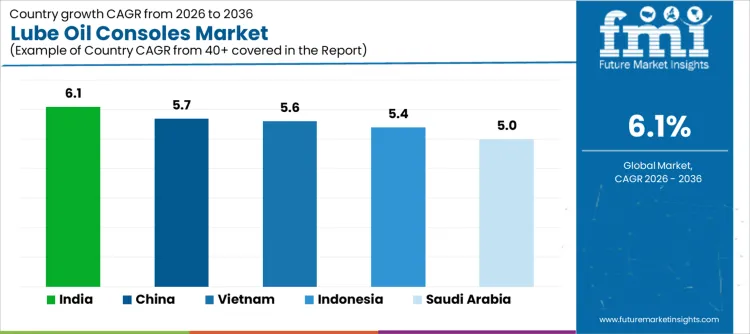
| Country | CAGR (%) |
|---|---|
| India | 6.1 |
| China | 5.7 |
| Vietnam | 5.6 |
| Indonesia | 5.4 |
| Saudi Arabia | 5.0 |
Why Is India Emerging As A Key Growth Market For Lube Oil Consoles?
India’s lube oil consoles market is growing at a CAGR of 6.1% during 2026-2036, driven by expanding power generation capacity, refinery upgrades, and growth in heavy industrial machinery installations. Lube oil consoles are widely deployed in steam turbines, gas turbines, compressors, and large rotating equipment where continuous lubrication and cooling are critical. Demand is supported by new thermal power plants, refinery modernization projects, and industrial capacity additions. Buyers prioritize system reliability, filtration efficiency, and compatibility with automated monitoring systems. Cost sensitivity influences procurement, but operational reliability remains a key decision factor due to the high risk of equipment downtime. Replacement demand is also increasing as aging lubrication systems are upgraded to meet higher performance standards. India represents a growth-oriented market where success depends on competitive pricing, local assembly capability, strong aftersales service, and the ability to customize systems for diverse industrial applications.
How Is China Sustaining Steady Demand For Lube Oil Consoles?
China’s lube oil consoles market is expanding at a CAGR of 5.7% during 2026-2036, supported by large-scale industrial operations across power generation, petrochemicals, and heavy manufacturing. These systems are integral to maintaining reliability of turbines, compressors, and rotating equipment operating under continuous load. Buyers emphasize high throughput, robust filtration, and long service life. Local manufacturing plays a major role in supply availability and cost control, while standardization across industrial facilities drives replacement demand. Procurement decisions favor suppliers with proven engineering capability, compliance with industrial standards, and strong service networks. Market value is driven by equipment modernization, maintenance cycles, and expansion of industrial assets. China represents a volume-driven market where competitiveness depends on manufacturing scale, system standardization, and ability to support large industrial installations consistently.
Why Is Vietnam Gaining Momentum In The Lube Oil Consoles Market?
Vietnam’s lube oil consoles market is growing at a CAGR of 5.6% during 2026-2036, driven by sustained industrial expansion and a steady pipeline of new power generation and manufacturing projects. Demand is primarily project-led, with lube oil consoles specified as integral components within turbine, compressor, and generator packages during plant design. Buyers focus on system reliability, compact design, ease of installation, and competitive pricing, particularly in fast-track projects. Imported systems dominate supply, often selected through EPC contractors overseeing plant construction and commissioning. Supplier selection is strongly influenced by adherence to project specifications, delivery timelines, and on-site technical support. Market value is supported by foreign direct investment, expansion of industrial zones, and increasing installed base of rotating equipment. Replacement demand remains limited but is expected to rise as installed assets age. Vietnam represents an emerging market where supplier success depends on strong EPC engagement, flexible customization, and effective commissioning and aftersales support.
What Is Driving Growth Of Lube Oil Consoles In Indonesia?
Indonesia’s lube oil consoles market is expanding at a CAGR of 5.4% during 2026-2036, supported by ongoing investments in power generation, oil & gas facilities, and industrial processing plants. Lube oil consoles are critical for ensuring reliable operation of turbines, compressors, and other rotating equipment exposed to humid and corrosive operating environments. Buyers prioritize durability, filtration efficiency, corrosion resistance, and ease of routine maintenance. Demand is split between new installations linked to infrastructure projects and replacement of aging lubrication systems in existing facilities. Procurement decisions often favor suppliers with local service presence, spare parts availability, and experience supporting industrial assets over long operating cycles. Market value is driven by infrastructure expansion, refinery maintenance programs, and consistent operational uptime requirements. Indonesia represents a balanced growth market where success depends on system robustness, responsive field service, and long-term lifecycle support.
How Is Saudi Arabia Maintaining Controlled Growth In The Lube Oil Consoles Market?
Saudi Arabia’s lube oil consoles market is growing at a CAGR of 5.0% during the forecast period, reflecting steady demand from oil & gas production, refining, petrochemicals, and power generation sectors. Lube oil consoles support critical rotating equipment operating continuously under high loads and harsh environmental conditions. Buyers place strong emphasis on engineering quality, system redundancy, and compliance with stringent industrial and project specifications. Procurement is largely project-driven, aligned with refinery upgrades, capacity expansions, and new energy infrastructure developments. Supplier qualification processes are rigorous, focusing on proven field performance, documentation quality, and long-term reliability. Replacement demand remains stable due to disciplined maintenance practices and asset life-extension programs. Saudi Arabia represents a mature, energy-focused market where growth is measured, and supplier success depends on technical excellence, project execution capability, and alignment with long-term operational strategies.
How Are Companies Competing in the Lube Oil Consoles Market?
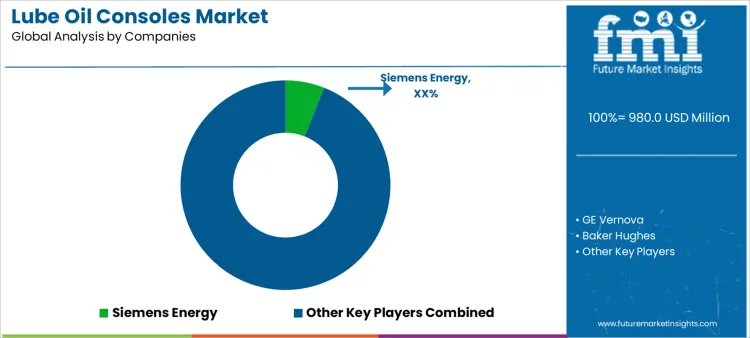
Competition in the lube oil consoles market is shaped by reliability under continuous operation, precision lubrication control, and documented integration with rotating equipment monitoring systems that matter to OEM engineers, maintenance teams, and plant reliability professionals. Siemens Energy positions its lube oil systems with official materials emphasizing modular design, high-efficiency filtration, and compatibility with gas and steam turbines. Brochures highlight system diagnostics and ease of serviceability tailored for heavy rotating machinery in power generation and industrial plants.
GE Vernova competes by aligning its lube oil consoles with comprehensive asset monitoring platforms, offering materials that focus on synchronized lubrication control, thermal stability, and integration with digital twin frameworks. Official documentation underscores robust construction suitable for high-duty cycles and remote condition monitoring. Baker Hughes differentiates through engineered consoles designed for high-pressure and high-temperature environments, with product literature detailing advanced control logic and fail-safe mechanisms that protect bearings and gearboxes across oil & gas rotating assets.
Global industrial solutions providers emphasize system robustness and aftermarket support. MAN Energy Solutions and Elliott Group position their lube oil consoles with materials that highlight engineered filtration stages, redundancy options, and documented reliability in gas compressor and marine propulsion applications. Howden and Atlas Copco bring competitive breadth with consoles supported by official literature focusing on vibration-tolerant designs, efficient heat rejection, and integration with condition-based maintenance programs.
Heavy-duty equipment specialists also contribute to the competitive landscape. Sulzer and Ingersoll Rand offer consoles with brochures that stress modular configurations and service network responsiveness. SKF competes by coupling lubrication consoles with its bearing and condition monitoring expertise, positioning solutions with documentation on predictive lubrication scheduling and extended asset life. Across all suppliers, differentiation is established through brochure-verified control precision, equipment compatibility, and lifecycle support rather than pricing alone.
Key Players in Lube Oil Consoles Market
- Siemens Energy
- GE Vernova
- Baker Hughes
- MAN Energy Solutions
- Elliott Group
- Howden
- Atlas Copco
- Sulzer
- Ingersoll Rand
- SKF
Scope of Report
| Attribute | Description |
|---|---|
| Quantitative Unit | USD Million |
| Equipment Served | Gas Turbines, Steam Turbines, Centrifugal Compressors, Large Pumps, Generators |
| End Use | Power Generation, Oil & Gas, Petrochemicals, Industrial Manufacturing, Marine |
| Countries Covered | China, Japan, South Korea, India, Australia & New Zealand, ASEAN, Rest of Asia Pacific, Germany, United Kingdom, France, Italy, Spain, Nordic, BENELUX, Rest of Europe, United States, Canada, Mexico, Brazil, Chile, Rest of Latin America, Kingdom of Saudi Arabia, Other GCC Countries, Turkey, South Africa, Other African Union, Rest of Middle East & Africa |
| Regions Covered | Asia Pacific, Europe, North America, Latin America, Middle East & Africa |
| Key Companies Profiled | Siemens Energy, GE Vernova, Baker Hughes, MAN Energy Solutions, Elliott Group, Howden, Atlas Copco, Sulzer, Ingersoll Rand, SKF |
| Additional Attributes | Dollar sales by equipment served and end use are evaluated across rotating machinery applications. The report covers installed base demand, OEM versus aftermarket supply, oil conditioning standards, filtration and cooling system configurations, redundancy requirements, reliability benchmarks, retrofit opportunities, and country-level forecasts for power generation, oil & gas, industrial, and marine sectors during 2026-2036. |
Lube Oil Consoles Market by Key Segments
Equipment Served:
- Gas Turbines
- Steam Turbines
- Centrifugal Compressors
- Large Pumps
- Generators
End Use:
- Power Generation
- Oil & Gas
- Petrochemicals
- Industrial Manufacturing
- Marine
Region:
- Asia Pacific
- China
- Japan
- South Korea
- India
- Australia & New Zealand
- ASEAN
- Rest of Asia Pacific
- Europe
- Germany
- United Kingdom
- France
- Italy
- Spain
- Nordic
- BENELUX
- Rest of Europe
- North America
- United States
- Canada
- Mexico
- Latin America
- Brazil
- Chile
- Rest of Latin America
- Middle East & Africa
- Kingdom of Saudi Arabia
- Other GCC Countries
- Turkey
- South Africa
- Other African Union
- Rest of Middle East & Africa
Bibiliography
- International Association of Oil & Gas Producers. (2024, April). S-744J: Supplementary specification to API Standard 614 (Lubrication, shaft-sealing, and control-oil systems and auxiliaries). IOGP.
- SKF. (2024). Automatic oil circulation lubrication systems: Product catalogue 2024. SKF.
- MAN Energy Solutions. (2024, August 23). Project guide: L23/30DF (Technical documentation). MAN Energy Solutions.
- Baker Hughes Company. (2025). System 1 software: Datasheet (108M5214, Rev. BA). Bently Nevada (Baker Hughes).
- GE Vernova. (2025, July). UK SMR documentation: Turbine Lube Oil System (TLOS) description (NEDO-34173, Rev. B). GE Vernova Nuclear.
Frequently Asked Questions
How big is the lube oil consoles market in 2026?
The global lube oil consoles market is estimated to be valued at USD 980.0 million in 2026.
What will be the size of lube oil consoles market in 2036?
The market size for the lube oil consoles market is projected to reach USD 1,771.7 million by 2036.
How much will be the lube oil consoles market growth between 2026 and 2036?
The lube oil consoles market is expected to grow at a 6.1% CAGR between 2026 and 2036.
What are the key product types in the lube oil consoles market?
The key product types in lube oil consoles market are gas turbines, steam turbines, centrifugal compressors, large pumps and generators.
Which end use segment to contribute significant share in the lube oil consoles market in 2026?
In terms of end use, power generation segment to command 30.0% share in the lube oil consoles market in 2026.
Preview the report firsthand - request a free sample
Get SampleGet the brochure for pricing and purchase details.
Get PDFTable of Content
- Executive Summary
- Global Market Outlook
- Demand-side Trends
- Supply-side Trends
- Technology Roadmap Analysis
- Analysis and Recommendations
- Market Overview
- Market Coverage / Taxonomy
- Market Definition / Scope / Limitations
- Market Background
- Market Dynamics
- Drivers
- Restraints
- Opportunity
- Trends
- Scenario Forecast
- Demand in Optimistic Scenario
- Demand in Likely Scenario
- Demand in Conservative Scenario
- Opportunity Map Analysis
- Product Life Cycle Analysis
- Supply Chain Analysis
- Investment Feasibility Matrix
- Value Chain Analysis
- PESTLE and Porter’s Analysis
- Regulatory Landscape
- Regional Parent Market Outlook
- Production and Consumption Statistics
- Import and Export Statistics
- Market Dynamics
- Global Market Analysis 2021 to 2025 and Forecast, 2026 to 2036
- Historical Market Size Value (USD Million) Analysis, 2021 to 2025
- Current and Future Market Size Value (USD Million) Projections, 2026 to 2036
- Y-o-Y Growth Trend Analysis
- Absolute $ Opportunity Analysis
- Global Market Pricing Analysis 2021 to 2025 and Forecast 2026 to 2036
- Global Market Analysis 2021 to 2025 and Forecast 2026 to 2036, By Equipment Served
- Introduction / Key Findings
- Historical Market Size Value (USD Million) Analysis By Equipment Served , 2021 to 2025
- Current and Future Market Size Value (USD Million) Analysis and Forecast By Equipment Served , 2026 to 2036
- Gas Turbines
- Steam Turbines
- Centrifugal Compressors
- Large Pumps
- Generators
- Gas Turbines
- Y-o-Y Growth Trend Analysis By Equipment Served , 2021 to 2025
- Absolute $ Opportunity Analysis By Equipment Served , 2026 to 2036
- Global Market Analysis 2021 to 2025 and Forecast 2026 to 2036, By End Use
- Introduction / Key Findings
- Historical Market Size Value (USD Million) Analysis By End Use, 2021 to 2025
- Current and Future Market Size Value (USD Million) Analysis and Forecast By End Use, 2026 to 2036
- Power Generation
- Oil & Gas
- Petrochemicals
- Industrial Manufacturing
- Marine
- Power Generation
- Y-o-Y Growth Trend Analysis By End Use, 2021 to 2025
- Absolute $ Opportunity Analysis By End Use, 2026 to 2036
- Global Market Analysis 2021 to 2025 and Forecast 2026 to 2036, By Region
- Introduction
- Historical Market Size Value (USD Million) Analysis By Region, 2021 to 2025
- Current Market Size Value (USD Million) Analysis and Forecast By Region, 2026 to 2036
- North America
- Latin America
- Western Europe
- Eastern Europe
- East Asia
- South Asia and Pacific
- Middle East & Africa
- Market Attractiveness Analysis By Region
- North America Market Analysis 2021 to 2025 and Forecast 2026 to 2036, By Country
- Historical Market Size Value (USD Million) Trend Analysis By Market Taxonomy, 2021 to 2025
- Market Size Value (USD Million) Forecast By Market Taxonomy, 2026 to 2036
- By Country
- USA
- Canada
- Mexico
- By Equipment Served
- By End Use
- By Country
- Market Attractiveness Analysis
- By Country
- By Equipment Served
- By End Use
- Key Takeaways
- Latin America Market Analysis 2021 to 2025 and Forecast 2026 to 2036, By Country
- Historical Market Size Value (USD Million) Trend Analysis By Market Taxonomy, 2021 to 2025
- Market Size Value (USD Million) Forecast By Market Taxonomy, 2026 to 2036
- By Country
- Brazil
- Chile
- Rest of Latin America
- By Equipment Served
- By End Use
- By Country
- Market Attractiveness Analysis
- By Country
- By Equipment Served
- By End Use
- Key Takeaways
- Western Europe Market Analysis 2021 to 2025 and Forecast 2026 to 2036, By Country
- Historical Market Size Value (USD Million) Trend Analysis By Market Taxonomy, 2021 to 2025
- Market Size Value (USD Million) Forecast By Market Taxonomy, 2026 to 2036
- By Country
- Germany
- UK
- Italy
- Spain
- France
- Nordic
- BENELUX
- Rest of Western Europe
- By Equipment Served
- By End Use
- By Country
- Market Attractiveness Analysis
- By Country
- By Equipment Served
- By End Use
- Key Takeaways
- Eastern Europe Market Analysis 2021 to 2025 and Forecast 2026 to 2036, By Country
- Historical Market Size Value (USD Million) Trend Analysis By Market Taxonomy, 2021 to 2025
- Market Size Value (USD Million) Forecast By Market Taxonomy, 2026 to 2036
- By Country
- Russia
- Poland
- Hungary
- Balkan & Baltic
- Rest of Eastern Europe
- By Equipment Served
- By End Use
- By Country
- Market Attractiveness Analysis
- By Country
- By Equipment Served
- By End Use
- Key Takeaways
- East Asia Market Analysis 2021 to 2025 and Forecast 2026 to 2036, By Country
- Historical Market Size Value (USD Million) Trend Analysis By Market Taxonomy, 2021 to 2025
- Market Size Value (USD Million) Forecast By Market Taxonomy, 2026 to 2036
- By Country
- China
- Japan
- South Korea
- By Equipment Served
- By End Use
- By Country
- Market Attractiveness Analysis
- By Country
- By Equipment Served
- By End Use
- Key Takeaways
- South Asia and Pacific Market Analysis 2021 to 2025 and Forecast 2026 to 2036, By Country
- Historical Market Size Value (USD Million) Trend Analysis By Market Taxonomy, 2021 to 2025
- Market Size Value (USD Million) Forecast By Market Taxonomy, 2026 to 2036
- By Country
- India
- ASEAN
- Australia & New Zealand
- Rest of South Asia and Pacific
- By Equipment Served
- By End Use
- By Country
- Market Attractiveness Analysis
- By Country
- By Equipment Served
- By End Use
- Key Takeaways
- Middle East & Africa Market Analysis 2021 to 2025 and Forecast 2026 to 2036, By Country
- Historical Market Size Value (USD Million) Trend Analysis By Market Taxonomy, 2021 to 2025
- Market Size Value (USD Million) Forecast By Market Taxonomy, 2026 to 2036
- By Country
- Kingdom of Saudi Arabia
- Other GCC Countries
- Turkiye
- South Africa
- Other African Union
- Rest of Middle East & Africa
- By Equipment Served
- By End Use
- By Country
- Market Attractiveness Analysis
- By Country
- By Equipment Served
- By End Use
- Key Takeaways
- Key Countries Market Analysis
- USA
- Pricing Analysis
- Market Share Analysis, 2025
- By Equipment Served
- By End Use
- Canada
- Pricing Analysis
- Market Share Analysis, 2025
- By Equipment Served
- By End Use
- Mexico
- Pricing Analysis
- Market Share Analysis, 2025
- By Equipment Served
- By End Use
- Brazil
- Pricing Analysis
- Market Share Analysis, 2025
- By Equipment Served
- By End Use
- Chile
- Pricing Analysis
- Market Share Analysis, 2025
- By Equipment Served
- By End Use
- Germany
- Pricing Analysis
- Market Share Analysis, 2025
- By Equipment Served
- By End Use
- UK
- Pricing Analysis
- Market Share Analysis, 2025
- By Equipment Served
- By End Use
- Italy
- Pricing Analysis
- Market Share Analysis, 2025
- By Equipment Served
- By End Use
- Spain
- Pricing Analysis
- Market Share Analysis, 2025
- By Equipment Served
- By End Use
- France
- Pricing Analysis
- Market Share Analysis, 2025
- By Equipment Served
- By End Use
- India
- Pricing Analysis
- Market Share Analysis, 2025
- By Equipment Served
- By End Use
- ASEAN
- Pricing Analysis
- Market Share Analysis, 2025
- By Equipment Served
- By End Use
- Australia & New Zealand
- Pricing Analysis
- Market Share Analysis, 2025
- By Equipment Served
- By End Use
- China
- Pricing Analysis
- Market Share Analysis, 2025
- By Equipment Served
- By End Use
- Japan
- Pricing Analysis
- Market Share Analysis, 2025
- By Equipment Served
- By End Use
- South Korea
- Pricing Analysis
- Market Share Analysis, 2025
- By Equipment Served
- By End Use
- Russia
- Pricing Analysis
- Market Share Analysis, 2025
- By Equipment Served
- By End Use
- Poland
- Pricing Analysis
- Market Share Analysis, 2025
- By Equipment Served
- By End Use
- Hungary
- Pricing Analysis
- Market Share Analysis, 2025
- By Equipment Served
- By End Use
- Kingdom of Saudi Arabia
- Pricing Analysis
- Market Share Analysis, 2025
- By Equipment Served
- By End Use
- Turkiye
- Pricing Analysis
- Market Share Analysis, 2025
- By Equipment Served
- By End Use
- South Africa
- Pricing Analysis
- Market Share Analysis, 2025
- By Equipment Served
- By End Use
- USA
- Market Structure Analysis
- Competition Dashboard
- Competition Benchmarking
- Market Share Analysis of Top Players
- By Regional
- By Equipment Served
- By End Use
- Competition Analysis
- Competition Deep Dive
- Siemens Energy
- Overview
- Product Portfolio
- Profitability by Market Segments (Product/Age /Sales Channel/Region)
- Sales Footprint
- Strategy Overview
- Marketing Strategy
- Product Strategy
- Channel Strategy
- GE Vernova
- Baker Hughes
- MAN Energy Solutions
- Elliott Group
- Howden
- Atlas Copco
- Sulzer
- Ingersoll Rand
- SKF
- Siemens Energy
- Competition Deep Dive
- Assumptions & Acronyms Used
- Research Methodology


