

- Industry Size (2026)
- USD 0.61 Bn
- Forecast (2036)
- USD 1.02 Bn
- CAGR (2026 to 2036)
- 5.28%
Mono-PE Medical Device Pouches Market Size, Market Forecast and Outlook By FMI
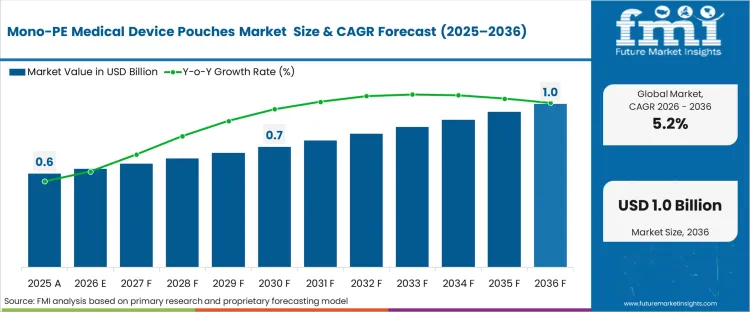
The mono-PE medical device pouches market was valued at USD 0.58 billion in 2025. The sector is expected to reach USD 0.61 billion in 2026 at a CAGR of 5.28% during the forecast period. Sustained investment propels the total opportunity to USD 1.02 billion through 2036 as "Design for Recycling" mandates in healthcare supply chains force a shift away from multi-material laminates toward mono-polymer streams to mitigate the impact of the EU Plastic Levy and escalating national taxes on non-recycled plastic waste.
Procurement directors in the medical device sector are currently navigating a fundamental transition from a protection at any cost mentality to protection within circularity. This decision shift is not merely an environmental preference but a response to hospital-side waste management costs where mixed-material sterile barrier systems are increasingly penalized. The stakes for delay are significant, as non-compliant packaging risks exclusion from large-scale GPO contracts that now weigh sustainability alongside aseptic integrity. The maturation of recyclable packaging solutions has proven that mono-material films can achieve the puncture resistance required for heavy orthopedic implants without relying on nylon or PET tie layers. FMI's analysis suggests that while material costs for advanced mono-PE resins remain stable, the real value is captured through reduced EPR liabilities at the point of end use.
The market enters a self-reinforcing growth phase only once hospital sterile processing departments (SPDs) achieve a critical threshold of waste segregation infrastructure. This gate condition is triggered by the integration of dedicated PE-only collection streams within surgical suites, which justifies the premium paid for mono-material pouches. Once this operational loop is closed, the logistical friction of recycling medical-grade plastics drops significantly, making the next unit of adoption easier than the last.
Summary of Mono-PE Medical Device Pouches Market
- Mono-PE Medical Device Pouches Market Definition
- A specialized segment of the healthcare packaging industry focusing on sterile pouches constructed from 100% polyethylene resins to enable circular economy goals without compromising aseptic performance.
- Demand Drivers in the Market
- Extended producer responsibility frameworks compel hospital supply chain managers to reduce mixed-material waste volume.
- Advancements in machine direction orientation (MDO) allow packaging engineers to achieve high-clarity films without using secondary polymers.
- Mandatory PFAS-free (Per- and Polyfluoroalkyl Substances) compliance requirements in the US and EU necessitate the re-qualification of all medical-grade PE films and processing aids.
- Key Segments Analyzed in the FMI Report
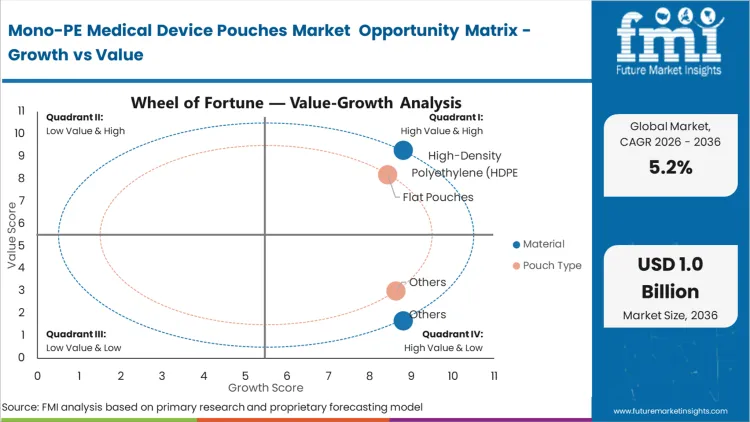
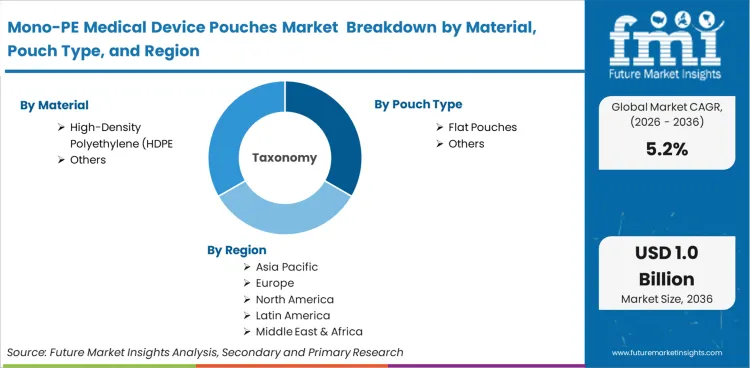
- High-Density Polyethylene (HDPE): HDPE is likely to hold 44.5% share in 2026, as it provides the necessary stiffness and puncture resistance for heavy surgical tools.
- Flat Pouches: Flat Pouches are expected to grab 52.0% share in 2026, driven by their widespread use in high-volume, standard surgical instrument sets.
- Surgical Instruments: This application segment dominates due to the high turnover rate of sterilized kits in acute care settings.
- India: 6.8% compound growth, reflecting the rapid leapfrogging of domestic plants to export-ready sustainable packaging standards.
- Analyst Opinion at FMI
- Ismail Sutaria, Principal Analyst, Packaging, at FMI, opines, "The generalist assumption that mono-material conversion is a simple resin swap ignores the thermal reality of sterile processing. My observation from field audits is that the real bottleneck isn't material performance, but the seal-window sensitivity. Traditional laminates are forgiving; Mono-PE is not. Manufacturers who succeed are those who re-engineer their sealing equipment alongside the film, recognizing that a 5-degree temperature fluctuation can be the difference between a validated sterile barrier and a catastrophic seal failure."
- Strategic Implications / Executive Takeaways
- Packaging engineers must re-validate heat-sealing parameters to account for the narrower processing window of mono-PE films compared to legacy laminates.
- Hospital procurement teams must leverage Environmental Excellence scorecards from GPOs such as Vizient and Premier to quantify waste-diversion credits and EPR savings provided by mono-PE formats.
- Tier-1 converters face a structural requirement to invest in MDO-PE film lines to remain competitive as medical device OEMs phase out non-recyclable formats.
- Methodology
- Primary research focused on the intersection of medical device manufacturing and surgical suite waste protocols.
- Desk research targeted the technical evolution of medical-grade resins and compliance with updated sterile barrier standards.
- Market sizing leveraged unit consumption data from major healthcare hubs and resin volume tracking.
- Validation utilized the disclosed sustainability targets of the top 20 global medical device manufacturers.
Demand for medical pouches in India is set to grow at a CAGR of 6.8%, driven by domestic manufacturing expansion and export compliance needs. The China market is projected to rise at 6.5% compound annual rate as regional players modernize production lines for high-barrier films. Germany's sector is expected to demonstrate a CAGR of 5.1%, reflecting strict adherence to European packaging waste directives. Sales of mono-PE products in the USA are on track to record a CAGR of 4.8%, while France is likely to post a CAGR of 4.7% through 2036. The UK industry is anticipated to increase by a CAGR of 4.5%, followed by Japan at 4.2% annually. The structural divergence across these rates is governed by the varied pace at which regional healthcare systems are mandating the removal of multi-layer structures from sterile barrier qualifications.
Mono-PE Medical Device Pouches Market Key Takeaways
| Metric | Details |
|---|---|
| Industry Size (2026) | USD 0.61 billion |
| Industry Value (2036) | USD 1.02 billion |
| CAGR (2026–2036) | 5.28% |
Source: Future Market Insights (FMI) analysis, based on proprietary forecasting model and primary research
Mono-PE Medical Device Pouches Market Definition
The Mono-PE Medical Device Pouches Market comprises sterile barrier systems constructed entirely from polyethylene-based polymers, including various densities and oriented films. This market is defined by the functional requirement to maintain terminal sterility of medical devices while ensuring the entire pouch structure belongs to a single recycling stream. Unlike traditional multi-material laminates, these pouches eliminate the need for mechanical separation during recycling, focusing on performance parity in seal strength and microbial barrier properties.
Mono-PE Medical Device Pouches Market Inclusions
This market includes flat, gusseted, and header pouches specifically engineered for medical device sterilization using Ethylene Oxide (EO), Gamma, or E-beam methods. It covers high-performance mono-material packaging films such as MDO-PE and specialized HDPE structures that provide the necessary thermal and mechanical resistance. Inclusion extends to pouches used for surgical instruments, orthopedic implants, and dental tools, provided the primary construction is a mono-polymer polyethylene system.
Mono-PE Medical Device Pouches Market Exclusions
Exclusions from this market include sterile pouches constructed from mixed-material laminates such as PET/PE, Paper/Film, or Tyvek/Nylon structures where the base polymer is not exclusively polyethylene. Furthermore, standard industrial or food-grade polyethylene pouches that lack the necessary bio-burden controls and medical-grade cleanroom certifications are excluded. Functional components like non-PE heat-seal coatings or paper-based lids that prevent mono-stream recycling are also outside the scope of this analysis.
Mono-PE Medical Device Pouches Market Research Methodology
- Primary Research: FMI conducted interviews with sterile barrier validation engineers, hospital procurement directors, and regulatory affairs managers at tier-1 medical device manufacturers.
- Desk Research: Analysis was performed on ISO 11607-1:2019 compliance registries, hospital waste management audit reports, and technical data sheets from healthcare-grade resin suppliers.
- Market-Sizing and Forecasting: The baseline is anchored to the annual consumption of sterile barrier units in surgical settings, adjusted for the penetration rate of mono-material conversion projects.
- Data Validation and Update Cycle: Forecasts were cross-validated against resin-specific trade data and the announced sustainability roadmaps of major global medical device conglomerates.
Segmental Analysis
Mono-PE Medical Device Pouches Market Analysis by Material
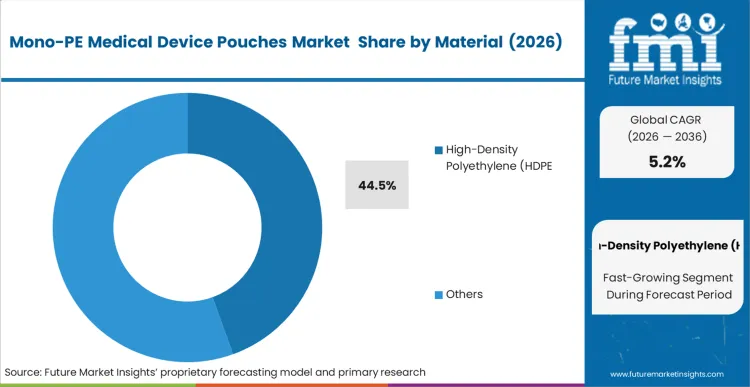
The displacement of multi-material structures is accelerating as incumbents fail to meet the "Design for Recycling" requirements now integrated into hospital procurement scorecards. Material selection is no longer purely a function of barrier properties but an economic hedge against rising waste disposal fees in European and North American markets. According to FMI's estimates, HDPE remains the structural foundation for this transition, as it mimics the mechanical integrity of complex laminates through the use of Biaxially Oriented Polyethylene (BOPE) or MDO-PE, eliminating the recycling penalty of traditional PET/PE structures. Packaging engineers are increasingly specifying oriented PE structures to ensure that large surgical kits do not compromise the pouch during high-vibration transport cycles. The decision to move to medical grade pe resins is often triggered when an OEM initiates a global product refresh, allowing for a single global validation of the sterile barrier. Organizations that cling to legacy laminates face a fragmented regulatory landscape where their packaging is treated as a liability rather than a carrier.
- Resin yield: Higher stiffness in modern mono-PE resins allows for downgauging without sacrificing the puncture resistance required for pointed dental tools. Procurement managers capture this material efficiency and offset the premium of specialized resins through reduced shipping weight.
- Conversion costs: The shift to mono-material films requires higher capital investment in cooling and tension control during the extrusion process to prevent film curling. Manufacturers who fail to optimize these lines face higher scrap rates during the initial qualification phase.
- Thermal stability: Advanced polyethylene blends now maintain seal integrity through both gamma and E-beam cycles, ensuring that the microbial barrier remains uncompromised across varied sterilization modalities. Hospital staff benefit from consistent peel-open characteristics regardless of the sterilization method used.
Mono-PE Medical Device Pouches Market Analysis by Pouch Type
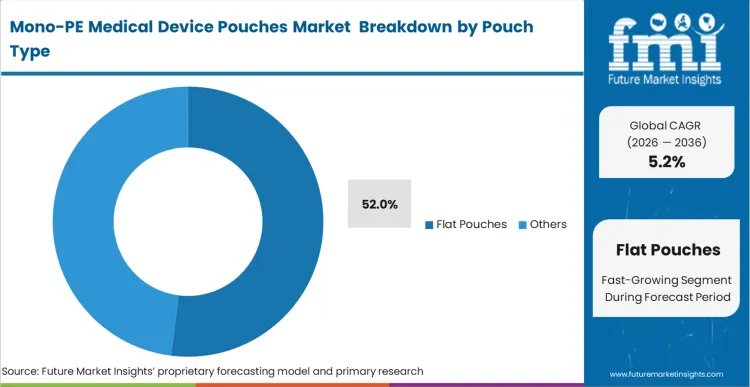
The dominance of flat pouches comes down to a structural logic of high-volume manufacturing: they are the most efficient format for high-speed automated filling lines used for standard surgical disposables. This share figure of 52.0% is not just a legacy preference but a result of the format’s compatibility with established validation protocols in sterile barrier systems. According to FMI's projection, the conversion to pouches market solutions that are 100% recyclable is most advanced in this segment because the flat geometry minimizes the stress on mono-material seals. As manufacturers transition, they are focusing on the heat-seal window, which is narrower for polyethylene than for PET-based laminates. A minor deviation in temperature can lead to seal thinning, a failure mode that is particularly critical for medical devices. The operational consequence of a seal breach is an immediate loss of sterility, necessitating the re-processing or disposal of expensive medical assets.
- Seal creep: Pouch designs must account for the lower softening point of PE during steam sterilization to prevent catastrophic failure of the sterile barrier. Quality directors in diagnostic labs utilize rigorous burst testing to validate that mono-PE formats can survive pressurized cycles.
- Edge tear: Mono-material structures are more prone to notch-sensitivity, requiring specific corner-rounding in pouch design to prevent accidental tearing during manual handling. Surgical techs in high-throughput ORs rely on these design features to ensure safe and rapid aseptic presentation.
- Microbial ingress: The structural integrity of the seal area is the primary defense against airborne contaminants during long-term storage in hospital inventory. Facilities that choose poorly during the material transition face increased rates of sterile barrier compromise and associated wastage.
Mono-PE Medical Device Pouches Market Analysis by Application
The decision to adopt mono-PE for surgical instruments is driven by the sheer volume of waste generated by high-frequency surgical procedures in acute care settings. This application segment is the primary target for sustainability initiatives because it offers the highest potential for measurable recycling impact. FMI analysts opine that surgical device manufacturers are being forced to decide between maintaining legacy packaging or restructuring their entire validation file to meet the procurement standards of "green hospitals." The transition is often led by the surgical device packaging sector, where the move toward mono-material streams provides a clear competitive advantage in tender processes. Delaying this transition complicates the regulatory pathway in regions like the EU, regions like the EU, where the Packaging and Packaging Waste Regulation (PPWR) increasingly mandates specific recyclability targets for healthcare primary packaging.
- Puncture resistance: Heavily weighted surgical tools require specific film orientation to prevent the device from piercing the pouch during distribution. Packaging designers utilize MDO-PE to achieve the necessary tensile strength that multi-material laminates traditionally provided.
- Aseptic transfer: The peel-strength consistency of mono-PE ensures that the instrument can be presented to the sterile field without shedding fibers or tearing the film. Clinical staff in ambulatory centers depend on this predictable behavior to maintain surgical flow and patient safety.
- Clarity and inspection: High-density mono-material films must maintain enough transparency to allow for the visual verification of the device and its integrity before use. Gaps in clarity under low-light conditions can lead to procedural delays and increased risk of error.
Mono-PE Medical Device Pouches Market Analysis by End Use
The consequence of hospital systems failing to adopt mono-material waste streams is a direct increase in variable operating costs associated with clinical waste disposal. Hospitals are no longer passive recipients of packaging; they are active influencers of the supply chain, demanding healthcare packaging that aligns with their internal carbon-neutral goals. FMI's view is that the adoption sequence starts with large academic medical centers that have the infrastructure for dedicated plastic recycling. These facilities are forcing a change in the procurement cycle, where the "recyclability" of a pouch is weighed as heavily as its unit price. Diagnostic labs and smaller surgical centers are expected to follow as the secondary ecosystem for medical-grade plastic recycling matures, making it easier to manage mono-polymer waste.
- Infrastructure readiness: Facilities with established waste segregation protocols are the first to capture the economic benefits of mono-PE packaging. Waste managers in these hospitals utilize dedicated balers to prepare medical-grade PE for high-value recycling markets.
- Procurement leverage: Large hospital groups are utilizing their scale to demand that medical device OEMs move away from mixed laminates. Sourcing directors face internal pressure to demonstrate progress toward sustainability targets during annual performance reviews.
- Regulatory alignment: Hospitals operating in jurisdictions with strict packaging waste directives are the primary drivers of mono-PE adoption. Compliance officers utilize these sustainable formats to meet regional mandates and avoid significant financial penalties for excessive incineration.
Mono-PE Medical Device Pouches Market Drivers, Restraints, and Opportunities
The primary driver for this market is the structural shift in how healthcare systems quantify the "total cost" of a medical device, including its end-of-life disposal. Regulatory frameworks such as the EU Packaging and Packaging Waste Regulation (PPWR) are forcing medical device manufacturers to move away from multi-material laminates that are traditionally incinerated as medical waste. This forcing condition compels procurement directors at global device firms to initiate large-scale sterilization pouches market conversion projects. The commercial stakes are high: failing to provide a recyclable packaging format can lead to the loss of preferred supplier status in highly regulated European and North American hospital networks.
The primary restraint in the market is the structural "qualification inertia" that defines medical device manufacturing. Unlike food packaging, a material change in a sterile pouch requires a full re-validation of the sterile barrier system according to ISO 11607 standards, which can take 12 to 18 months. This friction is not just about the cost of the film, but the organizational resources required for stability testing, shipping trials, and regulatory filings. Furthermore, the existing installed base of heat-sealing equipment in many plants is optimized for PET/PE laminates, which have a much wider sealing window than mono-material polyethylene. This technical gap creates a barrier for smaller manufacturers who lack the capital to upgrade to precision-controlled sealing lines.
Opportunities in the Mono-PE Medical Device Pouches Market
- Down-gauging efficiency: The development of high-tenacity polyethylene resins allows for thinner pouch walls that still meet rigorous puncture standards. Device manufacturers who adopt these materials can reduce their total resin consumption and shipping costs simultaneously.
- MDO-PE integration: Machine Direction Orientation (MDO) technology enables the production of high-barrier PE films with the clarity of polyester. Converters who invest in this barrier films market capability can win contracts with premium device brands that require visual inspection of the device.
- Closed-loop partnerships: Opportunities exist for packaging vendors to partner with large hospital groups to reclaim used mono-PE pouches for high-grade recycling. Strategic sourcing managers can capture this value by demonstrating a truly circular product lifecycle to skeptical stakeholders.
Regional Analysis
Based on the regional analysis, the Mono-PE Medical Device Pouches market is segmented into North America, Europe, Asia Pacific, Latin America, Middle East, and Africa across 40 plus countries.
.webp "Top Country Growth Comparison Mono Pe Medical Device Pouches Market Cagr (2026 2036)")
| Country | CAGR (2026 to 2036) |
|---|---|
| India | 6.8% |
| China | 6.5% |
| Germany | 5.1% |
| USA | 4.8% |
| France | 4.7% |
| UK | 4.5% |
| Japan | 4.2% |
Source: Future Market Insights (FMI) analysis, based on proprietary forecasting model and primary research
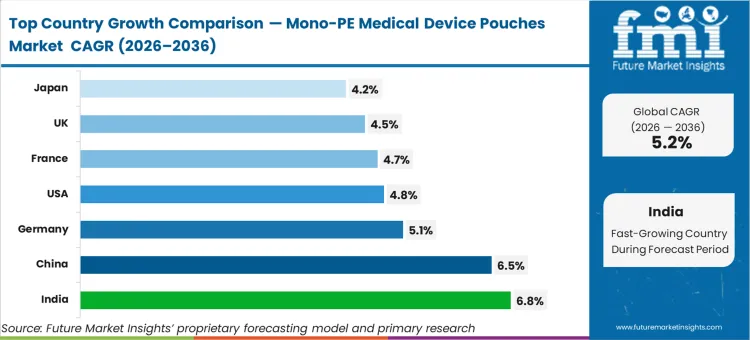
Asia Pacific Mono-PE Medical Device Pouches Market Analysis
Infrastructure-led growth defines the Asia Pacific region, particularly in hubs where new medical device plants are being built with integrated sustainable packaging capabilities from the start. Unlike older facilities in Western markets that must undergo expensive retrofitting, Asian manufacturers are leapfrogging legacy laminates to meet the stringent "Design for Recycling" requirements of their export customers in Europe. According to FMI's assessment, the rapid decentralization of medical device manufacturing is creating a surge in demand for high-barrier mono-PE films that can survive long-haul sea freight. Procurement directors in China and India are increasingly prioritizing hdpe packaging solutions that offer both mechanical protection and compliance with global circularity standards.
- India: India's rapid expansion of medical device manufacturing zones, supported by government production-linked incentives, is forcing a modernization of packaging lines toward mono-material streams. Demand for medical pouches in India is set to grow at 6.8% CAGR as domestic plants secure export contracts that mandate sustainable sterile barriers.
- China: China's sector is poised to expand at 6.5% annually, reflecting the transition of regional OEMs toward high-clarity oriented PE films for premium cardiovascular and orthopedic kits. Companies that move first capture preferred supplier status in procurement frameworks that are unlikely to reopen once initial vendors are qualified.
- Japan: Japan's industry is projected to witness growth at a CAGR of 4.2%, constrained by a highly mature healthcare market and a slow transition of established clinical protocols. Manufacturers who successfully integrate mono-PE solutions gain a significant edge in the specialized dental and orthopedic sectors.
Europe Mono-PE Medical Device Pouches Market Analysis
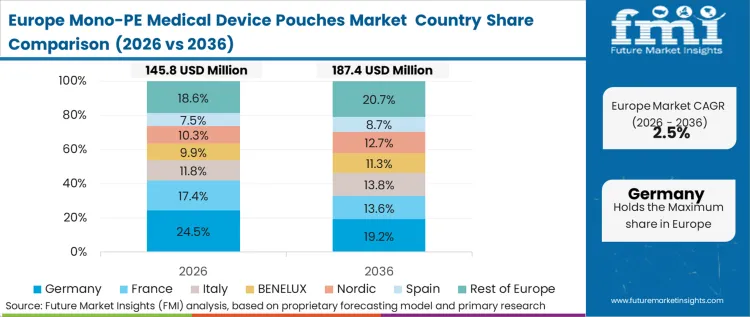
Policy-led dynamics dominate the European landscape, where the updated Packaging and Packaging Waste Regulation (PPWR) creates a direct economic penalty for non-recyclable sterile barrier systems. This regulatory environment makes the transition to mono-PE a commercial necessity rather than an environmental choice for medical device firms operating in the region. Based on FMI's assessment, the "incineration tax" applied to mixed-material medical waste is a significant driver for medical pouches market conversion in high-volume hospitals. Clinical waste managers are actively seeking to divert sterile packaging from the red-bag waste stream into the plastic recycling loop to meet national sustainability quotas.
- Germany: Germany's updated extended producer responsibility requirements create a direct cost differential between legacy laminates and repulpable mono-PE alternatives. The market is advancing at 5.1% CAGR as pharmaceutical logistics operators running German distribution routes requalify their primary packaging materials to achieve long-term operational cost reductions.
- France: France is expected to see its mono-PE pouches sector grow at a compound annual rate of 4.7%, driven by the implementation of national circular economy roadmaps in public hospital systems. Sourcing directors are increasingly excluding non-recyclable packaging from large-scale tenders for surgical disposables.
- United Kingdom: The UK market for mono-PE medical pouches is likely to post a CAGR of 4.5% through 2036, reflecting the NHS’s commitment to a net-zero supply chain. Early adopters among device manufacturers are winning market share by simplifying the waste management burden for overworked NHS facility managers.
North America Mono-PE Medical Device Pouches Market Analysis
Buyer behavior-led shifts are the primary catalyst in North America, where the consolidation of healthcare systems into massive Group Purchasing Organizations (GPOs) is centralizing the demand for sustainable solutions. GPOs are increasingly adding "environmental impact" as a weighted criteria in their multi-year sourcing reviews for sterile disposables. In FMI's view, the North American aseptic packaging market is responding to this pressure by investing in resin technologies that bridge the performance gap between mono-PE and legacy laminates.
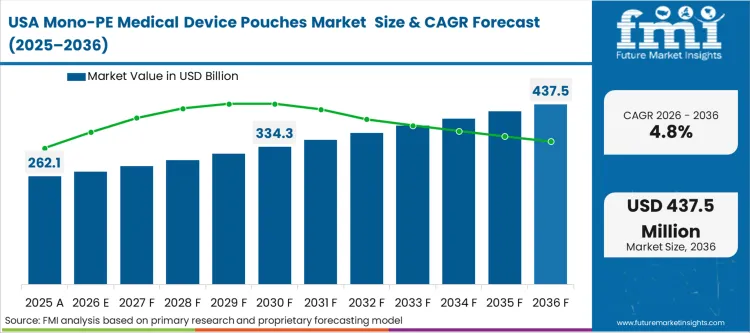
- USA: US medical device firms are absorbing commercial pressure from brand-conscious healthcare systems that use sustainability metrics as a differentiator in a crowded market. Demand for mono-PE pouches in the USA is set for a CAGR of 4.8%, reflecting a rate of compliance-led capital refresh that tracks the GPO sourcing review calendar.
FMI's report includes detailed analysis of Canada, Brazil, Mexico, and other emerging markets. The structural pattern across these additional regions shows that mono-material adoption tracks closely with the export-readiness of local device manufacturers.
Competitive Aligners for Market Players
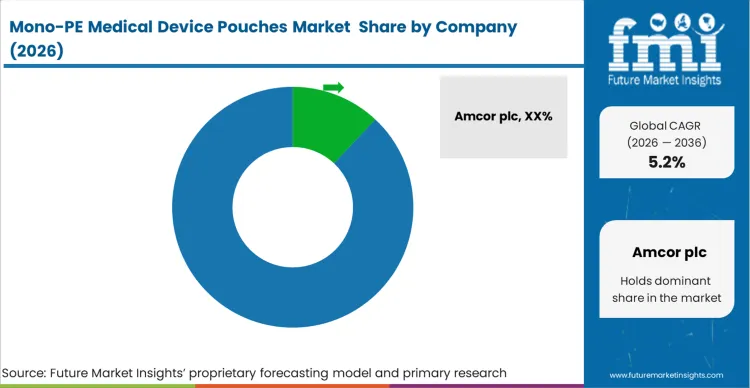
The structural concentration of the Mono-PE Medical Device Pouches Market is high because the expertise required to produce medical-grade oriented films is limited to a small group of tier-1 converters. Buyers distinguish qualified vendors not on unit price, but on their ability to provide a complete validation package that includes stability data for mono-material seals. Leading companies like Amcor plc, Mondi Group, and Berry Global Inc. have established dominance by investing in proprietary MDO-PE lines that produce films with the mechanical and thermal properties necessary for sterile barrier systems.
Incumbents maintain a significant advantage through their established relationships with medical device OEMs and their deep understanding of ISO 11607 compliance. A challenger must build more than just a production line; they must develop a technical support infrastructure capable of helping buyers navigate the 18-month requalification cycle. The primary variable buyers use to distinguish vendors is the "sealing window" consistency of their films, as mono-PE requires much tighter process control than traditional PET/PE laminates. One FMI hyperlink within a mechanism sentence flexible packaging solutions indicates that winners in this space are those who provide the material and the sealing expertise as a bundled service.
Large buyers like global surgical device brands are increasingly resisting vendor lock-in by demanding that mono-PE structures be cross-compatible with multiple equipment manufacturers. The structural tension between these buyer preferences and the incentive for vendors to create proprietary, high-margin film structures will define the competitive landscape toward 2036. The market is expected to remain concentrated as the capital requirements for medical-grade cleanroom extrusion and high-precision testing facilities continue to rise, favoring players with global scale.
Key Players in Mono-PE Medical Device Pouches Market
- Amcor plc
- Mondi Group
- Berry Global Inc.
- Huhtamaki Oyj
- Constantia Flexibles
- ProAmpac
- SEE (formerly Sealed Air Corporation)
- Winpak Ltd.
- Oliver Healthcare Packaging
- SteriPack Group
Scope of the Report
| Metric | Value |
|---|---|
| Quantitative Units | USD 0.61 billion to USD 1.02 billion, at a CAGR of 5.28% |
| Market Definition | Sterile barrier systems constructed from 100% polyethylene resins, designed to maintain device sterility while allowing for circular economy recycling in a single polymer stream. |
| Material Segmentation | High-Density Polyethylene (HDPE), Low-Density Polyethylene (LDPE), Linear Low-Density Polyethylene (LLDPE) |
| Pouch Type Segmentation | Flat Pouches, Gusseted Pouches, Header Pouches |
| Application Segmentation | Surgical Instruments, Dental Tools, Orthopedic Implants, Cardiovascular Devices |
| End Use Segmentation | Hospitals, Ambulatory Surgical Centers, Diagnostic Labs |
| Regions Covered | North America, Europe, Asia Pacific, Latin America, Middle East, Africa |
| Countries Covered | India, China, Germany, USA, France, UK, Japan, and 40 plus countries |
| Key Companies Profiled | Amcor plc, Mondi Group, Berry Global Inc., Huhtamaki Oyj, Constantia Flexibles, ProAmpac, Sealed Air Corporation, Winpak Ltd., Oliver Healthcare Packaging, SteriPack Group |
| Forecast Period | 2026 to 2036 |
| Approach | Primary interviews were conducted with sterile barrier engineers and procurement directors. Baseline sizing utilized unit consumption data from surgical settings, validated against resin trade volumes and OEM sustainability roadmaps. |
Source: Future Market Insights (FMI) analysis, based on proprietary forecasting model and primary research
Mono-PE Medical Device Pouches Market Analysis by Segments
Material:
- High-Density Polyethylene (HDPE)
- Low-Density Polyethylene (LDPE)
- Linear Low-Density Polyethylene (LLDPE)
Pouch Type:
- Flat Pouches
- Gusseted Pouches
- Header Pouches
Application:
- Surgical Instruments
- Dental Tools
- Orthopedic Implants
- Cardiovascular Devices
End Use:
- Hospitals
- Ambulatory Surgical Centers
- Diagnostic Labs
Regions:
- North America
- United States
- Canada
- Mexico
- Latin America
- Brazil
- Argentina
- Europe
- Germany
- United Kingdom
- France
- Italy
- Spain
- East Asia
- China
- Japan
- South Korea
- South Asia
- India
- ASEAN
- Oceania
- Australia
- New Zealand
- Middle East & Africa
- GCC
- South Africa
Bibliography
- ASTM International. (2024, January). ASTM F88/F88M-24 Standard Test Method for Seal Strength of Flexible Barrier Materials. ASTM Publications.
- Mondi Group. (2024, June). EcoSolutions: Mono-Material Polyethylene Solutions for Medical Grade Applications. Mondi Group.
- Sterilization Packaging Manufacturers Council (SPMC). (2024, March). Technical Guide: Material Selection for Sterilizable Medical Pouches. SPMC Resources.
- U.S. Food and Drug Administration (FDA). (2024, April). Guidance for Industry: Sterility Requirement for Medical Device Packaging. FDA Guidance.
- Flexible Packaging Association (FPA). (2024, August). 2024 State of the Flexible Packaging Industry Report. FPA Industry Data.
- Healthcare Plastics Recycling Council (HPRC). (2024, July). 2024 White Paper: Design for Recyclability in Hospital Settings. HPRC White Papers. .
- European Medical Device Regulation (MDR) Portal. (2024, November). Updated Requirements for Sterile Barrier Systems. European Commission.
This bibliography is provided for reader reference. The full FMI report contains the complete reference list with primary source documentation.
This Report Addresses
- Market intelligence to support strategic decision making across mono-PE flat pouches, gusseted pouches, and oriented polyethylene film technologies.
- Market size estimation and 10-year revenue forecasts from 2026 to 2036, supported by unit consumption data from surgical settings and hospital waste audits.
- Growth opportunity mapping across healthcare circularity initiatives with emphasis on the integration of hospital-side PE waste segregation infrastructure.
- Segment and regional revenue forecasts covering HDPE and LLDPE medical-grade resins across different regulatory environments like the EU MDR and US FDA guidelines.
- Competition strategy assessment including thermal sealing window optimization, MDO-PE film performance, and aseptic transfer consistency.
- Technology development tracking including high-barrier mono-material blends, puncture-resistant oriented films, and ISO 11607-1 compliance frameworks.
- Market access analysis covering Group Purchasing Organization (GPO) sustainability requirements and national packaging waste directives in Germany and France.
- Market report delivery in PDF, Excel, PPT, and interactive dashboard formats for executive strategy, sustainable procurement planning, and operational benchmarking use.
Frequently Asked Questions
How large is the Mono-PE Medical Device Pouches Market in 2026?
The market is estimated to reach USD 0.61 billion in 2026. This figure signals a fundamental shift in the healthcare packaging sector as manufacturers move away from incineration-prone mixed materials toward circular mono-polymer streams.
What will it be valued at by 2036?
The industry is projected to cross USD 1.02 billion by 2036. This valuation reflects the complete integration of recyclable sterile barrier systems into global healthcare supply chains, particularly as EPR penalties for multi-material waste become standardized.
What CAGR is projected for the Mono-PE Medical Device Pouches Market?
The market is expected to grow at a CAGR of 5.28% between 2026 and 2036. This rate is anchored to the 18-month qualification cycles of medical device OEMs, which prevents immediate surges but ensures a steady, structural transition toward sustainable formats.
Which Material segment leads the market?
High-Density Polyethylene (HDPE) is expected to hold 44.5% share in 2026. This leadership is due to HDPE's inherent stiffness and puncture resistance, which allow it to replace multi-layer laminates in surgical tool applications without compromising the integrity of the sterile barrier.
Which Pouch Type segment leads the market?
Flat Pouches are projected to grab 52.0% share in 2026. This segment leads because the flat geometry is the most compatible with high-speed automated filling lines and established sterile barrier validation protocols for high-volume surgical disposables.
Which Application segment leads the market?
Surgical Instruments lead the market due to the high turnover of sterilized kits in acute care settings. This segment is the primary target for hospital sustainability initiatives because it generates the highest volume of plastic waste that can be diverted into PE recycling streams.
What drives rapid growth in the Mono-PE Medical Device Pouches Market?
Growth is primarily driven by "Design for Recycling" mandates within hospital GPO contracts, which prioritize mono-material packaging to reduce clinical waste costs. This structural pressure forces device manufacturers to requalify their sterile barriers to maintain access to major healthcare networks.
What is the primary restraint for the Mono-PE Medical Device Pouches Market?
The primary restraint is the structural qualification inertia inherent in the healthcare industry. A change in pouch material requires a full ISO 11607 validation, a process that demands significant organizational resources and time, slowing the adoption rate despite clear sustainability benefits.
Which country grows fastest in the Mono-PE Medical Device Pouches Market?
India is the fastest-growing market with a 6.8% CAGR. This rapid pace, compared to China’s 6.5%, is due to the greenfield nature of India’s new medical device manufacturing zones, which are adopting mono-PE lines immediately to ensure export compliance for regulated Western markets.
How does ISO 11607-1 compliance affect the transition to Mono-PE?
Compliance with ISO 11607-1 requires that the sterile barrier system maintains integrity through the entire distribution and sterilization cycle. Mono-PE films must be engineered with specific orientation to match the mechanical properties of legacy laminates while navigating a much narrower heat-sealing window during production.
What is the role of MDO-PE in the medical pouches market?
Machine Direction Orientation (MDO) technology allows polyethylene to achieve clarity and stiffness comparable to polyester. This enables the creation of all-PE pouches that allow for visual inspection of the device, a critical requirement for clinical safety and aseptic presentation in the OR.
How are hospital procurement directors influencing packaging decisions?
Procurement directors are increasingly weighing "end-of-life cost" alongside unit price, favoring packaging that can be diverted from expensive medical waste streams. This behavior forces vendors to justify their material choices through the lens of hospital-side waste management efficiency.
Is Mono-PE compatible with steam sterilization?
Mono-PE requires specialized resin blends and oriented structures to withstand the high temperatures of steam sterilization without excessive shrinkage or seal creep. While traditionally used for EO or Gamma, Standard Mono-PE is generally optimized for EO and Gamma; however, specialized high-heat HDPE blends and cross-linked resins are currently being qualified for 121°C gravity steam cycles.
What are the consequences for OEMs who delay the move to mono-material pouches?
OEMs who delay face the risk of exclusion from "green tenders" in European and North American hospital systems. As GPOs move toward carbon-neutral supply chains, non-recyclable sterile barriers are being categorized as high-liability items that complicate a hospital's internal sustainability reporting.
Does the conversion to Mono-PE require new sealing equipment?
While not always requiring entirely new machines, the transition often necessitates high-precision temperature control upgrades. Polyethylene has a much narrower thermal sealing window than legacy laminates, making process stability critical to avoiding sterile barrier failure.
What is the expected growth rate for the German market?
The German market is projected to grow at 5.1% CAGR. This rate reflects the high maturity of Germany's recycling infrastructure and the early adoption of extended producer responsibility mandates that penalize mixed-material medical packaging.
How does the US market differ from Europe in its adoption of Mono-PE?
In the USA, adoption is driven primarily by GPO procurement preferences and corporate sustainability goals, whereas in Europe, growth is heavily mandated by national and regional packaging waste directives that include financial penalties for non-recyclable waste.
Can Mono-PE pouches provide adequate puncture resistance for orthopedic implants?
Yes, high-density MDO-PE films are specifically designed to provide the mechanical toughness required for heavy orthopedic implants. These films are often used in multi-layer PE structures that provide the necessary gauge while remaining in a single-polymer recycling stream.
What is the focus of competitive players in this market?
Competitive players are focusing on providing a "bundled validation" service, helping OEMs manage the complex testing required to prove that mono-PE seals remain sterile through the entire product shelf life. This technical support is a key differentiator in a high-stakes regulated market.
Are there exclusions to the mono-material trend?
Exclusions include multi-material pouches using paper or Tyvek lids that are not compatible with PE-stream recycling. While these remain common, the market shift is toward finding mono-polymer lids or all-PE header pouches to achieve a fully recyclable sterile barrier.
What is the structural trajectory of the market toward 2036?
The market is heading toward a state where mono-PE becomes the default standard for high-volume surgical disposables. By 2036, the structural tension between environmental goals and validation costs will be resolved through standardized testing protocols that lower the barrier to mono-material adoption.
How does FMI validate the data for the Mono-PE medical pouches report?
FMI validates sizing and growth data by triangulating resin production volumes from medical-grade suppliers with the annual surgical procedure rates in key regional markets. This approach is further cross-checked with the disclosed packaging reduction targets of global healthcare giants.
Preview the report firsthand - request a free sample
Get SampleGet the brochure for pricing and purchase details.
Get PDFTable of Content
- Executive Summary
- Global Market Outlook
- Demand-side Trends
- Supply-side Trends
- Technology Roadmap Analysis
- Analysis and Recommendations
- Market Overview
- Market Coverage / Taxonomy
- Market Definition / Scope / Limitations
- Research Methodology
- Chapter Orientation
- Analytical Lens and Working Hypotheses
- Market Structure, Signals, and Trend Drivers
- Desk Research Programme (Secondary Evidence)
- Company Annual and Sustainability Reports
- Peer-reviewed Journals and Academic Literature
- Corporate Websites, Product Literature, and Technical Notes
- Earnings Decks and Investor Briefings
- Statutory Filings and Regulatory Disclosures
- Technical White Papers and Standards Notes
- Trade Journals, Industry Magazines, and Analyst Briefs
- Conference Proceedings, Webinars, and Seminar Materials
- Government Statistics Portals and Public Data Releases
- Press Releases and Reputable Media Coverage
- Specialist Newsletters and Curated Briefings
- Sector Databases and Reference Repositories
- FMI Internal Proprietary Databases and Historical Market Datasets
- Subscription Datasets and Paid Sources
- Social Channels, Communities, and Digital Listening Inputs
- Additional Desk Sources
- Expert Input and Fieldwork (Primary Evidence)
- Primary Modes
- Qualitative Interviews and Expert Elicitation
- Quantitative Surveys and Structured Data Capture
- Blended Approach
- Why Primary Evidence is Used
- Field Techniques
- Interviews
- Surveys
- Focus Groups
- Observational and In-context Research
- Social and Community Interactions
- Stakeholder Universe Engaged
- C-suite Leaders
- Board Members
- Presidents and Vice Presidents
- R&D and Innovation Heads
- Technical Specialists
- Domain Subject-matter Experts
- Scientists
- Physicians and Other Healthcare Professionals
- Governance, Ethics, and Data Stewardship
- Research Ethics
- Data Integrity and Handling
- Primary Modes
- Tooling, Models, and Reference Databases
- Data Engineering and Model Build
- Data Acquisition and Ingestion
- Cleaning, Normalisation, and Verification
- Synthesis, Triangulation, and Analysis
- Quality Assurance and Audit Trail
- Market Background
- Market Dynamics
- Drivers
- Restraints
- Opportunity
- Trends
- Scenario Forecast
- Demand in Optimistic Scenario
- Demand in Likely Scenario
- Demand in Conservative Scenario
- Opportunity Map Analysis
- Product Life Cycle Analysis
- Supply Chain Analysis
- Investment Feasibility Matrix
- Value Chain Analysis
- PESTLE and Porter’s Analysis
- Regulatory Landscape
- Regional Parent Market Outlook
- Production and Consumption Statistics
- Import and Export Statistics
- Market Dynamics
- Global Market Analysis 2021 to 2025 and Forecast, 2026 to 2036
- Historical Market Size Value (USD Million) Analysis, 2021 to 2025
- Current and Future Market Size Value (USD Million) Projections, 2026 to 2036
- Y-o-Y Growth Trend Analysis
- Absolute $ Opportunity Analysis
- Global Market Pricing Analysis 2021 to 2025 and Forecast 2026 to 2036
- Global Market Analysis 2021 to 2025 and Forecast 2026 to 2036, By Material
- Introduction / Key Findings
- Historical Market Size Value (USD Million) Analysis By Material , 2021 to 2025
- Current and Future Market Size Value (USD Million) Analysis and Forecast By Material , 2026 to 2036
- High-Density Polyethylene (HDPE
- Others
- High-Density Polyethylene (HDPE
- Y-o-Y Growth Trend Analysis By Material , 2021 to 2025
- Absolute $ Opportunity Analysis By Material , 2026 to 2036
- Global Market Analysis 2021 to 2025 and Forecast 2026 to 2036, By Pouch Type
- Introduction / Key Findings
- Historical Market Size Value (USD Million) Analysis By Pouch Type, 2021 to 2025
- Current and Future Market Size Value (USD Million) Analysis and Forecast By Pouch Type, 2026 to 2036
- Flat Pouches
- Others
- Flat Pouches
- Y-o-Y Growth Trend Analysis By Pouch Type, 2021 to 2025
- Absolute $ Opportunity Analysis By Pouch Type, 2026 to 2036
- Global Market Analysis 2021 to 2025 and Forecast 2026 to 2036, By Region
- Introduction
- Historical Market Size Value (USD Million) Analysis By Region, 2021 to 2025
- Current Market Size Value (USD Million) Analysis and Forecast By Region, 2026 to 2036
- North America
- Latin America
- Western Europe
- Eastern Europe
- East Asia
- South Asia and Pacific
- Middle East & Africa
- Market Attractiveness Analysis By Region
- North America Market Analysis 2021 to 2025 and Forecast 2026 to 2036, By Country
- Historical Market Size Value (USD Million) Trend Analysis By Market Taxonomy, 2021 to 2025
- Market Size Value (USD Million) Forecast By Market Taxonomy, 2026 to 2036
- By Country
- USA
- Canada
- Mexico
- By Material
- By Pouch Type
- By Country
- Market Attractiveness Analysis
- By Country
- By Material
- By Pouch Type
- Key Takeaways
- Latin America Market Analysis 2021 to 2025 and Forecast 2026 to 2036, By Country
- Historical Market Size Value (USD Million) Trend Analysis By Market Taxonomy, 2021 to 2025
- Market Size Value (USD Million) Forecast By Market Taxonomy, 2026 to 2036
- By Country
- Brazil
- Chile
- Rest of Latin America
- By Material
- By Pouch Type
- By Country
- Market Attractiveness Analysis
- By Country
- By Material
- By Pouch Type
- Key Takeaways
- Western Europe Market Analysis 2021 to 2025 and Forecast 2026 to 2036, By Country
- Historical Market Size Value (USD Million) Trend Analysis By Market Taxonomy, 2021 to 2025
- Market Size Value (USD Million) Forecast By Market Taxonomy, 2026 to 2036
- By Country
- Germany
- UK
- Italy
- Spain
- France
- Nordic
- BENELUX
- Rest of Western Europe
- By Material
- By Pouch Type
- By Country
- Market Attractiveness Analysis
- By Country
- By Material
- By Pouch Type
- Key Takeaways
- Eastern Europe Market Analysis 2021 to 2025 and Forecast 2026 to 2036, By Country
- Historical Market Size Value (USD Million) Trend Analysis By Market Taxonomy, 2021 to 2025
- Market Size Value (USD Million) Forecast By Market Taxonomy, 2026 to 2036
- By Country
- Russia
- Poland
- Hungary
- Balkan & Baltic
- Rest of Eastern Europe
- By Material
- By Pouch Type
- By Country
- Market Attractiveness Analysis
- By Country
- By Material
- By Pouch Type
- Key Takeaways
- East Asia Market Analysis 2021 to 2025 and Forecast 2026 to 2036, By Country
- Historical Market Size Value (USD Million) Trend Analysis By Market Taxonomy, 2021 to 2025
- Market Size Value (USD Million) Forecast By Market Taxonomy, 2026 to 2036
- By Country
- China
- Japan
- South Korea
- By Material
- By Pouch Type
- By Country
- Market Attractiveness Analysis
- By Country
- By Material
- By Pouch Type
- Key Takeaways
- South Asia and Pacific Market Analysis 2021 to 2025 and Forecast 2026 to 2036, By Country
- Historical Market Size Value (USD Million) Trend Analysis By Market Taxonomy, 2021 to 2025
- Market Size Value (USD Million) Forecast By Market Taxonomy, 2026 to 2036
- By Country
- India
- ASEAN
- Australia & New Zealand
- Rest of South Asia and Pacific
- By Material
- By Pouch Type
- By Country
- Market Attractiveness Analysis
- By Country
- By Material
- By Pouch Type
- Key Takeaways
- Middle East & Africa Market Analysis 2021 to 2025 and Forecast 2026 to 2036, By Country
- Historical Market Size Value (USD Million) Trend Analysis By Market Taxonomy, 2021 to 2025
- Market Size Value (USD Million) Forecast By Market Taxonomy, 2026 to 2036
- By Country
- Kingdom of Saudi Arabia
- Other GCC Countries
- Turkiye
- South Africa
- Other African Union
- Rest of Middle East & Africa
- By Material
- By Pouch Type
- By Country
- Market Attractiveness Analysis
- By Country
- By Material
- By Pouch Type
- Key Takeaways
- Key Countries Market Analysis
- USA
- Pricing Analysis
- Market Share Analysis, 2025
- By Material
- By Pouch Type
- Canada
- Pricing Analysis
- Market Share Analysis, 2025
- By Material
- By Pouch Type
- Mexico
- Pricing Analysis
- Market Share Analysis, 2025
- By Material
- By Pouch Type
- Brazil
- Pricing Analysis
- Market Share Analysis, 2025
- By Material
- By Pouch Type
- Chile
- Pricing Analysis
- Market Share Analysis, 2025
- By Material
- By Pouch Type
- Germany
- Pricing Analysis
- Market Share Analysis, 2025
- By Material
- By Pouch Type
- UK
- Pricing Analysis
- Market Share Analysis, 2025
- By Material
- By Pouch Type
- Italy
- Pricing Analysis
- Market Share Analysis, 2025
- By Material
- By Pouch Type
- Spain
- Pricing Analysis
- Market Share Analysis, 2025
- By Material
- By Pouch Type
- France
- Pricing Analysis
- Market Share Analysis, 2025
- By Material
- By Pouch Type
- India
- Pricing Analysis
- Market Share Analysis, 2025
- By Material
- By Pouch Type
- ASEAN
- Pricing Analysis
- Market Share Analysis, 2025
- By Material
- By Pouch Type
- Australia & New Zealand
- Pricing Analysis
- Market Share Analysis, 2025
- By Material
- By Pouch Type
- China
- Pricing Analysis
- Market Share Analysis, 2025
- By Material
- By Pouch Type
- Japan
- Pricing Analysis
- Market Share Analysis, 2025
- By Material
- By Pouch Type
- South Korea
- Pricing Analysis
- Market Share Analysis, 2025
- By Material
- By Pouch Type
- Russia
- Pricing Analysis
- Market Share Analysis, 2025
- By Material
- By Pouch Type
- Poland
- Pricing Analysis
- Market Share Analysis, 2025
- By Material
- By Pouch Type
- Hungary
- Pricing Analysis
- Market Share Analysis, 2025
- By Material
- By Pouch Type
- Kingdom of Saudi Arabia
- Pricing Analysis
- Market Share Analysis, 2025
- By Material
- By Pouch Type
- Turkiye
- Pricing Analysis
- Market Share Analysis, 2025
- By Material
- By Pouch Type
- South Africa
- Pricing Analysis
- Market Share Analysis, 2025
- By Material
- By Pouch Type
- USA
- Market Structure Analysis
- Competition Dashboard
- Competition Benchmarking
- Market Share Analysis of Top Players
- By Regional
- By Material
- By Pouch Type
- Competition Analysis
- Competition Deep Dive
- Amcor plc
- Overview
- Product Portfolio
- Profitability by Market Segments (Product/Age /Sales Channel/Region)
- Sales Footprint
- Strategy Overview
- Marketing Strategy
- Product Strategy
- Channel Strategy
- Mondi Group
- Berry Global Inc.
- Huhtamaki Oyj
- Constantia Flexibles
- ProAmpac
- Amcor plc
- Competition Deep Dive
- Assumptions & Acronyms Used


