

- Market Size (2026)
- USD 213.6 Mn
- Forecast (2036)
- USD 712.5 Mn
- CAGR (2026 to 2036)
- 12.8%
How big is Natural Larval Inhibitors Market in 2026?
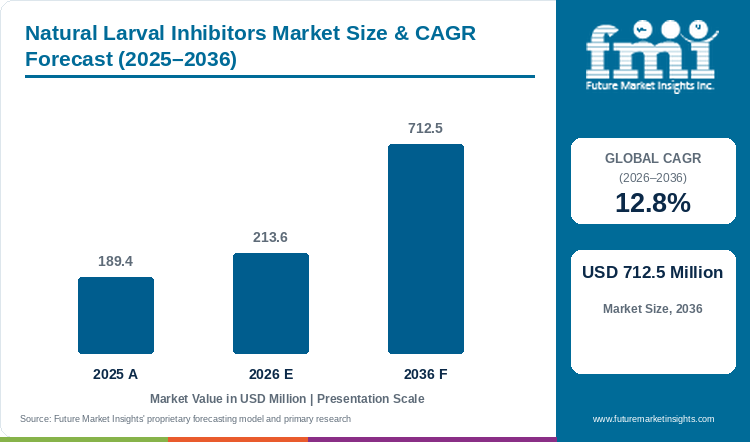
Demand for natural larval inhibitors is projected to expand at 12.8% CAGR between 2026 and 2036. Industry value grows from USD 189.4 million in 2025 to USD 213.6 million in 2026 and is projected to reach USD 712.5 million by 2036.
The natural larval inhibitors market is expected to grow from USD 189.4 million in 2025 to USD 213.6 million in 2026 and reach USD 712.5 million by 2036, reflecting a CAGR of 12.8% during the 2026 to 2036 forecast period. Expansion can be attributed to increasing crop loss before harvesting which is making growers move towards larval-stage treatment. Pests and plant diseases destroy up to 40% of global crops every year, according to the International Plant Protection Convention in March 2025 [1]. Bacillus products are mature owing to established Bt use, while fungal and botanical actives are increasing the application spread. availability of stable formulations that can work through soil, foliar and transplant routes is supporting the shift towards premium-grade products. As per FMI, crop use and application convenience are expected to support revenue sales during the forecast period.
Regional adoption patterns are developing along distinct trajectories across countries, as South Korea is expected to grow at 12.5% CAGR whereas Germany is likely to expand at 12.2%. In May 2025, the European Union established its coordinated residue-monitoring program for 2026 to 2028, requiring 683 sample units across 32 food commodities to track pesticide compliance [2]. South Korea is moving toward streamlined registration pathways for microbial disease suppressors, whereas Germany operates within strict European maximum residue thresholds. Easier product clearance accelerates commercial introductions in South Korea, while German buyers prioritize residue compliance and documented field efficacy.
Key Takeaways
- Pest pressure and resistance management are making larval-stage control a recurring crop-protection purchase.
- Based on active type, bacillus-based products are projected to account for 45.8% in 2026 owing to established Bt use and direct larval activity.
- By crop type, cereals and grains are estimated to hold 43.2% in 2026 because broad-acre pest exposure creates repeat treatment opportunities.
- In 2026, soil or drench is expected to lead application method with 52.9% share owing to direct root-zone access.
- South Korea is projected at 12.5% CAGR through 2036, whereas Germany is forecast at 12.2% amid different regulatory pathways.
- Notable companies in the natural larval inhibitors market include Vestaron, BioWorks, e-nema, Bayer Crop Science, Syngenta, Corteva Agriscience, FMC Corporation, and Sumitomo Chemical.
Analyst Perspective
“Repeat demand will favour products showing control under actual crop conditions. Wider adoption will come from formulations fitting existing farm routines.”
- Nikhil Kaitwade, Principal Consultant, Future Market Insights.
How is the natural larval inhibitors market segmented?
Natural larval inhibitors market is segmented on the basis of active type, crop type, application method, target setting, sales channel, and region. Bacillus-based products are projected at 45.8%, cereals and grains at 43.2%, and soil or drench at 52.9% in 2026.
By active type: bacillus-based, Trichoderma and fungal-based, botanical extracts, and bacteriophage and others.
By crop type: cereals and grains, fruits and vegetables, oilseeds and pulses, turf and ornamentals, and others.
By application method: soil or drench, foliar spray, seed or transplant treatment, and others.
By target setting: open field, protected cultivation, post-plant rescue, and others.
By sales channel: agri-input distributors, cooperatives, agri-retail chains, online or direct-to-farm, and others.
By region: North America, Latin America, Western Europe, Eastern Europe, East Asia, South Asia and Pacific, and Middle East and Africa.
What makes Bacillus-Based products central to the Active Type category?
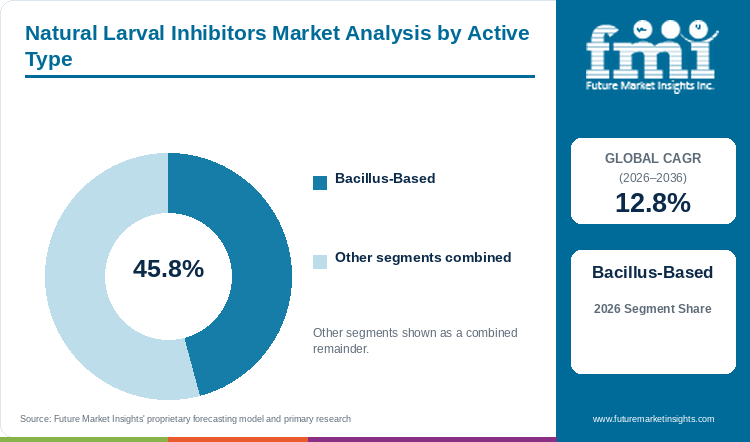
Based on active type, bacillus-based products are projected to account for 45.8% in 2026, supported by established Bt use and direct larval activity.
Bacillus-based products are gaining preference as these formulations leverage bacillus metabolites to act directly against susceptible larvae. The U.S. EPA identifies Bacillus thuringiensis as a microbial pesticide used against selected insect groups [3]. The active needs to be eaten by the susceptible pest due to which correct identification of pest and larval stage is required. Increasing resistance against conventional insecticides is also making growers include another mode in crop rotations. Owing to established Bt use and direct larval activity, bacillus-based products are expected to remain central in the Active Type category.
- Bacillus-Based products hold a 45.8% share of the Active Type category in 2026, backed by established Bt use and a direct larval-targeting mechanism.
- Correct larval-stage identification and compatibility with rotation programs are supporting preference for Bacillus-Based products.
Why do Cereals & Grains anchor the Crop Type category?
Cereals and grains are estimated to hold 43.2% of crop type demand in 2026, driven by repeated broad-acre pest exposure.
Increasing cultivation across large cereal and grain acreage is creating repeated requirement for control of caterpillars, borers and root-feeding larvae. Buyers in these crops normally compare treatment cost per hectare, timing and the yield that can be protected. In November 2025, Corteva announced Goltrevo for corn and soybean pests, with sales expected from 2027 subject to approvals [4]. This product pipeline is showing that biological larval control is moving from specialty crops towards broad-acre programs. Therefore, repeated pest exposure and large treated area are expected to support cereals and grains in the Crop Type category.
- Cereals & Grains hold a 43.2% share of the Crop Type category in 2026, reflecting broad-acre pest exposure and repeat insect-control decisions.
How does Soil / Drench lead the Application Method category?
With an estimated 52.9% share in 2026, soil or drench leads application method, underpinned by direct root-zone larval placement.
Soil or drench application is gaining adoption as it places the biological agent near root-feeding and soil-dwelling larvae. The method can also be included in irrigation and transplant routines without creating a separate farm operation. In April 2025, BioWorks received U.S. EPA approval for PRINCIPLE WP, with soil drench included among the application routes [5]. This reduces the requirement of complete canopy coverage when the susceptible stage is below the ground. Direct root-zone placement and compatibility with present farm practices are therefore, expected to support Soil / Drench in the Application Method category.
- Soil / Drench holds a 52.9% share of the Application Method category in 2026, backed by direct root-zone access to soil-dwelling larval stages.
What supports Open Field leadership in the Target Setting category?
Open field is forecast to represent 49.9% of target setting revenue in 2026, reflecting extensive commercial acreage and recurring field treatment cycles.
Open Field is expected to create high volume opportunities owing to large acreage and repeated field treatment cycles. However, changing moisture, temperature and short application windows can affect biological performance. In June 2025, Syngenta announced the expansion of its biologicals portfolio to scale nature-inspired biocontrol and bio-insecticide formulations across commercial open-field acreage [6]. Wider acreage alone will not create repeat purchasing unless formulation remains stable and can pass through normal farm equipment. Thus, stable handling and consistent output under changing field conditions are expected to drive commercial adoption of microbial and botanical actives across open fields.
- Open Field holds a 49.9% share of the Target Setting category in 2026, owing to the scale of broad-acre pest management and repeated field treatment cycles.
What drives Agri-Input Distributors in the Sales Channel category?
Agri-input distributors are anticipated to contribute 49.0% of sales channel revenue in 2026, owing to essential local agronomic and technical support.
Agri-Input Distributors are important as these channels connect product labels with local pest pressure, seed treatment materials, and equipment available with growers. Vestaron expanded European access for SPEAR LEP in July 2025 through authorizations in Greece and Italy [7]. Local authorization opens crop-specific opportunities; however, actual sales will depend on whether the channel explains treatment timing and expected field output. Product availability, local agronomic advice and after-sale guidance are expected to keep technical distributors central in the Sales Channel category.
- Agri-Input Distributors hold a 49.0% share of the Sales Channel category in 2026, owing to the value of local agronomic advice and product availability.
- Local availability and treatment guidance are supporting the role of Agri-Input Distributors in repeat farm purchases.
What are the drivers, restraints, and opportunities in the natural larval inhibitors market?
Resistance-management and lower-chemical crop programs support demand, while field validation and biological handling constrain adoption, and more stable broad-acre formulations create the clearest expansion opportunity.
- Driver: Resistance management and lower-chemical IPM programs pull natural larval control into recurring crop-protection rotations.
- Restraint: Performance can depend on pest stage and environmental conditions. Formulation handling and market-specific registration also affect adoption.
- Opportunity: More stable formulations and broad-acre application systems is expected to expand biological larval control in cereals and open-field programs.
Resistance Management Supports Crop Rotations
Increasing resistance against conventional insecticides is widening the role of biological larval control in crop rotations. In April 2025, FMC linked grower interest in Sofero Fall pheromone with fall armyworm resistance against traditional insecticides [8]. The product works through mating suppression and is not a conventional larvicide; however, the development explains the requirement for additional control routes. Natural larval inhibitors are expected to witness higher repeat demand where these products protect the crop at correct larval stage and can be included with established spray programs.
Field Validation Limits Repeat Use
Variation in field performance is one of the major factors restricting repeat adoption of natural larval inhibitors. Biological activity can change according to pest stage, moisture, temperature and ultraviolet exposure. A 2025 study in Frontiers in Insect Science documented that environmental factors, particularly ultraviolet radiation and rainfall, significantly reduce the foliar persistence of microbial biopesticides unless stabilized through protective formulations [9]. Local trials increase the cost and time of launch; however, these trials also show where a product can perform. Incorrect timing can make an effective active appear inconsistent, which in turn increases the requirement for clear labels and training when integrating larvicides with semiochemical-based mating disruption.
Application Flexibility Opens Field Use
Improvement in formulation is creating growth opportunities for natural larval inhibitors across field crops. In February 2026, Sumitomo Chemical announced the integration of its French subsidiaries to consolidate European distribution and accelerate regional commercialization of its biorational and biological crop-protection portfolios [10]. Availability of different routes enables growers to place the active near the susceptible pest stage instead of changing the complete farm operation. Products having stable handling and compatibility with present equipment are expected to witness higher adoption alongside complementary biostimulants across commercial field programs.
Which country CAGRs are profiled in the natural larval inhibitors market?
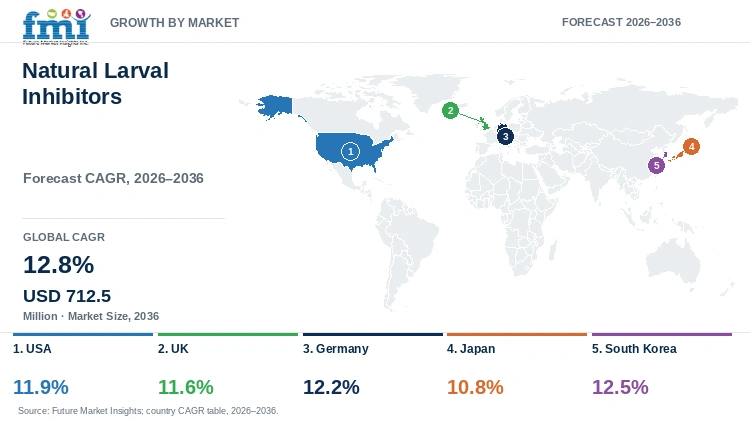
| Country | CAGR |
|---|---|
| USA | 11.9% |
| UK | 11.6% |
| Germany | 12.2% |
| Japan | 10.8% |
| South Korea | 12.5% |
How do country-level CAGRs compare in the natural larval inhibitors market?
Country growth is expected to remain different as regulation, crop mix and biological distribution is not similar in every market. South Korea and Germany show higher expansion owing to registration changes and residue-related policies. The USA and UK have established technical channels, while Japan requires closer product localization according to crop and application practices. Therefore, a higher CAGR does not itself indicate the largest revenue opportunity. Treated acreage, crop-protection spending and channel reach will also decide the actual revenue sales in every country.
- United States growers are adopting biological pest management across commercial acreage, supported by expanding technical distribution and label availability.
- United Kingdom buyers are emphasizing documented safety and efficacy evidence, with early adoption concentrated in protected crops and specialty horticulture.
- German farms combine strict maximum residue compliance with expanding organic cultivation, requiring validated biological alternatives within integrated crop protection.
- Japanese growers prioritize localized field validation and crop compatibility under national initiatives for sustainable food production and reduced chemical risk.
- South Korean producers benefit from differentiated microbial pesticide registration pathways, accelerating commercial introduction of domestic and imported biological strains.
CAGR describes the pace of expansion rather than the absolute revenue opportunity. A slower-growing country can still support larger sales if it has more treated acreage, higher crop-protection spending, or deeper channel penetration. Conversely, a faster-growing country may start from a smaller base or require more technical support. In the FMI report, country growth is evaluated together with product registration and crop economics. Application practice and route-to-market conditions are assessed separately.
Full report country CAGRs cover: North America; Latin America; Western Europe; Eastern Europe; East Asia; South Asia and Pacific; Middle East and Africa.
Country-wise Analysis
- Natural larval inhibitor demand in the USA is anticipated to rise at 11.9% CAGR through 2036. FMI data suggests the USA benefits from a national registration route and a wide commercial crop base, but each active still needs evidence for its proposed use. In February 2024, USDA NASS reported that U.S. certified organic crop sales reached USD 9.56 billion across 4.99 million certified acres, expanding the commercial base for non-synthetic larval controls [11]. Federal review provides one regulatory entry point before state-level distribution and field placement. Growers evaluate whether the active reaches the target larval stage without disrupting existing spray plans. The result is steady adoption where technical distributors connect registration, pest scouting, and treatment timing.
- The UK natural larval inhibitors outlook is anticipated to advance at 11.6% CAGR through 2036, backed by demand for lower-residue pest management. Approval remains the commercial gate. In September 2025, the Health and Safety Executive stated that a biopesticide must be approved before sale or use and that applicants must provide safety and effectiveness evidence [12]. That requirement narrows the gap between a promising laboratory mode and a usable field product. Protected crops can offer controlled early applications, while open-field programs require local performance under changing weather. Suppliers with UK trial records and trained distributors are better placed to turn interest into repeat purchasing.
- Germany is estimated to post 12.2% CAGR through 2036 as organic policy and pesticide oversight keep biological alternatives in view. In July 2025, Germany's Federal Office of Consumer Protection and Food Safety reported that organic and low-risk plant protection applications accounted for an expanding share of specialty crop treatments across federal states [13]. Germany participates in that common regulatory system, where active substances are assessed at EU level and products are authorized nationally. The monitoring program does not guarantee demand for any one biological active. It does, however, preserve buyer attention on residue control and documented use. Local labels, crop-specific efficacy, and distribution through established plant-protection channels will decide commercial uptake.
- Demand for natural larval inhibitors in Japan is predicted to advance at 10.8% CAGR through 2036, with adoption tied to local crop proof. Japan has a long-running policy direction toward lower pesticide risk, but commercial use still depends on registration and fit with established farm routines. In April 2024, the Ministry of Agriculture, Forestry and Fisheries updated implementation progress for the MIDORI Strategy, maintaining a 50% chemical pesticide reduction target supported by expanded biological control registrations [14]. Buyers test biological products against local pest timing, weather, and application practice before wider use. The slower growth rate therefore reflects a careful qualification route, not weak interest. Suppliers need Japanese trial data, clear application protocols, and partners able to support growers after launch.
- By 2036, South Korea is expected to grow at 12.5% CAGR, backed by a clearer route for microbial pesticide registration. In February 2026, the Rural Development Administration created separate criteria for microbial products and reported 25 registered microbial items covering 29 products [15]. The change addressed time and cost barriers that arose when microbial products followed requirements designed around chemical pesticides. A small existing product base gives new suppliers room, but it also limits distributor experience. Local strains, domestic crop trials, and practical handling guidance will remain necessary. The regulatory change can shorten entry work, while field proof is expected to decide whether registrations develop into repeat orders.
Who are the notable companies in the natural larval inhibitors market?
Vestaron, BioWorks, e-nema, Bayer Crop Science, Syngenta, Corteva Agriscience, FMC Corporation, and Sumitomo Chemical are the notable companies profiled in this market.
As noted by FMI, competition in natural larval inhibitors market is divided according to biological mode and the ability of companies to take the product from registration to farm use. Vestaron is focusing on peptide insecticides, BioWorks on microbial and biological plant-health products, while e-nema has built its position around entomopathogenic nematodes for soil and substrate pests. Bayer Crop Science, Syngenta and Corteva Agriscience are using larger R&D and regulatory platforms to move biological insect control into broad crop systems. FMC is developing pheromone-based mating disruption, whereas Sumitomo Chemical participates through a wider biorational portfolio. Therefore, company scale alone will not decide competition, as target specificity, formulation usability and field support are equally important.
- Direct biological control specialists: Vestaron, BioWorks, and e-nema compete through differentiated modes of action, crop-specific technical support, and products designed around biological execution.
- Global crop-protection platforms: Bayer Crop Science, Syngenta, and Corteva Agriscience combine discovery partnerships, regulatory resources, and established farm channels to scale biological insect control.
- Integrated biorational and IPM platforms: FMC Corporation and Sumitomo Chemical extend natural pest management through pheromone or microbial portfolios that can sit beside conventional crop protection.
Competitive Benchmarking: Natural Larval Inhibitors Market
| Company | Direct Larval Targeting | Application Flexibility | Biological Commercialization Depth | Geographic Reach |
|---|---|---|---|---|
| Vestaron | High | Medium | Medium | Medium |
| BioWorks | Medium | High | High | Medium |
| e-nema | High | High | High | Medium |
| Bayer Crop Science | Medium | Medium | High | Medium |
| Syngenta | Medium | Medium | High | Medium |
| Corteva Agriscience | High | Medium | Medium | Medium |
| FMC Corporation | Low | Medium | Medium | Medium |
| Sumitomo Chemical | Medium | Medium | High | Medium |
Scoring basis: Direct Larval Targeting measures documented products or pipelines that act on larval or caterpillar stages; High reflects explicit direct targeting, Medium reflects partial or pipeline evidence, and Low reflects a documented indirect mode such as adult mating disruption. Application Flexibility measures documented use across multiple delivery routes or production settings. Biological Commercialization Depth measures evidence of registered products, biological manufacturing or portfolio depth, and supporting channels. Low indicates a documented limitation.
Key Developments in the Natural Larval Inhibitors Market
- In February 2026, Sumitomo Chemical announced the integration of its French crop-protection subsidiaries to strengthen regional distribution for its biorational and biological portfolio.
- In November 2025, Corteva Agriscience announced Goltrevo for chewing pests in corn and soybean, with broad-acre commercial availability planned from 2027.
- In July 2025, Vestaron expanded European access for SPEAR LEP through new authorizations for greenhouse and open-field specialty crops in Greece and Italy.
- In April 2025, BioWorks received U.S. EPA approval for PRINCIPLE WP, adding foliar spray, soil drench, dipping, and aerial routes for biological pest control.
Key Players in the Natural Larval Inhibitors Market
Direct Biological Larval-Control Specialists
- Vestaron
- BioWorks
- e-nema
Global Biological Insect-Control Platforms
- Bayer Crop Science
- Syngenta
- Corteva Agriscience
Integrated Biorational and IPM Platforms
- FMC Corporation
- Sumitomo Chemical
Natural Larval Inhibitors Market - Report Scope
| Coverage field | Report scope |
|---|---|
| Market breakdown | Active Type, Crop Type, Application Method, Target Setting, Sales Channel, and Region |
| Quantitative Units | USD Million |
| Market Definition | Revenue includes natural or biological crop-protection products sold to suppress, kill, or prevent damaging insect larval stages within the stated segmentation universe. It excludes downstream crop revenue, conventional synthetic insecticides, and adjacent products without a defined larval-pest control role. |
| Regions Covered | North America, Latin America, Western Europe, Eastern Europe, East Asia, South Asia and Pacific, Middle East and Africa |
| Countries Covered | USA, UK, Germany, Japan, South Korea, and more than twenty-five additional countries in the full report |
| Key Companies Profiled | Vestaron, BioWorks, e-nema, Bayer Crop Science, Syngenta, Corteva Agriscience, FMC Corporation, Sumitomo Chemical |
| Forecast Period | 2026 to 2036 |
| Approach | FMI applies a hybrid bottom-up and top-down sizing approach that reconciles product commercialization, crop and application exposure, channel evidence, and country-level adoption indicators within the defined revenue boundary. |
Natural Larval Inhibitors Market - Research Methodology
| Method | Approach |
|---|---|
| Primary Research | Structured primary discussions are used to assess buying criteria, target-pest fit, application practice, channel economics, and adoption barriers across biological crop-protection manufacturers, formulators, distributors, crop advisers, growers, and technical specialists. The findings are used to test the direction and plausibility of market assumptions without assigning fixed respondent weights. |
| Desk Research | FMI reviews official agricultural statistics, regulator guidance, product authorizations, company filings and news releases, technical labels, trade information, and peer-reviewed or institutional plant-protection literature. Sources are screened for relevance to larval pest control and for fit with the stated revenue boundary. |
| Market Sizing and Forecasting | The market is sized through a hybrid bottom-up and top-down framework. Product availability, pricing structure, treated crop exposure, application routes, channel structure, and adoption indicators are reconciled to establish the 2025 baseline and the 2026 to 2036 forecast path. |
| Data Validation | Findings are cross-checked across source types and against the defined segment structure. Validation excludes double-counting across channels, downstream crop value, conventional synthetic substitutes, and adjacent biological products that do not directly support larval pest management. |
Natural Larval Inhibitors Market by Segments
Natural Larval Inhibitors Market segmented by Active Type:
- Bacillus-Based
- Trichoderma & Fungal-Based
- Botanical Extracts
- Bacteriophage & Others
Natural Larval Inhibitors Market segmented by Crop Type:
- Cereals & Grains
- Fruits & Vegetables
- Oilseeds & Pulses
- Turf & Ornamentals
- Others
Natural Larval Inhibitors Market segmented by Application Method:
- Soil / Drench
- Foliar Spray
- Seed / Transplant Treatment
- Others
Natural Larval Inhibitors Market segmented by Target Setting:
- Open Field
- Protected Cultivation
- Post-Plant Rescue
- Others
Natural Larval Inhibitors Market segmented by Sales Channel:
- Agri-Input Distributors
- Cooperatives
- Agri-Retail Chains
- Online / Direct-to-Farm
- Others
Natural Larval Inhibitors Market by Region:
- North America
- United States
- Canada
- Latin America
- Brazil
- Mexico
- Argentina
- Chile
- Western Europe
- Germany
- France
- United Kingdom
- Italy
- Spain
- Benelux
- Nordics
- Eastern Europe
- Poland
- Czech Republic
- Romania
- Hungary
- East Asia
- China
- Japan
- South Korea
- South Asia and Pacific
- India
- ASEAN
- Australia and New Zealand
- Middle East and Africa
- GCC Countries
- South Africa
- Türkiye
- Israel
Research Sources and Bibliography
- [1] International Plant Protection Convention. (2025, March 17). FAO Director-General calls for investments on plant health to ensure global food security.
- [2] European Commission. (2025, May 7). Commission Implementing Regulation (EU) 2025/854 of 7 May 2025 concerning a coordinated multiannual control programme of the Union for 2026, 2027 and 2028 to ensure compliance with maximum residue levels of pesticides.
- [3] U.S. Environmental Protection Agency. (2025, October 8). What are biopesticides?
- [4] Corteva Agriscience. (2025, November 5). Corteva announces nature-inspired solutions to control insects and help farmers protect yield.
- [5] BioWorks. (2025, April 11). BioWorks receives EPA approval for PRINCIPLE WP, a biological insecticide for thrips, aphid and whitefly control.
- [6] Syngenta. (2025, June 30). Syngenta to expand biologicals platform with nature-inspired crop protection.
- [7] Vestaron. (2025, July 22). Vestaron expands European access for SPEAR LEP with new authorizations on tomatoes in Greece and olives in Italy.
- [8] FMC Corporation. (2025, April 10). FMC receives first product registration in Brazil for Sofero Fall pheromone.
- [9] Frontiers in Insect Science. (2025, October 23). Increasing the use of biological pesticides in integrated pest management: Environmental persistence and formulation dynamics.
- [10] Sumitomo Chemical. (2026, February 26). Group to integrate French subsidiaries to strengthen crop protection business in Europe.
- [11] U.S. Department of Agriculture, National Agricultural Statistics Service. (2024, February 13). 2022 Census of Agriculture: Organic agriculture highlights.
- [12] UK Health and Safety Executive. (2025, September 3). Biopesticides: Regulatory guidance and efficacy requirements.
- [13] Federal Office of Consumer Protection and Food Safety (BVL). (2025, July 15). Plant protection product sales and authorization report for Germany.
- [14] Ministry of Agriculture, Forestry and Fisheries of Japan. (2024, April 18). MIDORI Strategy for Sustainable Food Systems: Progress and chemical reduction milestones.
- [15] Rural Development Administration, Republic of Korea. (2026, February 6). Registration criteria relaxed to expand the use of microbial pesticides.
This bibliography is provided for reader reference and is not exhaustive. The full report contains the complete reference list and detailed citations.
This Report Answers
- What is the Natural Larval Inhibitors Market size in 2026 and what value is forecast by 2036?
- Why do Bacillus-Based products hold the leading position within Active Type?
- Why does Soil / Drench hold the leading position within Application Method?
- How do Vestaron, BioWorks, e-nema, Bayer Crop Science, Syngenta, Corteva Agriscience, FMC Corporation, and Sumitomo Chemical differ by biological role and route to market?
- What should growers, agronomists, and crop-protection procurement teams evaluate before purchasing a natural larval inhibitor?
Frequently Asked Questions
How large is the Natural Larval Inhibitors Market in 2026?
Future Market Insights estimates that the natural larval inhibitors market will reach USD 213.6 million in 2026. The market is projected to expand further and reach USD 712.5 million by 2036.
What CAGR is forecast for the Natural Larval Inhibitors Market through 2036?
As per FMI, the natural larval inhibitors market is projected to grow at a 12.8% CAGR from 2026 to 2036. Growth is supported by increasing adoption of microbial and biological treatments to manage pest resistance.
Which active type holds a notable natural larval inhibitors demand share in 2026?
Future Market Insights projects bacillus-based products to hold 45.8% of active type demand in 2026. The segment benefits from established Bt use and direct action against susceptible larvae.
Which application segment holds a notable natural larval inhibitors share in 2026?
FMI finds that soil or drench will hold 52.9% of application method demand in 2026. Demand is supported by direct root-zone access to soil-dwelling larval stages.
Which country has a notable natural larval inhibitors expansion outlook during the forecast period?
Future Market Insights predicts South Korea to expand at a 12.5% CAGR during the 2026 to 2036 assessment period. Growth is supported by the country's separated microbial-pesticide registration criteria and expanding commercial biological adoption.
Which companies are active in the Natural Larval Inhibitors Market during 2026?
As per FMI analysis, notable companies include Vestaron, BioWorks, e-nema, Bayer Crop Science, Syngenta, Corteva Agriscience, FMC Corporation, and Sumitomo Chemical. These companies are focusing on production expansion, wider formulation offerings, and technical support capabilities.
Preview the report firsthand - request a free sample
Get SampleGet the brochure for pricing and purchase details.
Get PDFTable of Content
- Key Takeaways
- Market Size and CAGR
- Top Growth Driver
- Fastest Growing Segment
- Leading Region
- Key Companies
- Emerging Opportunities
- Executive Summary
- Global Market Outlook
- Demand-side Trends
- Supply-side Trends
- Technology Roadmap Analysis
- Analysis and Recommendations
- Analyst Perspective (What is happening? Why now? What should investors know?)
- Key Questions Answered
- How large is the market?
- What is the CAGR?
- What are key trends?
- Which region dominates?
- Who are the leaders?
- Market Overview
- Market Coverage / Taxonomy
- Market Definition / Scope / Limitations
- Research Methodology
- Chapter Orientation
- Analytical Lens and Working Hypotheses
- Market Structure, Signals, and Trend Drivers
- Benchmarking and Cross-market Comparability
- Market Sizing, Forecasting, and Opportunity Mapping
- Research Design and Evidence Framework
- Desk Research Programme (Secondary Evidence)
- Expert Input and Fieldwork (Primary Evidence)
- Tooling, Models, and Reference Databases
- Data Engineering and Model Build
- Quality Assurance and Audit Trail
- Market Background
- Market Dynamics (Drivers, Restraints, Opportunity, Trends)
- Scenario Forecast (Optimistic, Likely, Conservative)
- Impact Analysis
- AI Impact
- Sustainability Impact
- Regulatory Impact
- Technology Impact
- Consumer / Buyer Analysis
- Purchase Drivers
- Adoption Barriers
- Buyer Journey
- Opportunity Map Analysis
- Product Life Cycle Analysis
- Supply Chain Analysis
- Investment Feasibility Matrix
- Value Chain Analysis
- PESTLE and Porter's Analysis
- Regulatory Landscape
- Regional Parent Market Outlook
- Production and Consumption Statistics
- Import and Export Statistics
- Global Market Analysis and Forecast, 2021 to 2036
- Historical Market Size Value (USD Million) Analysis, 2021 to 2025
- Current and Future Market Size Value (USD Million) Projections, 2026 to 2036
- Y-o-Y Growth Trend Analysis
- Absolute $ Opportunity Analysis
- Global Market Pricing Analysis, 2021 to 2036
- Global Market Analysis and Forecast, By Active Type, 2021 to 2036
- Introduction / Key Findings
- Historical Market Size Value (USD Million) Analysis By Active Type, 2021 to 2025
- Current and Future Market Size Value (USD Million) Analysis and Forecast By Active Type, 2026 to 2036
- Bacillus-Based
- Trichoderma & Fungal-Based
- Botanical Extracts
- Bacteriophage & Others
- Y-o-Y Growth Trend Analysis By Active Type, 2021 to 2025
- Absolute $ Opportunity Analysis By Active Type, 2026 to 2036
- Global Market Analysis and Forecast, By Crop Type, 2021 to 2036
- Introduction / Key Findings
- Historical Market Size Value (USD Million) Analysis By Crop Type, 2021 to 2025
- Current and Future Market Size Value (USD Million) Analysis and Forecast By Crop Type, 2026 to 2036
- Cereals & Grains
- Fruits & Vegetables
- Oilseeds & Pulses
- Turf & Ornamentals
- Others
- Y-o-Y Growth Trend Analysis By Crop Type, 2021 to 2025
- Absolute $ Opportunity Analysis By Crop Type, 2026 to 2036
- Global Market Analysis and Forecast, By Application Method, 2021 to 2036
- Introduction / Key Findings
- Historical Market Size Value (USD Million) Analysis By Application Method, 2021 to 2025
- Current and Future Market Size Value (USD Million) Analysis and Forecast By Application Method, 2026 to 2036
- Soil / Drench
- Foliar Spray
- Seed / Transplant Treatment
- Others
- Y-o-Y Growth Trend Analysis By Application Method, 2021 to 2025
- Absolute $ Opportunity Analysis By Application Method, 2026 to 2036
- Global Market Analysis and Forecast, By Target Setting, 2021 to 2036
- Introduction / Key Findings
- Historical Market Size Value (USD Million) Analysis By Target Setting, 2021 to 2025
- Current and Future Market Size Value (USD Million) Analysis and Forecast By Target Setting, 2026 to 2036
- Open Field
- Protected Cultivation
- Post-Plant Rescue
- Others
- Y-o-Y Growth Trend Analysis By Target Setting, 2021 to 2025
- Absolute $ Opportunity Analysis By Target Setting, 2026 to 2036
- Global Market Analysis and Forecast, By Sales Channel, 2021 to 2036
- Introduction / Key Findings
- Historical Market Size Value (USD Million) Analysis By Sales Channel, 2021 to 2025
- Current and Future Market Size Value (USD Million) Analysis and Forecast By Sales Channel, 2026 to 2036
- Agri-Input Distributors
- Cooperatives
- Agri-Retail Chains
- Online / Direct-to-Farm
- Others
- Y-o-Y Growth Trend Analysis By Sales Channel, 2021 to 2025
- Absolute $ Opportunity Analysis By Sales Channel, 2026 to 2036
- Global Market Analysis and Forecast, By Region, 2021 to 2036
- Introduction
- Historical Market Size Value (USD Million) Analysis By Region, 2021 to 2025
- Current Market Size Value (USD Million) Analysis and Forecast By Region, 2026 to 2036
- North America
- Latin America
- Western Europe
- Eastern Europe
- East Asia
- South Asia and Pacific
- Middle East and Africa
- Market Attractiveness Analysis By Region
- North America Market Analysis and Forecast, By Country, 2021 to 2036
- Historical Market Size Value (USD Million) Trend Analysis By Market Taxonomy, 2021 to 2025
- Market Size Value (USD Million) Forecast By Market Taxonomy, 2026 to 2036
- By Country
- United States
- Canada
- By Active Type
- By Crop Type
- By Application Method
- By Target Setting
- By Sales Channel
- By Country
- Market Attractiveness Analysis
- By Country
- By Active Type
- By Crop Type
- By Application Method
- By Target Setting
- By Sales Channel
- Key Takeaways
- Latin America Market Analysis and Forecast, By Country
- Historical Market Size Value (USD Million) Trend Analysis By Market Taxonomy, 2021 to 2025
- Market Size Value (USD Million) Forecast By Market Taxonomy, 2026 to 2036
- By Country
- Brazil
- Mexico
- Argentina
- Chile
- By Active Type
- By Crop Type
- By Application Method
- By Target Setting
- By Sales Channel
- By Country
- Market Attractiveness Analysis
- By Country
- By Active Type
- By Crop Type
- By Application Method
- By Target Setting
- By Sales Channel
- Key Takeaways
- Western Europe Market Analysis and Forecast, By Country
- Historical Market Size Value (USD Million) Trend Analysis By Market Taxonomy, 2021 to 2025
- Market Size Value (USD Million) Forecast By Market Taxonomy, 2026 to 2036
- By Country
- Germany
- France
- United Kingdom
- Italy
- Spain
- Benelux
- Nordics
- By Active Type
- By Crop Type
- By Application Method
- By Target Setting
- By Sales Channel
- By Country
- Market Attractiveness Analysis
- By Country
- By Active Type
- By Crop Type
- By Application Method
- By Target Setting
- By Sales Channel
- Key Takeaways
- Eastern Europe Market Analysis and Forecast, By Country
- Historical Market Size Value (USD Million) Trend Analysis By Market Taxonomy, 2021 to 2025
- Market Size Value (USD Million) Forecast By Market Taxonomy, 2026 to 2036
- By Country
- Poland
- Czech Republic
- Romania
- Hungary
- By Active Type
- By Crop Type
- By Application Method
- By Target Setting
- By Sales Channel
- By Country
- Market Attractiveness Analysis
- By Country
- By Active Type
- By Crop Type
- By Application Method
- By Target Setting
- By Sales Channel
- Key Takeaways
- East Asia Market Analysis and Forecast, By Country
- Historical Market Size Value (USD Million) Trend Analysis By Market Taxonomy, 2021 to 2025
- Market Size Value (USD Million) Forecast By Market Taxonomy, 2026 to 2036
- By Country
- China
- Japan
- South Korea
- By Active Type
- By Crop Type
- By Application Method
- By Target Setting
- By Sales Channel
- By Country
- Market Attractiveness Analysis
- By Country
- By Active Type
- By Crop Type
- By Application Method
- By Target Setting
- By Sales Channel
- Key Takeaways
- South Asia and Pacific Market Analysis and Forecast, By Country
- Historical Market Size Value (USD Million) Trend Analysis By Market Taxonomy, 2021 to 2025
- Market Size Value (USD Million) Forecast By Market Taxonomy, 2026 to 2036
- By Country
- India
- ASEAN
- Australia and New Zealand
- By Active Type
- By Crop Type
- By Application Method
- By Target Setting
- By Sales Channel
- By Country
- Market Attractiveness Analysis
- By Country
- By Active Type
- By Crop Type
- By Application Method
- By Target Setting
- By Sales Channel
- Key Takeaways
- Middle East and Africa Market Analysis and Forecast, By Country
- Historical Market Size Value (USD Million) Trend Analysis By Market Taxonomy, 2021 to 2025
- Market Size Value (USD Million) Forecast By Market Taxonomy, 2026 to 2036
- By Country
- GCC Countries
- South Africa
- Türkiye
- Israel
- By Active Type
- By Crop Type
- By Application Method
- By Target Setting
- By Sales Channel
- By Country
- Market Attractiveness Analysis
- By Country
- By Active Type
- By Crop Type
- By Application Method
- By Target Setting
- By Sales Channel
- Key Takeaways
- Key Countries Market Analysis
- United States
- Pricing Analysis
- Market Share Analysis, 2025
- By Active Type
- By Crop Type
- By Application Method
- By Target Setting
- By Sales Channel
- Canada
- Pricing Analysis
- Market Share Analysis, 2025
- By Active Type
- By Crop Type
- By Application Method
- By Target Setting
- By Sales Channel
- Mexico
- Pricing Analysis
- Market Share Analysis, 2025
- By Active Type
- By Crop Type
- By Application Method
- By Target Setting
- By Sales Channel
- Brazil
- Pricing Analysis
- Market Share Analysis, 2025
- By Active Type
- By Crop Type
- By Application Method
- By Target Setting
- By Sales Channel
- Chile
- Pricing Analysis
- Market Share Analysis, 2025
- By Active Type
- By Crop Type
- By Application Method
- By Target Setting
- By Sales Channel
- Germany
- Pricing Analysis
- Market Share Analysis, 2025
- By Active Type
- By Crop Type
- By Application Method
- By Target Setting
- By Sales Channel
- United Kingdom
- Pricing Analysis
- Market Share Analysis, 2025
- By Active Type
- By Crop Type
- By Application Method
- By Target Setting
- By Sales Channel
- Italy
- Pricing Analysis
- Market Share Analysis, 2025
- By Active Type
- By Crop Type
- By Application Method
- By Target Setting
- By Sales Channel
- Spain
- Pricing Analysis
- Market Share Analysis, 2025
- By Active Type
- By Crop Type
- By Application Method
- By Target Setting
- By Sales Channel
- France
- Pricing Analysis
- Market Share Analysis, 2025
- By Active Type
- By Crop Type
- By Application Method
- By Target Setting
- By Sales Channel
- India
- Pricing Analysis
- Market Share Analysis, 2025
- By Active Type
- By Crop Type
- By Application Method
- By Target Setting
- By Sales Channel
- ASEAN
- Pricing Analysis
- Market Share Analysis, 2025
- By Active Type
- By Crop Type
- By Application Method
- By Target Setting
- By Sales Channel
- Australia and New Zealand
- Pricing Analysis
- Market Share Analysis, 2025
- By Active Type
- By Crop Type
- By Application Method
- By Target Setting
- By Sales Channel
- China
- Pricing Analysis
- Market Share Analysis, 2025
- By Active Type
- By Crop Type
- By Application Method
- By Target Setting
- By Sales Channel
- Japan
- Pricing Analysis
- Market Share Analysis, 2025
- By Active Type
- By Crop Type
- By Application Method
- By Target Setting
- By Sales Channel
- South Korea
- Pricing Analysis
- Market Share Analysis, 2025
- By Active Type
- By Crop Type
- By Application Method
- By Target Setting
- By Sales Channel
- Poland
- Pricing Analysis
- Market Share Analysis, 2025
- By Active Type
- By Crop Type
- By Application Method
- By Target Setting
- By Sales Channel
- Hungary
- Pricing Analysis
- Market Share Analysis, 2025
- By Active Type
- By Crop Type
- By Application Method
- By Target Setting
- By Sales Channel
- Türkiye
- Pricing Analysis
- Market Share Analysis, 2025
- By Active Type
- By Crop Type
- By Application Method
- By Target Setting
- By Sales Channel
- South Africa
- Pricing Analysis
- Market Share Analysis, 2025
- By Active Type
- By Crop Type
- By Application Method
- By Target Setting
- By Sales Channel
- United States
- Market Structure Analysis
- Competition Dashboard
- Competition Benchmarking
- Market Share Analysis of Top Players
- By Regional
- By Active Type
- By Crop Type
- By Application Method
- By Target Setting
- By Sales Channel
- Emerging Startups
- Innovation Benchmarking
- Competition Analysis
- Competition Deep Dive
- Vestaron
- Overview
- Product Portfolio
- Profitability by Market Segments
- Sales Footprint
- Strategy Overview
- Marketing Strategy
- Product Strategy
- Channel Strategy
- BioWorks
- e-nema
- Bayer Crop Science
- Syngenta
- Corteva Agriscience
- FMC Corporation
- Sumitomo Chemical
- Vestaron
- Case Studies
- Success Stories
- Recent Developments
- Competition Deep Dive
- Assumptions & Acronyms Used


