

- Industry Size (2026)
- USD 408.4 Mn
- Forecast (2036)
- USD 1257.1 Mn
- CAGR (2026 to 2036)
- 11.9%
NIR LED Market Forecast and Outlook 2026 to 2036
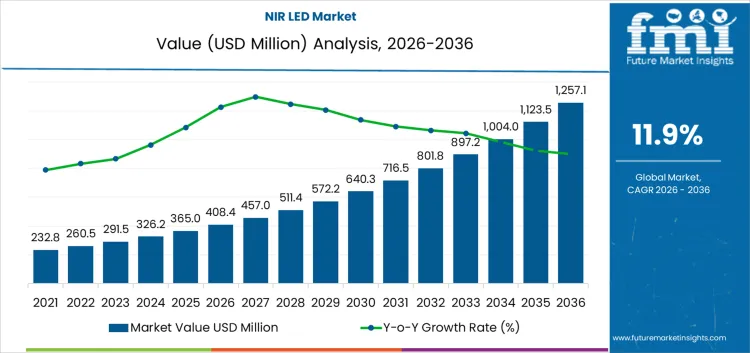
The NIR LED market is likely to be valued at USD 408.4 million in 2026 and reach USD 1,257.1 million by 2036, at a CAGR of 11.9%. Procurement dynamics in this space are shaped by buyer preferences for reliability, long-term support, and compatibility across use cases. Vendor selection is influenced by integration track record, lifecycle guarantees, and module consistency. Buyers often exhibit risk aversion in critical sectors like healthcare and automotive, where performance deviations can lead to system failure or regulatory penalties.
Vendor lock-in becomes common once calibration protocols and sensing platforms are aligned to a specific emitter type. Switching costs are elevated due to embedded design configurations, testing cycles, and certification dependencies. Standardization efforts are selectively adopted, but specification variance across applications hinders full interoperability. As procurement officers prioritize footprint efficiency and spectral consistency, firms offering turnkey support and ecosystem stability are favored during sourcing decisions and framework agreements.
Quick Stats for NIR LED Market
- NIR LED Market Value (2026): USD 408.4 Million
- NIR LED Market Forecast Value (2036): USD 1,257.1 Million
- NIR LED Market Forecast CAGR 2026 to 2036: 11.9%
- Leading Type in NIR LED Market: 850-950 nm LEDs (40% share)
- Leading Application in NIR LED Market: Medical & Healthcare (30% share)
- Key Growth Regions in NIR LED Market: Asia Pacific, North America, Europe, Middle East & Africa, Latin America
- Top Key Players in NIR LED Market: OSRAM Opto Semiconductors, Nichia Corporation, Lumileds LLC, Samsung Electronics Co., Ltd., Everlight Electronics Co., Ltd., LG Innotek Co., Ltd., ROHM Semiconductor, Cree, Inc., Vishay Intertechnology, Inc., Epistar Corporation
NIR LED Market Key Takeaways
| Metric | Value |
|---|---|
| NIR LED Market Value (2026) | USD 408.4 Million |
| NIR LED Market Forecast Value (2036) | USD 1,257.1 Million |
| NIR LED Market Forecast CAGR 2026 to 2036 | 11.9% |
Why Is the NIR LED Market Experiencing Significant Growth?
The NIR LED market is expanding due to rising adoption in healthcare, consumer electronics, and industrial applications. Near-infrared LEDs are used for biometric sensing, night vision, medical imaging, security surveillance, and optical communication. Increasing demand for non-invasive monitoring, enhanced imaging systems, and smart electronic devices is driving market growth across multiple sectors.
Technological advancements are supporting growth in the NIR LED market. Manufacturers are improving wavelength precision, power efficiency, and device lifetime while reducing size for compact integration. Innovations in chip materials, packaging, and thermal management enhance performance and reliability. These developments enable adoption in wearable sensors, automotive LiDAR, and industrial inspection, expanding potential applications.
Rising investments in healthcare technology, IoT devices, and smart electronics are further reinforcing growth in the NIR LED market. Growth in remote patient monitoring, security systems, and consumer electronics applications is increasing demand for high-performance NIR LEDs. Combined, technological innovation, diversified applications, and sectoral adoption are sustaining strong market expansion over the forecast period.
What Does The Segment Overview Indicate About The NIR LED Market?
The NIR LED (Near-Infrared Light-Emitting Diode) market is segmented by wavelength range and application area, reflecting differences in spectral suitability and functional use. LEDs in the 850-950 nm range lead the product segment with an estimated 40% share, offering optimal sensitivity for medical diagnostics, biometric systems, and surveillance devices. Devices emitting <850 nm or >950 nm cater to niche applications with specific optical requirements. On the application side, medical and healthcare account for approximately 30% share, driven by growing use in imaging, phototherapy, and non-invasive monitoring. Automotive, consumer electronics, and security sectors also use NIR LEDs for sensing, recognition, and environmental detection.
Why Do 850-950 nm LEDs Hold The Leading Type Share In The NIR LED Market?
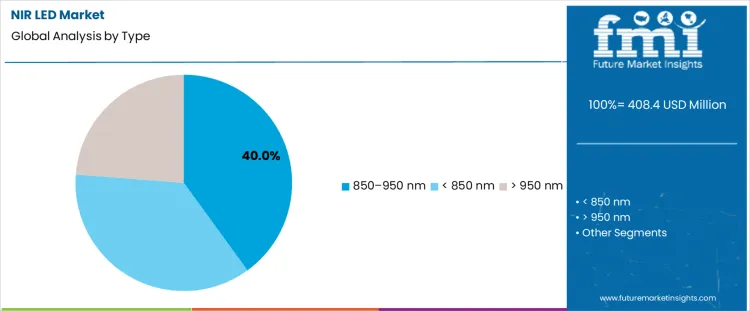
NIR LEDs in the 850-950 nm range hold the leading 40% share due to their optimal balance between penetration depth and sensor responsiveness across multiple end uses. These wavelengths are widely used in medical diagnostics, face recognition, surveillance cameras, and industrial imaging systems. Devices operating in this band offer high absorption in biological tissues and strong compatibility with standard silicon-based sensors. Manufacturers prefer this range for near-field detection, ambient light immunity, and robust signal output. The segment also benefits from its utility in time-of-flight systems and active IR illumination for biometric security. Demand variation exists based on required spectral resolution, package type, and thermal management needs. Continuous advancements in efficiency and power density further reinforce this band’s dominance in the NIR LED market.
How Does Medical And Healthcare Drive Application Demand In The NIR LED Market?
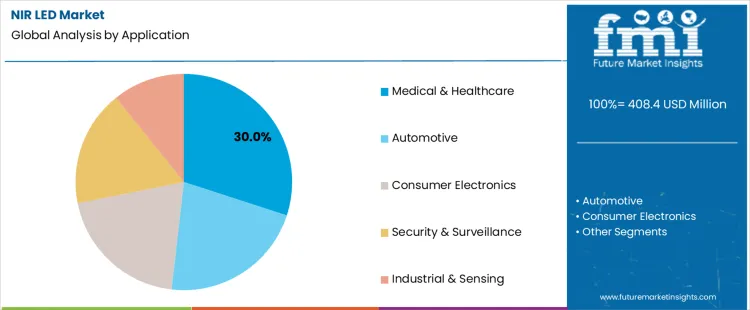
Medical and healthcare applications account for the largest 30% share in the NIR LED market, driven by demand for safe, non-invasive technologies in monitoring, diagnostics, and therapeutic systems. NIR LEDs are used in pulse oximeters, photoplethysmography sensors, and wearable health monitors, where light penetrates tissue to detect oxygen saturation and blood flow. They are also used in wound assessment and near-infrared imaging for deeper anatomical insights. Healthcare providers favor NIR systems for patient-friendly diagnostics that reduce the need for physical sampling. Demand is increasing across outpatient care, wearable medical devices, and home monitoring solutions. Growth is further supported by aging populations, rising chronic disease cases, and miniaturization of medical electronics. These factors continue to position healthcare as a major and sustained driver in the NIR LED market.
What Does The Segment Overview Indicate About The NIR LED Market?
The NIR LED (Near-Infrared Light-Emitting Diode) market is segmented by wavelength range and application area, reflecting differences in spectral suitability and functional use. LEDs in the 850-950 nm range lead the product segment with an estimated 40% share, offering optimal sensitivity for medical diagnostics, biometric systems, and surveillance devices. Devices emitting <850 nm or >950 nm cater to niche applications with specific optical requirements. On the application side, medical and healthcare account for approximately 30% share, driven by growing use in imaging, phototherapy, and non-invasive monitoring. Automotive, consumer electronics, and security sectors also use NIR LEDs for sensing, recognition, and environmental detection.
Why Do 850-950 nm LEDs Hold The Leading Type Share In The NIR LED Market?
NIR LEDs in the 850-950 nm range hold the leading 40% share due to their optimal balance between penetration depth and sensor responsiveness across multiple end uses. These wavelengths are widely used in medical diagnostics, face recognition, surveillance cameras, and industrial imaging systems. Devices operating in this band offer high absorption in biological tissues and strong compatibility with standard silicon-based sensors. Manufacturers prefer this range for near-field detection, ambient light immunity, and robust signal output. The segment also benefits from its utility in time-of-flight systems and active IR illumination for biometric security. Demand variation exists based on required spectral resolution, package type, and thermal management needs. Continuous advancements in efficiency and power density further reinforce this band’s dominance in the NIR LED market.
How Does Medical And Healthcare Drive Application Demand In The NIR LED Market?
Medical and healthcare applications account for the largest 30% share in the NIR LED market, driven by demand for safe, non-invasive technologies in monitoring, diagnostics, and therapeutic systems. NIR LEDs are used in pulse oximeters, photoplethysmography sensors, and wearable health monitors, where light penetrates tissue to detect oxygen saturation and blood flow. They are also used in wound assessment and near-infrared imaging for deeper anatomical insights. Healthcare providers favor NIR systems for patient-friendly diagnostics that reduce the need for physical sampling. Demand is increasing across outpatient care, wearable medical devices, and home monitoring solutions. Growth is further supported by aging populations, rising chronic disease cases, and miniaturization of medical electronics. These factors continue to position healthcare as a major and sustained driver in the NIR LED market.
What Is the Country-Wise Growth Outlook for the NIR LED Market?
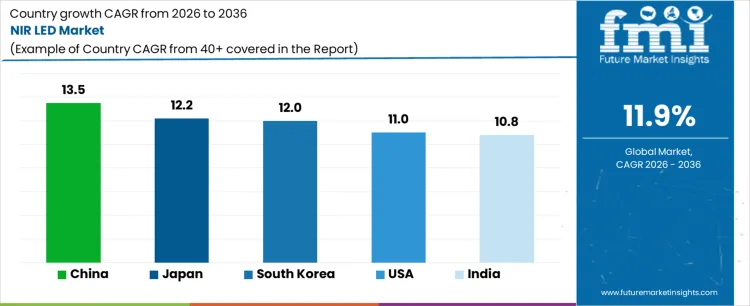
The NIR LED market is expanding in countries focused on advanced sensing, biometric security, and machine vision applications. China leads the growth with a CAGR of 13.5% due to large-scale adoption in surveillance, facial recognition, and industrial automation. Japan follows with 12.2% CAGR, driven by miniaturized NIR integration in automotive and medical imaging systems. South Korea posts a 12.0% CAGR with demand rising in smartphone facial authentication and gesture recognition. The USA records an 11.0% CAGR on the back of strong R&D investments in night vision and healthcare monitoring. India shows a 10.8% CAGR as local electronics and security device production scales up.
| Country | CAGR |
|---|---|
| China | 13.5% |
| Japan | 12.2% |
| South Korea | 12.0% |
| USA | 11.0% |
| India | 10.8% |
Why Is China a Key Growth Market for NIR LEDs?
Demand for the NIR LED in China is increasing at a CAGR of 13.5%, driven by rising integration in surveillance infrastructure, AI-based facial recognition systems, and machine vision solutions. Domestic electronics manufacturers are incorporating NIR emitters into smartphones, smart access control systems, and automotive driver monitoring units. The government’s ongoing push for public security infrastructure further accelerates adoption of NIR lighting in public spaces and transportation hubs. Chinese LED foundries have expanded their NIR production capacity, optimizing costs and improving wavelength precision. Adoption of NIR technology is also growing in the industrial sector, where factory automation and inspection systems rely on high-precision sensors. Local companies are developing vertically integrated modules to serve demand from medical imaging and biosensing. The combination of robust domestic supply chains, mass-market consumer electronics, and smart city investments ensures sustained market leadership.
What Is Driving NIR LED Usage in Japan?
Sales for the NIR LED in Japan are growing at a CAGR of 12.2%, supported by strong demand in automotive safety systems, biometric access control, and minimally invasive medical imaging. Japanese OEMs are adopting NIR emitters in driver alertness monitoring systems, enabling lane discipline and drowsiness detection in premium vehicles. Semiconductor firms are developing high-efficiency NIR diodes tailored for low-power operation in compact sensor modules. Hospitals and diagnostic centers are integrating NIR-based imaging for tissue monitoring and vascular assessment. Japan’s consumer electronics sector incorporates NIR technology into gesture-based control systems and facial recognition modules in smartphones and tablets. Research institutes collaborate with manufacturers to improve emitter reliability and spectral consistency across temperature ranges. The country’s aging population also drives interest in non-contact monitoring systems powered by NIR. Precision engineering, stringent quality control, and end-user demand for high-performance solutions keep Japan at the forefront of mid-infrared optoelectronics innovation.
Why Is South Korea Embracing NIR LED Technology?
Sales for the NIR LED market in South Korea are expanding at a CAGR of 12.0%, primarily due to integration in biometric modules, mobile devices, and healthcare diagnostics. Local consumer electronics brands lead global shipments of smartphones equipped with NIR-powered facial authentication and eye tracking systems. South Korean semiconductor companies invest in chip-scale packaging for NIR emitters, facilitating compact integration into wearable and handheld products. Defense and security applications utilize NIR for night vision enhancement, target identification, and gesture-based control in unmanned systems. Hospitals are adopting NIR for imaging capillaries, measuring oxygen saturation, and non-invasive diagnostics. The country’s advanced manufacturing infrastructure supports both upstream chip development and downstream application testing. Government R&D initiatives fund optical sensor improvements to meet export quality benchmarks. Integration of NIR modules in industrial robotics, vehicle interiors, and smart appliances is also accelerating.
What Is Fueling NIR LED Adoption in the USA?
Demand for the NIR LED in the USA is rising at a CAGR of 11.0%, supported by high deployment in biometric security systems, smart lighting, and medical diagnostics. USA firms are integrating NIR components in access control, eye-safe illumination, and human-machine interface modules. In the automotive sector, OEMs are adopting NIR lighting in advanced driver-assistance systems (ADAS) and interior monitoring. Healthcare providers increasingly use NIR spectroscopy in non-invasive glucose monitoring, tissue oxygenation tracking, and wound imaging. Research institutions and startups are developing specialized NIR emitters for agricultural monitoring, food quality analysis, and pharmaceutical validation. Defense contractors integrate NIR arrays in night vision optics and tactical equipment. Regulatory focus on product safety and privacy compliance is accelerating the shift toward precision-tuned NIR systems. USA-based chip designers are exploring quantum dot NIR solutions and broad-spectrum emitters for next-generation devices.
How Is India Developing Its NIR LED Industry?
Sales for the NIR LED in India are growing at a CAGR of 10.8%, as domestic demand increases for biometric systems, IoT-enabled lighting, and public surveillance solutions. Government-backed programs such as Digital India and Smart Cities Mission are incorporating NIR-based technologies for secure authentication and facial recognition in urban infrastructure. Indian electronics manufacturers are localizing assembly of NIR modules used in mobile phones, access control, and low-cost medical diagnostics. Agricultural universities and startups explore NIR applications in soil moisture analysis, crop health sensing, and food adulteration detection. Affordable NIR-based sensors are entering wearable health monitors used for heart rate, sleep, and skin diagnostics. Startups focus on building compact and energy-efficient NIR products for mass-market wearables and mobile accessories. Collaboration with global OEMs helps drive quality improvements and technology transfer.
How Are Leading Companies Competing And Differentiating In The NIR LED Market?
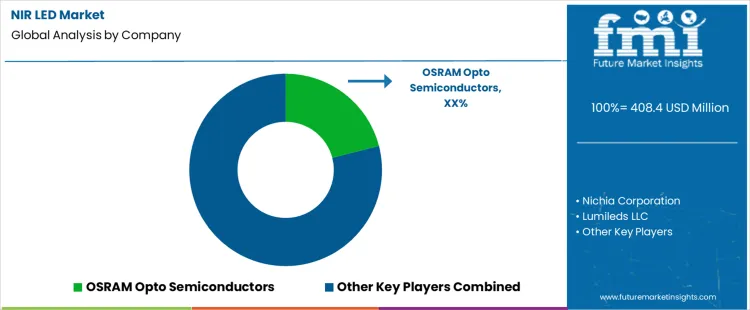
Competition in the NIR LED market is being shaped by wavelength precision, optical efficiency, and reliability. OSRAM Opto Semiconductors is being positioned around high-performance NIR LEDs for industrial sensing, imaging, and medical applications, with product brochures highlighting stable emission, long lifespan, and compact package design. Nichia Corporation is being differentiated through proprietary chip technologies that deliver high radiant flux and narrow spectral width, emphasizing consistent performance for biometric and automotive sensing applications. Lumileds LLC focuses on high-power NIR solutions, promoting thermal management, uniform light distribution, and application versatility.
Integration and miniaturization are being leveraged by Samsung Electronics Co., Ltd., Everlight Electronics Co., Ltd., and LG Innotek Co., Ltd. Samsung emphasizes small-form factor NIR LEDs for mobile devices and security systems, highlighting energy efficiency and stable operation. Everlight promotes customizable NIR arrays for industrial inspection, while LG Innotek is being positioned on precision manufacturing and high-reliability packages for automotive, surveillance, and healthcare devices. ROHM Semiconductor and Cree, Inc. focus on durable and high-radiance NIR LEDs suitable for harsh environments, with brochures stressing temperature tolerance and extended operational life.
A different competitive angle is being applied by Vishay Intertechnology, Inc. and Epistar Corporation. Vishay markets NIR LEDs with optimized spectral output for optical communication and monitoring applications, highlighting precision control and quality consistency. Epistar emphasizes wafer-level process innovations and scalable production, framing performance and reliability as key differentiators. Across the market, competition is being driven by optical efficiency, wavelength stability, and package reliability, with product brochures translating technical specifications into performance assurance for imaging, sensing, and industrial applications.
Key Players in NIR LED Market
- OSRAM Opto Semiconductors
- Nichia Corporation
- Lumileds LLC
- Samsung Electronics Co., Ltd.
- Everlight Electronics Co., Ltd.
- LG Innotek Co., Ltd.
- ROHM Semiconductor
- Cree, Inc.
- Vishay Intertechnology, Inc.
- Epistar Corporation
Scope of Report
| Attributes | Description |
|---|---|
| Quantitative Unit | USD Million |
| Type | 850-950 nm, < 850 nm, 950 nm |
| Application | Medical & Healthcare, Automotive, Consumer Electronics, Security & Surveillance, Industrial & Sensing |
| Regions Covered | Asia Pacific, Europe, North America, Latin America, Middle East & Africa |
| Countries Covered | China, Japan, South Korea, India, Australia & New Zealand, ASEAN, Rest of Asia Pacific, Germany, United Kingdom, France, Italy, Spain, Nordic, BENELUX, Rest of Europe, United States, Canada, Mexico, Brazil, Chile, Rest of Latin America, Kingdom of Saudi Arabia, Other GCC Countries, Turkey, South Africa, Other African Union, Rest of Middle East & Africa |
| Key Companies Profiled | OSRAM Opto Semiconductors, Nichia Corporation, Lumileds LLC, Samsung Electronics Co., Ltd., Everlight Electronics Co., Ltd., LG Innotek Co., Ltd., ROHM Semiconductor, Cree, Inc., Vishay Intertechnology, Inc., Epistar Corporation |
| Additional Attributes | Market revenue by NIR wavelength type and application; adoption trends across medical, automotive, consumer, and industrial sectors; regional growth analysis; projected market size and CAGR for 2026 to 2036; technological advancements in NIR LED efficiency and integration; competitive landscape with strategy and portfolio analysis of leading players; emerging applications in security, sensing, and industrial automation; supply chain and distribution overview. |
NIR LED Market by Key Segments
Type:
- 850-950 nm
- < 850 nm
- 950 nm
Application:
- Medical & Healthcare
- Automotive
- Consumer Electronics
- Security & Surveillance
- Industrial & Sensing
Region:
- Asia Pacific
- China
- Japan
- South Korea
- India
- Australia & New Zealand
- ASEAN
- Rest of Asia Pacific
- Europe
- Germany
- United Kingdom
- France
- Italy
- Spain
- Nordic
- BENELUX
- Rest of Europe
- North America
- United States
- Canada
- Mexico
- Latin America
- Brazil
- Chile
- Rest of Latin America
- Middle East & Africa
- Kingdom of Saudi Arabia
- Other GCC Countries
- Turkey
- South Africa
- Other African Union
- Rest of Middle East & Africa
Bibliography
- International Electrotechnical Commission. (2024). IEC 62471-2: Photobiological safety of lamps and lamp systems — Part 2: Guidance on LED product safety requirements. IEC.
- International Organization for Standardization. (2024). ISO 20473: Optics and photonics — Terms and definitions for near-infrared radiation and measurement. ISO.
- Commission Internationale de l’Éclairage. (2025). CIE S 026:2025 — System for optical radiation measurement and classification of near-infrared light-emitting diodes. CIE.
Frequently Asked Questions
How big is the nir led market in 2026?
The global nir led market is estimated to be valued at USD 408.4 million in 2026.
What will be the size of nir led market in 2036?
The market size for the nir led market is projected to reach USD 1,257.1 million by 2036.
How much will be the nir led market growth between 2026 and 2036?
The nir led market is expected to grow at a 11.9% CAGR between 2026 and 2036.
What are the key product types in the nir led market?
The key product types in nir led market are 850–950 nm, < 850 nm and > 950 nm.
Which application segment to contribute significant share in the nir led market in 2026?
In terms of application, medical & healthcare segment to command 30.0% share in the nir led market in 2026.
Preview the report firsthand - request a free sample
Get SampleGet the brochure for pricing and purchase details.
Get PDFTable of Content
- Executive Summary
- Global Market Outlook
- Demand-side Trends
- Supply-side Trends
- Technology Roadmap Analysis
- Analysis and Recommendations
- Market Overview
- Market Coverage / Taxonomy
- Market Definition / Scope / Limitations
- Market Background
- Market Dynamics
- Drivers
- Restraints
- Opportunity
- Trends
- Scenario Forecast
- Demand in Optimistic Scenario
- Demand in Likely Scenario
- Demand in Conservative Scenario
- Opportunity Map Analysis
- Product Life Cycle Analysis
- Supply Chain Analysis
- Investment Feasibility Matrix
- Value Chain Analysis
- PESTLE and Porter’s Analysis
- Regulatory Landscape
- Regional Parent Market Outlook
- Production and Consumption Statistics
- Import and Export Statistics
- Market Dynamics
- Global Market Analysis 2021 to 2025 and Forecast, 2026 to 2036
- Historical Market Size Value (USD Million) Analysis, 2021 to 2025
- Current and Future Market Size Value (USD Million) Projections, 2026 to 2036
- Y-o-Y Growth Trend Analysis
- Absolute $ Opportunity Analysis
- Global Market Pricing Analysis 2021 to 2025 and Forecast 2026 to 2036
- Global Market Analysis 2021 to 2025 and Forecast 2026 to 2036, By Type
- Introduction / Key Findings
- Historical Market Size Value (USD Million) Analysis By Type, 2021 to 2025
- Current and Future Market Size Value (USD Million) Analysis and Forecast By Type, 2026 to 2036
- 850–950 nm
- < 850 nm
- > 950 nm
- 850–950 nm
- Y-o-Y Growth Trend Analysis By Type, 2021 to 2025
- Absolute $ Opportunity Analysis By Type, 2026 to 2036
- Global Market Analysis 2021 to 2025 and Forecast 2026 to 2036, By Application
- Introduction / Key Findings
- Historical Market Size Value (USD Million) Analysis By Application, 2021 to 2025
- Current and Future Market Size Value (USD Million) Analysis and Forecast By Application, 2026 to 2036
- Medical & Healthcare
- Automotive
- Consumer Electronics
- Security & Surveillance
- Industrial & Sensing
- Medical & Healthcare
- Y-o-Y Growth Trend Analysis By Application, 2021 to 2025
- Absolute $ Opportunity Analysis By Application, 2026 to 2036
- Global Market Analysis 2021 to 2025 and Forecast 2026 to 2036, By Region
- Introduction
- Historical Market Size Value (USD Million) Analysis By Region, 2021 to 2025
- Current Market Size Value (USD Million) Analysis and Forecast By Region, 2026 to 2036
- North America
- Latin America
- Western Europe
- Eastern Europe
- East Asia
- South Asia and Pacific
- Middle East & Africa
- Market Attractiveness Analysis By Region
- North America Market Analysis 2021 to 2025 and Forecast 2026 to 2036, By Country
- Historical Market Size Value (USD Million) Trend Analysis By Market Taxonomy, 2021 to 2025
- Market Size Value (USD Million) Forecast By Market Taxonomy, 2026 to 2036
- By Country
- USA
- Canada
- Mexico
- By Type
- By Application
- By Country
- Market Attractiveness Analysis
- By Country
- By Type
- By Application
- Key Takeaways
- Latin America Market Analysis 2021 to 2025 and Forecast 2026 to 2036, By Country
- Historical Market Size Value (USD Million) Trend Analysis By Market Taxonomy, 2021 to 2025
- Market Size Value (USD Million) Forecast By Market Taxonomy, 2026 to 2036
- By Country
- Brazil
- Chile
- Rest of Latin America
- By Type
- By Application
- By Country
- Market Attractiveness Analysis
- By Country
- By Type
- By Application
- Key Takeaways
- Western Europe Market Analysis 2021 to 2025 and Forecast 2026 to 2036, By Country
- Historical Market Size Value (USD Million) Trend Analysis By Market Taxonomy, 2021 to 2025
- Market Size Value (USD Million) Forecast By Market Taxonomy, 2026 to 2036
- By Country
- Germany
- UK
- Italy
- Spain
- France
- Nordic
- BENELUX
- Rest of Western Europe
- By Type
- By Application
- By Country
- Market Attractiveness Analysis
- By Country
- By Type
- By Application
- Key Takeaways
- Eastern Europe Market Analysis 2021 to 2025 and Forecast 2026 to 2036, By Country
- Historical Market Size Value (USD Million) Trend Analysis By Market Taxonomy, 2021 to 2025
- Market Size Value (USD Million) Forecast By Market Taxonomy, 2026 to 2036
- By Country
- Russia
- Poland
- Hungary
- Balkan & Baltic
- Rest of Eastern Europe
- By Type
- By Application
- By Country
- Market Attractiveness Analysis
- By Country
- By Type
- By Application
- Key Takeaways
- East Asia Market Analysis 2021 to 2025 and Forecast 2026 to 2036, By Country
- Historical Market Size Value (USD Million) Trend Analysis By Market Taxonomy, 2021 to 2025
- Market Size Value (USD Million) Forecast By Market Taxonomy, 2026 to 2036
- By Country
- China
- Japan
- South Korea
- By Type
- By Application
- By Country
- Market Attractiveness Analysis
- By Country
- By Type
- By Application
- Key Takeaways
- South Asia and Pacific Market Analysis 2021 to 2025 and Forecast 2026 to 2036, By Country
- Historical Market Size Value (USD Million) Trend Analysis By Market Taxonomy, 2021 to 2025
- Market Size Value (USD Million) Forecast By Market Taxonomy, 2026 to 2036
- By Country
- India
- ASEAN
- Australia & New Zealand
- Rest of South Asia and Pacific
- By Type
- By Application
- By Country
- Market Attractiveness Analysis
- By Country
- By Type
- By Application
- Key Takeaways
- Middle East & Africa Market Analysis 2021 to 2025 and Forecast 2026 to 2036, By Country
- Historical Market Size Value (USD Million) Trend Analysis By Market Taxonomy, 2021 to 2025
- Market Size Value (USD Million) Forecast By Market Taxonomy, 2026 to 2036
- By Country
- Kingdom of Saudi Arabia
- Other GCC Countries
- Turkiye
- South Africa
- Other African Union
- Rest of Middle East & Africa
- By Type
- By Application
- By Country
- Market Attractiveness Analysis
- By Country
- By Type
- By Application
- Key Takeaways
- Key Countries Market Analysis
- USA
- Pricing Analysis
- Market Share Analysis, 2025
- By Type
- By Application
- Canada
- Pricing Analysis
- Market Share Analysis, 2025
- By Type
- By Application
- Mexico
- Pricing Analysis
- Market Share Analysis, 2025
- By Type
- By Application
- Brazil
- Pricing Analysis
- Market Share Analysis, 2025
- By Type
- By Application
- Chile
- Pricing Analysis
- Market Share Analysis, 2025
- By Type
- By Application
- Germany
- Pricing Analysis
- Market Share Analysis, 2025
- By Type
- By Application
- UK
- Pricing Analysis
- Market Share Analysis, 2025
- By Type
- By Application
- Italy
- Pricing Analysis
- Market Share Analysis, 2025
- By Type
- By Application
- Spain
- Pricing Analysis
- Market Share Analysis, 2025
- By Type
- By Application
- France
- Pricing Analysis
- Market Share Analysis, 2025
- By Type
- By Application
- India
- Pricing Analysis
- Market Share Analysis, 2025
- By Type
- By Application
- ASEAN
- Pricing Analysis
- Market Share Analysis, 2025
- By Type
- By Application
- Australia & New Zealand
- Pricing Analysis
- Market Share Analysis, 2025
- By Type
- By Application
- China
- Pricing Analysis
- Market Share Analysis, 2025
- By Type
- By Application
- Japan
- Pricing Analysis
- Market Share Analysis, 2025
- By Type
- By Application
- South Korea
- Pricing Analysis
- Market Share Analysis, 2025
- By Type
- By Application
- Russia
- Pricing Analysis
- Market Share Analysis, 2025
- By Type
- By Application
- Poland
- Pricing Analysis
- Market Share Analysis, 2025
- By Type
- By Application
- Hungary
- Pricing Analysis
- Market Share Analysis, 2025
- By Type
- By Application
- Kingdom of Saudi Arabia
- Pricing Analysis
- Market Share Analysis, 2025
- By Type
- By Application
- Turkiye
- Pricing Analysis
- Market Share Analysis, 2025
- By Type
- By Application
- South Africa
- Pricing Analysis
- Market Share Analysis, 2025
- By Type
- By Application
- USA
- Market Structure Analysis
- Competition Dashboard
- Competition Benchmarking
- Market Share Analysis of Top Players
- By Regional
- By Type
- By Application
- Competition Analysis
- Competition Deep Dive
- OSRAM Opto Semiconductors
- Overview
- Product Portfolio
- Profitability by Market Segments (Product/Age /Sales Channel/Region)
- Sales Footprint
- Strategy Overview
- Marketing Strategy
- Product Strategy
- Channel Strategy
- Nichia Corporation
- Lumileds LLC
- Samsung Electronics Co., Ltd.
- Everlight Electronics Co., Ltd.
- LG Innotek Co., Ltd.
- ROHM Semiconductor
- Cree, Inc.
- Vishay Intertechnology, Inc.
- Epistar Corporation
- OSRAM Opto Semiconductors
- Competition Deep Dive
- Assumptions & Acronyms Used
- Research Methodology


