

- Industry Size (2026)
- USD 1.4 Bn
- Forecast (2036)
- USD 4.8 Bn
- CAGR (2026 to 2036)
- 13.11%
Provider Directory Accuracy Management Market Size, Market Forecast and Outlook By FMI
The provider directory accuracy management market was valued at USD 1.2 billion in 2025. The sector is set to reach USD 1.4 billion in 2026 at a CAGR of 13.11% during the forecast period. Sustained investment takes the market to USD 4.8 billion through 2036. The implementation of the No Surprises Act eliminates the era of passive provider roster management, forcing Medicare Advantage Organizations to actively validate network data or face crippling daily fines.
Health plans that delay transitioning from siloed credentialing databases to unified master data environments lose their ability to control out-of-network balance billing costs. The true operational failure point is rarely provider unresponsiveness; rather, it is the internal friction where distinct payer departments continuously overwrite each other's verified data. This structural reality makes advanced clinical data exchange platforms mandatory for surviving CMS network adequacy audits.
Summary of Provider Directory Accuracy Management Market
- Provider Directory Accuracy Management Market Definition:
- This market provides the digital infrastructure and data validation services health plans require to keep public provider directories synchronized with actual contracting status, eliminating surprise billing risks caused by inaccurate network rosters.
- Demand Drivers in the Market:
- The regulations forces commercial health plans to absorb out-of-network costs if members receive care based on incorrect directory information.
- CMS network adequacy requirements compel Medicare Advantage Organizations to audit and correct provider demographics every 90 days.
- High rates of practitioner turnover drive dental and specialty payers to automate credentialing synchronization to prevent member attrition.
- Key Segments Analyzed in the FMI Report:
- Software Platforms: 65.4% share in 2026, driven by the mandate to replace manual fax campaigns with algorithmic data matching.
- Cloud-based API: 78.2% share in 2026, necessitated by the requirement to update public-facing directories within 48 hours of a provider status change.
- Medicare/Medicaid Managed Care: 46.5% share in 2026, heavily reliant on continuous validation due to the severity of CMS civil monetary penalties.
- United States: 14.5% compound growth, propelled by the unparalleled punitive framework of the No Surprises Act.
- Analyst Opinion at FMI:
- Sabyasachi Ghosh, Principal Analyst, Healthcare, opines, "The true bottleneck is internal data fragmentation across payer departments, not provider unresponsiveness. Health plans that fail to establish a unified Master Data Management architecture will face compounded CMS penalties as credentialing and claims teams continuously overwrite each other's updates."
- Strategic Implications / Executive Takeaways:
- Health plan Chief Compliance Officers must deploy bi-directional API connections with provider databases to eliminate manual data entry errors before the next CMS audit cycle.
- Commercial network directors should segment roster updates by clinical impact, prioritizing specialists with high out-of-network billing risk.
- Healthcare IT vendors must embed continuous background validation rather than relying on provider portal fatigue, or face displacement by larger data aggregators.
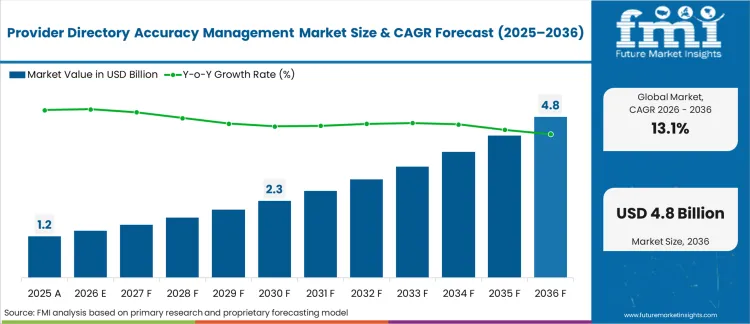
Health plan network managers must achieve real-time synchronization between internal credentialing systems and public-facing directories before CMS transitions from enforcement discretion to active, systematic auditing. This requires IT directors to deploy bi-directional APIs capable of parsing Electronic Medical Record updates instantaneously. Once this digital threshold is crossed, health plans permanently reduce the administrative overhead associated with manual outreach campaigns.
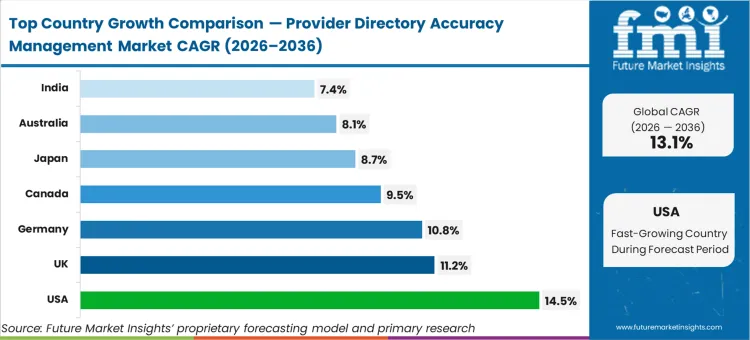
The United States advances at a 14.5% compound annual rate as strict mandates dictate immediate compliance architectures. The United Kingdom tracks an 11.2% CAGR as National Health Service trusts centralize fragmented regional registries. Germany grows at 10.8% driven by the Digital Healthcare Act pushing statutory insurers toward unified digital identities. Canada expands at 9.5% as provincial health ministries mandate standardized referral networks. Japan records an 8.7% rate as an ageing population stresses localized clinic discovery tools. Australia follows at 8.1% amidst private health fund modernization, while India posts a 7.4% expansion rate. This growth spread exists structurally because centralized, single-payer systems require vastly different data validation architectures than fragmented commercial markets.
Provider Directory Accuracy Management Market Key Takeaways
| Metric | Details |
|---|---|
| Industry Size (2026) | USD 1.4 billion |
| Industry Value (2036) | USD 4.8 billion |
| CAGR (2026-2036) | 13.11% |
Provider Directory Accuracy Management Market Definition
The Provider Directory Accuracy Management Market encompasses the software, platforms, and outsourced services utilized by healthcare payers to ingest, verify, and syndicate provider demographic and credentialing data. It fundamentally resolves the misalignment between internal payer contracting systems and public-facing physician rosters. The market is distinguished from general credentialing software by its exclusive focus on real-time network adequacy compliance, ensuring patients are not subjected to balance billing due to outdated directory listings.
Provider Directory Accuracy Management Market Inclusions
Core inclusions consist of API-driven roster ingestion engines, continuous data validation platforms, automated physician outreach portals, and master data management systems built specifically for health plans. The market also includes proprietary data lakes that cross-reference external sources like the National Plan and Provider Enumeration System (NPPES) against internal payer records to establish a verifiable gold record for every practitioner.
Provider Directory Accuracy Management Market Exclusions
The market explicitly excludes standalone Electronic Health Record (EHR) systems, general hospital billing software, and consumer-facing appointment scheduling apps like Zocdoc. It also excludes core claims adjudication platforms. These technologies are excluded because their primary function is clinical documentation or financial transaction processing, rather than the systematic validation of provider network participation data for regulatory compliance.
Provider Directory Accuracy Management Market Research Methodology
- Primary Research: FMI analysts engaged with Chief Network Officers, VP of Provider Relations, and Health Plan Compliance Directors operating within major Medicare Advantage and commercial insurance organizations.
- Desk Research: Aggregation of CMS network adequacy enforcement reports, implementation guidelines, and CAQH data accuracy benchmarks.
- Market-Sizing and Forecasting: The baseline derives from the total number of active health plan networks multiplied by the baseline investment required to achieve a 2-day directory update capability, modelled against projected CMS audit cycles.
- Data Validation and Update Cycle: Projections were cross-validated against vendor earnings reports and the observed adoption rates of API-driven directory management tools among top-tier health insurers.
Segmental Analysis
Provider Directory Accuracy Management Market Analysis by Component
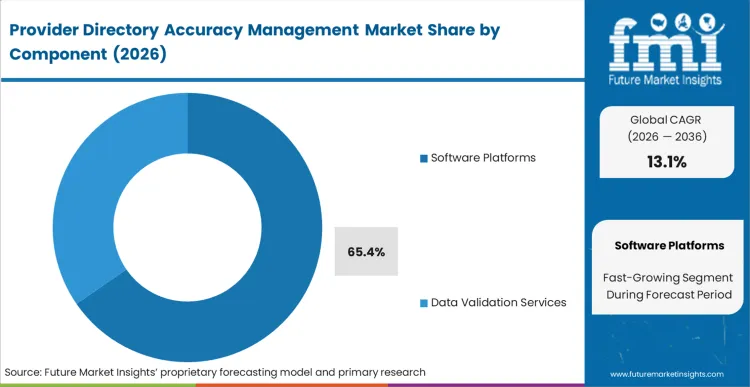
The manual dissemination of spreadsheets and bulk faxes is actively failing under the weight of the CMS two-day update mandate, positioning software platforms as the absolute requirement for compliance. Based on FMI's assessment, Software Platforms dominate with a 65.4% share in 2026 because human data entry cannot scale to meet 90-day rolling validation cycles across tens of thousands of practitioners. Health plan IT directors must replace batch processing with robotic process automation capable of continuous matching against external primary sources. If network operations teams attempt to meet requirements using legacy methods, they guarantee eventual systemic failure and subsequent regulatory fines.
- Algorithmic matching: Intelligent data parsing engines resolve conflicting addresses originating from different internal payer departments. IT directors deploying these platforms establish a single source of truth across the enterprise.
- Outreach automation: Digital workflow triggers initiate provider contact only when external data discrepancies are detected. Network managers utilizing this capability drastically reduce physician abrasion.
- Reporting dashboards: Audit-ready compliance logs generate instant proof of 90-day verification efforts. Compliance officers presenting these logs successfully deflect CMS monetary penalties during unexpected network adequacy reviews.
Provider Directory Accuracy Management Market Analysis by Deployment
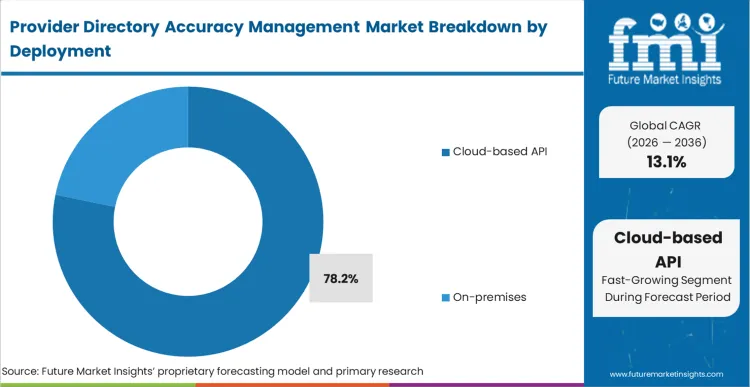
Cloud-based APIs hold a 78.2% share in 2026 due to the fundamental structural necessity of connecting disparate external data lakes directly to internal payer routing engines. FMI analysts opine that on-premises deployments are inherently unsuited for the bi-directional data flow required to keep public directories synchronized with live clinic realities. Cloud infrastructure allows vendor solutions to cross-reference National Plan and Provider Enumeration System (NPPES) updates in real-time. Systems integrators establishing this cloud infrastructure deployment enable payers to react instantaneously to provider location changes, averting the out-of-network billing liabilities associated with delayed manual uploads.
- Real-time syndication: Serverless architectures push demographic updates to consumer-facing portals within milliseconds of validation. Member experience directors leveraging this speed ensure patients never book appointments at outdated clinic addresses.
- External integration: Seamless API handshakes connect payer databases directly with massive proprietary credentialing data lakes. Data architects implementing these connections eliminate the need to build verification algorithms from scratch.
- Scalable processing: Elastic computing environments handle the massive surge in transaction volume during peak open enrollment periods. System administrators relying on this elasticity prevent directory crashes when member traffic spikes.
Provider Directory Accuracy Management Market Analysis by End User
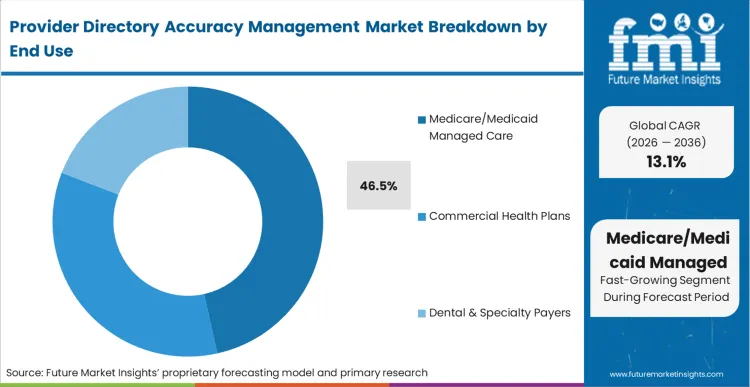
Medicare Advantage Organizations (MAOs) operate under direct threat of CMS star rating downgrades and civil monetary penalties for directory inaccuracies. This severe regulatory condition ensures Medicare/Medicaid Managed Care leads the segment with a 46.5% share in 2026. According to FMI's estimates, commercial plans face different but equally punitive pressures from the No Surprises Act, forcing them into rapid adoption, but MAOs remain the foundation of the market due to longer-standing audit frameworks. Dental network administrators are also compelled to upgrade capabilities as provider volatility increases. Government program directors who fail to deploy automated validation frameworks face immediate suspension of their ability to enroll new beneficiaries.
- Star rating protection: Algorithmic validation ensures high scores on Medicare network adequacy metrics. MAO executives maintaining these ratings secure crucial federal bonus payments.
- Balance billing prevention: Automated synchronization ensures commercial members are only directed to verified in-network specialists. Health plan actuaries utilizing these controls protect profit margins from forced out-of-network reimbursements.
- Specialty integration: Configurable master data engines accommodate the unique practice structures of dental and vision providers. Directors of dental network solutions adopting these tools reduce administrative overhead associated with high-turnover clinic staff.
Provider Directory Accuracy Management Market Drivers, Restraints, and Opportunities
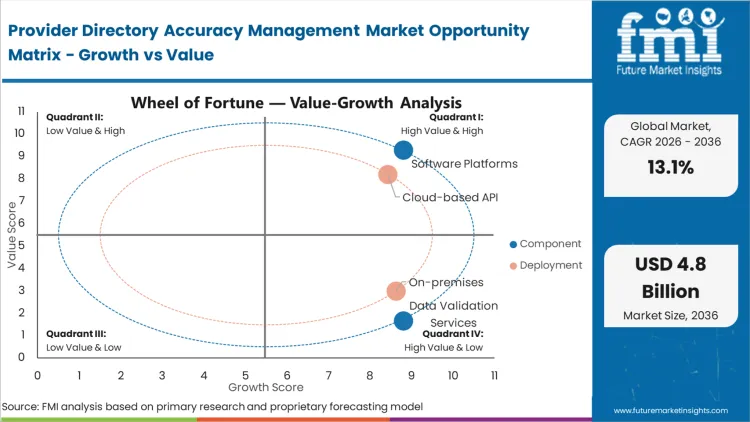
The rapid expansion of digital health ecosystems is shifting the competitive landscape for technology vendors, as payers and providers increasingly prioritize platforms capable of supporting longitudinal patient engagement. Instead of focusing solely on transactional data exchanges, organizations are investing in systems that integrate behavioral insights, population‑level trends, and predictive analytics to deliver personalized care pathways. This emerging model emphasizes proactive intervention, identifying risks before they escalate, while enabling care teams to coordinate seamlessly across virtual, in‑person, and community‑based settings. Companies that can unify these capabilities into a single, interoperable framework are positioned to define the next decade of healthcare innovation.
The primary operational friction restraining the market is the deep fragmentation of internal payer databases. Health plans typically operate separate, siloed systems for claims processing, provider credentialing, and network contracting, leading to scenarios where a validated update in one system is overwritten by outdated legacy data from another. The emerging workaround involves deploying overarching Master Data Management (MDM) layers to establish a "gold record," but this requires massive internal change management. This structural limit means even the best external validation software will fail if the payer's internal data governance remains disjointed.
Opportunities in the Provider Directory Accuracy Management Market
- Pre-validated Data Lakes: Aggregating vast repositories of verified physician data allows vendors to offer instant accuracy uplift upon implementation. Software providers commercializing these lakes secure long-term, high-margin contracts with mid-tier payers desperate for immediate compliance.
- EHR-integrated Syndication: Developing bi-directional APIs that read demographic changes directly from hospital Electronic Health Records eliminates the need for manual provider portal updates. IT vendors building these frictionless pipelines achieve dominant market share by completely solving physician outreach fatigue.
- AI-driven Anomaly Detection: Deploying machine learning models to identify suspicious patterns, such as a provider listed at 15 different physical locations simultaneously, flags errors before they reach the public directory. Data science teams integrating this predictive algorithm deployment drastically reduce the volume of manual audits required by network staff.
Regional Analysis
Based on the regional analysis, the Provider Directory Accuracy Management market is segmented into North America, Latin America, Europe, East Asia, South Asia, Oceania, and Middle East and Africa across 40 plus countries.
.webp "Top Country Growth Comparison Provider Directory Accuracy Management Market Cagr (2026 2036)")
| Country | CAGR (2026 to 2036) |
|---|---|
| United States | 14.5% |
| United Kingdom | 11.2% |
| Germany | 10.8% |
| Canada | 9.5% |
| Japan | 8.7% |
| Australia | 8.1% |
| India | 7.4% |
North America Provider Directory Accuracy Management Market Analysis
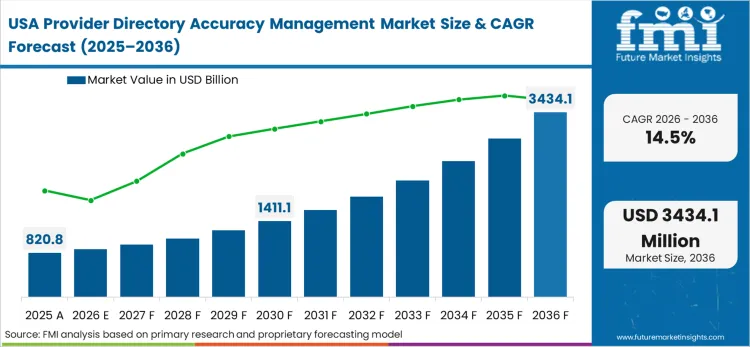
Regulations forces the absolute restructuring of payer directories across North America. Unlike regions experimenting with centralized registries, the privatized nature of the US healthcare system places the entire burden of data validation directly on individual commercial and Medicare insurers. Based on FMI's assessment, this necessitates the rapid deployment of massive, proprietary data lakes capable of syndicating updates across thousands of disconnected systems. Health plan executives operating within this punitive framework must invest in API-driven health informatics infrastructure or face catastrophic daily fines.
- United States: The United States' aggressive CMS enforcement mechanism forces Medicare Advantage Organizations to update directories within 48 hours of receiving provider information. This strict deadline requires health plan compliance officers to fully automate roster validation. The market is advancing at 14.5% compound between 2026 and 2036. Continuous auditing from federal regulators confirms this rapid transition away from manual data entry Network directors who operate under legacy spreadsheet methods face severe civil monetary penalties during their next audit.
- Canada: Provincial health ministries in Canada require regional health authorities to maintain standardized specialist referral databases to reduce patient wait times. This distinct public-sector dynamic drives a 9.5% CAGR to 2036. IT procurement leads must deploy interoperable registries to ensure seamless care transitions across provincial borders.
FMI's report includes comprehensive evaluation of Mexico and other Latin American healthcare ecosystems. The ongoing digitalization of private health insurance networks in these emerging economies relies heavily on adopting established data governance frameworks from their northern counterparts.
Europe Provider Directory Accuracy Management Market Analysis
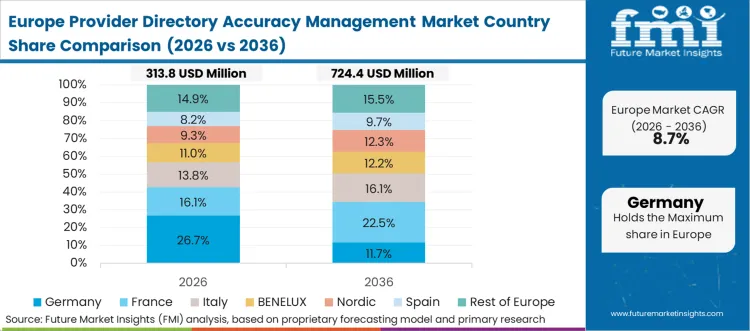
Specific policy directives regarding digital identity and secure data exchange drive the European dynamic, prioritizing patient data rights alongside provider accuracy. European health systems are deeply engaged in building centralized, state-sponsored registries rather than relying on fragmented commercial health plan directories. In FMI's view, this forces vendors to build solutions that integrate seamlessly with national digital health architectures rather than proprietary payer silos.
- United Kingdom: The National Health Service's ongoing effort to unify fragmented regional trust registries dictates the United Kingdom's modernization strategy. This infrastructure consolidation enables the market to expand at an 11.2% compound annual rate through 2036. System integrators in the UK must navigate complex NHS interoperability standards to successfully deploy directory tools.
- Germany: Germany's Digital Healthcare Act (DVG) legally mandates statutory health insurers to integrate deeply with the centralized telematics infrastructure. This regulatory pressure anchors the country to a 10.8% annual expansion through the decade. Statutory fund managers operating under these laws must utilize certified validation software to maintain their connection to the national digital identity network.
FMI's report includes detailed analysis of France, Italy, and the Nordics. Across these member states, the broader European Health Data Space initiative is accelerating the standardization of provider attributes.
East Asia Provider Directory Accuracy Management Market Analysis
Specific digital infrastructure investments and rapidly aging demographics dictate the transition toward advanced provider discovery tools in East Asia. As populations age, the necessity for accurate, hyper-localized clinic and specialist data becomes critical for daily healthcare access. FMI analysts opine that vendors succeeding in this region must optimize their platforms for mobile-first patient populations and deeply integrated regional health information exchanges.
- Japan: Japan's rapidly aging demographic forces local prefectures to maintain highly accurate, geographically precise registries of elder-care specialists and clinics. This specific necessity tracks 8.7% annual growth to 2036. Healthcare IT vendors must develop solutions that seamlessly integrate with Japan's expanding comprehensive community care systems.
- India: The rapid expansion of the Ayushman Bharat Digital Mission enables India to establish a unified digital registry for medical professionals. This ambitious national infrastructure project drives a 7.4% CAGR through 2036. Digital health architects must align their directory tools with the government's specific API standards to participate in this massive modernization effort.
- Australia: The competitive reality yields an 8.1% compound rate. Australia's private health funds require advanced syndication to manage high provider overlap across different insurance tiers. Fund network managers utilizing these systems effectively differentiate their consumer offerings in a crowded market.
FMI's report includes coverage of South Korea and Southeast Asia. The push for smart hospital ecosystems in these regions is heavily reliant on establishing foundational master data management for all medical personnel.
Competitive Aligners for Market Players
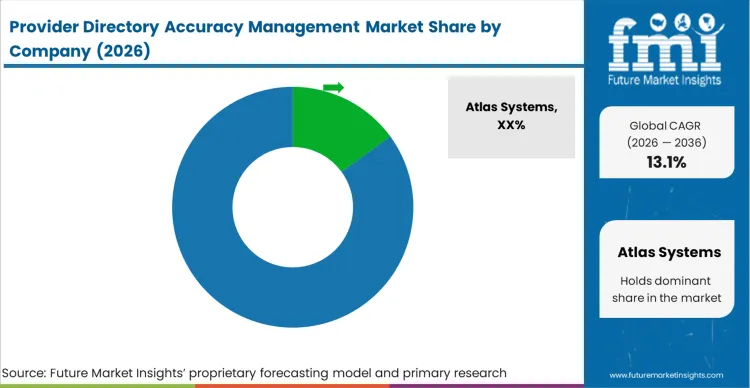
The Provider Directory Accuracy Management market is moderately consolidated around a few massive data aggregators and specialized software developers. This structure exists because creating a verifiable "gold record" requires aggregating billions of data points from primary sources, establishing a massive barrier to entry based on raw data access. Companies like LexisNexis Risk Solutions, CAQH, and ProviderTrust lead by offering vast, pre-validated proprietary data lakes. Buyers utilize the breadth and historical accuracy of these data lakes as the primary competitive variable to distinguish qualified enterprise vendors from smaller, unproven startups.
To disrupt these incumbents, a challenger must build capabilities that bypass the traditional "data lake" approach and instead focus on real-time extraction. Innovative firms are developing bi-directional APIs that read directly from hospital Electronic Health Records and credentialing software, updating the payer directory instantaneously without any manual intervention from the physician. Vendors demonstrating this level of frictionless bi-directional data syndication secure a massive structural advantage. Challengers entering this market must entirely solve the issue of "provider portal fatigue" to gain any significant traction.
Large health plans prevent vendor lock-in by establishing internal Master Data Management (MDM) systems that sit above any single vendor's validation tool. Buyers want control of their internal "gold record," while dominant vendors want payers fully reliant on their external proprietary data subscriptions. This tension limits the pricing power of data aggregators, forcing them to compete heavily on the speed and integration capabilities of their APIs. As the market progresses to 2036, it will become less concentrated around raw data providers and more competitive among workflow automation specialists who can effectively harmonize disparate internal payer systems.
Key Players in Provider Directory Accuracy Management Market
- Atlas Systems
- LexisNexis Risk Solutions
- InterSystems
- ProviderTrust
- Quest Analytics
- SKYGEN
- IQVIA
- CAQH
Scope of the Report
| Metric | Value |
|---|---|
| Quantitative Units | USD 1.4 billion to USD 4.8 billion, at a CAGR of 13.11% |
| Market Definition | The market provides the digital infrastructure and data validation services health plans require to keep public provider directories synchronized with actual contracting status, eliminating surprise billing risks caused by inaccurate network rosters. |
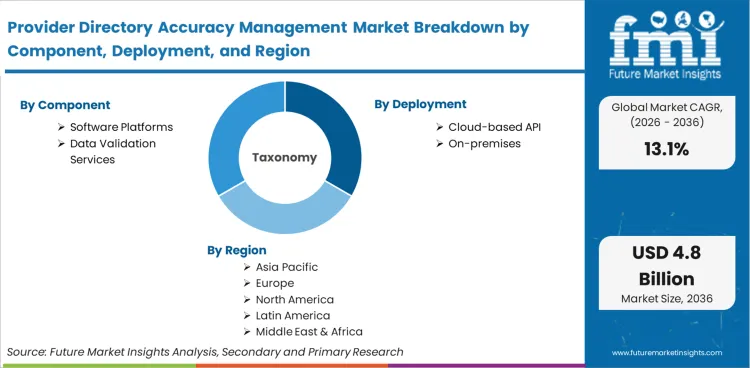
| Component Segmentation | Software Platforms, Data Validation Services |
| Deployment Segmentation | Cloud-based API, On-premises |
| End User Segmentation | Commercial Health Plans, Medicare/Medicaid Managed Care, Dental & Specialty Payers |
| Regions Covered | North America, Latin America, Europe, East Asia, South Asia, Oceania, Middle East and Africa |
| Countries Covered | United States, United Kingdom, Germany, Canada, Japan, Australia, India, and 40 plus countries |
| Key Companies Profiled | Atlas Systems, LexisNexis Risk Solutions, InterSystems, ProviderTrust, Quest Analytics, SKYGEN, IQVIA, CAQH |
| Forecast Period | 2026 to 2036 |
| Approach | FMI analysts interviewed Chief Network Officers and Compliance Directors at major health plans. Forecasts rely on CMS enforcement timeline modeling, validated against the commercial adoption rates of API-driven roster management tools. |
Provider Directory Accuracy Management Market Analysis by Segments
Component:
- Software Platforms
- Data Validation Services
Deployment:
- Cloud-based API
- On-premises
End User:
- Commercial Health Plans
- Medicare/Medicaid Managed Care
- Dental & Specialty Payers
Region:
- North America
- United States
- Canada
- Europe
- Germany
- United Kingdom
- France
- East Asia
- Japan
- China
- South Asia
- India
- Oceania
- Australia
- Latin America
- Brazil
- Middle East and Africa
- South Africa
Bibliography
- Centers for Medicare & Medicaid Services. (2025, July 29). Provider Directory API: Frequently Asked Questions
- Medicare Payment Advisory Commission. (2024, June 13). Chapter 2: Provider networks and prior authorization in Medicare Advantage (June 2024 report).
- USA Government Accountability Office. (2024, July 8). Defense health care: DOD should improve accuracy of behavioral health provider information in TRICARE directories (GAO-24-106588).
- Office of Inspector General, U.S. Department of Health and Human Services. (Issued October 2, 2025; posted October 7, 2025). Many Medicare Advantage and Medicaid Managed Care Plans Have Limited Behavioral Health Provider Networks and Inactive Providers (OEI-02-23-00540).
- CAQH. (2024, May). Provider directories.
- Haeder, S. F., & Zhu, J. M. (2024). Inaccuracies in provider directories persist for long periods of time. Health Affairs Scholar, 2(6), qxae079.
- Zhu, J. M., & Barnett, M. L. (2025). Building a reliable national provider directory-lessons from other sectors. JAMA Health Forum, 6(10), e254408.
This bibliography is provided for reader reference. The full FMI report contains the complete reference list with primary source documentation.
This Report Addresses
- Market intelligence to support strategic decision making across automated roster validation and master data management tools unique to this market
- Market size estimation and 10-year revenue forecasts from 2026 to 2036, supported by CMS network adequacy enforcement reports and health plan compliance budget modeling
- Growth opportunity mapping across deployment and component categories from this market with emphasis on the transition to real-time synchronization between internal credentialing systems and public directories
- Segment and regional revenue forecasts covering cloud-based APIs and data validation services across strict regulatory environments
- Competition strategy assessment including proprietary data lakes, API integration speed, and physician portal fatigue mitigation capabilities
- Capability development tracking including continuous matching algorithms, bi-directional EHR syndication, and compliance frameworks discussed in this article
- Market access analysis covering public-sector registry integration, Medicare Advantage audit channels, and commercial health plan procurement pathways
- Market report delivery in PDF, Excel, PPT, and interactive dashboard formats for executive strategy, network adequacy compliance planning, and operational benchmarking use
Frequently Asked Questions
How large is the Provider Directory Accuracy Management Market in 2026?
The market is poised to reach USD 1.4 billion in 2026, driven directly by massive payer investments to avoid balance billing liabilities.
What will it be valued at by 2036?
It is projected to reach USD 4.8 billion by 2036 as manual roster updates become structurally impossible to maintain.
What CAGR is projected?
A 13.11% CAGR is projected, structurally supported by the strict 90-day verification mandates enforced by federal regulators.
Which Component segment leads?
Software Platforms lead with a 65.4% share in 2026, as algorithmic matching completely displaces legacy fax and phone-based outreach.
Which Deployment segment leads?
Cloud-based API deployment holds a 78.2% share, enabling the real-time syndication required to update directories within 48 hours.
Which End User segment leads?
Medicare/Medicaid Managed Care captures 46.5% of the market because MAOs face direct, severe civil monetary penalties for directory inaccuracies.
What drives rapid growth?
The regulations force health plans to guarantee accurate out-of-network status or absorb the resulting patient billing discrepancies.
What is the primary restraint?
Deep fragmentation within payer databases prevents external validation tools from establishing a permanent "gold record" when internal teams continuously overwrite data.
Which country grows fastest?
The United States grows fastest at 14.5%, directly reacting to the unparalleled punitive framework of the No Surprises Act.
How does the No Surprises Act impact this technology?
It explicitly mandates that commercial insurers verify provider network status every 90 days and update any changes within two business days.
Why are bi-directional APIs replacing provider portals?
Physicians experience severe administrative fatigue from updating multiple payer portals; APIs extract the data directly from EHRs without manual intervention.
How do large data aggregators dominate the landscape?
Incumbents rely on massive, proprietary data lakes built over decades, which provide payers an immediate accuracy uplift upon initial implementation.
Why is Master Data Management critical here?
Without an MDM layer to establish a single source of truth, claims, credentialing, and network teams will perpetually corrupt their own directories.
What role does AI play in directory management?
Machine learning algorithms detect anomalies, such as a practitioner listed at 15 simultaneous physical locations, before the error is published.
How does Medicare Advantage auditing differ from commercial plans?
MAOs face direct threats to their highly lucrative star ratings and federal bonus payments if they fail CMS secret-shopper network tests.
Why is the UK market growing at 11.2%?
The NHS is systematically attempting to centralize fragmented regional trust registries into unified digital infrastructure.
How do dental payers manage directory accuracy?
Dental network administrators use highly configurable MDM engines specifically designed to handle the high-turnover nature of clinic support staff.
Can robotic process automation solve the 48-hour update rule?
Yes, RPA is the only mathematically viable way to ingest, verify, and syndicate thousands of daily provider demographic changes within the CMS window.
What is the impact of National Provider Identifier (NPI) cross-referencing?
Platform vendors constantly cross-reference internal records against the federal NPPES database to ensure the foundational identity of the physician remains accurate.
Why are on-premises solutions losing market share?
They lack the elastic computing power and external connectivity required to execute real-time syndication with massive external credentialing databases.
How do vendors prevent provider portal fatigue?
They implement "validate once" frameworks that syndicate a single physician update across multiple health plans simultaneously.
What methodology supports the 13.11% forecast?
Growth models anchor to the total volume of active health plan networks multiplied by the minimum IT investment required to achieve regulatory compliance.
Preview the report firsthand - request a free sample
Get SampleGet the brochure for pricing and purchase details.
Get PDFTable of Content
- Executive Summary
- Global Market Outlook
- Demand-side Trends
- Supply-side Trends
- Technology Roadmap Analysis
- Analysis and Recommendations
- Market Overview
- Market Coverage / Taxonomy
- Market Definition / Scope / Limitations
- Research Methodology
- Chapter Orientation
- Analytical Lens and Working Hypotheses
- Market Structure, Signals, and Trend Drivers
- Benchmarking and Cross-market Comparability
- Market Sizing, Forecasting, and Opportunity Mapping
- Research Design and Evidence Framework
- Desk Research Programme (Secondary Evidence)
- Company Annual and Sustainability Reports
- Peer-reviewed Journals and Academic Literature
- Corporate Websites, Product Literature, and Technical Notes
- Earnings Decks and Investor Briefings
- Statutory Filings and Regulatory Disclosures
- Technical White Papers and Standards Notes
- Trade Journals, Industry Magazines, and Analyst Briefs
- Conference Proceedings, Webinars, and Seminar Materials
- Government Statistics Portals and Public Data Releases
- Press Releases and Reputable Media Coverage
- Specialist Newsletters and Curated Briefings
- Sector Databases and Reference Repositories
- FMI Internal Proprietary Databases and Historical Market Datasets
- Subscription Datasets and Paid Sources
- Social Channels, Communities, and Digital Listening Inputs
- Additional Desk Sources
- Expert Input and Fieldwork (Primary Evidence)
- Primary Modes
- Qualitative Interviews and Expert Elicitation
- Quantitative Surveys and Structured Data Capture
- Blended Approach
- Why Primary Evidence is Used
- Field Techniques
- Interviews
- Surveys
- Focus Groups
- Observational and In-context Research
- Social and Community Interactions
- Stakeholder Universe Engaged
- C-suite Leaders
- Board Members
- Presidents and Vice Presidents
- R&D and Innovation Heads
- Technical Specialists
- Domain Subject-matter Experts
- Scientists
- Physicians and Other Healthcare Professionals
- Governance, Ethics, and Data Stewardship
- Research Ethics
- Data Integrity and Handling
- Primary Modes
- Tooling, Models, and Reference Databases
- Desk Research Programme (Secondary Evidence)
- Data Engineering and Model Build
- Data Acquisition and Ingestion
- Cleaning, Normalisation, and Verification
- Synthesis, Triangulation, and Analysis
- Quality Assurance and Audit Trail
- Market Background
- Market Dynamics
- Drivers
- Restraints
- Opportunity
- Trends
- Scenario Forecast
- Demand in Optimistic Scenario
- Demand in Likely Scenario
- Demand in Conservative Scenario
- Opportunity Map Analysis
- Product Life Cycle Analysis
- Supply Chain Analysis
- Investment Feasibility Matrix
- Value Chain Analysis
- PESTLE and Porter’s Analysis
- Regulatory Landscape
- Regional Parent Market Outlook
- Production and Consumption Statistics
- Import and Export Statistics
- Market Dynamics
- Global Market Analysis 2021 to 2025 and Forecast, 2026 to 2036
- Historical Market Size Value (USD Million) Analysis, 2021 to 2025
- Current and Future Market Size Value (USD Million) Projections, 2026 to 2036
- Y-o-Y Growth Trend Analysis
- Absolute $ Opportunity Analysis
- Global Market Pricing Analysis 2021 to 2025 and Forecast 2026 to 2036
- Global Market Analysis 2021 to 2025 and Forecast 2026 to 2036, By Component
- Introduction / Key Findings
- Historical Market Size Value (USD Million) Analysis By Component , 2021 to 2025
- Current and Future Market Size Value (USD Million) Analysis and Forecast By Component , 2026 to 2036
- Software Platforms
- Data Validation Services
- Software Platforms
- Y-o-Y Growth Trend Analysis By Component , 2021 to 2025
- Absolute $ Opportunity Analysis By Component , 2026 to 2036
- Global Market Analysis 2021 to 2025 and Forecast 2026 to 2036, By Deployment
- Introduction / Key Findings
- Historical Market Size Value (USD Million) Analysis By Deployment, 2021 to 2025
- Current and Future Market Size Value (USD Million) Analysis and Forecast By Deployment, 2026 to 2036
- Cloud-based API
- On-premises
- Cloud-based API
- Y-o-Y Growth Trend Analysis By Deployment, 2021 to 2025
- Absolute $ Opportunity Analysis By Deployment, 2026 to 2036
- Global Market Analysis 2021 to 2025 and Forecast 2026 to 2036, By End Use
- Introduction / Key Findings
- Historical Market Size Value (USD Million) Analysis By End Use, 2021 to 2025
- Current and Future Market Size Value (USD Million) Analysis and Forecast By End Use, 2026 to 2036
- Medicare/Medicaid Managed Care
- Commercial Health Plans
- Dental & Specialty Payers
- Medicare/Medicaid Managed Care
- Y-o-Y Growth Trend Analysis By End Use, 2021 to 2025
- Absolute $ Opportunity Analysis By End Use, 2026 to 2036
- Global Market Analysis 2021 to 2025 and Forecast 2026 to 2036, By Region
- Introduction
- Historical Market Size Value (USD Million) Analysis By Region, 2021 to 2025
- Current Market Size Value (USD Million) Analysis and Forecast By Region, 2026 to 2036
- North America
- Latin America
- Western Europe
- Eastern Europe
- East Asia
- South Asia and Pacific
- Middle East & Africa
- Market Attractiveness Analysis By Region
- North America Market Analysis 2021 to 2025 and Forecast 2026 to 2036, By Country
- Historical Market Size Value (USD Million) Trend Analysis By Market Taxonomy, 2021 to 2025
- Market Size Value (USD Million) Forecast By Market Taxonomy, 2026 to 2036
- By Country
- USA
- Canada
- Mexico
- By Component
- By Deployment
- By End Use
- By Country
- Market Attractiveness Analysis
- By Country
- By Component
- By Deployment
- By End Use
- Key Takeaways
- Latin America Market Analysis 2021 to 2025 and Forecast 2026 to 2036, By Country
- Historical Market Size Value (USD Million) Trend Analysis By Market Taxonomy, 2021 to 2025
- Market Size Value (USD Million) Forecast By Market Taxonomy, 2026 to 2036
- By Country
- Brazil
- Chile
- Rest of Latin America
- By Component
- By Deployment
- By End Use
- By Country
- Market Attractiveness Analysis
- By Country
- By Component
- By Deployment
- By End Use
- Key Takeaways
- Western Europe Market Analysis 2021 to 2025 and Forecast 2026 to 2036, By Country
- Historical Market Size Value (USD Million) Trend Analysis By Market Taxonomy, 2021 to 2025
- Market Size Value (USD Million) Forecast By Market Taxonomy, 2026 to 2036
- By Country
- Germany
- UK
- Italy
- Spain
- France
- Nordic
- BENELUX
- Rest of Western Europe
- By Component
- By Deployment
- By End Use
- By Country
- Market Attractiveness Analysis
- By Country
- By Component
- By Deployment
- By End Use
- Key Takeaways
- Eastern Europe Market Analysis 2021 to 2025 and Forecast 2026 to 2036, By Country
- Historical Market Size Value (USD Million) Trend Analysis By Market Taxonomy, 2021 to 2025
- Market Size Value (USD Million) Forecast By Market Taxonomy, 2026 to 2036
- By Country
- Russia
- Poland
- Hungary
- Balkan & Baltic
- Rest of Eastern Europe
- By Component
- By Deployment
- By End Use
- By Country
- Market Attractiveness Analysis
- By Country
- By Component
- By Deployment
- By End Use
- Key Takeaways
- East Asia Market Analysis 2021 to 2025 and Forecast 2026 to 2036, By Country
- Historical Market Size Value (USD Million) Trend Analysis By Market Taxonomy, 2021 to 2025
- Market Size Value (USD Million) Forecast By Market Taxonomy, 2026 to 2036
- By Country
- China
- Japan
- South Korea
- By Component
- By Deployment
- By End Use
- By Country
- Market Attractiveness Analysis
- By Country
- By Component
- By Deployment
- By End Use
- Key Takeaways
- South Asia and Pacific Market Analysis 2021 to 2025 and Forecast 2026 to 2036, By Country
- Historical Market Size Value (USD Million) Trend Analysis By Market Taxonomy, 2021 to 2025
- Market Size Value (USD Million) Forecast By Market Taxonomy, 2026 to 2036
- By Country
- India
- ASEAN
- Australia & New Zealand
- Rest of South Asia and Pacific
- By Component
- By Deployment
- By End Use
- By Country
- Market Attractiveness Analysis
- By Country
- By Component
- By Deployment
- By End Use
- Key Takeaways
- Middle East & Africa Market Analysis 2021 to 2025 and Forecast 2026 to 2036, By Country
- Historical Market Size Value (USD Million) Trend Analysis By Market Taxonomy, 2021 to 2025
- Market Size Value (USD Million) Forecast By Market Taxonomy, 2026 to 2036
- By Country
- Kingdom of Saudi Arabia
- Other GCC Countries
- Turkiye
- South Africa
- Other African Union
- Rest of Middle East & Africa
- By Component
- By Deployment
- By End Use
- By Country
- Market Attractiveness Analysis
- By Country
- By Component
- By Deployment
- By End Use
- Key Takeaways
- Key Countries Market Analysis
- USA
- Pricing Analysis
- Market Share Analysis, 2025
- By Component
- By Deployment
- By End Use
- Canada
- Pricing Analysis
- Market Share Analysis, 2025
- By Component
- By Deployment
- By End Use
- Mexico
- Pricing Analysis
- Market Share Analysis, 2025
- By Component
- By Deployment
- By End Use
- Brazil
- Pricing Analysis
- Market Share Analysis, 2025
- By Component
- By Deployment
- By End Use
- Chile
- Pricing Analysis
- Market Share Analysis, 2025
- By Component
- By Deployment
- By End Use
- Germany
- Pricing Analysis
- Market Share Analysis, 2025
- By Component
- By Deployment
- By End Use
- UK
- Pricing Analysis
- Market Share Analysis, 2025
- By Component
- By Deployment
- By End Use
- Italy
- Pricing Analysis
- Market Share Analysis, 2025
- By Component
- By Deployment
- By End Use
- Spain
- Pricing Analysis
- Market Share Analysis, 2025
- By Component
- By Deployment
- By End Use
- France
- Pricing Analysis
- Market Share Analysis, 2025
- By Component
- By Deployment
- By End Use
- India
- Pricing Analysis
- Market Share Analysis, 2025
- By Component
- By Deployment
- By End Use
- ASEAN
- Pricing Analysis
- Market Share Analysis, 2025
- By Component
- By Deployment
- By End Use
- Australia & New Zealand
- Pricing Analysis
- Market Share Analysis, 2025
- By Component
- By Deployment
- By End Use
- China
- Pricing Analysis
- Market Share Analysis, 2025
- By Component
- By Deployment
- By End Use
- Japan
- Pricing Analysis
- Market Share Analysis, 2025
- By Component
- By Deployment
- By End Use
- South Korea
- Pricing Analysis
- Market Share Analysis, 2025
- By Component
- By Deployment
- By End Use
- Russia
- Pricing Analysis
- Market Share Analysis, 2025
- By Component
- By Deployment
- By End Use
- Poland
- Pricing Analysis
- Market Share Analysis, 2025
- By Component
- By Deployment
- By End Use
- Hungary
- Pricing Analysis
- Market Share Analysis, 2025
- By Component
- By Deployment
- By End Use
- Kingdom of Saudi Arabia
- Pricing Analysis
- Market Share Analysis, 2025
- By Component
- By Deployment
- By End Use
- Turkiye
- Pricing Analysis
- Market Share Analysis, 2025
- By Component
- By Deployment
- By End Use
- South Africa
- Pricing Analysis
- Market Share Analysis, 2025
- By Component
- By Deployment
- By End Use
- USA
- Market Structure Analysis
- Competition Dashboard
- Competition Benchmarking
- Market Share Analysis of Top Players
- By Regional
- By Component
- By Deployment
- By End Use
- Competition Analysis
- Competition Deep Dive
- Atlas Systems
- Overview
- Product Portfolio
- Profitability by Market Segments (Product/Age /Sales Channel/Region)
- Sales Footprint
- Strategy Overview
- Marketing Strategy
- Product Strategy
- Channel Strategy
- LexisNexis Risk Solutions
- InterSystems
- ProviderTrust
- Quest Analytics
- SKYGEN
- IQVIA
- CAQH
- Atlas Systems
- Competition Deep Dive
- Assumptions & Acronyms Used


